
The explanation that finally works is almost always shorter than the one you have been giving.
Most of us start out doing it properly. We explain what nerves do, what happens when they are damaged, why the feet go first, why numb can also mean burning. We are thorough. We are accurate. And the person nods, says something kind, and three weeks later asks whether we have tried walking more.
That is not because they were not listening. It is because understanding a condition and believing a person are two different things, and only one of them was ever the goal.
What follows is mostly sentences. Take the ones that fit and leave the rest.
Why the Medical Explanation Keeps Failing
Three reasons, and it helps to know which one you are running into.
The translation problem, word by word
| You say | They hear | Say instead |
|---|---|---|
| Numbness | Absence of feeling, so absence of suffering | The signals are wrong, not missing |
| Nerve damage | An injury, which heals | It is ongoing, and it is a bad day and a good day, not a recovery |
| I get tired | Everyone gets tired | I can do about an hour on my feet, then I am finished for the day |
| I have neuropathy | A word they will not retain | My feet hurt constantly and I cannot feel the floor properly |
Nobody can picture it. A broken arm comes with a cast. A bad hip comes with a limp anyone can see. Neuropathy comes with nothing to look at, and plenty of other conditions share that problem. From the outside you look like a person standing still, and standing still is what people do when they are fine. Our page on what neuropathy actually feels like exists partly because the sensations genuinely do not map onto anything most people have experienced.
The word “numb” undoes the word “pain.” Say numbness and the listener hears absence. An absence of feeling sounds like an absence of suffering, which sounds like the good version of a nerve problem. Then you mention burning and they quietly file you as inconsistent. This one specific confusion causes more disbelief than everything else combined.
They see the good hours. People see you at the wedding. They do not see the next day. Functioning is not the same as feeling well, and the entire cost of an outing is paid privately, afterward, where nobody is watching. From outside, the only visible data is a person doing fine at a party.
Explain the Consequence, Not the Condition
Here is the shift that changes these conversations.
A test for any sentence before you say it
Ask whether the sentence tells the other person something they can act on. If it does not, it is a lecture, and it will be forgotten by Thursday.
Fails the test: “The nerves in my feet are damaged.” True, and there is nothing to do with it.
Passes the test: “If we are standing a long time, I will need to find somewhere to sit.” Now they know to look for a chair, and you have said nothing about nerves at all.
Nobody in your life needs to understand nerve fibers. They need to know what to expect from you and what it means about them. Almost every failed explanation is an attempt to transfer medical understanding when the person was actually asking a social question: are you all right, do you still like me, why did you leave early.
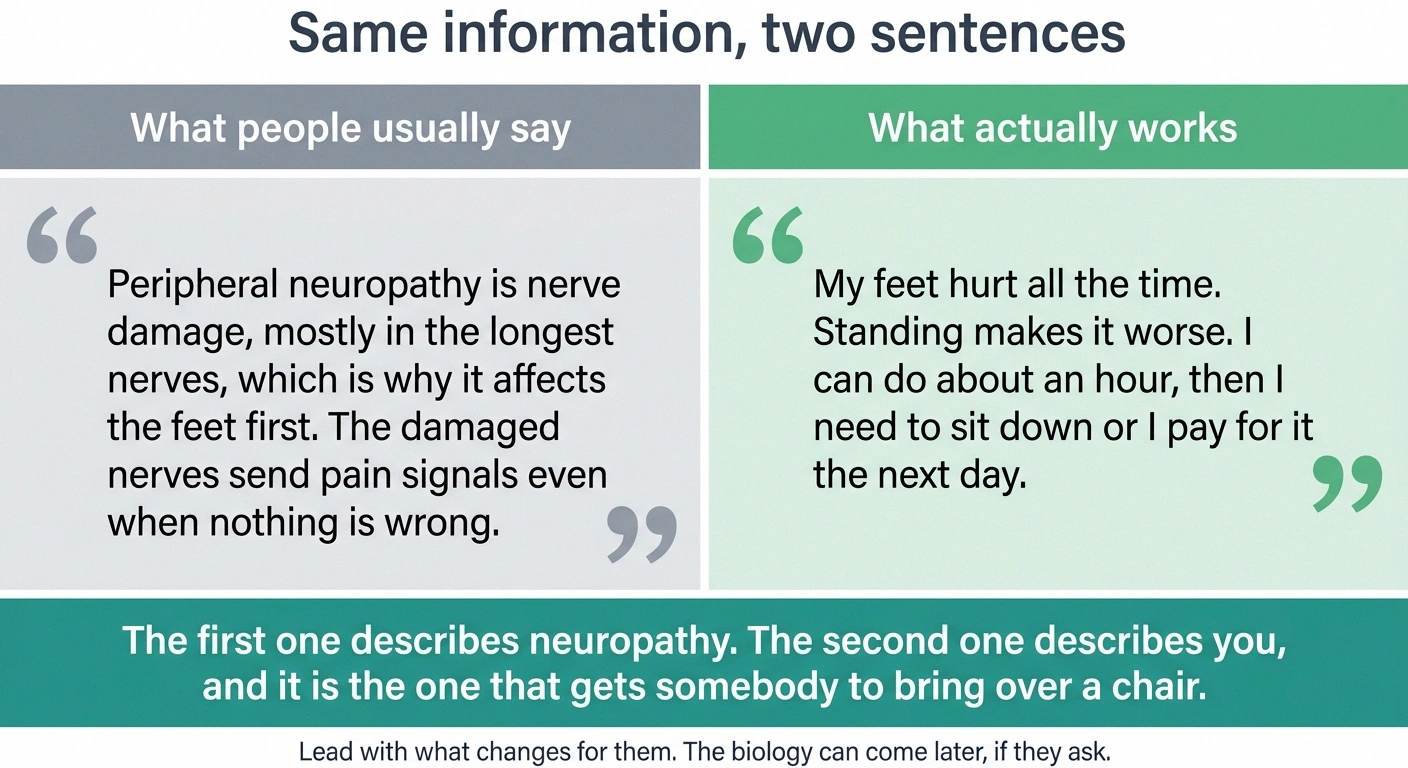
Compare these two.
“Peripheral neuropathy is nerve damage, mostly in the longest nerves, which is why it affects the feet first. The damaged nerves send pain signals even when nothing is wrong.”
“My feet hurt all the time. Standing makes it worse. I can do about an hour, then I need to sit down or I pay for it the next day.”
The first is a better description of neuropathy. The second is a better description of you, and it is the one that gets someone to bring over a chair.
Lead with what changes for them. The biology, if they want it, can come later.
Sentences That Work
Steal these. Adjust the numbers to your own reality.
For an invitation you want to accept partly:
“I would love to come. I will need to leave around eight, and that is not about the company. Can I come anyway?”
For an invitation you have to decline:
“I am not up to it this week. Ask me again next time, because the answer changes.”
That second sentence matters more than it looks. The main reason people stop inviting someone is that they think they are being kind. Tell them to keep asking.
For explaining the payback:
“I can usually do one big thing in a day. If we do the market in the morning, I am done by afternoon. That is the trade, and it is worth it, I just have to pick.”
For numbness that hurts:
“The nerves are damaged, so they send the wrong signals. Some of them stopped reporting, which is the numbness. Others got stuck on, which is the burning. Same damage, two results.”
For “have you tried” advice:
“I have, actually. I know you are trying to help, and honestly what helps most is you not needing me to be better.”
For a grandchild:
“My feet don’t work right. They tell my brain they hurt even when nothing happened. I can still read to you, I just can’t stand up for very long.”
Children handle this better than adults do. They accept a simple mechanical explanation and move on to the next thing.
For someone you need practical help from:
“Could you carry that? It is not the weight, it is that my balance is off when my hands are full.”
Name the specific task and the specific reason. Vague requests for help make people feel responsible for everything, and that is where caregiver burnout starts.
The Analogies That Land, and the One That Backfires
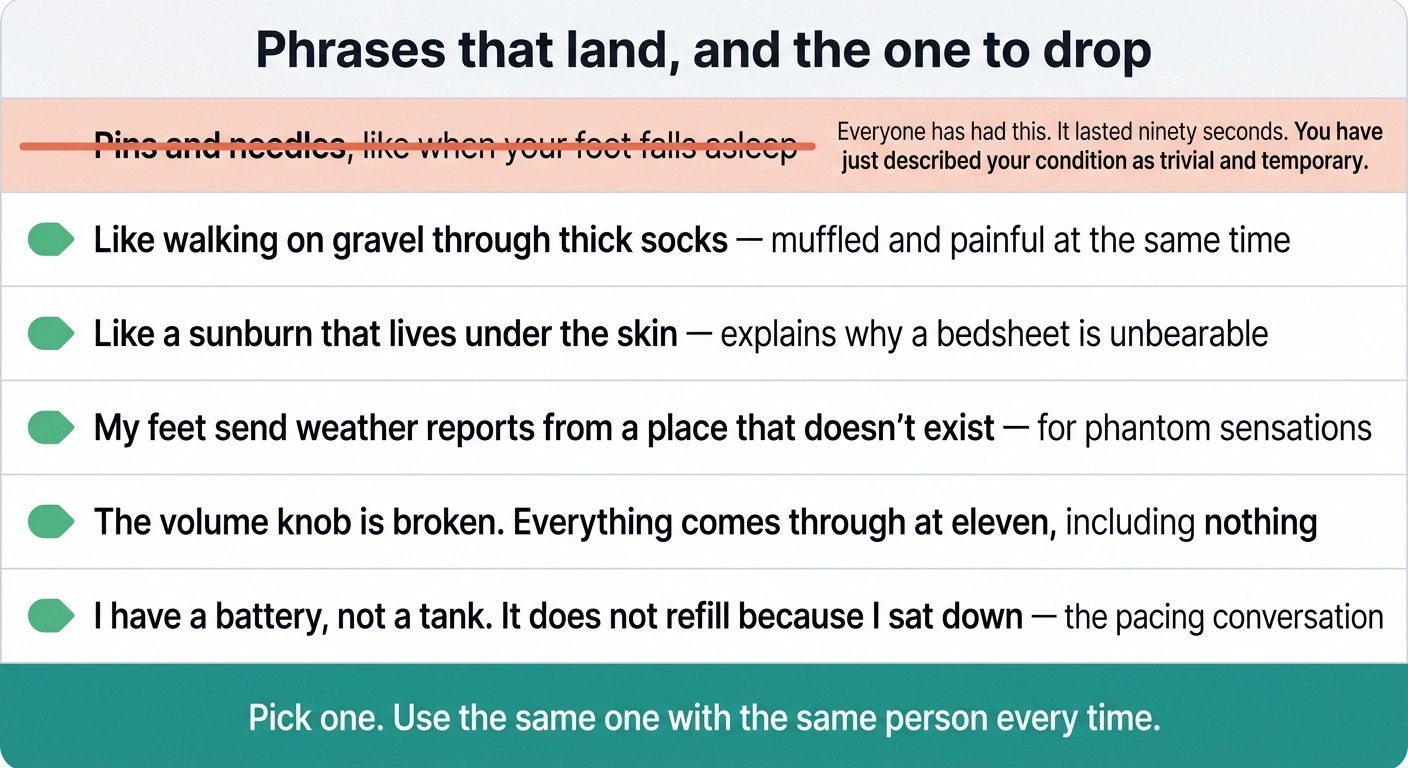
Skip this one: “pins and needles, like when your foot falls asleep.” It is the most common comparison and it is the worst one available. Everyone has had a foot fall asleep. It lasted ninety seconds and was mildly annoying. You have just told them your condition is a mildly annoying thing that goes away.
These work better.
- “Like walking on gravel through thick socks.” Communicates the two contradictory parts at once: muffled and painful.
- “Like a sunburn that lives under the skin instead of on it.” Everyone knows sunburn. Everyone knows that a bedsheet on sunburn is unbearable, which explains why blankets are a problem.
- “My feet send weather reports from a place that doesn’t exist.” Useful for the phantom sensations, the wetness that is not there, the sock that is not on.
- “The volume knob is broken. Everything comes through at eleven, including nothing.”
- “I have a battery, not a tank. It does not refill just because I sat down.” The single most useful analogy for the pacing conversation, because it explains why rest before an event does not buy extra capacity.
Pick one. Use the same one every time with the same person. Repetition is what makes a phrase stick, and a person who has heard “gravel through thick socks” four times will eventually start using it themselves.
What to Say When Someone Tells You That You Look Fine

Almost everyone with an invisible condition hears this, and it is worth having something ready, because the improvised version tends to come out sharper than intended.
The thing to understand is that it is usually not a challenge. It is usually clumsy reassurance. They are trying to say something nice and reaching for the only compliment available.
Three responses at three temperatures.
Warm: “Thank you. It is one of the strange things about this, that it does not show.”
Neutral: “It does not show at all. That is most of the problem, honestly.”
Direct, for someone who keeps doing it: “I know. It never looks like anything. That is why I need you to take my word for it when I say I am done for the day.”
That last one converts a comment about your appearance into a request, which gives them something to do. People are far more comfortable with a job than with sympathy.
Not Everyone Gets the Same Version
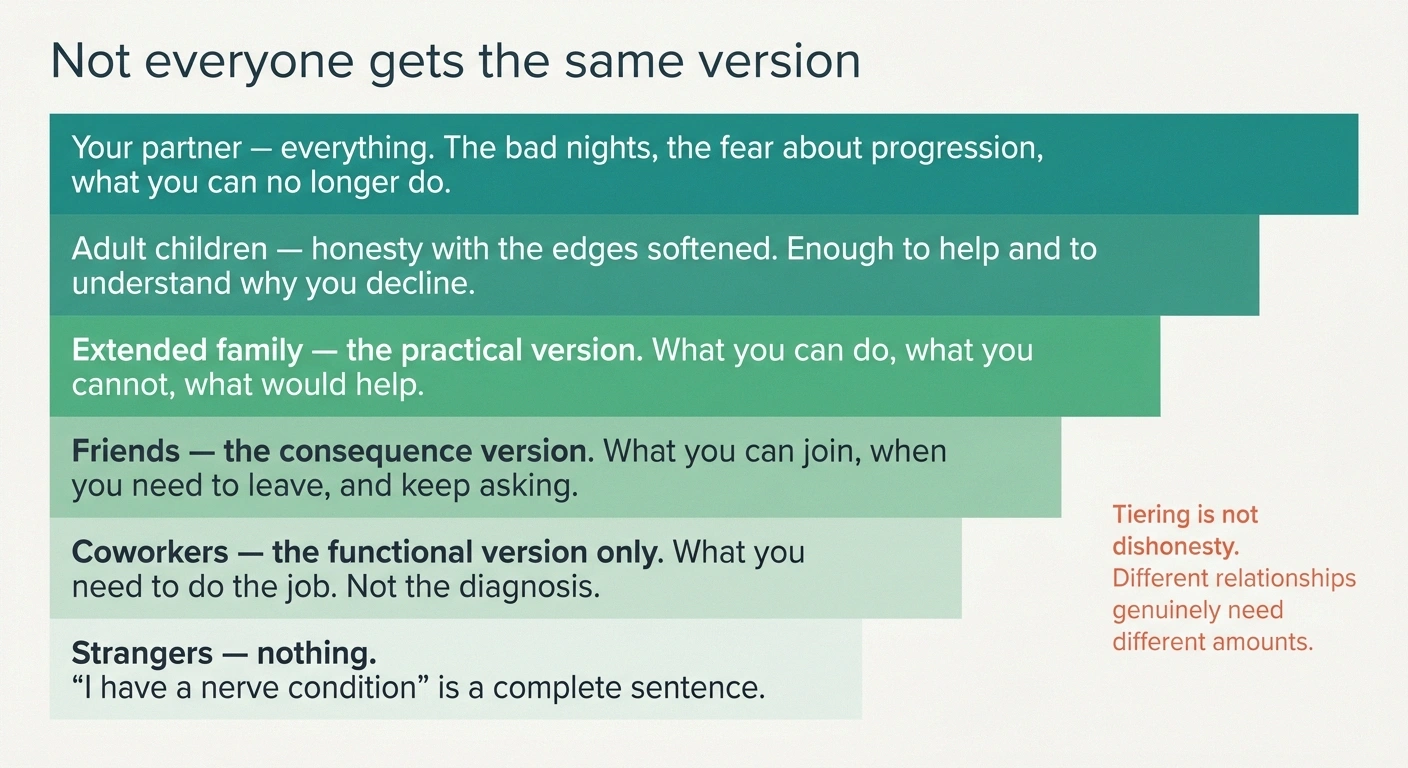
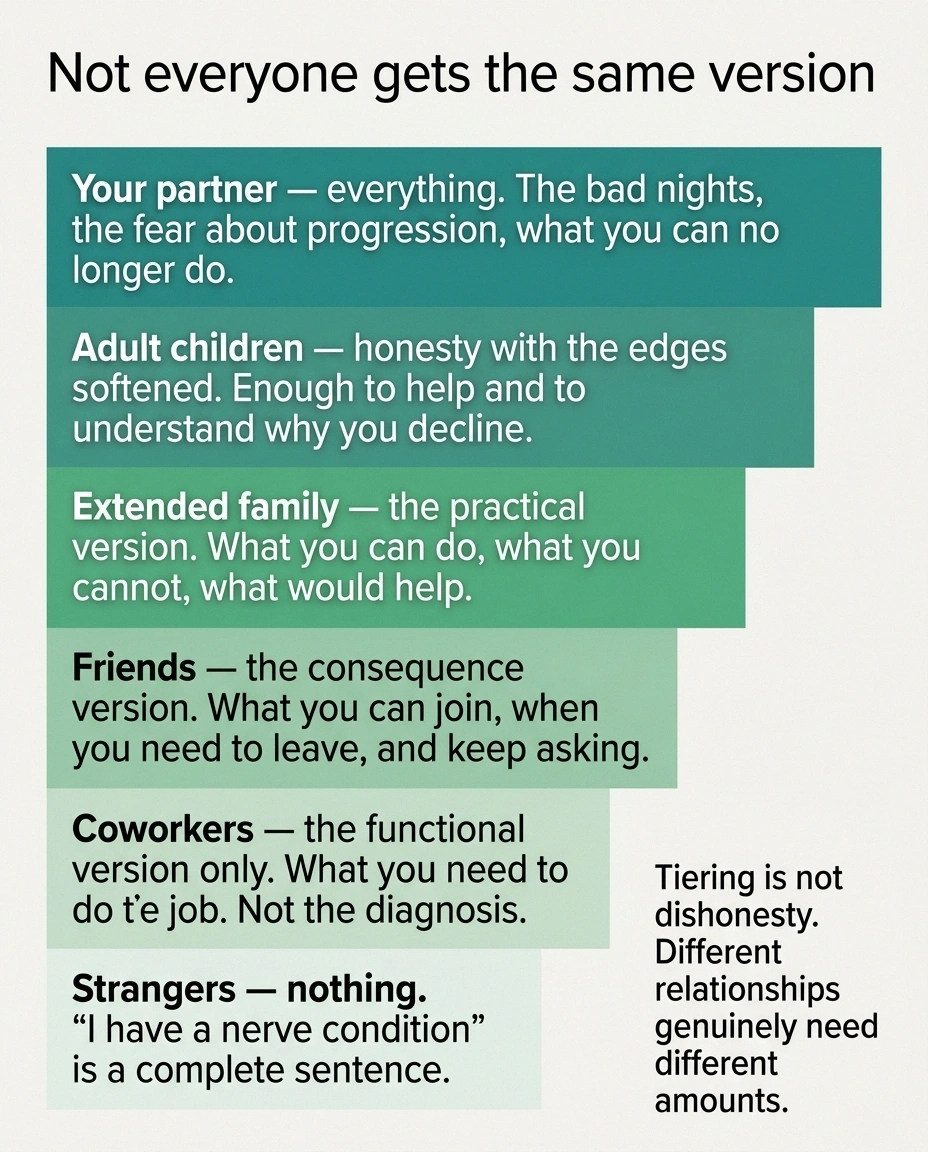
A tiered approach saves an enormous amount of energy, and it is not dishonest. Different relationships genuinely need different amounts.
Your partner gets everything. The bad nights, the fear about progression, what you can no longer do and how you feel about it. This is the one relationship where holding back causes more damage than sharing does, and it is worth reading up on how nerve pain reshapes a marriage before resentment does the explaining for you.
Adult children get honesty with the edges softened. They need enough to help and to understand why you decline things. Many of them are also quietly frightened about what comes next, and they will not say so.
Extended family gets the practical version. What you can do, what you cannot, what would help. One clear paragraph at the start of a visit prevents a whole weekend of small negotiations. This is especially true around holidays and family gatherings, where the schedule is set by whoever has the most energy.
Friends get the consequence version. What you can join, when you need to leave, and the standing instruction to keep asking.
Coworkers get the functional version only. What you need to do the job. Not the diagnosis, not the prognosis. If you need actual adjustments, that is a documented conversation rather than a casual one, and our guide to workplace accommodations covers how to frame it.
Strangers get nothing. “I have a nerve condition” is a complete sentence. Nobody in a queue is owed a follow-up.
When You Are Tired of Explaining

There is a specific exhaustion that comes from telling the same story to the eleventh person, and it is a real and documented part of living with a condition nobody can see.
Four ways to say it once
- The saved note
- Three or four sentences in your phone. Reciting costs almost nothing. Composing on the spot, for the eleventh time, is what actually wears you down.
- The advance text
- Send the same paragraph a day before a visit. The conversation is over before you arrive, and nobody has to have it in front of an audience.
- The delegate
- Brief one person properly and let them handle the wider family. Every large family already distributes news this way about everything else.
- The standing line
- One sentence you use every time, unchanged. Repetition is what makes a phrase stick, and after the fourth hearing people start repeating it back to each other, which means you have stopped being the only one explaining.
Two things help.
Write it once. Three or four sentences in a note on your phone. When someone asks, you are not composing, you are reciting, and reciting costs almost nothing. Some people send the same paragraph by text ahead of a visit so the conversation is already had by the time they arrive.
Let one person carry it. A partner, a sibling, one well-briefed cousin. Tell them properly and let them handle the extended family. Delegating the explanation is not a failure of nerve; it is how large families work about everything else.
And notice when the tiredness is not about explaining at all. Constantly justifying your own experience wears down mood in a way that is well documented, and if the weight has shifted from irritating to heavy, that is worth attention in its own right. Both mental health with neuropathy and the isolation that builds around chronic pain cover what that looks like and what helps.
When Someone Will Not Come Around

Some people will not believe you. Usually a small number, and often the ones you most wanted on your side.
The arithmetic of who to convince
Being understood by everyone is not achievable and was never the requirement. What you need is a small number of people who believe you without being re-persuaded each time.
- One person who adjusts plans without being asked. This is worth more than ten who say the right things.
- One person you can tell the truth to on a bad day without managing their reaction afterwards.
- One or two people who need no explanation at all, which usually means people with the same condition.
Three or four is a functioning support structure. Chasing the person who will not believe you costs energy that those three could have had.
Sometimes it is fear. If your condition is real and arrived without warning, it could arrive for them, and disbelief is cheaper than that thought. Sometimes it is a fixed conviction that illness is a matter of effort. Occasionally it is just someone who has never been curious about anyone.
You cannot argue a person into belief, and the attempt is expensive. What you can do is stop spending the energy there and put it where it produces something. Set the expectation once, plainly, and then let their opinion be their business.
This is also the strongest argument for finding people who need no explanation at all. In a room of people with neuropathy, nobody has to be convinced that numbness hurts. That is the whole appeal of a support group, in person or online, and it is why people who join one often describe the relief as coming from something other than the advice.
You are not required to make anyone understand. Being believed by three or four people is enough to live well. Aim there.
Frequently Asked Questions
How do I explain neuropathy to someone who has never had it?
Lead with the consequence rather than the biology. Say what it does to your day, how long you can stand, what makes it worse, and what you need. Save the mechanism for people who ask a follow-up question. Most people are asking a social question rather than a medical one.
What do I say when someone tells me I look fine?
Usually it is clumsy reassurance rather than a challenge. A useful reply turns it into a request: “It never looks like anything. That is why I need you to take my word for it when I say I am done for the day.” That gives the person something to do, which is more comfortable for both of you than sympathy.
How do I explain numbness that hurts?
Frame it as one injury producing two opposite failures. Damaged nerves send the wrong signals: a portion of them go quiet, and that quiet is the numbness, while others jam in the on position and fire pain with nothing to fire about. Presenting it as a single problem with two faces stops you sounding inconsistent, which is the thing that quietly costs you credibility.
How do I tell people I need to leave an event early?
Say it when you accept the invitation rather than on the night. “I would love to come, I will need to leave around eight, and that is not about the company.” Announced in advance it is a plan. Announced at eight it looks like something went wrong.
What if my family thinks I am exaggerating?
Explain the payback pattern, because it is the piece they cannot see. They watch you manage an afternoon and never watch the day it costs. If someone still will not believe you, stop spending energy there. You do not need everyone. Three or four people is enough.
Should I tell my employer?
Tell them what you need to do the job, not your diagnosis and not your prognosis. If you need actual adjustments to your work, that is a formal, documented conversation rather than a casual mention, and it is worth preparing for properly.
How do I stop feeling guilty about cancelling?
Replace the apology with an instruction. “I am not up to it this week, ask me again next time.” Guilt largely comes from the fear that declining ends the invitations. Telling people directly to keep asking removes the reason for the guilt, and it is the single most useful sentence on this page.
About the Author