One of the hardest things to watch when you live with neuropathy is the slow change in your own body. The arches of your feet that used to be full now look hollow. The little muscles between your thumb and index finger have flattened. Your calves are thinner than they used to be. Your jeans don't fit quite the same way. Friends and family may not notice it right away — but you do, every time you catch a glimpse of your hand in the mirror or pull on a sock.
This is muscle atrophy. And while it is one of the most disheartening symptoms of long-standing neuropathy, it is also one of the most misunderstood. People assume it is “just” weakness, or aging, or something they will have to live with. The truth is more nuanced — there are real reasons muscle atrophy happens with neuropathy, there are real ways to slow it, and in many cases, there are real ways to rebuild what has been lost.
I want to walk through what is actually happening inside the muscle, why some types of neuropathy cause more wasting than others, the warning signs that suggest your atrophy is progressing, and the strategies that the research and clinical experience point to as the most effective interventions. Most of what you can do is in your hands. But you have to understand what you are working against first.
What Muscle Atrophy Actually Is — And Why Nerves Cause It
Atrophy means a muscle has gotten smaller. Wasting is the same word with a more emotional weight. Both refer to a loss of muscle mass — the muscle fibers shrink, some disappear entirely, and the muscle's ability to generate force drops.
What makes neuropathy-related atrophy different from the atrophy of a person who is simply out of shape is the nerve connection. A motor nerve is not just a wire that delivers a “contract” signal to a muscle. It is a constant source of biochemical maintenance instructions. Healthy muscle requires a continuous low-level conversation with its nerve to maintain its size, its fiber types, and its readiness to work. This nerve-driven maintenance signal is called trophic support, and when it goes missing, the muscle starts to break down even if you are still using it.
This is called denervation atrophy, and it is the defining feature of muscle loss in peripheral neuropathy. The muscle is not weak because it is unused. It is weak because the nerve that should be feeding it instructions has either died back or stopped working properly.
You can see this clearly in the timeline. A person who breaks a leg and is in a cast for six weeks loses muscle that they can rebuild in a few months of consistent work. A person with motor neuropathy losing the same volume of muscle over six months will have a much harder time rebuilding it, because the nerve supply is not fully intact. The nerve has to recover first, and then the muscle can follow.
The Two Pathways: Denervation vs. Disuse
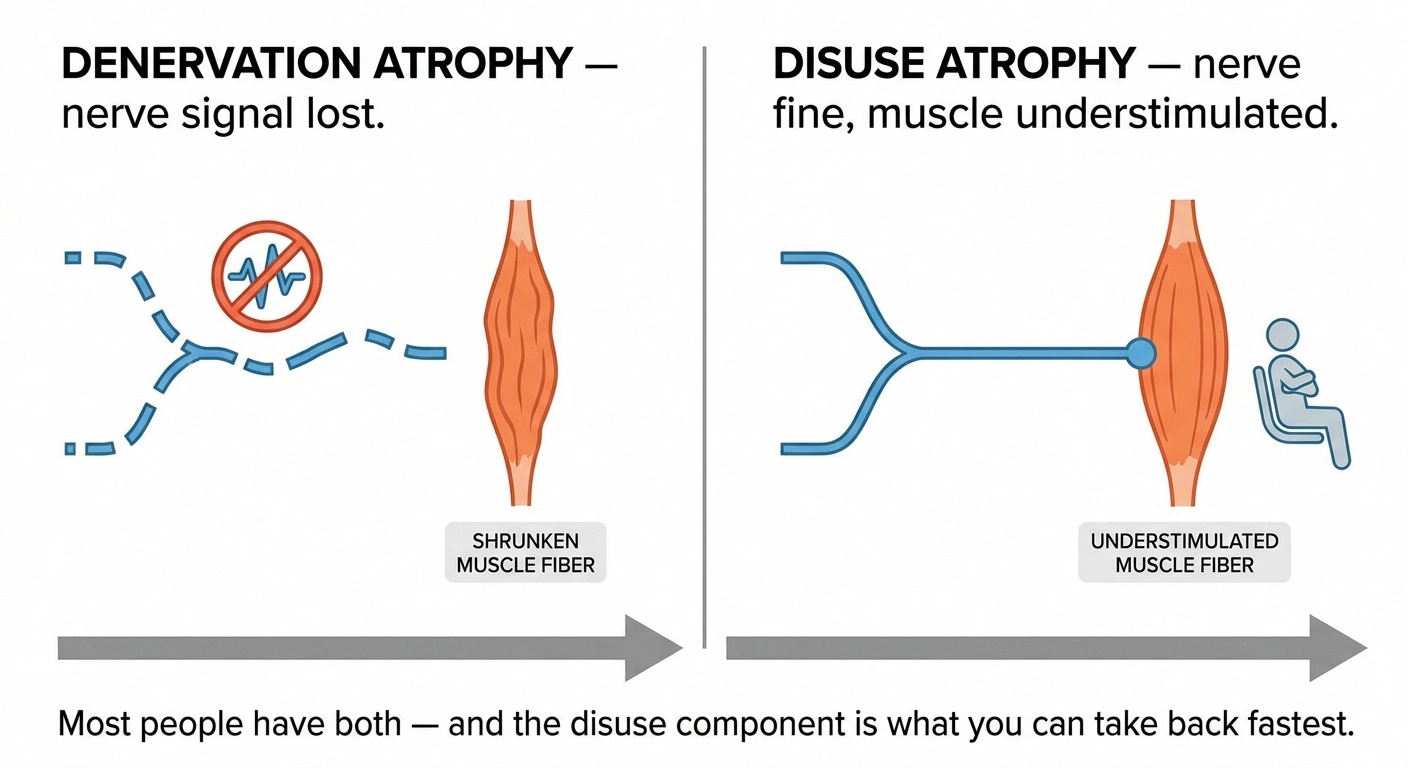
In most people with long-standing neuropathy, muscle atrophy comes from a mix of two processes. Understanding the mix matters because the strategies are different.
Reversal: Partial — only as the nerve recovers.
Key strategy: Protect the nerves you still have.
Reversal: Highly reversible with loading.
Key strategy: Consistent resistance training.
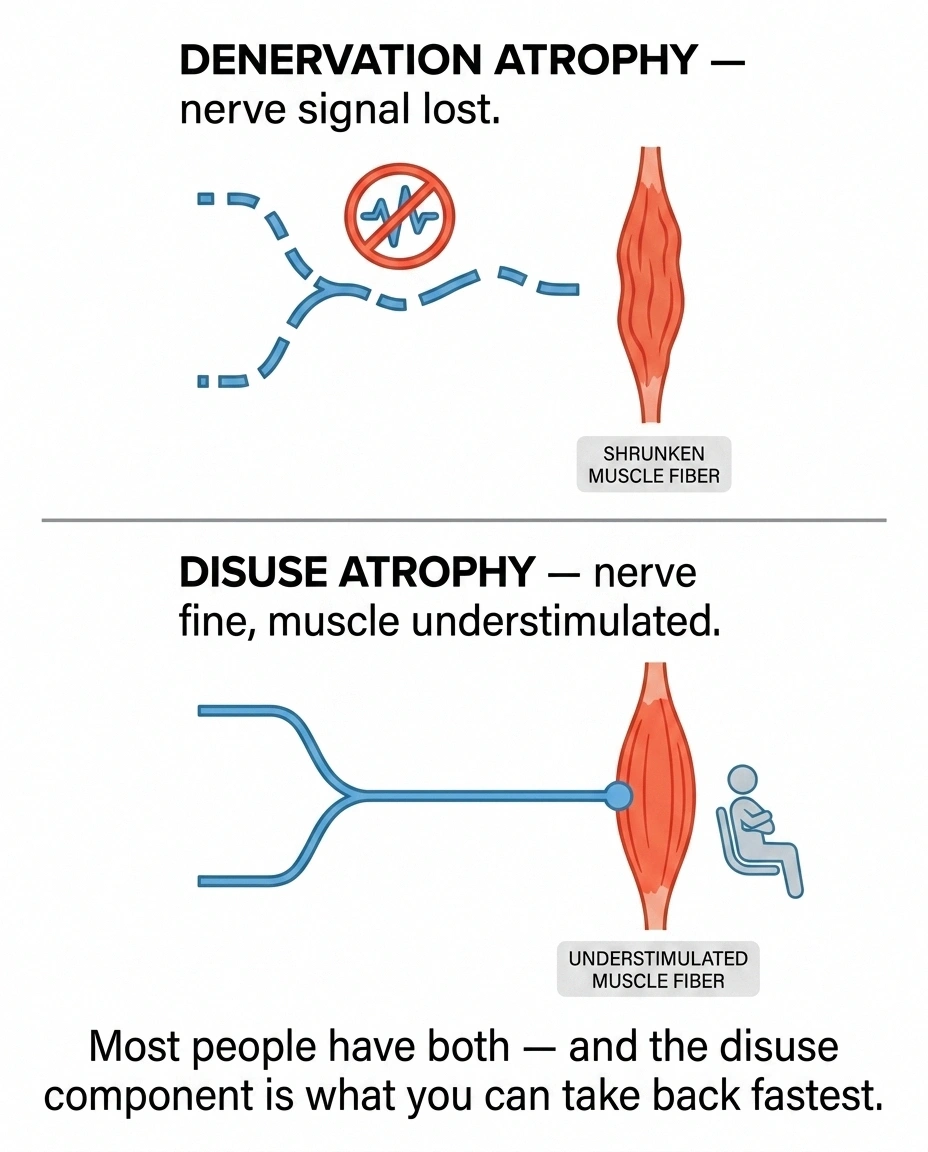
Denervation atrophy is what we just described — the motor nerve is failing, the trophic signal is weakened or absent, and individual muscle fibers shrink because they have lost their nerve supply. In the early stages, surviving nerves can “adopt” orphaned muscle fibers and partially compensate. In later stages, the adoption stops keeping up, and the muscle visibly thins. This is the pattern you see in long-standing diabetic neuropathy, chronic inflammatory neuropathies like CIDP, hereditary neuropathies like Charcot-Marie-Tooth, and after severe single-nerve injuries.
Disuse atrophy is what happens when a muscle is simply not being challenged. This happens to anyone — astronauts in microgravity, people on bedrest, people who stop moving because they are in pain. With neuropathy, disuse atrophy stacks on top of denervation atrophy because pain, balance problems, and fear of falling all conspire to make you move less. The muscle that is already struggling to hold on to its mass gets even less stimulation.
Here is the practical implication: disuse atrophy is highly reversible. Denervation atrophy is partially reversible — and the part that responds is whatever active motor units you still have. If you have neuropathy and you are losing muscle, you are almost certainly losing some to both processes. The good news is that the disuse component is yours to take back through deliberate movement. The denervation component is also addressable, but the strategy is different — it is about protecting and stimulating the nerves you still have.
Which Neuropathies Cause the Most Wasting
Not all neuropathies look the same when it comes to muscle. Some are predominantly sensory — they cause numbness, burning, and pain but leave motor function largely intact. Others are predominantly motor — they preferentially attack the nerves that drive muscles. Knowing where your specific neuropathy falls on this spectrum tells you a lot about what to expect.
The neuropathies most strongly associated with muscle atrophy include:
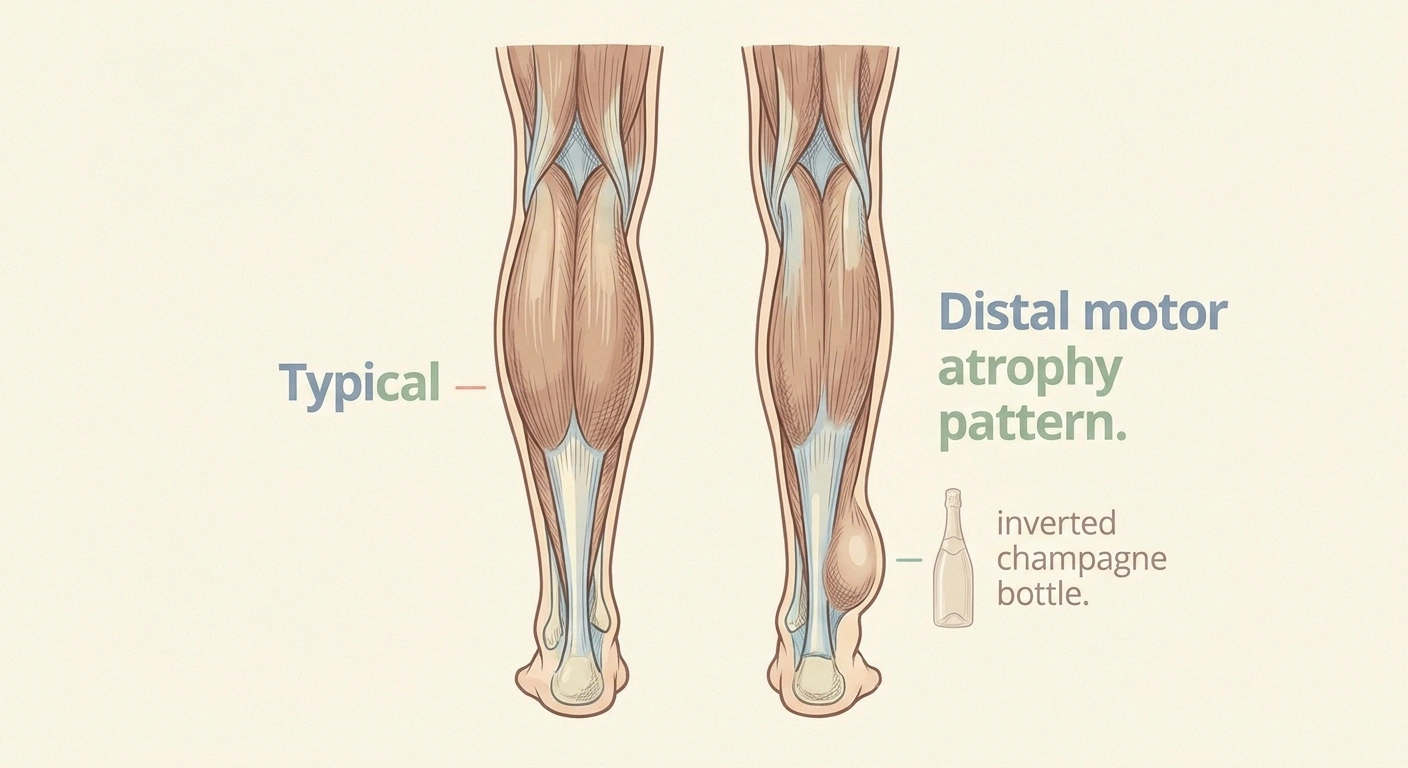
Charcot-Marie-Tooth (CMT) disease. This hereditary neuropathy classically causes severe atrophy of the foot muscles, the calves (producing the “inverted champagne bottle” leg shape), and the small muscles of the hand. The pattern of atrophy is often what brings people to their first diagnosis.
Chronic inflammatory demyelinating polyneuropathy (CIDP). This autoimmune neuropathy can cause rapid and significant motor loss, and the muscle wasting that follows can be dramatic. The encouraging news is that CIDP often responds well to treatment, and a substantial amount of motor function and muscle can be regained.
Diabetic motor neuropathy. Long-standing diabetic neuropathy eventually involves the motor nerves, particularly the deep intrinsic muscles of the foot and hand. The hollowing of the arch, the clawing of the toes, and the thinning between the thumb and index finger are all signatures of this.
Multifocal motor neuropathy. A rare but treatable condition that selectively attacks motor nerves, causing significant wasting in specific muscle groups while sensation stays intact. It is sometimes mistaken for ALS, which is why correct diagnosis matters so much.
Vasculitic and toxic neuropathies. Severe single-nerve infarcts or chemical injuries can cause profound atrophy of the muscles supplied by that nerve.
Recovery phases of Guillain-Barré syndrome. Even after the acute illness resolves, the muscle wasting that occurred during the paralysis phase takes months to rebuild.
Pure sensory neuropathies, including small fiber neuropathy and many cases of idiopathic neuropathy, often produce very little visible muscle loss for years — though long-standing cases eventually involve some motor components as well.
The Warning Signs That Atrophy Is Progressing
One of the cruelest things about muscle atrophy is how easy it is to miss day-to-day. You see your own body every morning, so a slow change feels like no change. But the signs are there if you look. The earlier you catch progression, the more leverage you have to slow it down.
The “champagne bottle” calf shape. A normal calf has a defined muscle belly in the upper portion and tapers down to the ankle. In CMT and other motor neuropathies, the muscle belly thins out so much that the calf looks like an inverted bottle — thin top, slightly thicker just above the ankle.
The hollow between the thumb and index finger. Spread your fingers apart and look at the back of your hand. The webbing between the thumb and index finger should be a small flat or slightly raised area of muscle. When that muscle (the first dorsal interosseous) atrophies, you can see a clear hollow there. This is one of the most reliable early signs of motor neuropathy in the hand.
The high or “hollow” arch. The deep muscles of the foot keep the arch shaped correctly. As they atrophy, the arch can either collapse (flat foot) or become exaggeratedly high (pes cavus). The toes may start to claw or hammertoes may develop.
Asymmetric clothing fit. Pants that used to fit at the calf are loose. A wedding band is slipping off because the muscles of the hand have thinned. Shoes feel different — heels slip, toes feel loose. These mundane observations are often the first real-world signal.
Functional changes. You can no longer open a jar you used to open. You trip over carpets because your toes do not lift the way they used to (foot drop). You feel like your hand “won't work” even when you can see it move. Stairs feel harder, especially descending. These functional changes track muscle loss closely.
If you notice any of these and you have not had a recent clinical exam, schedule one. A simple muscle strength assessment combined with your nerve conduction history can clarify whether your neuropathy is progressing, has stabilized, or is responding to treatment.
What Actually Helps — The Strategies That Move the Needle
The frustrating reality is that we cannot regrow a fully denervated muscle by willpower alone. What we can do is protect the nerve supply that remains, maximize the strength of the surviving motor units, and aggressively defend against the disuse component that piles on top of denervation. Here are the strategies, in roughly the order of leverage they offer.
1. Treat the Underlying Cause Aggressively
This is the highest-leverage intervention by far. If your neuropathy has a treatable cause and that cause is still active, every month of unchecked progression is more nerve loss and more muscle that cannot be rebuilt.
If it is diabetic, the single most powerful lever is tight glucose control. Hemoglobin A1C in the 6 to 7 range, glucose variability minimized, blood pressure managed. The nerves that remain depend on this.
If it is autoimmune (CIDP, vasculitis, multifocal motor neuropathy), treatment with IVIG, plasma exchange, steroids, or other immunomodulators can stop the active attack on the nerves and let recovery begin.
If it is nutritional (B12 deficiency, copper deficiency, other vitamin issues), correcting the deficiency before too much damage has occurred can fully halt progression.
If it is toxic (alcohol, certain medications, chemotherapy, heavy metals), removing the exposure is the only way the nerves get a chance to regenerate.
The general principle: the muscle cannot be rebuilt if the nerves keep dying. Treating the cause is muscle preservation.
2. Resistance Training — Carefully, Consistently, Progressively
This is the most underused intervention in muscle preservation with neuropathy. People with neuropathy are often told to “be careful” and “don't overdo it” and the unintended consequence is that they stop challenging their muscles at all. The result is that the disuse component of atrophy compounds the denervation component.
Resistance training works for people with neuropathy. Studies in diabetic neuropathy, post-chemotherapy populations, and people with hereditary neuropathies consistently show that progressive resistance training improves strength, preserves muscle mass, and improves functional ability. The keys are:
- Train against resistance two to three times per week. Bodyweight, resistance bands, light dumbbells, machines — whatever you have access to. The muscle responds to the stimulus of working against load, not to the type of equipment.
- Aim for 2 to 3 sets of 8 to 12 repetitions per exercise. The last few reps should feel genuinely hard. Easy reps do not stimulate the protein-synthesis response that builds and preserves muscle.
- Hit all the major muscle groups. Legs (squats, leg press, calf raises), back (rows, pull-downs), chest (push-ups, presses), shoulders, arms, core. Atrophy can be selective, so all muscle groups need stimulation.
- Build the load up gradually. Add a small amount of weight or one extra repetition every week or two. Progressive overload is what drives adaptation. Plateaus mean no further adaptation is happening.
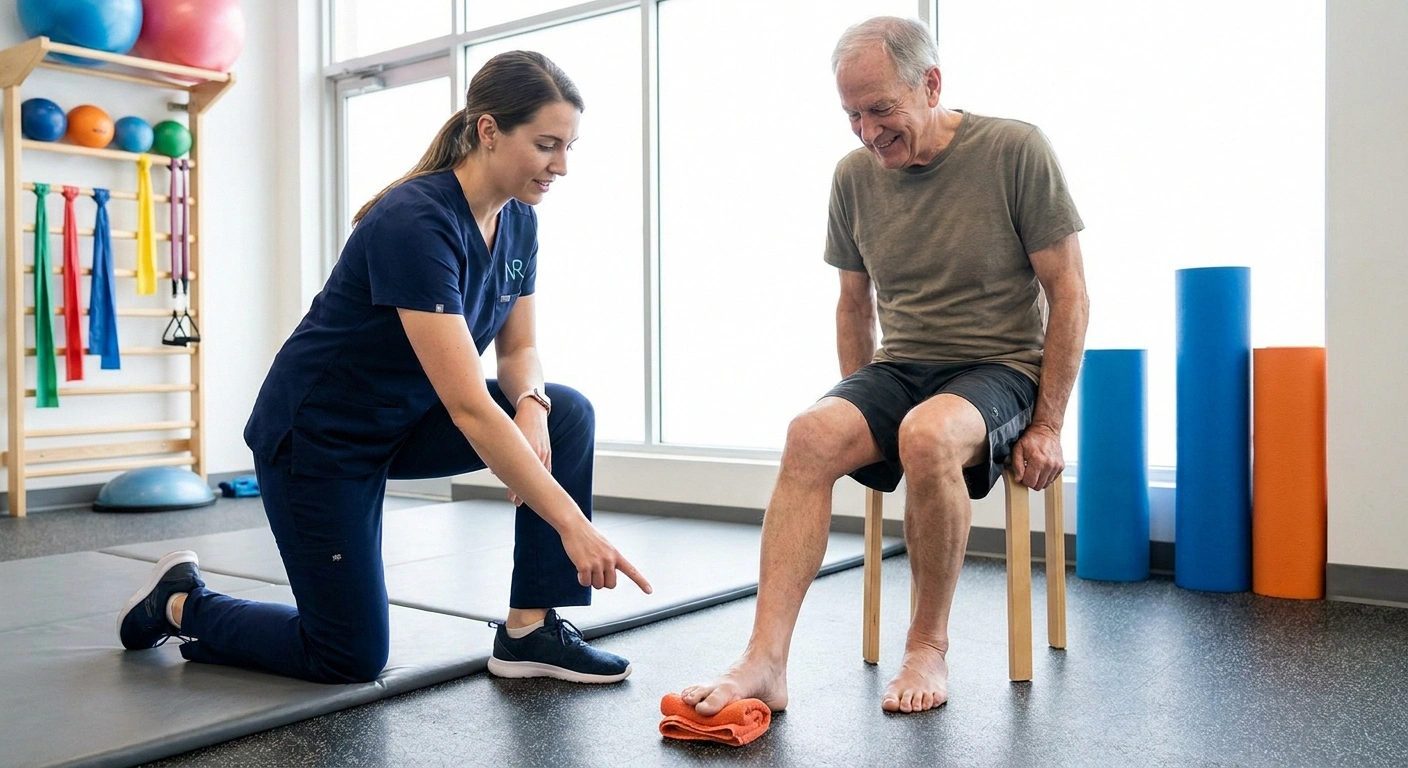
- Pay particular attention to the small intrinsic muscles of the foot and hand, which are commonly affected and often skipped. Toe-spreading exercises, towel scrunches, marble pickups for feet. Putty squeezing, finger spreads, opposition drills for hands.
One of the most important findings in modern neuropathy research is that even when the nerve cannot regenerate, the surviving motor units can be trained to do more — recruit more fibers per impulse, contract more powerfully, and adapt to the load. This is essentially how Olympic athletes get stronger without growing new muscle: they extract more performance from the muscle they have. People with neuropathy can do the same. Working with a physical therapist who has neuropathy experience can make a meaningful difference here.
3. Protein Intake That Actually Supports Muscle
Older adults — and many people with neuropathy are older adults — chronically under-eat protein. The general guidance for someone trying to preserve or build muscle is at least 1.2 to 1.6 grams of protein per kilogram of body weight per day, spread across the day rather than concentrated in one meal. For a 70 kg person that is 85 to 110 grams of protein daily.
What that looks like in practice: a palm-sized portion of protein at every meal, plus a protein-rich snack between meals. Eggs, Greek yogurt, cottage cheese, fish, poultry, beans and lentils, tofu, edamame, lean meats. If meal-by-meal protein is hard, a quality protein shake once or twice a day can fill the gap.
The reason protein matters so much: muscle protein synthesis is the cellular process that builds and rebuilds muscle fibers. It is triggered by the combination of resistance training plus available amino acids. Without enough protein, the resistance training stimulus has nothing to build with.
If you have kidney disease, talk to your nephrologist before pushing protein intake high. For most people without kidney issues, the safety of higher protein intake is well established.
4. Stand and Walk on Your Feet Every Day
Foot intrinsic muscles, calf muscles, and the small stabilizers of the ankle all depend on being loaded. Sitting in a chair all day deprives them of their basic stimulus. Walking for even ten to fifteen minutes a day, broken into short blocks, sends mechanical signals to those muscles that they should not shrink. Standing while doing tasks that you would otherwise sit for adds more load. A standing desk for part of the workday for those who can manage it adds even more.
If walking is painful or unsafe for you, work with a physical therapist on safer alternatives. Stationary cycling, water walking, recumbent stepping. The point is daily loading of the leg muscles — not the specific activity.
5. Specific Tools and Therapies Worth Knowing About
A few additional interventions have evidence supporting them in specific situations:
Neuromuscular electrical stimulation (NMES). When the nerve supply is partially intact, electrical stimulation of the muscle can produce contractions that help preserve mass. This is most useful in severe motor neuropathies and during recovery from acute paralysis. It is not a substitute for voluntary exercise when voluntary exercise is possible — but it can be a useful adjunct.
Targeted physical therapy. A physical therapist who has experience with neuropathy can build a program that addresses your specific weakness pattern, accounts for your balance and safety constraints, and progresses the load appropriately. This is often the single best investment a person with motor neuropathy can make.
Orthotics and bracing. When foot atrophy has caused functional problems like foot drop or claw toes, custom orthotic support or specialized footwear can substitute for the muscle work and prevent falls. The orthotic does not rebuild the muscle, but it lets you stay active without further injury.
Adequate creatine intake. Five grams of creatine monohydrate daily is one of the best-supported interventions for muscle preservation in older adults and people with motor disorders. It is inexpensive, safe in people without kidney disease, and provides a small but consistent advantage for muscle size and strength when paired with resistance training. Talk with your provider before starting it.
What Does Not Work — Or At Least, Not on Its Own
It is worth saying clearly: there is no supplement that rebuilds atrophied muscle by itself. There is no cream that restores muscle mass. There is no machine that does the work for you. The fundamental requirements are still the boring ones — nerve preservation, mechanical loading, protein, time.
Supplements like B vitamins, alpha-lipoic acid, acetyl-L-carnitine, and CoQ10 have a real and important role in supporting nerve health and may slow neuropathy progression — but they are nerve-support tools, not muscle-rebuilding tools. They help create the conditions in which muscle preservation strategies can work.
Massage feels good and may help with stiffness, but it does not preserve muscle mass. Compression sleeves are useful for circulation and comfort but do not stimulate muscle growth. Topical creams have no muscle-building effect.
This is not pessimism. It is realism. The most expensive interventions on the market do not work as well as consistent resistance training plus adequate protein plus aggressive treatment of the underlying cause. The boring strategies are the ones that move the needle.
When to Push Harder for Specialist Care

If your muscle atrophy is progressing despite efforts to control the underlying cause and exercise consistently, it is worth getting a fresh look from someone who specializes in neuromuscular disorders. Possibilities to consider:
A neuromuscular neurologist. A subspecialist who sees motor neuropathies all the time will catch patterns and treatable causes that a general neurologist may not. If you have not had a thorough recent workup — including EMG/NCS, autoimmune labs, genetic testing if indicated, and consideration of treatable causes like CIDP or MMN — push for one.
A physical medicine and rehabilitation (PM&R) physician. Sometimes called a physiatrist. PM&R specialists are experts in maximizing function in the setting of nerve and muscle disease. They can be excellent guides to bracing, NMES, and the rehab program that matches your specific limitations.
A physical therapist with neuromuscular expertise. Not every PT has experience with motor neuropathies. Ask for a PT who has specifically worked with patients with peripheral neuropathy, CIDP, or hereditary neuropathies. The difference in program quality is significant.
A registered dietitian. Especially if you are an older adult, have multiple medical conditions, or have been told to restrict certain foods — a dietitian can help you hit the protein and nutrient targets that protect muscle without compromising other parts of your health.
The Mental and Emotional Side
Watching your own body change in ways you cannot fully control is genuinely hard. It can shake confidence, change how you see yourself, alter what you do socially. Many people with progressive neuropathy describe a kind of slow grief — for the body they used to have, for the activities they used to do without thinking, for the strength they took for granted.
Some things that help with this part:
Track function, not appearance. Take note of what you can do — how far you can walk, how many push-ups, how easily you can open a jar — and track those numbers over time. Function tells you more than how a muscle looks in the mirror.
Find others walking the same path. Online communities for CMT, CIDP, diabetic neuropathy, and other motor neuropathies are full of people who have practical wisdom about adapting, advocating, and accepting. You are not the first person to face this.
Get the mental health support you would get for any other chronic illness. Depression and anxiety are common companions of chronic neuropathy and they are treatable. Treating them is part of treating the whole picture.
Celebrate the small wins. Adding two reps to your strength workout, walking ten minutes longer than last week, learning a new exercise that works around a limitation — these are real victories. They compound over months and years.
Frequently Asked Questions
Can muscle that has been lost to neuropathy come back? Partially yes, with important caveats. The part of the loss that came from disuse can be substantially rebuilt with consistent resistance training and adequate nutrition. The part that came from full denervation cannot be regrown until the nerve regenerates, which can happen but is slow and incomplete in most adults. The good news is that even small gains in surviving motor units make a meaningful functional difference.
How long does it take to see results from a resistance training program? Most people notice strength gains in four to six weeks even before visible muscle changes. Measurable muscle mass changes usually take twelve to sixteen weeks of consistent training. People with neuropathy generally respond more slowly than people without — but they do respond.
Is electrical stimulation worth doing at home? For most people with neuropathy, voluntary exercise produces better and more functional results than at-home electrical stimulation. TENS units are for pain, not muscle building. Medical-grade NMES is appropriate in specific situations, ideally under physical therapy guidance.
Should I take testosterone or other hormones to fight muscle loss? For most people the answer is no, but men with documented low testosterone should discuss this with their primary care provider or endocrinologist. The risks and benefits of hormone replacement need individual evaluation. There is no good evidence for using testosterone purely to combat neuropathy-related atrophy.
Will I end up in a wheelchair? The answer depends heavily on your specific type of neuropathy and how aggressively you treat it. Many people with motor neuropathies — including CMT, CIDP, and diabetic motor neuropathy — never need a wheelchair if they treat the underlying cause and stay consistent with strength and balance work. Mobility aids when needed are tools for staying active, not signs of failure.
What is the single most important thing I can do? If you do one thing, do consistent resistance training two to three times a week paired with a protein-rich diet. If you do two things, add aggressive treatment of the underlying cause. If you do three, add walking and standing as much as your safety allows. This stack is what moves the needle.
Are there specific exercises I should not do? Avoid exercises that put you at risk of falls if your balance is compromised. Avoid maximal-effort lifts that risk injury. Avoid pushing through joint pain, which usually indicates you are loading a joint that is no longer aligned correctly because of muscle loss around it. Otherwise the menu is open — and your physical therapist can help you choose the right options.
How do I know if my atrophy is from neuropathy or just aging? Some muscle loss is normal with aging (sarcopenia). What distinguishes neuropathic atrophy is the pattern — particular muscle groups (foot intrinsics, hand intrinsics, calves) preferentially affected, often asymmetric, often visible in characteristic shapes (champagne-bottle calf, hollow first webspace, claw toes). An EMG and clinical exam clarify the picture.
About the Author