
Not so long ago, a diagnosis of hereditary ATTR amyloidosis with nerve involvement came with one real question: how fast would it progress? Today it comes with a different and much better problem — which treatment?
There are now pills, infusions, clinic injections, a pen you use at home, and a one-time gene-editing treatment in late-stage trials. Their names are long, their mechanisms sound like science fiction, and the websites that rank for them are mostly written for doctors. Some patient pages still list a drug that's no longer sold in the United States, and hardly any of them flag the detail that trips up so many families: one of the best-known ATTR drugs isn't approved for nerves in the US at all.
So this is the comparison I'd want on my own kitchen table. It covers what each drug does, how it's taken, what the trials showed, the monitoring each one needs, and the honest reason nobody can tell you which is best.
What TTR Is and Why It Damages Nerves
Transthyretin, or TTR, is a protein made mostly by your liver. Its day job is carrying things around in your bloodstream, including thyroid hormone and vitamin A — and that second cargo becomes important later.
| Drug | Hereditary ATTR neuropathy | ATTR heart disease |
|---|---|---|
| Tafamidis | No (approved for it in the EU) | Yes, hereditary or wild-type |
| Acoramidis | No | Yes, hereditary or wild-type |
| Diflunisal | Off-label use only | No |
| Patisiran | Yes | No |
| Vutrisiran | Yes | Yes, hereditary or wild-type |
| Eplontersen | Yes | No |
| Inotersen | Approved, but US marketing stopped in 2024 | No |
| Nex-z | Trials only | Trials only |
Healthy TTR travels as a four-part bundle. In ATTR amyloidosis, that bundle comes apart, the pieces misfold, and they clump into stiff deposits called amyloid. Those deposits build up in nerves, the heart and other organs, and they damage whatever they settle in. Our overview of amyloid neuropathy explains the symptoms in more detail: numbness and burning that usually start in the feet, and often autonomic problems too, such as dizziness on standing, digestive trouble and weight loss.
There are two kinds, and the difference shapes everything that follows:
- Hereditary (variant) ATTR comes from a change in the TTR gene that makes the protein less stable. It can affect nerves, heart or both, and it runs in families.
- Wild-type ATTR happens with a normal gene, as the protein becomes less stable with age. It mainly affects the heart in older adults, often after years of carpal tunnel syndrome in both wrists, which is why our comparison of carpal tunnel and peripheral neuropathy is worth a look if that's part of your story.
Here's the detail most pages leave out. Every drug with a US approval for ATTR neuropathy is approved specifically for the neuropathy of the hereditary form. The drugs approved for wild-type ATTR are approved for the heart. If you have wild-type disease with nerve symptoms, that's a conversation to have with your specialist, not something a label will settle.
Three Strategies: Hold It Together, Turn It Down, Switch It Off
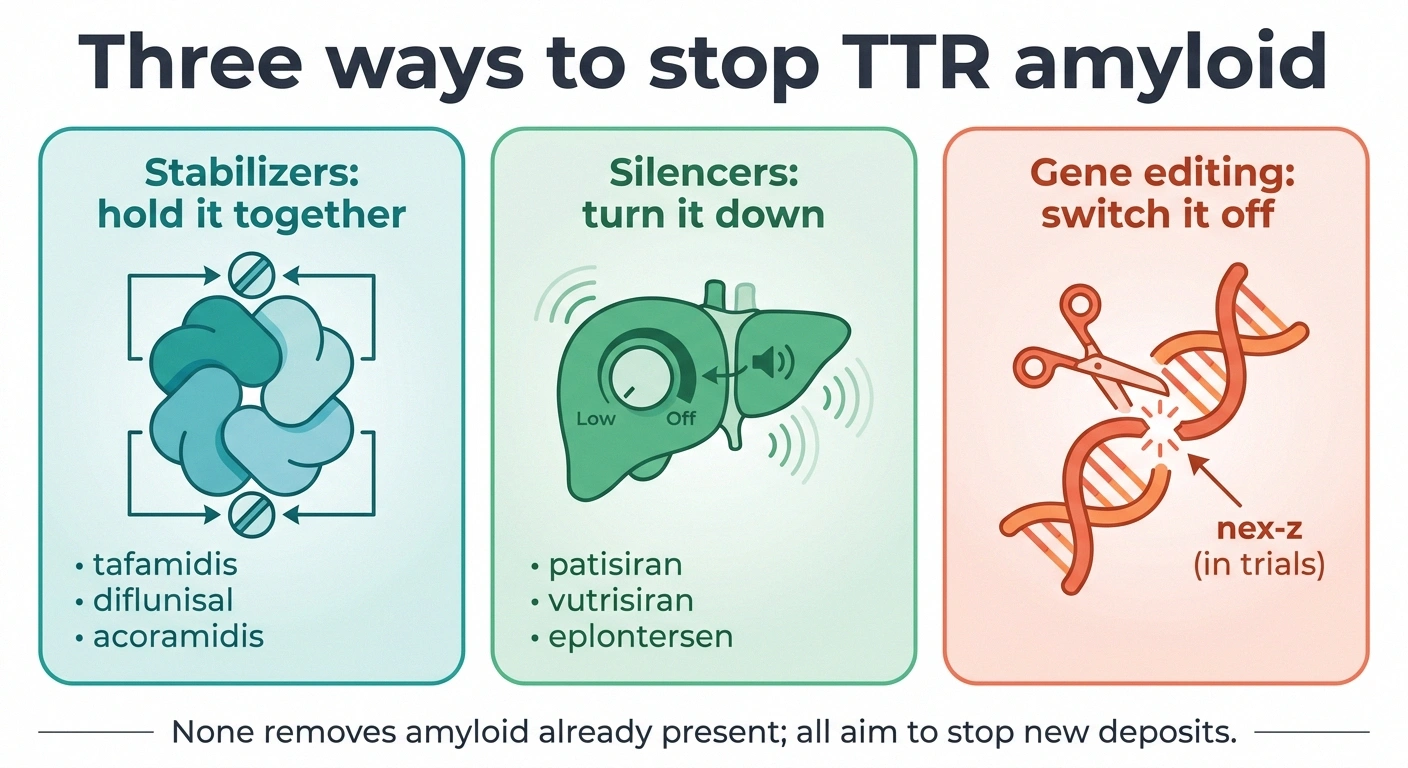
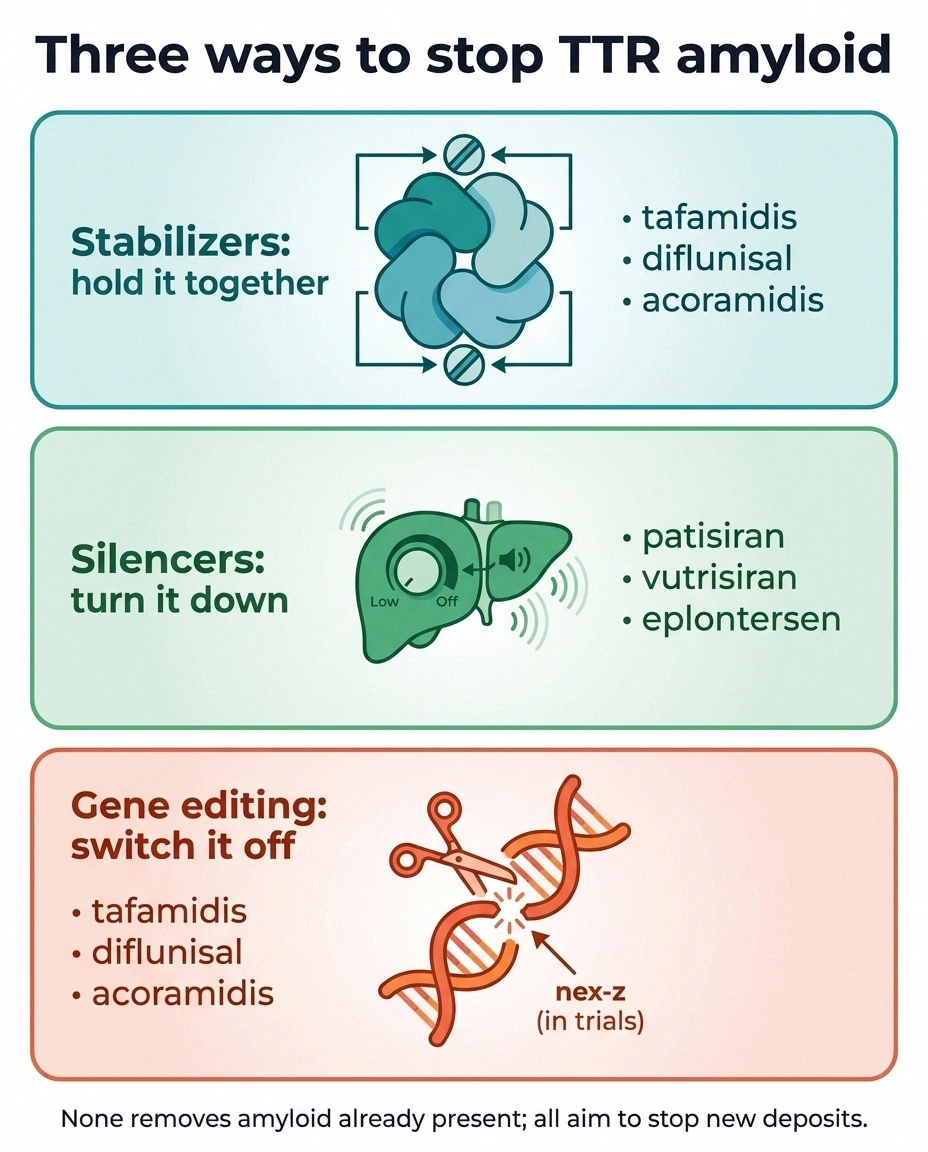
Every ATTR treatment works on one simple idea — less unstable TTR in the blood means less new amyloid.
There are three ways to get there. Stabilizers are pills that latch onto the TTR bundle and hold it together so it doesn't fall apart. Silencers tell the liver to make far less TTR in the first place, lowering the level in your blood by roughly 80 percent or more. Gene editing aims to switch the liver's TTR gene off permanently with a single treatment.
None of them removes amyloid that's already there. The body can clear some deposits slowly on its own once new ones stop forming, but the realistic goal of treatment is to stop or slow the damage. That's why specialists push so hard for early diagnosis. Nerve function you still have is much easier to protect than nerve function you've lost.
The Stabilizers: Tafamidis, Diflunisal and Acoramidis

Tafamidis (Vyndaqel, Vyndamax)
This is the drug that causes the most confusion. Tafamidis is a once-daily capsule, and in Europe it has been approved since 2011 for adults with early-stage (stage 1) hereditary ATTR polyneuropathy. In its 18-month European trial, the TTR protein was stabilized in 98 percent of patients taking it and in none on placebo, and patients showed 51 to 81 percent less deterioration in several measures of nerve function.
In the United States, though, tafamidis is approved only for ATTR cardiomyopathy, the heart form. Pfizer states it directly: the drug is not approved for ATTR polyneuropathy in the US. Some specialists still use it, but it won't carry the neuropathy indication on your prescription, and insurance can treat it differently as a result. Our dedicated article on tafamidis for ATTR goes deeper.
Diflunisal
Diflunisal is an old, inexpensive generic anti-inflammatory painkiller, from the same broad family as ibuprofen, that also happens to stabilize TTR. It's used off-label, typically 250 mg twice a day. In a randomized trial of 130 people published in JAMA in 2013, it significantly slowed the progression of nerve impairment over two years compared with placebo.
The catch is the side-effect profile that comes with anti-inflammatories: kidney problems, stomach upset or bleeding, and fluid retention. That makes it a poor fit for many older adults, especially anyone with heart failure or reduced kidney function, which are common in ATTR.
Acoramidis (Attruby)
Acoramidis is a newer stabilizer taken twice daily, approved in the US in late 2024 — for the heart. Its label lists cardiomyopathy only. You may well hear about it, since it's heavily promoted, but it isn't a neuropathy drug in the US.
The Silencers: Four Drugs That Turn Down TTR
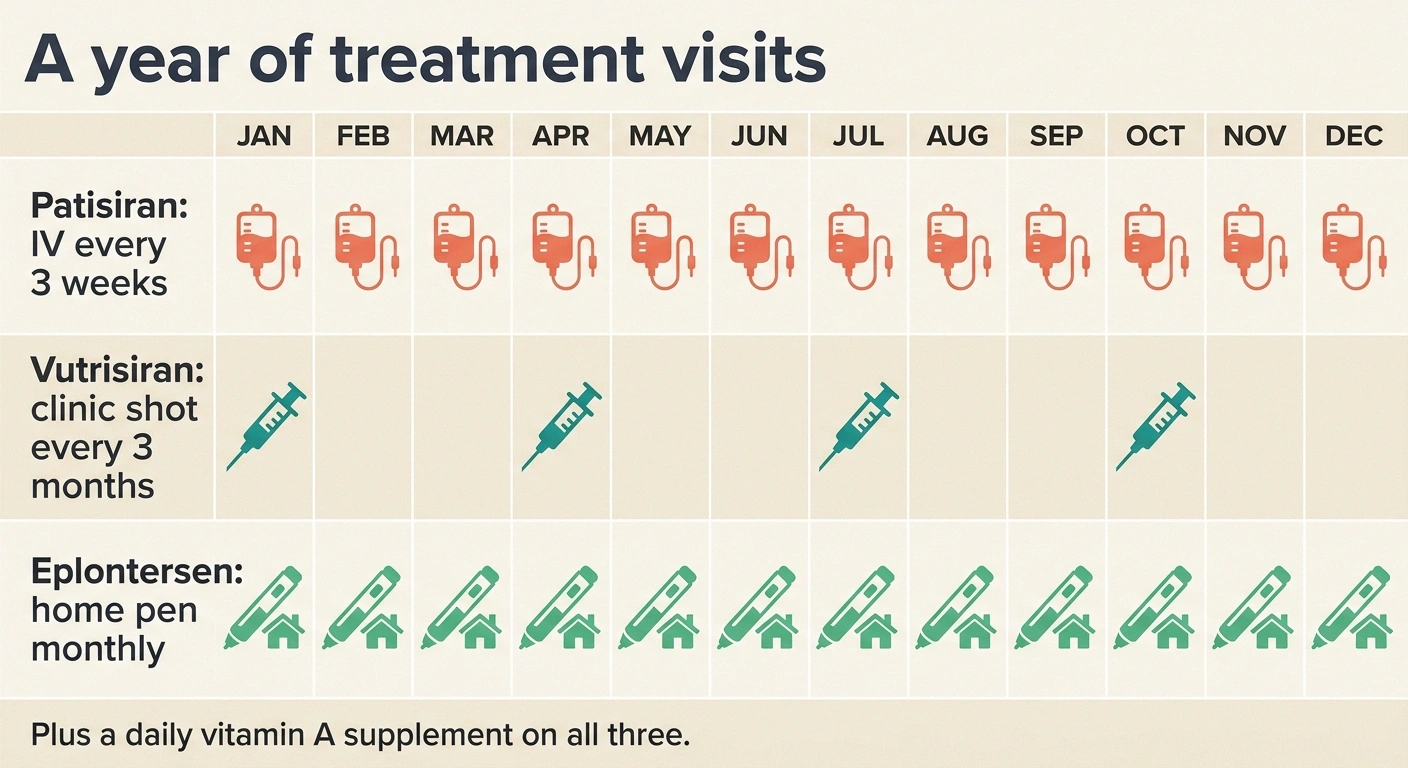
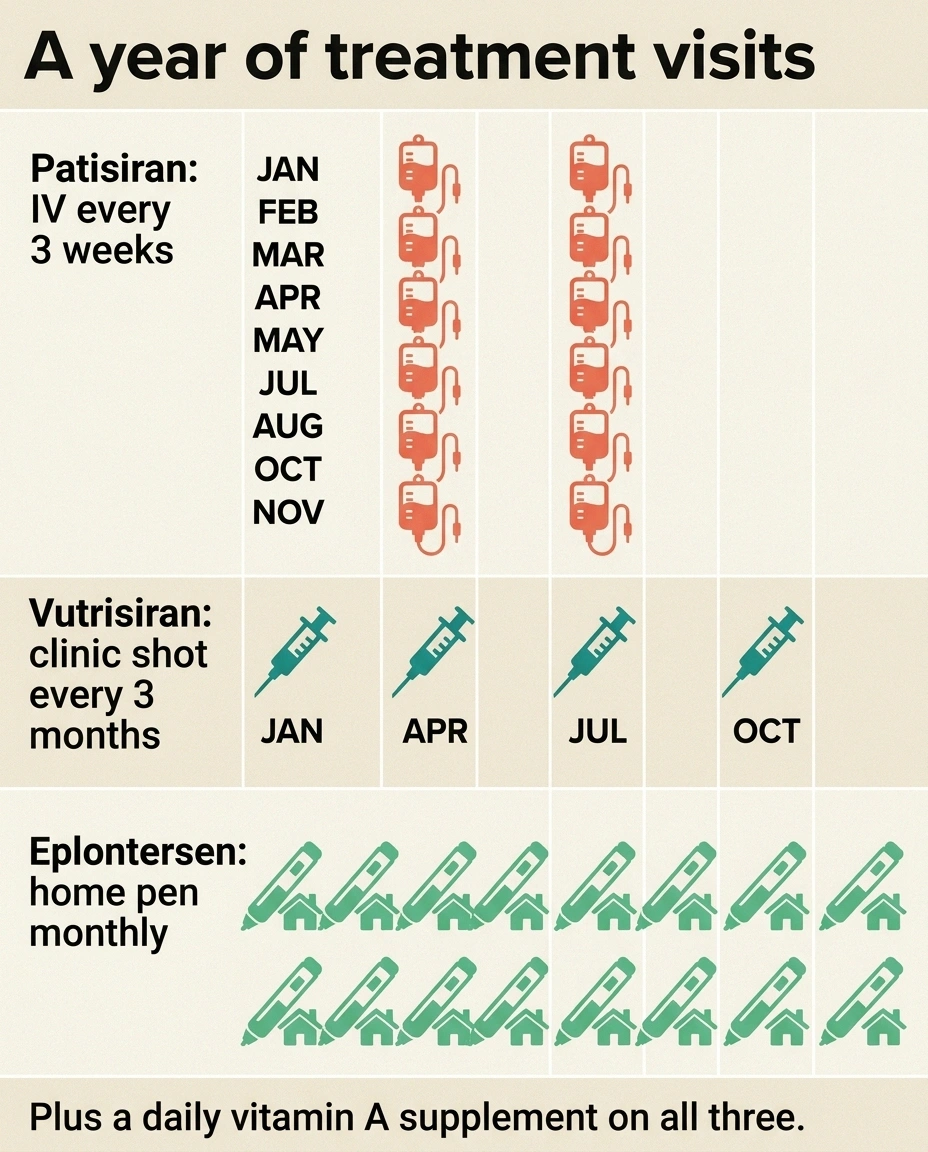
Silencers use small pieces of genetic material that find the TTR instructions in liver cells and stop them being used. There are two technologies, RNA interference (the drug names ending in -siran) and antisense (ending in -rsen), but for a patient the practical differences are how often you're treated, where, and what monitoring is involved.
- Patisiran (Onpattro): about 17 infusions
- An 80-minute IV every three weeks, with premedication beforehand each time. Plan for the steroid and antihistamine to make you drowsy on infusion days.
- Vutrisiran (Amvuttra): 4 injections
- A quick injection under the skin at a clinic every three months. The fewest visits of any option.
- Eplontersen (Wainua): 12 injections, at home
- A monthly autoinjector pen most people use themselves. Handy for rural patients; needs enough hand strength to work the pen.
- All three: a daily vitamin A supplement
- At the ordinary recommended daily amount, plus prompt reporting of any eye symptoms.
Patisiran (Onpattro)
The first silencer approved, in 2018. It's given as an IV infusion of about 80 minutes every three weeks, and everyone receives premedication beforehand — a steroid, acetaminophen and antihistamines — to reduce infusion reactions. Even so, reactions occurred in 19 percent of patients, against 9 percent on placebo.
Its APOLLO trial set the bar for the whole class. Over 18 months, a standard nerve-impairment score (called mNIS+7) improved slightly with patisiran, by 6 points, while it worsened by 28 points on placebo. For a progressive disease, holding steady or improving was a big shift.
Vutrisiran (Amvuttra)
Vutrisiran is a small injection under the skin, given by a healthcare professional once every three months. In its HELIOS-A trial it lowered blood TTR by 83 percent and, at nine months, patients scored about 17 points better on the nerve-impairment scale than a placebo comparison group. Its most common side effects were pain in the arms or legs (15 percent) and joint pain (11 percent).
Since March 2025, vutrisiran has been the only drug approved in the US for both hereditary ATTR neuropathy and ATTR cardiomyopathy, including wild-type heart disease. For someone with both nerve and heart involvement, that dual approval matters a great deal. Our full guide to vutrisiran covers the details.
Eplontersen (Wainua)
Eplontersen is a monthly injection that most people give themselves at home with an autoinjector pen, which suits anyone who lives far from a treatment center. In its NEURO-TTRansform trial it cut TTR by 81 percent, and at 35 weeks nerve-impairment scores were essentially unchanged, while the placebo comparison group had worsened by about 9 points.
You may have seen headlines in late August 2026 that eplontersen's heart trial, CARDIO-TTRansform, missed its main goal. That trial tested the drug for cardiomyopathy. It doesn't change its approval for hereditary ATTR neuropathy, which rests on separate trial data. There's more in our article on eplontersen.
Inotersen (Tegsedi)
Inotersen was a weekly self-injection approved for hereditary ATTR neuropathy, and it worked; in its trial, nerve-impairment scores worsened far less than on placebo. But it carried boxed warnings for sudden drops in platelets and a serious kidney inflammation, which meant frequent blood and urine tests. Its maker stopped marketing it in the US on September 27, 2024, citing low sales rather than any new safety or effectiveness problem. If you're reading an older page that lists it as an option, that page is out of date.
Vitamin A: The Side Effect Every Silencer Shares

Remember that TTR carries vitamin A? Turn down TTR and your blood vitamin A drops with it. It's listed on every silencer's label — on patisiran's, 99 percent of patients who started with normal levels ended up with low ones.
- Chasing the blood number. Levels stay low because the carrier protein is gone. Taking more to “fix” the result is exactly what the labels warn against.
- Doubling up by accident. Add up the vitamin A in your multivitamin, eye-health formula and any separate supplement so the total stays at the recommended amount.
- Keeping the eye doctor in the dark. Tell your optometrist or ophthalmologist you take a TTR silencer, so night-vision complaints are taken seriously.
The labels all give the same advice, and it's slightly counterintuitive. Take a supplement at the normal recommended daily amount, not more. Blood levels will stay low whatever you do, because the carrier protein is missing, and those low blood readings don't reflect how much vitamin A your body actually holds. Megadosing to “fix” the number can do harm.
What you should watch for is your eyes. Report any eye symptoms that could point to vitamin A deficiency, trouble seeing in dim light being the classic one, and see an eye doctor if they appear.
Gene Editing: Nex-z and the One-Time Treatment

Nexiguran ziclumeran, mercifully shortened to nex-z, uses CRISPR gene editing, delivered in a single IV infusion, to switch off the TTR gene in liver cells for good. In its early-stage study, it lowered TTR by an average of 91 percent, and the reduction held through two years. Nerve scores were stable or improved.
It is not approved — it's available only inside clinical trials. It has also had a serious setback. In October 2025, a participant in the heart trial developed a severe liver reaction, and the FDA placed both late-stage trials on hold. That patient died in November 2025; the company said the case involved complicating other conditions. The holds were lifted in early 2026, the neuropathy trial in January and the heart trial in March, with much closer liver monitoring and new exclusions. By mid-2026 the company reported that the highest liver-enzyme rises had occurred in people carrying one particular immune-system gene type, and it expected to finish enrolling the neuropathy trial in the second half of 2026.
A one-time treatment is an extraordinary idea for a lifelong disease. But it's still being tested, and its safety picture isn't settled. Our article on nex-z tracks where the trials stand.
Why No One Can Tell You Which Is Best
This is the question everyone asks their specialist, and the honest answer is that the trials were never designed to answer it.
Each drug was tested against placebo, not against its rivals. Worse for comparison purposes, the vutrisiran and eplontersen neuropathy trials didn't even have their own placebo groups. Because it's no longer ethical to leave people with a progressive disease untreated for long, both borrowed “external” placebo groups from earlier trials. That's scientifically reasonable, but it makes the headline numbers harder to line up side by side.
A 2026 analysis in the European Journal of Neurology pooled six randomized trials and concluded that direct head-to-head comparisons are largely absent. It found the RNA-interference drugs had the most favorable efficacy profile, but its authors called the findings hypothesis-generating rather than definitive. In other words, promising, not proof.
The stabilizers have the same problem. The only published comparison of diflunisal and tafamidis for nerves is a 2024 single-center study that followed 35 people on diflunisal and 22 on tafamidis. Nerve-conduction decline didn't differ between the two groups. That's interesting, given the price gap between them, but it wasn't a randomized trial, and a small observational study can't settle the question.
So the choice between the silencers usually comes down to your life, not a scoreboard.
Choosing in Practice: The Questions That Decide It

These are the questions I'd bring to the appointment, in roughly the order they tend to settle things.
| Question | My answer | Usually leans toward |
|---|---|---|
| Is my heart involved too? | If yes, a drug approved for both | |
| How far is my treatment center? | Far: fewer visits or at-home dosing | |
| Can I work an injection pen with my hands? | If not, clinic-given options | |
| Kidney, stomach or fluid problems? | If yes, diflunisal is usually out | |
| What does my plan cover, and with what prior approval? | Ask the specialty pharmacy before deciding |
Is my disease hereditary or wild-type? This determines which approvals apply to you. If you haven't had genetic testing of the TTR gene, ask why not, because it also matters for your children and siblings.
Is my heart involved? Many people with hereditary ATTR have both nerve and heart disease. A drug approved for both, currently vutrisiran, can simplify things considerably.
How do I feel about needles, infusions and travel? An infusion every three weeks, a clinic injection every three months, or a pen at home every month are very different commitments, especially if the treatment center is two hours away. And if autonomic symptoms such as blood-pressure drops on standing make travel hard, that counts.
What about my kidneys and stomach? These rule diflunisal in or out quickly.
How will I pay for it? US list prices for the brand-name drugs run from roughly $244,000 a year for acoramidis to about $476,000 for vutrisiran and $499,000 for eplontersen, according to reported launch and wholesale prices. Almost nobody pays list price. Insurance, prior authorization and manufacturer assistance programs determine what you actually pay, and specialty pharmacies and patient advocacy groups can help you through that paperwork.
Should I consider a trial? For some people, especially those whose disease is progressing despite treatment, a clinical trial is worth discussing. Our guide to finding neuropathy clinical trials explains how to look.
There's no wrong answer to wanting the option that fits your week. The best drug on paper does very little if the schedule is one you can't keep.
Frequently Asked Questions
What is the difference between a TTR stabilizer and a TTR silencer?
A stabilizer is a pill that binds the TTR protein and holds it together so it doesn't break apart and form amyloid. A silencer is an injection or infusion that tells the liver to make much less TTR, lowering blood levels by roughly 80 percent or more. Gene editing, still investigational, aims to switch the TTR gene off permanently.
Is tafamidis approved for ATTR neuropathy in the US?
No. In the United States, tafamidis (Vyndaqel and Vyndamax) is approved only for ATTR cardiomyopathy. It has been approved in the European Union since 2011 for early-stage hereditary ATTR polyneuropathy.
Which ATTR neuropathy drugs are approved in the US?
Patisiran (Onpattro), vutrisiran (Amvuttra) and eplontersen (Wainua) are approved for the polyneuropathy of hereditary ATTR amyloidosis. Inotersen (Tegsedi) was also approved, but its US marketing stopped in September 2024. Diflunisal is sometimes used off-label.
Which ATTR drug is best for neuropathy?
No head-to-head trials have compared them directly, so there is no proven best drug. A 2026 analysis found the RNA-interference drugs had the most favorable efficacy profile but called the findings hypothesis-generating. The choice usually depends on heart involvement, dosing schedule, side effects and coverage.
Why do I need vitamin A with Amvuttra, Onpattro or Wainua?
TTR carries vitamin A in the blood, so lowering TTR lowers blood vitamin A. The labels advise a supplement at the normal recommended daily allowance, not higher doses, and prompt attention to any eye symptoms that could suggest vitamin A deficiency.
Is Tegsedi still available?
Its manufacturer stopped marketing inotersen (Tegsedi) in the United States on September 27, 2024, citing low sales rather than a new safety or effectiveness concern. Other silencers are available as alternatives.
Is CRISPR gene editing available for ATTR amyloidosis?
Not outside clinical trials. Nexiguran ziclumeran (nex-z) is in Phase 3 trials for ATTR neuropathy and cardiomyopathy. The trials were paused after a serious liver reaction and a patient death in late 2025 and resumed in early 2026 with closer liver monitoring.
About the Author