
Seventeen. Four. Two.
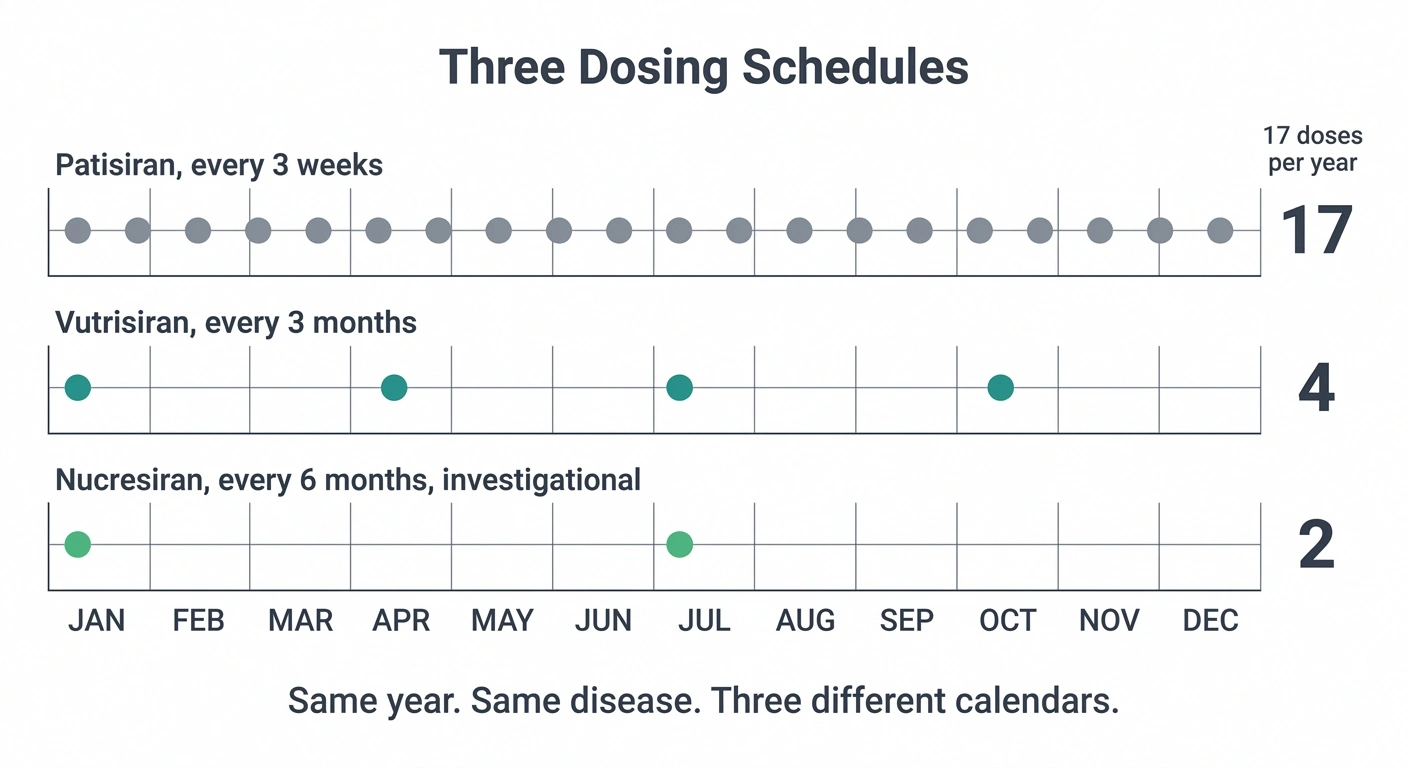
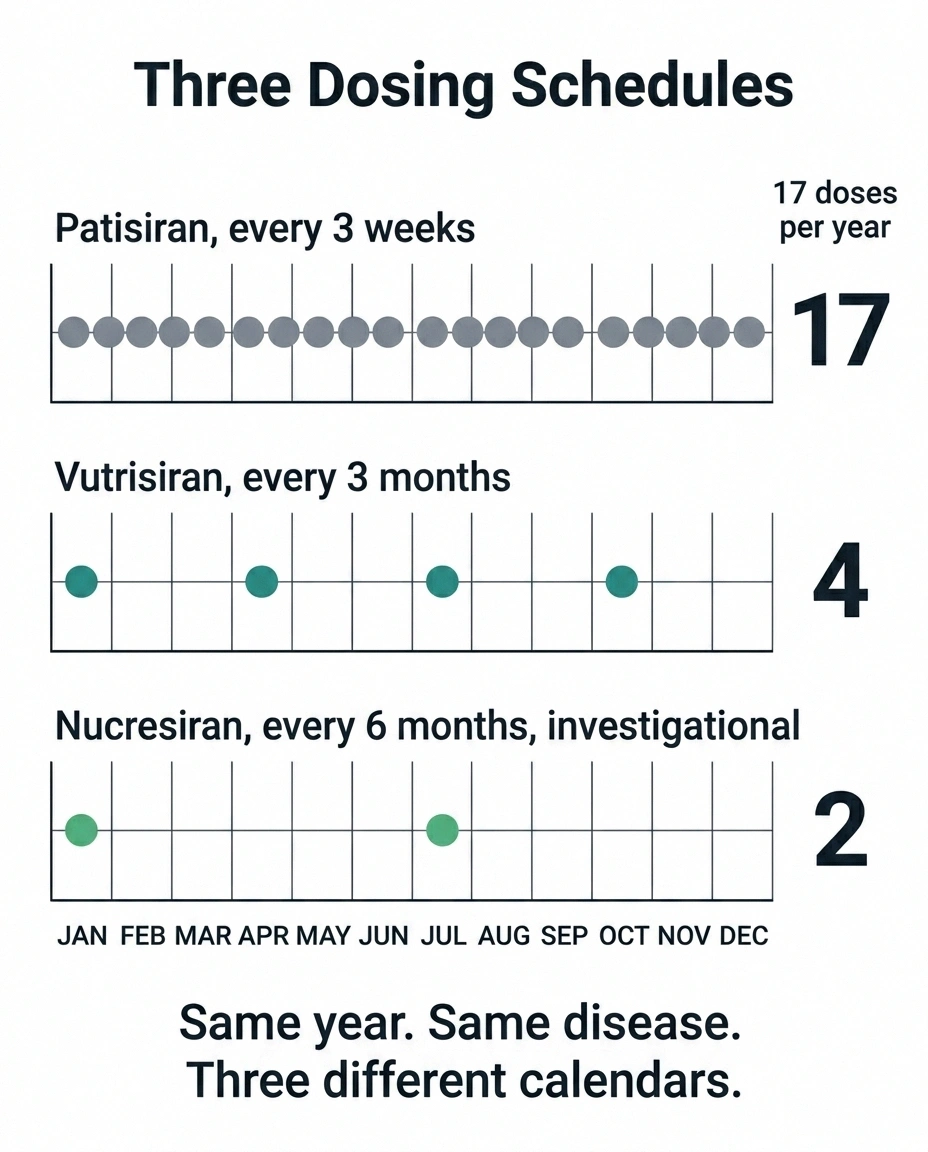
Those are the number of treatments per year for the three generations of transthyretin silencers. Patisiran is an intravenous infusion every three weeks, so roughly seventeen trips to an infusion center annually. Vutrisiran is a subcutaneous injection every three months, so four. Nucresiran, now in Phase 3, is designed for two injections a year.
Press coverage of nucresiran leads with a different number, the depth of protein knockdown, because that is the number that sounds impressive. The dosing interval is the one that changes a life. For a disease treated indefinitely, in people whose feet already make travel difficult, going from four appointments to two is not a convenience feature.
Here is what nucresiran is, what its trials are actually testing, and the specific reason more knockdown might not translate into better nerves.
What a Silencer Does, and Why It Is Different
Transthyretin, or TTR, is a protein the liver makes. It circulates as a stable group of four linked units. When that group comes apart, the pieces misfold and deposit in tissue as amyloid, which is what produces amyloid neuropathy and the cardiac form of the disease.
Treatments per year, by generation
The axis that changes a calendar, not a press release.
17
Patisiran
IV infusion every 3 weeks
4
Vutrisiran
Injection every 3 months, approved
2
Nucresiran
Injection every 6 months, investigational
Two strategies exist for cutting off the supply of misfolded protein.
Stabilizers hold the four-unit group together so it cannot dissociate. They are oral drugs taken daily, and in the United States they are approved for the heart.
Silencers work further upstream. Instead of protecting the protein, they reduce how much of it the liver produces at all. Nucresiran is an RNAi therapeutic, which means it works by destroying the messenger RNA that instructs liver cells to build transthyretin. Less messenger RNA, less protein made, less material available to misfold. It suppresses both the variant protein produced by an inherited gene change and the normal wild-type protein.
The silencer class is the one that carries polyneuropathy approvals in the United States. If your ATTR shows up primarily in your nerves, this is the family of drugs your neurologist is choosing from.
Nucresiran, developed by Alnylam and previously known by the code ALN-TTRsc04, is built on a newer delivery platform than the one that produced vutrisiran. The chemistry is designed for deeper and more durable suppression from a single dose.
The Phase 1 Numbers
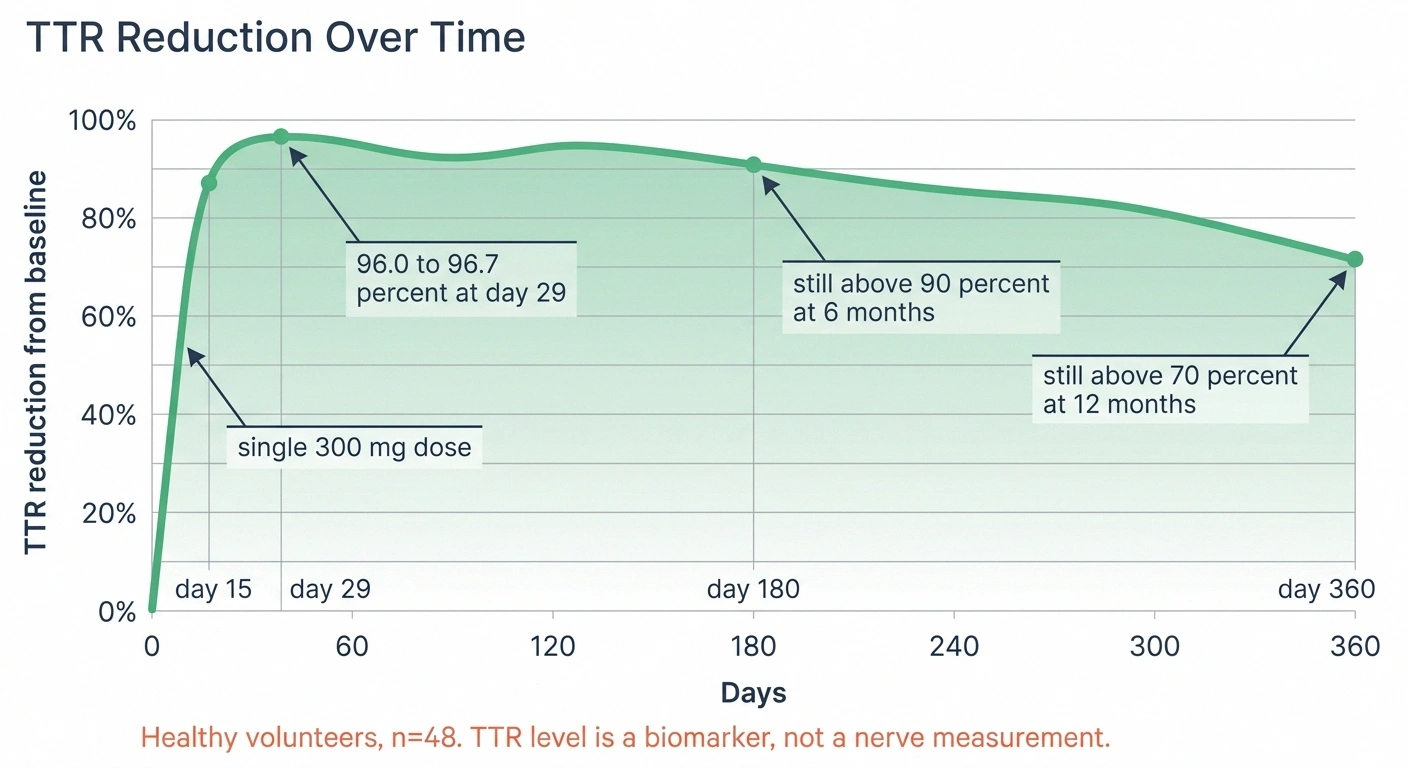
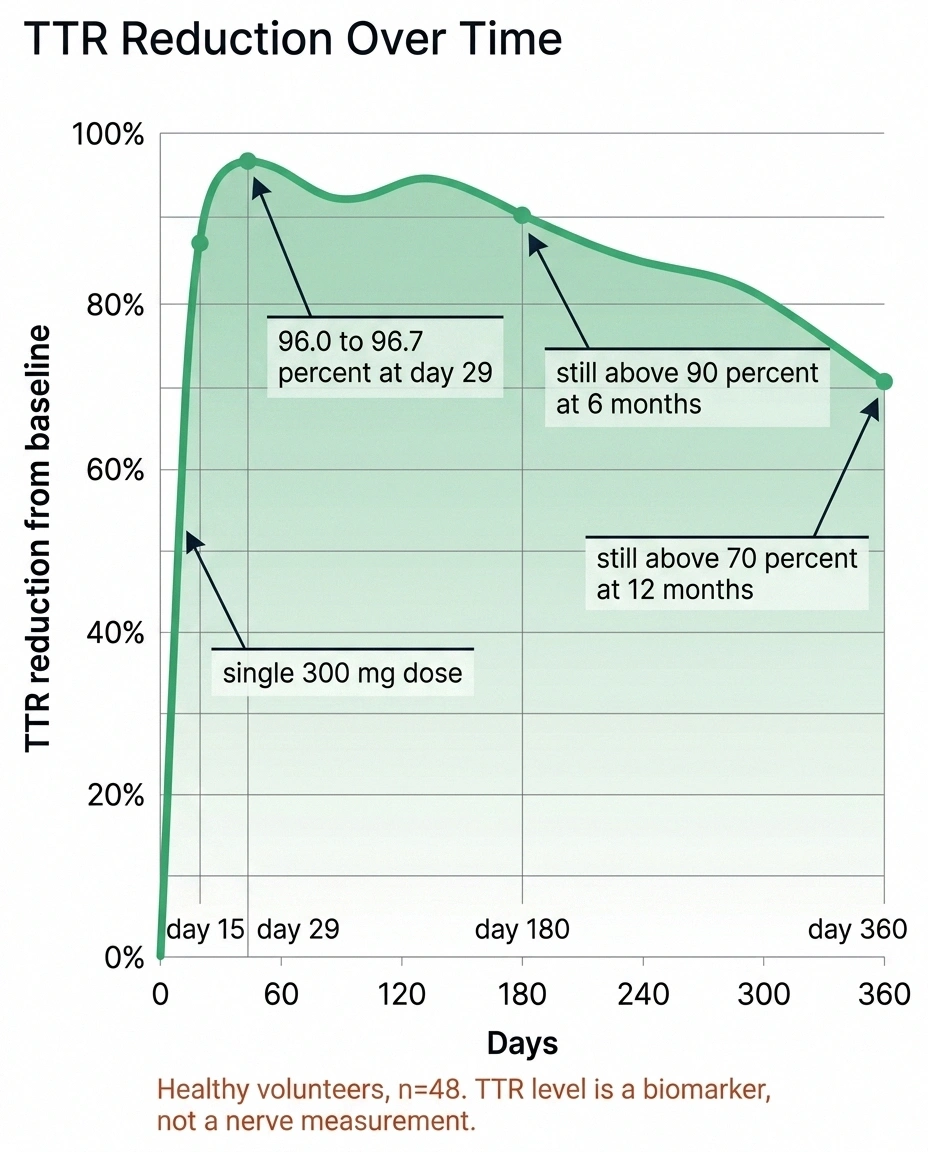
The first human study enrolled 48 healthy adults, randomized three to one, each receiving a single dose of 5, 25, 100, 300, 600, or 900 milligrams, or placebo.
A single dose of 300 milligrams or higher knocked TTR down by more than 90 percent starting at day 15, and held it there for at least six months. At day 29, mean reduction was 96.0 to 96.7 percent in the 300 milligram group, 96.6 to 98.6 percent at 600 milligrams, and 96.0 to 97.3 percent at 900 milligrams.
The result that got the most attention was at twelve months. A full year after one 300 milligram injection, mean TTR reduction was still above 70 percent.
Safety was clean. The drug was well tolerated at every dose, most adverse events were mild, none were judged treatment-related, there were no injection site reactions, and no liver signals appeared.
Now the caveats, which matter as much as the numbers.
These were healthy volunteers. Nobody in the study had amyloidosis. Their nerves were fine before the injection and fine after it, which means the study could not have detected a nerve benefit even if one existed.
And TTR level is a biomarker. It is a measurement of a protein in blood, and it is a reasonable stand-in for how much raw material is available to form amyloid. It is not a measurement of sensation, strength, balance, or the ability to walk to the mailbox. A drug can move a biomarker beautifully and change very little about how a person functions. That gap is where most of the disappointments in this field have lived.
TRITON-PN: The Trial That Matters for Nerves
Two Phase 3 trials make up the TRITON program. Only one of them is about nerves.
TRITON-PN, NCT07223203, started 16 January 2026
Group I, treatment period
Nucresiran 300 mg subcutaneously every 6 months
Extension period: continues on nucresiran
Group II, treatment period
Vutrisiran 25 mg subcutaneously every 3 months, an approved drug rather than placebo
Extension period: crosses over to nucresiran every 6 months
Formal superiority is being sought on serum TTR level. Neurologic impairment, quality of life, nutritional status, disability and gait speed are tracked alongside it. That split is the clearest signal of what the sponsor expects to be able to prove within the trial window.
TRITON-PN, registered as NCT07223203, is a global, randomized, open-label Phase 3 study in adults with hereditary ATTR amyloidosis with polyneuropathy. It began on 16 January 2026 and recruited through the year.
The design has two groups. Group I receives nucresiran, 300 milligrams by subcutaneous injection every six months, for the whole trial. Group II receives vutrisiran, 25 milligrams by subcutaneous injection every three months, during the main treatment period, and then switches to nucresiran every six months for the extension.
Read that second group again. The comparison is not against placebo. It is against vutrisiran, an approved drug that works.
The outcomes being tracked are neurologic impairment, quality of life, nutritional status, disability, and gait speed. Separately, the trial is designed to test whether nucresiran is superior to vutrisiran on serum TTR levels.
That last sentence contains a detail worth sitting with. Superiority is being formally sought on the blood biomarker. The nerve measures are being tracked for effect, but they are not where the superiority claim is aimed. That tells you something honest about what the sponsor believes it can prove inside a trial of realistic length: that this drug suppresses the protein harder than the current standard, and that whether harder suppression produces better nerves is a longer question.
The other trial, TRITON-CM, is an event-driven cardiovascular outcomes study in people with the cardiac form. If it succeeds, approval on that side is anticipated around 2030.
Why There Is No Placebo Group
Twenty years ago, a Phase 3 trial in hereditary ATTR polyneuropathy would have compared the new drug against placebo. That is no longer acceptable, and the reason is the strongest evidence in this whole story that the silencer class works.
Hereditary ATTR polyneuropathy is relentlessly progressive. Untreated, it takes people from numb toes to a wheelchair over years. Once approved treatments existed that demonstrably slowed that course, randomizing someone to placebo meant knowingly letting their nerves deteriorate while an effective option sat on the shelf.
So the standard shifted. New drugs now have to beat an active comparator, which is a much harder test. Placebo-controlled results tend to look dramatic because the control group is deteriorating. Active-comparator results tend to look modest, because both groups are being treated and the difference between two effective drugs is naturally small.
When results from TRITON-PN eventually appear and the nerve differences look unimpressive, that is worth remembering. A modest difference against a drug that already works is not the same finding as a modest difference against nothing.
The open-label design is a second thing to note. Everyone knows which drug they are getting, because the two treatments are given on different schedules and blinding would require dummy injections. Open-label trials are more vulnerable to expectation effects on subjective outcomes like quality of life. Objective measures such as nerve conduction and TTR levels are much less affected.
The Ceiling Problem

Here is the part that skeptical readers should hold onto, and it is not in the press releases.
The number that sells the drug is not the number that helps you
Going from roughly 90 percent suppression to roughly 96 percent is a real laboratory difference. Whether it is a real clinical one depends on a threshold nobody has located: the residual TTR level below which amyloid formation effectively stops.
If the threshold sits below what current treatment already achieves: the extra suppression buys little, and the honest benefit of nucresiran is the six-month schedule.
If benefit keeps scaling with suppression: deeper knockdown matters, and it should show up in the nerve measures.
TRITON-PN was not designed to settle this. Expect the answer from long-term registry data years after approval, not from the trial readout.
Vutrisiran already produces deep TTR knockdown. Adding nucresiran on top raises it further, to roughly 96 percent in early studies. On paper that is a clear improvement.
But biology does not have to reward you proportionally. If the amount of TTR left over after vutrisiran is already below whatever threshold matters for amyloid formation, then removing more of it may accomplish very little. You would be measuring an impressive laboratory difference that produces no additional clinical one.
Nobody knows where that threshold is, or whether it exists in the form described here. It is possible that every additional percentage point of suppression buys proportional benefit. It is also possible the curve flattened somewhere below the level vutrisiran already reaches.
TRITON-PN was not designed to answer that question about nerves. It was designed to demonstrate biomarker superiority and track nerve outcomes. Which means the ceiling question may stay open for years after the drug is approved, resolved eventually by long-term registry data rather than by the trial itself.
This is not an argument against nucresiran. It is an argument for reading its eventual results with the right expectation, which is that the dosing interval is the reliable benefit and the depth of suppression is a hypothesis.
What mNIS+7 Actually Measures
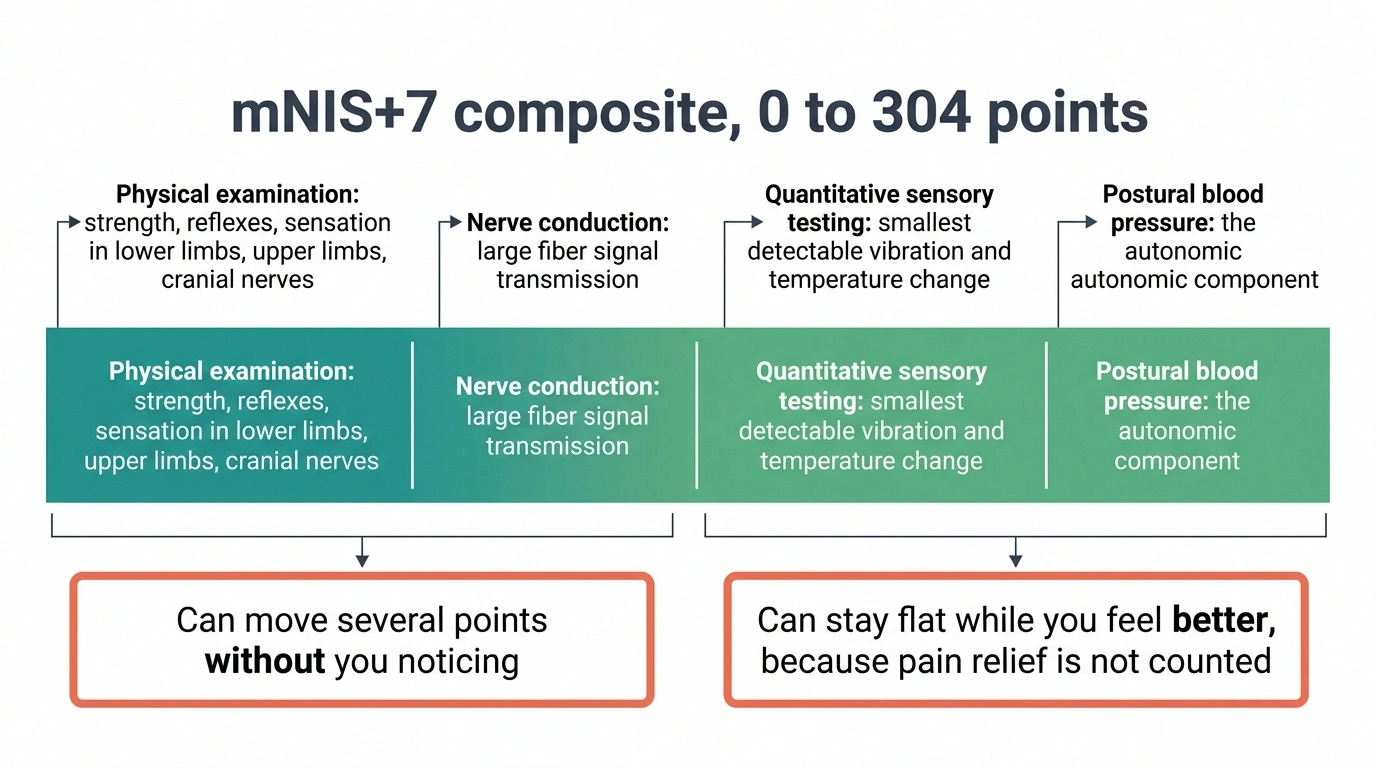
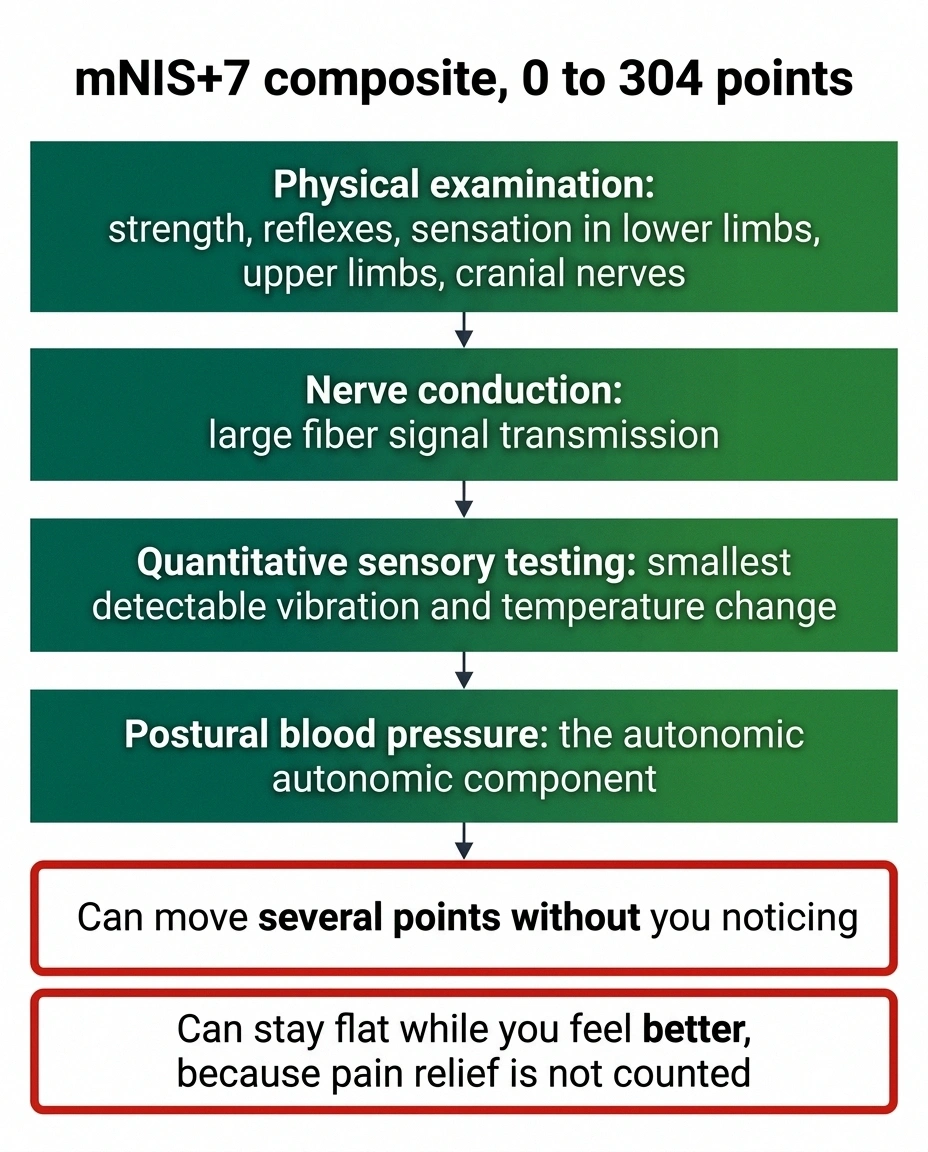
Every drug in this space gets judged against a composite score called mNIS+7, and readers deserve to know what it contains, because it explains why trial results and personal experience can diverge.
Four things inside one number
Scale runs 0, no impairment, to 304, maximum impairment.
- Physical examination
- Strength, reflexes and sensation in lower limbs, upper limbs and cranial nerves
- Nerve conduction
- Electrophysiologic measurement of how well large fibers still transmit signals
- Quantitative sensory testing
- The smallest vibration or temperature change you can reliably detect
- Postural blood pressure
- The autonomic component, since ATTR damages blood pressure regulation alongside sensation
Built to detect progression reliably across many patients. It can shift several points without you noticing, and it can sit flat while you feel better, because relief of pain is not part of what it counts.
The score runs from 0, meaning no impairment, to 304, meaning maximum impairment. It combines four kinds of measurement.
There is a physical examination of the lower limbs, upper limbs, and cranial nerves, testing strength, reflexes and sensation. There are electrophysiologic measurements, essentially nerve conduction studies, capturing how well large nerve fibers transmit signals. There is quantitative sensory testing, measuring the smallest vibration or temperature change a person can detect. And there is postural blood pressure, which brings in the autonomic nervous system, because ATTR damages the nerves that regulate blood pressure alongside the ones that carry sensation.
A 304-point scale can move by several points without a person noticing anything. It can also stay flat while someone feels considerably better, if what improved was pain rather than measurable impairment. The score was built to detect disease progression reliably across many patients, not to reflect a single person’s day.
Who Is Eligible, and Who Is Not

TRITON-PN enrolls hereditary ATTR amyloidosis with polyneuropathy. Both halves of that phrase are exclusions.
Hereditary means a confirmed disease-causing variant in the TTR gene, established by genetic testing. Wild-type ATTR, the far more common late-onset form driven by normal protein misfolding with age, is not in this trial. Wild-type is largely cardiac, and it is TRITON-CM that addresses it.
Polyneuropathy means documented nerve involvement, not just a positive genetic test. Someone who carries a variant and has no symptoms is not eligible for this study, though prevention trials in asymptomatic carriers exist separately.
Trials also set boundaries on disease stage. People too early may not show measurable progression within the study window, and people too advanced may have accumulated damage that no drug can address, since amyloidosis destroys nerve fibers rather than simply irritating them. Understanding how neuropathy stages progress makes those windows easier to interpret.
If you have hereditary ATTR with nerve symptoms and want to be considered, the practical route is an amyloidosis center rather than a general neurology practice. Our guide to finding and joining neuropathy clinical trials covers how that conversation usually goes.
If You Are on Vutrisiran Now

The most common question about a next-generation drug is whether the current one has been superseded. It has not.
Vutrisiran is approved and available. Nucresiran is investigational, meaning it is not available outside a trial and its Phase 3 results are years from reporting. Switching is not an option that exists, apart from enrolling in TRITON-PN, where half of participants receive vutrisiran anyway.
There is also a scenario worth naming. If nucresiran turns out to match vutrisiran on nerve outcomes while requiring half as many injections, that would be a real gain in a specific and limited sense. Fewer injections, fewer appointments, less scheduling around a chronic illness. It would not mean better nerve protection, and it should not be sold as such.
Meanwhile, the gene editing approach represented by nexiguran ziclumeran is pursuing an entirely different endpoint: switching off TTR production permanently with a single treatment. Silencers suppress on a schedule. Gene editing aims to remove the schedule.
The Realistic Timeline
TRITON-PN started in January 2026. Phase 3 trials in slowly progressive nerve disease need years of follow-up, because the outcome being measured is the rate of decline rather than an immediate change.
Approval on the cardiac side is anticipated around 2030 if TRITON-CM succeeds. The polyneuropathy program is described as the faster route, since the endpoints read out sooner than cardiovascular events do, but faster still means years.
Between now and then, expect interim announcements about biomarker results, enrollment milestones, and conference presentations. Those are legitimate news and they are not efficacy results. The question that matters, whether people on nucresiran do better than people on vutrisiran, will be answered once, at the end.
If you are preparing to ask a specialist about any of this, our guide to getting the most out of a neurology appointment covers how to structure questions so you get specific answers rather than general reassurance.
Frequently Asked Questions
What is nucresiran?
Nucresiran, previously coded ALN-TTRsc04, is an investigational RNAi therapeutic from Alnylam that reduces production of transthyretin in the liver. It suppresses both variant and normal wild-type protein and is given as a subcutaneous injection of 300 milligrams every six months in Phase 3 trials.
How is nucresiran different from vutrisiran?
Both are RNAi silencers that reduce TTR production, but nucresiran is built on a newer delivery platform designed for deeper and longer-lasting suppression from a single dose. The practical difference is the schedule: vutrisiran is given every three months, nucresiran every six. In early studies nucresiran also produced greater knockdown, roughly 96 percent at day 29 after a 300 milligram dose.
Is nucresiran approved?
No. It is investigational and is not available outside a clinical trial. Phase 3 studies in both the polyneuropathy and cardiomyopathy forms of ATTR began in 2026. Approval on the cardiac side is anticipated around 2030 if that trial succeeds.
What is TRITON-PN, and who can join?
TRITON-PN, registered as NCT07223203, is a global randomized open-label Phase 3 study in adults with hereditary ATTR amyloidosis with polyneuropathy. It compares nucresiran every six months against vutrisiran every three months, with all participants moving to nucresiran in the extension period. Eligibility requires a confirmed disease-causing TTR gene variant and documented nerve involvement. Wild-type ATTR and asymptomatic carriers are not included.
Why is the comparison against vutrisiran instead of placebo?
Because effective treatments already exist for hereditary ATTR polyneuropathy, and the disease progresses relentlessly without treatment. Assigning someone to placebo would mean allowing preventable nerve damage. Active-comparator trials are harder to win, and their results look more modest, because both groups are receiving effective treatment.
Does deeper TTR knockdown mean better nerve function?
Not necessarily. If the residual TTR left after current treatment is already below whatever level drives amyloid formation, removing more may add little clinical benefit. That threshold is not known. TRITON-PN is designed to demonstrate superiority on the blood biomarker while tracking nerve outcomes, so the relationship between deeper suppression and better nerves may not be settled by this trial.
Does nucresiran work for wild-type ATTR?
The drug reduces both variant and wild-type transthyretin, so the mechanism applies. But the polyneuropathy trial, TRITON-PN, enrolls only hereditary disease. Wild-type ATTR is addressed by TRITON-CM, the cardiovascular outcomes trial.
What is mNIS+7?
It is the composite neurologic impairment score used to judge drugs in hereditary ATTR polyneuropathy, running from 0 for no impairment to 304 for maximum impairment. It combines physical examination of the limbs and cranial nerves, nerve conduction measurements of large fiber function, quantitative sensory testing, and postural blood pressure as an autonomic measure. It was built to detect progression across groups of patients, which is why it can move without an individual noticing, or stay flat while someone feels better.
About the Author