When I was first diagnosed with neuropathy, I thought my active days were over. The numbness in my feet made every step feel uncertain, and the burning pain in my legs made me want to stay on the couch. But one of the most important things I’ve learned over the years is this: movement isn’t the enemy of neuropathy — it’s one of the most powerful tools you have against it.
Research suggests that regular exercise may help reduce neuropathy pain, improve balance, slow nerve damage progression, and even support nerve regeneration. A 2021 systematic review and expert consensus published in Frontiers in Medicine concluded that exercise is an effective complementary therapy for most patients with neuropathic pain — spanning diabetic neuropathy, chemotherapy-induced neuropathy, and more.
But not all exercises are created equal when you’re dealing with nerve damage. Some can make symptoms worse. Others can genuinely transform how you feel day to day. This guide covers the best evidence-backed exercises for neuropathy, how to do them safely, and how to build a routine that works for your body — whether you’re just starting out or looking to expand what you’re already doing.
Why Exercise Matters When You Have Neuropathy
It might seem counterintuitive to exercise when your nerves are damaged. But the evidence is encouraging — and the benefits go far beyond just “staying active.”
Regular physical activity may send more blood to your peripheral nerves, and with it the oxygen and nutrients that damaged nerves desperately need. A 2012 review in Oncology Nursing Forum proposed that exercise stimulates vascular endothelial growth factor (VEGF) expression, increasing blood flow to nerves and improving mitochondrial energy production — the cellular process that keeps nerves functioning. The authors said the idea rests on a limited number of human and animal studies and still needs testing.
Beyond circulation, exercise offers these documented benefits for people with neuropathy:
- Pain reduction — aerobic exercise is thought to trigger endorphin release, your body’s natural pain-relieving chemicals
- Better blood sugar control — critical for diabetic neuropathy, since over time high blood sugar can damage nerves
- Improved balance and fall prevention — balance training has been shown to improve balance and reduce fear of falling in people with diabetic neuropathy
- Reduced muscle wasting — nerve damage leads to muscle atrophy if muscles aren’t regularly challenged
- Better sleep — regular activity helps regulate sleep patterns, which are often disrupted by neuropathy pain at night
- Improved mood — exercise reduces the anxiety and depression that frequently accompany chronic neuropathy
The Foundation for Peripheral Neuropathy says four kinds of activity — aerobic, flexibility, strength training, and balance — belong in a complete routine.
Aerobic Exercises: Building Your Cardiovascular Foundation
Aerobic exercise — anything that gets your heart rate up and keeps it there — is the foundation of a neuropathy exercise program. The goal is about 30 minutes of moderate aerobic activity on most days of the week. If that sounds like a lot, remember: you can start with just 10 minutes and build up gradually.
Best Aerobic Exercises for Neuropathy — Compared
Impact: Low
Equipment: Good shoes
Best for: Beginners, daily routine
Impact: Zero
Equipment: Pool access
Best for: Severe foot symptoms
Impact: Very low
Equipment: Bike/stationary
Best for: Leg strength + cardio
Impact: Very low
Equipment: Gym access
Best for: Full body, stable feet
Walking
Walking is the single most accessible exercise for neuropathy. You don’t need equipment, a gym membership, or special skills. Start on flat, even surfaces and wear proper supportive shoes. If numbness in your feet makes you unsteady, use walking poles or a cane for extra stability.
A small 2012 study found that people with diabetic neuropathy who did supervised aerobic and strength training rated their worst pain lower afterward, though their nerve conduction velocity didn’t change. Start with 10-15 minute walks and work your way up to 30 minutes.
Swimming and Water Aerobics
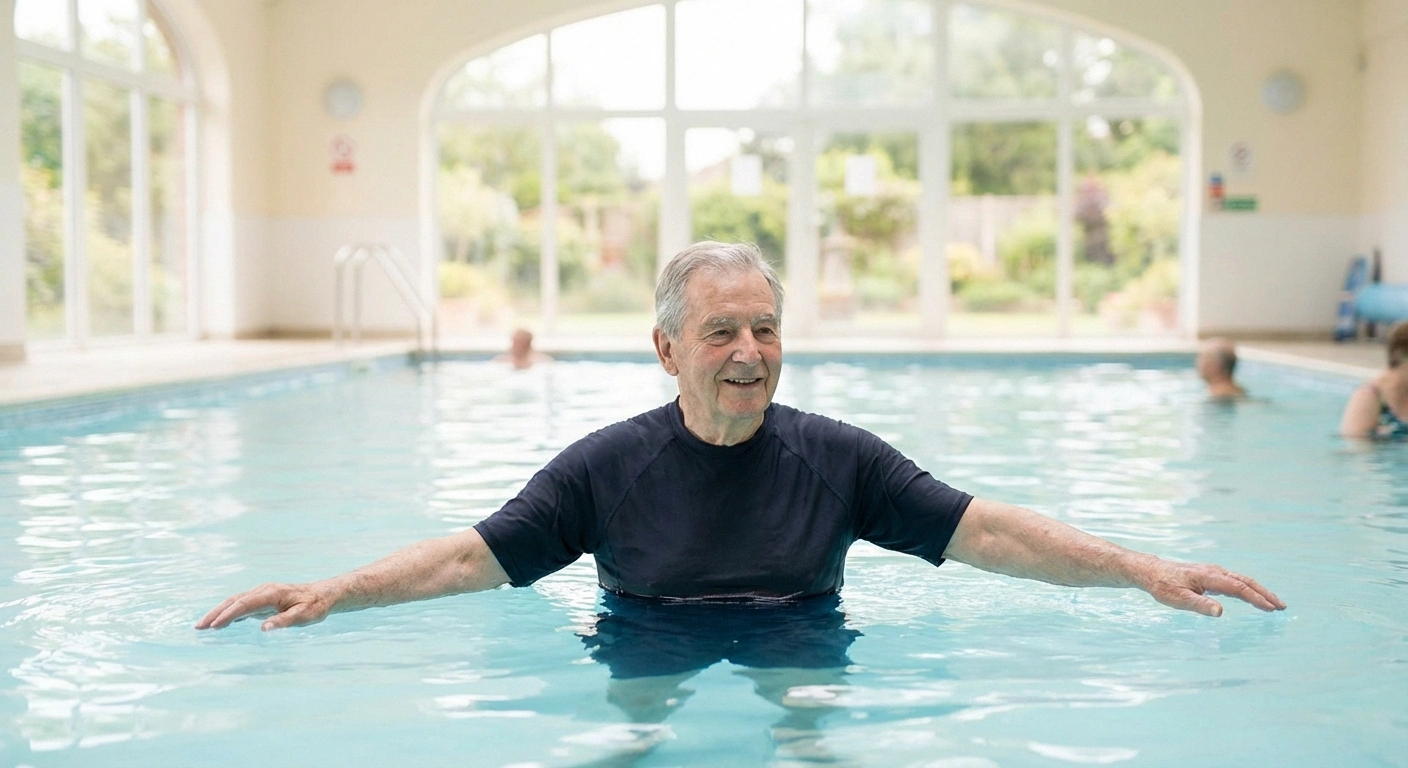
Swimming is arguably the ideal exercise for neuropathy. Water supports your body weight, eliminating impact on sensitive feet while providing resistance that builds muscle. The hydrostatic pressure of water also improves circulation. Water temperature matters — warm pools (83-88°F) are usually comfortable for exercising, while very cold water can worsen symptoms.
Cycling and Stationary Biking
Cycling is low-impact and excellent for building leg strength while improving cardiovascular fitness. A stationary bike is particularly good because it removes balance concerns entirely — you can pedal at your own pace without worrying about uneven terrain. Recumbent bikes offer additional back support and a more stable seated position.
Elliptical Training
Elliptical machines provide a smooth, gliding motion that’s easier on your feet than walking on hard surfaces. Because your feet stay on the pedals throughout the movement, there’s no repetitive impact. Many gyms have ellipticals with handles for upper body engagement and added stability.
Balance Training: Your Fall Prevention Foundation
Neuropathy directly impairs your proprioception — your body’s ability to sense where it is in space. When your feet can’t feel the floor properly, your brain receives incomplete information about your balance. That’s why falls are one of the most dangerous complications of peripheral neuropathy, especially for older adults.
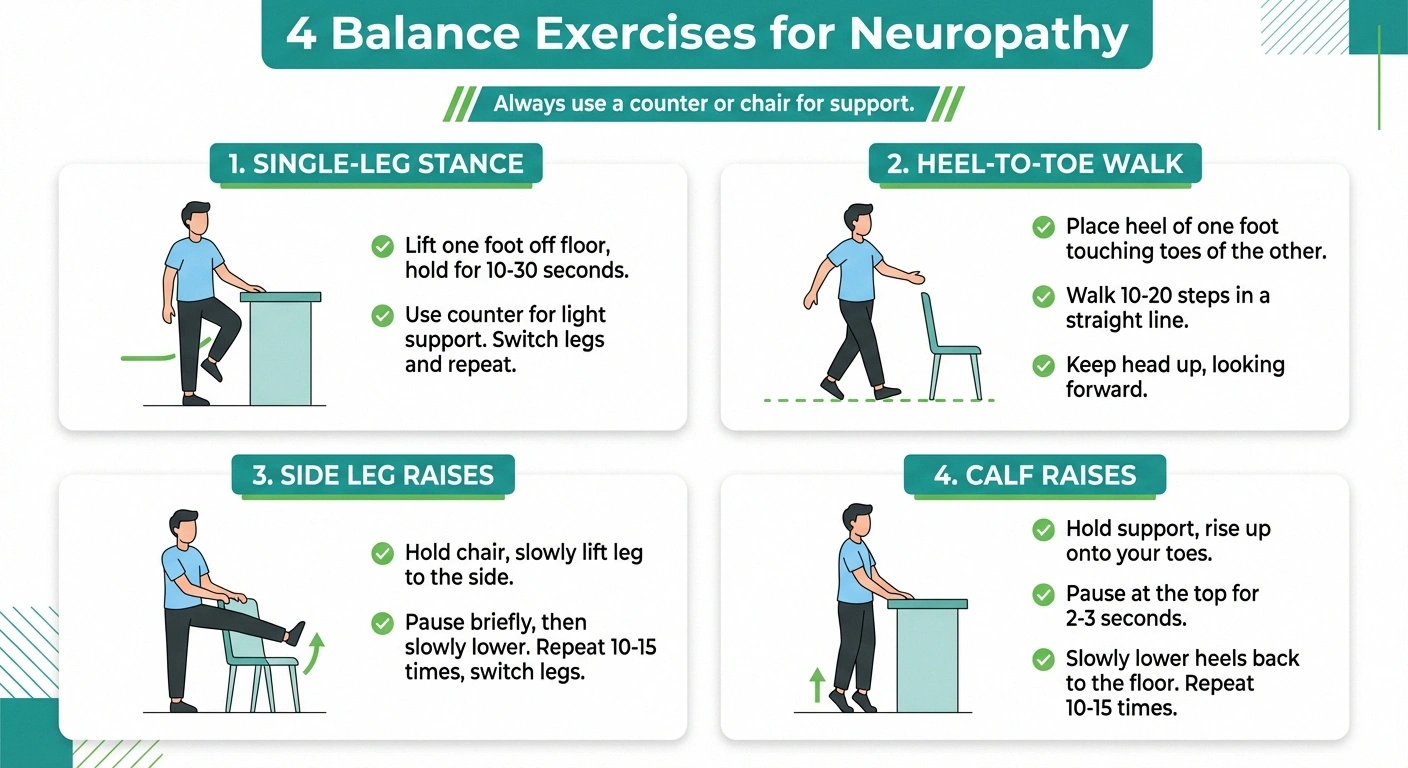
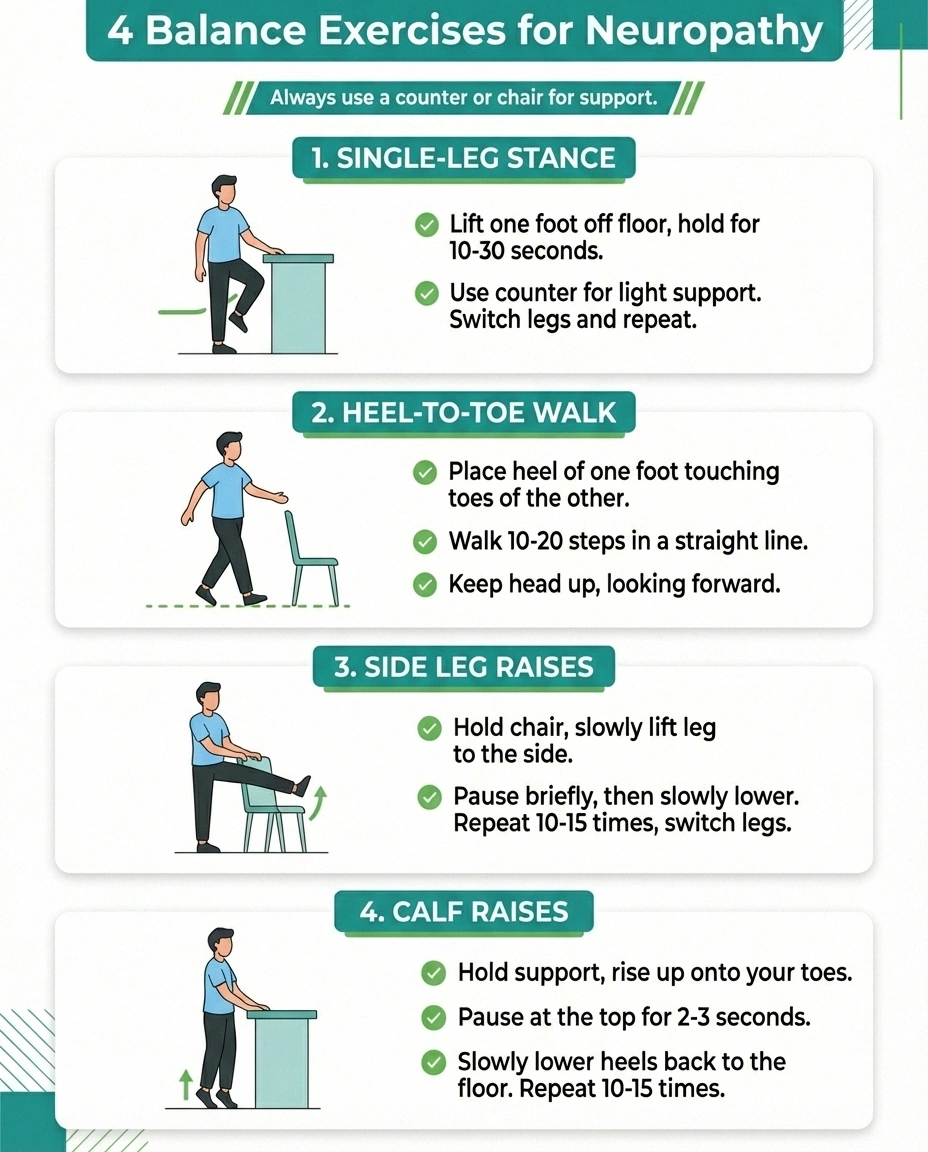
Balance training teaches your body to compensate using other sensory systems — primarily vision and the vestibular system in your inner ear. With consistent practice, these exercises can meaningfully improve your balance.
Single-Leg Stance
Stand near a counter or sturdy chair. Lift one foot slightly off the ground and hold for 10-30 seconds. Switch feet. As you improve, try closing your eyes (with the counter nearby for safety) to challenge your balance further. Work up to 3 sets on each leg.
Heel-to-Toe Walk
Walk in a straight line, placing your heel directly in front of the toes of your other foot with each step. This mimics a sobriety test — and for good reason. It forces your balance system to make constant micro-adjustments. Start alongside a wall or counter for support.
Side Leg Raises
Hold onto a chair back. Slowly lift one leg out to the side, keeping your back straight and toes pointing forward. Hold for 5-10 seconds, then lower. Repeat 10-15 times on each side. This strengthens your hip abductors — the muscles that prevent sideways falls.
Calf Raises
Stand behind a chair with both hands on the back for support. Rise up onto your toes, hold for 3-5 seconds, then slowly lower your heels. Start with 10 repetitions and build to 3 sets. Calf raises strengthen the muscles that stabilize your ankles — crucial for preventing ankle rolls and stumbles.
Strength Training: Fighting Muscle Wasting
Nerve damage can lead to muscle atrophy — the gradual loss of muscle mass and strength that happens when nerves can’t properly signal your muscles to contract. Strength training directly counteracts this process by challenging your muscles to grow and maintain their function.
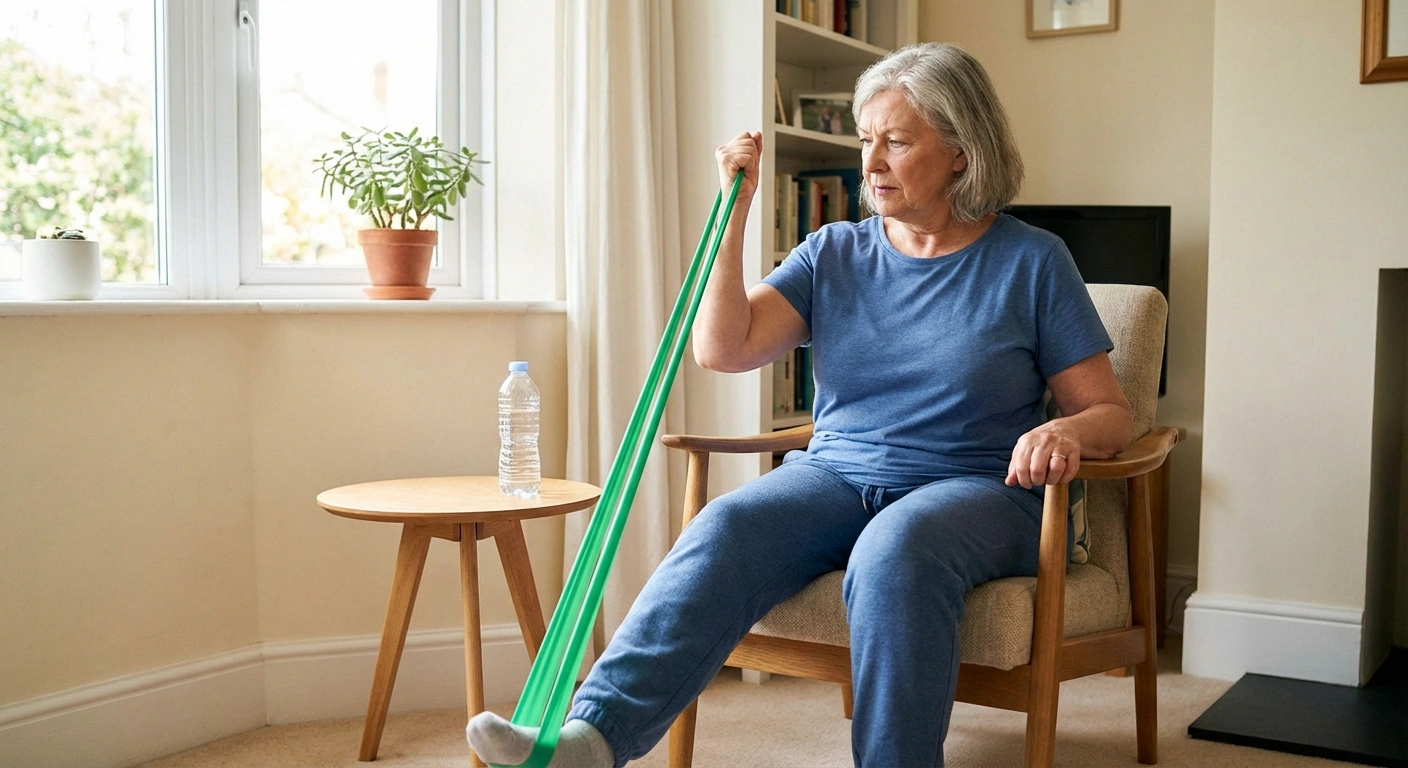
The key is starting light and progressing gradually. A 2010 study by Allet and colleagues found that twice-weekly gait and balance training with functional strengthening for 12 weeks significantly improved balance and walking speed and reduced fear of falling in people with type 2 diabetes and neuropathy — and most of the gains were still there six months after the program ended.
Seated Exercises
If standing exercises feel unsafe, seated strength training is an excellent starting point:
- Seated leg extensions — Sit in a sturdy chair, slowly straighten one knee, hold for 3 seconds, lower. Repeat 10-15 times each leg.
- Seated marching — Lift your knees alternately, as if marching in place while seated. This engages your hip flexors and core.
- Resistance band arm curls — Sit on the middle of a resistance band, curl the handles toward your shoulders. Start with the lightest band available.
Resistance Band Training
Resistance bands are ideal for neuropathy because they provide progressive resistance without heavy weights that could cause injury if dropped. They’re also inexpensive and portable. Use them for:
- Ankle dorsiflexion — Loop a band around your foot, anchor the other end, and flex your toes toward your shin. This strengthens the muscles that help you clear your toes while walking, preventing tripping.
- Hip abduction — Loop a band around both ankles and step sideways. This builds the lateral stability muscles.
- Seated rows — Wrap a band around a door handle or stair post and pull toward your chest. Strengthens your upper back and improves posture.
Light Weight Training
If you have access to dumbbells or a gym, light weight training can be safe and beneficial. Focus on controlled movements rather than heavy loads. Machines like the leg press, seated leg curl, and chest press are safer than free weights because they control the movement path and reduce balance demands. For specific strength training routines adapted for neuropathy, check out our dedicated strength training with neuropathy guide.
Flexibility and Stretching: Keeping Your Body Mobile
Neuropathy can cause muscles to tighten and joints to stiffen, especially if pain has been limiting your movement. Regular stretching maintains flexibility, reduces muscle tension, and may help improve circulation to nerve endings. Stretch gently — never push into sharp pain.
Key Takeaway
Stretching doesn’t just feel good — it maintains the flexibility your joints need to compensate for nerve damage. Rolling a tennis ball under your foot for 2-3 minutes daily is one of the simplest things you can do for neuropathy in your feet.
Calf Stretch
Face a wall with one foot forward and one back. Keep your back heel on the floor and lean forward until you feel a gentle stretch in your back calf. Hold for 15-30 seconds. Repeat 3 times on each side. Tight calves are common with neuropathy and can contribute to foot pain and balance problems.
Seated Hamstring Stretch
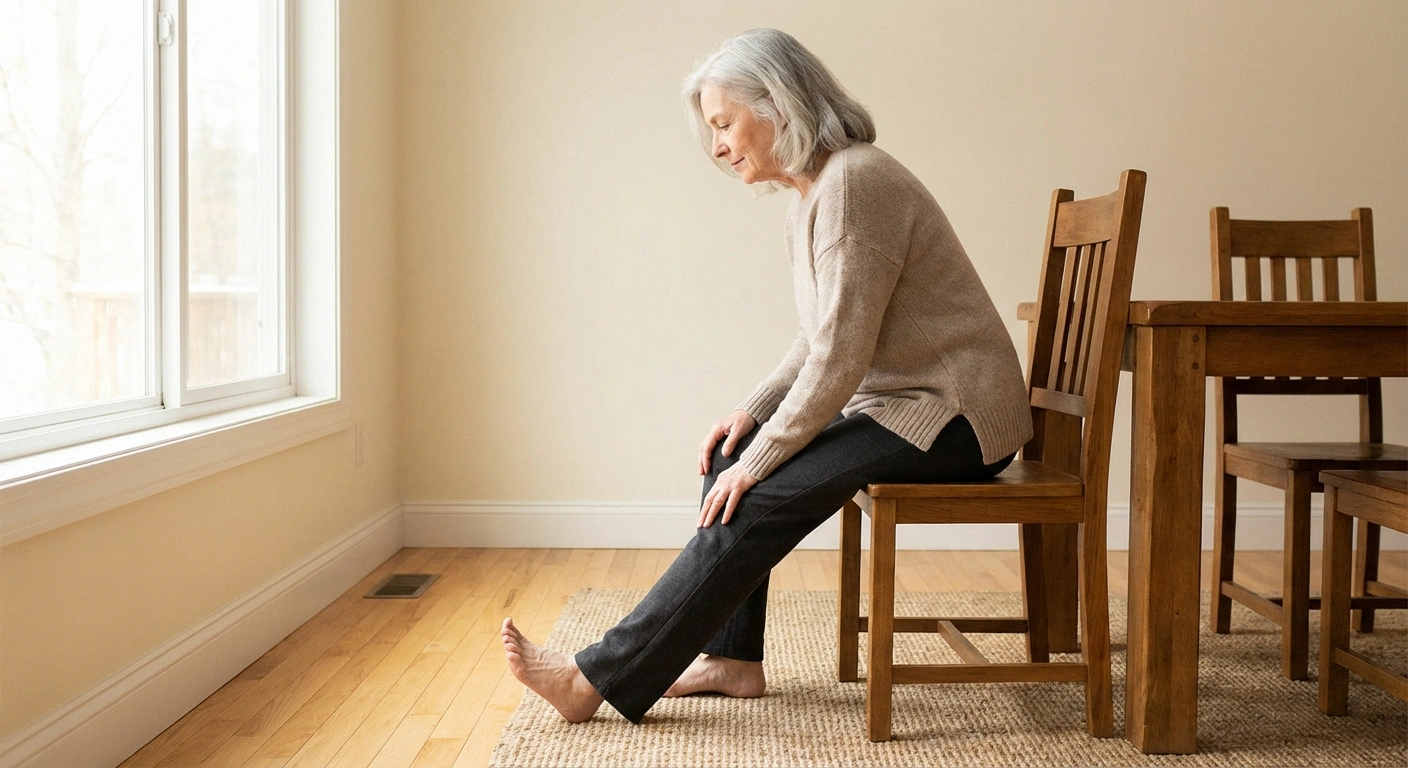
Sit on the edge of a chair with one leg extended straight, heel on the floor, toes pointing up. Keeping your back straight, lean forward gently from the hips until you feel a stretch in the back of your thigh. Hold 15-30 seconds. Repeat 3 times per leg.
Plantar Fascia Roll
Sit in a chair and roll a tennis ball under your foot for 2-3 minutes per foot. This provides a gentle self-massage that stimulates the sensory receptors on the bottom of your foot while releasing tension in the plantar fascia. It’s one of the simplest things you can do daily to maintain foot health.
Mind-Body Exercises: Yoga, Tai Chi, and Beyond
Mind-body practices combine physical movement with breath awareness and mental focus — a combination that’s particularly powerful for neuropathy. These approaches address not just the physical symptoms but also the stress, anxiety, and emotional toll that chronic nerve pain creates.
Yoga for Neuropathy
Yoga improves flexibility, balance, and strength simultaneously while teaching breathing techniques that help manage pain. Small studies suggest that regular yoga practice may improve neuropathy symptoms and quality of life. Chair yoga is an excellent option if standing poses are too challenging — many of the same poses can be adapted to a seated position.

Tai Chi
Tai chi involves slow, flowing movements that shift your weight from one foot to the other — making it essentially a moving balance exercise. Studies show it may improve balance and walking in older adults with peripheral neuropathy. The gentle pace makes it accessible even for people with significant mobility limitations.
Exercises to Avoid or Modify
Not every exercise is safe when you have neuropathy. The two biggest risks are foot injuries you can’t feel and falls from impaired balance. Here’s what to avoid or approach with caution:
Important Safety Note
If you have diabetic neuropathy with reduced foot sensation, the American Diabetes Association’s current guidance says: “Moderate-intensity walking may not lead to an increased risk of foot ulcers or reulceration in those with peripheral neuropathy who use proper footwear.” It adds that “anyone with a foot injury or open sore should be restricted to non–weight-bearing activities.” Always check your feet before and after every exercise session for blisters, cuts, or redness.
- High-impact activities — Running, jumping, and plyometrics create repetitive impact forces your numb feet can’t properly absorb. This increases the risk of stress fractures, blisters, and ulcers — especially dangerous for diabetic foot complications.
- Heavy barbell exercises while standing — Barbell squats, deadlifts, and overhead presses require excellent balance and proprioception. If your feet are numb, you can’t feel shifts in your center of gravity. Use machine-based alternatives instead.
- Exercises on unstable surfaces — Bosu balls, wobble boards, and similar balance challenge tools can increase fall risk if your neuropathy is moderate to severe. Only use them under direct supervision from a physical therapist.
- Prolonged standing exercises — Long periods of standing, especially on hard surfaces, can exacerbate foot pain. Alternate between standing and sitting exercises.
- Exercising in extreme temperatures — Very cold environments can worsen neuropathy symptoms, while extreme heat increases fall risk through dizziness and dehydration. Exercise in moderate conditions.
How to Build Your Neuropathy Exercise Routine
A complete neuropathy exercise program includes all four types: aerobic, balance, strength, and flexibility. Here’s a framework to build your weekly routine:
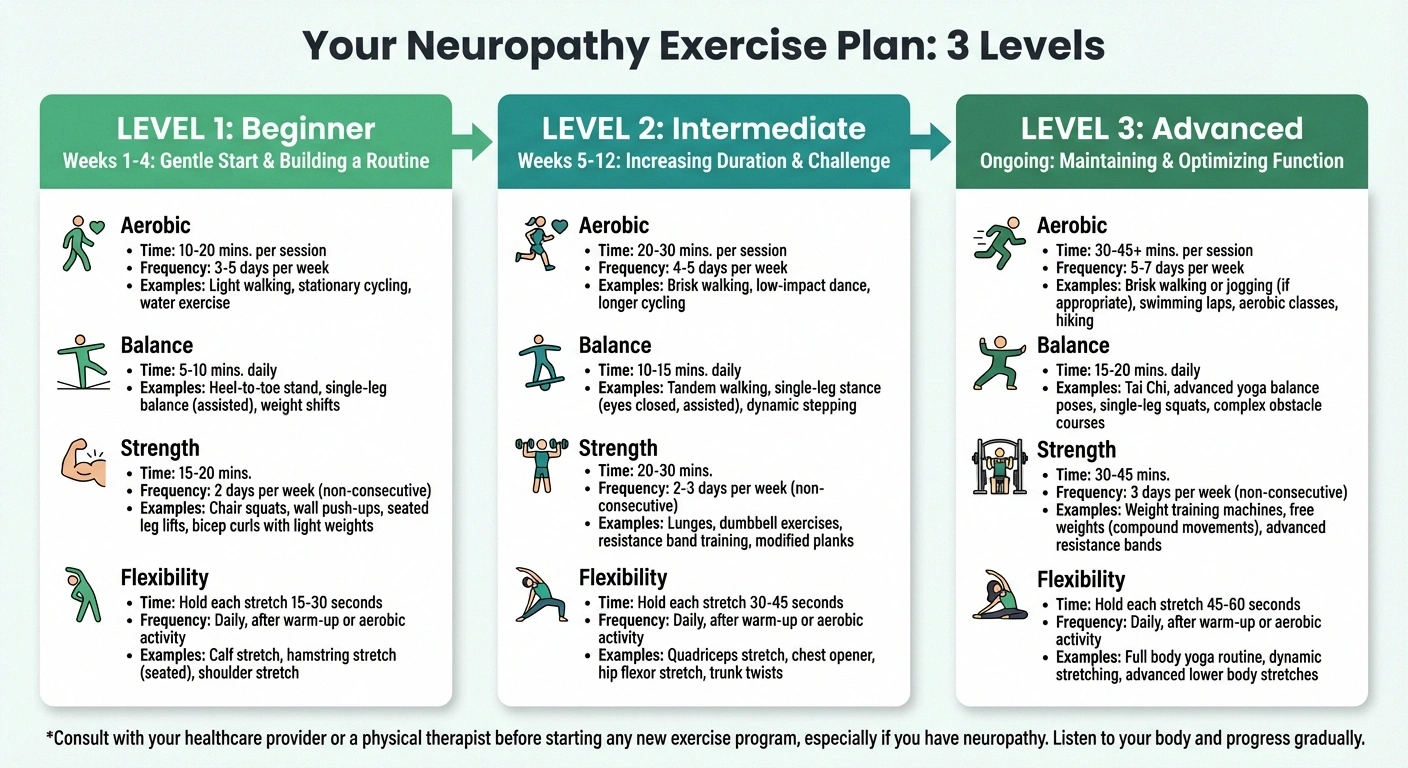

Beginner Level (Weeks 1-4)
- Aerobic: 10-15 minutes of walking or stationary biking, 3 days per week
- Balance: Single-leg stance and heel-to-toe walk, 5 minutes daily
- Strength: Seated exercises with no added weight, 2 days per week
- Flexibility: Calf and hamstring stretches, 5 minutes after every session
Intermediate Level (Weeks 5-12)
- Aerobic: 20-30 minutes of walking, swimming, or cycling, 4-5 days per week
- Balance: Add side leg raises and calf raises, 10 minutes 3 times per week
- Strength: Resistance bands or light weights, 2-3 days per week
- Flexibility: Full stretching routine including plantar fascia roll, 10 minutes daily
Advanced Level (Ongoing)
- Aerobic: 30-45 minutes of varied activities, 5 days per week
- Balance: Single-leg stance with eyes closed, tai chi or yoga class, 3 times per week
- Strength: Progressive resistance training with bands or machines, 2-3 days per week
- Flexibility: Yoga or dedicated stretching session, daily
Safety Tips for Exercising with Neuropathy
Exercise with neuropathy is safe — but it requires some extra precautions that healthy individuals don’t need to think about.
Pre-Exercise Safety Checklist
- Check your feet before and after every exercise session. Look for blisters, redness, cuts, or swelling. If you can’t feel your feet, you may not notice injuries until they become serious. This is especially critical for diabetic foot care.
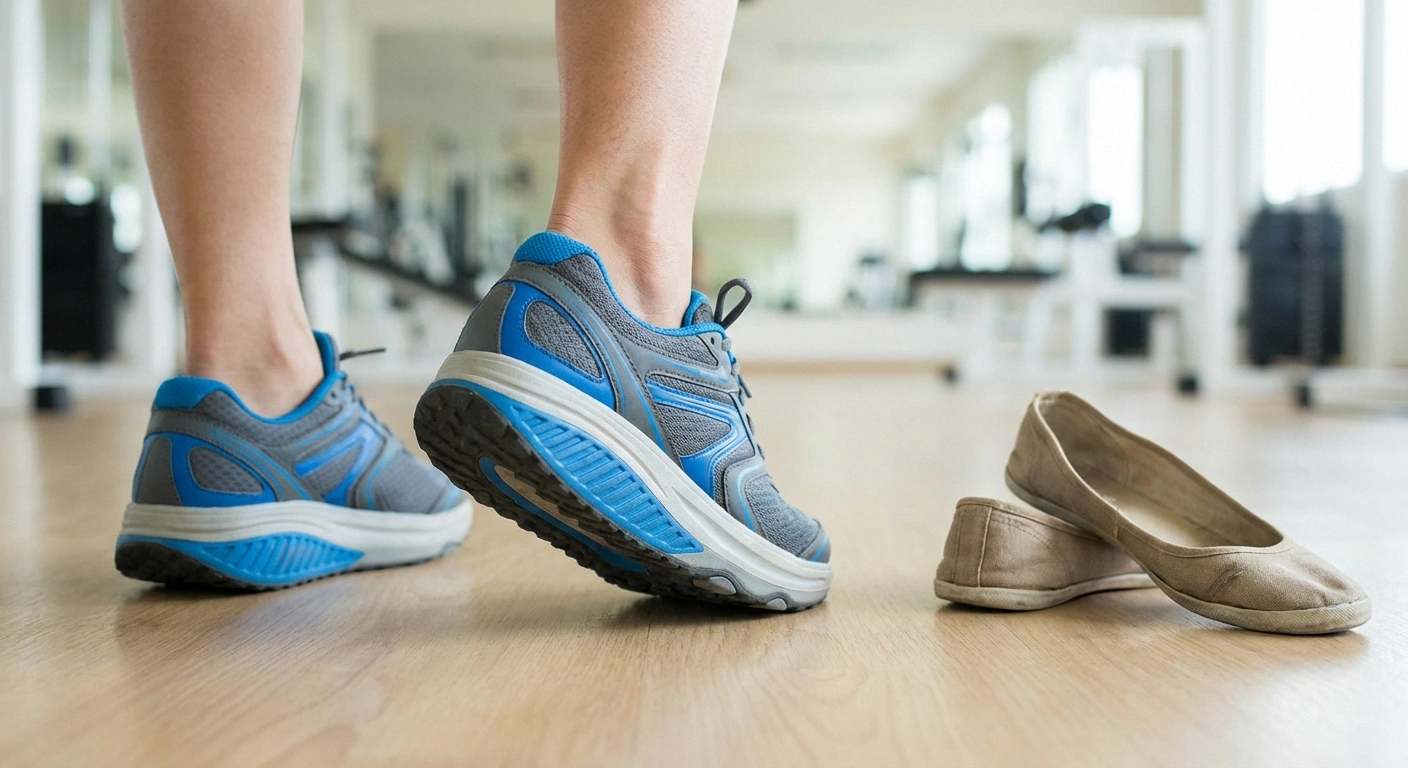
- Wear proper footwear. Supportive, well-fitting shoes with cushioned soles protect your feet during exercise. Never exercise barefoot.
- Start slow and progress gradually. The 10% rule is a common rule of thumb — increase duration, intensity, or frequency by no more than 10% per week.
- Exercise with a buddy or in a supervised setting if your balance is significantly impaired. Many community centers and YMCAs offer group exercise programs for people with chronic conditions.
- Stay hydrated and exercise in a comfortable temperature environment.
- Stop if you experience sharp pain, dizziness, or chest discomfort. Some muscle soreness after exercise is normal. Sharp, shooting nerve pain is not — that’s a signal to back off.
- Talk to your doctor or a physical therapist before starting any new exercise program, especially if you have severe neuropathy, diabetic foot ulcers, or significant balance impairment. A physical therapist can design a program specifically for your needs and limitations.
When Exercise Alone Isn’t Enough
Exercise is a powerful tool, but it works best as part of a comprehensive approach. Pair your exercise routine with:
The Complete Approach
Exercise works best when combined with a nerve-friendly diet, targeted supplements, proper foot care, and stress management. Think of exercise as one pillar of a multi-pillar approach to managing neuropathy — not a standalone solution.
- A nerve-friendly diet rich in B vitamins, antioxidants, and anti-inflammatory foods
- Supplements like alpha-lipoic acid, B vitamins, and acetyl-L-carnitine
- Proper foot care routines to protect vulnerable feet
- Stress management techniques — chronic stress amplifies pain perception
- Regular check-ins with your healthcare team to monitor your neuropathy progression
If you’re unsure where to start, browse our guides on individual exercise types: yoga for neuropathy, swimming and water therapy, exercises for seniors, and strength training with neuropathy.
Frequently Asked Questions
How much exercise should I do with neuropathy?
Aim for at least 150 minutes of moderate aerobic activity per week, spread across 3-5 sessions, plus 2-3 days of balance and strength training. If you’re just starting out, even 10 minutes of walking 3 times a week provides benefits. The most important thing is consistency — regular, moderate exercise does more for neuropathy than occasional intense sessions.

Can exercise make neuropathy worse?
When done safely, exercise does not make neuropathy worse and typically improves symptoms over time. However, high-impact activities, exercising in extreme temperatures, or pushing through sharp nerve pain can potentially cause injury or temporary symptom flare-ups. Stick to low-impact, moderate-intensity activities and progress gradually.
What is the best exercise for neuropathy in feet?
Swimming and stationary cycling are often considered the best options for neuropathy in feet because they provide cardiovascular benefit without putting impact stress on your feet. For foot-specific exercises, calf raises, toe curls, and ankle circles directly strengthen the muscles and improve circulation in your lower extremities. Rolling a tennis ball under your foot also stimulates sensory receptors.
Should I exercise during a neuropathy flare-up?
During a flare-up, scale back rather than stopping completely. Switch from walking to swimming or seated exercises. Gentle stretching and range-of-motion exercises are usually safe even during a flare. Avoid high-intensity or high-impact activities until the flare subsides. Maintaining some movement helps prevent the deconditioning cycle that makes flares worse over time.
Can exercise reverse neuropathy?
Exercise may help slow nerve damage and, in some cases, support nerve regeneration — especially when the underlying cause of neuropathy is addressed simultaneously. For diabetic neuropathy, exercise helps control blood sugar, reducing a major source of nerve damage. However, exercise alone is unlikely to fully reverse established nerve damage. It is most effective as part of a comprehensive treatment approach that addresses the root cause of your neuropathy.
Is walking barefoot good for neuropathy?
Walking barefoot is generally not recommended for people with neuropathy. While some people find that barefoot walking on safe surfaces stimulates remaining nerve endings, the risk of undetected foot injuries is significant — especially if you have reduced sensation. A small cut, blister, or puncture wound that you cannot feel can lead to serious infection. Always wear supportive, well-fitting shoes when exercising.
Start Where You Are
The best exercise for neuropathy is the one you’ll actually do. Don’t let the perfect be the enemy of the good. If all you can manage right now is a 10-minute walk around the block and some seated stretching, that’s a legitimate starting point that your nerves will thank you for. The research is encouraging: people with neuropathy who exercise regularly tend to do better — improved balance and function, and in some studies less pain and a better quality of life — than those who don’t.
Talk to your doctor or a physical therapist about what’s right for your specific situation. Then start moving. Your nerves — and the rest of your body — will benefit.
About the Author