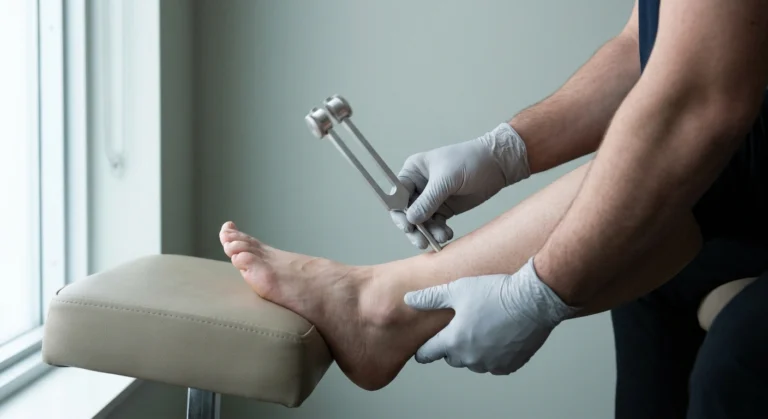
The first time someone in my support group used the word “handicap” in front of me, I flinched. So did she — and then she laughed at herself. “I know,” she said. “I’m not handicapped, I just can’t walk to the back of a parking lot anymore without paying for it for two days. But the form says handicap, so that’s what I’m filling out.” That conversation is what made me realize how much shame people carry around even asking about a parking permit when neuropathy makes walking long distances hard. They feel like frauds. They feel like they’re taking something away from someone who needs it more. They put it off for years.
I’m Janet. I’m a patient advocate, not a doctor, and I want to make this as straightforward as possible. If neuropathy is genuinely limiting how far you can walk safely, you almost certainly qualify for a disability parking placard in your state, and getting one is a short, very ordinary administrative process. Here’s exactly how it works, what the eligibility actually is, and how to have the conversation with your doctor without it being awkward.
You’re Not Taking Something From Someone Else
Let’s get this out of the way first because it’s the thing that holds most people back. Disability parking spots aren’t a fixed lottery. Every state has plenty of placards available, and the spots themselves are sized for everyone who legitimately qualifies. If your neuropathy genuinely meets the criteria, your placard does not come at someone else’s expense. The shame is real, the math isn’t.
Key Takeaway
If neuropathy limits how far you can walk safely, you almost certainly qualify. You don’t need a wheelchair, you don’t need a specialist, and you don’t need to be the “worst case” in the parking lot. The criteria measure your limitation, not the severity of your diagnosis. A 15-minute office visit and a free or low-cost DMV form are all that stand between you and the parking spot you actually need.
The other piece of shame that’s worth unpacking: “I’m not that bad.” I’ve heard this dozens of times. Here’s the truth — disability parking eligibility is not about how bad your neuropathy is on your worst day or your best day. It’s about whether you have a documented condition that limits your ability to walk a certain distance safely. If burning feet, balance issues, foot drop, severe numbness, or autonomic symptoms make a long parking-lot walk unsafe or significantly painful, that is the eligibility criterion in nearly every state. You don’t have to be the worst case in the parking lot. You just have to meet the criteria.
The Two Kinds of Placards (And When You Get Which)
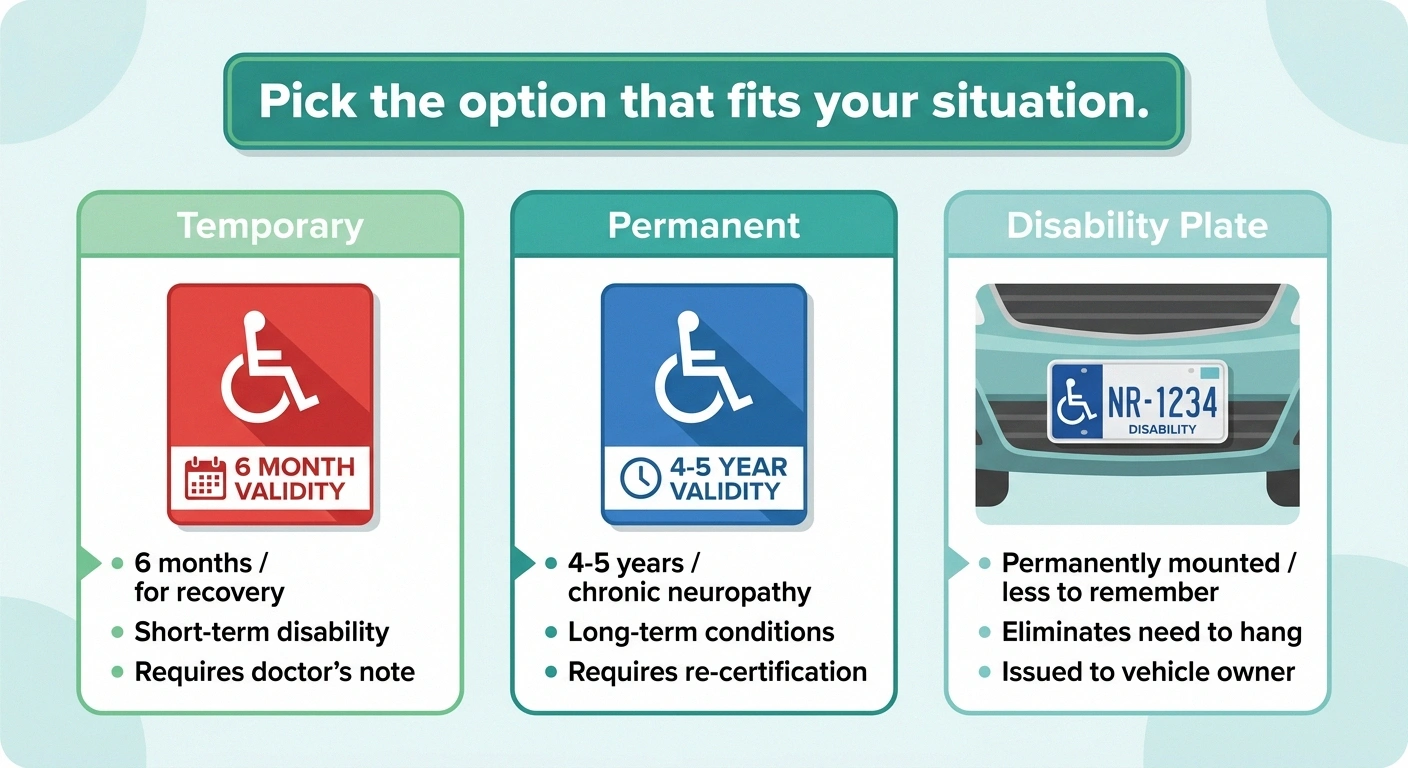
Every state issues two basic versions of a disability parking permit:
Temporary vs. Permanent vs. Plate
Most states allow you to have a placard AND a plate for the same person — placard for the spouse’s car, plate for your own.
Temporary placard. Usually red, valid for 6 months (sometimes up to 12). Issued when your mobility limitation is expected to resolve — after a surgery, an injury, an acute flare, a course of treatment that should restore function. For neuropathy, temporary placards are sometimes issued during active chemotherapy treatment, after a foot surgery, or while you’re recovering from a fall.
Permanent placard. Usually blue, valid for 4 to 5 years depending on your state, renewable on a simple form. Issued when your condition is chronic and not expected to fully resolve. Most chronic peripheral neuropathies — diabetic, idiopathic, chemo-induced once chronic, autoimmune, hereditary — fit here.
You can also get a disability license plate in most states, which works the same way as a placard but is permanently attached to the vehicle. Many people prefer the placard because it transfers between cars (useful if a spouse drives you to appointments). Some prefer the plate because it’s one less thing to remember on the dashboard.
A few states also issue “DV” (disabled veteran) plates with broader parking privileges. If your neuropathy is service-connected through the VA, that’s a separate conversation worth having with your VA representative. We have a broader breakdown of related VA territory at the diabetic neuropathy guide where service-connection comes up.
What the Eligibility Criteria Actually Say
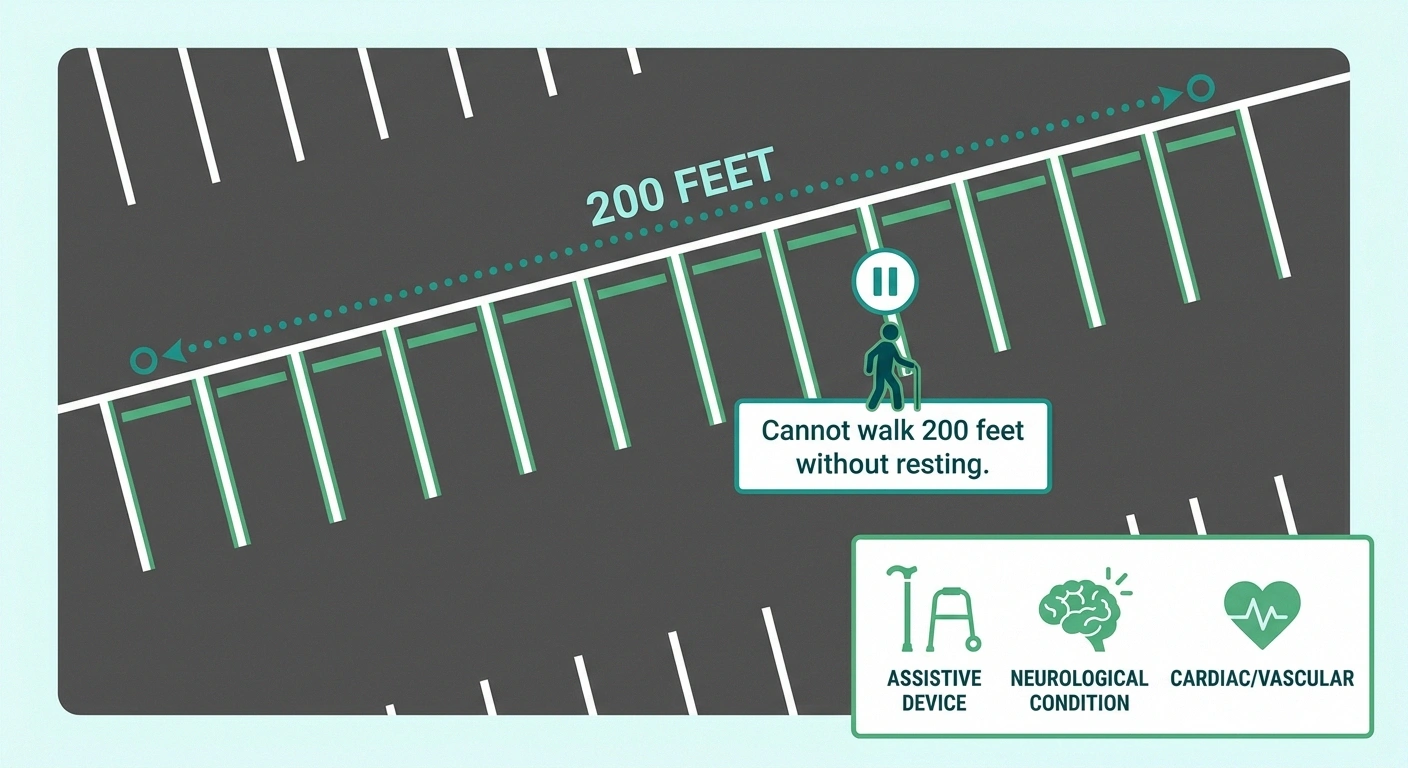
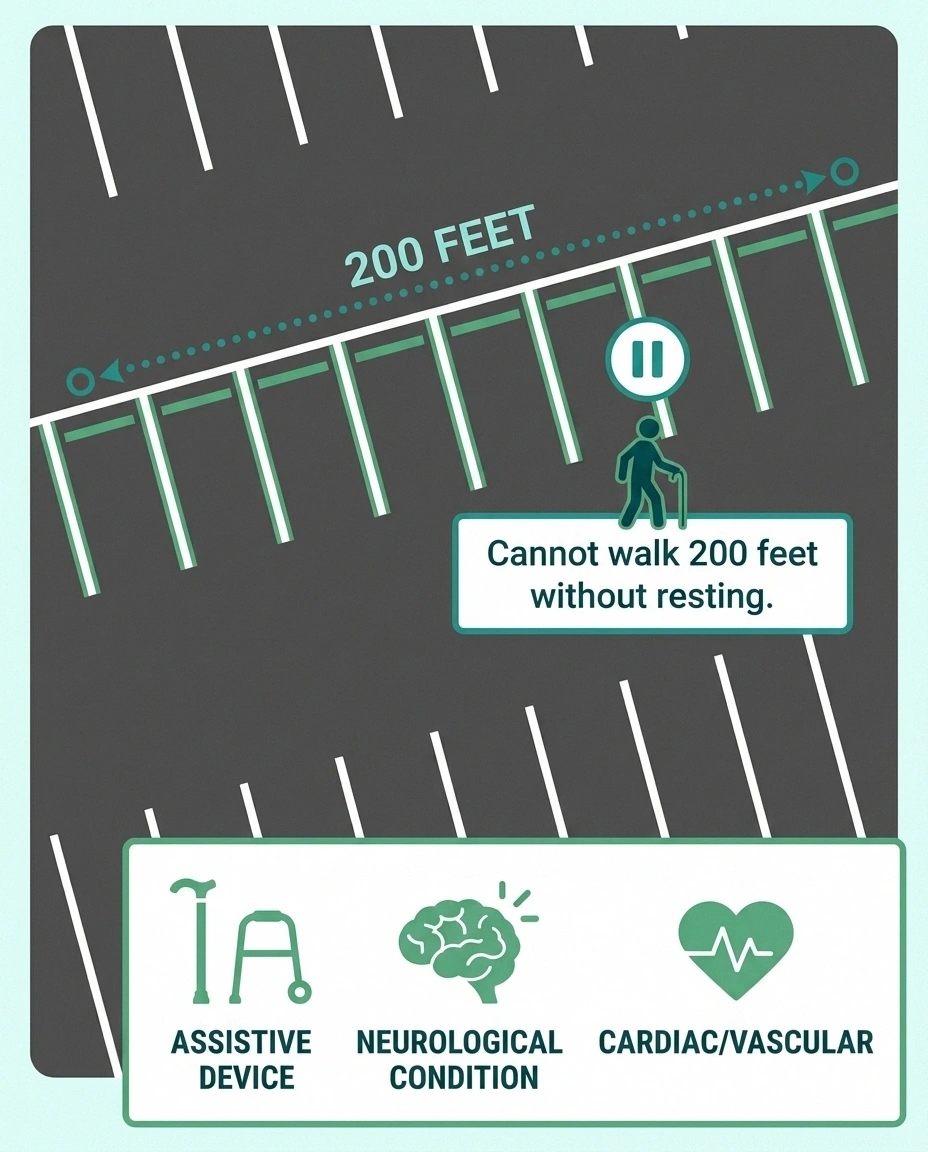
The exact wording varies state-by-state, but the criteria are surprisingly consistent across the country. To qualify for a disability parking permit, a licensed health care provider needs to certify that you meet at least one of these criteria:
You Qualify If Any ONE of These Applies
- Cannot walk 200 feet without stopping to rest — about one parking-lot row. Pain, numbness, balance, or breathlessness that forces a stop counts.
- Need an assistive device — cane, walker, crutch, AFO brace, even sometimes. The “sometimes” matters; you don’t have to use it every day.
- Severely limited by neurological, orthopedic, or arthritic conditions — the catch-all that covers most neuropathy with gait, balance, or pain limitation.
- Severely limited by lung, cardiac, or vascular disease — autonomic neuropathy with significant orthostatic symptoms sometimes qualifies here.
You do not need to use a wheelchair. Most disability placards go to ambulatory people. The criterion is the limitation, not the absence of walking.
- Cannot walk 200 feet without stopping to rest. This is the single most common criterion and the one neuropathy patients most often meet. 200 feet is roughly the length of a parking lot row. If you have to stop, lean on something, or change pace because of pain, numbness, balance, or breathlessness within that distance, you meet this criterion.
- Cannot walk without assistance from another person, a cane, a walker, a crutch, a brace, or other assistive device. If you use any of these even some of the time because of neuropathy — a cane for uneven surfaces, an AFO brace for foot drop, a walker for balance — you meet this criterion.
- Severely limited by lung, cardiac, or vascular disease. Less commonly relevant to peripheral neuropathy specifically, but autonomic neuropathy with significant orthostatic symptoms can sometimes qualify a person here.
- Cannot walk without portable oxygen. Not usually a neuropathy criterion.
- Severely limited by neurological, orthopedic, or arthritic conditions. The catch-all. Peripheral neuropathy with significant balance, gait, or pain limitation generally qualifies here even if you don’t formally measure walking distance.
The big takeaway: you do not have to use a wheelchair or be unable to walk at all. Most people with disability placards are ambulatory. The criteria are about the limitation, not the absence of walking. A few states use the phrase “permanently disabled” in their forms, which scares people off — but in context, “permanently” generally just means “chronic and not expected to fully resolve,” which is the standard for nearly every chronic peripheral neuropathy.
Whose Signature Counts
Every state has a list of providers who can sign your form. The list almost always includes:
Who Can Sign Your Form
- Your medical doctor (MD)
- Your doctor of osteopathy (DO)
- A licensed podiatrist
- A licensed nurse practitioner (NP)
- A licensed physician assistant (PA)
- A licensed chiropractor (in many but not all states)
- An optometrist (only for visual conditions, not neuropathy)
For neuropathy specifically, your primary care provider, your neurologist, or your podiatrist are the three most common signers. Any of them can do it. You do not need a specialist signature — a primary care provider who knows your neuropathy history is fully sufficient.
One specific point worth knowing: your podiatrist can sign the form for neuropathy. A lot of people with diabetic or idiopathic neuropathy see a podiatrist more often than their primary care doctor for foot care and routine monitoring. If you’re more comfortable asking your podiatrist than your primary care doctor, ask your podiatrist. The state agency doesn’t care which one signs as long as the provider is licensed and the signature is real.
How to Ask Your Doctor (Without It Being Awkward)
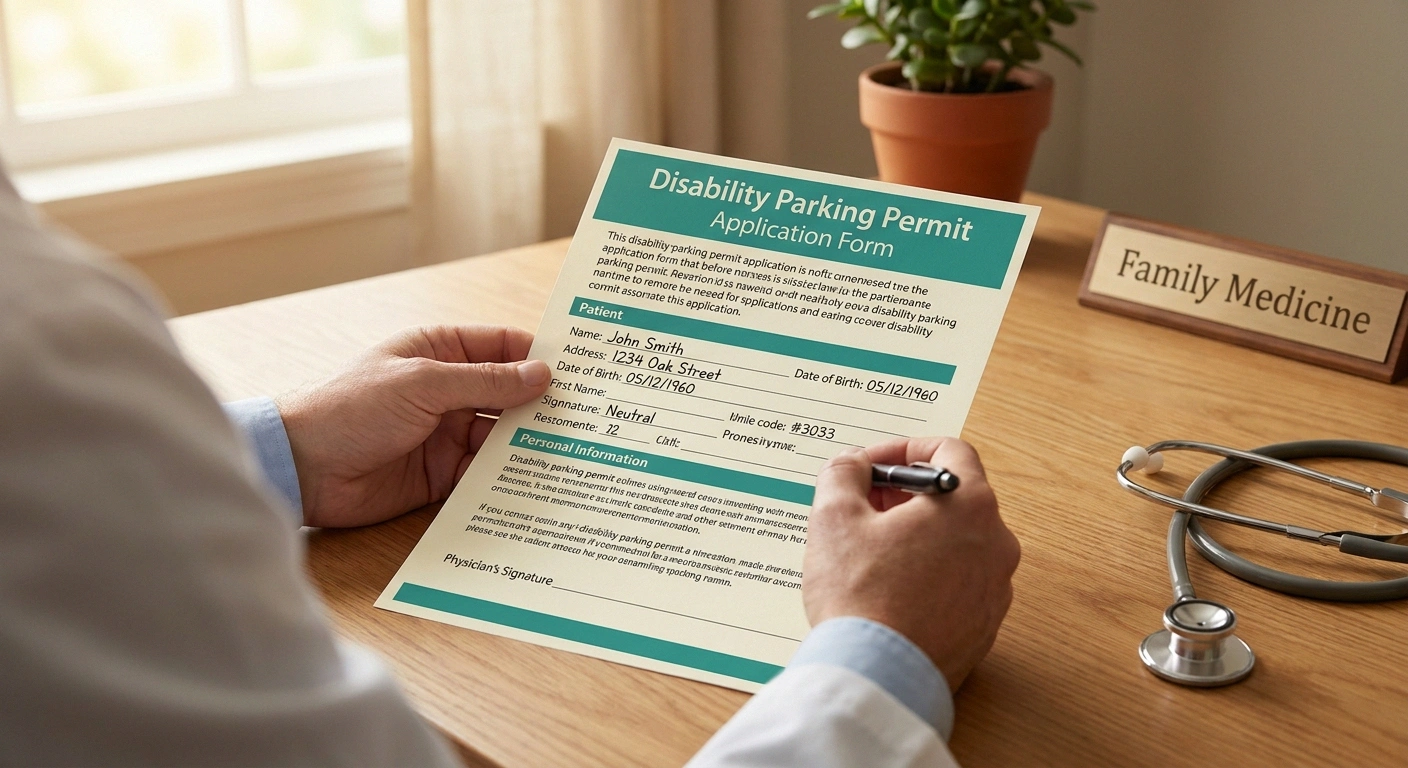
This is the part most people get hung up on, and it’s the part I want to make easy. Here’s the script that almost always works:
The Conversation, Word-for-Word
That’s it. Most providers say yes immediately — they sign these forms two or three times a week. Make it easier for both of you:
- Download and print your state’s form ahead of time.
- Pre-fill your patient section at home — leave only the certification blank.
- Be specific about your limitation (“half a block before my feet burn and I stop”).
- Mention any falls, missed errands, or stopped activities.
“Walking long distances has gotten harder because of my neuropathy. I’d like to apply for a disability parking placard for my state. Would you be willing to sign the form?”
That’s it. That’s the whole conversation. Most providers will say yes immediately — they sign these forms all the time, often two or three a week for various patients. Some will want a brief discussion about what specifically has changed, what symptoms limit you most, or whether you’ve tried any further treatment. That’s a normal, helpful conversation, not a barrier.
If you want to make it even easier for both of you:
- Download your state’s form ahead of time and bring it printed to the appointment. Don’t make them search for it.
- Pre-fill the patient sections at home — name, address, vehicle info, etc. Leave only the medical certification section for the provider.
- Schedule it as a brief office visit rather than tacking it onto an unrelated appointment, so neither of you is rushed. Some offices will sign without an in-person visit; many ask for a quick face-to-face, especially if it’s been more than 12 months since they’ve seen you.
- Be specific about your limitations. “I can walk maybe half a block before my feet start burning and I have to stop” is more useful than “It’s harder than it used to be.” If you’ve fallen, mention it. If you’ve stopped doing something because of the walk involved (grocery shopping, going to church, visiting friends), mention that.
The conversation does not need to be a negotiation. If your symptoms are real and your limitation is real, the certification follows. If your provider is uncomfortable signing for some reason — uncommon, but it happens — you have the right to seek a second opinion. Your podiatrist, your neurologist, or another primary care provider in the same practice can all sign.
The Application Process, Step by Step
Every state has its own form, fee structure, and processing time, but the basic flow is the same nearly everywhere. Here’s the process:
From Form to Placard: Six Steps
Step 1: Download your state’s form. Go to your state’s Department of Motor Vehicles (DMV) website and search for “disability parking placard” or “handicap parking permit.” Every state DMV has a downloadable PDF. Print it.
Step 2: Fill in your section. Your name, address, date of birth, driver’s license number, vehicle registration if applying for a plate, any required signatures from you. Don’t skip the parts asking which type of placard (temporary vs. permanent vs. plate) — pick what fits.
Step 3: Get your medical certification signed. Bring the form to your provider’s appointment. They check the relevant criteria, sign, and date. Some states require the signature to be notarized; most do not.
Step 4: Submit the form to your state DMV. Methods vary:
- In person at a DMV office — fastest, often a same-day placard issuance. Bring a photo ID.
- By mail — usually 2-4 weeks turnaround. Send by certified mail if your state allows so you have a tracking number.
- Online or by fax — about half of states now offer online submission. Check your state’s site.
Step 5: Pay the fee (if any). Most states charge a small fee for a temporary placard ($5-$20). Permanent placards are usually free or near-free. A few states are entirely free for all placards. The disability plate has the same fee as a regular plate. No state charges large fees for these — if you see a third-party “service” charging $100+ to “expedite” your application, that’s not legitimate.
Step 6: Hang it correctly. When you use the placard, hang it from the rearview mirror with the dated side facing the windshield. Remove it while driving (most states require this — a hanging placard while driving can be a fix-it ticket). Don’t let anyone borrow it. Most states have stiff fines for placard fraud, and a fraudulent use can cost you the placard permanently.
Renewals, Replacements, and Common Headaches
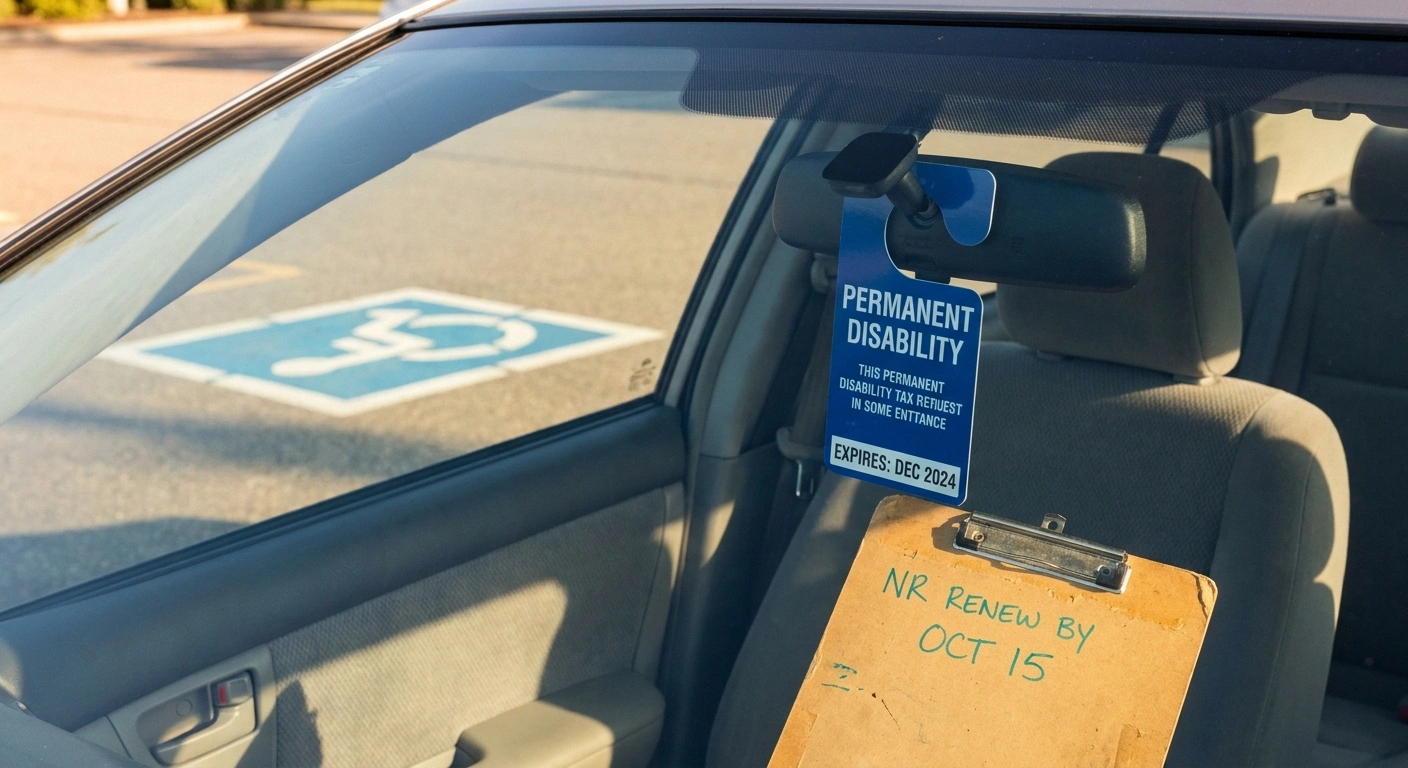
A few practical things to know after you have your placard:
Renewals. Most permanent placards renew every 4 to 5 years. Most states send a renewal notice by mail to the address on file. If you move, update your address with the DMV. A surprising number of placard expirations come from missed renewal notices that went to an old address. Your renewal can almost always be done by mail with a short form re-certifying your continued limitation.
Lost or stolen placards. Report to your state DMV immediately. They’ll issue a replacement, usually for a small fee. Some states want a police report for a stolen placard.
Multiple vehicles. A placard transfers between vehicles, which is one of its main advantages. Just move it to the windshield of whichever car you’re using. If you have two regular drivers in your household and you both share a vehicle, one placard works.
Out-of-state travel. Every state honors valid out-of-state disability placards under federal reciprocity. You can drive from Virginia to Arizona and your placard works in Arizona. Hang it from the mirror as usual. Carry your state’s placard documentation paperwork in the glove compartment in case of any question.
Out-of-state moves. When you move to a new state, you typically get a window of 30-60 days to switch your placard to the new state. The application process starts fresh in your new state — sometimes with a new doctor’s certification, sometimes with proof of the prior placard accepted as documentation.
Renewing when your doctor is no longer available. If your prescribing provider has retired, moved, or you’ve changed practices, your new provider can renew. You may need to schedule a brief visit so they can document your current limitation. This is routine.
When Your Application Gets Denied (It’s Rare, But It Happens)
Denials are uncommon when a licensed provider has signed a clear medical certification. When they do happen, the most common reasons are:
- An incomplete form (missing signature, missing date, missing required boxes checked).
- A provider’s certification that doesn’t match any of the listed criteria (rare — most providers know how to fill these out).
- An expired or unreadable signature.
- Mismatch between the patient name on the form and on the driver’s license.
If you’re denied, the denial letter will explain why. The fix is usually a single correction — get the signature, check the box, fix the typo — and resubmit. There’s no penalty for resubmitting a corrected application. If the denial is for a more substantive reason (“medical certification does not meet state criteria”), your next step is a conversation with the certifying provider about adding more detail or having a specialist re-certify.
One scenario I’ve seen a few times: a primary care provider who’s never seen the patient before declines to sign because they don’t yet know the patient’s history. The fix is straightforward — schedule one substantive office visit to establish care, discuss the neuropathy history and your neuropathy diagnosis, and then ask about the form at a follow-up. Most providers prefer to know the patient before certifying any disability paperwork, which is reasonable.
Using It Without Guilt
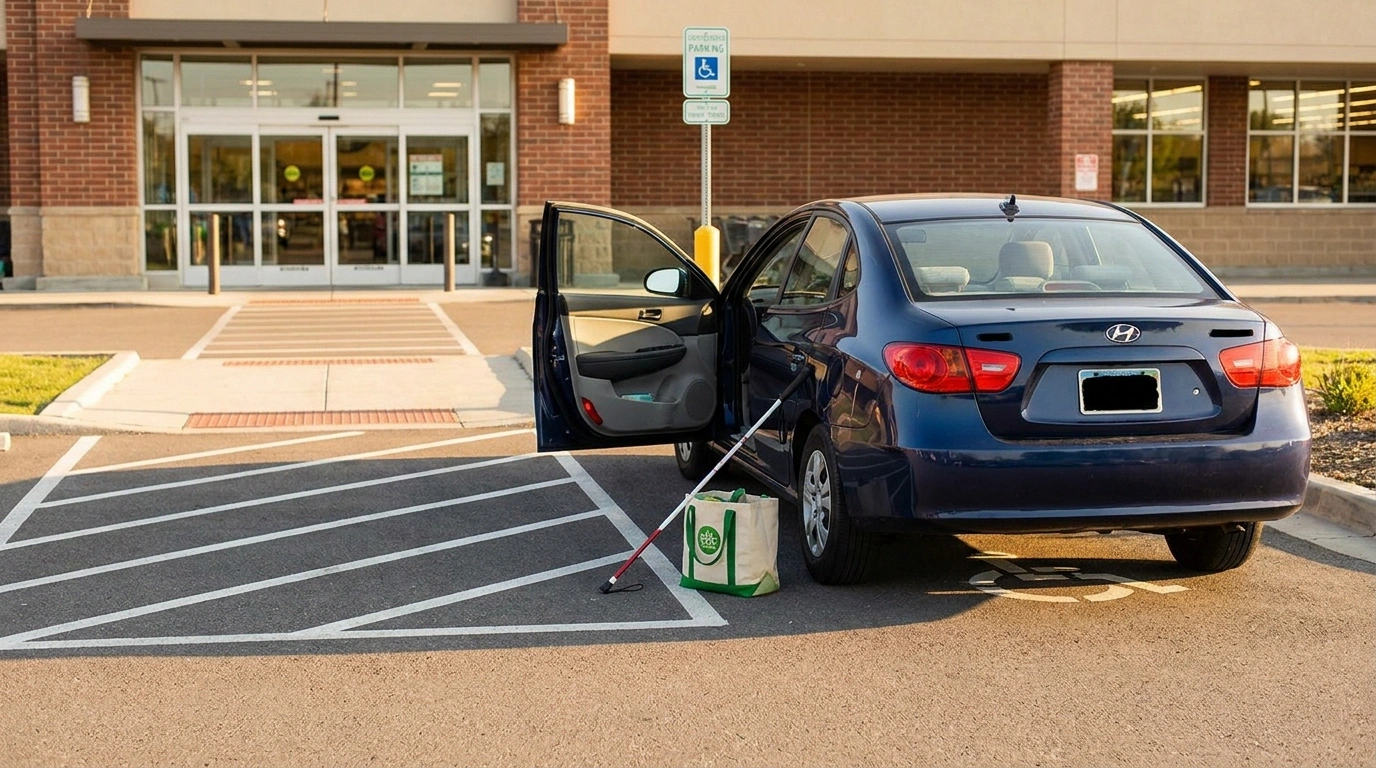
I’ll close with this because it really matters. Once you have your placard, use it. Don’t park in the back of the lot anyway because you feel like you should “save” the spot. The spots are designed for the actual range of mobility limitations, and yours is one of them. Park there. Use the extra space to open your door fully. Take the shorter walk. Save the spoons for what actually matters that day — buying groceries, picking up grandkids, getting to a doctor visit on time without arriving exhausted.
The placard isn’t a sign of decline. It’s a tool, and it’s a small piece of a larger toolkit for managing chronic neuropathy alongside your good shoes, your home foot-care routine, your medication schedule, your symptom tracking, and your fall-prevention strategies. Each tool buys you back a little energy and a little safety. The placard is one of the cheapest, simplest tools on the list, and one of the most consistently useful.
If you’ve been putting this off, today’s the day. Print the form. Schedule the visit. Hand it to your provider. It’s a 15-minute conversation that will change a hundred small moments of your year.
Frequently Asked Questions
Does neuropathy qualify for a handicap parking permit?
Yes, in nearly every case where neuropathy significantly limits your ability to walk safely. The standard eligibility is being unable to walk 200 feet without resting, or needing a cane, walker, brace, or other assistive device, or being severely limited by a neurological condition. Chronic peripheral neuropathy with pain, balance, or gait limitation meets these criteria in almost every state.
How do I get a disability parking placard?
Download your state’s disability parking placard application from the state DMV website, fill in the patient section, bring it to your primary care provider, neurologist, or podiatrist for medical certification, then submit the form to the DMV in person, by mail, or online. Most states process in 2-4 weeks by mail or same-day in person. Fees range from free to about $20.
Who can sign the medical certification?
A licensed medical doctor (MD or DO), nurse practitioner, physician assistant, podiatrist, or in many states a chiropractor can sign. For neuropathy, your primary care provider, neurologist, or podiatrist are the three most common signers. You do not need a specialist.
Can I get a placard for diabetic neuropathy?
Yes. Diabetic neuropathy is one of the most common conditions for which disability parking placards are issued. Your primary care provider, endocrinologist, neurologist, or podiatrist can sign the form, and the diagnosis along with documented gait, balance, or pain limitations meets state criteria in nearly every case.
Does the placard work in other states?
Yes. Under federal law, every state honors valid disability parking placards issued by any other state. You can travel anywhere in the United States and use your placard normally. Hang it from your rearview mirror with the date facing the windshield. Carry the issuing-state paperwork in your glove compartment in case anyone asks.
How long does a permanent placard last?
Permanent disability parking placards typically last 4 to 5 years depending on your state and renew with a short re-certification form. Temporary placards usually last 6 months. Renewal notices are mailed to the address on file with the DMV, so always keep your address current.
Do I have to use a wheelchair to qualify?
No. The eligibility criteria are about your functional limitation in walking, not about which mobility devices you do or do not use. Most disability placards are issued to people who walk independently but have significant limitations on distance, balance, pain, or safety. You do not need to use any assistive device to qualify.
Can my doctor refuse to sign?
A provider can decline to sign if they do not believe your condition meets the criteria or if they have not seen you recently enough to certify. If your provider declines and your symptoms are real, you have the right to seek a second opinion. Your podiatrist, neurologist, or another primary care provider can sign instead.
What is the difference between a placard and a license plate?
A placard is a hangtag that you hang from your rearview mirror and transfer between vehicles. A disability license plate is permanently attached to one specific vehicle. Both provide the same parking privileges. The placard is more flexible if more than one vehicle is sometimes used; the plate is more convenient if you always use the same car. Most states allow you to have both for the same person.
Can someone else drive me using my placard?
Yes, as long as you are the passenger they are picking up or dropping off. The placard is for the eligible person, not the vehicle. If your spouse, an adult child, or a friend drives you to an appointment, they can use your placard while you are in the vehicle. The placard is not transferable to others when you are not present.
About the Author