
The first time my friend Margaret called me about it, she whispered. It was past nine on a Tuesday and she was in her bathroom with the door closed because she didn't want her husband to hear what she was about to say out loud.
“Janet, I think there's something on my legs.”
I asked her what she meant. She paused for a long time. “Crawling. Like — like ants. I keep looking and there's nothing there. I've changed the sheets twice. I've vacuumed. I had Walter check the basement. There's nothing. But I can feel them.”
Margaret has had diabetic neuropathy for about six years. She is not the kind of woman who imagines bugs. She is a retired math teacher who reads three newspapers a day and was the first person in our book club to learn about NFTs just so she could explain why they were silly. When she told me what she was feeling, she was scared — not of bugs, but of what it might mean that she was feeling bugs that weren't there.
What Margaret was describing has a name. It's called formication. It is a real, recognized nerve symptom. It has a mechanism. It has a treatment path. And anyone who has ever experienced it and whispered about it in a closed bathroom deserves to know that they are not losing their mind.
What Formication Actually Is
Formication is the sensation of insects crawling on or under your skin when nothing is there. The word comes from the Latin formica, meaning ant. Doctors classify it as a type of paresthesia — an abnormal sensation generated by misfiring sensory nerves rather than by anything happening to your skin from the outside.
Key Takeaway
Formication — the sensation of bugs crawling on your skin when nothing is there — is a recognized nerve symptom with a real mechanism. Damaged sensory fibers fire spontaneously, and your brain interprets those misfires as something moving on you. You are not imagining it, and you are not delusional.
The key piece here, and the piece that makes the experience so unsettling, is this: the sensation is real. Your brain is not making it up. Sensory nerves are firing electrical signals that the brain interprets as touch from something external. The signals are genuine. The source of the signals is internal. That distinction matters because it separates formication from anything imagined or hallucinated — those have a different brain signature entirely. Formication is a true peripheral sensory event with a misread origin.
If you've felt this and never had a word for it, I want to say plainly: there is a word, you are not alone in having it, and it is not crazy. People with healthy nerves don't experience formication. People with damaged sensory nerves often do.
Why Damaged Nerves Make You Feel Crawling Bugs
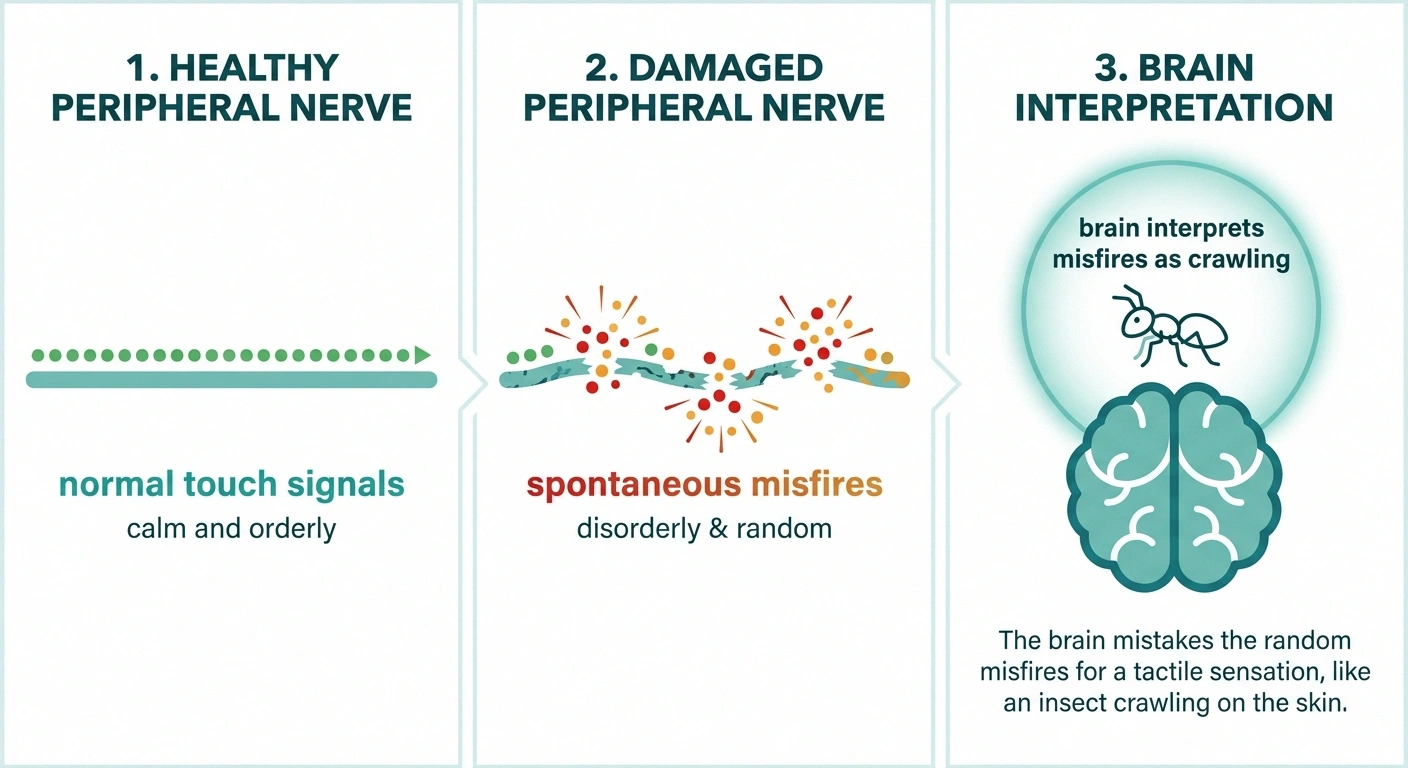
To understand why nerves would generate this specific sensation, it helps to know a little about the kinds of nerves involved.
Your peripheral nervous system carries two main groups of sensory fibers that report what your skin is feeling. The small unmyelinated C-fibers and lightly myelinated A-delta fibers are the ones that handle light touch, itch, temperature changes, and slow-burning pain. These are the same fibers that report “something tickled my arm” or “there's a draft on my ankle.” They are the most common fiber types damaged in small fiber neuropathy, in diabetic neuropathy, and in chemotherapy-induced nerve damage.
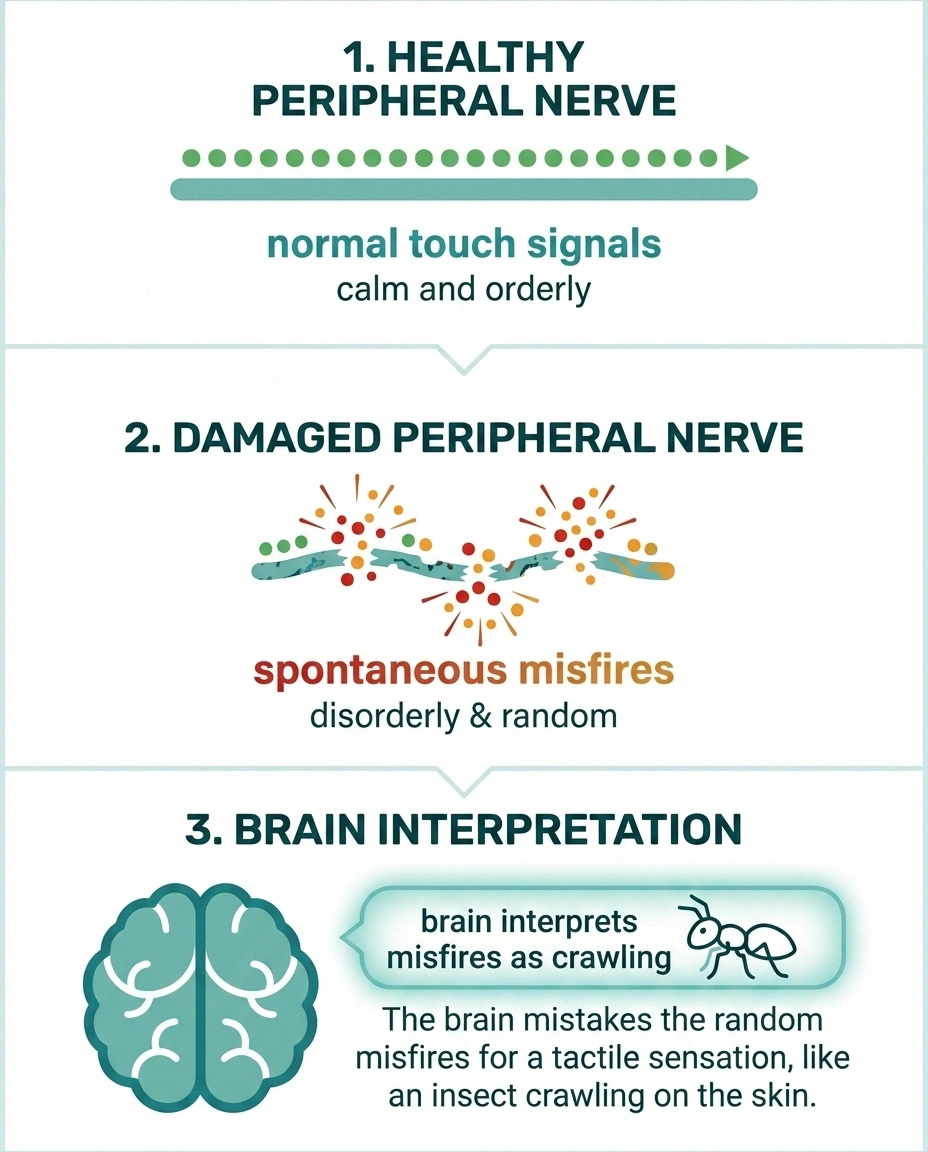
When these fibers are damaged but not killed outright — and that's the usual middle stage of any neuropathy — they become electrically unstable. They fire on their own without an outside stimulus. The technical term is ectopic firing. The damaged fiber sends a brief burst of “something touched me right here” signals up to the spinal cord and on to the brain. The brain, which has spent your whole life learning that signals from those fibers usually mean small light contact with the skin, dutifully reports back: something touched you. When the misfires keep happening in rapid succession across nearby fibers, the brain assembles the bursts into a pattern — and the pattern most consistent with brief, repeated, light contact across an area of skin is something moving on you. Something crawling.
That's why nerve damage produces this particular illusion rather than, say, the feeling of being hit. The brain is interpreting genuine nerve signals using the most plausible cause from its experience library. It's not a glitch. It's a perception system doing its job with bad incoming data.
Where Neuropathy Patients Most Often Get Formication

The pattern across our support group has been consistent. Most people who deal with formication have diabetic neuropathy or chemo-induced nerve damage, and it shows up most often in the feet, calves, and forearms — the same regions where their numbness and burning live. A smaller group describes it on the trunk, scalp, or face, which usually points toward small-fiber neuropathy with a non-length-dependent pattern, or toward the aftermath of shingles in those regions.
Three Reliable Triggers
1. Night and stillness
Daytime distractions gone, limbs cooled, no normal touch input — misfires get louder.
2. Heat
Hot showers, heating pads, warm bedrooms — damaged C-fibers are temperature-sensitive.
3. Stress
Lowers the threshold at which already-damaged nerves fire. Stressful weeks bring fresh spikes.
A few patterns Margaret and I noticed when she started tracking when it happened:
- It gets louder at night. This mirrors the general truth that neuropathy is worse at night. When the day's distractions fall away and you lie still, the brain has nothing else to listen to except the misfiring signals.
- Heat amplifies it. A hot shower, a heating pad left on too long, a warm bedroom — all reliable triggers in many patients. The damaged C-fibers seem to be especially temperature-sensitive.
- Stress lowers the threshold. On a calm Sunday morning the crawling sensation might be barely there. On a stressful Wednesday before a doctor's appointment, the same nerves can stage a parade.
- It travels. A patch on the left calf in the morning, a patch on the right forearm by evening. Nerves all over the body are damaged, and which ones are most actively misfiring shifts.
What Else Can Cause Formication — and Why It Matters

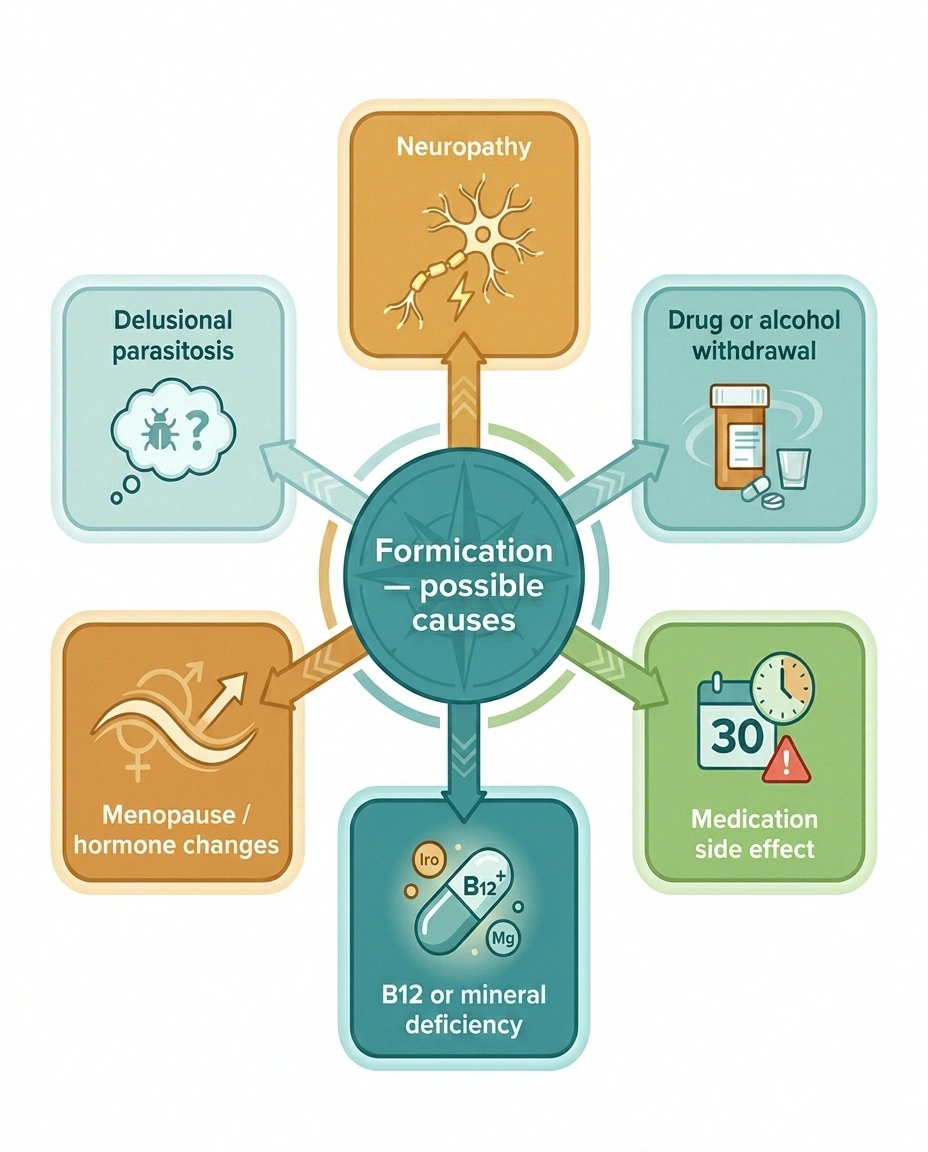
Formication isn't unique to neuropathy. A few other causes produce the exact same sensation, and a thoughtful doctor will think through them when formication shows up out of nowhere. Knowing these alternatives can also save you a few late-night terror searches.
The most common non-neuropathic causes include:
- Drug or alcohol withdrawal. Methamphetamine, cocaine, and ecstasy withdrawal all produce formication classically — the older slang “meth bugs” describes exactly this. Alcohol withdrawal does it too, often peaking around 24 to 72 hours after the last drink.
- Certain medication side effects. Some SSRIs (sertraline most commonly), some stimulants used for ADHD, and some Parkinson's medications can produce formication, especially at higher doses or when first started. If the symptom began within weeks of a new prescription, tell the prescriber.
- Vitamin and mineral problems. Severe B12 deficiency can produce formication directly, sometimes before classical neuropathy is obvious. Low calcium, low magnesium, and thyroid disorders are less common but real causes.
- Menopause and hormone changes. A subset of women describe formication during perimenopause, especially at night. The mechanism is not fully understood but is thought to involve estrogen's role in sensory nerve regulation.
- Delusional parasitosis. This is a distinct psychiatric condition in which the person is genuinely convinced that real parasites or insects are infesting them. They typically present with specimens (bits of lint, scabs, fibers) they believe are bugs and they pursue exterminators and dermatologists. The internal experience is different from neuropathic formication, where the person can usually tell that nothing is actually there — even when the sensation is unrelenting.
That last distinction is important. If you have neuropathy and you feel formication and you look at your skin and reason calmly that nothing is there, you are not delusional. You have a known sensory misfire and an intact reality check.
When Formication Should Trigger a Wider Workup
If formication shows up in someone who already has documented neuropathy and matches the rest of their symptom pattern, it's usually treated as one more facet of that neuropathy. But certain features should prompt a deeper look:
Call the Doctor Today If
Formication is paired with confusion, hallucinations, or unusual sweating — OR — started within weeks of a new medication — OR — appeared with rapidly progressing weakness. Any of those needs more than a routine workup.
- Sudden onset of formication with no prior nerve symptoms anywhere in the body.
- Formication paired with confusion, hallucinations, agitation, or unusual sweating.
- Formication only in a region that's never had any other neuropathy sign — for example, only on the scalp when your nerve issues have always been in the feet.
- Formication that started within weeks of a new medication.
- Formication with rapidly progressing weakness.
Any of those deserves a phone call to the prescribing doctor, and probably some blood work — full vitamin and mineral panel, thyroid, glucose, a careful medication review, and depending on the picture, a referral to a neurologist for a fresh examination.
What Actually Helps Once You Know It's Nerve-Related

I'll be honest with you: there is no targeted “anti-formication” pill on the market. What helps formication is what helps small-fiber paresthesia in general, because the misfiring fibers respond to the same approaches whether they're producing crawling, burning, electric shocks, or tingling.
The pieces of the playbook that consistently help in our group:
Treat the underlying cause aggressively. If you have diabetes, every percentage point of A1C improvement, every additional hour in glucose target range, reduces the rate of new nerve damage and helps existing nerves stabilize. If you have a B12 deficiency, correct it and stay corrected. If you're on a medication that causes neuropathy, talk with your prescriber about alternatives.
Consider first-line nerve-pain medications with your doctor. The same drugs that help burning and shooting nerve pain — gabapentin, pregabalin, duloxetine, and the tricyclic antidepressants — also dampen formication for many people. None of these are formication-specific; they all work by reducing the underlying nerve hyperexcitability that produces the misfires. Dose, timing, and side-effect profile are conversations with the prescriber.
Sleep, sleep, sleep. Nerve symptoms get louder when you're sleep-deprived. Building a consistent wind-down routine, addressing nighttime triggers, and keeping the bedroom cool all help. If your formication is concentrated in the feet at bedtime, light cotton socks sometimes help by giving the misfiring fibers a steady, predictable input instead of total stillness.
Stress and pacing matter. Stress lowers the threshold at which the damaged nerves fire. Anything that reduces baseline stress — gentle movement, mindfulness, time with people who don't drain you, a real lunch break — helps formication just as it helps every other nerve symptom.
The supplement question. Alpha-lipoic acid has the most evidence for diabetic neuropathy symptoms broadly, and many patients in our group report it dampens formication along with burning and tingling. It is not a substitute for treating the underlying cause, but it's a reasonable add-on with relatively low downside. Talk with the prescriber if you're on other medications.
Address the mental health load. Formication is exhausting and isolating. People hide it because it sounds delusional out loud, and the hiding adds shame to the load. Talking to a counselor who understands chronic illness — or just to one trusted friend who won't flinch — takes some of the weight off. There's a clear two-way relationship between mood and nerve symptom intensity, and treating the mood half of that loop usually helps the symptom half too.
What Doesn't Help and Can Quietly Make Things Worse
I want to flag a few things I've seen people try that backfire.
Helps vs Backfires
✓ Helps
Light cotton coverage, cool washcloth, paced breath, gentle limb movement, first-line nerve meds with your prescriber.
✗ Backfires
Scratching numb skin, strong topical anesthetics unsupervised, parasite-killing products, defaulting to long-acting opioids.
Scratching is the obvious one. Formication doesn't usually itch in the histamine sense, but the brain's instinct is to brush or scratch the area where it feels crawling. If you have neuropathy in your feet, the same numbness that lets the misfires happen also means you can't feel a developing skin break. People get infections from this. Pat or stroke the area with a clean cloth instead of scratching. If you must scratch, use the palm rather than fingernails.
Strong topical anesthetics like high-percentage lidocaine creams without medical guidance are another trap. They can numb the area temporarily and feel like a fix, but used unsupervised on broken skin they're absorbed too readily and can produce real toxicity. Same for topical pesticide products — I have seen patients in panic mode try permethrin cream on their legs because formication felt that real. It does nothing for the misfires and adds skin irritation.
Long-acting opioids for formication-only complaints are rarely the right answer. They have weak efficacy for neuropathic symptoms, they bring their own dependence risk, and switching to them tends to crowd out the medications that actually help. Most pain specialists will steer toward the neuropathy-targeted drugs first.
How To Talk About This With Your Doctor Without Sounding Crazy

This was the conversation Margaret rehearsed in my kitchen before her endocrinology appointment. The script we settled on, lightly cleaned up:
Research Says
Formication is classified as a paresthesia — an abnormal sensation generated by misfiring sensory fibers, predominantly the small unmyelinated C-fibers that handle light touch, itch, and temperature. The same nerve hyperexcitability that drives diabetic neuropathy pain produces the crawling sensation when the misfires cluster across nearby fibers.
“I want to flag a sensory symptom that's been bothering me. It feels like insects crawling on my skin, mostly at night, mostly on my calves and feet, but I know nothing is actually there and my skin looks normal. From what I've read this is called formication and it's a recognized symptom of nerve damage. Is that consistent with what you'd expect with my diabetic neuropathy, or should we look at anything else?”
What that script does well: it names the symptom precisely, locates it in space and time, signals that you have an intact reality check, demonstrates that you've done a little reading, and invites the doctor into a clinical conversation rather than a reassurance conversation. Margaret's endocrinologist nodded the whole way through, ordered a B12 and methylmalonic acid level just to be thorough, and added a low evening dose of gabapentin to her existing regimen. Within ten days, the crawling sensation at bedtime had eased by perhaps two-thirds. The remaining pieces have come and gone since, but they no longer scare her.
What Margaret Learned, and What I Want You to Take From This

The night Margaret called me from her bathroom, the worst part wasn't the sensation. It was being alone with a sensation she didn't have a word for, in a culture that treats anything weird about the body as either a joke or a sign of decline. The sensation was a small thing. The shame around it was the big thing.
Three Things to Take Away
1
It has a name.
2
It has a mechanism.
3
It has a treatment path.
If you have neuropathy and you've felt crawling that isn't there — even once, even briefly, even just a wave of it before drifting off to sleep — I want you to know three things:
- It has a name. It's called formication.
- It is a known nerve symptom with a real mechanism, and your doctor will not be surprised when you describe it.
- It usually responds to the same approaches that quiet the rest of neuropathy — better glucose control if relevant, the standard nerve-pain medications when needed, sleep, stress management, and the steady patient work of treating the underlying cause.
Margaret still gets it. Most weeks not at all. Some weeks, especially when she's tired or stressed, for an hour at bedtime. The difference now is that she knows what it is, she has a tool to dial it down, and she doesn't whisper about it anymore. Last book club she told two other women in our group about it. Both of them got a little quiet, then admitted they'd been having the same thing for years and never said a word. That afternoon I think four people decided to bring up formication at their next appointments.
This is the part of advocacy I love most. One small word, said out loud, lets a whole roomful of people stop hiding.
Frequently Asked Questions
Is formication a sign that my neuropathy is getting worse?
Not necessarily. Formication can appear at any stage of small-fiber damage and it can come and go without reflecting a change in the underlying neuropathy. What matters more is the overall trend in your symptoms over months, not the appearance of any single symptom. If formication shows up alongside new numbness, new weakness, or a clear extension of the area affected, that's worth a conversation with your doctor.
Could it actually be parasites and I'm being told it's nerves?
For someone with documented neuropathy and a normal skin exam, true infestation is exceedingly unlikely. A good clinician will look at the skin carefully precisely to rule it out. If you remain unconvinced, ask for the exam to be repeated by a dermatologist — there is nothing wrong with double-checking, and the visit usually settles the question definitively.
Will the formication ever fully go away?
For some people, yes — with good treatment of the underlying cause, plus appropriate nerve-pain medication when needed, formication can quiet down to the point where you go months without noticing it. For others it ebbs and flows even with treatment. The honest answer is that small-fiber misfires are hard to fully silence once they start, but you can usually get them from “constant and distressing” down to “occasional and bearable.”
Why is it always worse at night?
Three things stack together. Daytime distractions are gone, so the brain has more attention available for the misfiring signals. Limbs cool slightly at rest, and damaged C-fibers are temperature-sensitive. And lying still removes the normal touch input that masks the misfires. Most people see real improvement when they address even one of those — for example, by giving the feet a consistent light input with cotton socks.
Can stress alone make formication start?
Stress doesn't create new nerve damage, but it lowers the firing threshold of nerves that are already damaged. Many people see a fresh spike of formication during a stressful week even when their underlying neuropathy hasn't changed. This is part of the larger pattern of nerve symptoms tracking the nervous system's overall state.
I started a new medication and now I'm getting formication. Coincidence?
Possibly not. Several drug classes — certain SSRIs, stimulants, Parkinson's medications, some antibiotics — can produce formication as a side effect. If the timing lines up, tell the prescriber. Do not stop the medication on your own, especially if it's an antidepressant or seizure medication, but do flag the symptom for their input.
Are there any quick relief techniques I can try in the moment?
A few things help many people in the moment, none of them medical: a brisk cool washcloth pressed to the area for thirty seconds, light cotton coverage on the area, gentle movement of the affected limb, slow paced breathing, and shifting attention to something engaging. None of these fix the underlying nerves, but they often interrupt a wave of formication enough to let you fall asleep.
Should I see a dermatologist or a neurologist?
If your skin is normal and you have a known neuropathy diagnosis, start with the doctor who manages your nerve condition. If your skin shows any abnormalities — rash, scabs, visible bites, redness — see a dermatologist first to rule out a skin cause. If you have no neuropathy diagnosis yet and formication is the leading symptom, a neurologist is the right starting point.
About the Author