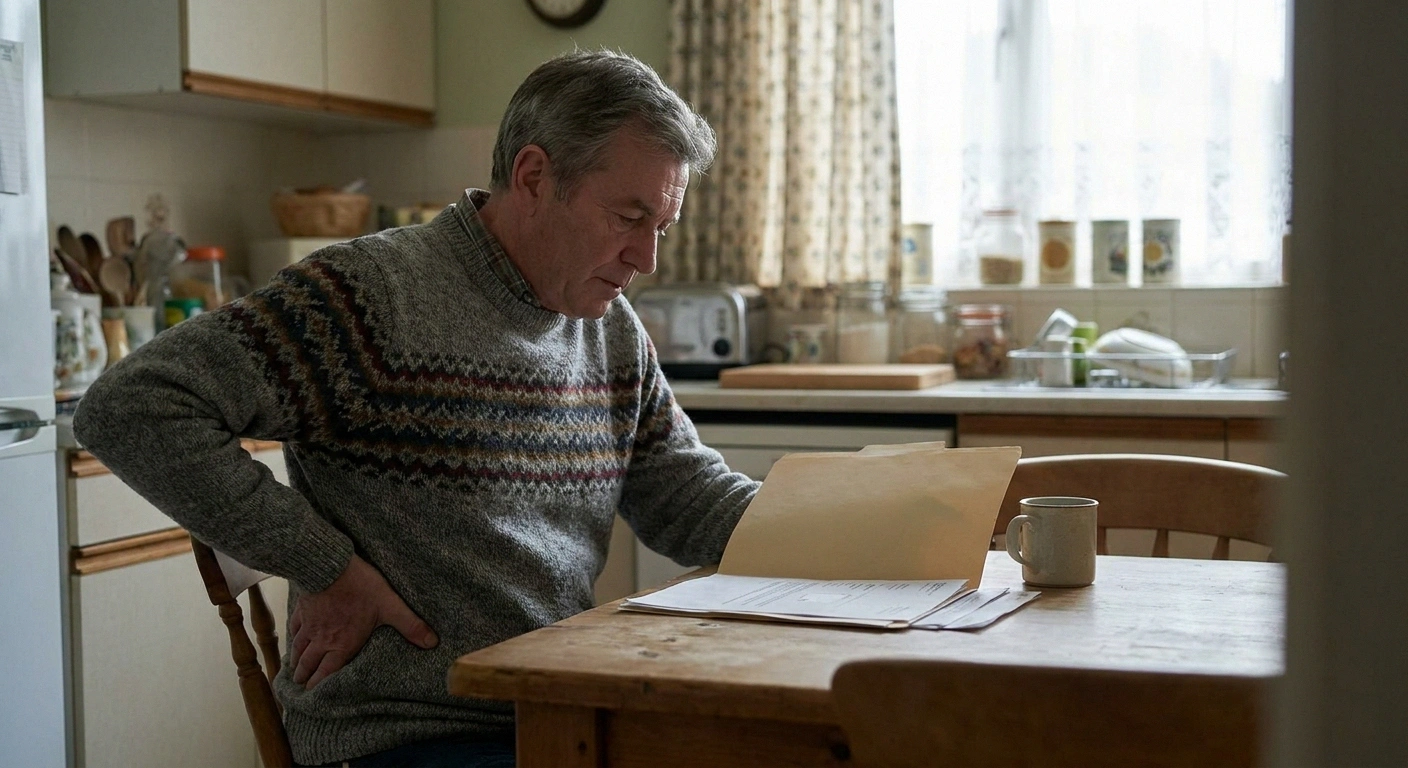
By the time most people learn there’s a name for this, they’ve collected a small stack of normal results.
An EKG. Probably a troponin, maybe two, drawn six hours apart. A chest X-ray. An abdominal ultrasound that found either nothing or a gallbladder everyone agrees is innocent. Possibly a CT. Somewhere in there, a doctor said the words “everything looks good,” and meant it kindly, and the person hearing it went home with a burning band still wrapped around one side of their ribcage.
That gap — normal tests, unmistakable pain — is where diabetic truncal neuropathy lives. It’s uncommon, it’s under-recognized, and it produces pain in the two places on the body where nobody is willing to guess: the chest and the abdomen.
So the workup wasn’t wasted. It was the correct order of operations, and I want to be unambiguous about that before going a single step further.
Why the Cardiac Workup Comes First, and Was Right
Chest pain gets treated as a heart problem until proven otherwise. That’s not defensive medicine. It’s the only sequence that makes sense when one of the possibilities can kill you in an afternoon and the others can’t.
This page describes a condition diagnosed only after the dangerous causes have been excluded. It is not a way to decide that your chest pain is harmless.
- Chest pain with shortness of breath, sweating, nausea or lightheadedness
- Pain spreading to the arm, jaw, neck or back
- Chest pressure or tightness lasting more than a few minutes, or coming and going
- Any chest pain that is new, or different from a pattern you have already had evaluated
- Sudden severe abdominal pain, a rigid abdomen, vomiting blood, or black stools
One extra reason to go, specific to diabetes: long-standing nerve damage can blunt cardiac pain, so a heart attack may produce far less warning than expected. Being the group most likely to dismiss chest pain as nerve pain is also being the group least able to afford it.
Diabetic truncal neuropathy is what doctors call a diagnosis of exclusion. It isn’t found by a test that lights up positive. It’s what remains after the dangerous causes have been ruled out, which means the ruling out isn’t a detour on the way to the answer. It’s how the answer gets made.
This matters twice over for people with diabetes, because diabetes is itself a major risk factor for heart disease, and long-standing neuropathy can blunt the sensation of cardiac pain. Silent heart attacks are more common in this group, not less. A person with diabetic nerve damage who assumes their chest pain is “just the nerve thing” is making exactly the wrong bet with exactly the wrong odds.
So here is the rule this entire article sits underneath: new, changed, or unexplained chest pain gets evaluated urgently, every time, no matter what you’ve read here or how well it seems to fit. Call emergency services for chest pain with shortness of breath, sweating, nausea, lightheadedness, or pain spreading to the arm, jaw or back. Nothing on this page is a reason to wait it out at home, and I’d rather you go and be told it’s the nerve than stay home and be right.
What follows is for the person who has already been through that door. Once the heart, the lungs and the gut have been cleared, the question becomes what’s left — and this is one of the answers that gets missed.
What the Pain Actually Feels Like
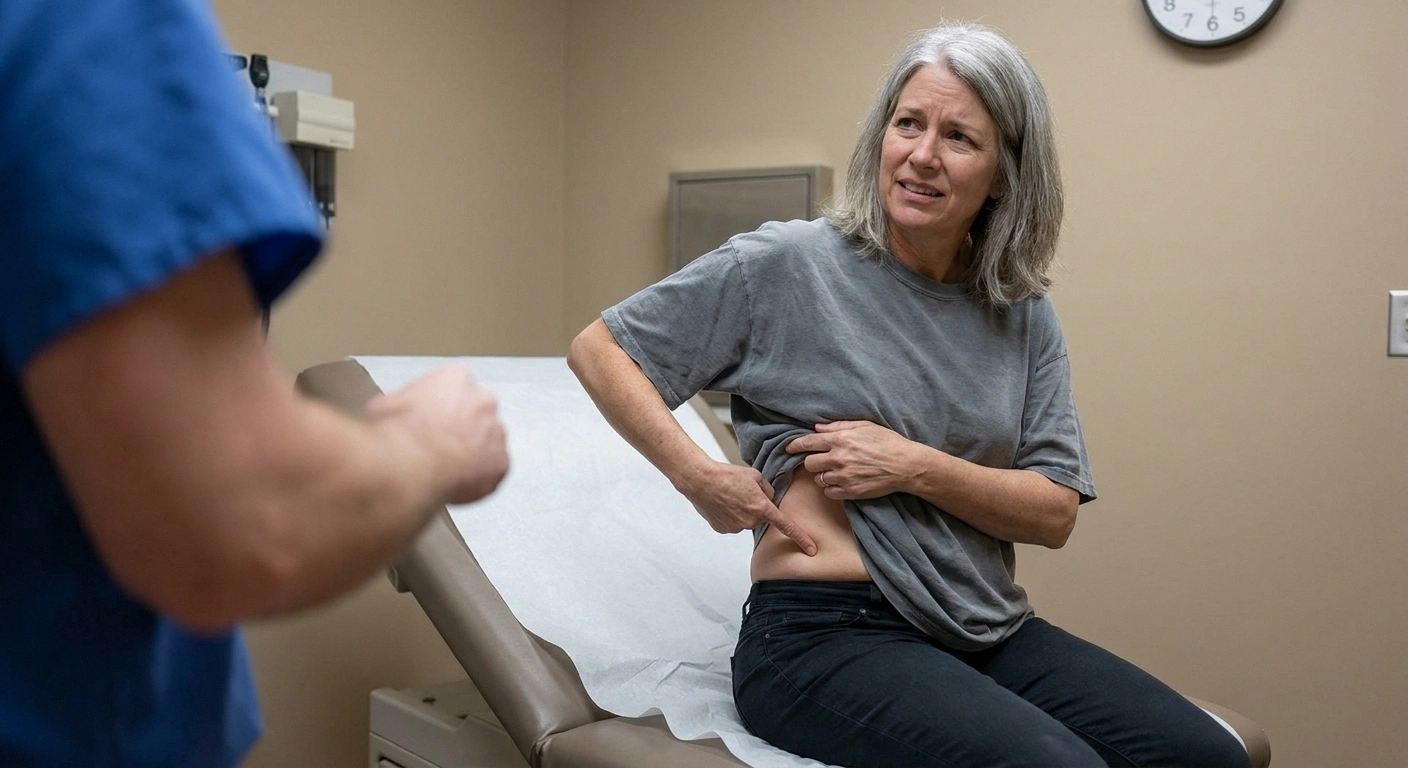
People describe it with remarkable consistency, which is one of the reasons it’s recognizable once you know to look.
None of these distinctions are reliable enough to act on alone. They are here so you can describe your pain in the terms that actually help someone sort it.
| Possible cause | The feature that tends to separate it |
|---|---|
| Truncal neuropathy | One side only, follows a horizontal band, burns, worse at night, skin hurts to light touch |
| Shingles | Identical band at first. A rash or blisters appear along the strip within several days |
| Cardiac | Pressure rather than burning, brought on by exertion, often with breathlessness or sweating |
| Gallbladder | Right upper abdomen, comes in waves after fatty meals, often with nausea |
| Muscle or rib strain | Tender to press on a specific spot, tied to a movement or an injury you can name |
| Spinal disc | Usually neck or lower back rather than mid-torso, and typically visible on imaging |
The most useful single sentence you can offer a clinician: whether the pain crosses the midline of your body. Truncal neuropathy usually does not, though more than one level can be involved.
It’s usually one-sided. Left or right, and typically not crossing the middle of the body — a feature that separates it from much of what it gets mistaken for. More than one level can be involved, and it can occasionally affect both sides, so one-sidedness is a strong clue rather than a rule.
It runs in a band. A strip wrapping from the spine around toward the front, following the curve of a rib or sitting across part of the belly. People draw it with a finger in a horizontal arc, and they draw roughly the same arc every time.
It burns, or it aches deeply, or both. Some describe a tight squeezing. Others say it’s like a sunburn under the skin, or a bruise that goes all the way through.
It’s worse at night. Reliably — lying still in a quiet bedroom is when it’s loudest.
The skin over it can be exquisitely touchy. A waistband, a bra strap, a bedsheet. When ordinary light touch registers as pain, that’s allodynia, and it’s a hallmark of nerve-generated pain rather than pain coming from an organ underneath.
Movement, coughing and sneezing make it flare.
Onset is sudden or builds over days to a couple of weeks. It doesn’t creep in over years the way distal diabetic neuropathy in the feet tends to.
The closest mimic, and the one worth naming out loud, is shingles before the rash arrives. Shingles also produces a one-sided burning band and can precede its blisters by several days. If a rash appears along the painful strip, that changes the picture and the treatment, and antiviral medication works best when started early. It’s worth a look in a mirror.
Why One Nerve Root Makes a Band
The band shape isn’t a coincidence. It’s anatomy, and once you see it the whole condition becomes easier to hold onto.
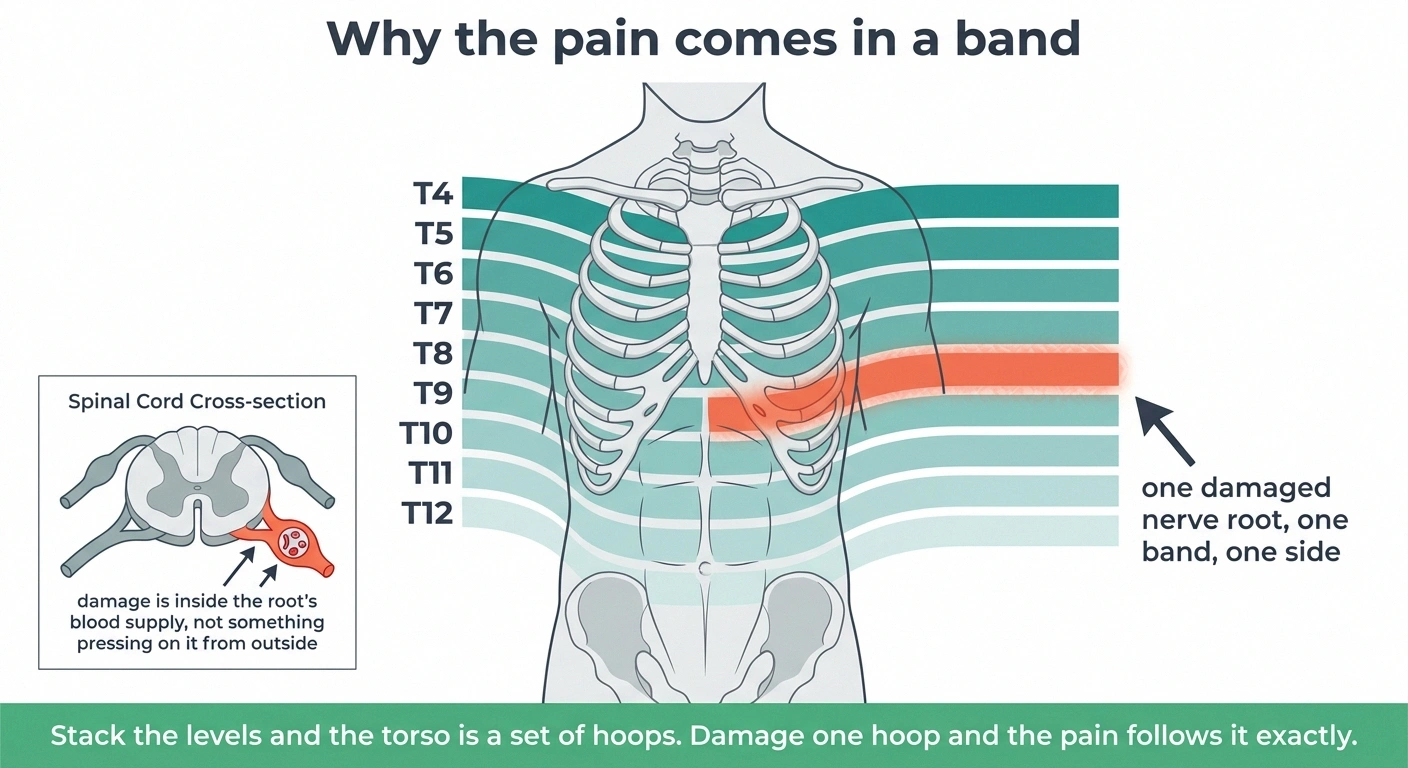
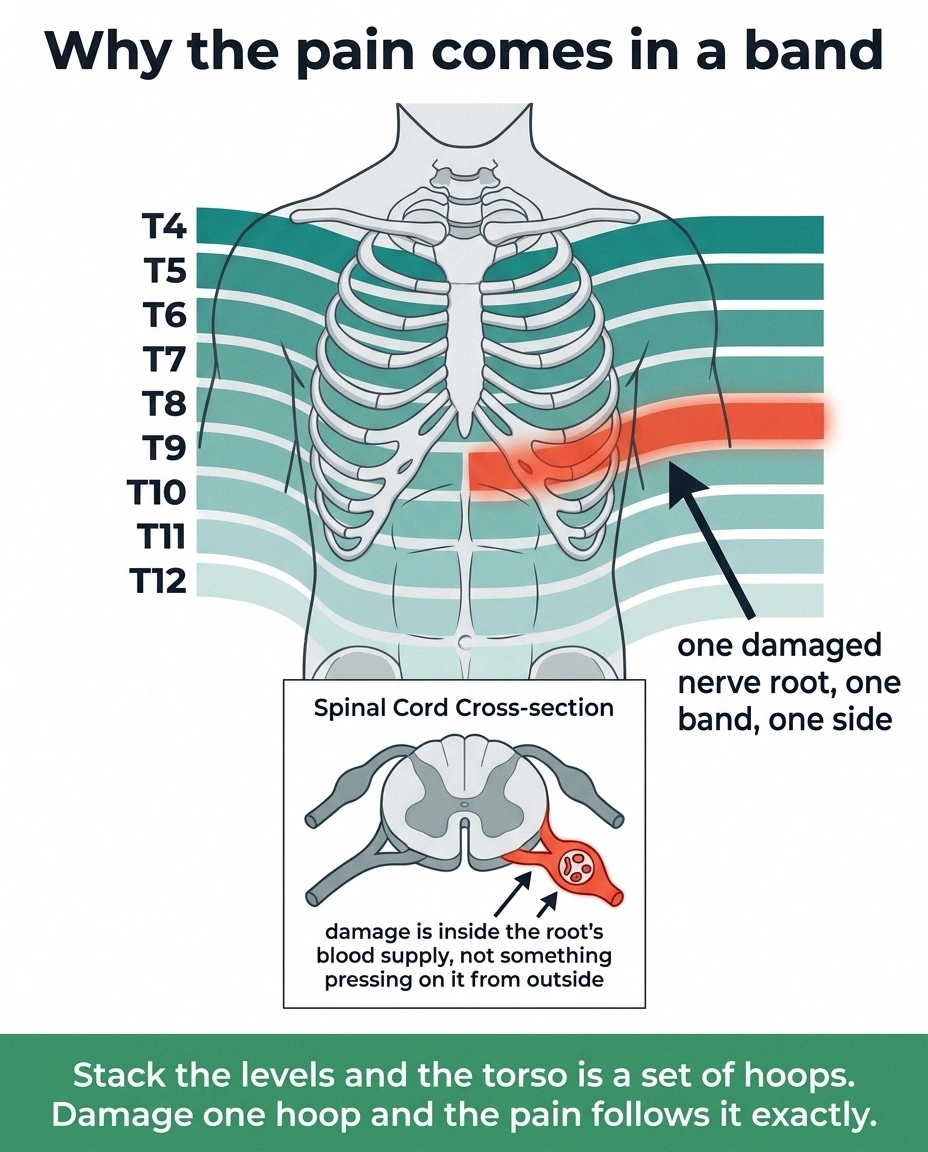
Nerves leave your spinal cord in pairs, one to each side, at every level of the spine. Each of those thoracic nerve roots supplies a specific horizontal strip of skin and muscle, wrapping from the spine around the trunk toward the midline. Clinicians call that strip a dermatome. Stack them up and your torso is essentially a set of bands, like the hoops on a barrel.
Damage one root and you get symptoms in one hoop, on one side. That’s the entire explanation for the band.
The mechanism of the damage itself looks to be microvascular and inflammatory rather than structural. The tiny vessels feeding the nerve root are compromised, the nerve becomes ischemic and inflamed, and it starts firing pain signals that your brain faithfully maps back to the strip of body wall that root is responsible for. The pain feels like it’s in your ribs because your brain has no other way to interpret a distress call arriving on that particular line.
This is why imaging is so often unremarkable. There’s usually nothing pressing on anything. A slipped disc in the neck or lower back shows up on an MRI; this doesn’t, because the problem is inside the nerve’s blood supply rather than outside it pushing in. If the distinction between a pinched root and a damaged one is new to you, our piece on radiculopathy versus neuropathy untangles the two.
It also explains the company this condition keeps. The same process, striking the nerve roots of the thigh instead of the trunk, produces diabetic amyotrophy — sudden one-sided thigh pain with weakness and wasting. Truncal neuropathy and amyotrophy are close relatives, they sometimes occur in the same person, and they share a reputation for arriving abruptly and then, eventually, leaving.
The Bulge That Is Not a Hernia
Here’s the feature that sends people to a surgeon, and the one most worth knowing in advance.
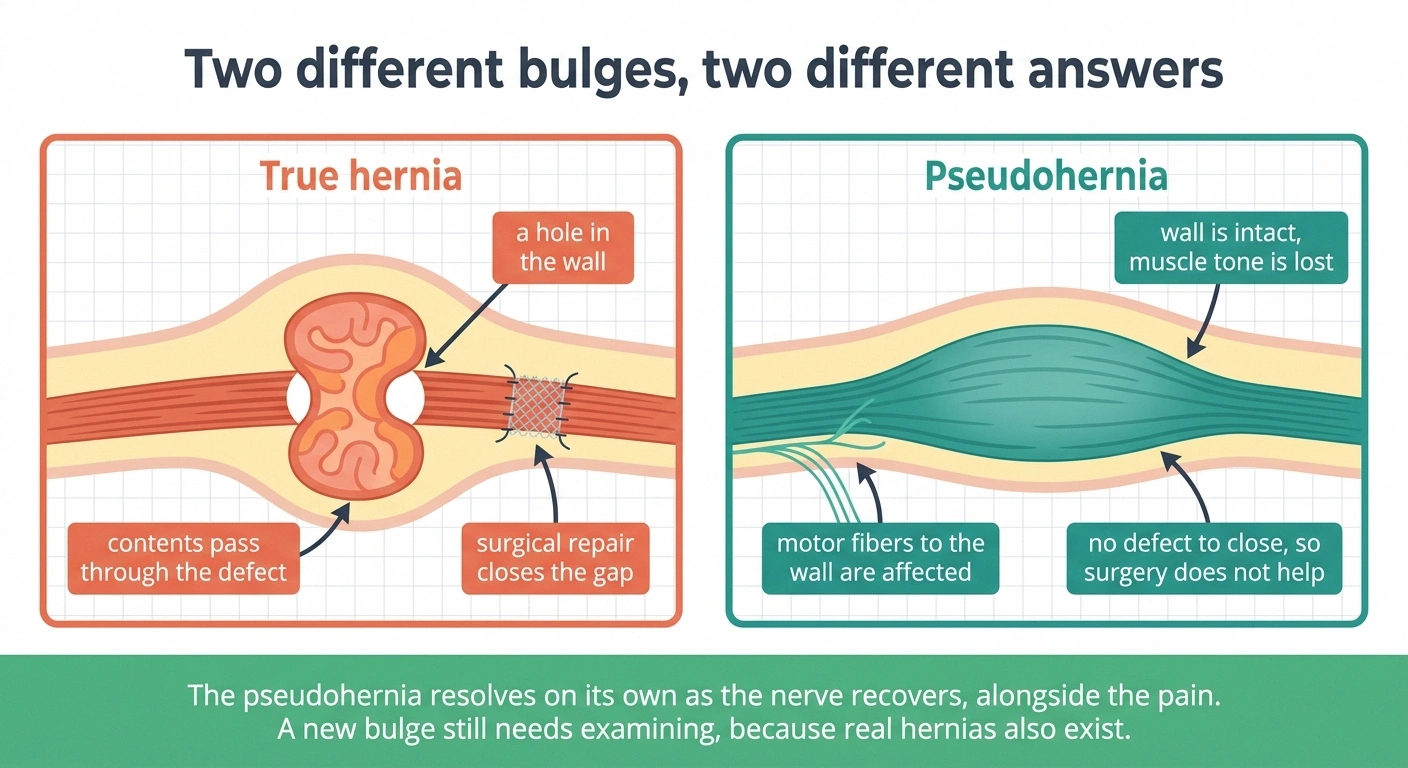
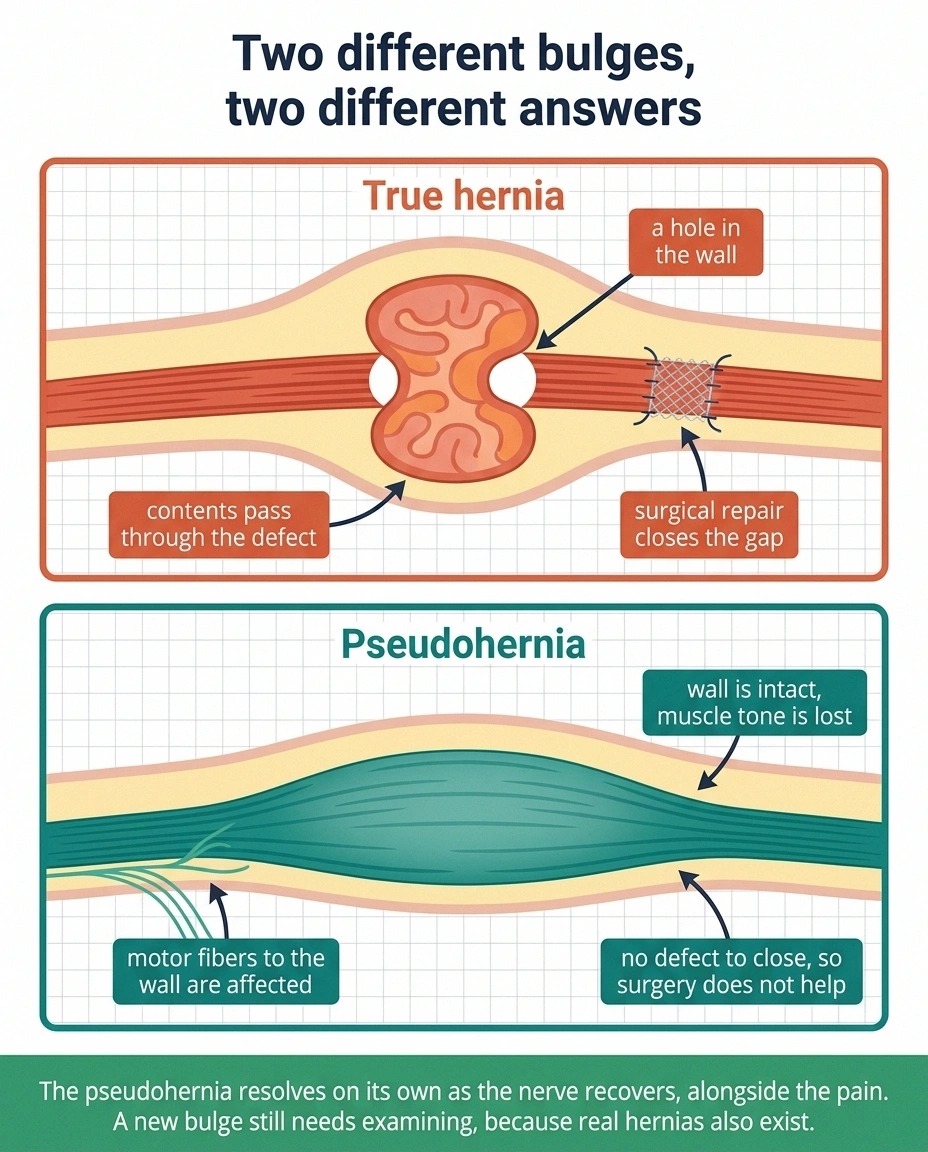
Those thoracic nerve roots don’t only carry sensation. They also carry motor signals to the abdominal wall muscles. When the motor fibers are affected, a section of abdominal wall weakens, and the contents behind it push outward. The result is a soft, asymmetric bulge on one side of the belly, often more obvious standing than lying down.
It looks like a hernia. It is not a hernia. A hernia is a defect in the wall itself, a hole with tissue coming through. This is intact wall that has lost its muscle tone — which is why it’s called a pseudohernia, and why the fix for a hernia does nothing for it.
Cases of exactly this being taken to the operating room appear repeatedly in the medical literature, which is precisely why they were written up. Surgery on a pseudohernia carries all the ordinary risks and none of the benefit, because there’s no defect to close. The bulge resolves on its own as the nerve recovers, alongside the pain.
If you have a new one-sided abdominal bulge, it still needs examining, since real hernias also exist and some of them are urgent. But if you have long-standing diabetes and burning band-like pain on that same side, that’s a specific and useful thing to say out loud. The combination of pain in a dermatome, a soft bulge, and a normal scan is a recognizable picture to anyone who’s seen it before.
The Weight Loss Nobody Warns You About
A striking number of people with this condition lose a substantial amount of weight, sometimes twenty or thirty pounds, over the weeks the pain is establishing itself.
Weight loss is a genuine feature of this syndrome and it usually reverses. It is also a symptom that stands on its own and should be worked up on its own terms. The common thresholds clinicians use:
- More than 5 percent of body weight lost in 6 to 12 months without trying. For a 180 pound adult that is 9 pounds.
- Loss that continues after the pain has begun improving.
- Loss accompanied by fever, night sweats, a lasting change in bowel habit, or blood anywhere.
Weigh yourself once a week, same day, same scale, and write it down. A recorded trend is the difference between a vague worry and a number worth acting on, in either direction.
It’s disproportionate, unintentional, and frightening — largely because of what everyone quietly worries it means. It’s a documented feature of this syndrome and of diabetic amyotrophy, and it isn’t explained by blood sugar control alone.
I’ll be careful here, because unexplained weight loss is a symptom that deserves real investigation on its own merits, and it should get one. Cancer, thyroid disease and other serious conditions cause weight loss too, and “it’s probably the nerve thing” is not an acceptable stopping point for a doctor or for you. What I’m telling you is that if the workup comes back clean and the weight still fell off, that fits this pattern rather than contradicting it.
The weight typically comes back as the condition resolves. That part surprises people, and it’s usually the first real evidence they get that the whole thing is heading in the right direction.
How the Diagnosis Actually Gets Made
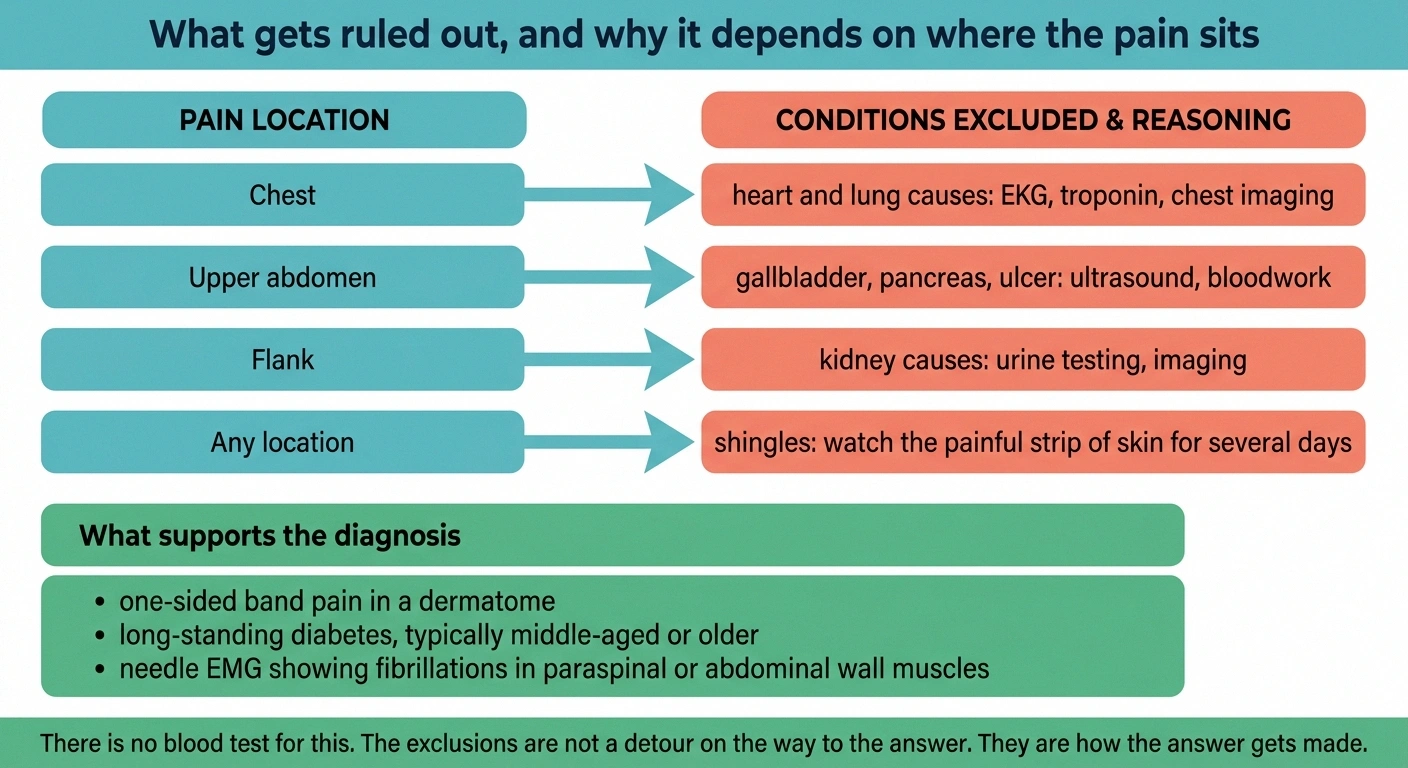
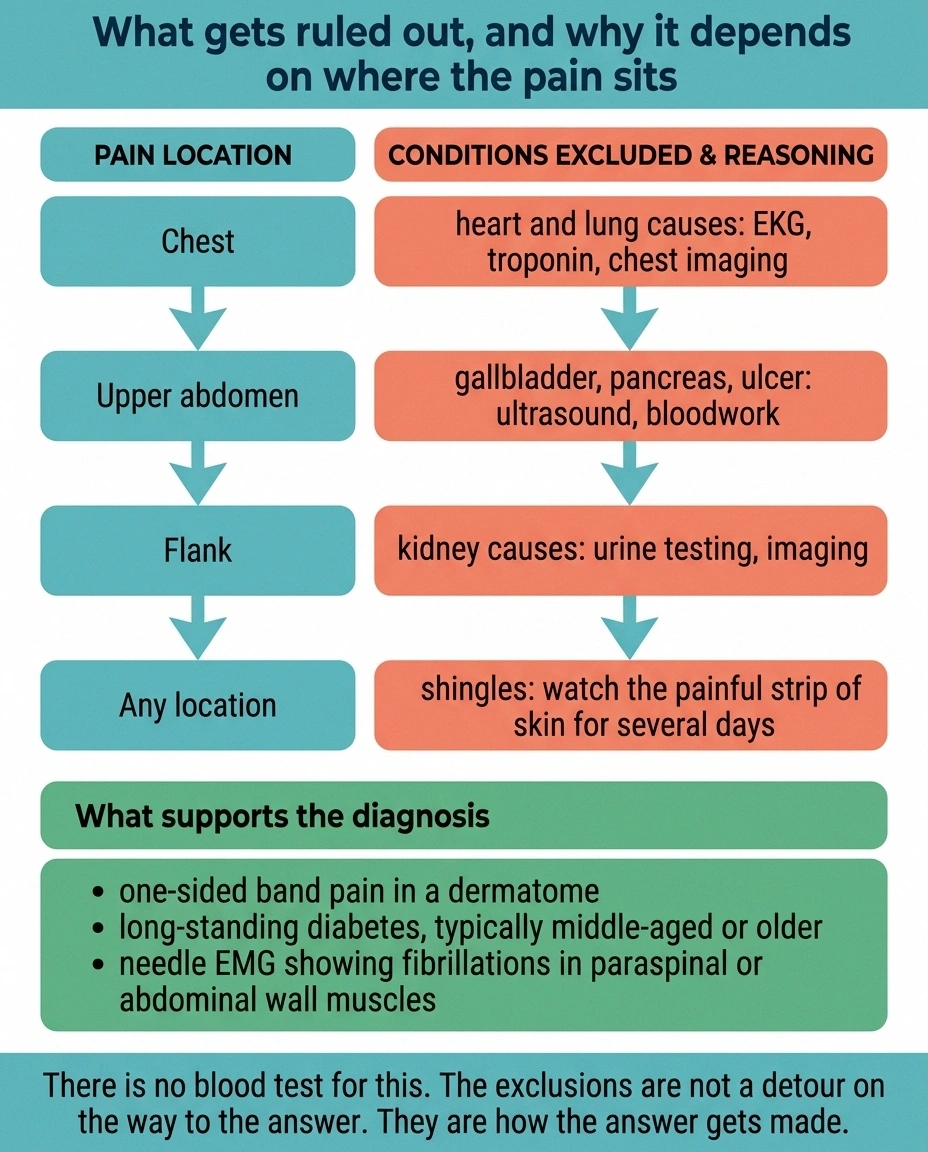
There’s no blood test for this — the diagnosis is built from three things: the clinical picture, the exclusion of everything more dangerous, and sometimes electrical testing.
The clinical picture is what you’ve read above — one-sided band pain, burning, nocturnal, allodynia, in someone with long-standing diabetes who is typically middle-aged or older. There’s a documented lean toward men with type 2 diabetes, though it certainly isn’t confined to them.
The exclusions depend on where the pain is. Chest means cardiac and pulmonary. Upper abdomen means gallbladder, pancreas, ulcer. Flank means kidney. Any of them means considering shingles. That list is the reason for the stack of normal results, and each one of those tests bought you information even though it came back negative.
Electrical testing can add real support. On needle EMG, the finding that points here is abnormal spontaneous activity, called fibrillations, in the muscles alongside the spine or in the abdominal wall at the affected levels. It shows the problem sits at the nerve root rather than further out, and it’s a genuinely useful confirmation. It isn’t always ordered, though, and a clear clinical picture with clean exclusions is often enough.
If you’re heading to a neurology appointment for this, going in organized is worth a great deal. Our guide to preparing for a neurology appointment covers the general approach. For this specific problem, bring three things: the date the pain started, a drawing of exactly where it runs, and the list of tests already done with their results.
What Helps While You Wait It Out

Treatment here is aimed squarely at symptoms, because there’s no procedure that repairs the root faster. The goal is to make the months livable.
More people abandon these medications over the timeline than over the side effects, because the ramp is rarely explained before it starts. Roughly what to expect:
Days 1 to 7. Starting dose, chosen to be tolerable rather than effective. Drowsiness and unsteadiness are common now and usually fade. Little or no pain relief yet, and that is expected rather than a bad sign.
Weeks 2 to 4. Dose climbing in steps. This is usually where the first real change shows up.
Weeks 4 to 8. An adequate dose held long enough to judge it. Only now is it fair to say whether a given medication works for you.
Two things worth knowing: a fair trial means an adequate dose, not merely a long one, so a medication abandoned at the starting dose was never actually tested. And these are not stopped abruptly, which matters if you decide one is not for you.
Neuropathic pain medication is the mainstay. The usual candidates are gabapentin and pregabalin, or duloxetine and certain tricyclics such as amitriptyline or nortriptyline. These aren’t painkillers in the ordinary sense; they change how readily the nerve fires. That also means they take one to several weeks at an adequate dose to show what they can do, and dosing usually starts low and climbs. Our overview of gabapentin for nerve pain covers what that ramp actually looks like.
Topical treatment fits this condition unusually well. Because the pain sits in a defined patch of body wall you can point to, lidocaine patches can be placed directly over it. That’s a much better anatomical match than it would be for pain scattered across both feet.
Clothing is a bigger lever than it sounds. When the skin is hypersensitive, waistbands, bras and stiff seams turn every hour into an aggravation. Soft, loose, seamless fabric over the affected band is free and it works the same day.
Get blood sugar as steady as you reasonably can. This won’t switch the pain off, and anyone promising that is overselling. But the underlying process is metabolic, and steadier glucose supports nerve recovery and reduces the risk of the next episode.
Sleep needs deliberate attention, since the pain peaks at night. A body pillow to stop rolling onto the affected side, loose bedding, and a sheet tented off the skin if touch is the trigger.
What isn’t indicated: surgery on the pseudohernia, and long-term opioids, which perform poorly against nerve pain while carrying every one of their usual costs.
The Timeline, Honestly
This is the part I’d have wanted first, so I’ll give it plainly.
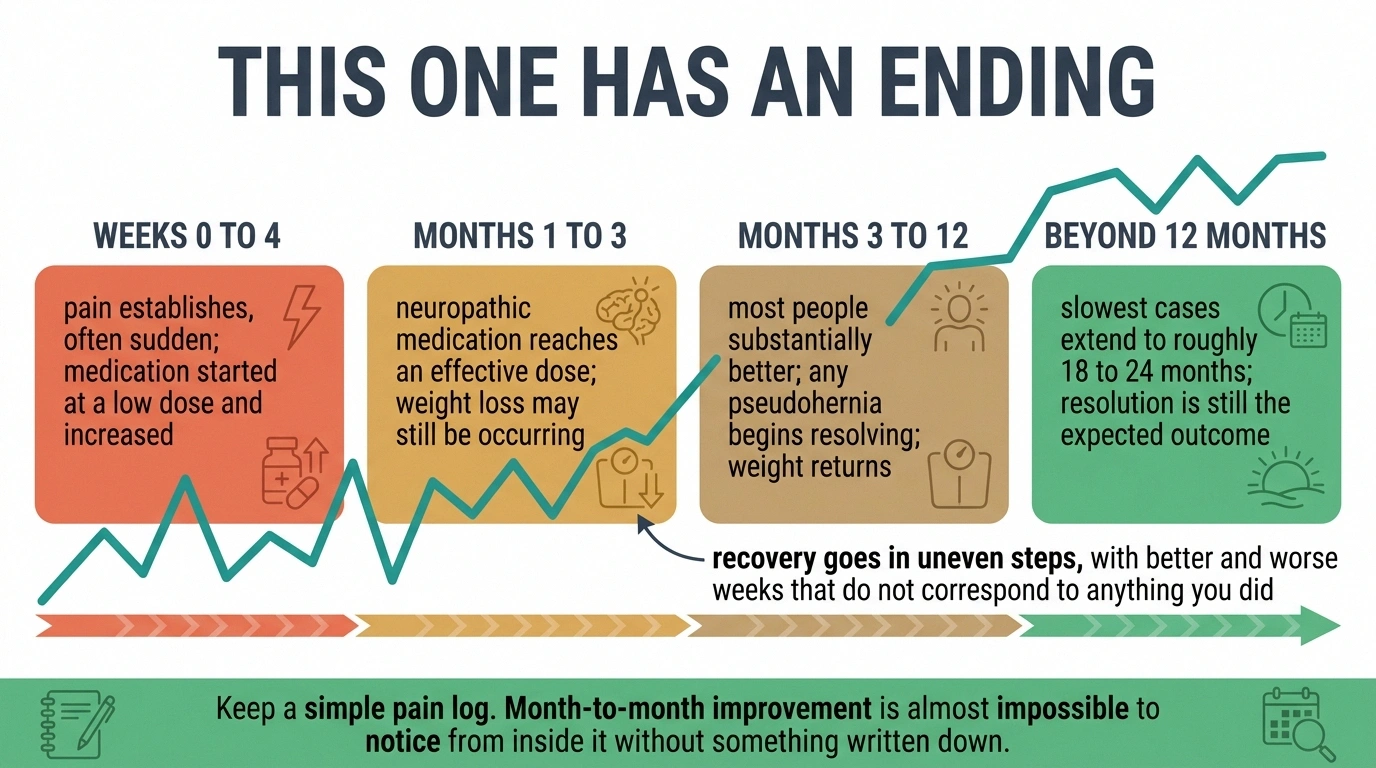
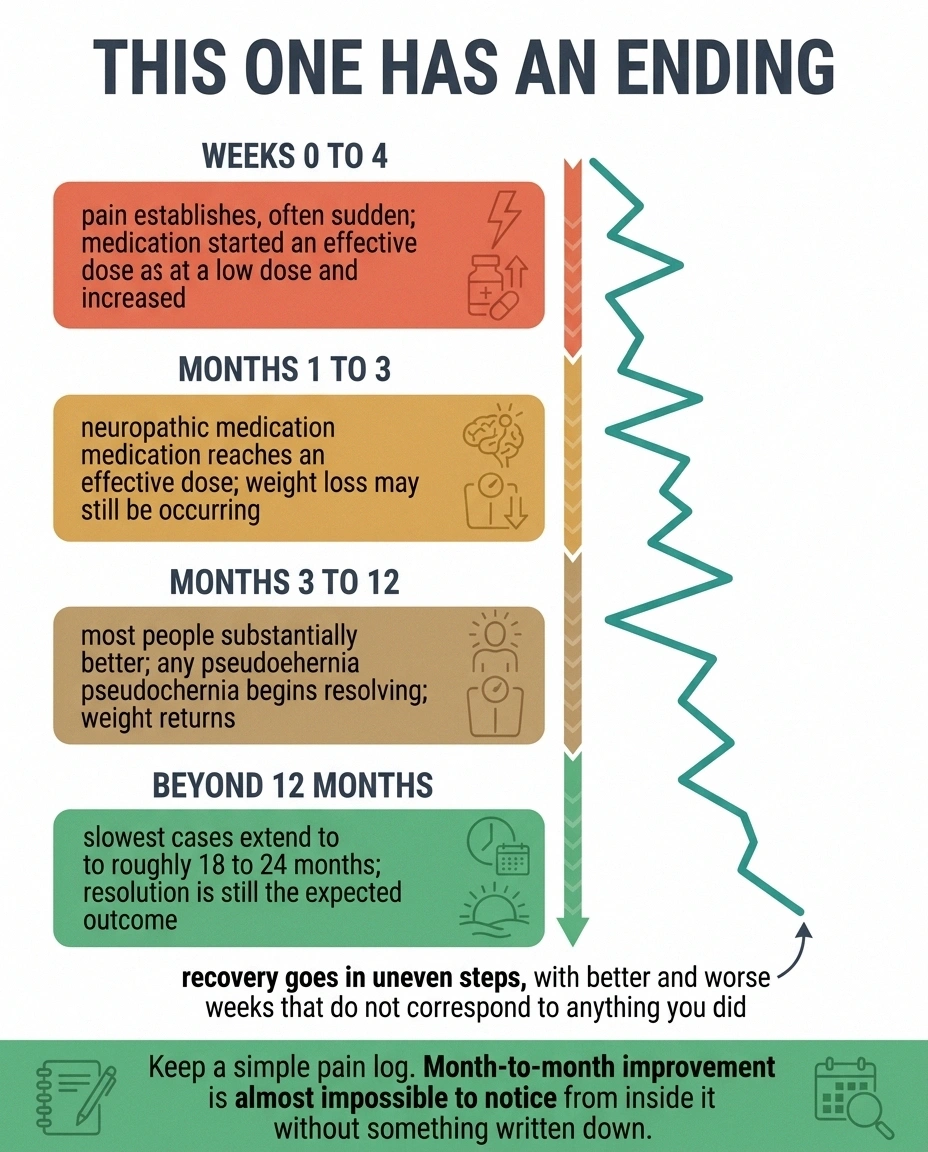
Diabetic truncal neuropathy is self-limiting. It resolves. Most people are substantially better within three to twelve months, and the medical literature describes pain subsiding within months, with an outer range extending to about a year and a half or two years in the slowest cases. The weakness and the bulge recover along with the pain. Surgery is not part of it.
Twelve months is not nothing, and I don’t want to package a hard year as good news. But it’s a genuinely different thing from the distal neuropathy in the feet that people with diabetes are used to hearing about, which tends to be a long-term management problem. This one has an ending, and telling the two apart matters for how you brace yourself.
Recovery isn’t linear either. It tends to improve in uneven steps, with better weeks and worse weeks that don’t obviously correspond to anything you did. A simple pain log helps here, not for your doctor but for you, because month-to-month improvement is nearly impossible to perceive from inside it without something written down.
Frequently Asked Questions
Can diabetes cause chest pain that isn’t coming from the heart?
Yes. Diabetic truncal neuropathy affects the thoracic nerve roots and produces pain felt in the chest or abdominal wall that has nothing to do with the heart. However, chest pain must always be evaluated as a possible cardiac problem first. People with diabetes are at higher risk of heart disease and may experience less warning pain during a heart attack, so assuming nerve pain without a proper evaluation is dangerous.
What does diabetic truncal neuropathy feel like?
Most people describe one-sided, band-like pain wrapping from the spine around the chest or abdomen, following the path of a rib or crossing part of the belly. It burns or aches deeply, is typically worse at night, and often comes with skin so sensitive that clothing or bedsheets hurt. Coughing, sneezing and movement tend to aggravate it. Onset is sudden or develops over days to weeks.
Why does my stomach bulge on one side?
When the affected nerve roots carry motor fibers to the abdominal wall, that section of muscle weakens and the wall pushes outward, creating a soft one-sided bulge. This is called a pseudohernia. It resembles a hernia but there is no defect in the wall, so surgical repair is not appropriate. A new bulge should still be examined, since genuine hernias also occur and some require prompt treatment.
How long does diabetic truncal neuropathy last?
It is self-limiting. Most people improve substantially within three to twelve months, and reported cases resolve within months up to a maximum of roughly one and a half to two years. Pain, weakness and any pseudohernia typically recover together. Recovery is usually uneven rather than steady, with better and worse weeks along the way.
Could this be shingles instead?
It could. Shingles produces a one-sided burning band in the same distribution and the pain can precede the rash by several days, making the two conditions nearly identical at first. If a rash or blisters appear along the painful strip, that points to shingles, and antiviral treatment is most effective when started early. Anyone with new one-sided band pain should watch that area of skin closely for the first several days.
Will an MRI show it?
Usually not. The damage is thought to be microvascular and inflammatory within the nerve root rather than something structural compressing it, so imaging is often normal. Scans are still frequently ordered, because their purpose is to exclude other causes rather than to confirm this one. Needle EMG can provide support by showing abnormal spontaneous activity in the paraspinal or abdominal wall muscles at the affected levels.
Does controlling blood sugar make the pain go away faster?
Steady blood sugar supports nerve recovery and reduces the likelihood of further episodes, but it does not switch off pain that is already established, and improvement in symptoms typically lags well behind improvement in glucose numbers. Pain relief in the meantime generally comes from neuropathic pain medications and topical treatments rather than from glycemic control alone.
Is the weight loss something to worry about?
Unintentional weight loss is a documented feature of this condition, and it usually reverses as the neuropathy resolves. It still warrants proper investigation on its own, because other serious conditions cause weight loss and should not be attributed to nerve damage without evaluation. If that workup is clean, weight loss alongside band-like pain fits the pattern of this syndrome.
About the Author