
Ask ten people with peripheral neuropathy how their feet feel, and one of the most common answers you'll hear is some version of this: “It's like I'm walking on marbles.” Or pebbles. Or gravel. Or lumpy socks that never smooth out no matter how many times you fix them. Or a folded-up sock that isn't actually there.
If you've felt it, you know exactly what I mean. And if you're the loved one of someone with neuropathy, this is one of the phrases you've probably heard them use — usually while glancing down at their feet with a puzzled look, or while sitting on the edge of the bed at night trying to figure out what's actually under their toes.
Nothing is under their toes. That's the whole point, and it's exactly what makes this sensation so unsettling. Your brain is telling you there's something small and hard rolling around beneath your foot. Your eyes are telling you there isn't. And you're the one who has to walk through the world with that mismatch every day.
Today I want to explain what's actually happening — why your nervous system generates this particular illusion, what it does and doesn't tell you about how your neuropathy is progressing, and what you can practically do about it. Because once you understand where “walking on marbles” comes from, it stops being spooky and starts making a lot of sense.
What “Walking on Marbles” Actually Feels Like
The classic description is a sensation that there are small, hard, round objects — marbles, pebbles, small stones — rolling around underneath the balls of the feet or the toes as you walk. Some people describe it as walking on a stack of quarters. Others say it feels like there's a bunched-up sock or a wrinkle in an insole that they can never smooth out no matter how many times they take their shoe off and check.
The sensation almost always shares some common features:
- It's most intense on the balls of the feet and in the toes, where the small nerve fibers are densest
- It's usually worse when you're standing or walking, and quieter (though not always absent) when you're sitting or lying down
- It's often worse at the end of the day, or after prolonged standing
- It's frequently paired with numbness — so the marbles feel real but the ground underneath doesn't
- Looking at your feet, taking off your shoe, and shaking out a sock changes nothing, because nothing is actually there
Some people feel it in both feet from the beginning. Others feel it in one foot first, and then the other joins in months or years later. Both patterns are common in different types of peripheral neuropathy.
Why Your Nervous System Creates This Illusion
Here's the piece that helps most people understand what's going on. The “marble” isn't in your shoe. It's in the signal.
Two Kinds of Damage, One Weird Sensation
✓ Key Takeaway
The “walking on marbles” sensation isn't a warning that something is physically wrong with your feet — it's a false signal generated by damaged small nerve fibers. Nothing is actually there, but your brain has no way to know that. Understanding the mechanism helps take the alarm out of the feeling.
Your feet are covered in different kinds of nerve fibers — some carry information about pain, some about temperature, some about vibration, and some about pressure and position (called proprioception). Together, these fibers create a constant, updating map of what your foot is doing and what it's touching.
In peripheral neuropathy, that map gets scrambled in two ways at once:
1. Some fibers are damaged and firing spontaneously. Damaged nerves don't just fall silent. They often become irritable — they send signals to your brain that don't correspond to anything actually happening on your skin. Your brain, which has spent your whole life interpreting nerve signals as “something is touching my foot,” faithfully interprets these false signals the same way. If the pattern of firing resembles what “a small round pressure” would look like, your brain concludes there's a small round something pressing on the ball of your foot.
2. Other fibers are damaged and NOT firing when they should. This is the numbness side of neuropathy. The fibers that should be reporting “the ground is flat, evenly distributed pressure across the whole sole” have gone quiet. What comes through is patchy — some spots reporting clearly, others reporting nothing, and still others sending noisy false signals. Your brain assembles this uneven, patchy input into the best guess it can make, and the guess often looks like small localized bumps where the false signals are firing.
Combine those two things — spontaneous firing from damaged small fibers plus dropped-out coverage from other damaged fibers — and you get exactly the pattern the brain interprets as “something small and round is under my foot.”
It's not that your feet have anything wrong with them structurally. Your skin is fine. Your bones are fine. Your muscles are fine. Your nervous system is generating a story that doesn't match reality, and unfortunately your brain has no way to know that.
Which Kinds of Neuropathy Cause This Feeling?


The walking-on-marbles sensation shows up most often in the neuropathies that damage small nerve fibers. Small fibers are the ones that carry pain, temperature, and some pressure signals. They're the first to be affected in many common forms of neuropathy, which is why sensory symptoms often precede the more obvious weakness or coordination problems.
🔬 The Research Says
The “walking on marbles” sensation is one of the classic self-reported symptoms of small-fiber peripheral neuropathy. Small fibers are the thinly-myelinated and unmyelinated nerves that carry pain, temperature, and some pressure information — and they're often the first affected in diabetic, chemotherapy-induced, and idiopathic neuropathies.
Conditions that most classically produce this feeling include:
- Diabetic peripheral neuropathy — by far the most common cause. Long-standing high blood sugar damages the small fibers first, producing exactly the pattern of scattered false signals plus patchy numbness that generates this sensation.
- Idiopathic small fiber neuropathy — many people with this condition report the marble feeling as one of their most distinctive early symptoms, sometimes before any measurable weakness.
- Chemotherapy-induced peripheral neuropathy — CIPN from taxanes, platinum drugs, vincristine, and bortezomib frequently causes this specific sensation as one of the early presenting complaints.
- Idiopathic sensory neuropathy — when doctors can't find a cause, the small-fiber pattern often still produces this hallmark sensation.
- Autoimmune small fiber neuropathies — conditions like Sjögren's syndrome and sarcoidosis can produce the sensation.
It's also worth noting what usually does not produce the walking-on-marbles feeling. Purely mechanical problems — a plantar wart, a real callus, a Morton's neuroma, a stone truly stuck in your shoe — usually feel differently and are localized to one specific spot that you can find with your finger. If pressing on the spot reproduces the sensation and letting go relieves it, that's a mechanical problem. If nothing on your foot corresponds to where the feeling is, and the sensation persists whether you're barefoot on carpet or wearing sneakers, that's a neurological signal.
Why It Gets Worse at Night (and Other Timing Patterns)

A lot of people notice that the marble feeling isn't constant. It has patterns. Understanding these patterns can be both reassuring (they're normal) and useful (you can plan around them).
When the Marble Feeling Gets Louder
Worse at night. Like a lot of neuropathy symptoms, the walking-on-marbles feeling can get louder in the evening and overnight. Part of this is the same reason neuropathy gets worse at night in general — less distraction, cooler skin temperature, changes in blood flow, and the small fibers having spent the whole day accumulating input. It's not that the neuropathy is progressing at night. It's that the brain is quieter and more able to attend to the noise.
Worse after standing. Prolonged standing loads the small fibers and increases the volume of noisy input coming from the feet. Sitting down often provides at least partial relief. This is why the marble sensation is often described as “worse at the end of a shopping trip” or “worse after cooking dinner.”
Worse in certain shoes. Some patients notice the sensation is worse in flexible thin-soled shoes and better in shoes with stable cushioned soles. Some notice the opposite. Both are real. Different feet respond differently, and the only way to know which pattern applies to yours is to pay attention over a few weeks.
Better with movement (sometimes). Interestingly, some people find that walking actively — not standing still — reduces the sensation, at least for a while. The theory is that steady rhythmic input from active gait provides “signal” that partially drowns out the noisy false signals. If you find this pattern in your feet, gentle regular movement can be a therapeutic tool.
Does the Marble Feeling Mean My Neuropathy Is Getting Worse?
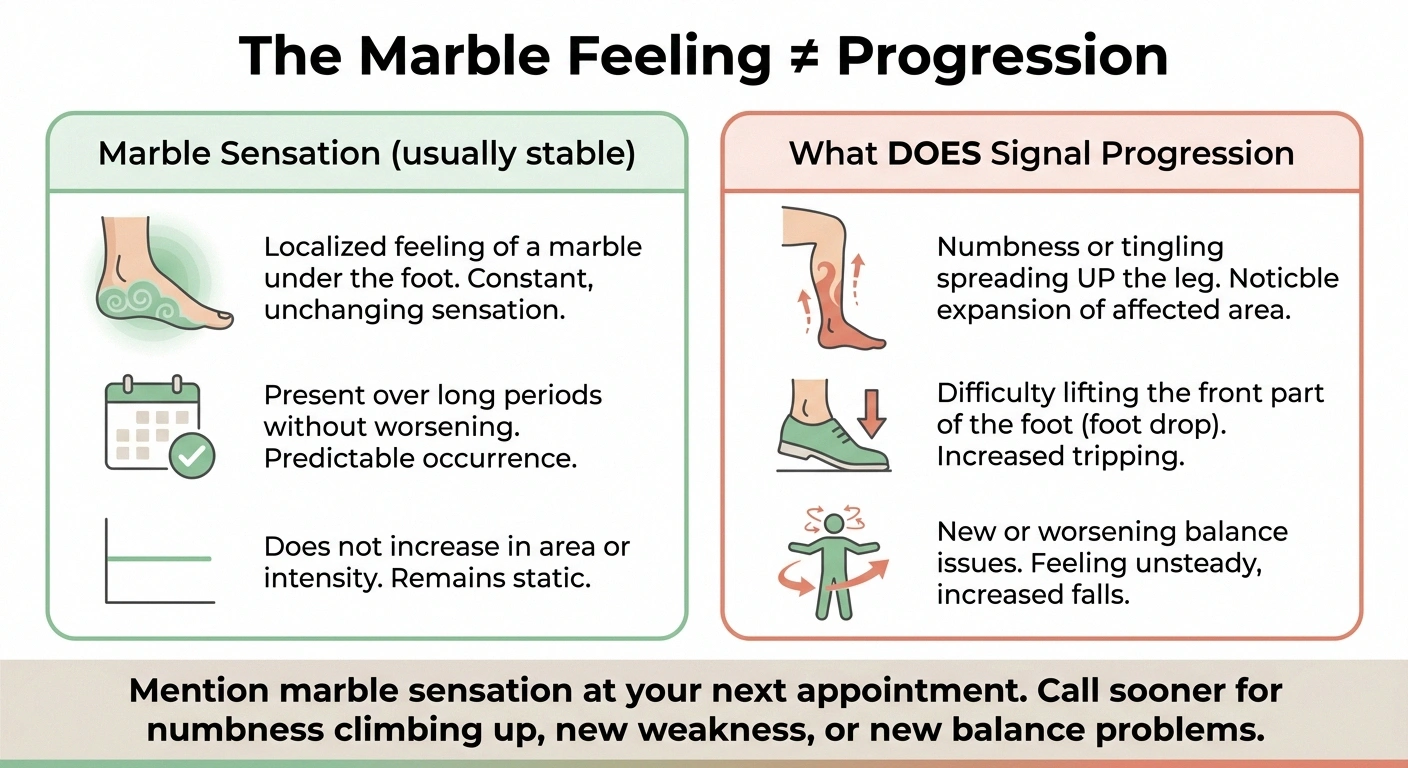
This is the question I hear most often when someone first develops this specific sensation, and the honest answer is: not necessarily.
⚠️ What Actually Signals Progression
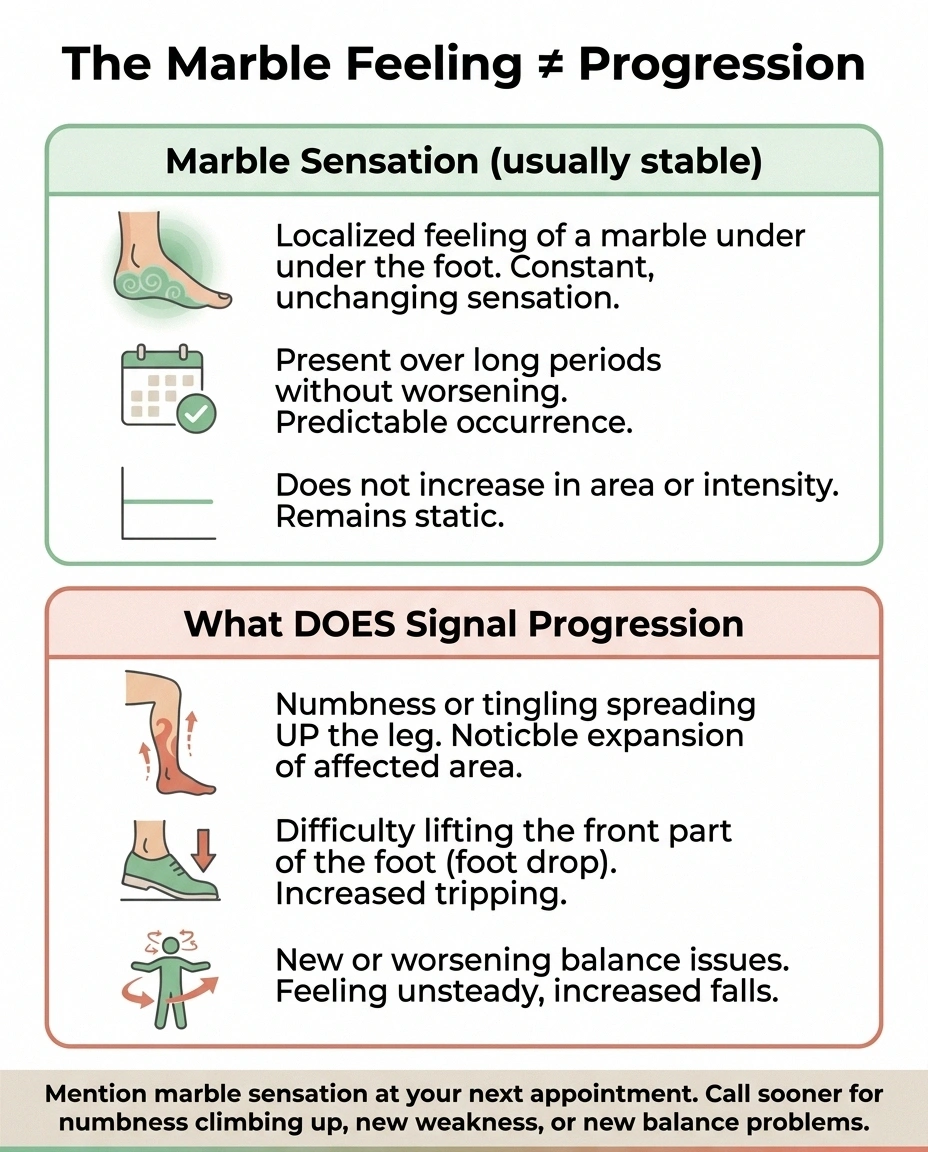
A stable marble feeling on its own is usually not a progression signal. But these are worth flagging for your neurologist:
- Numbness climbing up from your toes toward your calves
- Weakness — foot drop, difficulty rising on tiptoes, catching your toes on carpet
- New balance problems on flat surfaces
- Any sudden change from stable to significantly worse
The walking-on-marbles feeling is not a reliable marker of neuropathy progression. It's a marker of a particular pattern of small-fiber involvement. Some people have this sensation from the very first months of their neuropathy and it stays roughly the same for years. Some people develop it midway and then it fades even as other symptoms shift. Some people never develop it at all despite significant neuropathy.
What you're looking for as signs of actual progression is different — new areas becoming numb (the numbness climbing up from toes to feet to lower legs), new weakness (foot drop, difficulty rising up on tiptoes), or new balance problems (feeling unsteady even on flat surfaces with the lights on). Those changes matter and warrant a call to your neurologist. A stable marble sensation, on the other hand, usually just means the pattern of your neuropathy has settled into a shape that includes this particular symptom.
That said, any new onset of this sensation — especially if you've been previously symptom-free — is worth mentioning at your next appointment. It's not an emergency, but it is information worth putting in your medical record.
What Actually Helps (and What Doesn't)

There's no magic switch for this specific sensation. But there are meaningful practical approaches that can reduce how much it interferes with your daily life.
Practical Toolkit for the Marble Feeling
What often helps:
- Well-fitting stable shoes with adequate cushioning. Not necessarily maximalist “cloud” shoes — many people find those actually worsen the feeling because the foot has too little proprioceptive contact with the ground. Stable, supportive, moderately cushioned. Neuropathy-friendly shoe selection is genuinely worth the effort.
- Custom or over-the-counter orthotics that distribute pressure evenly across the sole. Many people find that reducing the peak pressure at the ball of the foot reduces the marble feeling significantly.
- Neuropathy socks or seamless socks. Not because they treat the neuropathy, but because they eliminate one common source of confusing input (seams, lumps, tight bands).
- Standard neuropathy medications — gabapentin, pregabalin, and duloxetine can dampen the false signal-firing that produces the sensation. They don't eliminate it in most people, but they can reduce it.
- Blood sugar control, if you have diabetes. This is a long game, not a fast fix, but every point of A1C reduction toward target ranges reduces future nerve damage.
- Regular gentle movement. As mentioned above, some people find that active walking quiets the sensation. Steady daily movement is worthwhile for many reasons.
What usually doesn't help:
- Constantly checking your shoe. It won't be there, and the checking behavior itself keeps the sensation front-of-mind. Give yourself permission to look once and then trust that nothing has changed.
- Aggressive foot rubbing or hot baths to “wear out” the feeling. Sensation isn't a build-up of physical stuff — you can't massage it away, and vigorous rubbing can create new skin irritation.
- Sleeping with your feet pressed against a firm surface hoping the pressure will overwhelm the false signal. It doesn't work, and in people with reduced sensation, sustained pressure can create pressure injuries you won't feel.
Foot Safety When You Can't Fully Trust What You Feel

Here's the practical warning to hold alongside all of the above: when you have a sensation of something being under your foot that isn't there, the reverse is also true. Something can be under your foot that IS there, and you may not feel it.
A pebble in your shoe. A small piece of glass on the kitchen floor. A crumpled sock that has actually crumpled. A too-hot bath. A hot pavement in July. These are the situations that turn small oversights into serious injuries in people with neuropathy.
Which means the daily foot inspection habit becomes essential — not because the marble sensation is dangerous, but because your normal early-warning system for feet is unreliable. Look at your feet every day. Take shoes off and check the insides before putting them on. Trust your eyes, not your feet, for what's actually going on down there.
This is particularly important if you also have diabetes. The combination of reduced sensation and reduced blood flow to the feet is the mechanism behind most preventable diabetic foot complications, and it's the exact reason your endocrinologist keeps asking whether you're checking your feet.
When to Actually Call Your Doctor

The walking-on-marbles feeling on its own, in someone with an established neuropathy diagnosis, is usually not something to call the doctor about. Mention it at your next scheduled appointment so it's in the record and so your doctor can track any changes over time.
But there are situations where the sensation warrants a sooner call:
- New onset with no prior diagnosis. If you don't have a known neuropathy and this feeling shows up, it's worth investigating what's causing it. Many treatable conditions (B12 deficiency, thyroid problems, prediabetes, medication side effects) can be the underlying driver, and catching them early matters.
- Sudden change from stable to significantly worse. A stable marble feeling that suddenly becomes constant and intense may reflect new nerve injury from a new cause and warrants evaluation.
- Marble feeling plus new weakness. Any new weakness — trouble lifting the front of your foot, difficulty walking on your heels, catching your toes on carpet — is a “call the neurologist this week” situation regardless of what other symptoms are doing.
- New injury signs. If you find a wound, a callus that's changed, discoloration, or unexplained swelling, don't wait — those are podiatry-today situations.
Living With the Sensation Long-Term

For people who've been living with this feeling for years — and there are a lot of you — I want to end with something practical rather than clinical.
✓ The Long View
The marble sensation rarely disappears completely, but it usually becomes quieter and less demanding over time. Not because it goes away — because your brain gradually learns this signal is not a call to action. Foreground becomes background. Something you notice becomes something you barely think about most of the day.
The marble sensation is often not “curable” in the sense that it goes away entirely. What changes for most people is their relationship to it. Early in the neuropathy journey, the feeling is startling and constantly demands attention. It feels like something is going wrong that you should be doing something about.
Over time, most people find that the sensation moves from foreground to background. It's still there. But your brain gradually learns that this signal is not a call to action — nothing needs to be done, nothing is wrong that you can fix, no shoe needs to be shaken out. The signal reaches consciousness less often, and when it does, it's less alarming.
Some things that help this transition happen faster:
- Getting on effective medication so the raw signal volume is lower
- Wearing shoes and socks that eliminate confounding real-world input
- Learning your patterns so you can predict when it'll be louder and softer
- Not fighting the sensation every time it happens — which paradoxically often makes it quieter
- Having other people you can talk to about it — because “walking on marbles” is a phrase that only makes sense to someone else who's felt it
None of this makes the sensation go away. But it makes it possible to live around it, plan around it, and eventually let it fade from a daily preoccupation into a background hum you barely notice most of the time.
And in the meantime — take care of your feet. Check them every day. Wear shoes that fit. See your neurologist for the checkups. And remember that this specific weird phantom feeling, unpleasant as it is, doesn't tell you anything worrying about the direction of your neuropathy. It just tells you what kind of pattern your particular version has settled into.
Frequently Asked Questions
Why does it feel like there are marbles under my feet when there aren't?
The sensation comes from damaged small nerve fibers in your feet that are firing spontaneously and sending false signals to your brain, combined with other fibers that have become quiet and stopped sending normal signals. Your brain interprets the patchy pattern of noisy signals as if something small and round were pressing on the ball of your foot. Nothing is actually there. Your nervous system is generating the illusion because the nerve fibers themselves are damaged and misreporting what your foot is touching.
Is walking on marbles a sign of nerve damage getting worse?
Usually not. The walking-on-marbles sensation reflects a particular pattern of small-fiber involvement rather than the overall severity or progression of your neuropathy. Many people have this sensation from early in their condition and it stays roughly stable for years. What actually indicates progression is different — new numbness spreading up from the toes, new weakness, or new balance problems. A stable marble sensation on its own does not mean your neuropathy is getting worse.
Can walking on marbles feeling go away?
For most people it does not fully go away, but it can become much quieter and less bothersome. Effective medications like gabapentin, pregabalin, or duloxetine can dampen the false signal firing. Good shoes and orthotics that distribute pressure evenly can reduce the sensation. Good blood sugar control if you have diabetes can slow further nerve damage. Over time, many people also find their brain adapts and the sensation fades into the background even if it does not disappear entirely.
What kind of shoes help with walking on marbles feeling?
Most people do best with well-fitting stable shoes that have moderate cushioning and a supportive sole. Extremely soft maximalist shoes sometimes make the feeling worse because the foot loses too much proprioceptive contact with the ground. Extremely thin flexible shoes can also worsen it because there is not enough pressure distribution. Custom or good over-the-counter orthotics that spread pressure evenly across the sole often reduce the sensation. Seamless neuropathy socks help by eliminating real-world seams and wrinkles that add to the confusion.
Should I be worried if walking on marbles feeling started suddenly?
A brand-new onset in someone with no prior neuropathy diagnosis is worth investigating with your doctor. Many potentially treatable causes — B12 deficiency, thyroid problems, prediabetes, side effects from certain medications, or autoimmune conditions — can produce this sensation. Catching them early matters because some are reversible. It is not an emergency, but do not wait months to bring it up. Schedule an appointment in the next few weeks so it can be evaluated properly.
Can walking on marbles feeling happen without any other neuropathy symptoms?
Yes, particularly in early small fiber neuropathy. Some people experience this specific sensation as one of their first symptoms, sometimes months or years before more obvious signs like measurable numbness or weakness develop. If this is your only symptom, mention it to your primary care doctor and ask about basic bloodwork for common causes. If those come back normal and the sensation persists, a neurologist consultation and possibly a small-fiber-specific evaluation may be worthwhile.
Does the walking on marbles sensation get worse at night?
For many people yes. Neuropathy symptoms in general often become more noticeable in the evening and at night when there is less distraction, the skin is cooler, and the brain has less competing input. This does not mean the neuropathy is progressing at night. It usually means the underlying signal is the same but you are more able to attend to it. Nighttime worsening often responds to taking neuropathy medications in the evening if your doctor agrees, keeping the bedroom cool but not cold, and having a warm shower before bed.
Can I test whether the marbles are real or not?
Yes, and I encourage this to become a habit rather than a repeated inspection cycle. Once per day, take off your shoe, look at the sole and the insole visually, shake out anything that might be there, and put the shoe back on. Then trust the check. If the feeling persists after a clean-shoe verification, you can be confident it is a nervous system signal rather than a physical object. Repeatedly stopping and checking through the day tends to make the sensation more prominent rather than less.
About the Author