
You take off your socks at the end of the day. You look down at your feet, half expecting to see red rings where the elastic had been pressing all day long. But there aren't any. The feeling is still there — that unmistakable sensation of a snug band squeezing around your feet, ankles, or lower calves — but there's nothing on you. There hasn't been anything on you for the last twenty minutes, and yet the sensation hasn't budged.
If that description sounds familiar, welcome. This is one of the most common phantom sensations in peripheral neuropathy, and it's one of the strangest, because unlike a burning pain or an electric shock, this one feels almost mundane. It's not painful (usually). It's not alarming. It's just there, like you're wearing an invisible extra sock that you can't take off.
People describe it in different ways: a tight sock, a snug band, an ace bandage that's not there, an invisible sleeve, tight stockings, a rubber band around the ankle. Some people say it feels more like fabric pressure. Some say it feels more like a strong hug. Some say it's specifically at the ankles, others across the toes, and some say the whole foot from ankle to toe box.
What all these descriptions share is the same underlying oddity: your nervous system is generating the feeling of external pressure on your skin when no external pressure exists. In this article I want to walk you through why that happens, what it does and doesn't mean, when to worry, and what actually helps take the edge off.
What “Tight Sock Feeling” Actually Feels Like
Peripheral neuropathy produces several classic phantom sensations, and the tight-sock feeling is different from all of them in some specific ways worth naming.
It is not sharp. It is not stabbing. It is not the electric-shock feeling that comes and goes. It is a steady, constant, low-level pressure sensation that feels like something is pulled snug against the skin. Sometimes it feels like fabric. Sometimes it feels more like compression. Sometimes it feels like a mildly damp cloth wrapped around the foot. But the through-line is that it is a continuous pressure experience, not a spike.
The most common patterns:
- Ankle-level band — feels like a snug sock cuff or a mild ace bandage circling the ankle
- Full-foot sock feeling — feels like you're wearing a real sock from toes to ankle even when barefoot
- Toe-band feeling — feels like a rubber band across the toes or the ball of the foot
- Calf-level compression — feels like a compression sleeve pulled up to mid-calf
- Glove feeling in the hands — the same phenomenon can occur in the hands, where it feels like you're wearing gloves you aren't wearing
Most people report that the sensation is roughly symmetric — it happens on both feet or both hands, in similar locations. That symmetric pattern is one of the classic fingerprints of peripheral neuropathy in general, sometimes called the “stocking and glove” distribution because it maps to the parts of the body that would be covered by stockings and gloves.
The intensity varies. Some people describe it as barely noticeable most of the time. Others say it's a constant background presence they can't tune out. Many people notice it worst when they've just taken off actual socks (the contrast is jarring) or when they're settling into bed at night.
✓ Key Takeaway
The tight-sock sensation isn't a warning — it's a phantom pressure signal generated by damaged nerve fibers. Your brain has learned to interpret certain patterns of nerve input as “sock pressure.” Damaged fibers happen to produce a similar pattern, even when nothing is touching your skin.
Why Your Feet Feel Compressed When Nothing Is Touching Them
Here's the piece that helps most people make sense of the sensation. To feel that a sock is pressing against your foot, your brain doesn't actually need a sock. It only needs the pattern of nerve signals that a sock would produce.
🔬 Three Mechanisms at Once
- Ectopic firing: Damaged fibers generate spontaneous signals without a real stimulus.
- Central sensitization: Spinal and brain pain-processing centers amplify what input does arrive.
- Lost “off” signals: Fibers that normally filter background noise stop doing their job.
Your feet are covered in different kinds of pressure-sensitive nerve endings. When you put on a real sock, these nerves fire in a very specific pattern — steady, moderate pressure distributed evenly across the parts of the skin that the sock is touching. Your brain has spent your entire life learning to interpret that pattern as “I am wearing a sock.”
In neuropathy, damaged nerve fibers can fire spontaneously — sending signals that resemble that same steady, moderate pressure pattern, even when nothing is actually touching the skin. The pattern isn't perfect, but it's close enough that your brain does the same thing it always does: it interprets the signal as external pressure. And because the fibers are damaged in a symmetric, stocking-and-glove distribution, the false signals also emerge in a stocking-and-glove distribution. So the phantom pressure feels like a sock or a glove, not like something random.
What's happening at the fiber level is a mix of a few things at once:
- Ectopic (out-of-place) firing from injured nerve fibers that have become irritable and generate signals without a real stimulus
- Central sensitization — the pain and pressure processing centers in the spinal cord and brain becoming amplified, so even a small amount of noisy input generates a strong perceived sensation
- Loss of normal “off” signals — damaged fibers that used to help the nervous system distinguish between real touch and background noise stop doing that job, so the noise floor rises
Add those together and you have a nervous system that's generating a plausible-enough imitation of “a sock is on your foot” to fool the interpretive part of your brain.
This is why the sensation persists even when you take off your actual socks and stare at your bare feet. The signal isn't coming from your skin. It's coming from further up the nerve chain. Your eyes see bare feet. Your nervous system reports a sock. Both are technically correct — the bare skin is real and the phantom nerve signal is also real. Just the interpretation is off.
Is the Tight-Sock Feeling a Sign of Progression?
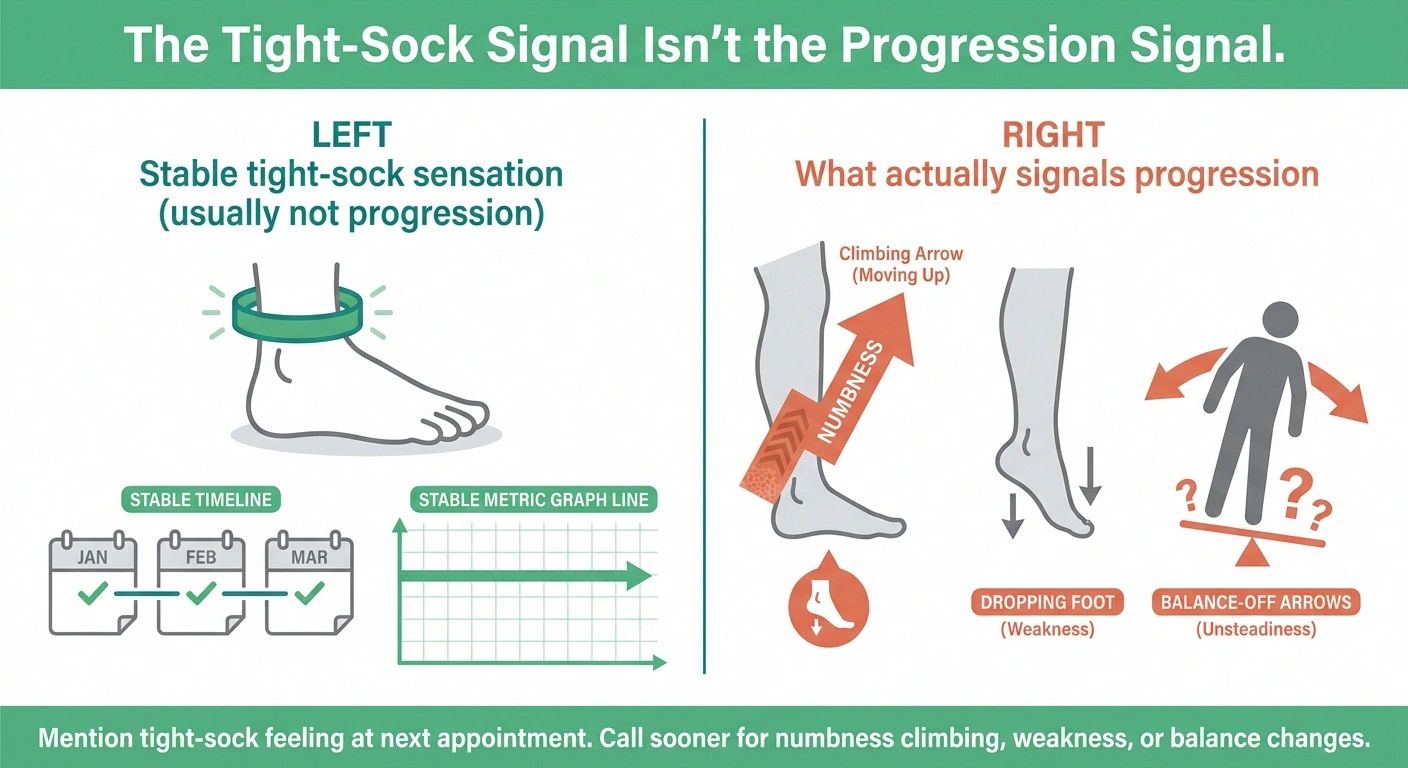
This is one of the first questions people ask me when they develop this sensation for the first time, and I want to give you the straight answer.
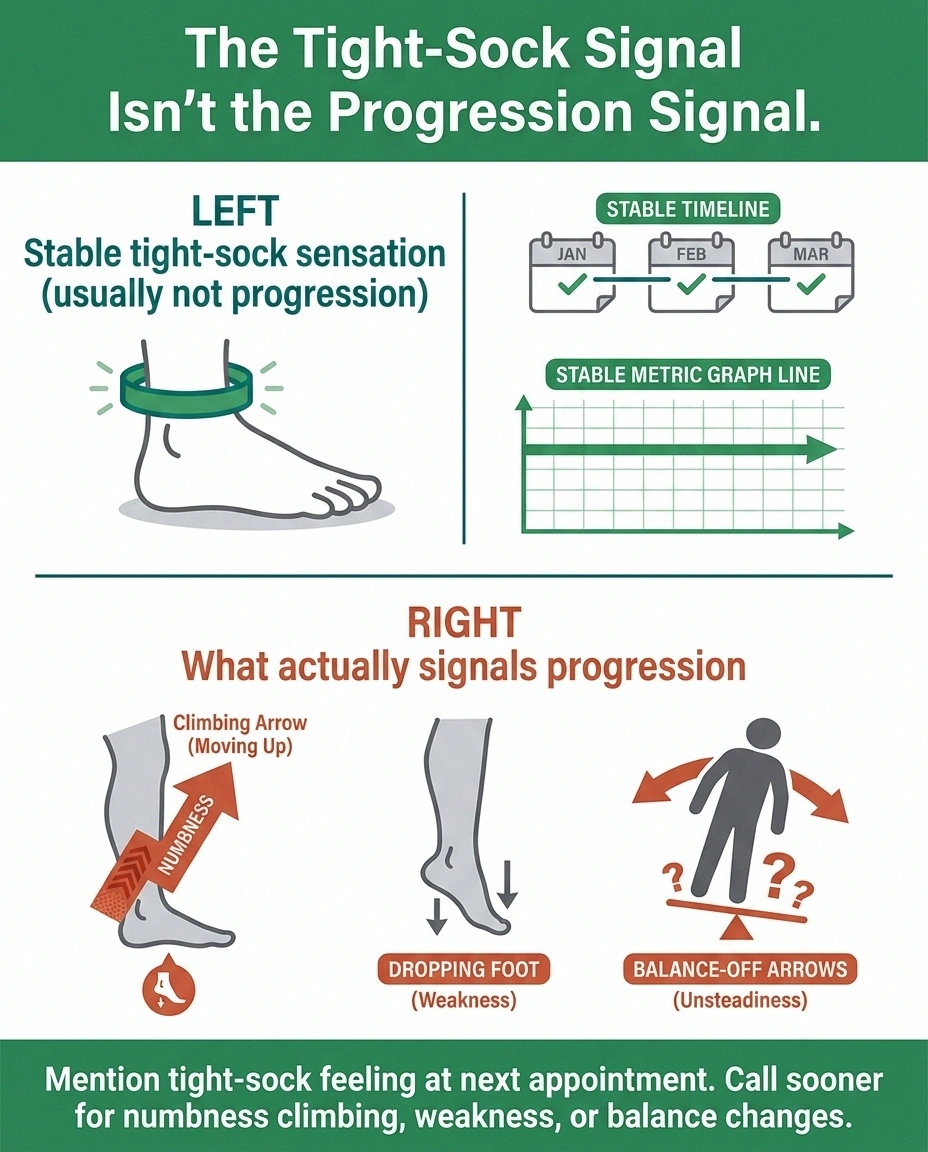
The tight-sock feeling is not by itself a reliable indicator that your neuropathy is progressing. It's one specific manifestation of a broader pattern of nerve fiber involvement, and it can appear early, appear late, come and go, or stay steady for years — all of these patterns are normal.
What actually matters for tracking progression is different:
- Numbness spreading upward — if the numb area is climbing from your toes up your foot, up the ankle, up the calf, that's a real progression signal
- New weakness — trouble lifting your foot, catching your toes on the carpet, difficulty rising up on your heels or toes
- New balance issues — feeling unsteady on flat ground, needing to reach out for support that you didn't need before
- New involvement of the hands — if you started with foot symptoms only and now have hand symptoms, that reflects the neuropathy climbing the length-dependent pattern
- Any new onset of symptoms in someone without a prior diagnosis — regardless of what the specific symptom is
A stable tight-sock feeling on its own is generally just information about the shape of your neuropathy, not a warning about its trajectory. Mention it at your next neurologist appointment so it's in the record. Don't treat it as a reason for a between-appointment call unless it's paired with one of the actual progression signals above.
The “Stocking and Glove” Pattern Explained
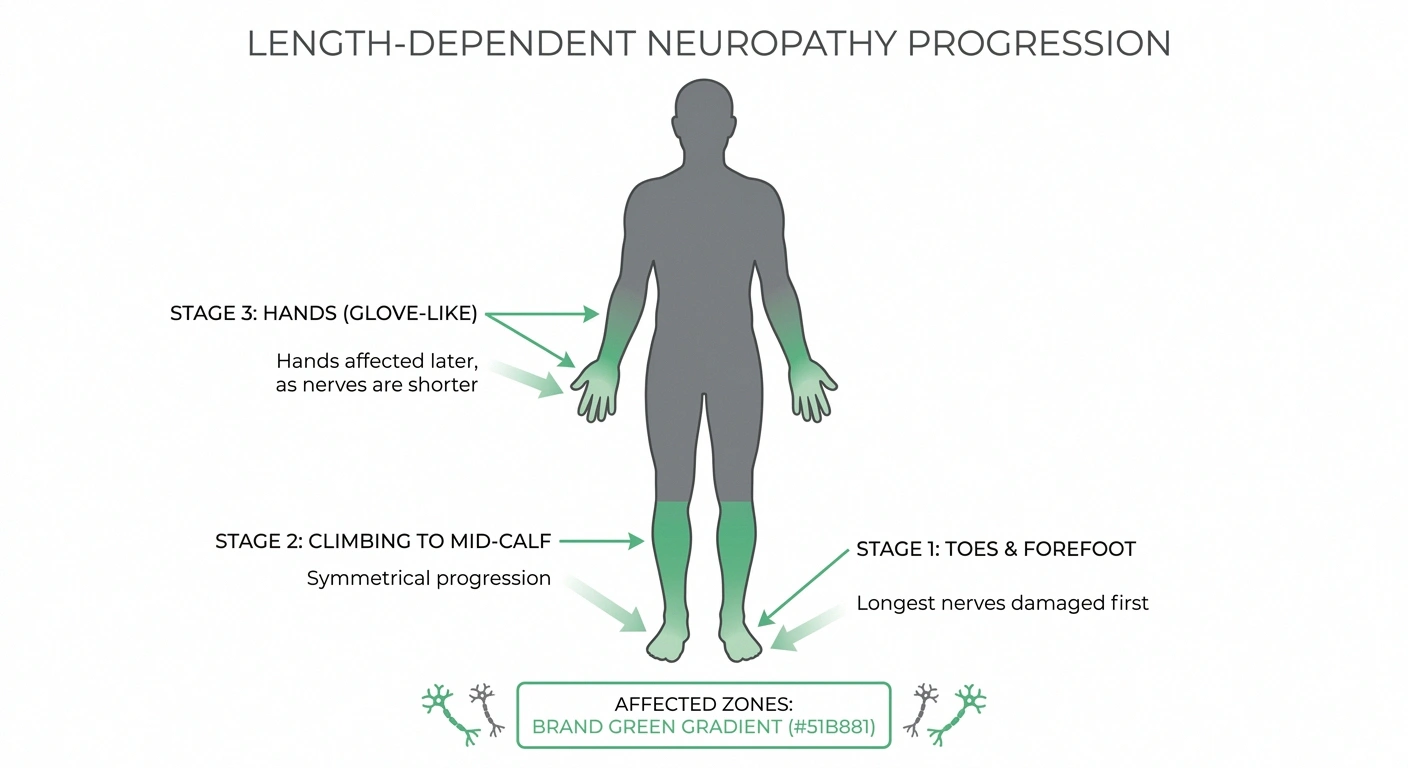
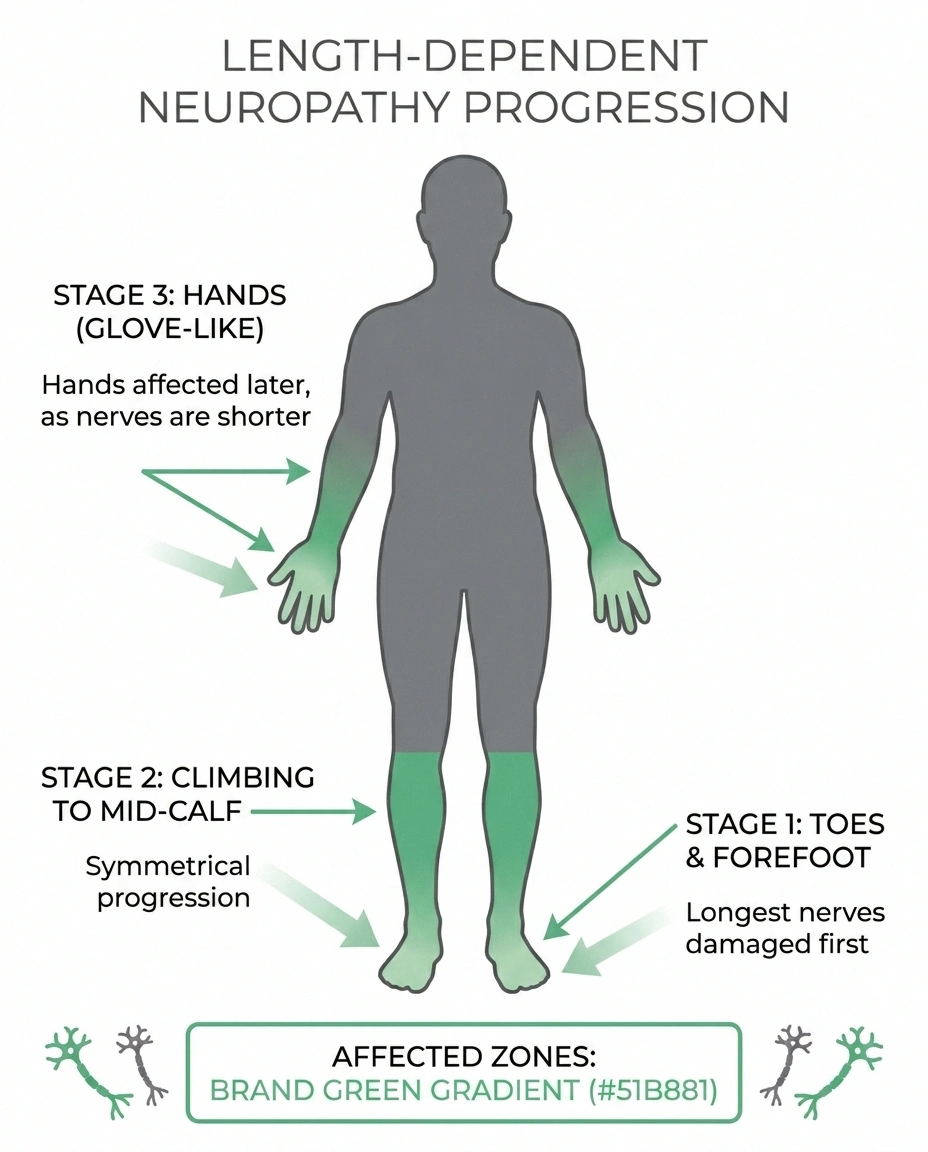
Since a lot of neuropathy patients hear the term “stocking and glove” from their doctors and never quite have it explained, I want to take a moment to unpack why the tight-sock sensation follows this specific geographical pattern on your body.
Peripheral neuropathy from diabetes, chemotherapy, alcoholic damage, and many other causes tends to affect nerves in what's called a length-dependent pattern. This means the longest nerves in your body — the ones running from your spinal cord down to your toes — are damaged earlier and more severely than shorter nerves.
Why? Because a long nerve fiber has more surface area to protect and more distance to keep healthy. If a metabolic problem (like high blood sugar) or a toxic exposure (like a chemotherapy drug) is causing damage, the longest fibers accumulate the most damage the fastest. So the symptoms show up first at the farthest ends — the toes — and then gradually climb upward as more of the fiber becomes affected.
By the time the damage has climbed to about mid-calf on the leg nerves, the shorter nerves supplying the hands are just starting to reach the same threshold at their far ends — the fingertips. That's why hand symptoms often begin around the time foot symptoms have progressed up to the knees. And it's why the sock-and-glove distribution is such a reliable pattern in generalized peripheral neuropathies.
Why It's Called “Stocking and Glove”
The longest nerves accumulate damage first — which is why symptoms map onto the exact areas a stocking and glove would cover.
The tight-sock feeling maps onto exactly this same geography. False pressure signals emerge where the nerve damage has reached — the feet first, then climbing, then the hands as their own length-dependent pattern kicks in. It's the same underlying process expressing itself as a specific type of sensation instead of numbness or pain.
Common Causes That Produce This Feeling

The tight-sock sensation is a general small-fiber and large-fiber neuropathy symptom, so it can be caused by many of the same conditions that produce the classic burning-and-tingling of neuropathy. The most common:
Most Common Causes of the Tight-Sock Feeling
- Diabetic peripheral neuropathy — the number one cause worldwide. Long-standing elevated blood sugar damages both small and large fibers in the length-dependent pattern.
- Chemotherapy-induced peripheral neuropathy — many of the chemotherapy drugs used for common cancers cause a very characteristic version of this sensation.
- Alcoholic neuropathy — chronic heavy alcohol use produces classic length-dependent neuropathy with the stocking-glove distribution.
- B12 and other vitamin deficiencies — B12, folate, B1, and B6 deficiencies can all produce this pattern. B12 deficiency is particularly common in older adults, vegetarians, and people on long-term acid-blocker medications.
- Idiopathic peripheral neuropathy — when doctors can't find a specific cause, the stocking-and-glove sensation still tends to appear.
- Thyroid disorders — an under-active thyroid can cause a slowly-progressive peripheral neuropathy with sock-like symptoms.
- Autoimmune conditions — Sjögren's syndrome, sarcoidosis, and some vasculitis conditions can produce this pattern.
What all these causes share is that the damage they produce follows the length-dependent pattern. That's why the symptom pattern (tight-sock feeling) is so consistent even when the underlying cause varies.
Things That Make It Worse (Even When Nothing Is Wrong)

The tight-sock feeling has patterns. Understanding what tends to make it more prominent helps you both plan around it and stop worrying every time it flares up.
End of the day. Like most neuropathy symptoms, the sensation is often quieter in the morning and louder in the evening. You've spent the day accumulating sensory input, your feet have been working, and there's less distraction. Not a sign of progression — a sign of your normal daily variation.
After actual sock wear. Ironically, taking off tight socks that were legitimately pressing on your skin often makes the phantom sensation more prominent afterward because your brain was masking it with the real signal. When the real signal disappears, the phantom becomes obvious.
Cool skin, warm blankets. Getting into a warm bed at night with slightly cool skin can trigger a wave of amplified sensations. This isn't specific to the tight-sock feeling — pain and burning also flare in this scenario — but the compression sensation often gets louder in the same window.
Dehydration. Some people notice their tight-sock sensation intensifies when they're dehydrated. The mechanism isn't well established but the pattern is real for many patients.
Stress and poor sleep. Both raise the baseline “gain” on the nervous system's amplifier, so signals that were manageable when rested become prominent when tired or stressed.
Standing still. Prolonged standing, especially in one position, tends to amplify all neuropathy sensations. This one often responds to gentle position changes or walking around.
What Actually Helps Reduce the Feeling

Because the tight-sock sensation is a nervous system signaling problem rather than a skin problem, the things that help are the same things that help most neuropathy sensory symptoms. But some have a particularly noticeable effect on the compression sensation specifically.
The Practical Toolkit
Actual sock choice matters. Some people find that wearing seamless neuropathy-friendly socks all day reduces the phantom sensation, presumably because a mild constant real signal keeps the brain from generating the phantom. Others find the opposite — that any sock at all triggers the sensation more strongly. The only way to know is to experiment. If you're a “socks make it better” person, invest in comfortable seamless socks that fit well. If you're a “socks make it worse” person, favor barefoot at home and looser socks outside.
Compression garments — carefully. Actual medical compression stockings help some people with the tight-sock sensation, apparently by giving the brain a real steady pressure signal to focus on instead of the phantom. But they can also worsen the sensation if you're the type of person for whom pressure input amplifies the false signals. Compression is worth trying if you're also dealing with edema or venous issues, but I would not buy it just for the phantom-sensation angle without a clinician's input.
Standard neuropathy medications. Gabapentin, pregabalin (Lyrica), and duloxetine (Cymbalta) all work on the ectopic firing and central sensitization that generate this sensation. They rarely eliminate the tight-sock feeling but often reduce it significantly. If it's substantially interfering with your quality of life, this is worth raising with your prescribing doctor.
Topical treatments. Lidocaine patches on the areas where the sensation is worst can help some people. Topical creams with capsaicin or menthol give the brain competing input that sometimes drowns out the phantom.
Sleep hygiene. Because the sensation is worse when tired, working on better sleep with neuropathy pays dividends here too. It's less direct than a medication but often more sustainable long-term.
Movement. Regular gentle movement throughout the day reduces the total burden of neuropathy sensations, including the tight-sock feeling. This doesn't need to be exercise in the athletic sense — regular walking, gentle stretching, and position changes throughout the day all help.
Blood sugar management. If you have diabetes, this is the single most important lever for both slowing progression and reducing symptom intensity over time.
What Usually Doesn't Help
Some interventions that people naturally reach for don't do much for the tight-sock sensation, and I want to save you some money and disappointment.
⚠️ A Serious Warning About Water Temperature
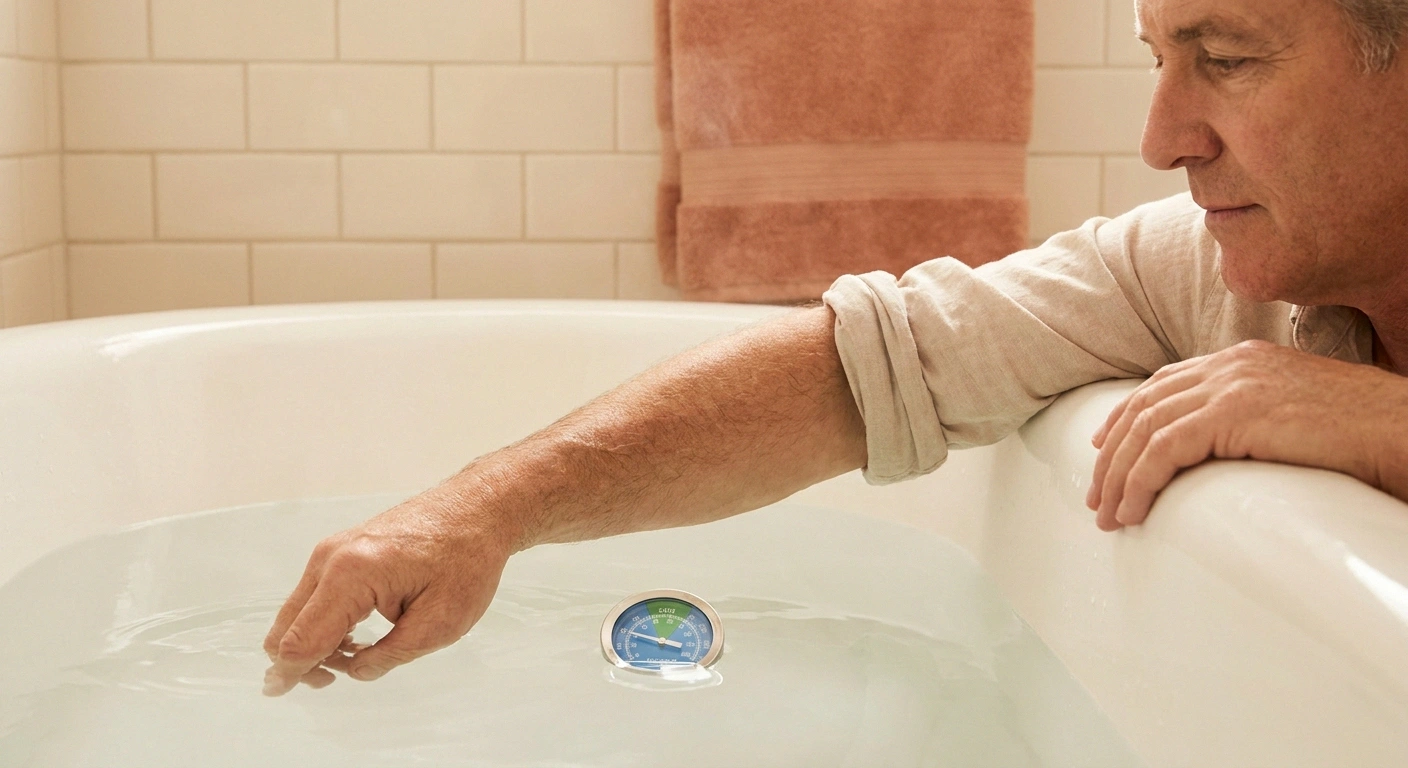
The phantom tight-sock signal has nothing to do with real skin temperature. Never test bath, shower, or foot-soak water with your feet. Use your hand or elbow. Even better, use a thermometer. Scalding burns on numb feet are one of the most common preventable injuries in neuropathy — and the tight-sock feeling won't warn you.
Aggressive foot massage. The sensation isn't from a physical build-up of tension. You can't rub it out. Deep pressure may temporarily override the phantom signal but doesn't reduce it long-term, and if you have reduced sensation, over-aggressive massage can create injury you won't feel.
Constantly checking that your socks are actually off. Understandable early on, but keeps the sensation front-of-mind and often makes it more prominent. Once per day, look at your feet, confirm they're bare or in the socks you meant them to be in, and trust the check.
Very hot water soaks. Warm baths can be soothing, but scalding-hot water is dangerous when foot sensation is reduced. Test water temperature with your hand or your elbow, not your foot. And don't rely on the tight-sock feeling to tell you when the water is too hot — the phantom signal has nothing to do with actual skin temperature.
Peripheral circulation aids that aren't actually addressing circulation. If your circulation is fine, adding compression, massage, or heat with the goal of “improving circulation” won't help the phantom sensation. If your circulation isn't fine — for example, you have peripheral artery disease — then you have a separate problem that needs its own workup.
When to Bring It Up With Your Doctor
For someone with an established peripheral neuropathy diagnosis, a stable tight-sock feeling is usually just something to mention at your next scheduled appointment. It's information to have in your chart, and your neurologist can track any changes over time.
5 Situations to Call Sooner Rather Than Later
Situations that deserve a sooner call:
- New onset without a prior neuropathy diagnosis. This warrants investigation — many treatable causes (B12 deficiency, thyroid issues, alcohol-related, medication-related) can be identified with basic bloodwork.
- Sudden significant change. A stable sensation that suddenly becomes much more intense or spreads to new areas over days-to-weeks may reflect a new process.
- Paired with new weakness. If you notice the tight-sock feeling is now accompanied by trouble lifting your foot, foot slap when you walk, or catching your toes on the carpet, that's a call-the-doctor-this-week situation.
- Actual skin changes. If you notice actual redness, discoloration, or swelling in the area where the sensation is, take it seriously — the phantom sensation doesn't cause skin changes, so any real skin change is a separate issue.
- Paired with hand symptoms if you didn't have them before. Adding hand involvement to a previously foot-only neuropathy is worth noting.
Living With the Sensation Over Time

I want to close with the practical, human piece. Because the mechanistic explanation of “your damaged nerves are generating false pressure signals” is accurate but incomplete — you still have to live inside that experience every day.
The Three Phases of Adapting
Most people who've had this sensation for a while go through three phases:
Phase 1: Constant attention. Early on, the sensation is new, unsettling, and demands constant checking. You take off your socks and look at your feet. You put your socks back on and take them off again. You feel the phantom pressure and try to figure out where it's coming from. This phase can last weeks or months. It's uncomfortable, but it's normal.
Phase 2: Adaptation. Gradually, without you consciously trying, your brain stops flagging the sensation as an emergency every time it fires. You still feel it, but it takes less of your attention. You go through longer stretches without checking your feet. When the sensation is more prominent — evenings, after long standing — you notice, but you don't panic. This phase takes months to develop.
Phase 3: Background. For many long-term neuropathy patients, the tight-sock feeling eventually settles into background awareness. It's still there. But it's like the hum of a refrigerator you've stopped hearing. Sometimes something reminds you it's there — you take off tight socks, you sit still in a quiet room — and it becomes noticeable again. But it's not driving your day.
The transition through these phases isn't guaranteed and it isn't fast. Some people take longer to adapt. Some conditions produce sensations too intense to fully background. But most people, given time and effective enough symptomatic treatment, do reach a place where the sensation is manageable rather than dominant.
What helps that transition happen: getting on effective medication when appropriate, finding the shoes and socks that work for your particular pattern, treating the underlying condition if there's a treatable one, staying gently active, sleeping as well as you can, and having other people you can talk to who understand exactly what you mean when you say “it feels like I'm wearing socks that aren't there.”
That last one is more important than it sounds. Chronic weird sensations that other people don't experience can be isolating, and the isolation often makes the sensation itself harder to live with. Neuropathy support communities online and in person exist precisely because “the tight-sock feeling” and “the marbles under my feet” and “the burning that comes and goes” are exactly the phrases that only make full sense to someone who's felt them too.
Frequently Asked Questions
Why do my feet feel like I'm wearing tight socks when I'm not?
The sensation comes from damaged nerve fibers in your feet that are firing spontaneously and sending false pressure signals to your brain. Your brain has spent your whole life learning to interpret steady, moderate, evenly-distributed pressure signals as “I am wearing a sock.” When damaged nerves generate a similar-looking pattern, your brain does the same thing it always does with that pattern — it concludes you're wearing a sock. The actual skin is bare, but the neurological signal is real, so the phantom sensation persists.
Is the tight sock feeling a sign of nerve damage getting worse?
Not by itself. The tight-sock feeling reflects a particular pattern of nerve fiber involvement rather than the severity or progression of your neuropathy. Many people have this sensation from early in their condition and it stays roughly stable for years. What actually indicates progression is different: numbness climbing upward from the toes, new weakness, new balance problems, or new involvement of the hands. A stable tight-sock feeling on its own is generally not a warning sign about your neuropathy trajectory.
Why does the tight sock feeling happen in both feet at once?
Most generalized peripheral neuropathies produce damage in a length-dependent, symmetric pattern. The longest nerves in your body — running from spinal cord to toes — are affected first and roughly equally on both sides. This produces the classic stocking-and-glove distribution, where symptoms appear symmetrically at the ends of the longest nerves. The tight-sock feeling follows this same pattern because it is caused by the same underlying nerve fiber damage.
What causes the tight sock feeling in neuropathy?
The most common causes are the same causes of peripheral neuropathy in general: diabetes, chemotherapy exposure, chronic heavy alcohol use, vitamin deficiencies (especially B12), idiopathic causes when no specific reason is found, thyroid disorders, and certain autoimmune conditions like Sjögren's syndrome. All of these cause damage to nerves in the length-dependent pattern that produces the sock-like symptom distribution.
Can wearing actual socks help or hurt the tight sock sensation?
It depends on the individual. Some people find that wearing seamless neuropathy-friendly socks all day reduces the phantom sensation because a mild real signal keeps the brain from generating the phantom. Others find the opposite — that any sock triggers the sensation more strongly. The only way to know which you are is to experiment. If comfortable socks help, invest in a few pairs that fit well. If they make it worse, favor barefoot at home and looser socks when you need to wear them.
Do compression stockings help the tight sock feeling?
They help some people and worsen it for others. Compression stockings give the brain a real steady pressure input that can override the phantom signal in some patients. In other patients, added pressure amplifies the false signals rather than dampening them. Compression is worth trying if you also have edema or venous issues that would benefit from it independently. I would not purchase medical-grade compression stockings solely to address phantom sensations without checking with your doctor first.
Should I see a doctor about the tight sock feeling?
If you have an established peripheral neuropathy diagnosis and the sensation is stable, mention it at your next scheduled appointment. It does not require an urgent call. However, you should call sooner if the sensation is a new onset without a prior neuropathy diagnosis, if it changes suddenly and significantly, if it is paired with new weakness or new balance problems, if it appears alongside actual skin changes like redness or swelling, or if it spreads to your hands when you previously only had foot symptoms.
Will the tight sock feeling ever go away?
For most people it does not fully disappear, but it usually becomes much less demanding over time. Effective neuropathy medications like gabapentin, pregabalin, and duloxetine can significantly reduce the intensity. Good foot care choices — the right socks, the right shoes — can lower the daily volume. Blood sugar control if you have diabetes slows the underlying damage. And over months to years, most people report that their brain gradually adapts, moving the sensation from constant foreground attention to background awareness. The signal stays, but its emotional weight lifts.
About the Author