
The bottle sat on Ruth’s kitchen counter for six years. Every morning she poured a glass of tomato juice, dropped two zinc lozenges under her tongue “because a woman my age needs her immunity up,” and went about her day. Ruth is seventy-one, retired from teaching, and a regular at the little neuropathy support group I run out of a church basement in Suffolk. She started catching her toe on sidewalks last spring. By August she was walking with a cane. By October her neurologist was calling the numbness in her feet “probably diabetic,” even though her A1c has been under six for a decade.
It was Ruth’s daughter, a nurse in Richmond, who asked the one question nobody in the exam room had asked. “Mom, what supplements are you taking?” Ruth listed a multivitamin, a fish oil, a probiotic, and the zinc. Ninety milligrams a day, split between two lozenges. Every day for six years. Her daughter went quiet on the phone for a beat, then said the four words that started this article. “Mom, get a copper panel.” I am Janet Ellis. I live with peripheral neuropathy, I am not a doctor, and I have watched a version of this scene play out three separate times in the last two years in our little group. This article is the map I wish Ruth had before those lozenges cost her the ability to walk unassisted.
How I Found Out the “Vitamin” Was the Problem
Ruth’s copper level came back at 21 micrograms per deciliter. The reference range starts at 70. Her ceruloplasmin was 8, floor was 20. Her serum zinc, the thing she had been dosing for six years, was 178. Ceiling was 110. In a single blood draw, the picture that had confused three doctors over eighteen months snapped into focus. Ruth did not have diabetic neuropathy. She had zinc-induced copper deficiency, and the copper deficiency was quietly damaging her spinal cord and her peripheral nerves at the same time.
When zinc and nerves collide in the medical literature, the story is almost always excess zinc silently draining copper out of the body, not zinc deficiency. The resulting copper deficiency attacks the spinal cord and peripheral nerves in a pattern that looks a lot like vitamin B12 deficiency, and it gets missed for months because doctors do not routinely test copper. The intervention that matters most is not a new supplement. It is finding and stopping the source of the excess zinc.
The counterintuitive thing about this diagnosis is that most people, including most patients and a fair number of primary-care clinicians, assume “zinc deficiency neuropathy” means not enough zinc. In practice, when zinc and nerves collide in the medical literature, the story is almost always the other direction. Too much zinc, over months or years, silently strips copper out of the body. Copper deficiency then attacks the nervous system in a very specific pattern that looks a lot like a vitamin B12 deficiency, and it gets missed for months at a time.
I want to walk you through what is actually happening in the body, where the excess zinc is coming from (three sources that almost nobody screens for), what the neurological picture looks like, what blood panel to ask for, and what recovery honestly looks like once the source is stopped. If you are worried about your own supplements, or a loved one’s, or your bariatric follow-up, or a legacy denture cream, this is the article I wish had existed when Ruth’s daughter made that phone call.
Why Zinc Deficiency Alone Rarely Causes Neuropathy
Let me address the surface-level question first, because it matters. Can pure nutritional zinc deficiency, all by itself, damage peripheral nerves? Yes, but it is far less common than the copper-driven story, and the presentation tends to be different. Zinc is a cofactor for hundreds of enzymes, including several involved in myelin maintenance and nerve regeneration, so animal models and a scattering of human case reports have linked severe zinc deficiency to distal small-fiber symptoms, burning feet, and impaired wound healing.
In real life, the people who show up with true isolated zinc deficiency tend to be older adults with poor food intake, people with active alcohol-use disorder, pregnant women, and patients with untreated malabsorption from celiac disease or Crohn’s. Their earliest zinc-deficiency signs are usually the ones your dermatologist notices first (skin rash around the mouth and hands, hair thinning, dulled sense of taste), followed by frequent infections and slow-healing wounds. Peripheral nerve symptoms tend to be a later and much subtler feature.
The reason we spend the rest of this article on the copper side of the equation is simple. When published neurology case series look at patients with “unexplained” myelopathy or subacute sensory ataxia, and they do the full metals panel, the picture that emerges over and over is excess zinc driving copper depletion driving nerve injury. That mechanism is worth understanding in a way that changes what you buy at the drugstore.
The Copper Connection: Zinc’s Quiet Cost to Your Nerves
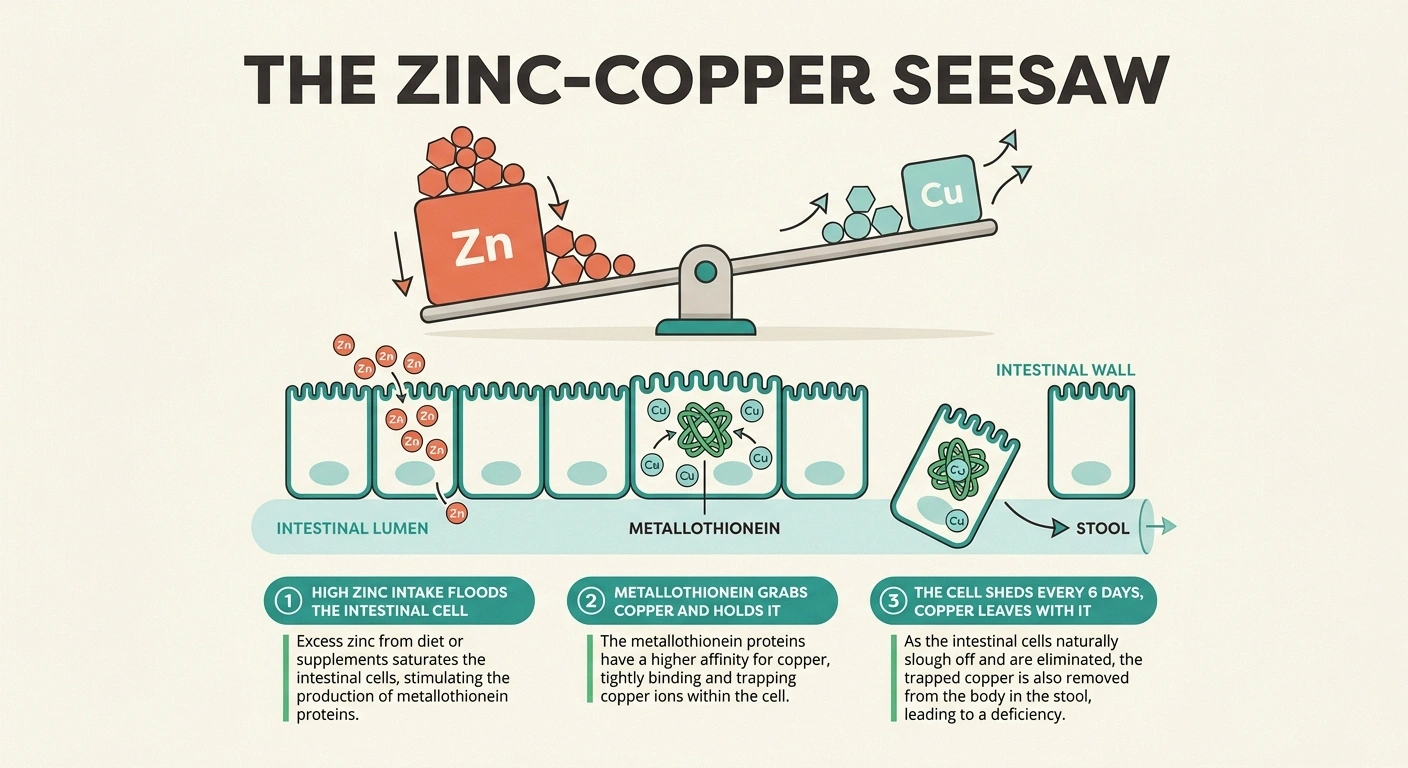
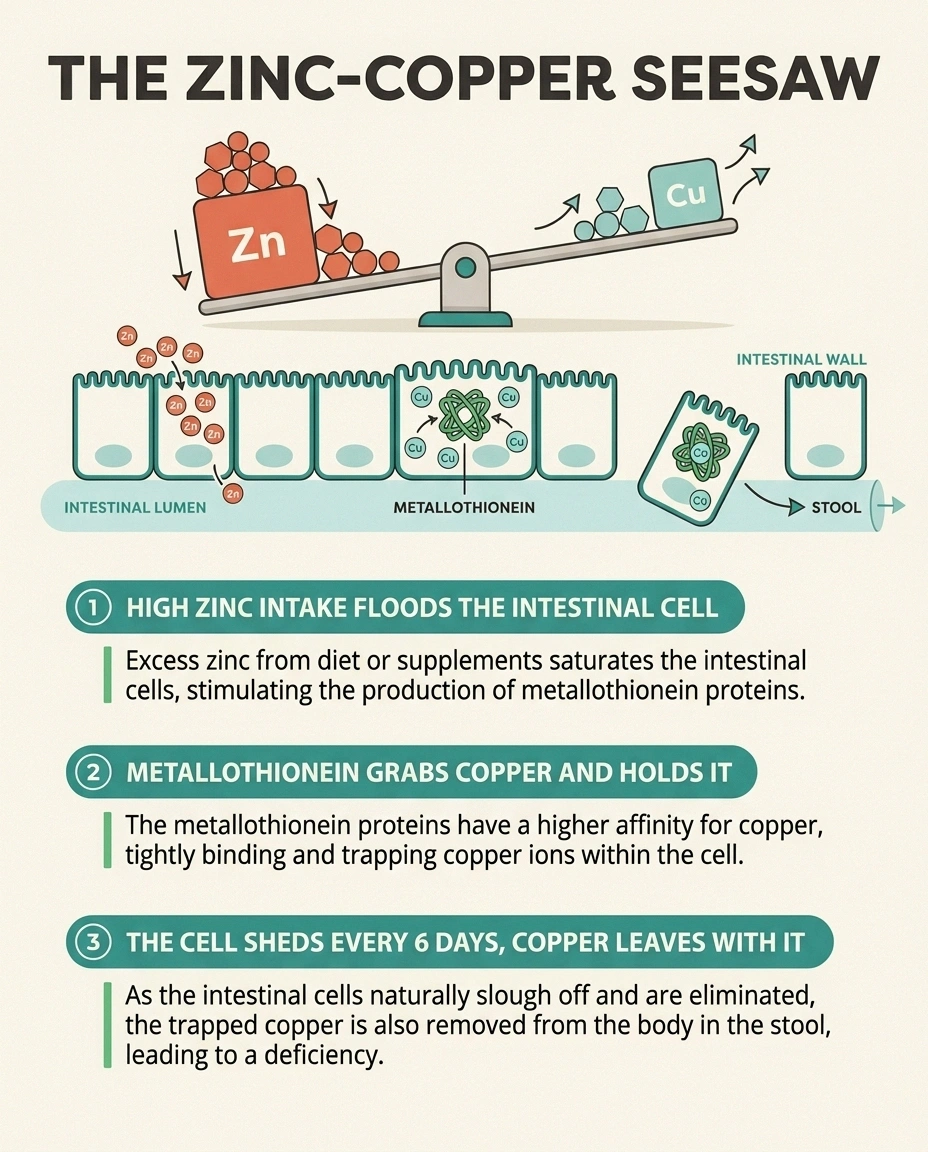
Zinc and copper compete for absorption in the small intestine. When you swallow a high dose of zinc, your intestinal cells respond by cranking up production of a protein called metallothionein. That protein binds copper preferentially over zinc, holds onto it inside the intestinal cell, and then, every six days or so, the whole cell is shed into the stool and the copper leaves with it. In a healthy person eating a mixed diet, this is a minor regulatory mechanism. In someone taking 50 milligrams of zinc a day for years, it becomes a slow copper drain.
The landmark paper (Kumar et al., Neurology 2004) established that acquired copper deficiency in adults reproduces the exact spinal-cord picture of vitamin B12 subacute combined degeneration, including T2 hyperintensity in the dorsal columns on cervical spine MRI. Because the MRI, symptoms, and exam are essentially identical, the diagnosis is routinely missed unless a copper panel is specifically ordered.
A 2023 review in the British Journal of Clinical Pharmacology called the condition “invariably iatrogenic” when driven by prescribed or over-the-counter zinc above 100 milligrams per day taken long-term.
Copper is a required cofactor for several enzymes your nervous system cannot live without. It is essential for cytochrome c oxidase (mitochondrial energy production in every nerve cell), for superoxide dismutase (mopping up free radicals), for dopamine-beta-hydroxylase (neurotransmitter synthesis), and for ceruloplasmin (which also happens to move iron around the body). Deprive the spinal cord and peripheral nerves of copper long enough, and the myelin insulation around them starts to fail in a pattern the neurology textbooks call subacute combined degeneration. If that phrase sounds familiar, it is because it is also what happens in severe vitamin B12 deficiency. The picture on the MRI can be identical, which is part of why this diagnosis is so often missed. Our overview of B12 injections for neuropathy explains that mimic in more detail; the takeaway is that a normal B12 level does not clear you if these symptoms are progressing.
The landmark paper describing this pattern was published in 2004 by Neeraj Kumar and colleagues at the Mayo Clinic. They reported that copper deficiency in adults could reproduce the exact spinal-cord and peripheral-nerve picture of B12 deficiency, complete with the dorsal-column signal changes on MRI. In the years since, hundreds of case reports have refined the picture. The nerves hit hardest are the long ones running to the legs, the fibers that carry position sense and vibration, and the corticospinal tracts controlling leg movement. If you want a deeper primer on how nutrient deficiencies do this kind of damage, our page on vitamin deficiency neuropathy is a solid next stop.
The Three Hidden Sources Nobody Screens For

Almost every case of zinc-induced copper deficiency I have read or heard about traces back to one of three sources. None of them look like “supplement abuse” on the surface. All of them are things a reasonable person could be doing for a reasonable reason.
Never take chronic high-dose zinc (above 40 milligrams per day for more than a few weeks) without periodic serum copper and ceruloplasmin monitoring. Audit these frequently overlooked sources today:
- Stacked supplements (multivitamin plus lozenge plus immune formula) that individually seem modest but add up to 60+ mg per day
- AREDS or AREDS2 eye vitamins taken daily for years, especially the older 80 mg formulations still sitting in medicine cabinets
- Testosterone, prostate, or “hair, skin, and nails” stacks that quietly include zinc in each pill
- Any legacy or imported denture adhesive whose label does not specifically say “zinc-free”
- Zinc lozenges taken daily as a cold-prevention habit, rather than only during active illness
Source one: pre-2011 denture adhesive cream. For decades, Fixodent and Super Poligrip used zinc as a bonding agent in their formulations. Heavy daily users, particularly people with ill-fitting dentures who applied multiple tubes a week, were ingesting milligram-scale doses of zinc every day. A 2008 Neurology paper by Nations and colleagues linked chronic denture-cream use to hypocupremia and progressive myeloneuropathy. The FDA got involved, GlaxoSmithKline voluntarily reformulated Super Poligrip in February 2010, and Procter and Gamble followed with Fixodent. Current U.S. products are zinc-free, but three problems persist. Legacy tubes sit in bathroom cabinets across the country. Some imported and off-brand products still contain zinc. And patients injured before the reformulation are still living with the neurological consequences.
Source two: bariatric surgery. Roux-en-Y gastric bypass, single-anastomosis gastric bypass, and biliopancreatic diversion with duodenal switch all bypass the duodenum and proximal jejunum, which is exactly where zinc and copper are absorbed. Copper deficiency after Roux-en-Y runs about 10 to 19 percent. After a duodenal switch, published rates run as high as 90 percent. Zinc deficiency after bariatric surgery runs 20 to 70 percent, and here is the cruel irony: patients are often prescribed zinc for post-surgical hair loss or wound healing, which then tips them into zinc-induced copper depletion on top of the malabsorption they already had. Our page on bariatric surgery and neuropathy covers the broader nutritional picture; the American Society for Metabolic and Bariatric Surgery recommends annual serum copper and ceruloplasmin monitoring after these procedures.
Source three: over-the-counter zinc supplements. This is the biggest bucket and the one closest to home. Zinc lozenges for cold prevention. Zinc pills for immune support. AREDS eye vitamins (older formulas contained 80 milligrams of zinc per serving; even the newer AREDS2 formula runs 25 milligrams). Testosterone and prostate stacks aimed at older men. “Hair, skin, and nails” combinations aimed at older women. Any product taken daily at more than 40 milligrams of elemental zinc, the U.S. tolerable upper intake level for adults, is in the risk zone if you keep taking it for months or years. A 2023 review in the British Journal of Clinical Pharmacology by Duncan and colleagues put it bluntly: this condition is “invariably caused by prescribing zinc in unnecessarily high doses of over 100 milligrams per day.” It is iatrogenic. It is preventable. And it is on drugstore shelves without a warning label.
What Copper-Deficiency Neuropathy Feels Like

The presentation has a signature and it is worth memorizing, because when you hear a friend describe it you may be the one to make the connection nobody else has made. It starts with the feet. Tingling, numbness, burning that creeps up from the toes over months. So far, so ordinary; a lot of things start this way.
What is different about the copper-deficiency version is the sensory ataxia. The dorsal columns of the spinal cord carry position sense (where your foot is in space) and vibration sense. When copper deficiency demyelinates those columns, the information stops arriving at the brain. People describe it as “walking on cotton” or “walking on marshmallows.” They are unsteady on uneven ground. They trip on the smallest lip in the sidewalk. They are dramatically worse in the dark or with their eyes closed, because vision was quietly compensating for the missing position sense. A doctor performing a Romberg test (stand feet together, close your eyes) will see them start to sway or fall almost immediately.
Two other clues often tip the diagnosis. First, the leg reflexes are frequently brisk (the lateral corticospinal tract is also involved), and some patients develop leg stiffness and even a positive Babinski sign. That combination of dorsal-column loss and corticospinal signs is what “subacute combined degeneration” means. Second, the systemic clues from bone marrow. Copper is required for normal blood-cell production, so people with copper deficiency often have unexplained anemia, low neutrophil counts, or full pancytopenia. If you or a family member has been told you have “possible early MDS” (myelodysplastic syndrome) along with leg symptoms, a copper level costs less than a hundred dollars and can rule out a mimicking diagnosis in one draw.
The Blood Tests Your Doctor Should Order

This is the section to print or forward. Order these together, not one at a time, because the individual results only make sense read against each other:
The Copper Deficiency Blood Panel at a Glance
| Test | Typical Reference Range | What the Result Suggests |
|---|---|---|
| Serum copper | 70 to 175 mcg/dL | Low in copper deficiency (sometimes only mildly) |
| Serum ceruloplasmin | 20 to 60 mg/dL | Low, often the most sensitive single marker |
| Serum zinc | 60 to 110 mcg/dL | High or high-normal in supplement or denture-cream cases; low in nutritional deficiency |
| 24-hour urine copper | 15 to 60 mcg/24 hr | Low in dietary or absorptive deficiency; high in Wilson disease (rules that out) |
| CBC with differential | Standard hematology ranges | Anemia, low neutrophils, or pancytopenia are classic supporting clues |
| B12, methylmalonic acid, homocysteine | B12 above 300 pg/mL, MMA under 0.4 nmol/mL | Rules out or quantifies the essential B12 mimic (often coexists) |
- Serum copper (low in copper deficiency, though sometimes only borderline)
- Serum ceruloplasmin (often more sensitive than serum copper alone)
- Serum zinc (high or high-normal in denture-cream and supplement cases; low in pure bariatric or nutritional cases)
- 24-hour urine copper (low in dietary or malabsorptive copper deficiency, high in Wilson disease, which is the important distinction)
- Complete blood count with differential (looking for anemia, low neutrophils, or a pancytopenia pattern)
- Serum vitamin B12, methylmalonic acid, and homocysteine (B12 deficiency is the essential mimic and often coexists; do not stop the workup at a normal B12)
- Folate, thiamine (B1), and vitamin E (other nutritional myeloneuropathy mimics)
- Hemoglobin A1c (rules out or quantifies coexisting diabetic neuropathy)
- MRI of the cervical and thoracic spine if there are myelopathic signs (the classic finding is T2 hyperintensity in the dorsal columns, often described as an “inverted V” on axial images)
- EMG and nerve conduction studies to quantify the peripheral nerve piece
Bring your supplement bottles and, if it applies, the actual denture-adhesive tube to the appointment. Yes, the whole tube. This is where the diagnosis is either made or missed. If your primary-care clinician is not comfortable ordering this panel, the specialist you want is a neurologist familiar with acquired myelopathies. Our overview of how neuropathy gets diagnosed covers the general workflow; the copper panel is what you add on top when the standard workup has come back normal but symptoms are still progressing.
Treatment: Stop the Source, Then Replete Copper

The single most important intervention is the one that costs nothing. Identify the source of the excess zinc, and stop it. Everything else is downstream of that decision.
The 4-Step Copper Repletion Sequence
- Stop the zinc. Audit every supplement in the house. Multivitamins, cold and immune formulas, prostate or testosterone stacks, AREDS-style eye vitamins, hair-and-nails combinations, and any standalone zinc lozenges or pills. Add up the total daily elemental zinc. If it is above 40 milligrams a day and you have been taking it for months, that is your first suspect. For denture-adhesive users, switch to a labeled zinc-free product and discard the old tubes. Better still, ask about a refit that does not need adhesive at all.
- Confirm the labs. Do not start copper repletion based on a suspicion. Get the panel above first, so you have a documented baseline and a diagnosis on the chart. This also matters because copper toxicity is a real thing (nausea, liver injury, Wilson-like syndrome), and self-supplementation without a documented deficiency is genuinely risky.
- Oral copper repletion, physician-supervised. A common regimen in the neurology literature is 2 milligrams of elemental copper per day for 8 to 12 weeks, with some clinicians starting higher (4 to 6 milligrams per day) for a short loading phase in more severe cases. Read the label carefully: 2 milligrams of elemental copper is roughly 14 milligrams of copper gluconate. The “elemental” number is what matters. Severe or hospitalized cases sometimes receive IV copper (cupric chloride or sulfate) at 2 milligrams a day for five days.
- Recheck labs at 8 to 12 weeks. Serum copper, ceruloplasmin, and CBC. Adjust dose based on the numbers, not on symptoms alone. Once repleted, most patients transition to a maintenance dose based on their underlying risk (bariatric patients typically need indefinite low-dose copper).
Supportive care matters and does not wait for the labs to come back. Physical therapy for balance and gait, fall prevention at home, assistive devices if you need them, and symptomatic management of neuropathic pain (gabapentin, duloxetine, or topical agents your clinician selects). Our broader guide to supplements for nerve health is worth reading precisely because it will remind you that “more supplements” is not the answer to a problem caused by too much of one supplement.
What Recovery Actually Looks Like

I owe you the honest picture on this, because most of what is written online either overpromises (“fully reversible with copper!”) or underpromises (“permanent nerve damage!”). The truth sits in the middle.
If any of this rings a bell for you or someone you love, please do not self-diagnose from an article. Print the blood-test list from the section above, bring your supplement bottles and any denture-adhesive tube to your next appointment, and ask your primary-care clinician or neurologist to run the copper panel alongside the standard workup. This is one of the neuropathies where the timeline matters. The sooner the source is stopped and copper is restored, the better the odds that the neurological damage stays where it is instead of worsening.
For related reading on nutritional and B12 mimics, see our overviews of vitamin deficiency neuropathy and B12 and neuropathy.
The hematologic recovery (the anemia, the low neutrophils, the pancytopenia) is usually good and reasonably fast. Blood counts often start normalizing within weeks of adequate copper repletion. This is the encouraging part, and it is what tells your clinician the treatment is working while you are still waiting to see whether the neurological symptoms budge.
The neurological recovery is often incomplete, and this is the part that requires realistic expectations. Case series consistently show that roughly 44 percent of patients experience meaningful neurological improvement with adequate copper repletion. The remaining patients stabilize (no further worsening) but do not regain what was already lost. Sensory ataxia in particular tends to be the stubborn one; once the dorsal-column axons are damaged, they do not regrow in a way that restores position sense. This is why early recognition is the whole ballgame, and why prevention (source avoidance and screening in high-risk groups) matters far more than any treatment can. Our page on whether neuropathy can be reversed covers the general prognosis question in more depth.
Ruth’s story, since I opened with it, ended in the honest middle. Her blood counts came back to normal by month three. Her balance and her walking improved over the following year, enough that she is back to the church without the walker and only uses the cane on uneven ground. Her tingling has faded but not disappeared. She has not regained the full sensation in her feet, and her neurologist told her honestly that she probably will not. She would still call it a good outcome, because she can shop and cook and drive again, and because the trajectory changed from “worsening every month” to “stable and slightly improving.” That is what “good” looks like here. And it happened only because her daughter asked the question.
Frequently Asked Questions
Can zinc deficiency really cause neuropathy?
Yes, in two distinct pathways. Pure nutritional zinc deficiency (uncommon on a mixed U.S. diet) can contribute to distal nerve symptoms as part of a broader deficiency picture. Far more commonly, excess zinc from supplements or denture cream depletes copper, and the resulting copper deficiency damages the spinal cord and peripheral nerves in a distinctive pattern that mimics vitamin B12 deficiency. When neurologists talk about “zinc-related neuropathy,” they almost always mean the second pathway.
How much zinc per day is too much?
The U.S. tolerable upper intake level for adults is 40 milligrams of elemental zinc per day. Case reports of copper deficiency have been published at chronic doses of 50 milligrams and up, with most severe cases occurring at 100 milligrams or higher taken for months to years. Short courses at higher doses (a few days of zinc lozenges during a cold) are not the concern. Daily long-term intake is.
Is Fixodent or Poligrip still dangerous today?
Current U.S. formulations of both brands have been zinc-free since 2010 to 2011, so newly purchased tubes are not the problem. Legacy tubes in bathroom cabinets and some imported or off-brand denture creams may still contain zinc. If you use denture adhesive daily, especially more than one tube per week, check the label for zinc and switch to a labeled zinc-free product if there is any doubt.
Can AREDS eye vitamins cause neuropathy?
They can contribute, particularly the older AREDS formula containing 80 milligrams of zinc per daily serving. Patients on macular-degeneration formulations for a decade or more have shown up in the copper-deficiency case literature. The updated AREDS2 formula reduced zinc to 25 milligrams, which is safer but still worth periodic monitoring if you are also taking any other zinc-containing supplement. Talk with your ophthalmologist about which formula you are on and whether an annual copper and ceruloplasmin check makes sense.
Do I need to take copper along with zinc?
If your clinician is prescribing chronic zinc for a specific reason (Wilson disease treatment, wound healing, or a documented deficiency), they should be monitoring copper on a set schedule regardless. For over-the-counter zinc use, the cleanest answer is: keep the daily dose below 40 milligrams of elemental zinc, do not stack multiple products (multivitamin plus lozenge plus immune formula), and if you need to take more than that for more than a few weeks, add periodic copper and ceruloplasmin testing rather than blindly adding a copper supplement.
Should bariatric surgery patients ask specifically about copper?
Yes, and it is worth asking directly because it is one of the nutrients that gets skipped in follow-up counseling. Patients hear a lot about B12, iron, calcium, and vitamin D. Copper is often overlooked, and the ASMBS guidelines recommend annual serum copper and ceruloplasmin monitoring after Roux-en-Y and duodenal-switch procedures. If your bariatric follow-up labs have not included copper, request them at the next visit.
Can other minerals cause a similar neuropathy pattern?
Chronic magnesium deficiency has its own set of neuromuscular symptoms and is worth ruling out; our page on magnesium and neuropathy covers that separately. Selenium and vitamin E deficiencies can also produce myelopathic pictures. The reason a full nutritional panel matters is that these deficiencies often travel together, especially in bariatric patients and in people with malabsorption syndromes.
What foods contain the most copper?
Beef liver is the standout by a wide margin. After that: oysters and other shellfish, dark chocolate, cashews, sunflower seeds and sesame seeds, mushrooms, and lentils. A varied diet including these foods will cover normal copper needs; food alone is generally not sufficient to correct a documented deficiency, which is why the treatment involves supplemental copper under physician supervision. Our page on the neuropathy diet covers the broader nutritional picture for nerve health.
About the Author