
The letter came in a plain white envelope with the insurance company logo on it, and I almost tossed it in the pile with the pharmacy bag and the church bulletin. I am glad I did not. It was a denial. My neurologist had written the prescription six weeks earlier, the specialty pharmacy had already called to schedule a delivery, and there in single-spaced font was the sentence: “Coverage is not available for this request because the requested service does not meet the plan’s criteria for medical necessity.”
I sat down on the arm of the couch and read it three times. I am Janet Ellis. I am not a doctor, not a lawyer, not an insurance broker. I am a woman in her sixties who has been living with peripheral neuropathy for the better part of a decade, and who has spent the last several years learning, letter by letter, how to fight these things and win more often than I lose. What follows is the map I wish I had that afternoon.
The Denial Letter That Made Me Sit Down
Here is the first thing I want you to know, because it changed how I read every denial after that one. According to CounterForce Health’s 2026 analysis of appeal outcomes, only about half a percent of denied health-insurance claims are ever appealed. Of the ones that are, roughly 20 to 40 percent get overturned. Higher for certain categories. Sometimes much higher.
You have more time and more levels than the denial letter implies. Commercial and ACA plans give you 180 days to file the first internal appeal, 4 months for external review by an independent organization whose decision binds the insurer. Medicare runs a five-level ladder that goes from your Medicare Administrative Contractor all the way to federal court. The insurance company is counting on you closing the envelope. The odds shift toward you the moment you do not.
Translate that. The insurance company is counting on the fact that most people will read the denial, feel defeated, and put the envelope in a drawer. The system is designed around that assumption. When you actually appeal, you have moved into a much smaller pool of people who tend to win. This is not because the insurance company suddenly likes you. It is because a denial written by an algorithm or a clerk stops looking so airtight once a physician, a specialist-society guideline, and a paper trail land on someone else’s desk.
None of this guarantees your appeal will win. Every plan is different, every case is different, and nothing in this guide is medical or legal advice. But the map is real. Let me walk you through it.
Why Neuropathy Treatments Get Denied More Than You Think
Neuropathy is a denial magnet, and it helps to know why before you write a word of appeal. Insurers deny neuropathy treatments in predictable patterns, and once you see the pattern the appeal writes itself.
CounterForce Health’s 2026 appeal-outcome analysis found that only about 0.5 percent of denied health-insurance claims are ever appealed. Of the ones that are appealed, 20 to 40 percent get overturned. Independent Review Organization decisions on “experimental” denials skew even higher when supported by specialty-society guidelines.
Translation: the insurance company is counting on the vast majority of denials to go unappealed. You are in a much smaller and much more successful pool the moment you file.
IVIG for small-fiber neuropathy gets denied as “experimental” almost every time, because the FDA labels for IVIG do not include small-fiber. Approval hinges on documenting immune-mediated etiology (positive TS-HDS, FGFR-3, or Plexin-D1 antibodies), failed first-line therapy, and functional impairment. IVIG for CIDP or multifocal motor neuropathy is on-label and easier to clear. Mayo Clinic Connect has years of patient threads on this exact fight; you are not the first to walk it.
Spinal cord stimulators (SCS) almost always require documented failure of six months of conservative therapy (medications, physical therapy, injections) plus a successful 3 to 7 day trial before the permanent implant. Denials often cite “not medically necessary until trial complete.” The fix is documenting the trial and the failed conservative course, not arguing about medical necessity in the abstract.
TENS units for diabetic peripheral neuropathy live in a strange middle ground. Medicare Local Coverage Determinations vary by regional contractor. Some MACs cover TENS as durable medical equipment for painful diabetic peripheral neuropathy, others deny it as “not medically necessary.” Documentation must include ICD-10 E11.42 (diabetic peripheral neuropathy with loss of protective sensation), a physician order, and failed conservative therapy. Roughly 82 percent of TENS appeals succeed with proper documentation, per Solace Health’s coverage analysis. Our deep dive on TENS units for neuropathy walks through the coverage rules in more detail.
Compounded topical creams (ketamine, amitriptyline, gabapentin, lidocaine, baclofen combinations) get denied as “non-FDA-approved formulation.” Traditional Medicare Part B does not cover most compounded drugs. Some commercial plans will cover with documented failure or intolerance of oral alternatives.
Pregabalin (Lyrica) and duloxetine (Cymbalta) are usually on-formulary but tangled up with quantity limits and step therapy. Most plans require documented failure of gabapentin or amitriptyline first. A formulary exception plus prior-failure documentation clears most denials for pregabalin and duloxetine.
Physical therapy visit caps are common. Many plans cap PT at 20 to 30 visits a year. An extension requires a documented functional-progress note and an updated plan of care from the physician.
Read the Denial First: The Codes That Tell You What to Fight
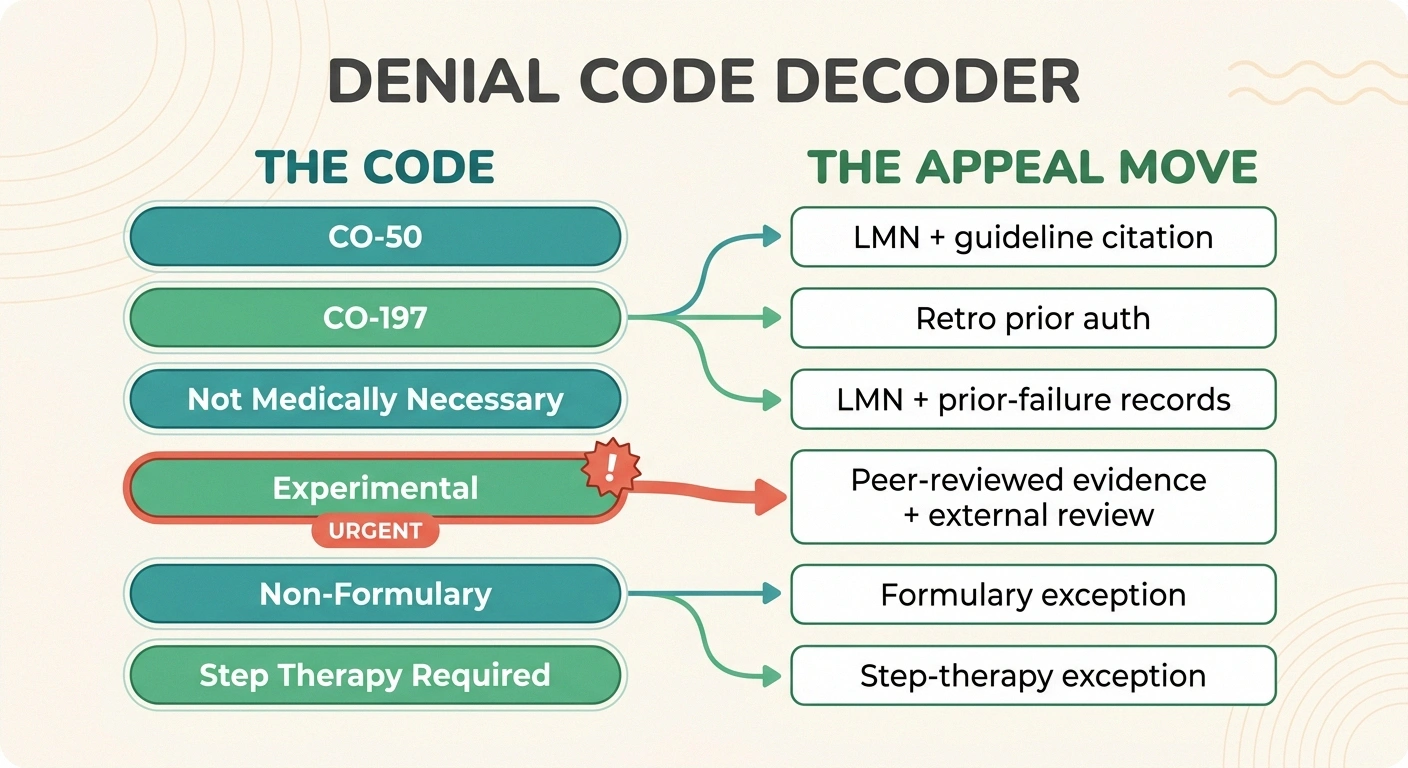
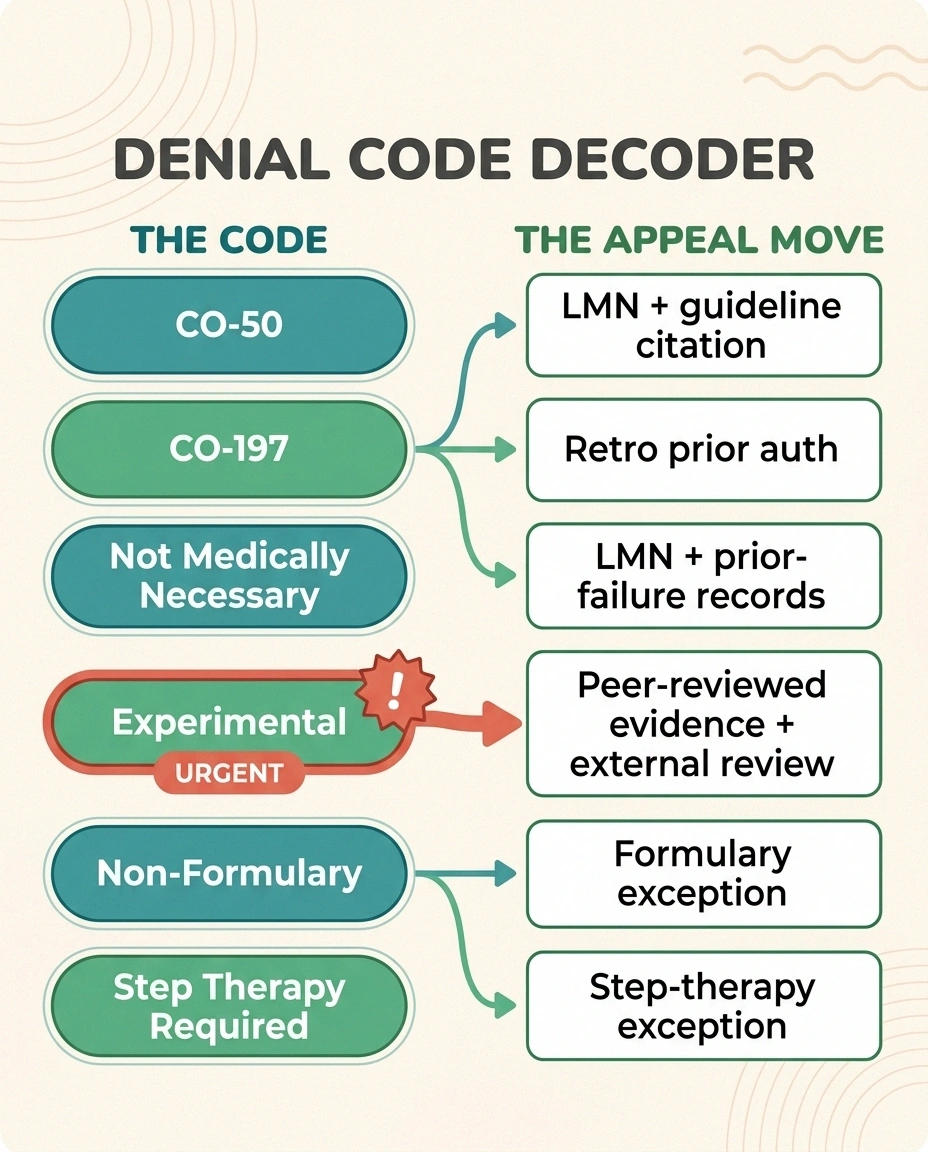
Before you do anything else, sit down with the denial letter or Explanation of Benefits and find these five things. Sixty seconds each, tops.
The deadline to appeal is printed on the denial letter itself. Miss it and your appeal is automatically dead, whether or not you were right on the merits. Common windows to memorize:
- Commercial or ACA plans: 180 days from the date of the denial letter
- Traditional Medicare Level 1 (Redetermination): 120 days from the Medicare Summary Notice
- Medicare Part D (Redetermination): 65 days from the coverage-determination denial
- Medicaid fair hearing: 30 to 90 days depending on your state
- Federal external review (IRO): 4 months from the final internal denial
Always confirm against the specific deadline printed on your denial notice and your current plan document. Rules can and do change.
- The denial reason narrative. Usually one sentence. This is what the insurer says is wrong.
- The reason code. Look for something like CO-50, CO-197, PR-11. These are Claim Adjustment Reason Codes and they tell you the category of the denial.
- The deadline to appeal, and the address (or portal) to send it to. This is required by law to be on the notice.
- Whether the denial is pre-service, concurrent, or post-service. Affects the timing rules the insurer has to follow.
- Any specific criteria the plan says you did not meet. This becomes the target of your appeal.
Now translate the code. A few common ones:
- “Not medically necessary” (often CO-50) means the treatment does not meet the plan’s clinical criteria. Fight it with a physician letter of medical necessity plus guideline citations (American Academy of Neurology, American Diabetes Association, International Association for the Study of Pain), plus records showing failed prior therapies.
- “Experimental or investigational” means the plan says the evidence is not there yet. Fight it with FDA labels for on-label indications, peer-reviewed studies, and specialty-society guidelines. Escalate to external review, because Independent Review Organizations frequently overturn “experimental” denials when the specialty-society evidence is solid.
- “Non-formulary” (drug) means the drug is not on the plan’s covered list. File a formulary exception; the prescriber must state that on-formulary alternatives are less effective or would cause adverse effects for you.
- “Quantity limit exceeded” (QL) means you were billed above the plan’s monthly cap. File a quantity-limit exception with dosing justification (weight, titration failures at lower doses).
- “Step therapy required” (ST) means you have to try the cheaper drug first. File a step-therapy exception documenting intolerance, contraindication, or prior failure.
- “Prior authorization required” (PA, sometimes CO-197) means approval was needed and was not obtained. Submit the PA now with medical records; a peer-to-peer call is often the fastest fix.
- “Not a covered benefit” means the service is excluded from the plan entirely. Read the Summary of Benefits carefully. If it is truly excluded, an appeal has limited traction, and you pivot to a patient assistance program or self-pay.
- “Out of network” means the provider is not contracted. Ask for a network-adequacy exception if there is no in-network specialist within reasonable distance.
Your Appeal Timeline Depends on Who Denied You
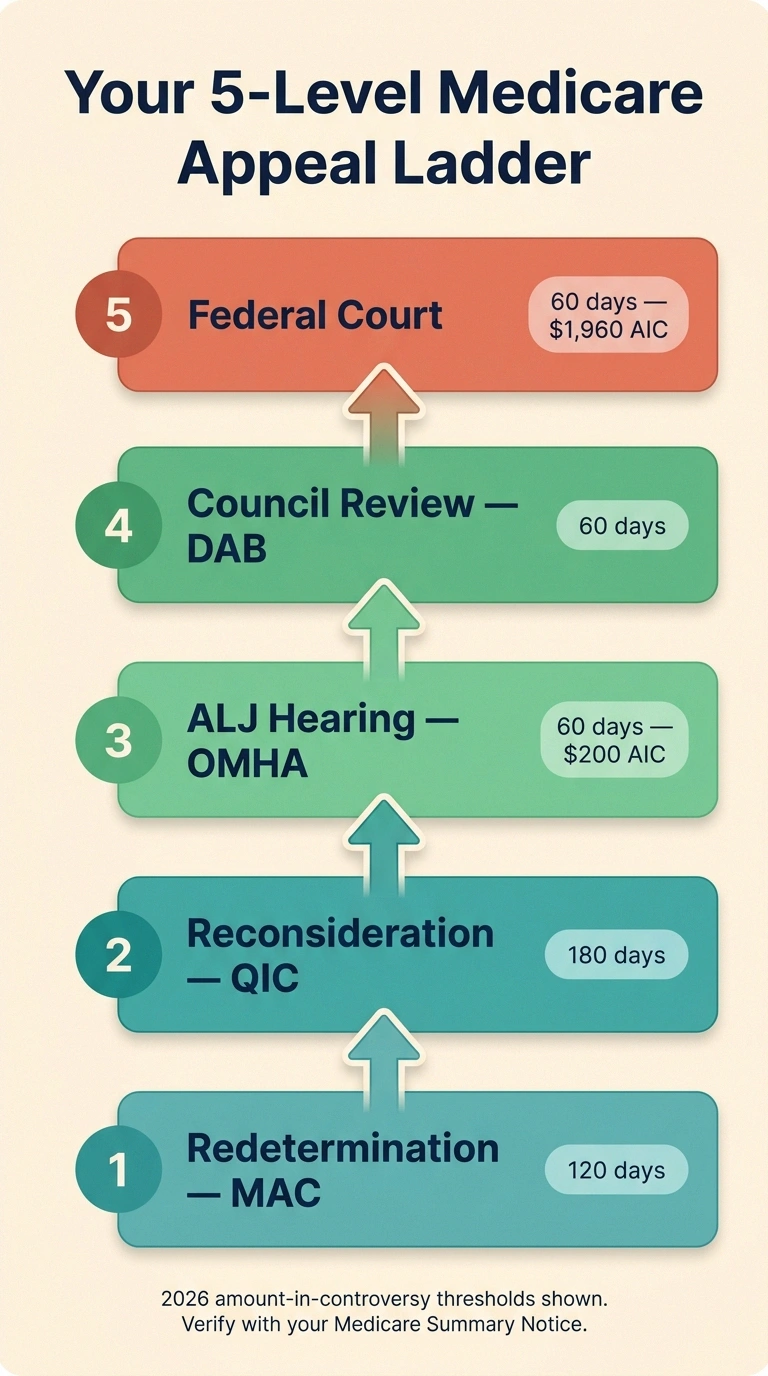
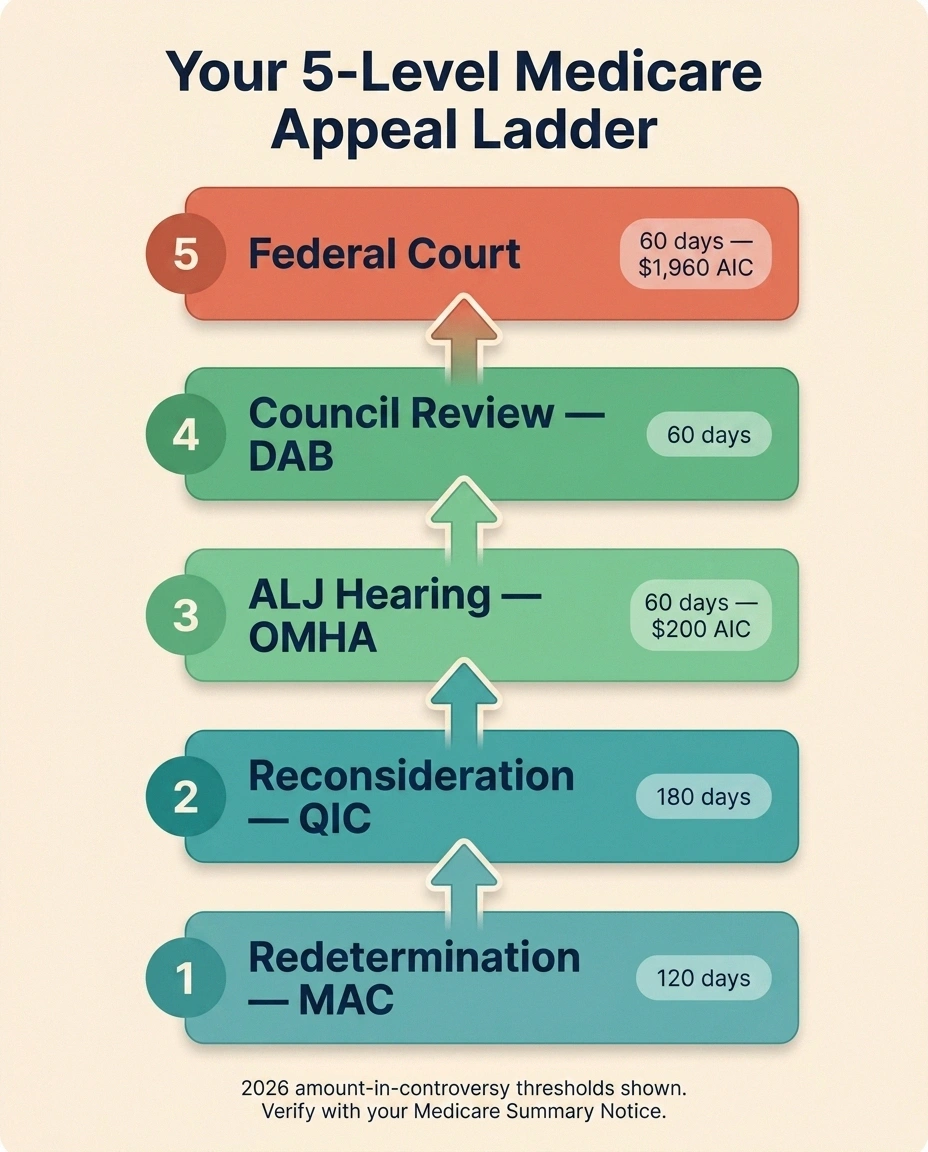
Here is where people lose appeals they would have won. Every payer has a different ladder and different deadlines, and the wrong deadline will kill your case whether or not you were right on the merits. Always cross-check what I write here against your current plan document, your most recent Medicare & You handbook, and the specific denial notice you were sent. Rules change, and the notice is the authoritative document for your specific case.
Timeline and Levels by Payer Type
| Payer Type | Level 1 Deadline | Level 1 Decision Window | External Review Deadline | Federal Court Threshold |
|---|---|---|---|---|
| Commercial / ACA | 180 days from denial | 30 pre / 60 post / 72h urgent | 4 months from final internal denial | N/A (IRO binding) |
| Traditional Medicare | 120 days from MSN | 60 days (MAC) | ALJ at $200 AIC (2026) | $1,960 (2026) |
| Medicare Advantage | Per plan notice | 30 pre / 60 pay / 72h urgent | Auto-forwarded to IRE | $1,960 (2026) |
| Medicare Part D | 65 days from coverage-det denial | 7 days std / 72h urgent | IRE, then ALJ at $200 AIC | $1,960 (2026) |
| Medicaid | 30 to 90 days (state varies) | State fair hearing | State-level judicial review varies | N/A |
2026 CMS amount-in-controversy thresholds shown. Always verify against your specific denial notice and current plan document.
Commercial insurance, ACA marketplace, and most employer plans (ERISA plus ACA rules) run a four-tier ladder. Level 1 internal appeal is due within 180 days of the denial date. The insurer must decide within 30 days for pre-service claims, 60 days for post-service, and 72 hours for expedited urgent appeals. Level 2 is a second internal review; most plans give you 60 days after the Level 1 decision to file. If both internal reviews uphold the denial, you have 4 months to request external review by an Independent Review Organization. The IRO’s decision is legally binding on the insurer.
Traditional Medicare (Part A and Part B) runs a five-level appeal. Level 1 (Redetermination by the Medicare Administrative Contractor) is due within 120 days of the initial determination on your Medicare Summary Notice. Level 2 (Reconsideration by a Qualified Independent Contractor) is due within 180 days of the Level 1 decision. Level 3 (Administrative Law Judge Hearing at OMHA) has a 60-day deadline and a 2026 amount-in-controversy threshold of $200. Level 4 (Medicare Appeals Council) is 60 days. Level 5 (Federal District Court) is 60 days with a 2026 amount-in-controversy threshold of $1,960.
Medicare Advantage (Part C) also has five levels, but the front end is different. Level 1 is a plan reconsideration by the MA plan itself (not the MAC). Standard windows: 30 days pre-service, 60 days for payment, 72 hours expedited. Level 2 is automatic. If the MA plan upholds the denial, it forwards the case to the Independent Review Entity (currently Maximus Federal Services). You do not have to re-file. Levels 3 through 5 mirror Traditional Medicare with the same $200 and $1,960 thresholds.
Medicare Part D (drug plans) starts with a coverage determination or exception request. Redetermination (Level 1) is due within 65 days of the coverage-determination denial. Reconsideration (Level 2) goes to the Part D IRE within 60 days. Levels 3 through 5 mirror the Medicare structure.
Medicaid guarantees a federal fair-hearing right when the state Medicaid agency or a Medicaid managed-care organization denies, reduces, suspends, or terminates a service. Deadlines to request the hearing vary by state, usually 30 to 90 days. Check the notice. Expedited hearings are available for urgent needs. Your Medicare coverage guide and general neuropathy insurance coverage page cover the payer landscape in more depth.
The Documents Your Doctor Needs to Send
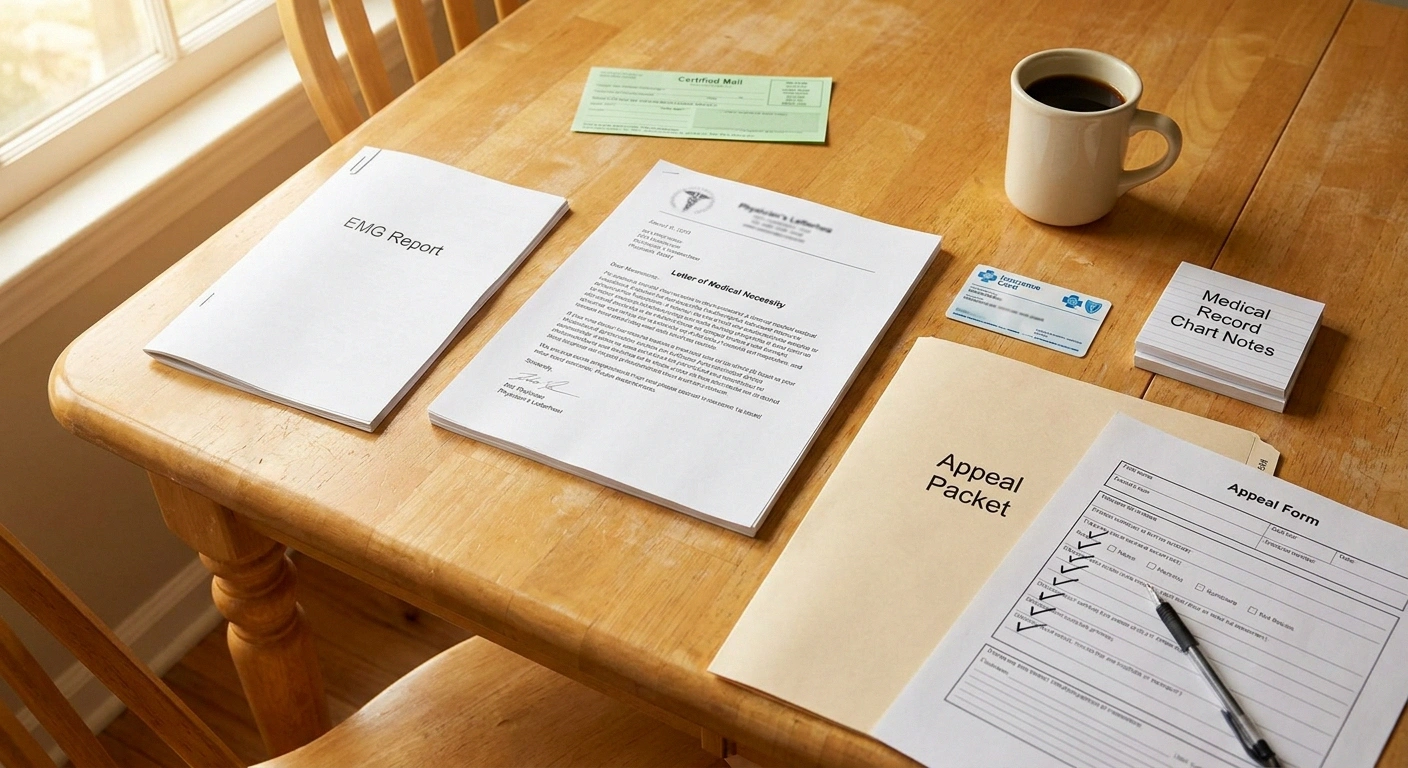
The single most important thing on this list is the physician’s Letter of Medical Necessity (LMN). Everything else is supporting evidence. The LMN is the argument.
Letter of Medical Necessity: The 8 Components
Physician authored. Share this list with your doctor’s office to make sure nothing is missing.
Your baseline packet, attached to every appeal:
- The denial letter or Explanation of Benefits, full copy including the reason code
- A copy of the plan’s appeal form (from the insurer’s portal or the denial notice)
- Your insurance card and policy number
- Complete medical records for the condition, including chart notes, hospital discharge summaries, and specialist consults from the last 12 to 24 months
- Diagnostic workup: EMG and nerve conduction studies, skin biopsy for small-fiber, relevant MRI, and labs (A1c, B12, methylmalonic acid, SPEP, ANA panel). Our guide on how neuropathy is diagnosed covers what a full workup includes.
- Prior-treatment failure documentation: drug names, doses, dates tried, side effects, why each was discontinued
- Guideline citations supporting the treatment (AAN, ADA, IASP, NCCN)
- A functional-impact statement in your own words, plus (optionally) a letter from a spouse or caregiver on what the untreated condition does to your sleep, work, driving, mobility, and fall risk. Our page on medications that cause neuropathy can help you build the prior-treatment history if any prior drug caused or worsened your neuropathy.
What the Letter of Medical Necessity should include (the physician writes this; you can share the components list with the office):
- Patient identification and policy number. Name, date of birth, member ID.
- ICD-10 diagnosis codes. Common ones: G60.9 (idiopathic peripheral neuropathy), E11.42 (diabetic peripheral neuropathy with loss of protective sensation), G61.81 (CIDP), G56.0 (carpal tunnel syndrome).
- The CPT, HCPCS, or NDC code for the requested treatment.
- Clinical history and severity. When was neuropathy first diagnosed, what evidence supports it (EMG, biopsy, labs), how severe is it now.
- Prior treatments tried, failed, or contraindicated. Specific drugs, specific doses, specific dates, specific reasons for stopping.
- Why this treatment is medically necessary for this patient. The individualized clinical argument.
- Guideline and peer-reviewed evidence citations. AAN, ADA, IASP, or relevant specialty-society position papers.
- Anticipated clinical benefit. Pain reduction, function preservation, fall prevention, avoidance of higher-cost care.
- Consequence of denial. Progression, disability, ER visits, hospitalizations.
- Physician signature, NPI, and direct contact info.
Send the packet by certified mail with return receipt, or upload through the insurer’s portal and screenshot the confirmation page. Keep a copy of every page. If you have taken the time to document a course of conservative therapy (rehab, physical therapy, targeted supplementation from our nerve-health supplements guide, foot-care protocols from our foot-care page), that documentation strengthens the appeal.
The Peer-to-Peer Call Nobody Tells You to Ask For

Before you draft a single word of a written appeal, ask your doctor’s office to request a peer-to-peer review. Also called a P2P or doc-to-doc. It is a phone call between your prescribing physician and the insurer’s medical director (or “peer reviewer”). It is not a formal appeal level. It happens before, or alongside, the internal appeal.
Why start here? It often resolves the denial in one 15-minute call. Faster than a paper appeal. No filing fee. No formal packet. And even when the P2P does not overturn the denial, the doctor walks away knowing exactly what the insurer’s specific objection is, so the written appeal can target it directly.
How to request it: the denial letter usually includes a scheduling line or phone number for peer-to-peer. Your doctor’s office calls to schedule. Most plans require the P2P inside a specific window (often 3 to 14 days after denial). Miss the window and the option is gone.
How to help your doctor prepare. This part matters. An AMA survey found only 16 percent of physicians felt the payer’s reviewer was appropriately qualified in their specialty. Do not assume the person on the other end is a neurologist. Bring the plan’s own Medical Policy Bulletin (most insurers publish these publicly) and match your clinical facts to the plan’s criteria line by line. Have prior-therapy failure documentation ready to quote in specific detail: drug, dose, duration, why discontinued.
Your job as the patient: confirm with your doctor’s office that the P2P was actually requested and completed. Ask for the reviewer’s name and the outcome in writing. This becomes part of the file if you escalate to a Level 2 or external review.
When to Escalate: State Regulators and External Review

Once you have exhausted the plan’s internal appeals (both levels for most commercial plans; the plan reconsideration for Medicare Advantage), you have two escalation paths. Sometimes both.
External review by an Independent Review Organization (IRO). This is the biggest lever most people never pull. Under federal ACA rules, you have 4 months from the final internal denial to request external review. The IRO is URAC-accredited and has no financial tie to the plan. The IRO decides within 45 days (72 hours expedited). The decision is legally binding on the insurer. If the IRO overturns the denial, the plan must pay. External review is free to the patient under federal law; some states charge a small fee (typically waived for hardship). Muni Health’s 2026 IRO guide and the NAIRO consumer guide both walk through the mechanics.
External review is where the “experimental” denials fall the hardest. IROs are independent clinicians reviewing specialty-society evidence, and when the guideline evidence is strong, an “experimental” label often does not survive scrutiny.
State insurance commissioner complaints. File one when your insurer missed a decision deadline, refused to explain the denial reason clearly, ignored medical records or a physician’s letter, sent contradictory notices, or denied an expedited request without justification. State Departments of Insurance can investigate for unfair delays or denials and force the insurer to answer regulatory inquiries (which often triggers an internal re-review). The NAIC keeps a directory of state DOI complaint forms; most accept online submissions. State DOIs cannot overturn a denial based on medical judgment (that is the IRO’s job) and cannot represent you as a lawyer.
One important limit. If your plan is a self-funded employer plan governed by ERISA, state DOIs have limited jurisdiction. File instead with the U.S. Department of Labor Employee Benefits Security Administration (EBSA).
If All Else Fails: Patient Assistance Programs
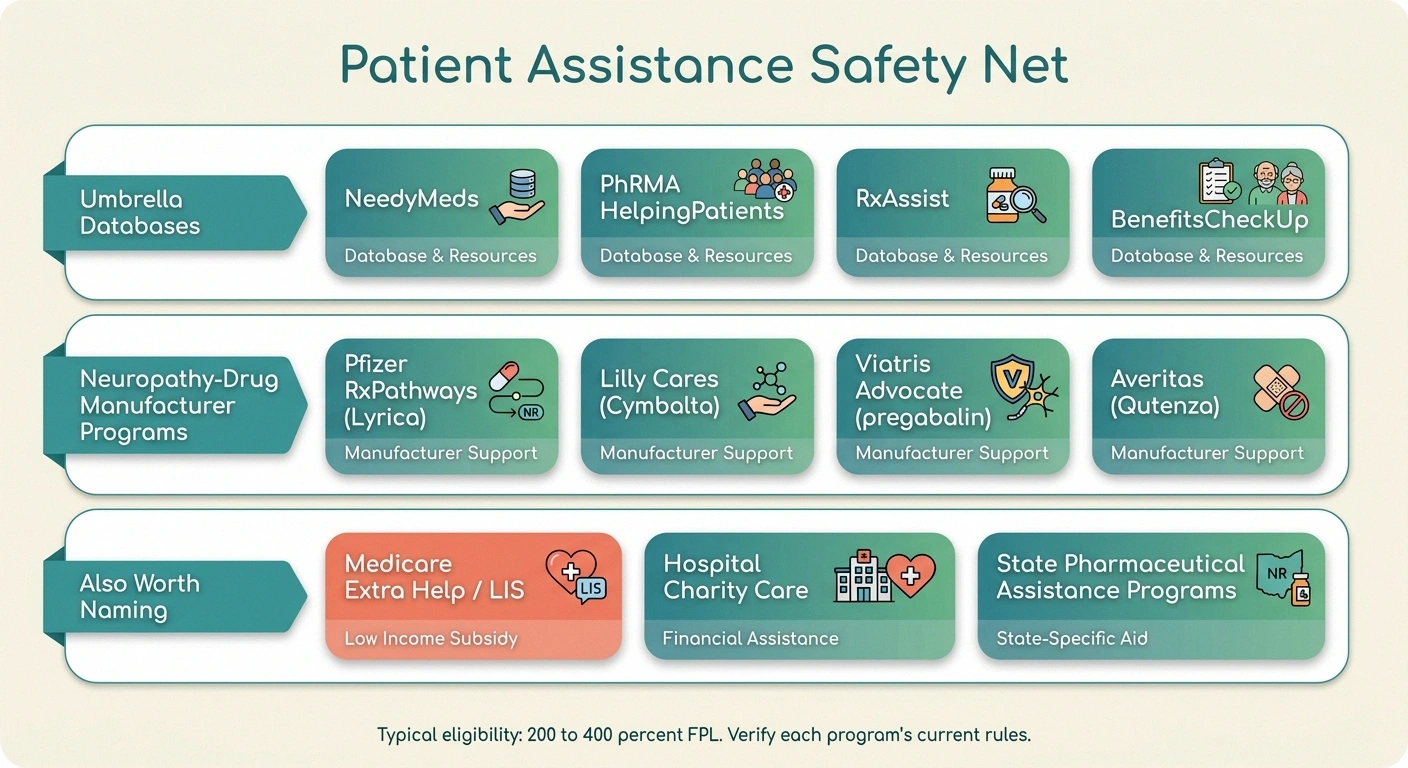
Sometimes the appeal fails. Sometimes the treatment is genuinely excluded. Sometimes you cannot wait while the pain worsens. Patient assistance programs are the safety net, and combined, the pharmaceutical industry distributes 10 to 14 billion dollars a year through them.
Appeals are exhausting when you are already tired. That is the honest truth of it. Bring an advocate. A spouse, a grown child, a friend who is calm on the phone. Somebody who can sit with you while you open the letter, take notes on the peer-to-peer call, and remember the certified-mail slip on the way home from the pharmacy.
The first no is not the last word. Most people never appeal, and the system counts on that. You do not have to be one of them.
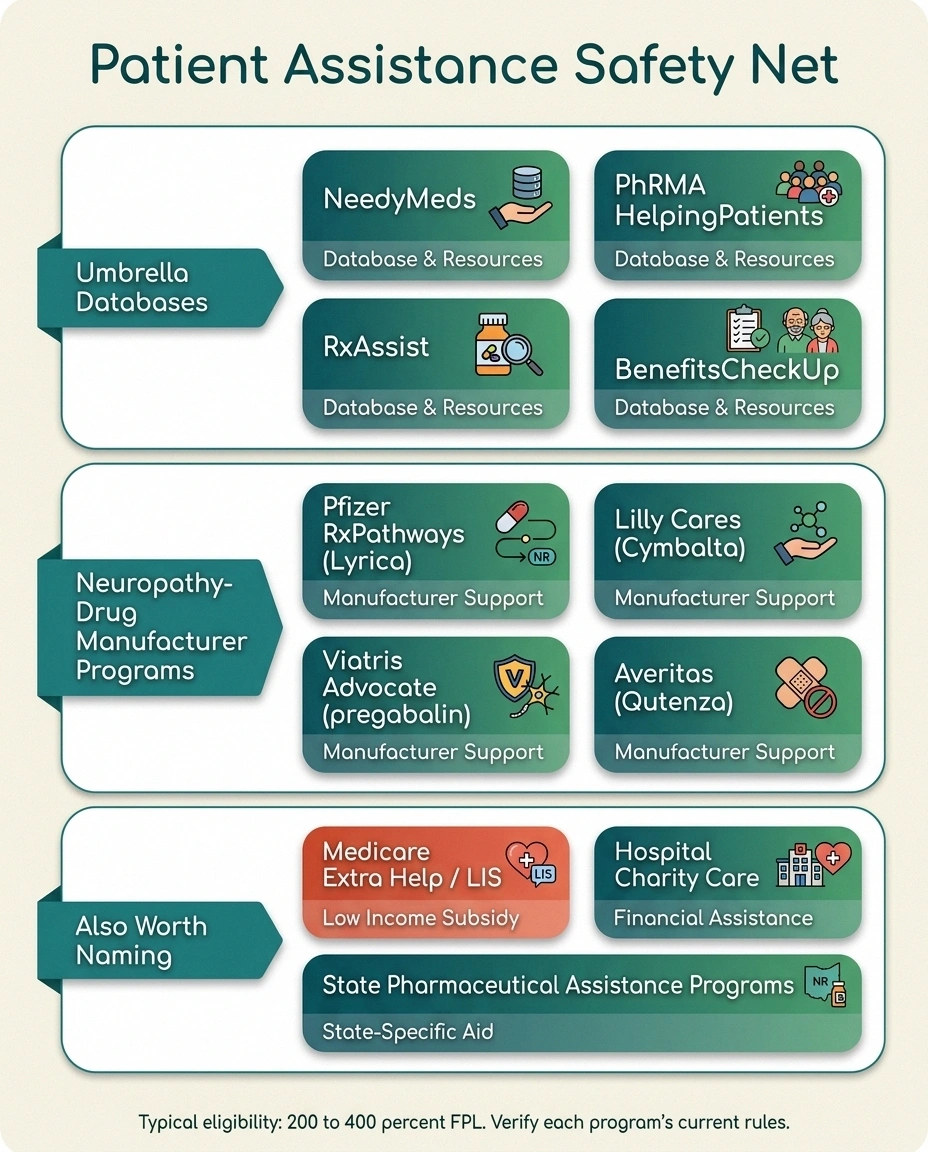
Start with the umbrella databases. NeedyMeds.org is the largest free directory, searchable by drug or brand. PhRMA’s HelpingPatients.org screens member-manufacturer PAPs. RxAssist.org is a pharma-company PAP directory. BenefitsCheckUp.org from the National Council on Aging screens benefits (also useful for Medicare Extra Help / Low-Income Subsidy). For Medicare beneficiaries below roughly 150 percent of the Federal Poverty Level, Medicare’s Extra Help program significantly reduces Part D costs.
For neuropathy drugs specifically, look at Pfizer RxPathways (brand Lyrica), Viatris Advocate Program (generic pregabalin), Eli Lilly Cares (Cymbalta), Averitas Pharma (Qutenza / capsaicin 8 percent patch), and the Grifols, Takeda, and CSL Behring programs for IVIG products used in CIDP. Eligibility typically requires income between 200 and 400 percent of the Federal Poverty Level (roughly $31,200 to $62,400 for a single person in 2026), U.S. residency, and a prescription from a U.S.-licensed provider.
Also worth naming: manufacturer copay cards for commercially insured patients (not valid with Medicare or Medicaid, due to anti-kickback rules), state pharmaceutical assistance programs (about twenty states run them), nonprofit hospital charity care (ask billing for the financial-assistance policy), 340B pricing at federally qualified health centers, and rare-disease foundations (the GBS/CIDP Foundation International offers IVIG and plasmapheresis assistance).
One last thing before the FAQ. Bring an advocate if you can. A spouse, a grown child, a friend who is calm on the phone. Somebody who can sit with you when you open the letter, take notes in the background on the peer-to-peer call, or pick up the certified-mail receipt on the way to the pharmacy. Do not take the first no as the last word. The letter in your hand today is the start of the fight, not the end of it.
Frequently Asked Questions
How long do I have to appeal a health insurance denial?
It depends on your plan type. For commercial and ACA plans, 180 days from the date on the denial letter (ACA and ERISA minimum). For Traditional Medicare, 120 days from the Medicare Summary Notice for Level 1 redetermination. For Medicare Part D, 65 days from a coverage-determination denial. For Medicaid, 30 to 90 days depending on your state. The exact deadline is printed on the denial notice itself. Miss it and the appeal is automatically dead, so this is the first thing to write on your calendar.
What is a peer-to-peer review and should I ask for one?
Yes, ask for one, and ask fast. A peer-to-peer is a phone call between your prescribing doctor and the insurer’s medical director (or “peer reviewer”). It often resolves a denial in a single 15-minute call. Most plans require the P2P inside 3 to 14 days of the denial, so call your doctor’s office right after you open the letter. Even when the P2P fails, it clarifies the insurer’s specific objection so the written appeal can target it precisely.
What is the difference between an internal appeal and an external review?
An internal appeal is the insurer reconsidering its own decision. An external review sends the case to an Independent Review Organization (IRO), which is a neutral URAC-accredited entity with no financial tie to the plan. The IRO’s decision is legally binding on the insurer. External review is available after you have exhausted the plan’s internal appeals, and under federal ACA rules, you have 4 months from the final internal denial to request it.
Can I appeal a Medicare Advantage denial the same way as Original Medicare?
The front end is different, then the ladder converges. Level 1 goes to the Medicare Advantage plan itself, not to a Medicare Administrative Contractor. If the MA plan upholds the denial, the case is automatically forwarded to the Independent Review Entity (currently Maximus). From Level 3 (Administrative Law Judge) through Level 5 (Federal District Court), Medicare Advantage appeals follow the same structure as Traditional Medicare, with the same 2026 amount-in-controversy thresholds of $200 (ALJ) and $1,960 (federal court).
What if my insurer misses the decision deadline?
A missed deadline is legally treated as the denial being upheld. You can proceed immediately to the next level of appeal. It is also a strong basis for filing a complaint with your state Department of Insurance for unfair claims practices. Document the missed deadline in writing (dated correspondence, screenshots of portal timestamps) and include the documentation in your escalation.
How much does external review by an IRO cost?
Federal external review is free to the patient. Some states charge a small fee (typically $25 or less, usually waived for financial hardship). The insurer pays the IRO’s actual fees. If the IRO overturns the denial, the plan must pay for the treatment.
Can my doctor file the appeal for me?
Yes, with your written authorization. Providers file most Medicare appeals on the patient’s behalf, and many commercial plans allow provider-filed appeals. This does not remove your right to appeal separately, and some situations (a formulary exception, for example) require the prescriber’s supporting statement regardless of who submits the paperwork.
Will appealing hurt my relationship with my insurance company?
No. Appeal is a legal right under federal law, and insurers cannot retaliate. Your rates cannot go up because you appealed. Your future claims cannot be denied because you appealed a past one. The insurer’s own paperwork always includes the appeal rights and the address to send an appeal to; using those rights is exactly what the system was designed for.
About the Author