
Carpal tunnel in both hands, released surgically four years ago. Burning in both feet that arrived without diabetes to explain it. Twenty pounds gone without trying. Lightheadedness on standing that everyone blamed on the blood pressure medication.
Four complaints, four different appointments, four separate explanations. In a small but real number of people, they are one disease, and the name of that disease is AL amyloidosis.
Peripheral neuropathy is the presenting sign in roughly fifteen percent of AL amyloidosis cases. That means a meaningful number of people meet this condition through their feet, arrive at a neurologist rather than a haematologist, and spend a long time being investigated in the wrong department.
This article is written for the person whose neuropathy does not add up. It covers what the disease is, why it damages nerves, the specific cluster of findings that should prompt two blood tests, the misdiagnosis that costs people the most time, and what treatment can and cannot recover.
What AL Amyloidosis Is
Deep in the bone marrow, plasma cells make antibodies. Antibodies are built from two kinds of building block, heavy chains and light chains, normally produced in balance and assembled into a finished antibody.
In AL amyloidosis, a single clone of plasma cells grows out of turn and pumps out light chains alone, in excess, and misfolded. Misfolded proteins are sticky. Rather than being cleared, they aggregate into rigid fibrils called amyloid and lodge in tissue.
The “AL” stands for amyloid light chain. It names the protein, and naming the protein is the entire point, because there are several different amyloid diseases built from several different proteins and they are not treated alike.
Where the fibrils land determines what the illness looks like. Deposit in the kidney and protein leaks into the urine. Deposit in the heart and the walls stiffen so the chamber cannot fill properly. Deposit in the tongue and it enlarges. Deposit in the small blood vessels feeding nerves, and in the nerves themselves, and you get neuropathy.
Most people have deposits in more than one organ at once. That multi-organ pattern is the fingerprint, and it is why a symptom list that seems to belong to four unrelated specialties is the thing worth paying attention to.
Why It Reaches the Nerves
Amyloid damages peripheral nerves along two routes.
The first is deposition in the endoneurium, the connective tissue inside the nerve trunk itself. Rigid protein accumulating between fibres crowds and injures them mechanically.
The second is deposition in the vasa nervorum, the tiny blood vessels that supply the nerve. Narrow those vessels and the fibres downstream lose their oxygen and nutrient supply. Nerve injury from vascular starvation looks different from nerve injury caused by direct attack on myelin, which matters when the results come back.
Two features follow from this mechanism. The neuropathy is axonal rather than demyelinating, meaning the nerve fibre itself is dying back rather than losing its insulation. And it hits small fibres hard, which is why pain and autonomic symptoms are so prominent and why the presentation overlaps heavily with small fiber neuropathy from any other cause.
Amyloid also has a habit of depositing in confined spaces where a nerve passes through a tunnel. The carpal tunnel at the wrist is the classic site, and bilateral carpal tunnel syndrome years before anything else declares itself is one of the most useful early clues in the whole disease.
The Cluster Worth Recognising
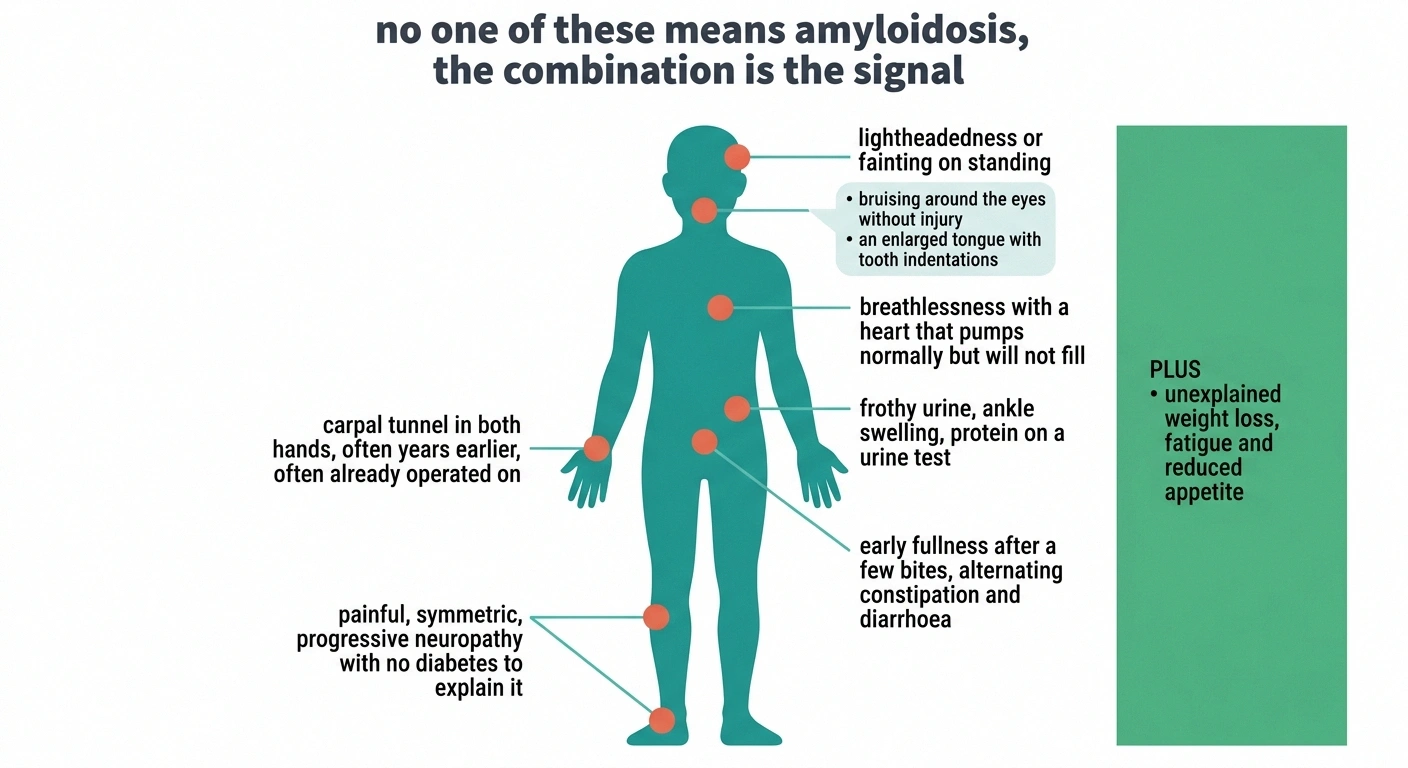
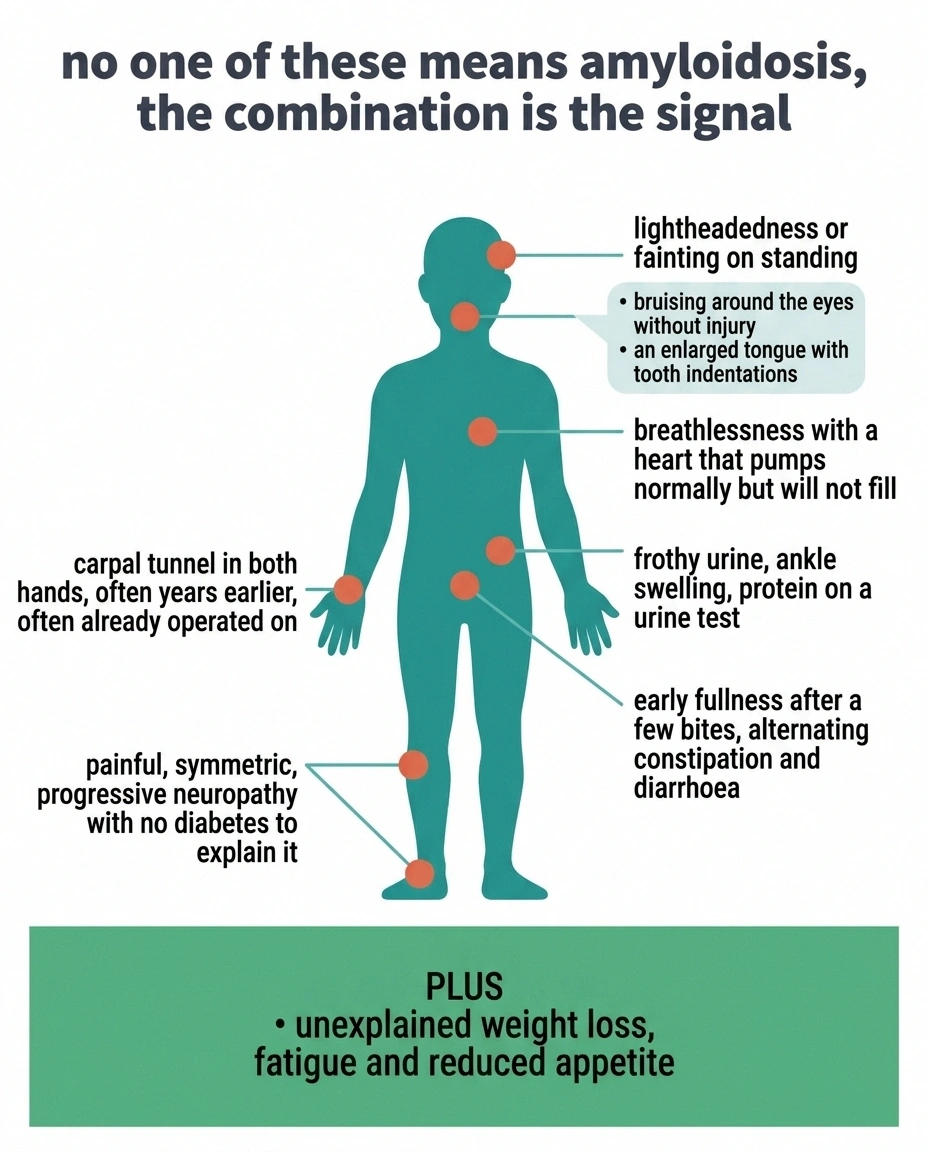
No single symptom here means amyloidosis. The combination is what carries the signal.
Four numbers that shape how this disease is found
15%
of AL amyloidosis cases present through peripheral neuropathy, which is why so many arrive at a neurologist first
7 of 8
patients in a published neuropathy-first series had severe pain, so a painless presentation is the exception here
6 of 8
in that same series had prominent autonomic dysfunction, which is the feature most often left out of the referral letter
3
tests, two blood and one urine, detect the abnormal protein in the great majority of cases
In a published series of patients whose amyloidosis presented through the nervous system, the initial symptoms were symmetric numbness in both lower limbs, pain in both lower limbs, and carpal tunnel syndrome. Seven of the eight had severe pain. Six had prominent autonomic dysfunction.
Set alongside that, the features that make a haematologist think of AL amyloidosis in the first place: protein in the urine at nephrotic levels, heart failure in which the pumping fraction is preserved but the heart will not fill, non-diabetic peripheral neuropathy, an enlarged liver with no obvious cause, and unexplained diarrhoea.
Read those two lists together and a picture emerges that no single specialist appointment is designed to catch.
Painful, progressive, symmetric neuropathy of the feet and legs without diabetes. The pain is a real feature rather than an afterthought. If burning feet are your dominant complaint and the usual causes have all come back clean, the search is not finished.
Carpal tunnel syndrome in both hands, often several years earlier, often already operated on.
Autonomic symptoms. Lightheadedness or fainting on standing, early fullness after a few bites of food, alternating constipation and diarrhoea, bladder difficulty, loss of sweating in the feet, erectile dysfunction. Any one of these can occur alone. Several together in someone with painful neuropathy is a pattern. Our overview of autonomic neuropathy and how it presents covers what each of those symptoms reflects.
Weight loss, fatigue, and reduced appetite that nobody has accounted for.
Something else going on in another organ. Frothy urine or ankle swelling from kidney protein loss. Breathlessness or reduced exercise tolerance from cardiac involvement.
The rarer signs are worth knowing because they are close to diagnostic when present: bruising around the eyes without injury, and a tongue that has visibly enlarged and shows tooth indentations along its edges.
The CIDP Mistake
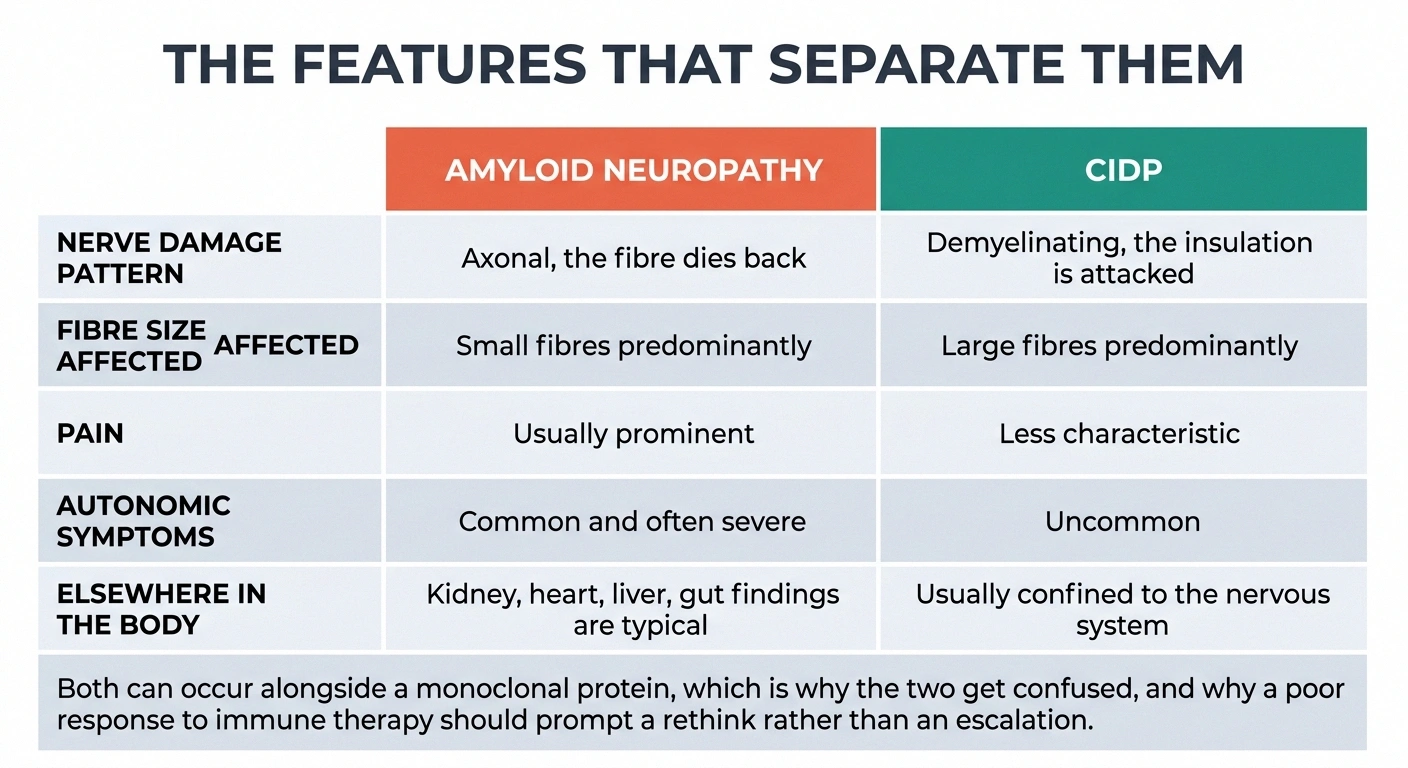
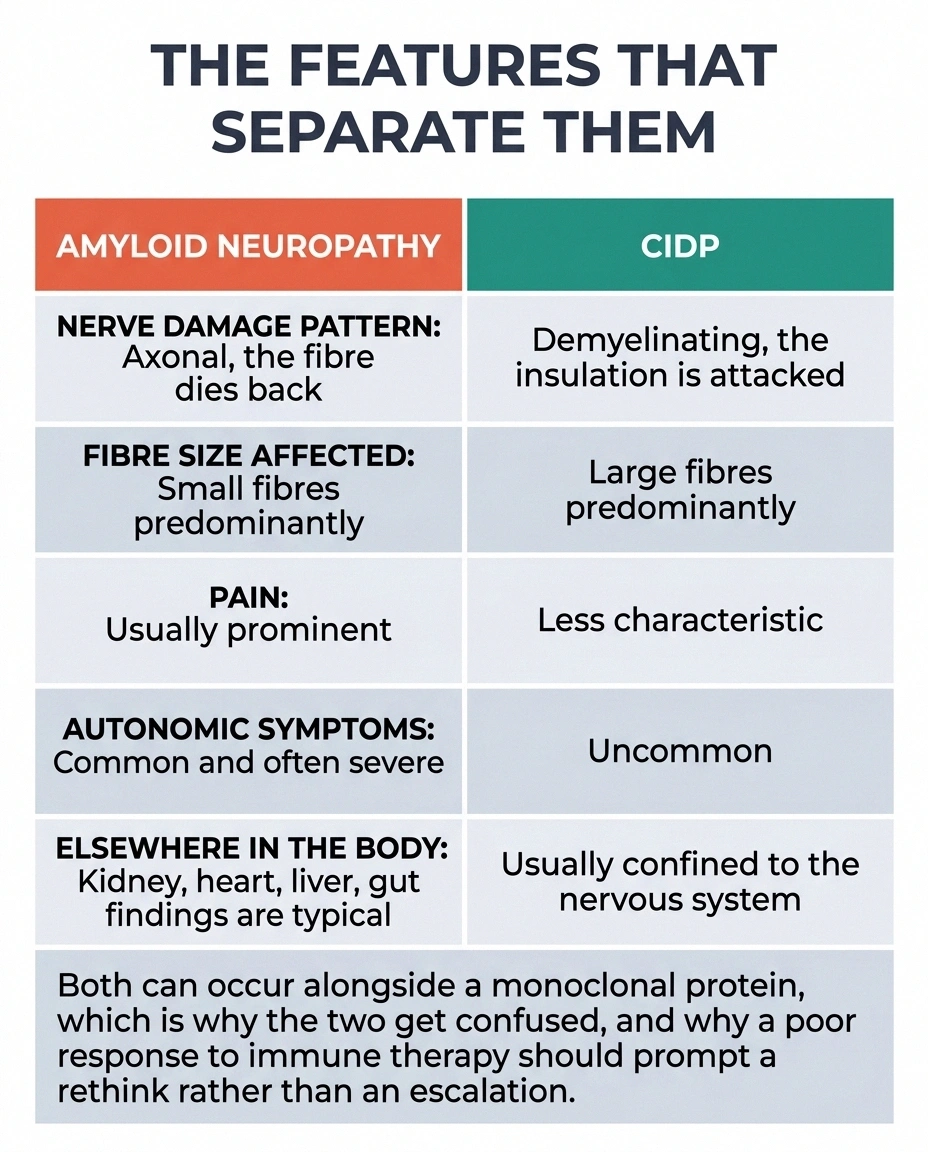
This is the single most valuable paragraph on this page.
Patients with peripheral neuropathy and a monoclonal gammopathy are frequently misdiagnosed as having chronic inflammatory demyelinating polyneuropathy.
The reason is structural rather than careless. Both conditions produce a progressive neuropathy. Both can occur alongside an abnormal protein in the blood. CIDP is treatable, common enough to be familiar, and worth trying treatment for on reasonable suspicion. So treatment starts, and the clock starts with it.
The cost of that detour is high in a way it would not be for most misdiagnoses. AL amyloidosis is progressive and its outlook depends heavily on how much organ damage has accumulated by the time therapy begins, particularly in the heart. Months spent on IVIG for the wrong condition are months during which light chains continue to be produced and continue to deposit.
Several things separate the two if they are asked about deliberately. Amyloid neuropathy is axonal and small-fibre predominant, while CIDP is demyelinating and affects large fibres, and nerve conduction studies distinguish those patterns. Amyloid neuropathy is usually painful with prominent autonomic involvement, which is less characteristic of CIDP. Amyloid produces organ findings outside the nervous system. And CIDP that responds poorly to standard immune treatment should always prompt a rethink rather than an escalation.
If you carry a CIDP diagnosis alongside a monoclonal protein, painful feet, autonomic symptoms, or a disappointing response to immune therapy, asking directly whether amyloidosis has been excluded is a reasonable question, and the tests that answer it are not exotic.
AL Is Not ATTR
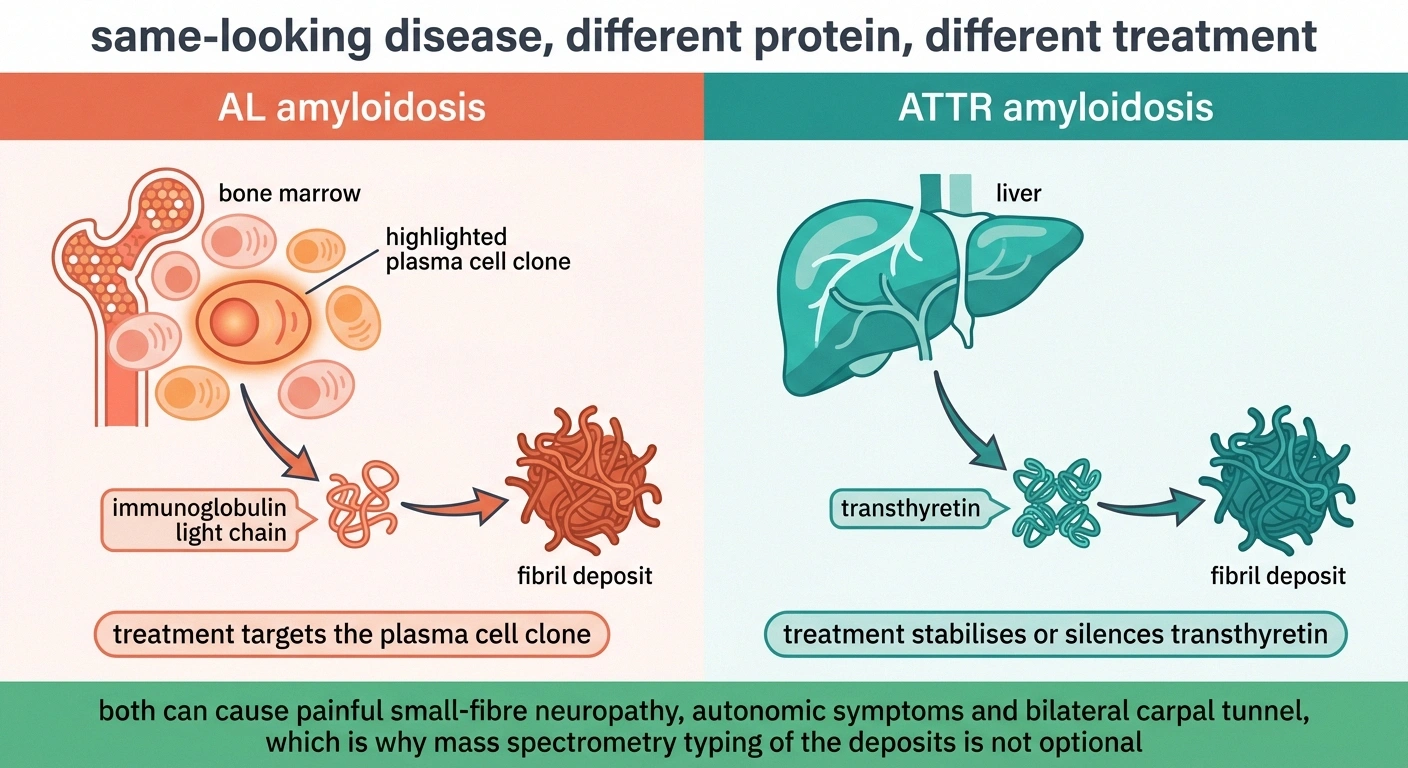
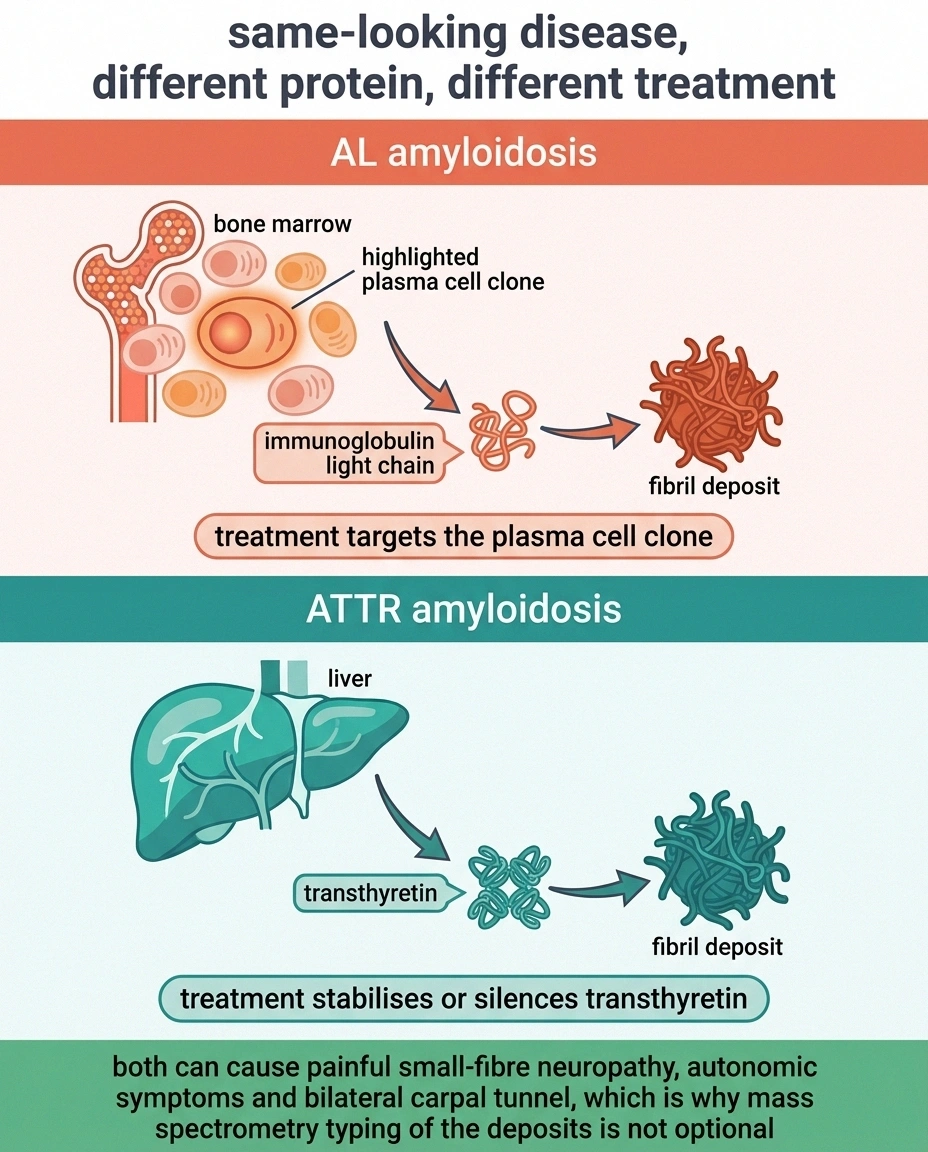
Two amyloid diseases damage nerves and they get confused constantly, including in search results. The distinction determines the treatment entirely.
AL amyloidosis is built from immunoglobulin light chains made by a rogue plasma cell clone in the bone marrow. It is a blood disorder. Treatment targets the plasma cells.
ATTR amyloidosis is built from transthyretin, a transport protein made by the liver. It comes in a hereditary form caused by an inherited variant and a wild-type form associated with ageing. Treatment targets transthyretin itself, either by stabilising the protein or by silencing its production, and there is a growing set of drugs designed to do exactly that. Our guide to ATTR amyloid neuropathy covers that disease on its own terms.
Both can produce a painful small-fibre neuropathy with autonomic features, bilateral carpal tunnel syndrome, and cardiac involvement. They look alike from the outside.
Which is why typing the amyloid deposits is mandatory rather than optional. Mass spectrometry on the biopsy tissue identifies which protein the fibrils are actually made of. Getting this wrong in either direction means treating the wrong disease with drugs that cannot work on it.
Getting to a Diagnosis
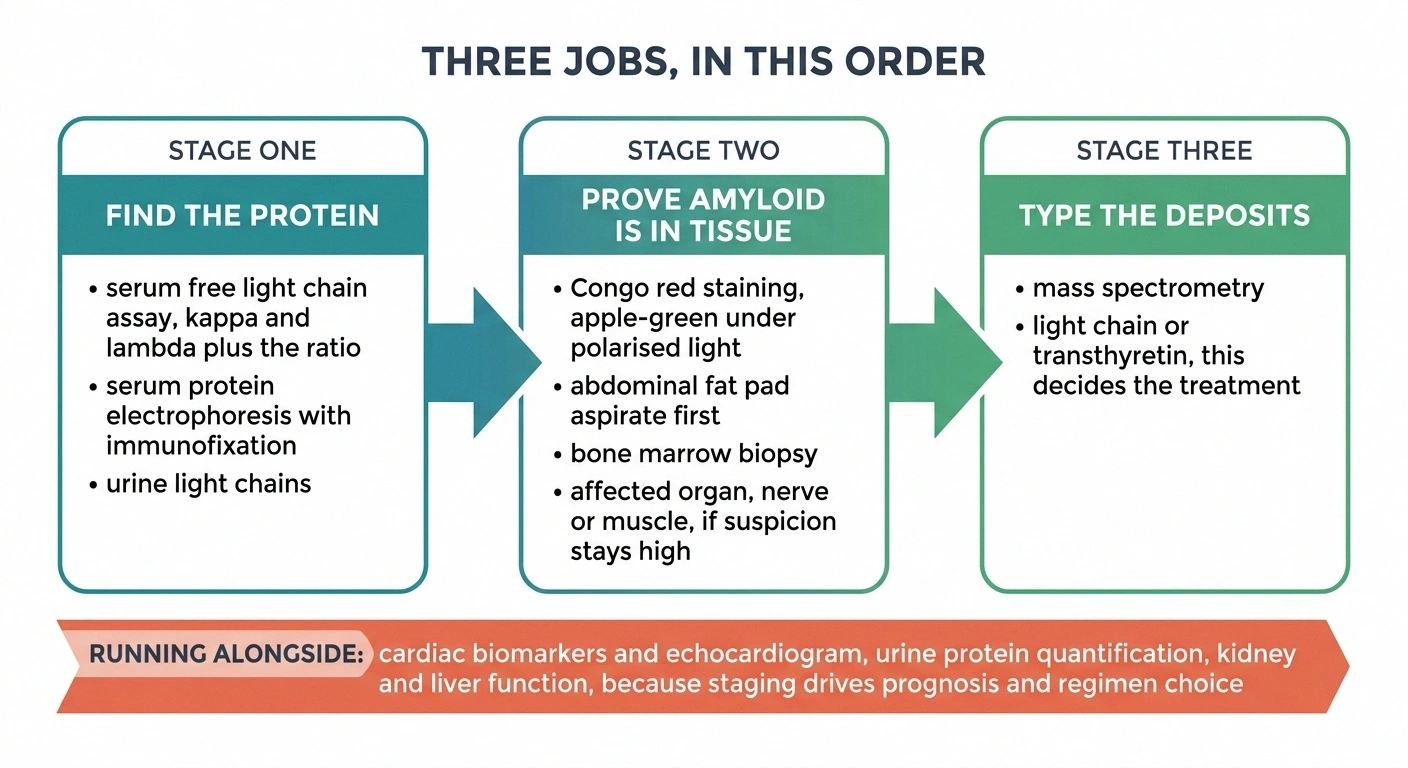
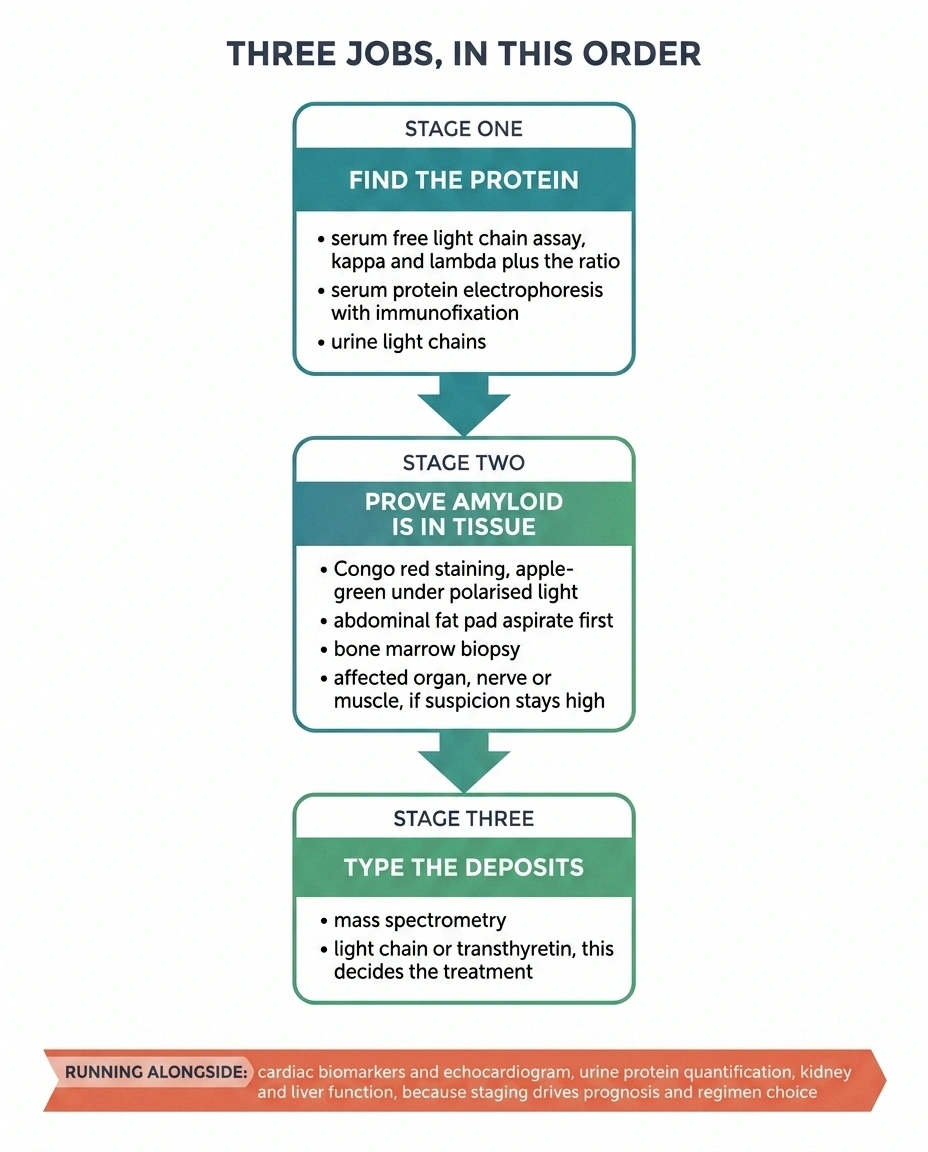
The workup has three jobs: find the abnormal protein, prove there is amyloid in tissue, and identify which protein the amyloid is made of.
The three tests, written the way they appear on an order form
Asking for these by name avoids the commonest gap, which is that a standard protein electrophoresis alone can miss cases that the free light chain assay catches. The two are ordered together for a reason.
- Serum free light chain assay, reported as kappa, lambda and the kappa to lambda ratio. The ratio is the part that carries the signal.
- Serum protein electrophoresis with immunofixation. Immunofixation is a separate step from electrophoresis and has to be requested, not assumed.
- Urine protein electrophoresis with immunofixation, on a 24-hour or spot sample as the lab prefers. This is what historically got called Bence-Jones protein.
Finding the protein. Two blood tests and one urine test do most of this work. A serum free light chain assay measures kappa and lambda light chains and, importantly, their ratio. Serum protein electrophoresis with immunofixation looks for a monoclonal band. Urine testing looks for light chains excreted by the kidney, historically called Bence-Jones protein. Used together, this trio detects the great majority of cases. Our list of blood tests worth having on record for unexplained neuropathy includes electrophoresis for this reason.
Proving amyloid is present. Tissue is stained with Congo red, which causes amyloid to glow apple-green under polarised light. An abdominal fat pad aspirate is the least invasive place to start. Bone marrow biopsy is usually done anyway to assess the plasma cell clone. When those are negative and suspicion remains high, biopsy of an affected organ, including nerve or muscle, is diagnostically valuable in exactly this situation.
Typing it. Mass spectrometry on the amyloid deposits establishes whether the fibrils are light chain, transthyretin, or something rarer.
Alongside that, organ assessment: cardiac biomarkers and an echocardiogram, urine protein quantification and kidney function, liver testing. The cardiac numbers do more than describe the heart. They drive the staging system that determines prognosis and shapes which treatment regimen is appropriate, which is why the heart gets scanned even in someone whose only complaint is in their feet.
Treatment, and the Bortezomib Problem

Treatment does not target the amyloid already deposited. It targets the factory.
The one set of symptoms that should not wait for a routine appointment
New breathlessness, ankle swelling that is getting worse, chest discomfort, fainting, or a sudden drop in what you can manage on a flight of stairs, in anyone with suspected or confirmed AL amyloidosis, warrants same-day assessment.
Cardiac staging drives prognosis in this disease more than any other single factor, and the heart is the one organ where the cost of waiting is measurable. Everything else in this article can be raised at the next scheduled visit.
Silence the plasma cell clone, and the supply of misfolded light chains stops. Organs then have a chance to clear existing deposits slowly and stabilise. This is why speed matters so much: every month of continued production adds to a burden that clears reluctantly at best.
The current frontline standard is a four-drug regimen usually abbreviated Dara-CyBorD, combining daratumumab with cyclophosphamide, bortezomib and dexamethasone. The ANDROMEDA trial established it, showing markedly higher rates of haematologic and organ response when daratumumab was added to the three-drug regimen it replaced. Reports of longer event-free and overall survival, and of fewer early deaths, have come from longer follow-up and from comparison studies rather than from that trial's original endpoint, so the survival picture is a developing one built on accumulating evidence rather than a single settled number. Autologous stem cell transplant remains an option for selected patients who are well enough for it.
Here is the complication that matters to anyone reading this because of their nerves.
Bortezomib causes peripheral neuropathy. It is one of the better-characterised neurotoxic drugs in oncology, and its dose-limiting toxicity in many patients is exactly the painful sensory neuropathy that brought this reader to the article. Giving it to someone who already has amyloid neuropathy means adding a second insult to nerves that are already failing.
The literature is explicit that pre-existing disease-related sensorimotor polyneuropathy can limit the use of bortezomib. This is a recognised clinical problem with an active search for answers rather than an oversight.
Nerve-sparing alternatives are under study rather than settled. A combination of daratumumab with ixazomib and dexamethasone has been investigated specifically as a neuropathy-sparing option, in early-phase work; it is not the standard frontline regimen and is not a swap a patient can request off a page like this one. Whether it fits a particular person is a judgement for an amyloidosis specialist weighing nerve risk against the need to shut down light chain production quickly.
Within the standard regimen, the levers that exist for reducing neurotoxicity are familiar to haematology teams: how often bortezomib is given, whether it goes in under the skin rather than into a vein, and how quickly the dose comes down when symptoms appear. Those are decisions for the treating team rather than a menu to choose from, and the reason to know they exist is so that reporting a symptom early is understood as useful information rather than complaining.
None of that means refusing effective therapy. Untreated AL amyloidosis is far more dangerous than treatment-related neuropathy. It means that baseline neuropathy should be documented before the first cycle, that symptoms should be reported early rather than tolerated quietly, and that the question of which regimen best fits a patient who already has nerve damage is a legitimate one to raise. The same monitoring logic applies here as in any chemotherapy-induced neuropathy, where early reporting is what preserves the option to adjust.
What Recovery Realistically Looks Like

Being straight about this is more useful than being encouraging about it.
Different organs recover on different schedules
Worth knowing before treatment starts, because judging the whole regimen by how your feet feel at month three sets the wrong expectation.
| What is being measured | Realistic expectation |
|---|---|
| Light chain levels in blood | The fastest to move, and the first sign the regimen is working. This is the number the haematology team watches. |
| Heart and kidney function | Organ response is a formal trial endpoint and a real experience, but it lags the blood response and is measured over many months. |
| Peripheral nerve symptoms | The slowest and least generous. Halting progression is the common and worthwhile outcome; some improvement happens; full reversal of established damage is not the expectation. |
| Day-to-day function | Often improves ahead of the nerve testing, because pain control, orthostatic management, balance work and foot protection are separate levers that do not wait on nerve repair. |
Once light chain production is suppressed, the heart and kidney can improve measurably. Organ response is a formal endpoint in trials and a real experience for patients.
Nerves are slower and less generous. Axonal damage regenerates at a crawl, and amyloid neuropathy has usually been progressing quietly for a long time before anyone names it. Stabilisation, meaning the neuropathy stops advancing, is the common outcome and a genuinely good one. Meaningful improvement happens for some people. Full reversal of established amyloid neuropathy is not the expectation.
Which is the argument for early diagnosis stated as plainly as it can be put. The nerve you keep is worth vastly more than the nerve you try to recover.
Symptom management runs in parallel with disease treatment and is not a lesser project. Neuropathic pain medication, orthostatic symptom management, attention to gut and bladder function, physical therapy for balance and strength, and foot protection where sensation is reduced all apply here as they do in any progressive peripheral neuropathy. The care team for this condition is genuinely a team, usually haematology, cardiology, nephrology and neurology together, and amyloidosis specialty centres exist precisely because coordinating that is hard to do piecemeal.
If you are reading this because your own neuropathy has never been explained, the practical takeaway is small and concrete. Two blood tests and a urine test. Ask whether they have been done.
Frequently Asked Questions
What is AL amyloidosis neuropathy?
It is peripheral nerve damage caused by deposits of misfolded immunoglobulin light chains in and around nerves. A clone of plasma cells in the bone marrow produces excess light chains that misfold into amyloid fibrils, which accumulate in the connective tissue inside nerve trunks and in the small blood vessels that supply them. The result is a painful, progressive, axonal neuropathy that typically affects small fibres and often involves the autonomic nervous system.
Can amyloidosis cause peripheral neuropathy?
Yes, and in AL amyloidosis peripheral neuropathy is the presenting sign in roughly fifteen percent of patients. The typical pattern is distal, symmetric and progressive, with sensory symptoms dominating and painful dysesthesias in the legs. Carpal tunnel syndrome, often bilateral and often years earlier, is a common early feature.
What is the difference between AL and ATTR amyloidosis?
They are built from different proteins and treated in completely different ways. AL amyloidosis comes from immunoglobulin light chains produced by an abnormal plasma cell clone in the bone marrow, and treatment targets those plasma cells. ATTR amyloidosis comes from transthyretin, made by the liver, in either an inherited or an age-related wild-type form, and treatment targets transthyretin by stabilising or silencing it. Both can cause painful neuropathy with autonomic features and bilateral carpal tunnel, which is why typing the amyloid by mass spectrometry is essential.
Why is AL amyloidosis mistaken for CIDP?
Both cause progressive neuropathy and both can occur alongside a monoclonal protein in the blood, so patients with neuropathy plus a monoclonal gammopathy are frequently misdiagnosed as having CIDP. The distinguishing features are that amyloid neuropathy is axonal and small-fibre predominant while CIDP is demyelinating, that amyloid neuropathy is usually painful with prominent autonomic symptoms, that amyloid produces findings in other organs, and that a poor response to standard immune therapy should prompt reconsideration.
What tests diagnose AL amyloidosis?
A serum free light chain assay, serum protein electrophoresis with immunofixation, and urine testing for light chains detect the abnormal protein in most cases. Amyloid then has to be confirmed in tissue with Congo red staining, commonly starting with an abdominal fat pad aspirate and bone marrow biopsy, and the deposits must be typed by mass spectrometry to confirm they are light chain rather than transthyretin.
Is AL amyloidosis neuropathy reversible?
Partial improvement is possible but full reversal of established amyloid neuropathy is not the expectation. Treatment stops the production of the light chains causing the damage, and the heart and kidneys often improve measurably once that happens. Nerves regenerate slowly and the neuropathy has usually been progressing for a considerable time before diagnosis, so halting progression is the realistic and worthwhile goal.
Does bilateral carpal tunnel syndrome mean amyloidosis?
Not on its own. Bilateral carpal tunnel syndrome is common and usually has ordinary causes. It becomes a meaningful clue when it appears alongside other features, such as unexplained painful neuropathy in the feet, autonomic symptoms, unexplained weight loss, protein in the urine, or a heart that has become stiff. It is the combination that warrants asking about amyloidosis, not the carpal tunnel alone.
How is AL amyloidosis treated?
Treatment targets the plasma cell clone producing the light chains rather than the amyloid already deposited. The current frontline standard combines daratumumab with cyclophosphamide, bortezomib and dexamethasone, a regimen shown to improve haematologic and organ response and to prolong survival compared with the three-drug combination it replaced. Autologous stem cell transplant is an option for selected patients.
Will chemotherapy make my neuropathy worse?
Bortezomib, part of the standard regimen, is known to cause peripheral neuropathy, and pre-existing disease-related neuropathy can limit its use. Strategies to reduce that risk include weekly rather than twice-weekly dosing, subcutaneous rather than intravenous administration, dose reduction when symptoms appear, and neuropathy-sparing alternatives such as daratumumab combined with ixazomib and dexamethasone, which has been studied for this purpose. Documenting baseline neuropathy before treatment starts and reporting changes early is what preserves the ability to adjust.
About the Author