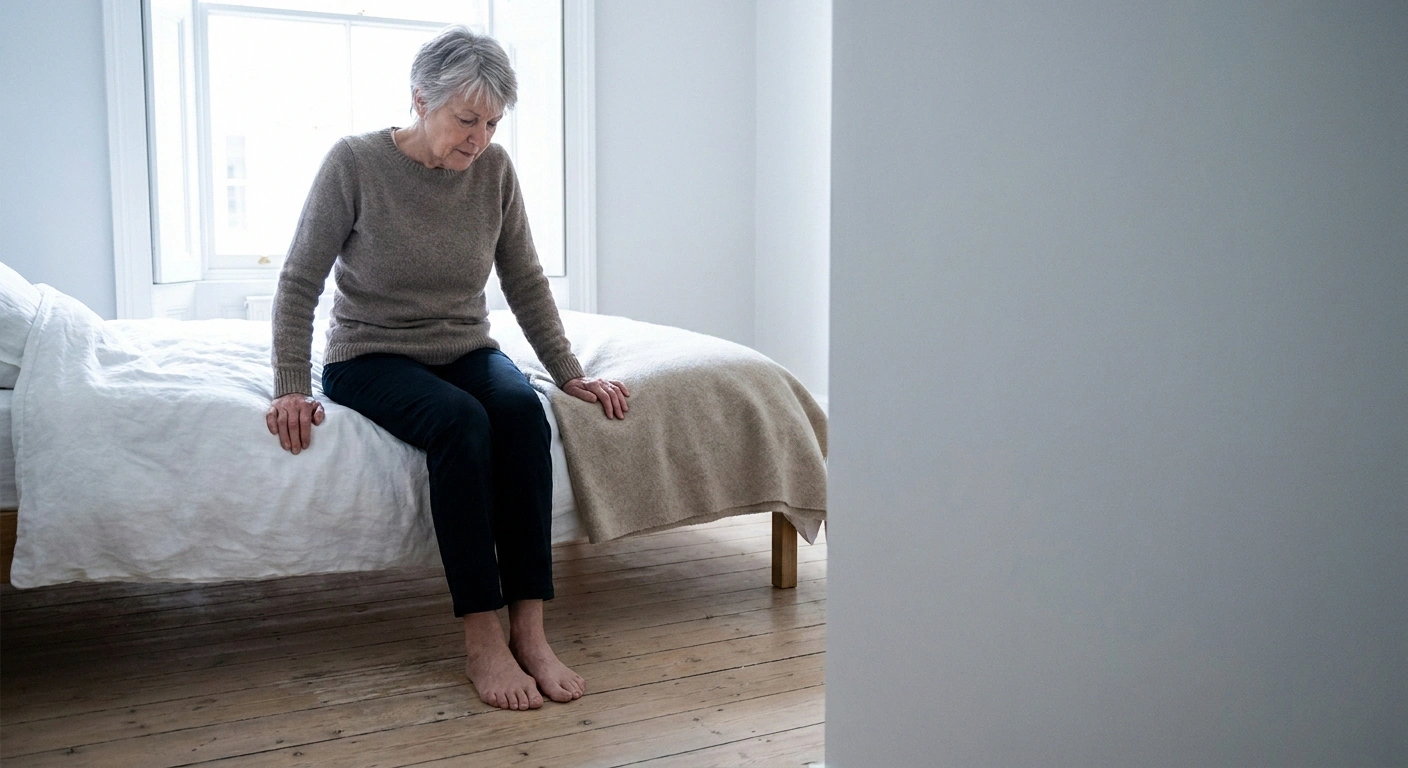
Go and sit on the edge of your bed, feet flat on the floor, and look down.
If your thighs slope downhill toward your knees, the bed is too high. If your knees sit higher than your hips, it is too low. Either way you have been fighting the furniture twice a day, every day, without registering it.
That measurement is where this starts, because bed height changes every transfer you make afterward. Technique matters, equipment matters, but a bed at the wrong height makes both of them work harder than they should.
The Number to Aim For, and How to Get There
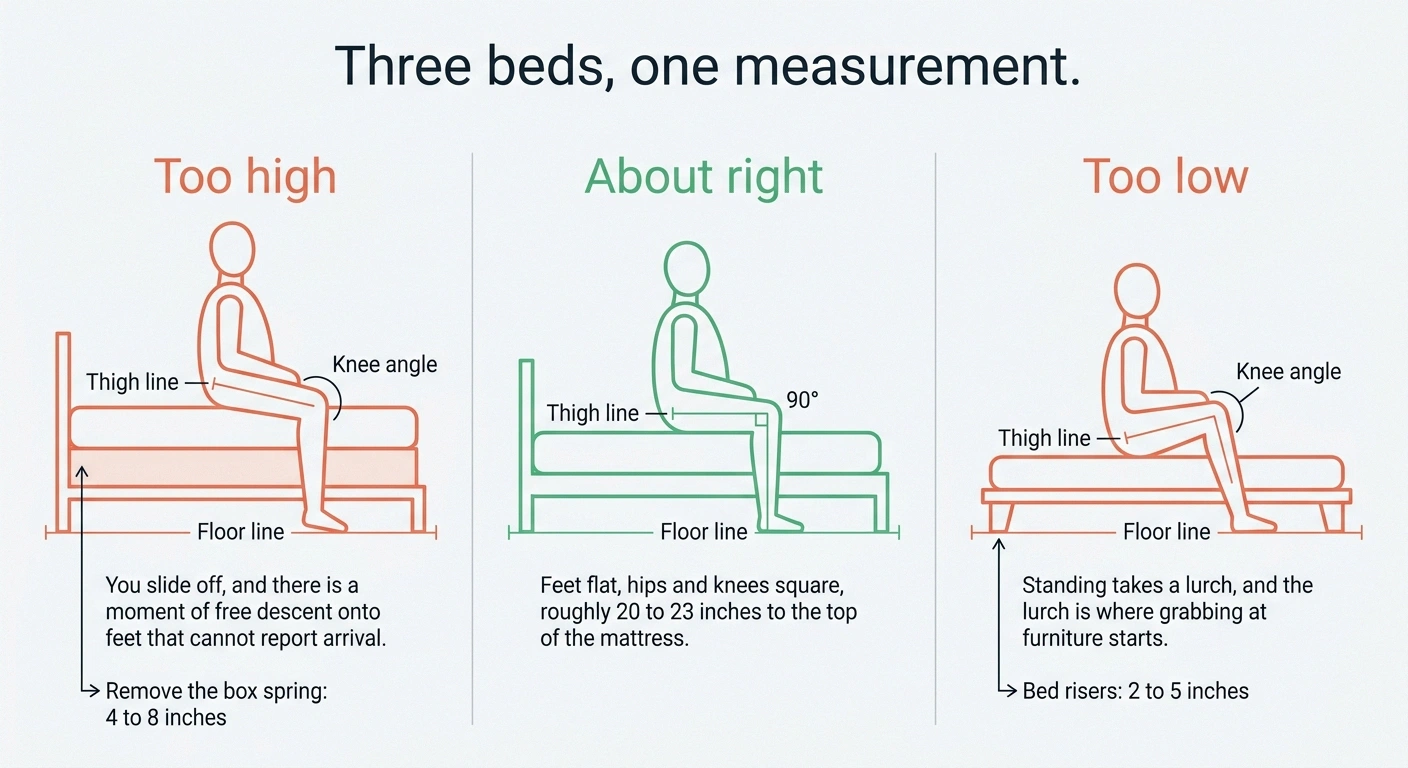
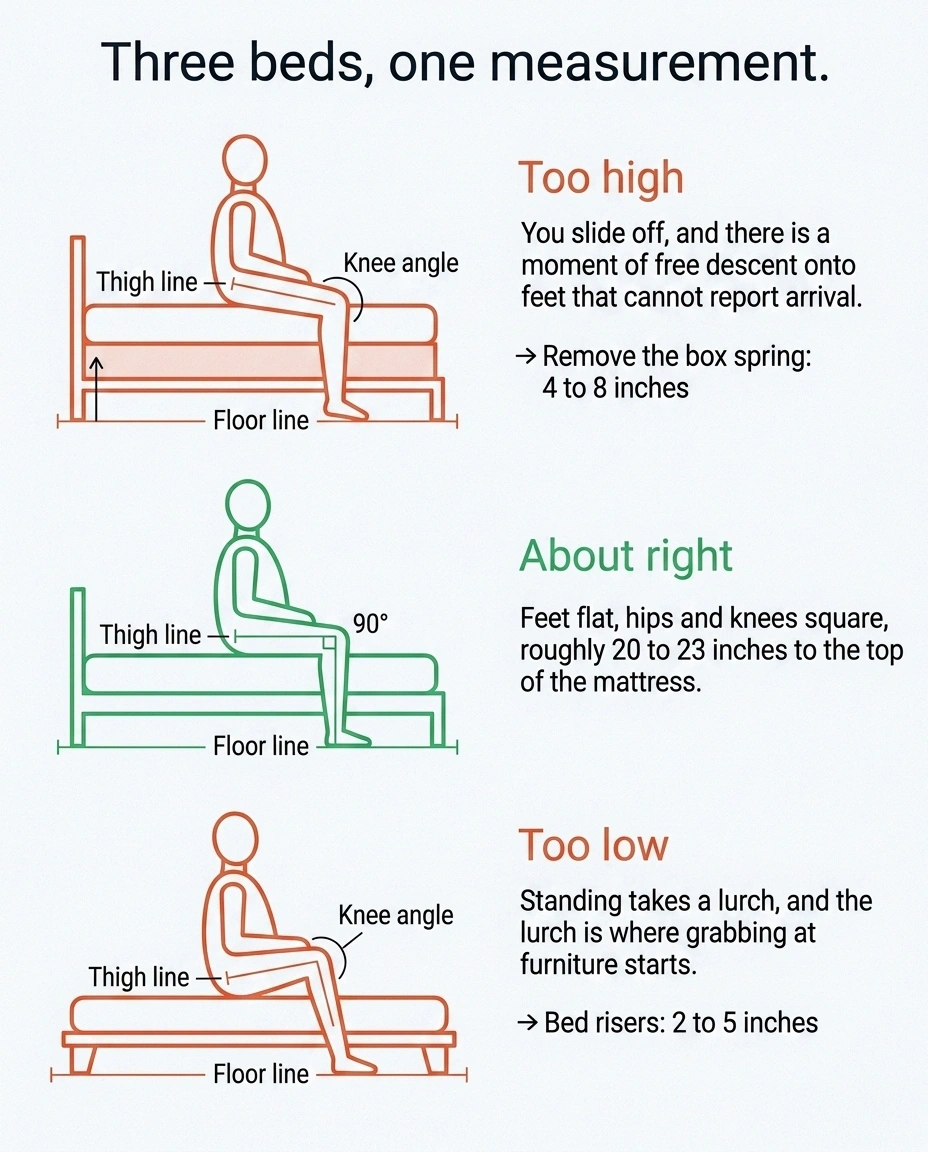
You want your feet flat on the floor with your hips and knees at roughly right angles and your thighs level. For most adults that puts the top of the mattress somewhere around twenty to twenty three inches from the floor, though your leg length decides it, not the average.
Read your thighs, then pick the fix
Sit on the edge with both feet flat. The slope of your thighs is the whole diagnostic, and it takes ten seconds.
| What you see | What it costs you | The fix |
|---|---|---|
| Thighs slope down toward the knees | Bed too high. You slide off and land on feet that cannot report arrival. | Remove the box spring, drops most beds 4 to 8 inches. Or a thinner mattress, or a platform frame. |
| Knees higher than hips | Bed too low. Standing demands a lurch, which is where the grabbing at furniture begins. | Bed risers, 2 to 5 inches, cheap and reversible. |
| Thighs level, feet flat | Nothing. Roughly 20 to 23 inches to the top of the mattress for most adults. | Leave it alone and spend the money on a rail instead. |
A bed that is too high means you slide off and land on feet that cannot tell you they have arrived. There is a moment of free descent, short but real, and it ends on a surface you cannot read.
A bed that is too low is a different problem. Standing from a low seat demands a great deal from the quadriceps and produces the forward lurch that puts people onto their hands and knees. It is also where a lot of grabbing at nearby furniture starts.
Fixing it is usually simple. Bed risers lift a frame two to five inches for very little money, and they are the fix when the bed is too low. Check the weight rating covers the bed plus everyone in it, make sure the frame legs seat fully into the cups rather than perching, and take the casters off first if your frame has them, because a riser under a wheel is a bed that moves when you lean on it. When it is too high, taking the box spring out often drops it four to eight inches in an afternoon, or a thinner mattress does the same. A platform frame sits lower than a traditional frame with a box spring on top.
Do the measurement before you buy anything. Sit, look at your thighs, and write down how many inches you are away from level.
Getting Out, in Four Movements

The wrong way is the way most people do it: sit straight up from flat, twist, and swing both legs over the side in one motion. That combination loads the lower back, and it stands you up faster than your blood pressure can follow.
Use the thirty seconds, do not just spend them
Sitting still lets blood pressure recover on its own. These four movements push blood back toward the heart and shorten the recovery, and all of them happen while seated.
- Ankle pumps, about a dozen. Toes up, toes down. The calf muscle is the pump that does most of this work.
- Clench and release both fists. Five or six times. Small effect, no cost, and it wakes your hands up before you use them for support.
- Straighten and bend each knee. Two or three each side, unhurried.
- Squeeze your thighs together and hold. A few seconds, twice. This one has the most immediate effect on the drop.
Then stand and wait a few more seconds before stepping. The second drop arrives after you are upright, not while you are rising.
The sequence that works uses your legs as a counterweight.
Roll onto your side first, the side you are getting out on. Bend your knees up as you roll so they finish near the edge of the mattress.
Let your legs come off the edge as you push up. Lower elbow under you, upper hand flat on the mattress, and push while your shins drop toward the floor. The weight of your legs going down helps lift your upper body. Done properly it costs surprisingly little effort.
Sit still. This is the part people skip and it is the part that prevents the most falls. Thirty to sixty seconds on the edge of the bed while your blood pressure catches up. If you have autonomic involvement, the reflexes that normally correct that drop are slower, and the grey swimming seconds are exactly the window where people go down. The same pause does the same job on the way to the bathroom at two in the morning.
Use the pause rather than just waiting it out. Pump your ankles up and down a dozen times. Clench and release your fists. Straighten and bend each knee. Squeeze your thighs together for a few seconds. These push blood back toward your heart and genuinely blunt the drop.
Some lightheadedness on standing is ordinary and the pause handles it. Some of it needs looking at rather than managing around. Get it assessed if you have fainted or nearly fainted, if it is still there after sitting a full minute, if it appeared or worsened after a medication change, or if it arrives alongside chest pain, a racing heart or confusion. The measurement that answers it is a blood pressure taken lying down and then again standing, by somebody watching you, and it takes about five minutes to do.
Then stand, holding something solid, and stand up rather than forward. Feet slightly apart, weight even, hands on a fixed support. Wait another few seconds upright before you take a step, because the second drop happens after standing rather than during it.
What Will Hold You and What Will Come Off the Wall
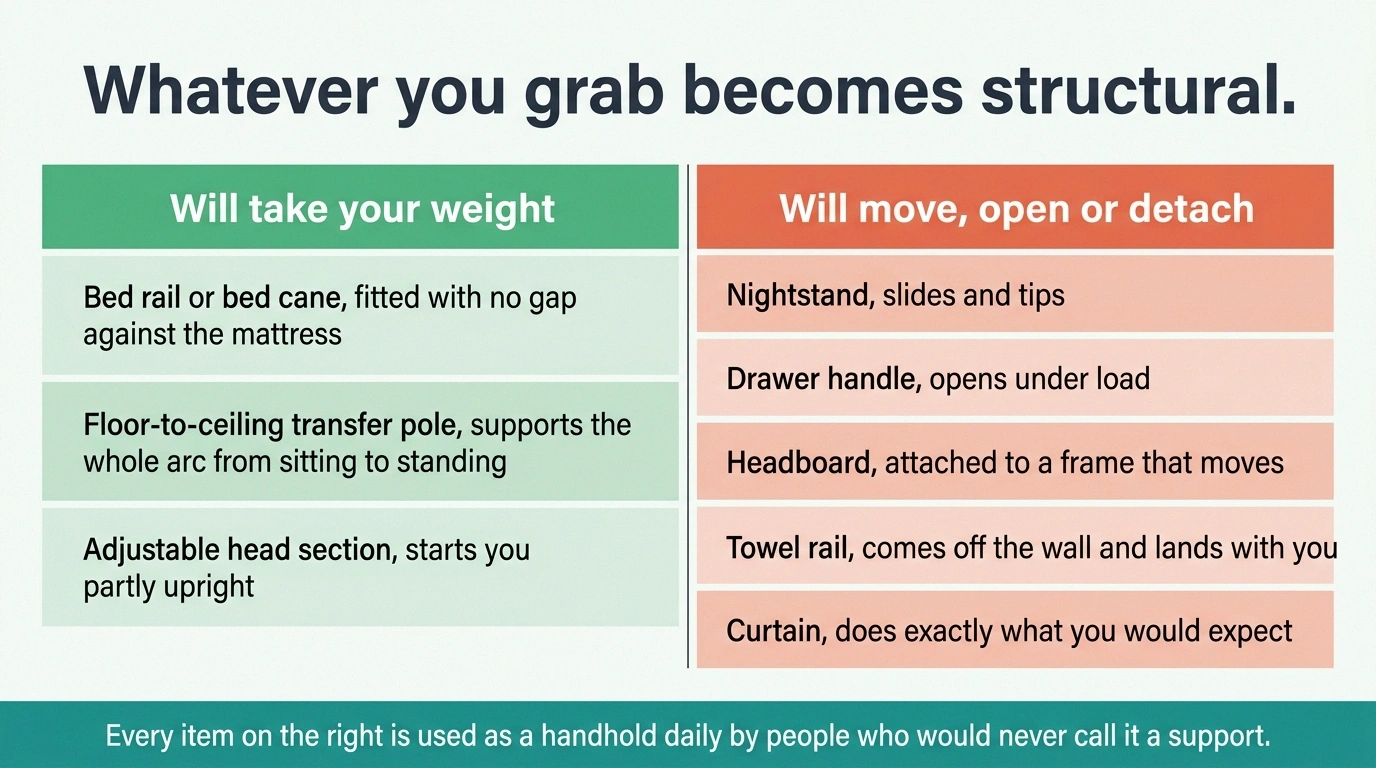
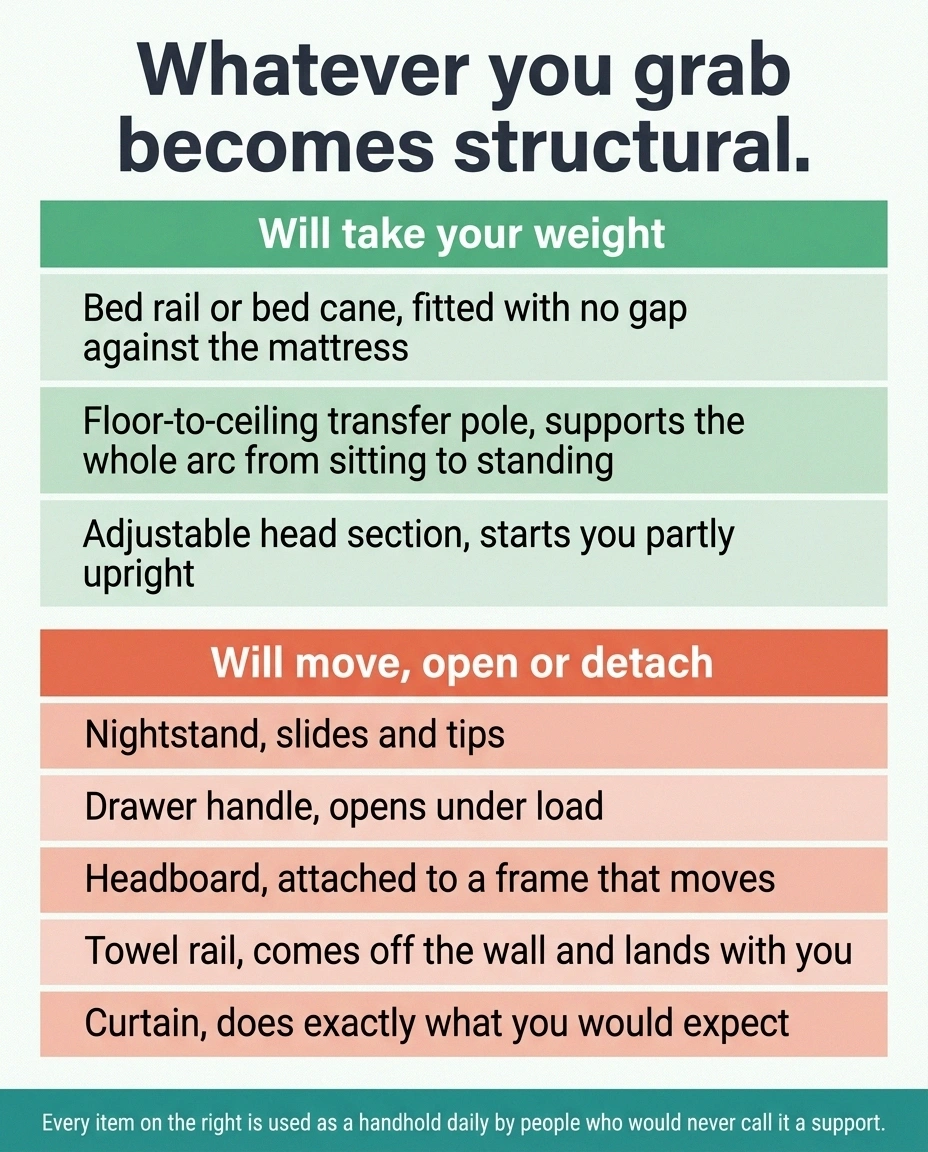
Whatever you reach for becomes structural the instant you put weight on it, so it needs to be chosen rather than grabbed.
Anything you grab becomes structural
The right-hand column is used as a handhold daily by people who would never call it a support. That is precisely why it fails: nobody decided to trust it.
Built to take your weight
- Bed rail or bed cane. Cheapest good answer. Check for gaps against the mattress.
- Floor-to-ceiling transfer pole. Better if standing is the hard half, because it supports the whole arc.
- Adjustable head section. Starts you partly upright and removes most of the sit-up work.
Will move, open or detach
- Nightstand. Slides, and tips if you pull sideways.
- Drawer handle. Opens under load, which is worse than giving way.
- Headboard. Attached to a frame that moves.
- Towel rail. Comes off the wall and lands with you.
- Curtain. Does exactly what you would expect.
A bed rail or bed cane fixes to the frame or slides under the mattress and gives you a fixed handhold at a sensible height. It is the cheapest good answer and it works for most people. Check the fit specifically for gaps between the rail and the mattress, since an entrapment gap is a genuine hazard and a poorly fitted rail is worse than none.
A floor-to-ceiling transfer pole is the better answer if standing is the hard part. It offers grip positions through the whole arc from sitting to standing, and unlike a rail it supports you once you are on your feet.
A bed with an adjustable head raises you into a partly seated position before you begin, which removes most of the sit-up work. Worth knowing about if you are replacing a bed anyway.
The list of things that will not hold you is shorter and more important. A nightstand slides. A drawer handle opens. A headboard is attached to a frame that moves. A towel rail comes off the wall and lands on you. A curtain does exactly what you expect. Every one of these gets used as a handhold daily by people who would never describe them as supports.
Getting In Is the Half Nobody Practices
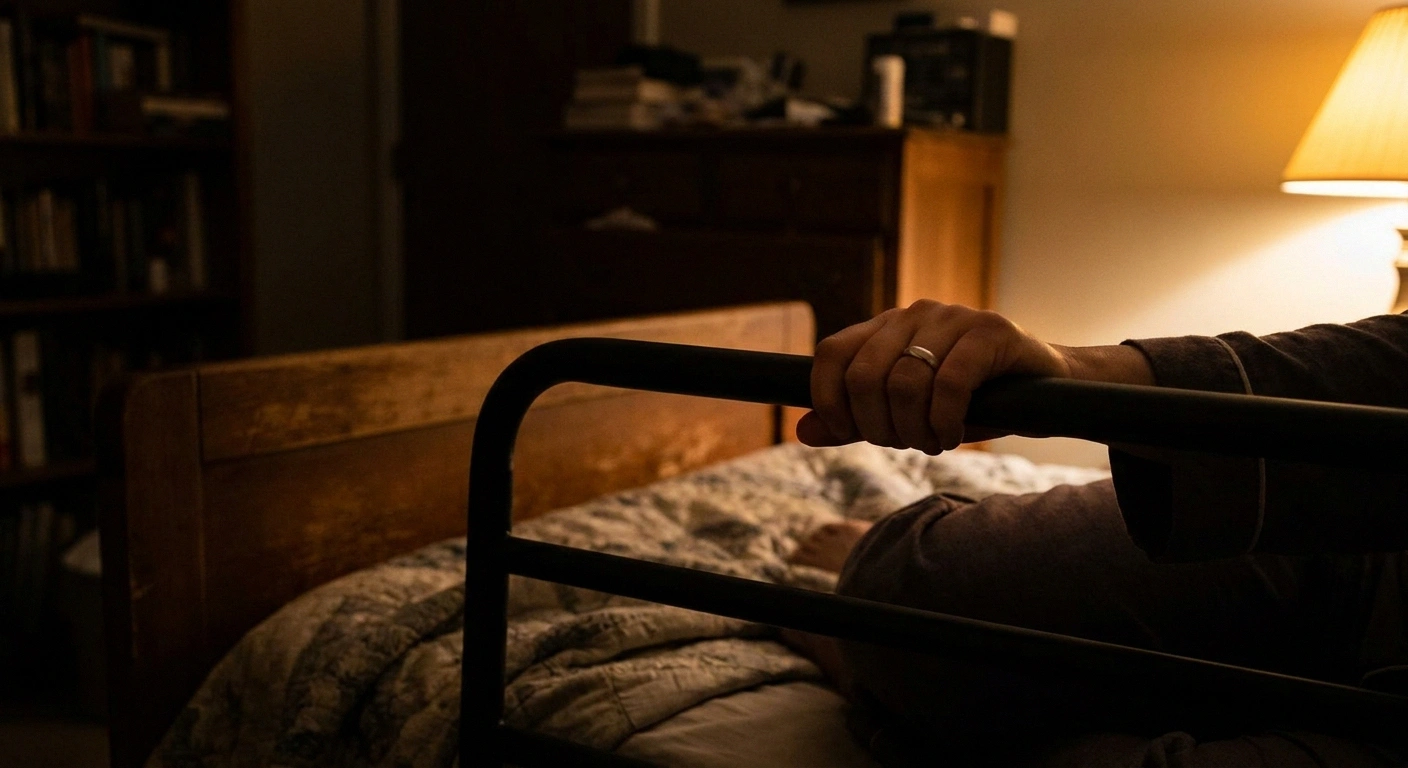
Every guide covers getting out. Almost none cover getting in, and for numb feet the return journey is arguably the less controlled one, because there is a moment when both feet leave the floor and your base of support disappears entirely.
Four steps in, four steps out, in opposite order
| Getting out | Getting in |
|---|---|
| Roll onto your side, knees bent toward the edge | Back up until the mattress touches the backs of your legs |
| Legs drop as you push up on elbow and hand | Reach back with both hands and lower under control |
| Sit 30 to 60 seconds, ankle pumps, fists, thighs | Sit a moment and take your shoes off here, while stable |
| Stand holding something solid, then wait before stepping | Lean onto one elbow, both knees up together, roll down |
The cue that makes the right-hand column work: sensation behind the knees is usually far better preserved than sensation in the feet. Backing up until you feel the mattress there replaces the foot contact you cannot rely on, and it is a physical confirmation rather than a visual estimate.
Reverse the order and it is straightforward.
Back up until the mattress touches the back of your legs. This is the whole trick, and it is worth its own sentence. When your feet cannot tell you where the bed is, the backs of your knees can. Sensation there is usually far better preserved than in the feet, and it gives you a reliable physical cue rather than a visual estimate. Keep backing up slowly until you feel contact.
Reach back with both hands and lower yourself. Do not drop. Controlled descent onto the mattress with your hands taking part of the weight.
Sit for a moment before you lift your feet. Take your shoes off here, while you are still stable, not while you are lying down and reaching.
Then reverse the roll. Lean onto one elbow, bring both knees up onto the bed together, and let your upper body follow as you roll onto your back. Legs and torso move as one unit rather than in two separate efforts.
Practise it once in daylight. It takes ninety seconds and it makes the version you do in the dark considerably less improvised.
Small Physics Around the Bed
A few details in the immediate area do more than their size suggests.
Two things worth raising at your next appointment
Near misses count. A stumble you caught is the most useful thing you can report, and it is the item people leave out because nothing happened. One near miss predicts the next one better than almost any test.
Ask about the timing of your medication. Blood pressure tablets and diuretics affect how steep the drop is when you stand. When you take them is a prescriber's decision, not one to adjust yourself, but it is a question worth asking, because the answer sometimes removes the problem rather than managing it.
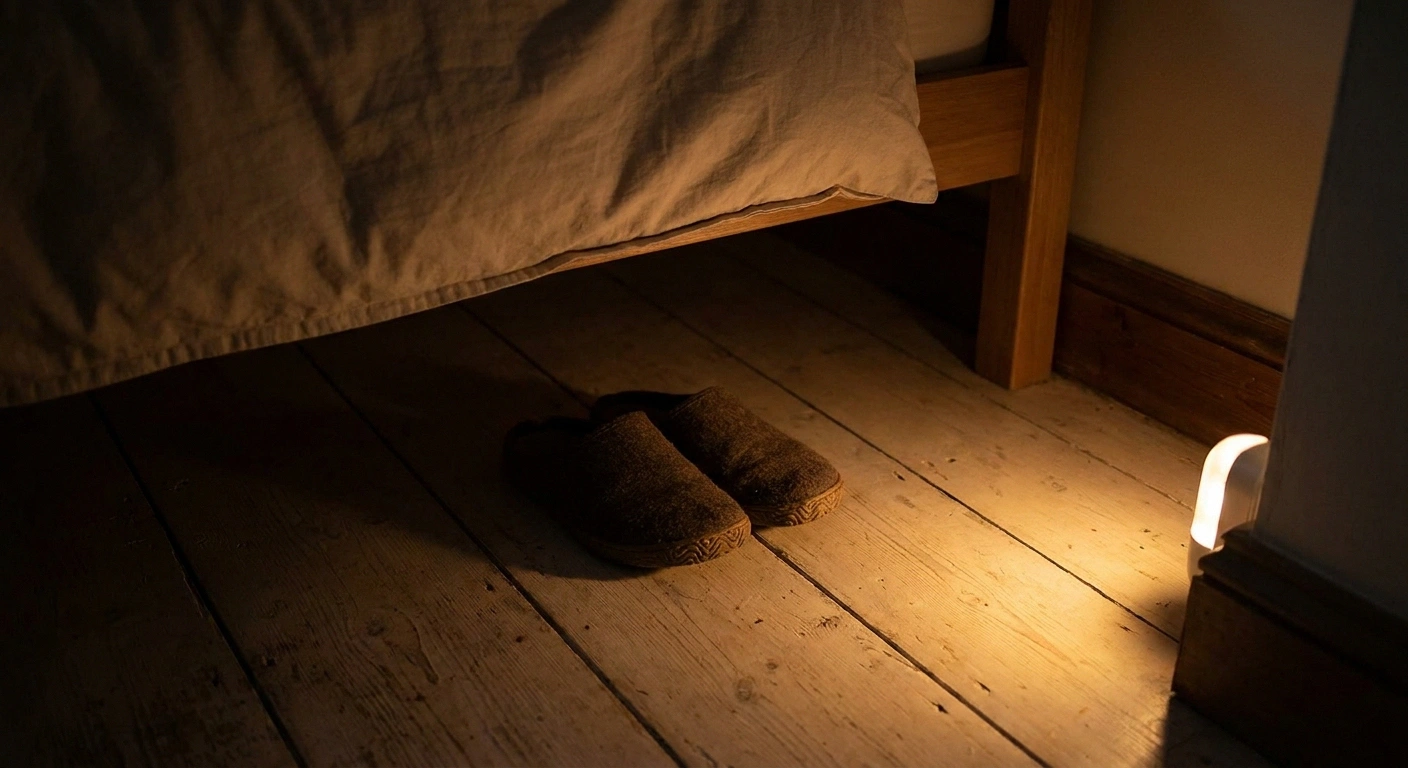
Shoes on before standing, every time. Closed-back, gripping sole, snug fit, kept in exactly one place beside the bed. Backless slippers come off mid-step, which is the worst possible moment. Everything that makes a shoe right for neuropathy during the day applies with more force at the bedside.
Satin and silk sheets are a real tradeoff. They make rolling over easier, which is a genuine benefit for anyone whose feet hurt more at night and who shifts position constantly. They also make sliding off the edge much faster and much less controlled. If you love them, keep them on the sleeping surface and put a cotton or bamboo sheet strip along the edge you get out on, or accept that you need the bed rail more than most people do.
Raise the head of the bed about four inches if you get lightheaded on standing. Blocks under the head-end legs, not extra pillows. It is a standard recommendation for orthostatic drops and it works overnight rather than on waking.
Keep the floor beside the bed empty. Not tidy, empty. No basket, no charging cable, no shoes other than the pair in their fixed place, no pet bed directly beside where your feet land. A rug you have stepped over for years is still a rug you cannot feel the edge of, and the same clearing logic applies to the rest of the house.
Light the floor before you move. A low warm light at ankle height along the route, on a switch you can reach lying down or on a motion sensor. Overhead light at three in the morning wakes you fully and costs you the rest of the night, which is one of several reasons the bedroom setup itself is worth a proper look.
Getting Somebody to Look at It Properly
If you are hesitating before transfers, holding furniture that was never meant to hold you, or have already had a near miss, an occupational therapist assessment is the right next step rather than a bigger purchase.
They come to the house, watch you actually do it, and recommend the specific equipment for your bed, your height, your floor and your particular pattern of lost position sense. That is a different quality of answer from a product page, and it usually costs less than the equipment somebody would otherwise buy twice. Ask your doctor for a referral, and mention any near misses specifically, because a near miss is the thing that most reliably changes what a clinician goes looking for.
Frequently Asked Questions
Why do I feel dizzy when I get out of bed?
Blood pressure falls when you move from lying to upright, and nerve damage affecting the autonomic system slows the reflexes that normally correct it within a couple of heartbeats. Sitting on the edge of the bed for thirty to sixty seconds, with ankle pumps and fist clenches during the pause, gives your circulation time to catch up before you commit your weight.
How high should my bed be?
High enough that your feet rest flat on the floor with your hips and knees at roughly right angles and your thighs level. For most adults that is around twenty to twenty three inches to the top of the mattress, but your leg length sets the number. Sit on the edge and look at your thighs; the slope tells you which way you are wrong.
Are bed rails safe to use?
A properly fitted one is, and fit is the whole question. Gaps between the rail and the mattress are an entrapment hazard, so check the fit against the manufacturer's guidance and make sure it is genuinely secured to the frame. If standing is your harder half rather than sitting up, a floor-to-ceiling transfer pole supports you through more of the movement.
What is the safest way to get back into bed?
Back up until you feel the mattress against the backs of your legs, reach behind with both hands, lower yourself under control, sit for a moment, then lean onto one elbow and bring both knees up together as your body rolls down. The back-of-the-knee contact is the cue that replaces the foot feedback you have lost.
Should I use a bed with an adjustable head?
It helps if sitting up from flat is the difficult part, since it starts you partly upright. It is an expensive answer to a problem a bed rail often solves, so it makes most sense when you were replacing the bed anyway or when a raised head position also helps your breathing or reflux.
My partner sleeps in the same bed. Does any of this change?
Mostly it means agreeing which side is yours and keeping that side clear and equipped. A rail on one side does not affect the other. If one of you is up several times a night, separate blankets reduce the number of times the other person is disturbed and reduce the tangling that causes some of these falls.
How long should I sit before standing?
Thirty seconds at minimum, sixty if you take blood pressure medication or a diuretic, and longer if you feel anything at all when you first sit up. There is no benefit to rushing it, and the pause costs less than the fall it prevents.
About the Author