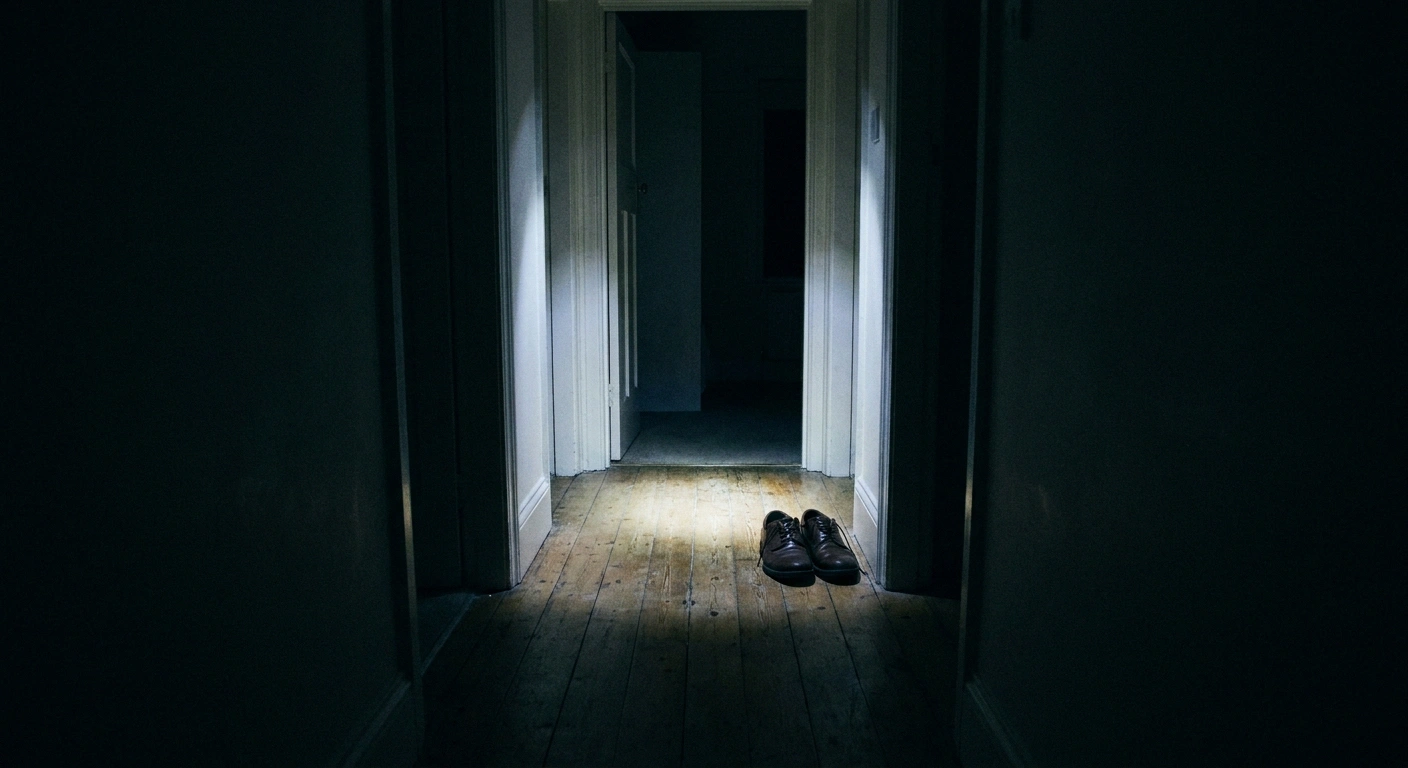
The lights go out at ten past seven on a February evening. The heating stops with them, though it takes an hour before anyone notices that part.
Within twenty minutes most people have done two things. They have gone looking for a flashlight, which means walking through a dark house. And once the cold sets in, they have gone looking for something warm to put against their feet.
Those are the two instincts, and if you have neuropathy they are the two things that hurt people. Not the outage itself. The perfectly reasonable response to it.
Everything below is built around that. The general preparedness lists are fine as far as they go, and they assume you can feel your feet.
The Trap in Plain Terms
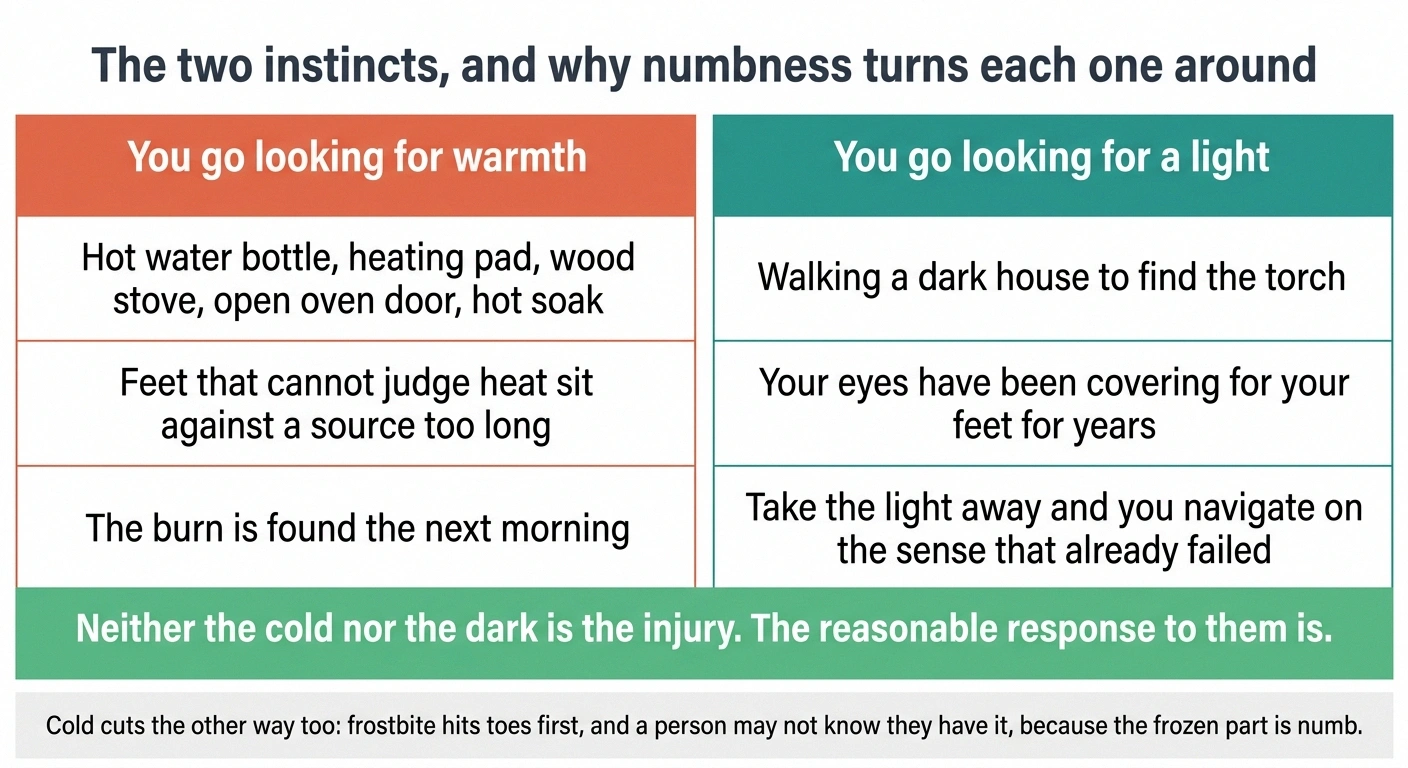
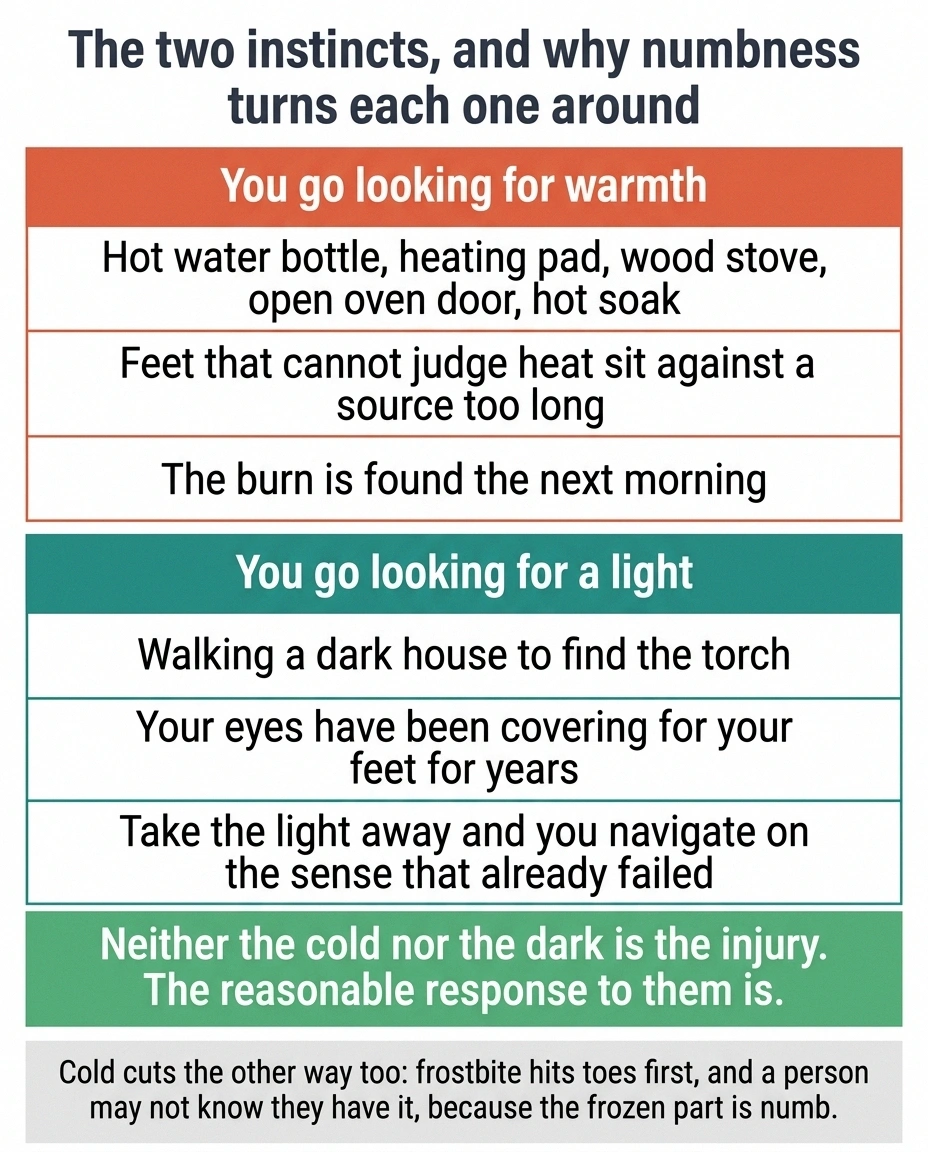
Numbness removes your warning system in exactly the conditions where you need it most.
Getting warm without getting burned
| Reach for | Leave alone |
|---|---|
| Loose wool socks, two pairs | Tight socks, which restrict circulation that is already poor |
| Blankets over the torso, and a hat | Anything hot placed against the soles of the feet |
| Warm drinks, repeatedly | The open oven door, a fireplace hearth, or sitting close to a stove |
| A covered hot water bottle on the lap or legs, temperature checked | A hot water bottle you sleep with, or one you filled straight from a kettle |
| One closed room, doors shut, towel along the gap | A heating pad the moment power returns, on feet that have been cold for hours |
The whole right-hand column is variations on one mistake: applying heat to skin that cannot report back.
You cannot judge how hot a heat source is. A hot water bottle, a heating pad on the second the power returns, a wood stove, the open oven door, a hot soak. Feet that cannot feel heat properly will sit against something too hot for far too long, and the burn is discovered the next morning. Our guide to using heating pads safely with neuropathy exists because this is the most common burn injury in this population, and an outage produces every one of the conditions that cause it.
You cannot judge how cold you are getting either. This runs the other way and gets less attention. Frostbite hits fingers, toes, ears and nose first, and the CDC’s own guidance notes that a person may not know they have it, because the frozen part is numb. Diabetes, poor circulation and older age all raise that risk. The people most likely to develop it are the people least able to detect it.
And walking through a dark house removes the sense you have been substituting. If your feet give you poor information about where the floor is, your eyes have been quietly filling the gap for years. Take the light away and you are navigating on the sense that already failed. This is the same mechanism behind our guidance on overnight bathroom trips, with the furniture rearranged and a candle involved.
The Box You Assemble in October
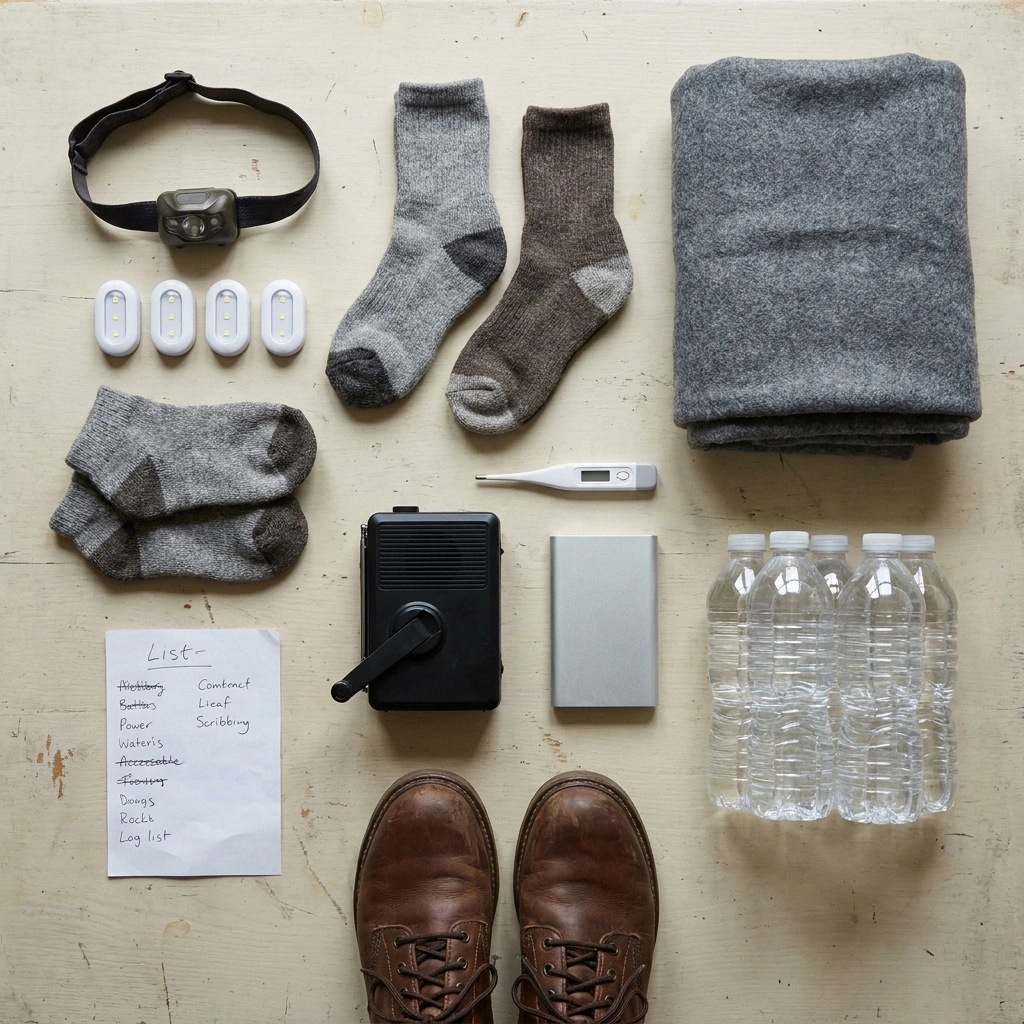
One container, in a place you can reach without stairs, checked once a year. Most of this is ordinary preparedness; the items in bold are the ones the standard lists leave out.
Twenty minutes, once a year, first weekend of October
A kit assembled three years ago and never opened is mostly a box of flat batteries. This is the check, not the shopping list.
- Switch on every light and replace any battery that has been in place a year, whether or not it still works
- Charge the power bank fully and note the date on it in marker
- Put the stick-on lights up now, on the route from bed to bathroom and at both ends of the stairs. Installing them in the dark is not a plan
- Rewrite the medication list, because doses change and last year’s list is a liability if someone else reads it
- Check the water dates and rotate anything past them into ordinary use
- Try the head torch on and adjust the strap. A torch you have to fit in the dark is a torch you will put down
Put the date in the calendar as a recurring entry the same day you first build the box. That single step is what stops this becoming a one-off.
- A headlamp, not just a flashlight. This is the single most useful item on the list. It leaves both hands free for the handrail and the wall, which a flashlight does not.
- Three or four battery-powered stick-on lights, placed in advance on the route from bed to bathroom and at the top and bottom of any stairs. Set them out when the season starts rather than trying to install them in the dark.
- Wool socks, two pairs, loose fitting. Wool insulates when damp, which cotton does not. Loose matters because tight socks restrict circulation in feet that already have too little.
- A digital thermometer for surfaces or water, the inexpensive kitchen kind. This is how you check a hot water bottle or a bath when your hands and feet cannot.
- Blankets, including one on the bed you can pull over without getting up
- A battery or hand-crank radio, and a charged power bank for your phone
- Bottled water, three days per person, and food that needs no cooking
- A written list of your medications with doses, plus your pharmacy and prescriber numbers, on paper. Phones die.
- Shoes beside the bed. Not slippers. Something with a sole, because you should not be walking barefoot on a floor you cannot inspect.
The headlamp and the shoes are the two items people skip and the two that do the most work. If you assemble nothing else, assemble those.
When the Outage Is Cold
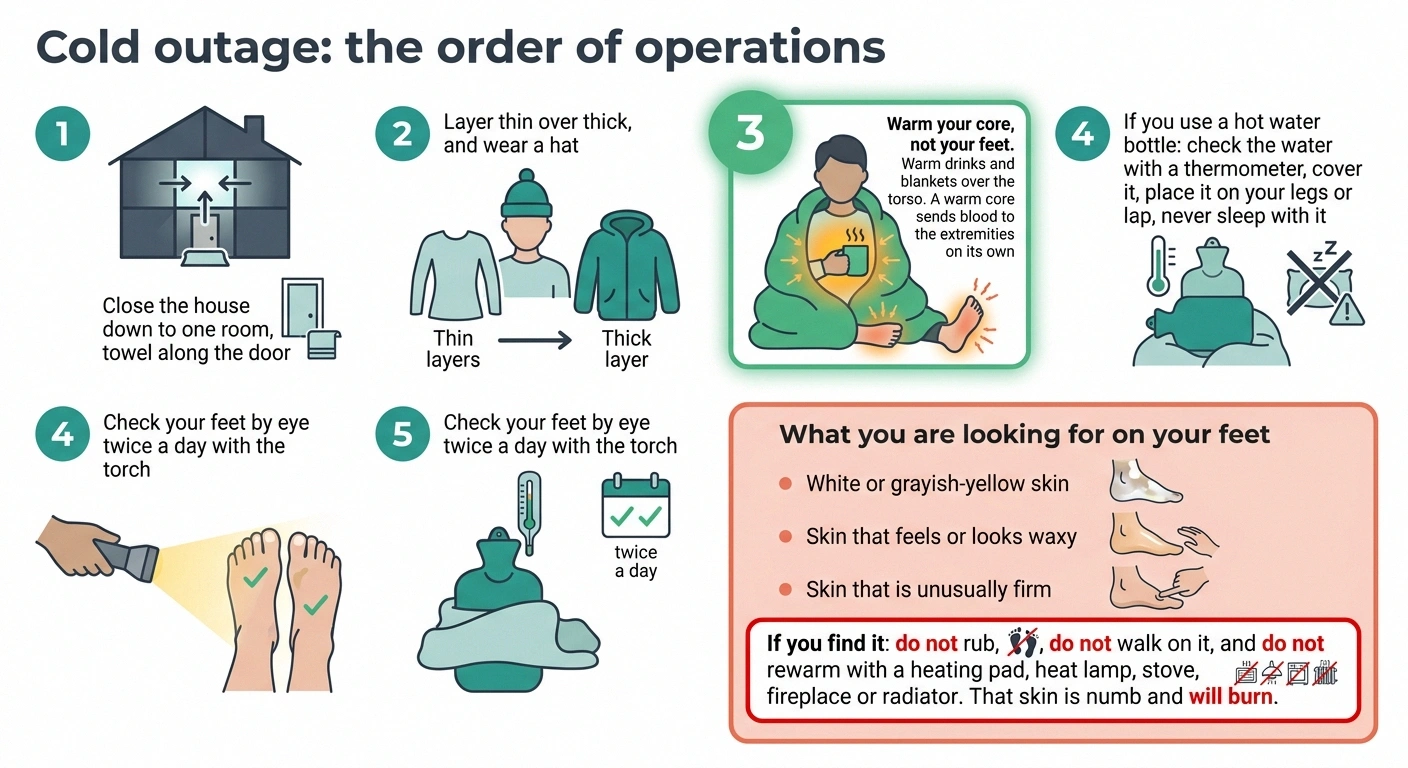
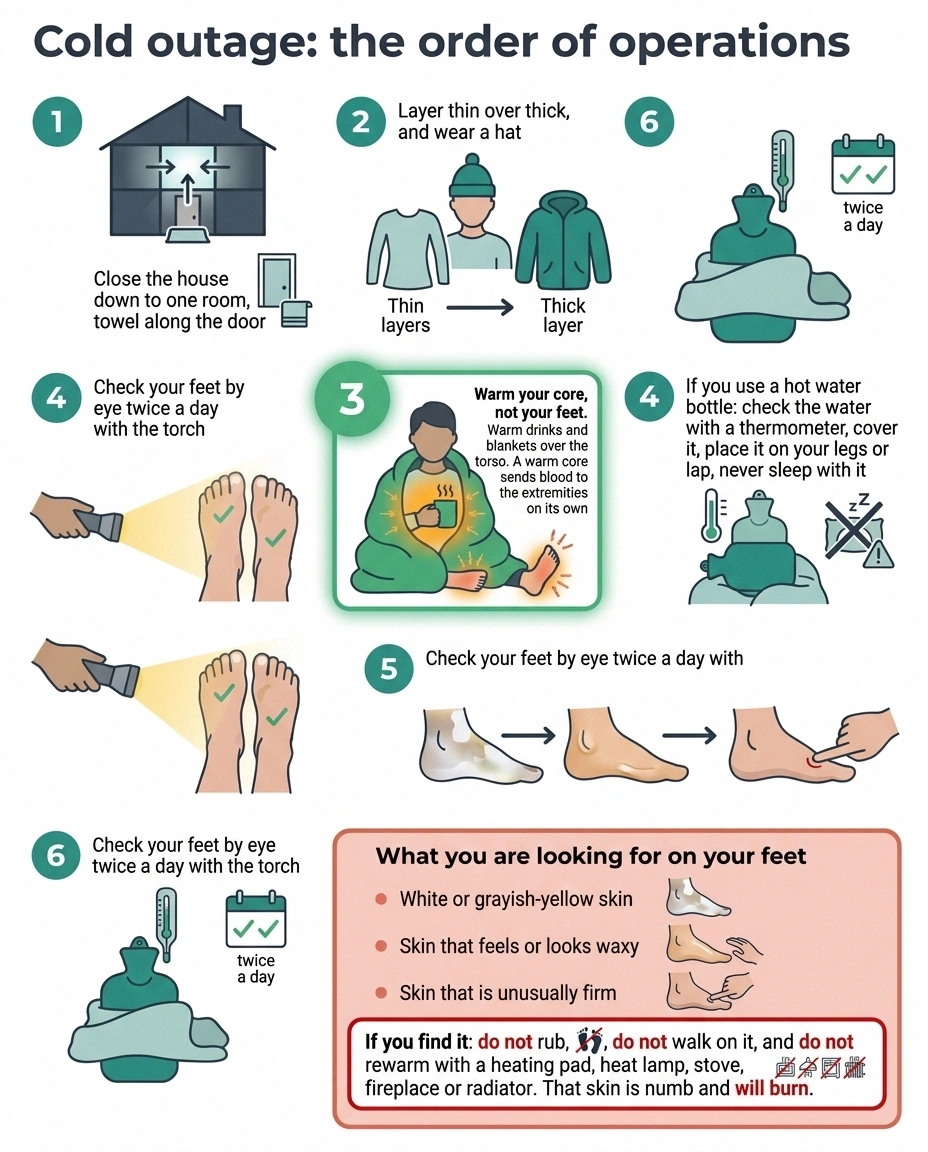
The order of operations matters more than any single tactic.
How to check a hot water bottle when your hands and feet cannot
The two-dollar kitchen thermometer in the box exists for this one job. Boiling water is not what goes into a hot water bottle even for people with normal sensation, and manufacturers say so on the packaging that nobody reads.
- Let boiled water stand several minutes before filling, and check it with the thermometer rather than by hand
- Fill to about two thirds, then press the air out before capping, so it moulds rather than presses
- Cover it, then wrap that in a towel. Two layers, not one
- Legs or lap, never the soles of the feet, and never in the bed once you are asleep
- Move it every twenty minutes or so, because the injury comes from duration in one place as much as from temperature
If you suspect frostbite anywhere, none of the above applies. That situation calls for body-temperature water or skin-to-skin contact and medical advice, and specifically not a heat source.
Close the house down to one room. Pick a room with the fewest windows, shut the doors to everywhere else, and put a rolled towel along the bottom of the door. A small heated volume beats a large cool one, and you will hold temperature for hours longer this way.
Layer from the inside out and cover your head. Several thin layers trap more air than one thick one. A hat matters more than it seems.
Warm your core, not your feet. This is the part that runs against instinct, and it is the important one. Warm drinks, blankets over the torso, another layer. When your core is warm your body sends more blood to the extremities on its own. Applying a heat source directly to numb feet is the route to a burn, and it addresses the symptom rather than the cause.
If you do use a hot water bottle, check the water with a thermometer, put a cover and then a towel around it, and place it against your legs or lap rather than the soles of your feet. Do not sleep with it.
Check your feet with your eyes, twice a day, using the headlamp. This is the substitute for the sensation you do not have. You are looking for colour changes, waxy or unusually firm skin, or anything white or grayish-yellow. Those are the frostbite signs, and you will see them before you feel them. The habit is the same one described in our daily foot care guide, just with a torch and a higher stake.
If you find a suspected frostbite area: do not rub it, do not walk on the affected foot, and do not use a heating pad, heat lamp, stove, fireplace or radiator to rewarm it. The CDC is explicit on that point, and the reason is precisely the one that applies to you: the area is numb and will burn. Warm water at body temperature, or skin-to-skin contact, and get medical advice.
Winter outages tend to arrive alongside conditions our page on why cold weather worsens neuropathy symptoms describes in more detail, so expect symptoms to be louder than usual on top of everything else.
When the Outage Is Hot
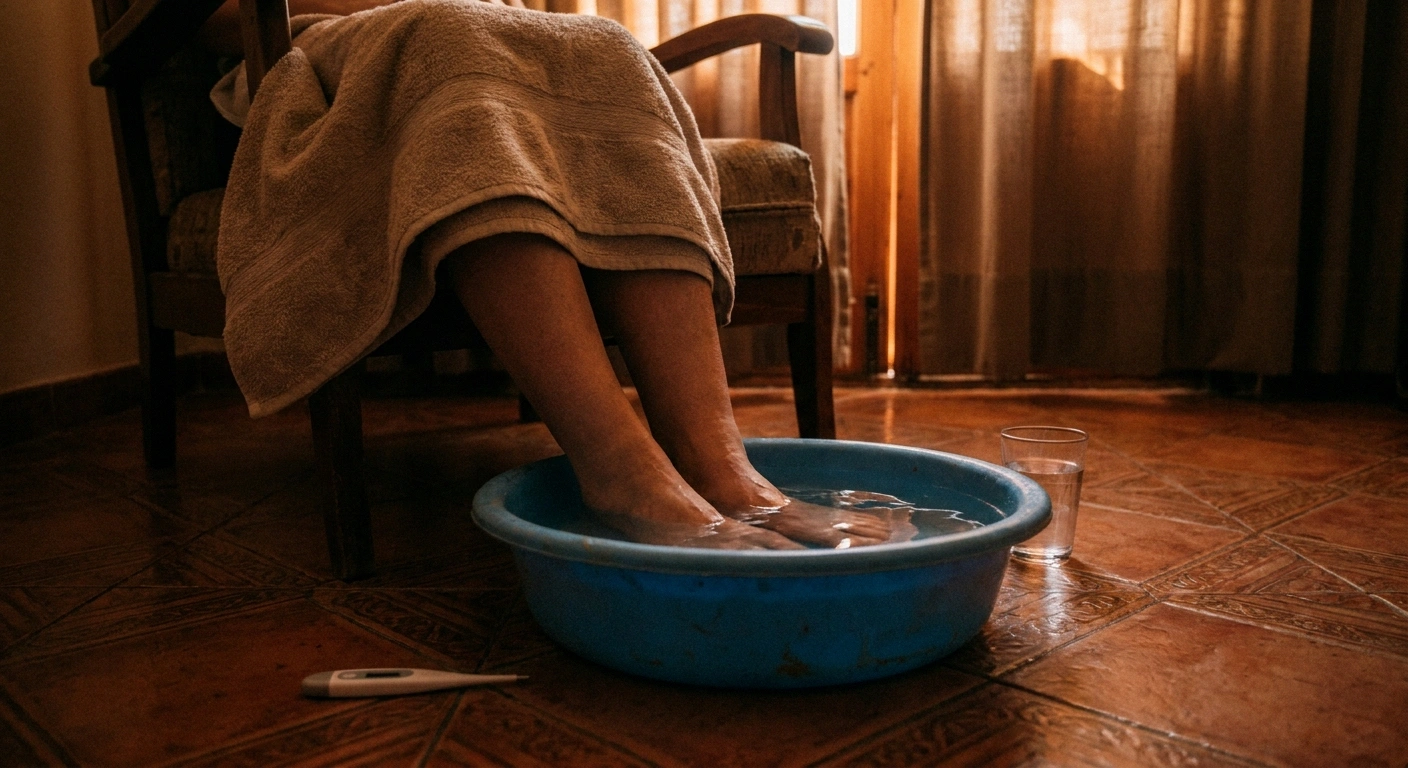
Summer outages get less preparation and can be more dangerous, especially for older adults.
Heat makes nerve pain worse through several routes at once: blood vessels dilate, dehydration and electrolyte shifts irritate nerve endings, swelling puts pressure on nerves in tight spaces like the ankle and the wrist, and humidity stops sweat evaporating so your core temperature climbs. Expect a flare and plan for it rather than being surprised.
What works without electricity:
- Cool water on the lower legs and feet. Immersing the lower limbs in cool water is one of the studied substitutes for air conditioning. Use a basin, keep it cool rather than cold, and check the temperature with a thermometer or your elbow, because altered temperature perception cuts both ways.
- A cold damp towel around the neck. The other studied substitute, and it takes one towel.
- Move downstairs and to the shaded side of the house. Close blinds on the sun side in the morning and leave them closed.
- Drink before you are thirsty. Thirst is a late signal in older adults, and dehydration worsens cramping and symptom intensity directly. Our notes on staying hydrated with neuropathy cover the timing.
- Leave, if you can. Health agencies recommend spending one to three hours a day somewhere air conditioned during extreme heat. A library, a shopping centre, a relative’s house on a different circuit. This is a legitimate plan, not a retreat.
Know where this stops being discomfort. Heat exhaustion tipping into heat stroke is the real risk in a summer outage, and it moves faster in older adults and in anyone taking several medications. Confusion or unusual agitation, a pounding headache with nausea and dizziness, fainting, a racing pulse, or skin that has gone hot and dry because sweating has stopped are all reasons to call emergency services rather than to try another glass of water. Move to somewhere cooler and start cooling the skin while you wait.
Our broader hot weather guide covers the flare itself in more depth.
Moving Around in the Dark
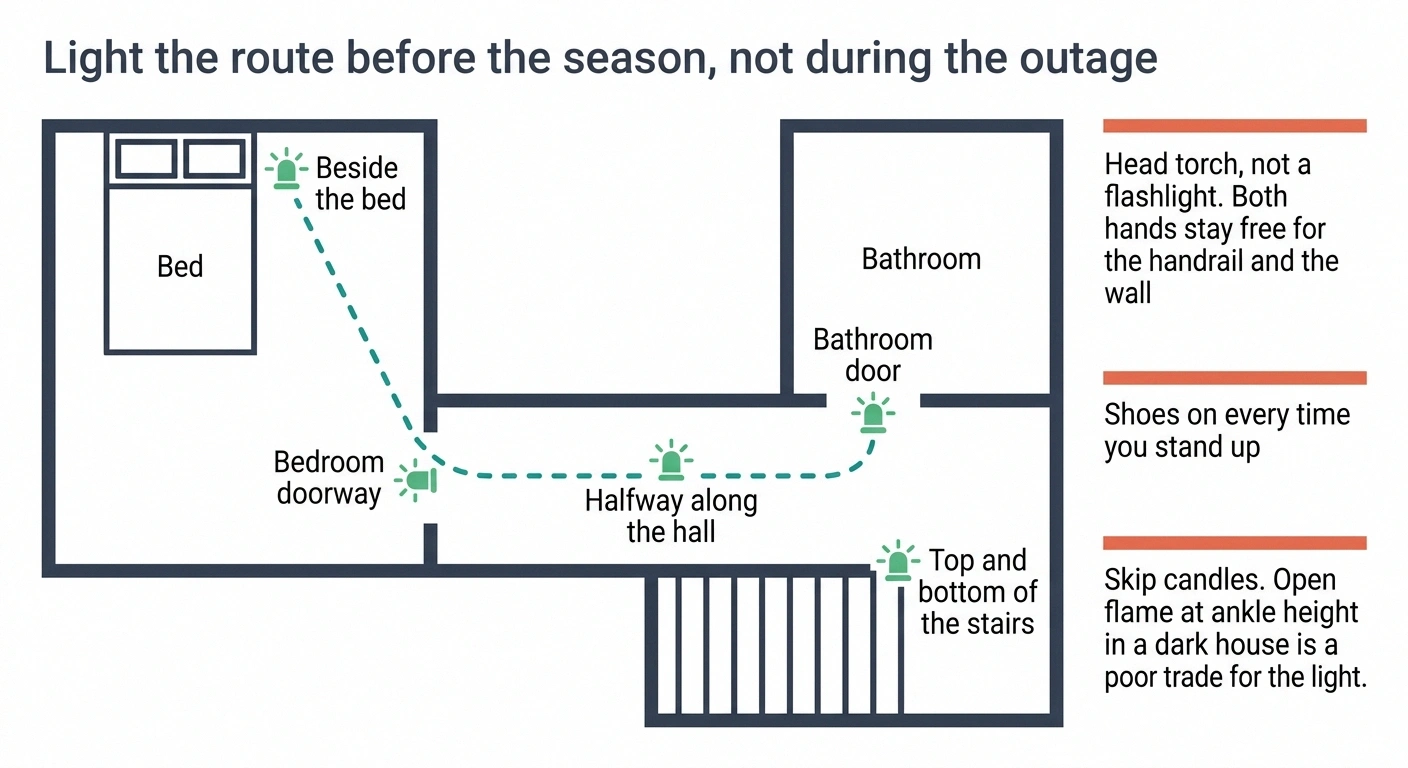
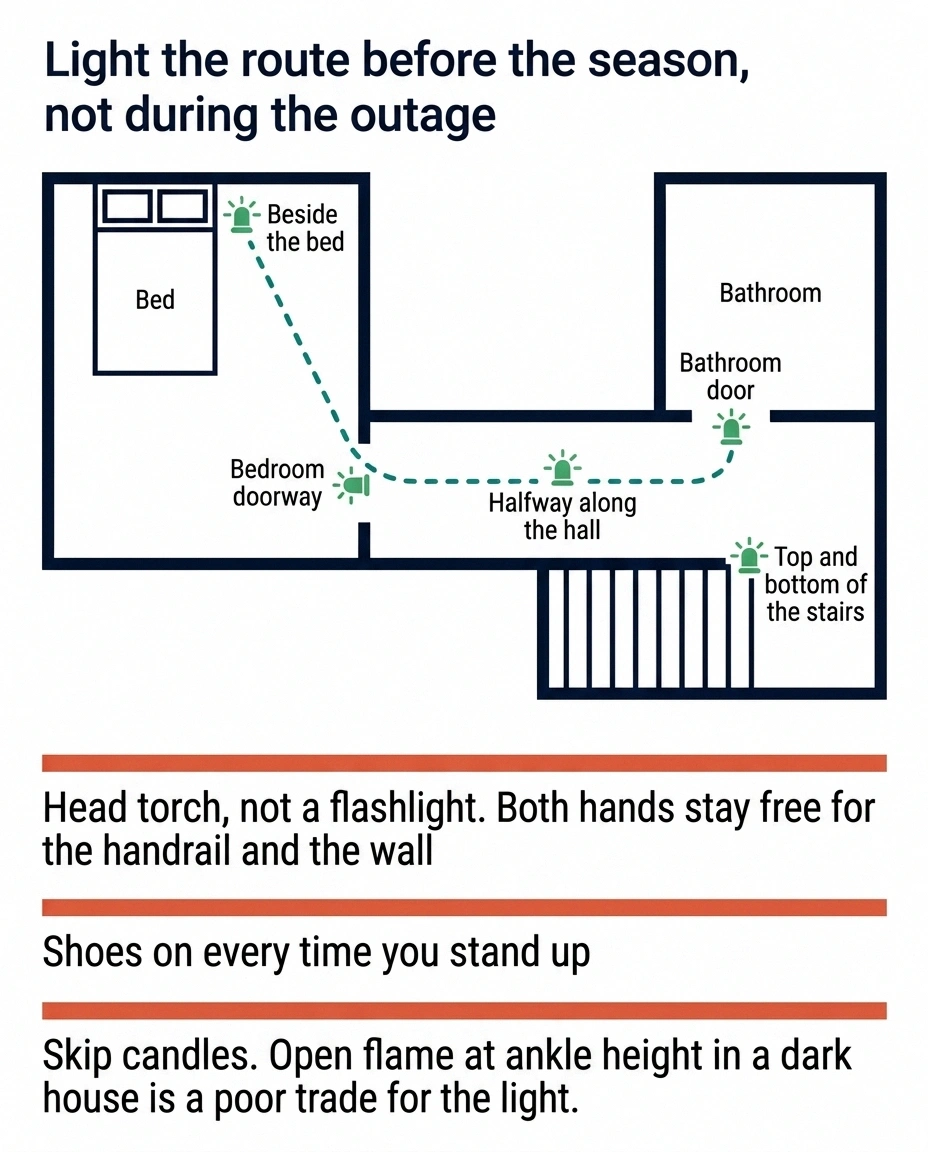
Most outage injuries are falls, and this is where preparation pays best.
Decide in advance that you will not move around unnecessarily. Set yourself up in one place with water, a phone, a light and a blanket within arm’s reach, and the number of trips drops to almost nothing.
Light the route before dark, not during it. The stick-on lights go up at the start of storm season.
Shoes on, every time you stand up. A floor you cannot inspect may have anything on it, and you will not feel it if you step on it.
Use the walls. A hand on the wall gives your brain a positional reference that your feet are no longer supplying, which is the practical response to the balance problems neuropathy creates.
Candles, honestly: skip them. Open flame at ankle height in a dark house, with reduced sensation and impaired balance, is a poor trade for the light it gives. Battery lights are better in every respect.
If your home has already had the modifications described in our room-by-room home safety guide, you are most of the way there. An outage is simply the night those changes earn their keep.
Medication, the Refrigerator, and a Closed Pharmacy
Keep the doors shut. Food stays safe in an unopened refrigerator for roughly four hours, and a full freezer holds a safe temperature for about 48 hours, or 24 hours if it is half full. Every opening resets that clock, so decide what you need before you open the door.
Three questions for the pharmacist, asked in September
- “Which of my prescriptions genuinely need to be cold, and for how long can each one be warm?”
- The answers surprise people in both directions. Some things assumed to need refrigeration do not, and some tolerate far less warmth than expected.
- “Can you put me a week ahead on the ones I take daily?”
- A one-week buffer is the difference between an inconvenience and an emergency when a regional outage closes every pharmacy for three days. Many plans allow it if you ask before you need it.
- “Which pharmacy near me has a generator?”
- In a widespread outage most do not, and the one that does will be the one everybody eventually finds. Knowing its name in advance is worth more than knowing it is somewhere.
On insulin specifically, the FDA’s emergency guidance is more reassuring than most people expect: vials and cartridges supplied by manufacturers, opened or unopened, can be left unrefrigerated between 59 and 86 degrees Fahrenheit for up to 28 days and continue to work. Effectiveness drops with extreme temperatures and with longer exposure, so a cooler with ice packs is still worth using, and this is a reason not to panic rather than a reason to relax.
One thing to get right about that cooler: the danger is not only heat. Freezing destroys insulin outright, and it ruins several other refrigerated medications too, and a cooler packed hard with ice can easily sit below fridge temperature. Keep the medication off the ice packs themselves with a towel or a rigid container between them, put the thermometer next to the medication rather than next to the ice, and aim for ordinary fridge range rather than as cold as possible. If insulin has frozen, or you suspect it has, do not use it even after it thaws.
For everything else: a cooler with ice packs and a small thermometer inside it covers most refrigerated medications through a multi-day outage. Ask your pharmacist in advance which of your prescriptions actually need cold and for how long they tolerate warmth. It is a two-minute conversation and the answers are frequently surprising in both directions.
Two more worth doing before storm season: keep at least a week of your non-refrigerated medications ahead of schedule, and know which nearby pharmacy has a generator, because in a widespread outage most do not.
The Conversation Worth Having in Advance
Tell one neighbour, before anything happens, that you have reduced sensation in your feet and that you would like them to knock during an extended outage.
That sentence is uncomfortable to say and it is the highest-value item on this page. Frostbite and hypothermia are both conditions that other people notice first. So are the effects of heat on an older adult in a house without air conditioning. A person who knows to knock is worth more than any equipment in the box.
If your utility runs a medical priority register for customers who depend on electricity for health reasons, ask whether you qualify. It does not guarantee faster restoration, but it does put you on a list that gets consulted.
Frequently Asked Questions
How do I keep my feet warm during a power outage if I have neuropathy?
Warm your core rather than your feet directly. Layers over the torso, a hat, warm drinks, and one closed-off room. When your core is warm, your body improves circulation to the extremities on its own. If you use a hot water bottle, check the water temperature with a thermometer, wrap it, place it against your legs rather than the soles of your feet, and never sleep with it. Loose wool socks are the safest direct warming you can apply.
Can I use a heating pad when the power comes back on?
Only with real caution, and not on a foot that has been cold for hours. Skin that cannot register heat properly will tolerate a damaging temperature without complaint, and skin that has just been chilled is at higher risk again. If you have any suspicion of frostbite, a heating pad is specifically advised against, and the same applies to heat lamps, stoves, fireplaces and radiators.
How long will my refrigerated medication stay good?
It depends on the medication, so ask your pharmacist which of yours actually require cold. As a general reference, an unopened refrigerator holds a safe temperature for about four hours and a full freezer for about 48 hours. Insulin is more forgiving than most people assume: FDA emergency guidance allows manufacturer-supplied vials and cartridges to sit between 59 and 86 degrees Fahrenheit for up to 28 days. A cooler with ice packs and a thermometer inside covers most situations.
What should be in a neuropathy emergency kit that is not in a normal one?
A headlamp rather than a flashlight, so both hands stay free. Battery stick-on lights placed along your usual routes in advance. Shoes with a real sole kept beside the bed. Loose wool socks. A digital thermometer for checking water and surfaces, since your hands and feet cannot. And a paper list of your medications with doses, because phones run out.
How do I check for frostbite if I cannot feel my feet?
Use your eyes and a good light, twice a day. Look for skin that is white or grayish-yellow, or that appears waxy or unusually firm. Compare one foot against the other. Because the affected area is numb, this is one of the situations where a visual check is not a supplement to sensation, it is the entire warning system. If you find something suspicious, do not rub it, do not walk on it, and do not apply a direct heat source.
Is a generator worth it if I have neuropathy?
It depends on whether you have equipment that genuinely needs power, such as an oxygen concentrator or a CPAP machine. For warmth and light alone, a portable power station or a good battery setup covers most of what you need with none of the carbon monoxide hazard. If you do use a fuel generator, it belongs well outside the house, never in a garage or near a window, and a working carbon monoxide alarm inside is not optional.
What if the outage happens in summer instead?
Expect symptoms to flare, since heat, dehydration and swelling all irritate damaged nerves. Cool your lower legs in a basin of cool water, put a cold damp towel around your neck, move to the shaded side of the house and keep blinds closed on the sun side. Drink on a schedule rather than waiting for thirst. If the heat is extreme, spending one to three hours somewhere air conditioned is the recommended response, and that is worth planning rather than improvising. Treat confusion, fainting, a severe headache with nausea, or skin that has gone hot and dry with sweating stopped as an emergency and call for help rather than continuing to self-manage.
About the Author