Read twenty reviews of a PEMF device and you will find people describing two different products. One group says their leg pain dropped by half in three weeks. Another group used the identical machine for months and felt nothing at all. Both groups are usually telling the truth.
A systematic review published in February 2026 explains why, and the explanation is not the one the sellers give. The people it works for and the people it does nothing for tend to have different problems, even though both have been told they have nerve pain.
What PEMF Actually Does
Pulsed electromagnetic field therapy sends short bursts of electromagnetic energy into tissue using a coil, a mat, a ring or a wrap. There is no heat, no ionizing radiation, and usually no sensation at all beyond a faint tingle. Some medical devices in this category pulse at 27.12 megahertz in bursts lasting 42 microseconds, delivered a thousand times per second. Consumer mats generally use much lower frequencies.
Four device categories that get sold as the same thing
Evidence does not transfer between these. A study of one says nothing about the others, which is worth knowing before a salesperson quotes research at you.
- PEMF, pulsed electromagnetic field
- Pulsed field induced through tissue by a coil, mat or wrap. Nothing to feel. Works through clothing. This article’s subject.
- TENS, transcutaneous electrical nerve stimulation
- Actual current through skin electrodes. You feel a tingle and you adjust intensity by feel. Different mechanism, different evidence base, and cheap by comparison.
- Static magnets
- Magnetic insoles, bracelets and wraps with no power source and no pulsing. Studied repeatedly and consistently negative. Frequently sold alongside PEMF products, which blurs the two in the buyer’s mind.
- Photobiomodulation and red light
- Light rather than field, absorbed in the first few millimetres of tissue. Its own small literature. Depth of penetration is the limiting question, and it is not the same question PEMF faces.
The proposed mechanisms are plausible rather than proven. Induced currents in tissue are thought to influence cell membrane behaviour, calcium signalling, local blood flow and inflammatory mediators. In laboratory work, that translates to changes in cultured cells. Whether it translates to a person’s feet is the entire question, and it is not settled by the mechanism.
Worth saying clearly because the marketing blurs it: PEMF is not TENS. A TENS unit puts electrical current through skin electrodes and you feel it working. PEMF induces fields through clothing and tissue with nothing to feel. They are different technologies with different evidence bases, and results from one say nothing about the other.
The 2026 Review That Split the Answer in Two
A systematic review and meta-analysis in Neurology International in February 2026 pooled nine randomized controlled trials covering 688 people. Five studied diabetic peripheral neuropathy, three studied spinal and radicular pain, one studied carpal tunnel syndrome.
Reading the numbers yourself, so the next device is easier to judge
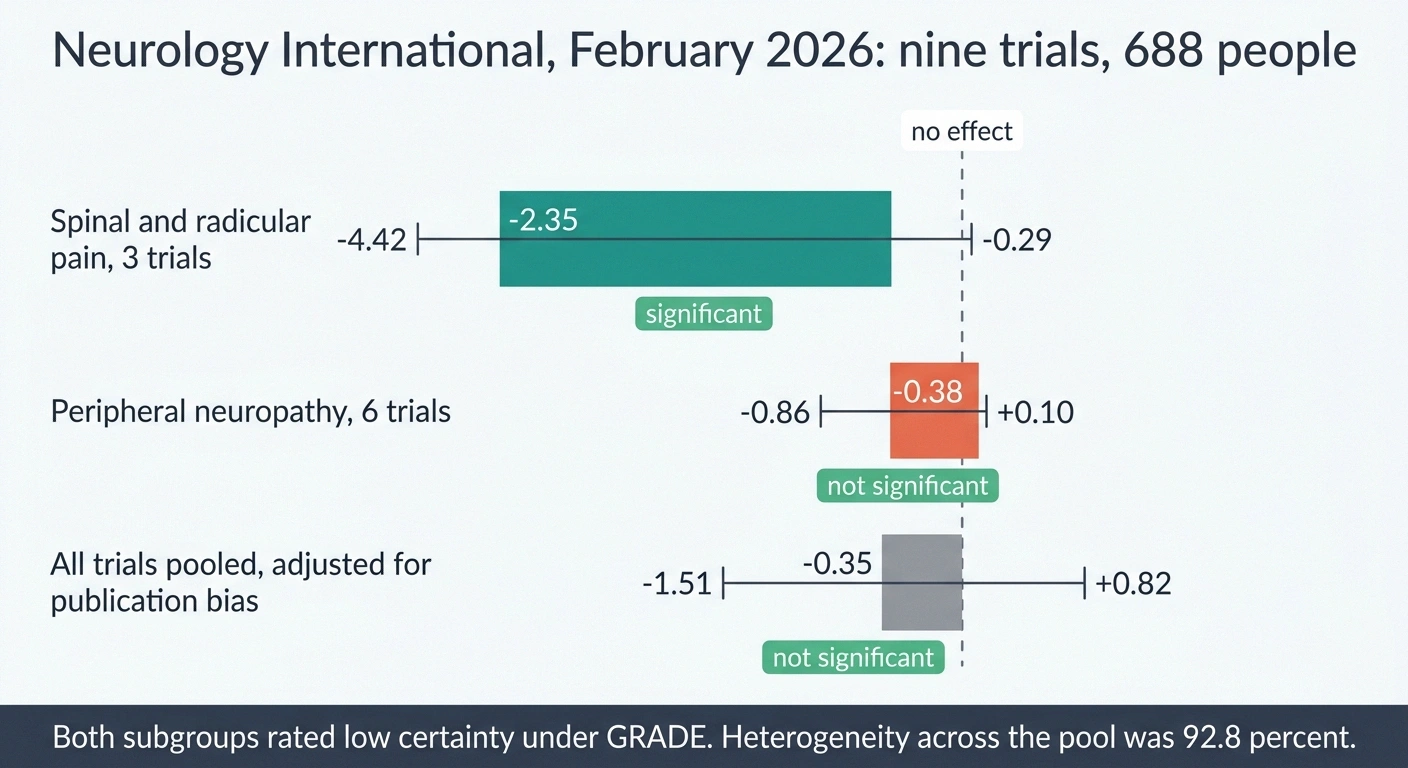
The confidence interval matters more than the headline figure. If the range crosses zero, the result is compatible with no benefit at all. Peripheral neuropathy came out at -0.38 with a range of -0.86 to +0.10. That plus sign at the end is the whole finding.
Heterogeneity above about 75 percent means the trials disagreed badly. This pool ran at 92.8 percent. Averaging studies that contradict each other produces a number, and the number does not mean much.
Publication bias adjustment is the honesty check. Negative device trials often go unpublished. When the authors corrected for the studies that appear to be missing, the overall effect fell from -1.01 to -0.35 and stopped being significant.
Low certainty under GRADE, which is how both subgroups here were rated, means the true effect could differ substantially from the estimate. It is not a verdict of no. It is a verdict of not yet known.
The headline number looked encouraging. Pooled across everything, PEMF beat sham with a standardised mean difference of −1.01. Then the details arrive, and they matter more than the headline.
Heterogeneity was 92.8 percent, which is about as inconsistent as a pooled result gets. The prediction interval ran from −4.26 to 2.25, meaning a future trial could plausibly land anywhere including on the wrong side of zero. And when the authors adjusted for publication bias, which their funnel plot and Egger’s test both indicated was present, the effect fell to −0.35 with a confidence interval crossing zero. The headline result did not survive the correction.
The subgroup analysis is where this becomes useful rather than merely discouraging.
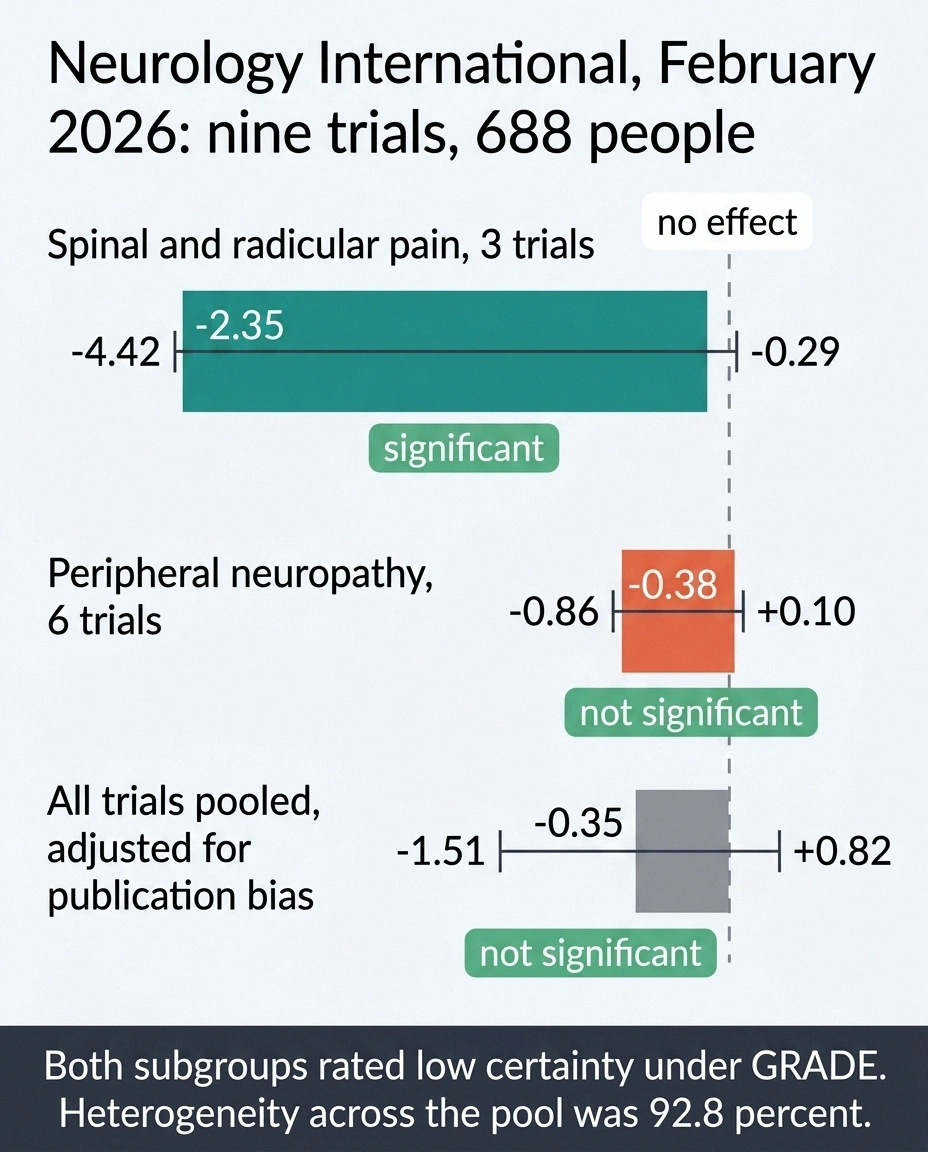
For spinal and radicular pain, across three trials, the effect was −2.35 with a confidence interval that stayed on the beneficial side. That is a large effect by any standard.
For peripheral neuropathy, across six trials, the effect was −0.38 with a confidence interval running from −0.86 to 0.10. It crosses zero. Not statistically significant.
The authors put it plainly: PEMF appears highly effective for spinal and radicular pathology, and shows limited efficacy for diffuse peripheral neuropathy. Both subgroups were rated low certainty under GRADE, downgraded for risk of bias, inconsistency and imprecision. So the spinal result is not gospel either. But the direction of the split is consistent and it explains the reviews.
Why the Back Pain Result Does Not Transfer to Your Feet
If a nerve root is compressed and inflamed where it exits the spine, the problem sits in one identifiable place a few centimetres below the skin. A field applied over that spot reaches the tissue that is generating the pain. Whether it helps is a fair question, but at least the target and the treatment are in the same location.
Diffuse peripheral neuropathy is not like that. The damage is spread along the last stretch of the longest nerves in the body, distributed through both feet and often both hands, and much of it involves nerve fibers that have already retracted or died. There is no single inflamed spot to aim at. A mat under the feet is treating an enormous distributed field of tiny endings, most of which are not inflamed so much as gone.
This distinction is worth knowing for reasons beyond PEMF, because the same confusion sends people to the wrong treatment repeatedly. If your symptoms actually come from spinal stenosis or a compressed nerve root rather than from length-dependent polyneuropathy, a lot of things behave differently, and the evidence you should be reading is different evidence. People with both conditions at once are common, which makes the personal experiment harder to interpret.
The Two Trials You Will Be Shown
Search this topic and you will meet the same two studies, usually only one of them at a time.
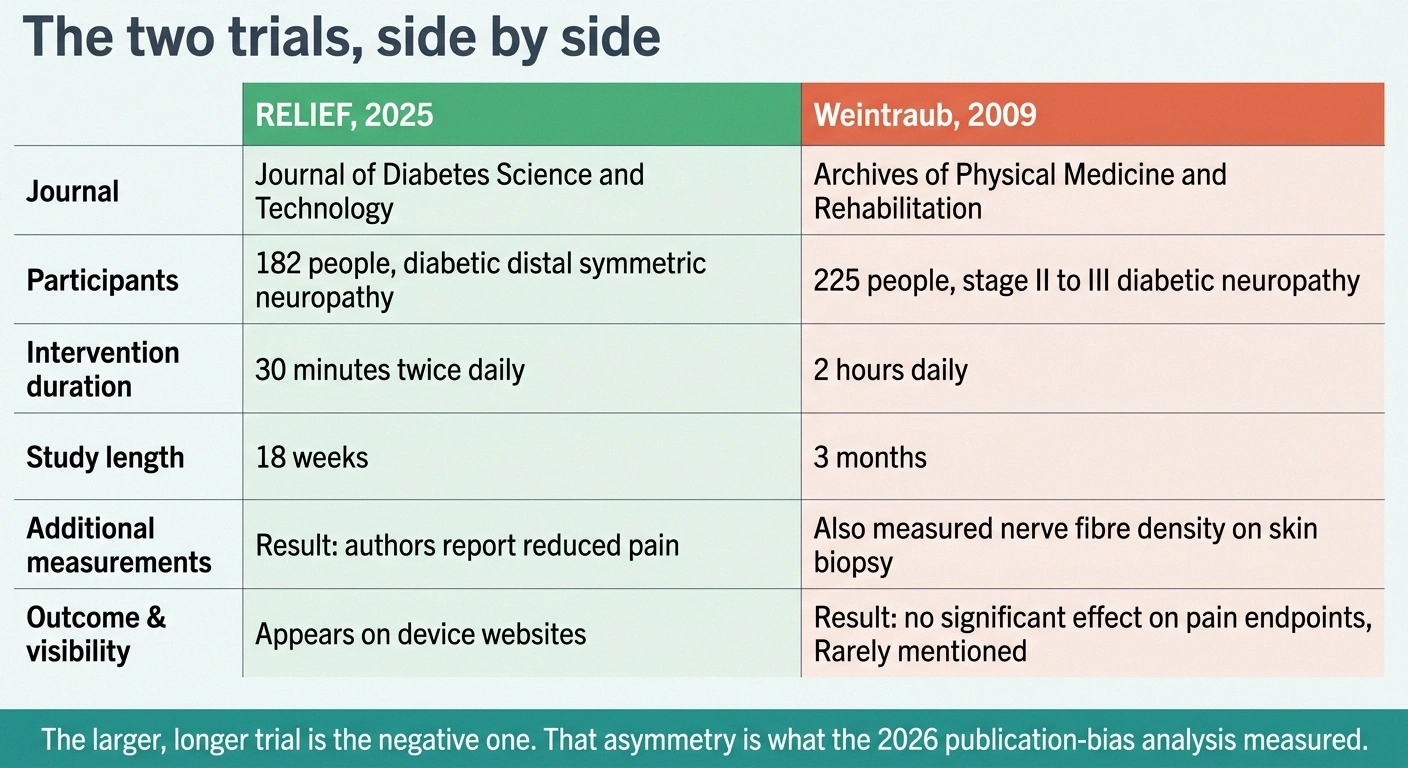
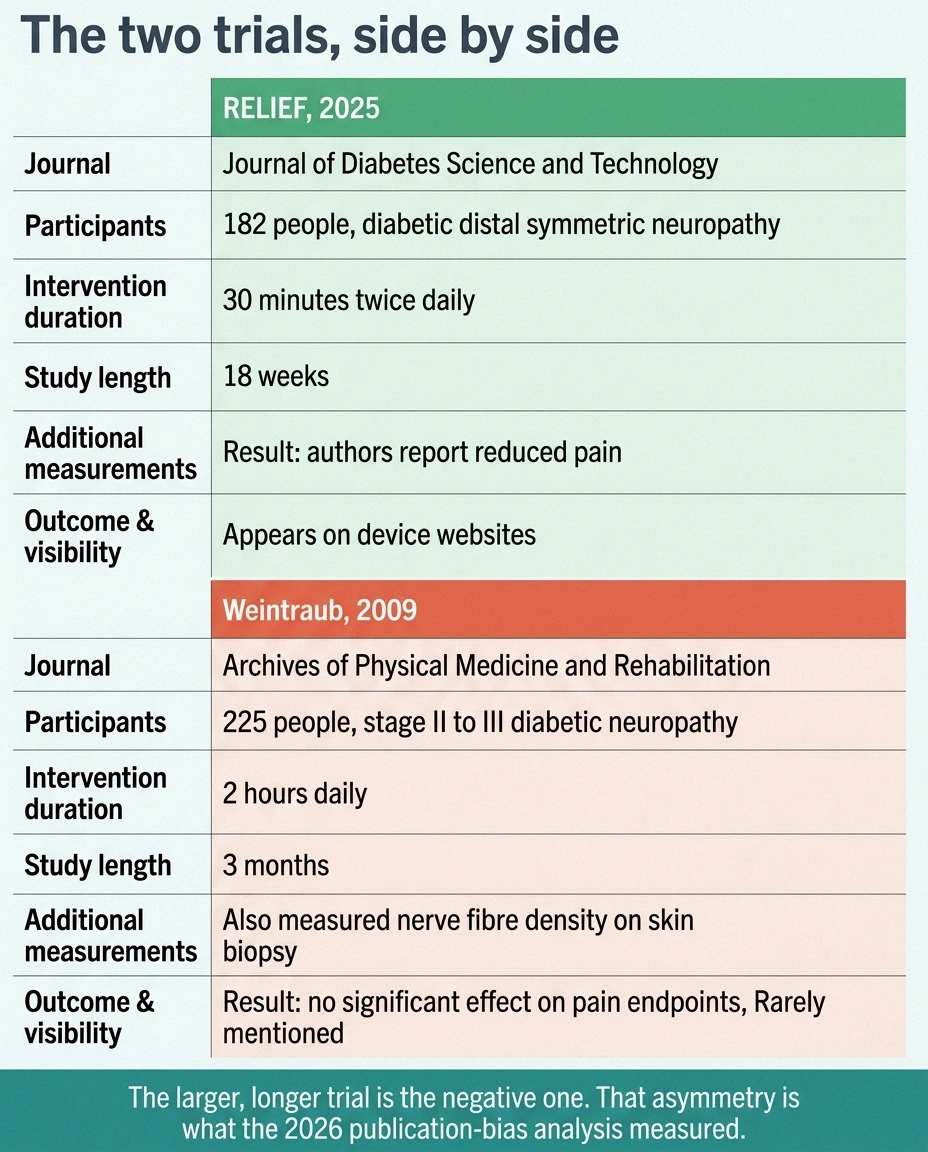
The RELIEF trial, 2025. Published in the Journal of Diabetes Science and Technology, this was a double-blind, sham-controlled randomized trial of 182 people with diabetes and confirmed distal symmetric peripheral neuropathy. Participants treated their feet for 30 minutes twice a day for 18 weeks and logged daily pain scores. The authors concluded that PEMF appears effective as a non-drug way of reducing diabetic neuropathy pain, with a signal suggesting improved microcirculation. Two mild device-related events occurred in the active arm, both transient allodynia. This is the strongest positive trial in the field. It also tested one specific dual-field device in a manufacturer-adjacent setting, which is normal for device research and worth knowing when you read it.
Weintraub and colleagues, 2009. Published in Archives of Physical Medicine and Rehabilitation, this trial randomized 225 people with stage II or III diabetic neuropathy to PEMF or placebo for two hours daily over three months. It measured pain on multiple scales, patient global impression of change, sleep, and epidermal nerve fiber density on skin biopsy, which is a genuine attempt to see whether nerves themselves changed. It is the larger trial, it ran longer per day, and subsequent reviews characterise it as having failed to demonstrate a significant effect on its pain endpoints.
Notice which one appears on device websites. The 2009 trial is bigger, older and negative, and it is almost never mentioned. That asymmetry is exactly the publication and promotion bias the 2026 meta-analysis measured.
What the FDA Clearance Actually Says
This is the part most likely to be misrepresented in a clinic waiting room.
The Provant Therapy System, one of the better-studied medical PEMF devices, holds FDA 510(k) clearances under numbers K972093, K091791 and K131979. The cleared indication reads: adjunctive use in the palliative treatment of post-operative pain and edema in superficial soft tissue.
Peripheral neuropathy is not in that sentence. Using it for neuropathy is off-label, which is legal and common in medicine, and which is a very different statement from “FDA approved for neuropathy.” A 510(k) clearance also is not an approval; it means the device was found substantially equivalent to something already on the market, and it does not require proof of effectiveness for a new condition.
Consumer PEMF mats and rings sold online are usually in a further category again. Most are marketed as wellness products, hold no clearance for any medical indication, and are not obliged to demonstrate anything. If a page uses the phrase “FDA registered,” that refers to the manufacturer’s facility being on a list, and says nothing whatsoever about the device.
Safety Is the Genuinely Good News
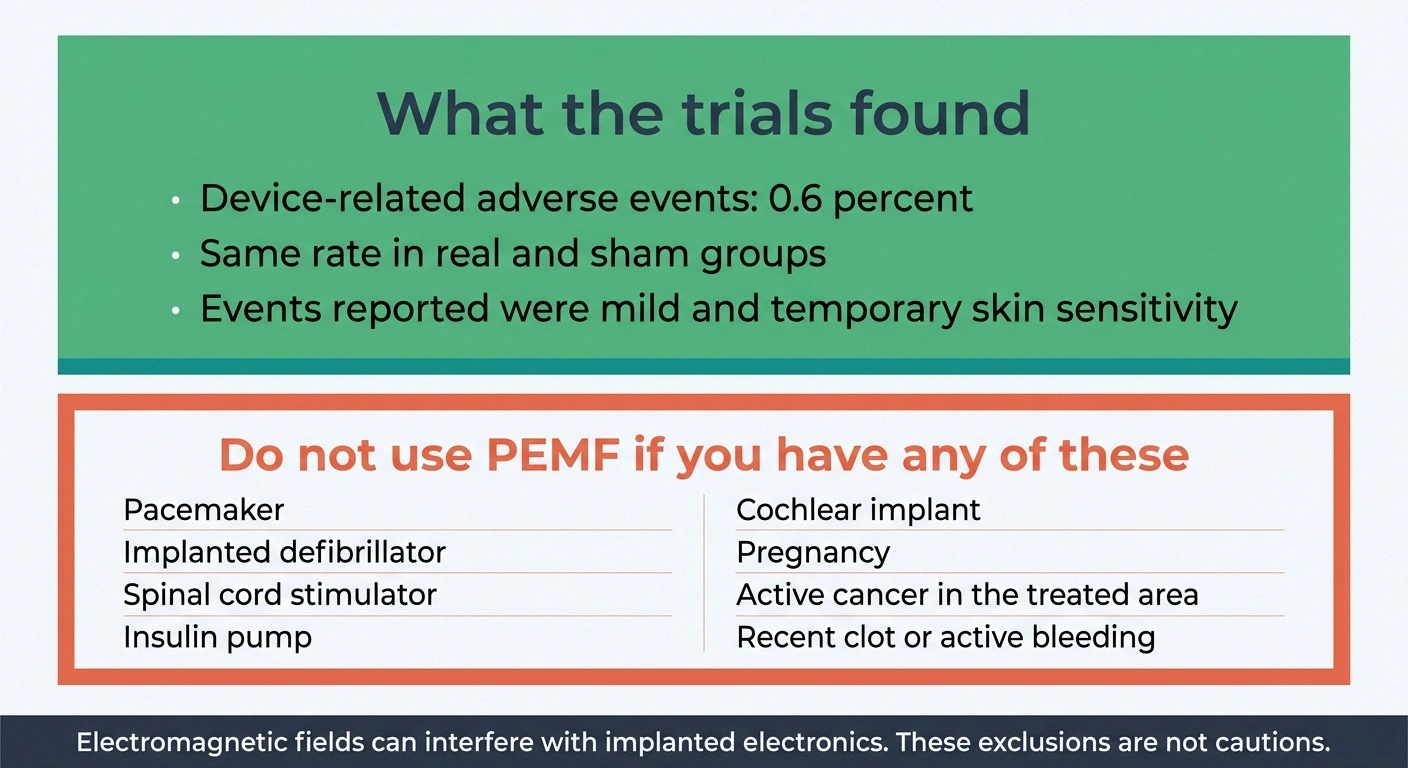
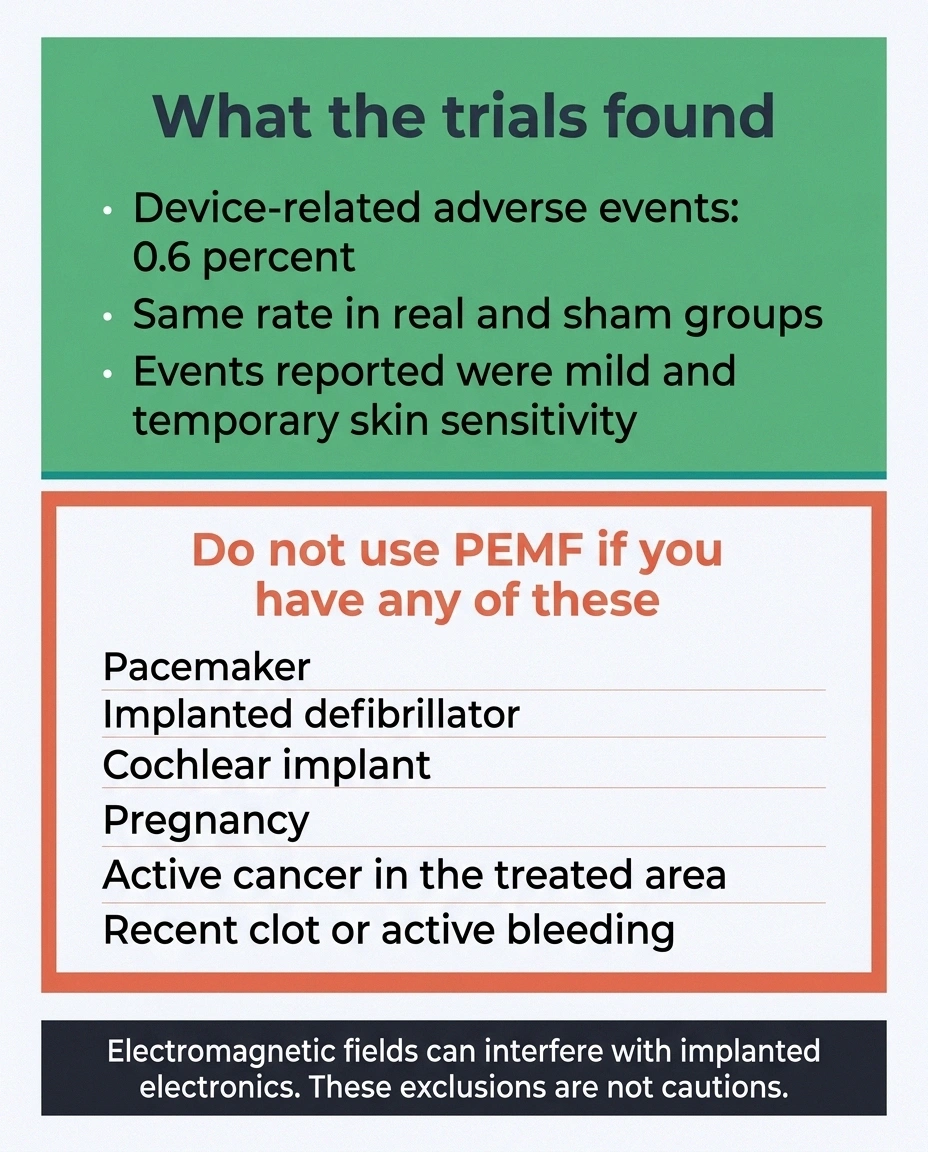
Across the pooled trials, device-related adverse events occurred in 0.6 percent of participants, and the rate was the same in the PEMF arms and the sham arms: two events out of 337 and two out of 352. The active-arm events were mild and temporary increases in skin sensitivity. One heart attack occurred during a trial and was adjudicated unrelated to the device.
Six questions to ask before you pay for anything
Ask all six by email rather than in a showroom, so the answers exist in writing.
- What frequency and intensity does this device deliver, and which published trial used those settings?
- Is it FDA cleared, and for exactly which indication? Ask for the K number.
- Can I rent or trial it for four weeks, and what is deducted if I return it?
- What is the refund window on a session package if I stop after three sessions?
- Does anything about my implants, medications or history exclude me?
- What would you expect to see by week eight, and what would count as it not working?
A seller who answers question six with a number rather than a shrug is unusual, and the answer gives you a stop rule you did not have to invent.
That places PEMF in a specific category worth naming: low evidence, low harm. It is not the same category as an unproven treatment that carries real risk, and it is not the same as an unproven treatment that costs nothing. The considerations are mainly money and time.
The standard contraindications do apply and they are absolute. Implanted electronic devices come first: pacemakers, defibrillators, spinal cord stimulators, insulin pumps, cochlear implants. Electromagnetic fields can interfere with them. Pregnancy is a contraindication on most labelling, as is active malignancy in the treatment area, and manufacturers generally exclude use over an active bleed or a recent clot.
What You Would Actually Be Buying
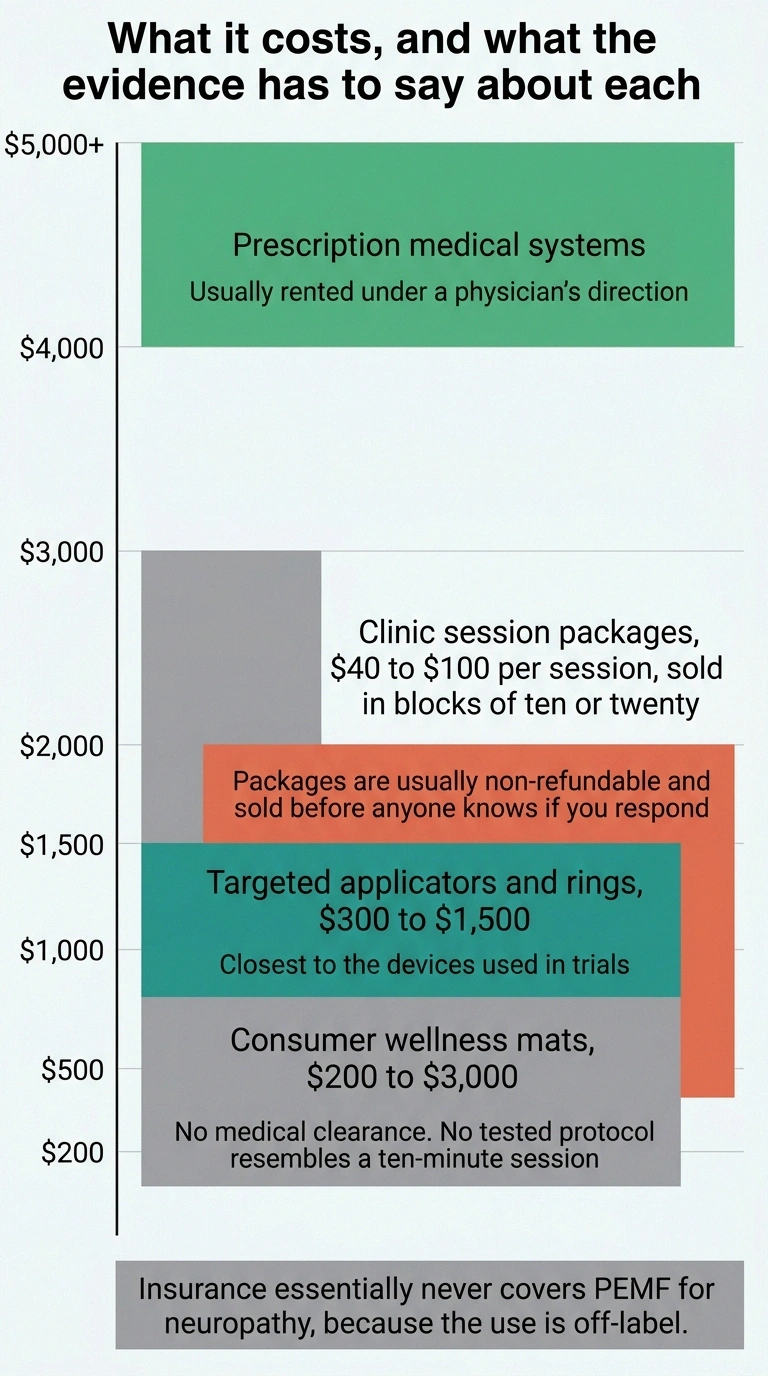
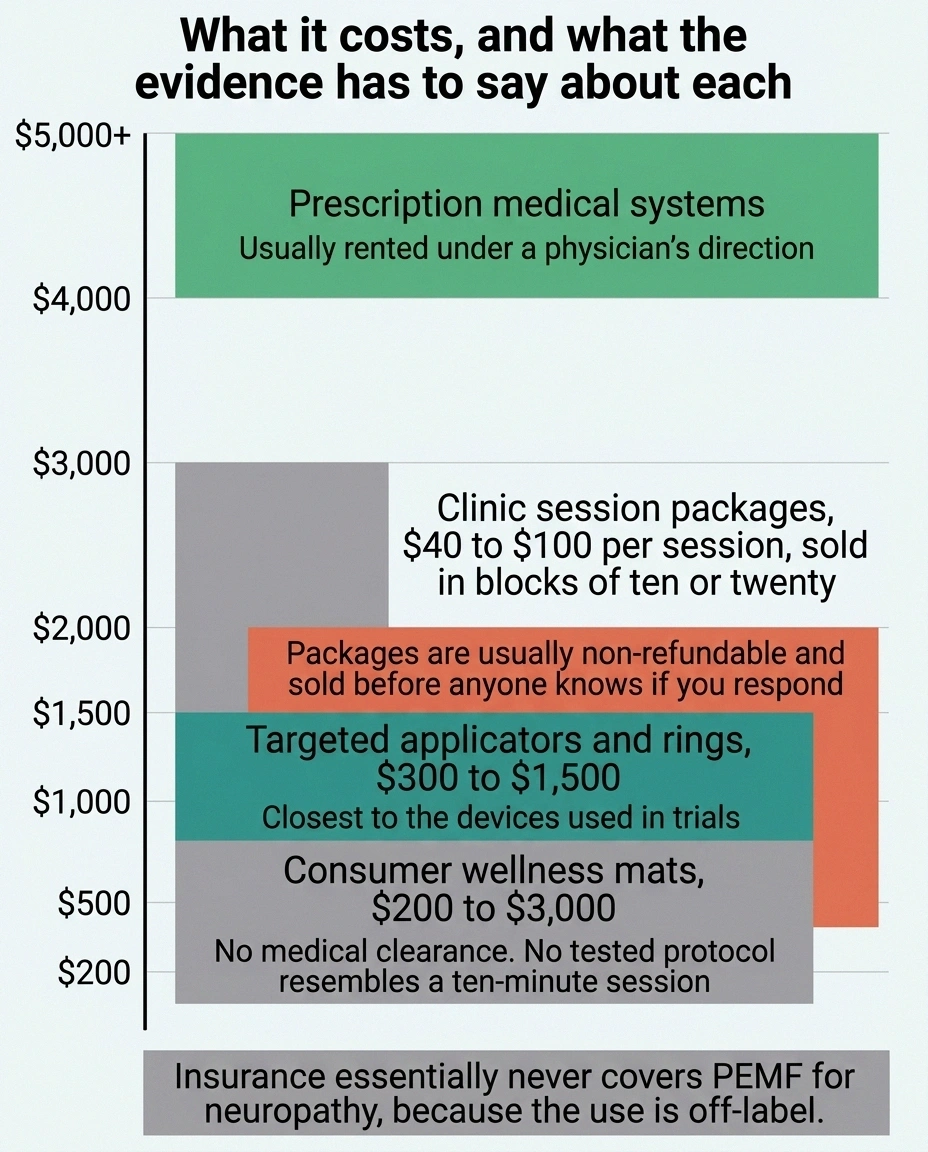
Prices in this category span roughly two orders of magnitude, and the price does not track the evidence.
Full-body mats run from about 200 dollars to several thousand. Localised ring and coil applicators tend to sit in the 300 to 1,500 dollar range. Clinic sessions are commonly 40 to 100 dollars each with packages sold in blocks of ten or twenty, and the packages are where the real money goes. Prescription medical systems used at home under a physician’s direction are usually rented rather than bought.
Insurance coverage for neuropathy is effectively nonexistent, precisely because the indication is off-label. Assume you are paying, and assume the package is not refundable.
If you are going to try it anyway, the trials that showed anything used the feet-directed applicators with meaningful daily exposure, either 30 minutes twice daily over months or two hours a day. A ten-minute session on a general wellness mat three times a week resembles nothing that has ever been tested.
How to Run a Fair Trial on Yourself

Nerve pain fluctuates on its own, which is why almost everything appears to work at first. A structured personal trial is the only way to separate the treatment from the fluctuation.
A ten-week structure that can actually answer the question
Two weeks of baseline before eight weeks of treatment. Written down, because memory rewrites the baseline to match whatever you are hoping for.
| Phase | What you do | What you record daily |
|---|---|---|
| Weeks 1 to 2 Baseline |
Nothing new. Change no medication, no supplement, no exercise routine. | Worst pain 0 to 10, average pain 0 to 10, night wakings |
| Weeks 3 to 10 Treatment |
30 minutes twice daily to the feet. Nothing else changes for the whole eight weeks. | Same three numbers, plus sessions completed |
| End of week 10 Decision |
Average your baseline fortnight against your final fortnight. Decide before you start that anything under a 2-point drop in worst pain means stop. | Two averages, one decision |
The stop rule is the part people skip, and it is the part that protects you. A single good day in week seven is not a result. It is a Tuesday.
Record two weeks of baseline before you start anything. Daily worst pain, daily average pain, and how many times you woke at night. A written symptom record beats memory decisively here, because memory reliably rewrites the baseline to match whatever you hope is happening.
Change one thing. If you begin PEMF the same week you start alpha-lipoic acid and increase your walking, you will learn nothing about any of the three.
Commit to a fixed duration and dose before you start, and choose one that matches the trials rather than the sales page. Eight weeks at 30 minutes twice daily is a reasonable test. Decide the stop rule in advance: if worst-pain scores have not moved by the end of the window, you stop, and you do not extend the window because a good day happened in week seven.
Try borrowing or renting before buying. Clinics often sell a package before anyone knows whether the person responds, which reverses the sensible order.
Where This Sits Against Everything Else
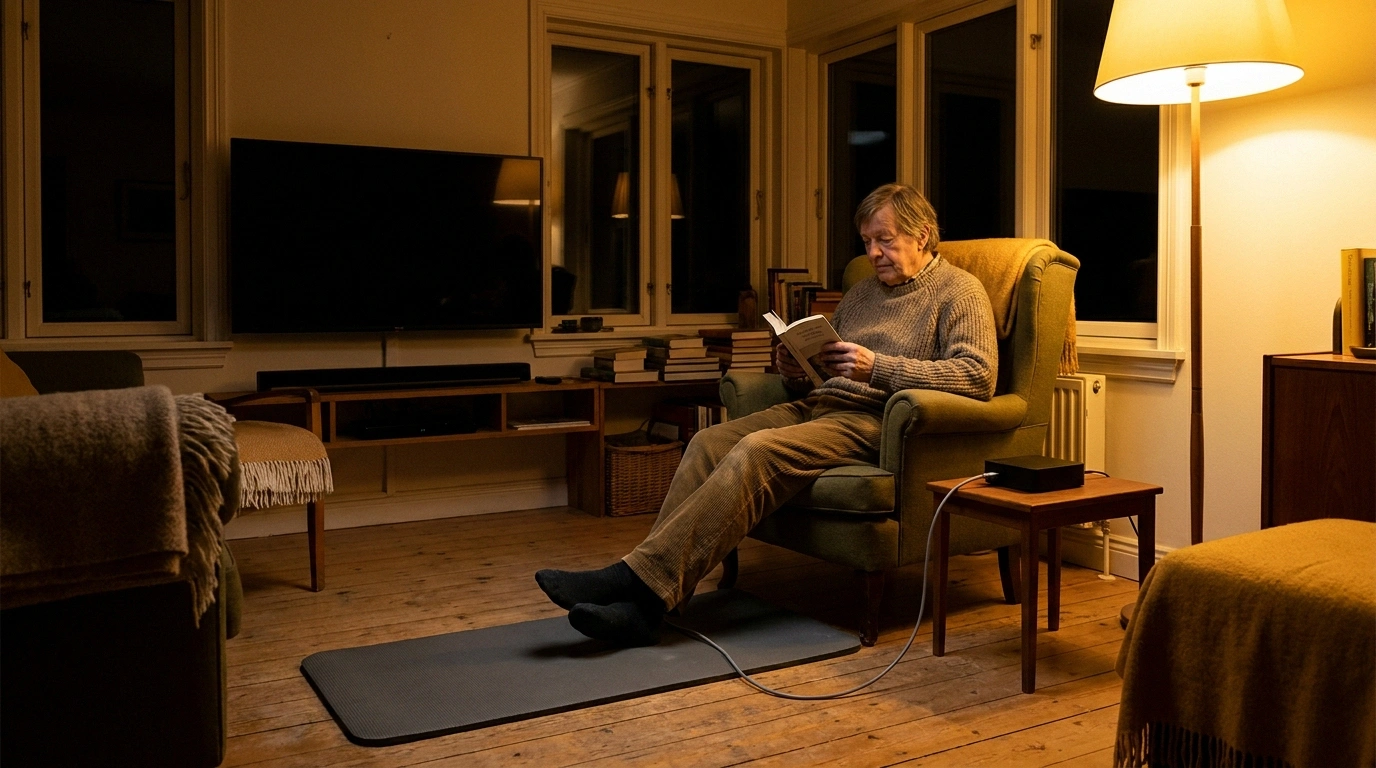
If you have distal symmetric polyneuropathy in both feet, PEMF is currently a low-priority option with an honest evidence summary of one positive trial, one larger negative trial, and a pooled result that is not significant for your specific problem. It is worth considering after the things with better support, not instead of them, and the fact that it is nearly harmless is a legitimate reason to be relaxed about trying it once the sequencing is right.
If your pain is radicular, coming from a nerve root at the spine, the picture genuinely is more favourable, and the same review that discouraged its use for polyneuropathy supports it for you. That is an unusual situation where the honest answer depends entirely on which diagnosis you actually have.
Among the other device-based options, photobiomodulation, red light therapy and scrambler therapy occupy similar territory: interesting mechanisms, small trials, enthusiastic marketing well ahead of the data. Setting them side by side in a ranked comparison of neuropathy treatments is more useful than evaluating any one of them alone, because the real question is not whether PEMF might help. It is what you should spend your next three months and your next thousand dollars on.
The most valuable thing in the 2026 review is not its verdict. It is the instruction the authors gave to the researchers who come next: stop running generic protocols and design trials around specific causes of nerve pain. When that happens, this question will get a real answer. It does not have one yet.
Frequently Asked Questions
Does PEMF therapy work for peripheral neuropathy?
The best current evidence says probably not much, at least for the diffuse kind affecting both feet. A 2026 systematic review pooling six trials in peripheral neuropathy found a standardised mean difference of −0.38 with a confidence interval crossing zero, meaning the result was not statistically significant, and rated the certainty of that evidence as low. The same review found a large and significant benefit for spinal and radicular nerve pain, which is a different problem.
Is PEMF FDA approved for neuropathy?
No. Some PEMF devices hold FDA 510(k) clearance, but the cleared indication for the best-studied medical system is adjunctive palliative treatment of post-operative pain and swelling in soft tissue. Neuropathy is not part of that indication, so use for nerve pain is off-label. Clearance is also not the same as approval, and most consumer PEMF mats hold no medical clearance at all.
Is PEMF safe?
The safety record in trials is good. Device-related adverse events occurred in 0.6 percent of participants, at the same rate in real and sham groups, and the events reported were mild and temporary. The important exceptions are absolute: anyone with a pacemaker, defibrillator, spinal cord stimulator, insulin pump or cochlear implant should not use PEMF, because the fields can interfere with implanted electronics. Pregnancy and active cancer in the treated area are also standard contraindications.
How long before I would know if it helps?
The trials that showed anything ran for months, not weeks. RELIEF used 30 minutes twice daily over 18 weeks. A reasonable personal test is eight weeks at that dose, with two weeks of written baseline before you start and a stop rule decided in advance.
What does it cost?
Consumer mats range from roughly 200 dollars to several thousand. Targeted applicators typically run 300 to 1,500 dollars. Clinic sessions are commonly 40 to 100 dollars each and are usually sold in packages. Insurance essentially never covers PEMF for neuropathy because the use is off-label, so plan on paying the full amount yourself.
Why do some people say it changed their life?
Three reasons that all coexist. Some of them have radicular pain from the spine rather than diffuse polyneuropathy, and the evidence genuinely supports PEMF there. Some are experiencing the natural fluctuation of nerve pain, which improves and worsens on its own regardless of treatment. And devices that require a daily ritual, cost real money and come with an expectation of benefit produce a substantial placebo response, which is a real reduction in felt pain even though the device is not causing it.
Is a cheap mat as good as a clinic machine?
They are not comparable products. The devices used in published trials deliver specific frequencies and intensities to a targeted area, most often the feet, for a defined duration. Consumer mats vary enormously in output, frequently do not publish their parameters, and are used in short general sessions that resemble no tested protocol. A cheap mat is not a cheaper version of the trial. It is a different intervention with no evidence behind it.
About the Author