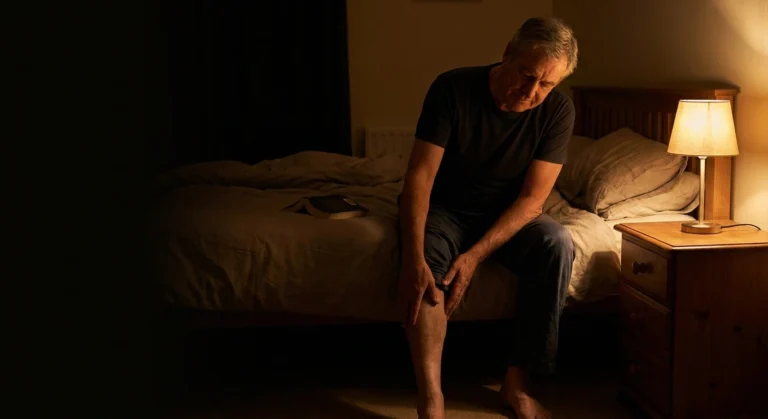
The question comes about four minutes into the appointment. “On a scale of zero to ten, how bad is your pain?”
And you stall. Because the honest answer is that your feet burned at maybe a four all week, but twice on Tuesday something went through your left heel like a live wire and you had to grab the counter, and the bedsheet has been unbearable every single night, and none of those three things are the same number. You pick six. Six is safe. Six gets written down, and the appointment moves on, and nothing you actually experienced made it into the chart.
That is not a failure of memory or a failure of nerve. It is a measurement problem. The zero-to-ten scale was built for a broken arm, where one number genuinely describes the situation. Nerve pain does not work that way, and a single number is the wrong instrument for it.
There is a better way to do this, and it is not complicated. It just requires rating a few things separately instead of averaging them into mush.
Why One Number Breaks Down Here
The numeric rating scale runs from 0, meaning no pain, to 10, meaning the worst pain imaginable. It measures exactly one property: intensity. For pain that has one character and one location, that works fine.
Nerve pain has several characters running at once, and they move independently of each other. The burning can improve while the electric jolts get worse. The tingling can be unchanged for months while your tolerance for a bedsheet collapses. If you compress all of that into one number, you throw away the part your doctor could actually act on.
There is a second problem, and it matters more than people realize. The number is unstable across time in a way you cannot control. Somebody who has lived with burning feet for six years recalibrates. What was an eight in year one becomes a five in year six, not because the nerves improved but because the reference point moved. Two years of your logs can show a slow decline in your reported numbers while the underlying condition progressed. That is a real thing that happens, and it is why intensity alone should never be the only thing you track.
None of this makes the zero-to-ten scale useless. It makes it insufficient. Keep it, and add to it.
The Five Dimensions Worth Rating Separately
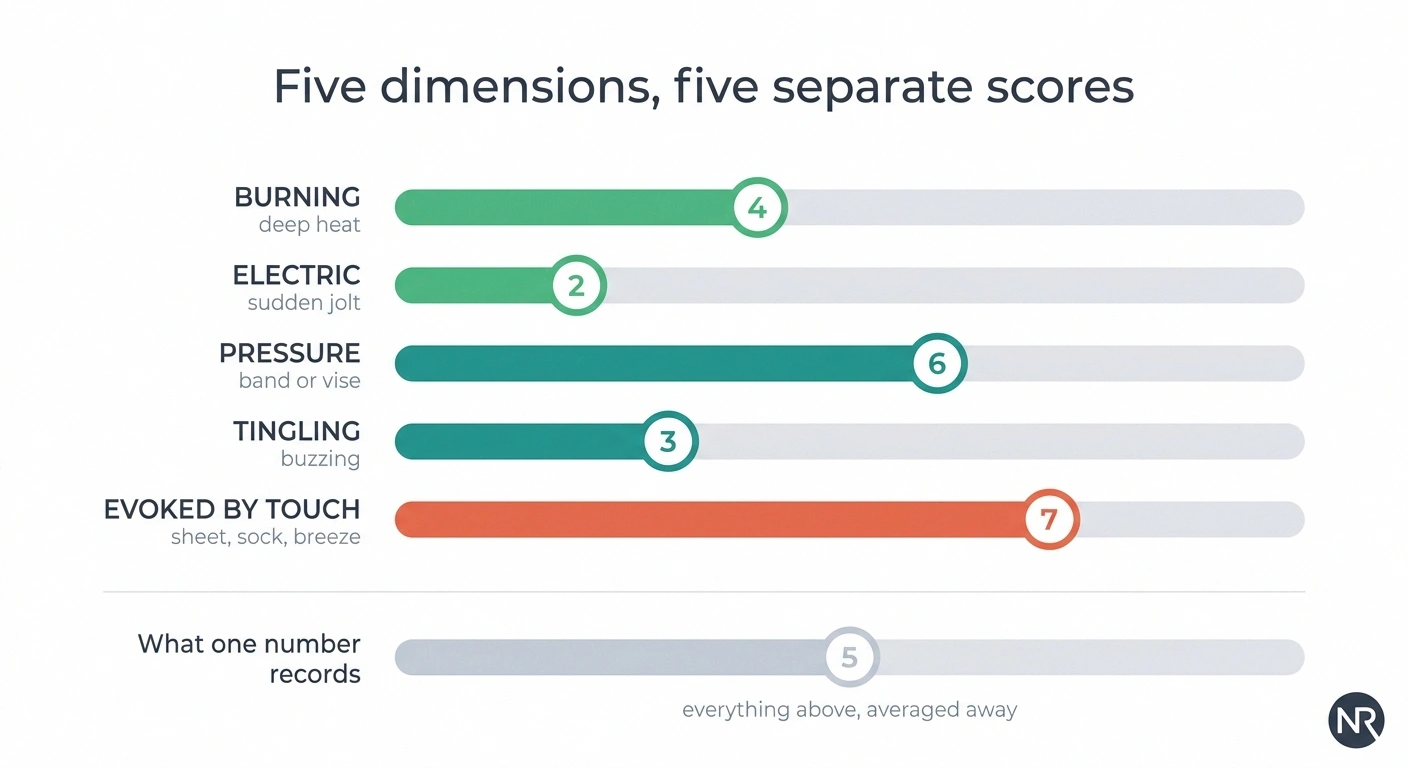
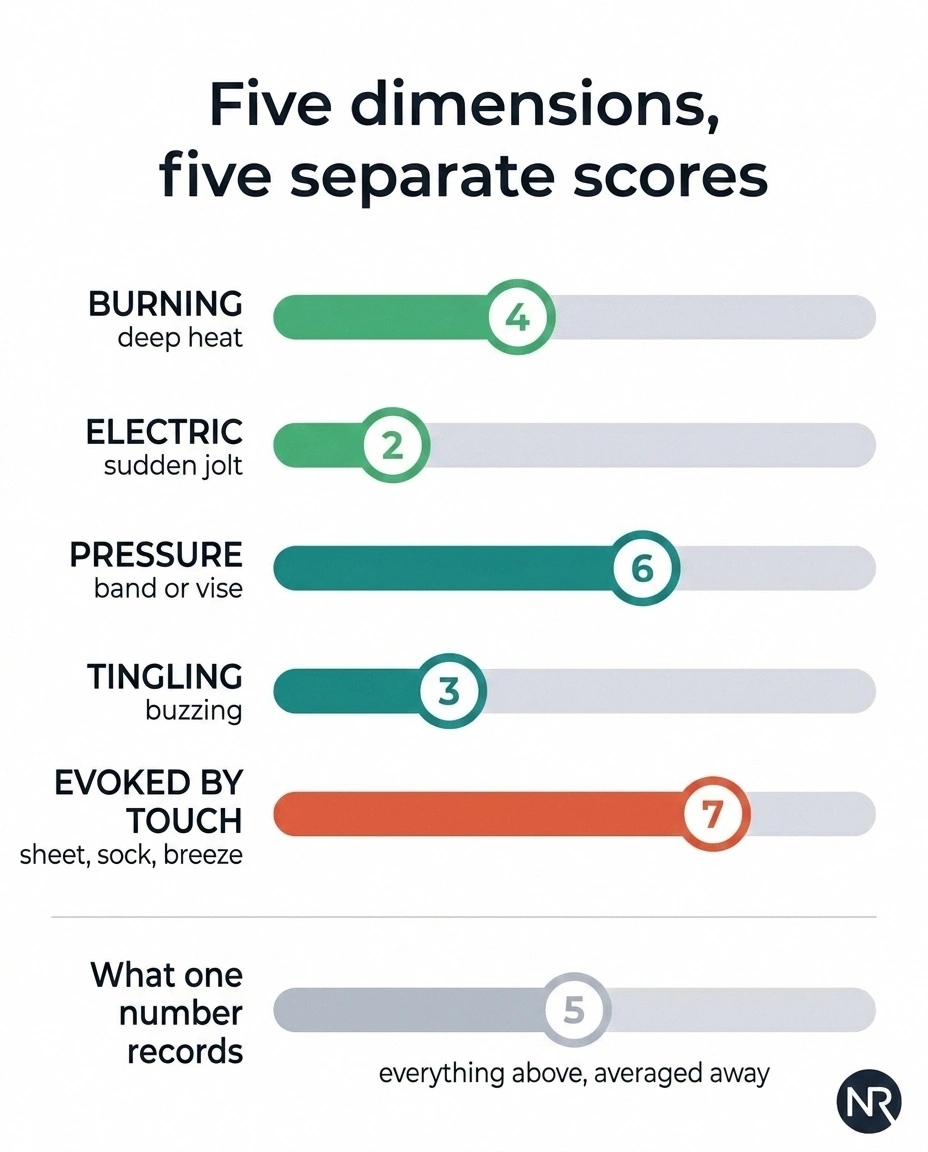
Researchers ran into the same wall and solved it the same way. The Neuropathic Pain Symptom Inventory, usually shortened to NPSI, is a validated instrument that abandons the single score entirely. It asks you to rate ten separate pain descriptors, each on its own 0 to 10 line, because the people who built it recognized that these sensations rise and fall on separate schedules.
You do not need the full clinical instrument. Five dimensions capture most of what changes:
| Dimension | What it feels like | What a change in it usually signals |
|---|---|---|
| Burning | Deep, continuous heat. Often worse at night, often described as standing in hot sand. | The most common baseline symptom. Responds most reliably to the standard nerve pain medications. |
| Electric or shock-like | Sudden, brief, violent. Arrives without warning and is gone in under a second. | Tracks separately from burning. Frequency per day is more informative than intensity. |
| Pressure or squeezing | A band around the foot or calf. A sock that is not there. A vise. | Often the last symptom to respond to treatment, and the one most people forget to mention. |
| Tingling and pins-and-needles | Buzzing, fizzing, crawling. More strange than painful, sometimes constant. | Can increase during nerve recovery as well as during progression. Context matters enormously. |
| Evoked pain | Pain triggered by something that should not hurt: bedsheets, socks, a shower, cool air. | The single most clinically meaningful dimension. See below. |
That last row deserves its own paragraph. Pain produced by a stimulus that is not painful has a name, allodynia, and it is a specific neurological finding rather than a description of severity. When you tell a clinician that a bedsheet on your feet is intolerable, you are not reporting that your pain is bad. You are reporting that your nervous system is amplifying a signal it should be ignoring. Those are different statements, and the second one carries far more diagnostic weight.
Rate each dimension zero to ten. Five numbers. It takes about twenty seconds once you are used to it, and the resulting picture is dramatically more useful than one averaged six.
Anchoring the Numbers to Something You Actually Did

Here is where most tracking systems fall apart. A column of numbers with nothing attached to them is nearly impossible to interpret three weeks later, and it is impossible for anyone else to interpret at all.
Copy this scale, not the hospital one
Write it once. Use the same wording every time. The point is that a 6 means the same thing in March as it did in January.
- 2
- Present, but I forget about it while I am occupied.
- 4
- Constant background. I did everything I planned anyway.
- 6
- I modified my day. Shorter walk, different shoes, sat down early.
- 8
- I cancelled something, or it kept me awake.
- 10
- I could not think about anything else.
Note the even numbers only. Five rungs are easier to apply consistently than eleven, and consistency is the entire value of a scale.
The fix is to anchor at least the high and low ends to function. Not “how bad did it feel” but “what did it stop me doing.”
Write your own anchors once, keep them, and use them consistently. Something like this:
- 2: Present, but I forget about it while I am occupied.
- 4: I notice it constantly, and I do everything I planned anyway.
- 6: I changed something. Shorter walk, different shoes, sat down early.
- 8: I cancelled something, or I could not sleep through it.
- 10: I could not think about anything else.
Now a six means something specific and repeatable. It means you modified your day. That is checkable, it does not drift as you acclimate, and it converts your log from a mood diary into evidence. A neurologist reading “6, cancelled the grocery run” understands the situation instantly. A neurologist reading “6” learns almost nothing.
Function anchors also solve the recalibration problem described earlier. Your tolerance for burning may climb over six years. Whether you cancelled the grocery run does not depend on your tolerance.
The Questionnaires a Neurologist May Hand You
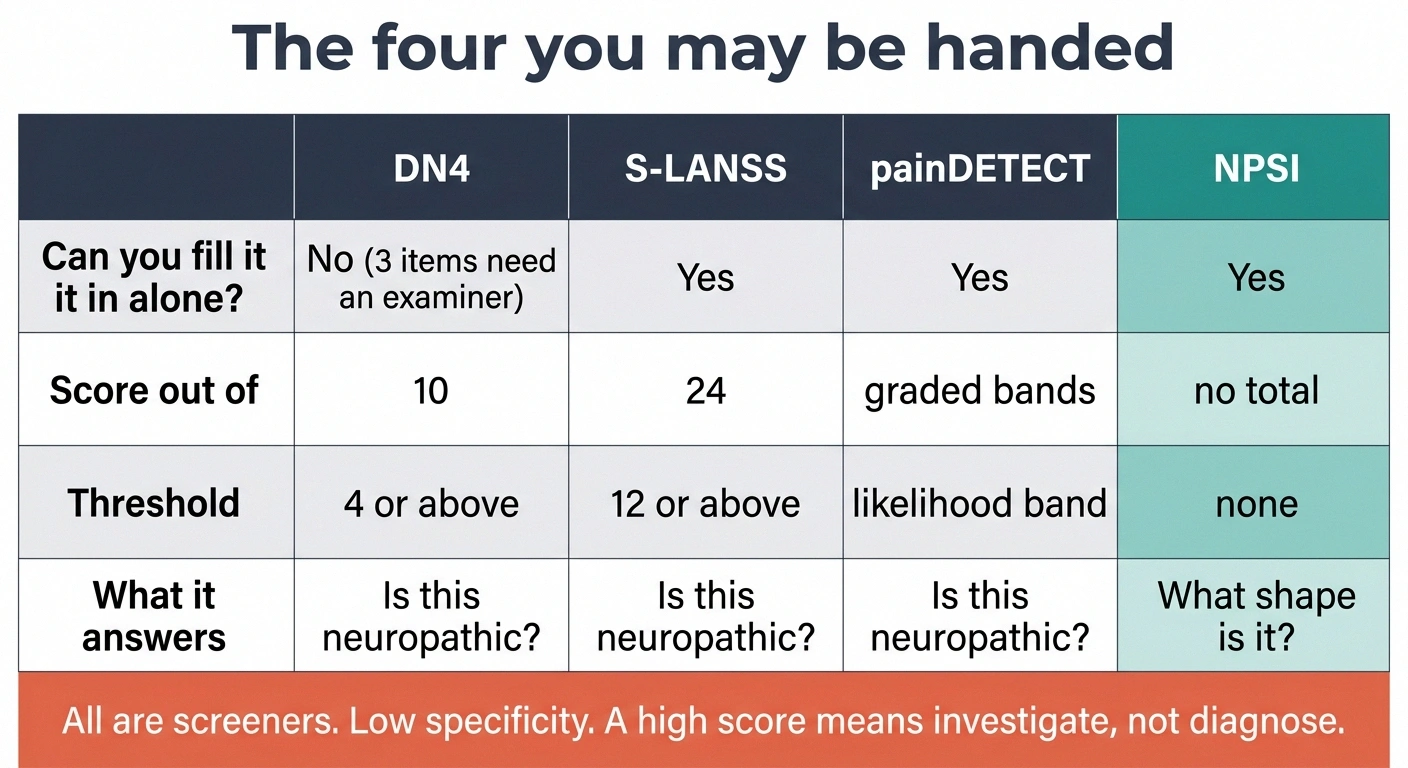
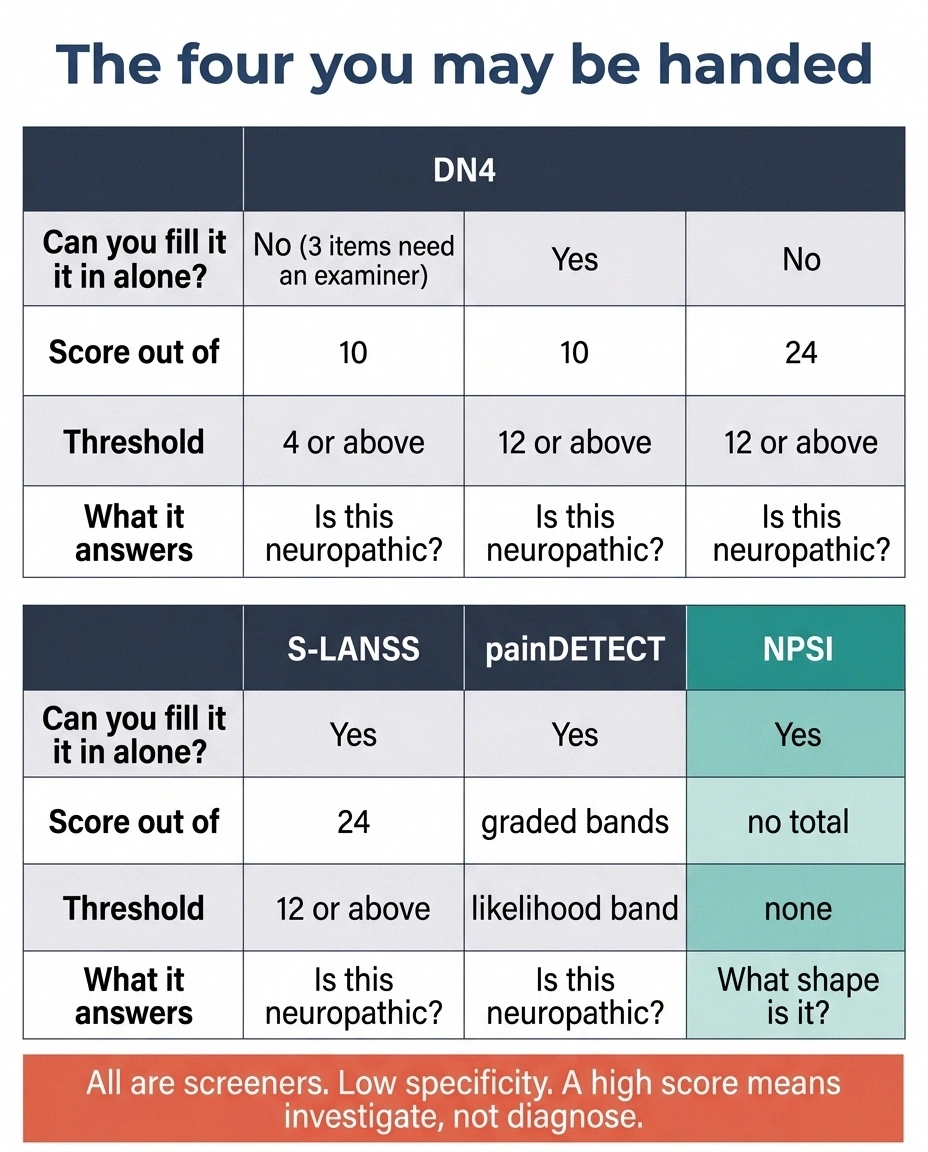
At some point you may be given a printed questionnaire with an odd name. These are screening instruments, and knowing what they are for makes the appointment less disorienting.
DN4 (from the French Douleur Neuropathique en 4 questions) has ten items: seven about your symptoms and three that require the clinician to touch your skin and test sensation. A score of four or above suggests a neuropathic component. In validation work its sensitivity runs around 83 percent with specificity near 90 percent, which is strong for a bedside tool. Because three items require an examiner, it is not something you can complete alone in the waiting room.
S-LANSS is the self-completed version of the Leeds Assessment of Neuropathic Symptoms and Signs. It scores out of 24. Below 12 suggests neuropathic mechanisms are unlikely to be driving your pain; 12 or above suggests they probably are contributing.
painDETECT is fully self-administered and was originally developed in people with back pain, to work out whether a nerve component was mixed in with a mechanical one. You will most often meet it in a pain clinic rather than a neurology clinic.
NPSI is the ten-descriptor inventory described earlier. It is a profiler rather than a screener. It does not ask whether your pain is neuropathic; it assumes so and maps its shape.
If you are heading into a first neurology appointment, it is worth knowing these exist so a clipboard of unfamiliar questions does not throw you. Our guide to preparing for a first neurology appointment covers the rest of what tends to happen in that hour.
What These Screeners Cannot Do
This section exists because the internet is full of “take the DN4 yourself” pages, and that is a genuinely bad idea.
Recent validation work in people with polyneuropathy symptoms found that only the DN4 held on to high sensitivity, around 0.87, while all three screeners showed low specificity. Their overall predictive ability in that population was described by the researchers as unsatisfactory. Low specificity means a high score does not confirm much on its own.
A 2025 analysis went further and argued there is a structural reason these tools cannot separate neuropathic pain from nociplastic pain, which is pain arising from altered pain processing rather than identifiable nerve damage. The questionnaires work by asking about descriptor words. Burning, electric, tingling. People with nociplastic pain conditions use those same words, honestly and accurately. The instrument has no way to tell the two apart, because the two sound identical in language.
What follows from that is simple. A high score is a reason to investigate, never a diagnosis. Nerve conduction studies, skin biopsy, blood work and an actual neurological examination are what settle the question. The questionnaire only decides whether the question gets asked.
One thing worth flagging quickly rather than logging
Tracking is for patterns over weeks. It is not for anything sudden. Weakness that appears over hours or days, numbness climbing up both legs, a new loss of bladder or bowel control, or pain following an injury needs same-day medical assessment, not an entry in a notebook. Log the slow things. Escalate the fast ones.
How Often to Rate, and When to Stop

Once a day, at roughly the same time, is the sweet spot. Evening usually works best because you can see the whole day from there.
What one evening entry looks like
Burning, Electric, Pressure, Tingling, Allodynia. Five letters, five numbers, one line of context. Roughly twenty seconds.
In this entry the pressure and evoked-pain numbers are the story, and both would have vanished if the day had been recorded as a single “5”.
Rating more often than that backfires for two reasons. It takes over your attention, and attention is not neutral in chronic pain. Repeatedly scanning your body for pain reliably makes pain more prominent, which is a well-documented effect and not a character flaw. The second reason is more mundane: nobody sustains hourly logging past week two, and an abandoned log is worth less than a sparse one.
Track intensively during the periods when the data will change a decision:
- Starting a new medication. Two weeks before, then through the titration. Without a before, you cannot evaluate the after.
- Changing a dose. Same logic, shorter window.
- Chasing a trigger. If you suspect a food, a shoe, a sleep pattern or a weather shift, log tightly for a month with that variable noted.
- The six weeks before an appointment. Enough for a trend, recent enough to be relevant.
Outside those windows, a weekly entry is plenty. Give yourself permission to stop entirely for a stretch. A tracking system you resent is one you will abandon, and there is no prize for unbroken data.
If you want a fuller structure with triggers, sleep and medication timing alongside the pain numbers, our symptom journal guide includes a free template you can print.
Turning Six Weeks of Numbers Into Ten Useful Minutes
Nobody is going to read your notebook. Assume that, and it changes what you prepare.
Bring a single page. Not the log, a summary of the log. Four things belong on it:
- Your five dimension averages, this period versus the last one. “Burning 6 down to 4. Shocks unchanged. Squeezing 3 up to 6.”
- Your worst-day count. How many days at 8 or above. This one number carries more weight than any average, because it describes how often your life stopped.
- The function line. What you stopped doing, and how often. “Missed church three Sundays. Stopped walking the dog after week two.”
- Your single question. One. The one thing you most need answered.
Hand the page over at the start rather than the end. It reframes the visit around your data instead of around recall under time pressure. If the conversation itself is the part that goes badly, our guide on talking to your doctor about neuropathy pain deals specifically with being heard.
What Counts as a Real Change
This is the question the numbers exist to answer, and there is a rough benchmark for it.
The number that decides whether a treatment stays
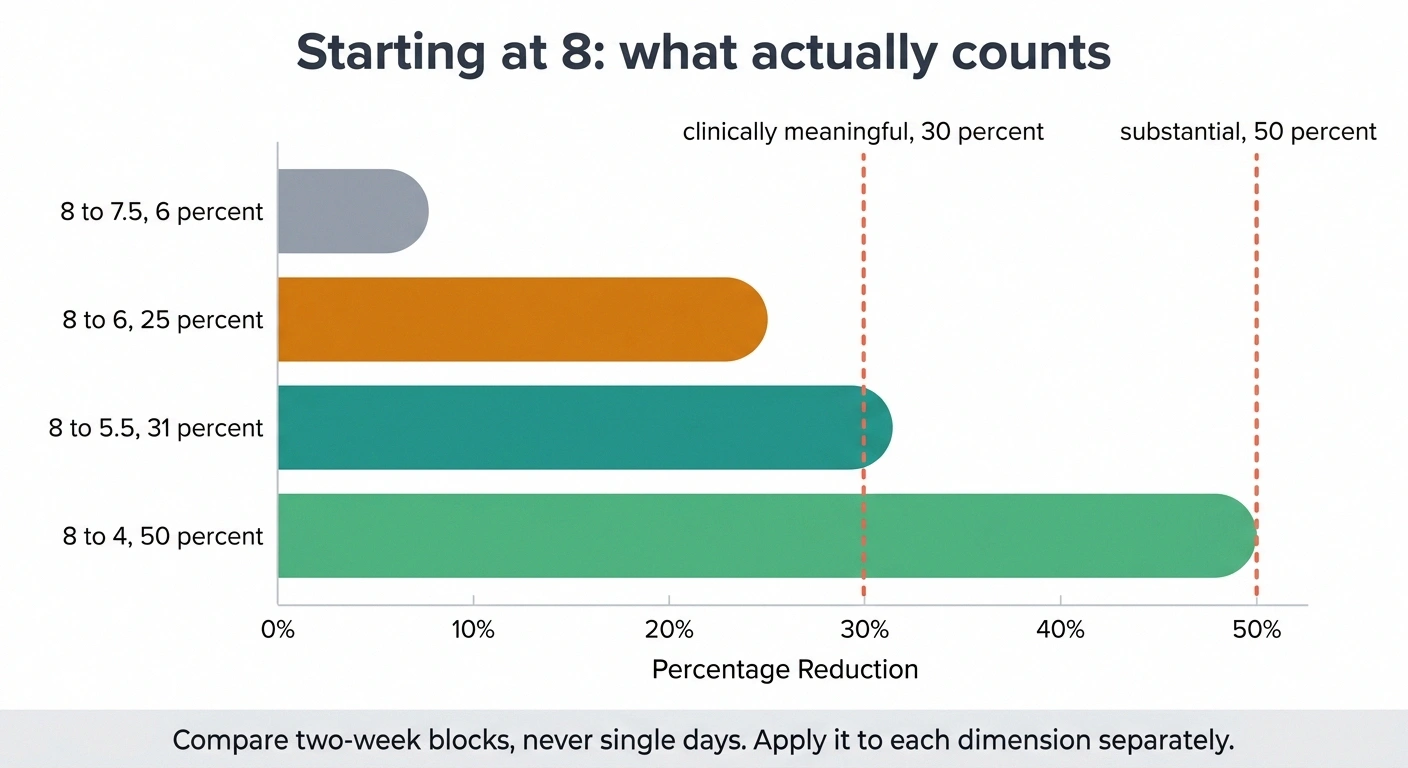
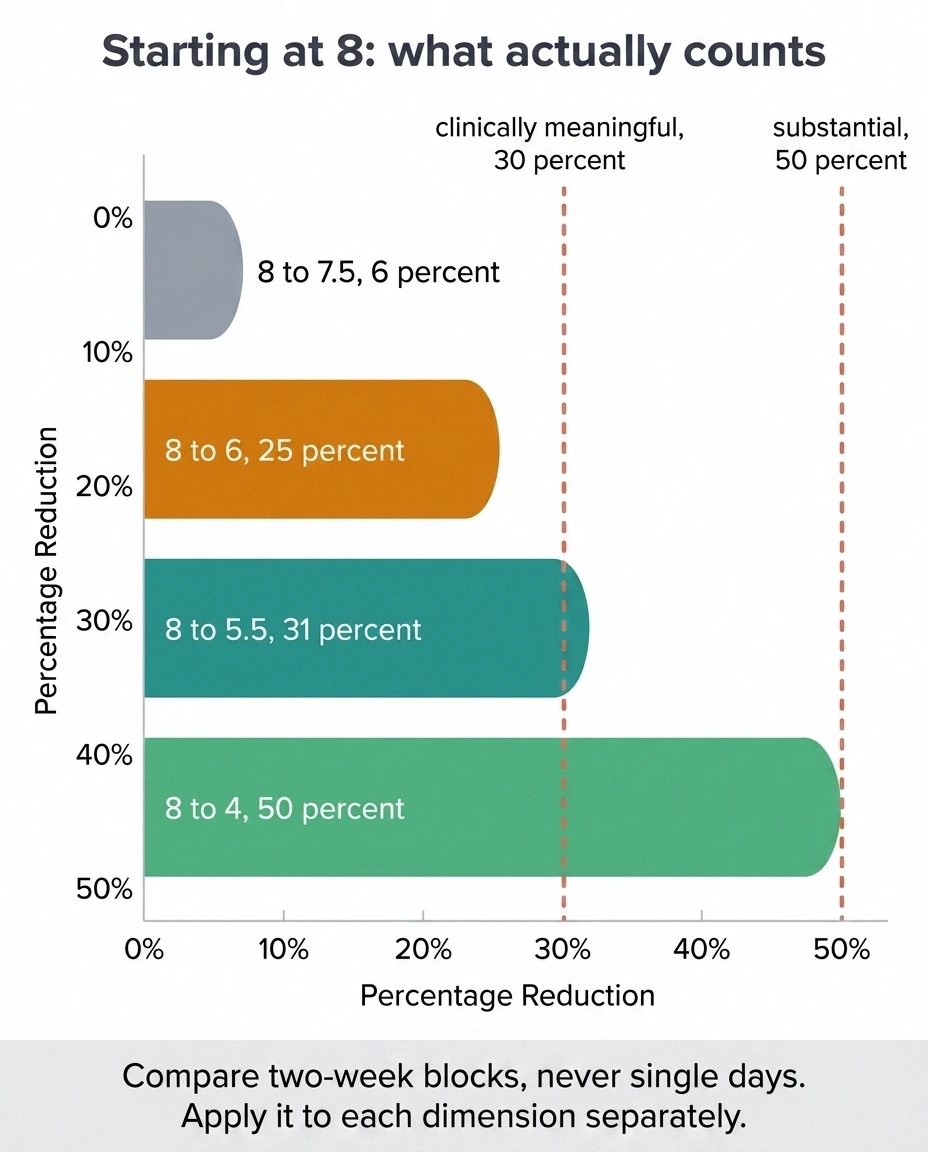
Chronic pain research treats roughly 30 percent intensity reduction as clinically meaningful and roughly 50 percent as substantial. Applied to a starting score of 8, that is the difference between a result and a rounding error:
| 8 down to 7.5 | 6 percent. Noise. |
| 8 down to 6 | 25 percent. Borderline. |
| 8 down to 5.5 | 31 percent. Meaningful. |
| 8 down to 4 | 50 percent. Substantial. |
Apply it per dimension and across two-week blocks. A drug that clears 40 percent of your burning and nothing of your squeezing is still worth knowing about.
In chronic pain research, a reduction of about 30 percent in pain intensity is generally treated as clinically meaningful, meaning patients themselves report it as a worthwhile improvement. Roughly 50 percent is considered substantial. Going from 8 to 6 counts. Going from 8 to 7.5 is probably noise.
Three cautions on applying that to yourself.
Nerve pain fluctuates enormously without any intervention at all. A good week proves nothing. Compare periods of at least two weeks, never day against day, or you will credit medications for weather and blame medications for a bad night’s sleep.
Apply the threshold per dimension. A drug that halves your burning and does nothing for the squeezing band around your calf is working, partially. That is genuinely useful information for choosing what to add next, and it disappears completely if you only tracked one overall number.
Finally, the intensity number is not the only outcome that matters. Sleeping through the night, walking further, and needing fewer rescue doses are all real improvements that can occur while your average holds steady at a five. Track those too. If a medication has stopped delivering any of them, our guide on what to do when neuropathy medication stops working walks through the next decisions.
A Note on Bad Weeks

Every long-term tracker eventually hits a stretch where the numbers climb and stay climbed, and the log starts to feel like a record of losing.
Two things help. Zoom out to the monthly view, where a bad fortnight looks like what it usually is, a bump on a flatter line. And write one sentence beside the bad entries about what else was happening. Sleep, stress, an infection, a heatwave, a schedule change. Flare-ups usually have inputs, and the log is often the only place those inputs are visible in hindsight.
If tracking is making things measurably worse for you rather than better, stop tracking. That is a legitimate finding about your own nervous system, and it is worth mentioning at your next appointment. The point of measurement was always to give you leverage. When it stops doing that, it has stopped earning its place.
Frequently Asked Questions
What is the neuropathy pain scale?
There is no single official neuropathy pain scale. Most clinics use the standard 0 to 10 numeric rating scale, where 0 is no pain and 10 is the worst pain imaginable. Because that scale only measures intensity, specialists often add a neuropathic instrument such as the DN4, S-LANSS, painDETECT or the Neuropathic Pain Symptom Inventory, which assess the character of the pain rather than just how strong it is.
Why is it so hard to give one number for nerve pain?
Nerve pain usually has several distinct components at once, such as burning, electric shocks, squeezing pressure, tingling, and pain triggered by light touch. These components change independently of one another. Compressing them into a single number discards the detail that would help a clinician choose a treatment, which is why rating each component separately gives a far more useful picture.
Can I take the DN4 or painDETECT questionnaire myself at home?
painDETECT and S-LANSS are designed to be self-completed, and the DN4 includes three items that require a clinician to test your sensation, so it cannot be fully completed alone. Regardless of which one you use, the result is a screening signal rather than a diagnosis. Research in people with polyneuropathy found these questionnaires have low specificity, meaning a high score does not confirm neuropathic pain on its own.
How much improvement counts as a real result from treatment?
In chronic pain research, roughly a 30 percent reduction in pain intensity is usually regarded as clinically meaningful, and roughly 50 percent is considered substantial. Compare periods of at least two weeks rather than individual days, because nerve pain fluctuates significantly on its own and a single good day does not indicate a trend.
How often should I record my pain score?
Once daily at a consistent time works well for most people, ideally in the evening when the whole day is visible. Rating more frequently tends to increase attention on pain without adding useful information. Weekly entries are enough during stable periods, with tighter daily tracking during medication changes or when investigating a suspected trigger.
What is allodynia and why does it matter more than my pain number?
Allodynia is pain caused by something that should not hurt, such as a bedsheet, a sock, a light breeze or a warm shower. It matters because it is a specific neurological finding rather than a measure of severity. Reporting that a bedsheet is intolerable tells a clinician something concrete about how your nervous system is processing signals, which a rating of 7 out of 10 does not convey.
Does a higher pain number mean my nerve damage is getting worse?
Not reliably. Pain intensity and the extent of nerve fiber loss do not track closely together. Some people experience severe pain early with relatively limited damage, and pain can sometimes decrease as more nerve fibers are lost. Changes in function, balance, weakness and sensation are better indicators of progression than the pain number alone.
What should I bring to an appointment instead of my full log?
Bring a single summary page rather than the complete journal. Include your average score for each pain dimension compared with the previous period, a count of how many days reached 8 or above, a short note on specific activities you stopped or modified, and one clear question. Handing this over at the beginning of the appointment is more effective than trying to recall details under time pressure.
About the Author