
If you were following riliprubart, you probably remember the Phase 2 numbers. Half of the patients who had already failed standard treatment responded. Of those who responded at six months, most were still doing well more than a year later. A blood marker of nerve damage fell by around a third. For a group of people who had run out of options, that looked like the beginning of something.
On 10 June 2026, Sanofi announced that the Phase 3 trial testing exactly that population was being stopped.
Not paused. Not delayed. An independent committee looked at the interim data and concluded the study was unlikely to show enough benefit to be worth completing.
This article covers what happened, why a 50% response rate in Phase 2 did not survive contact with a placebo group, what is still running, and how to read the next headline of this kind. That last part is the most useful thing here, because there will be a next one.
The Announcement, in Plain Terms
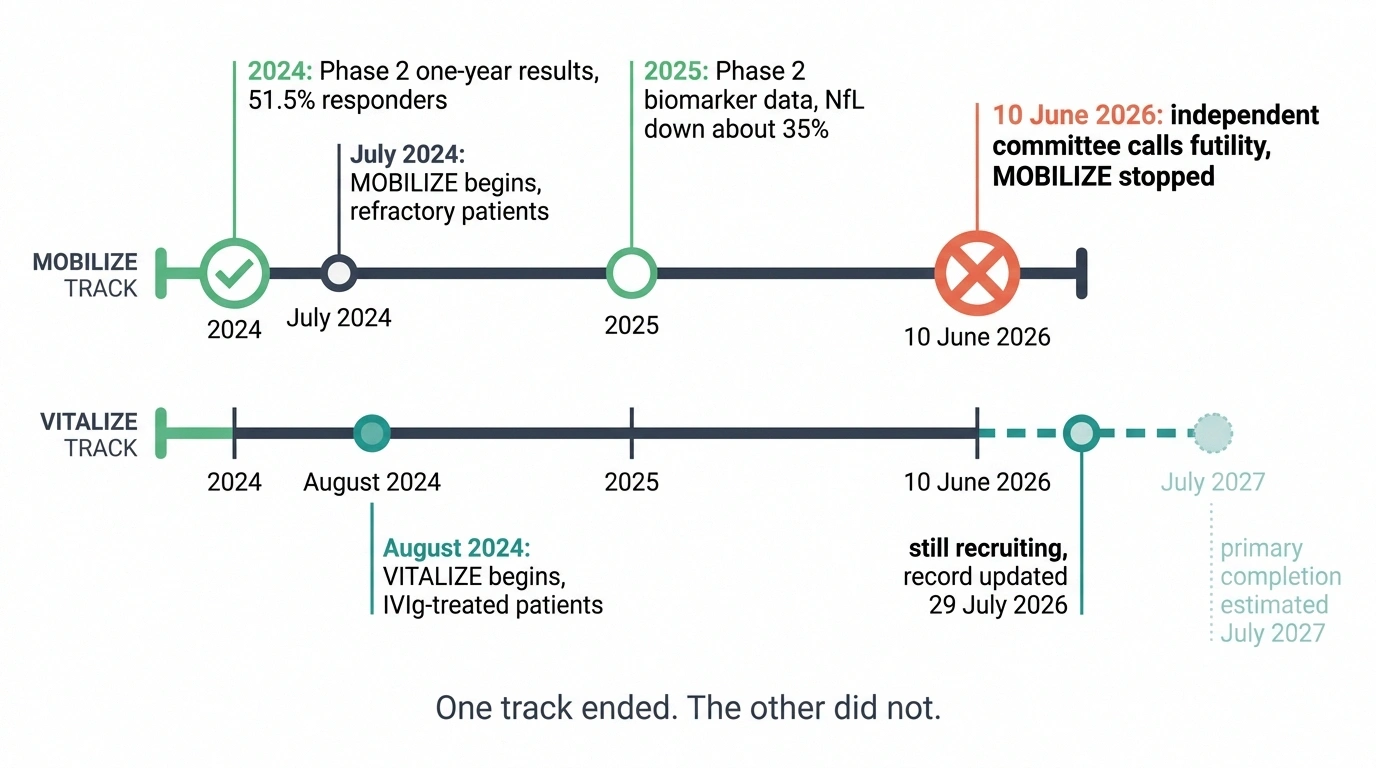
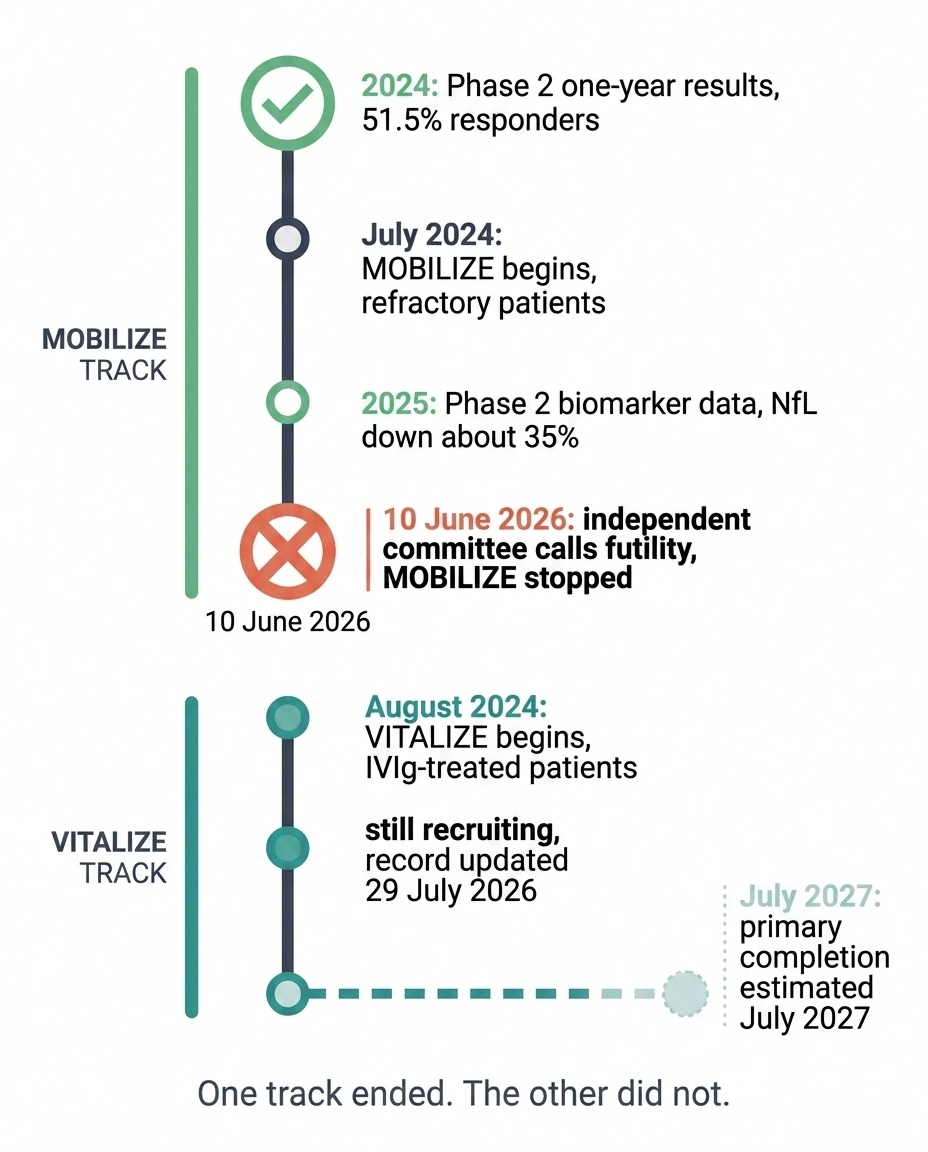
The trial was called MOBILIZE, registered as NCT06290128. It tested riliprubart against placebo in adults with CIDP who were refractory to standard treatment, meaning steroids, immunoglobulin and plasma exchange had already been tried without adequate benefit.
MOBILIZE, by the record
Announced
10 June 2026
Enrolled
109 of ~140 planned
Reason
Insufficient efficacy
Safety signals
None identified
The bottom two boxes are the ones that get conflated in headlines. A drug stopped because it did not help is in a different category from a drug stopped because it caused harm, and the difference determines whether the compound has any future at all.
An independent data monitoring committee, a group with access to unblinded results that neither the company nor the investigators can see while a trial runs, performed a scheduled interim analysis. Their determination, in the language of the press release, was that the study “is unlikely to provide sufficient efficacy.”
One sentence in that release deserves separating out, because it is the part most readers skip and the part that most changes the meaning:
No safety signals related to riliprubart were identified as part of this interim analysis.
The drug was not stopped because it hurt anyone. It was stopped because it was not working well enough to justify continuing to ask people to participate.
Sanofi committed to winding the study down with appropriate transition of care for enrolled patients. The registry now lists MOBILIZE as active but no longer recruiting, with an actual enrollment of 109 against a planned target of around 140, and an actual primary completion date of 10 June 2026, the day of the announcement.
What Riliprubart Was Built to Do
Riliprubart, coded SAR445088 in development, is a humanized monoclonal antibody that selectively inhibits activated C1s.
Complement is a cascade of blood proteins that autoimmune diseases recruit to do their damage. Antibodies mark a target; complement destroys it. In CIDP, that destruction strips myelin from peripheral nerves.
C1s sits at the very top of the classical pathway, the branch that fires specifically in response to bound antibodies. Blocking it is the most selective intervention available in this cascade: the lectin and alternative pathways continue running, preserving a meaningful amount of innate defense. The drug was given weekly as a subcutaneous injection.
The reasoning was sound, and it remains sound. That is worth saying clearly, because the failure of this trial does not invalidate the underlying idea that complement matters in CIDP. It tells you something narrower.
The Phase 2 Results That Made This Look Like a Winner
The Phase 2 study enrolled three groups: people currently on standard treatment, people refractory to it, and people who had never been treated.
The topline result was that 51.5% of participants were responders at week 24, with response rates broadly consistent across the three groups.
In the refractory group specifically, 9 of 18 responded, exactly 50%. Among those responders, 78% still had a sustained response at 76 weeks.
There was also a biomarker result, which carried real weight at the time. Plasma neurofilament light chain, a protein released into blood when nerve fibers are damaged, dropped by roughly 35% across cohorts over 48 weeks. Larger drops tracked with better functional improvement. Biomarkers that move in the right direction and correlate with how patients actually do are the kind of evidence that makes a development program feel de-risked.
Half of a refractory population responding, most of them durably, with a supportive biomarker. It is easy to see why this went to Phase 3 in that exact population.
Why That Number Did Not Survive a Placebo Group
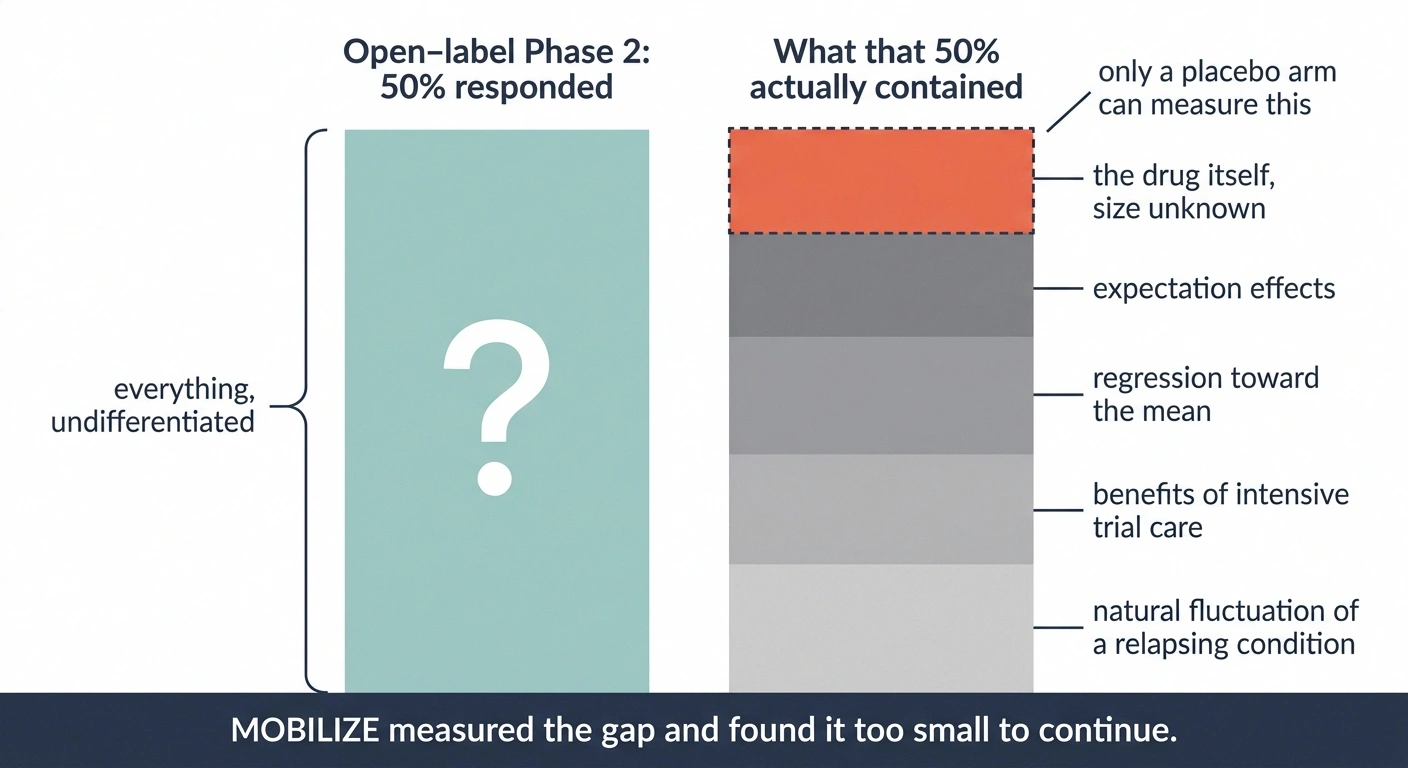
The Phase 2 study was open-label. Everyone knew they were receiving the drug. There was no placebo arm.
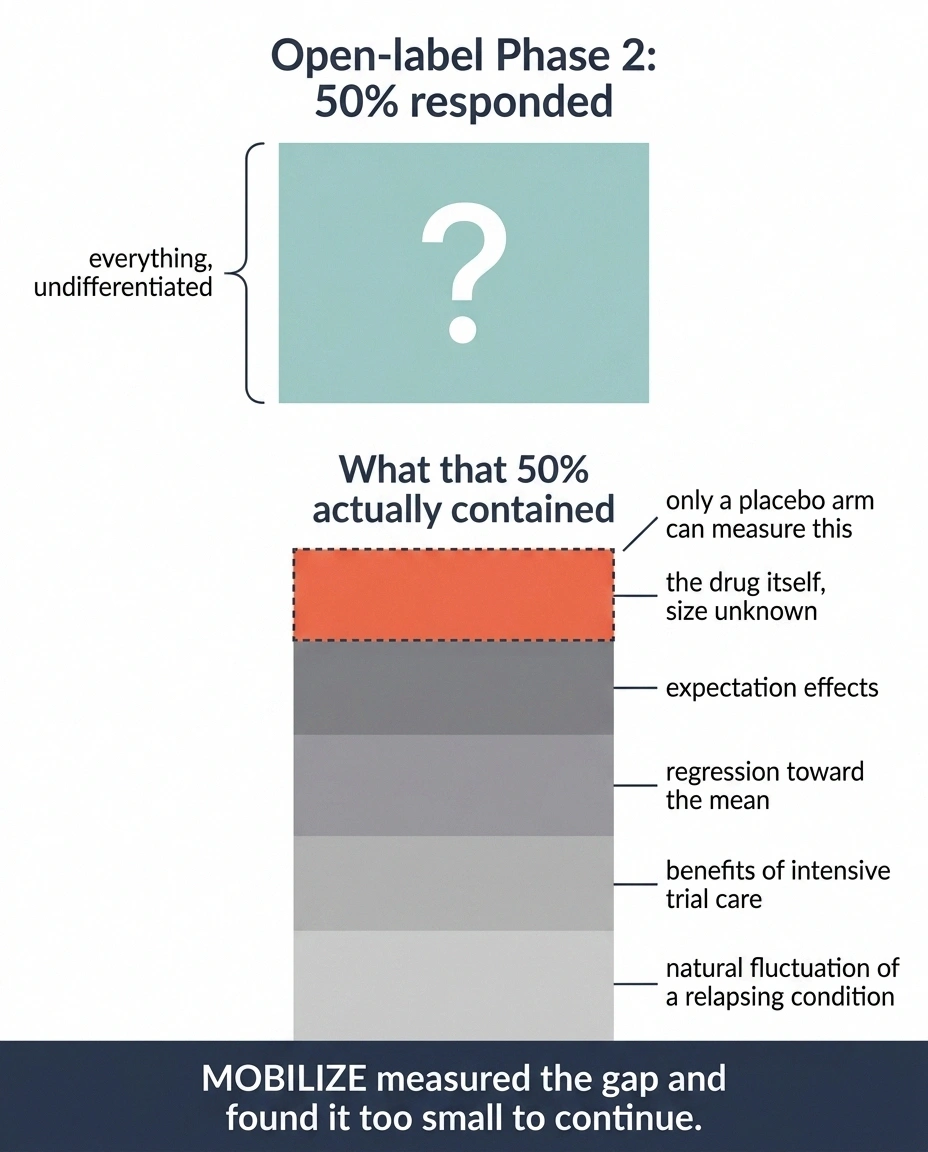
Unpacking a 50% response rate with no control group
Nine of eighteen refractory patients responded in the open-label Phase 2. Here is everything that number was measuring at once.
The drug itself. Some portion, unknown without a comparison arm.
Natural fluctuation. CIDP relapses and remits. Some people improve over 24 weeks with no change in treatment, and every one of them counts as a responder here.
Trial care itself. Frequent specialist review, closer monitoring, better-optimized supportive care. That improves outcomes on its own.
Regression to the mean. People enroll when they are doing badly. Some of what follows is simply a return to their own average.
Expectation. The endpoint rests partly on assessment and self-report, and nobody knowingly taking an experimental drug is a neutral observer of their own hands.
A placebo arm absorbs the bottom four. Whatever it shows is the amount attributable to everything that is not the drug. The real effect is only the gap. MOBILIZE measured that gap and found it too small to continue.
That single design fact is the whole explanation, and it is worth taking slowly, because it applies to nearly every promising early result you will ever read about.
When there is no control group, the 50% response rate is not measuring the drug. It is measuring the drug plus everything else that happens to a group of people over 24 weeks in a clinical trial.
Several things live inside that “everything else,” and in CIDP they are unusually large:
- CIDP fluctuates on its own. It is a relapsing and remitting condition. Some people improve over six months without any change in treatment. In an uncontrolled study, every one of those people is counted as a responder.
- Trial participation is itself an intervention. Participants get frequent specialist assessment, closer monitoring, better-optimized supportive care, and structured physiotherapy contact. That improves outcomes independently of the study drug.
- People enroll when they are doing badly. If you sign up during a rough patch, some of the subsequent improvement is regression toward your own average. This is one of the most reliable illusions in all of medicine.
- Expectation is measurable. The endpoint is a disability score partly built on assessment and self-report. Someone who knows they are receiving an experimental drug that might help is not a neutral observer of their own hands.
A placebo arm exists to absorb all of that. Whatever improvement the placebo group shows is the amount attributable to fluctuation, attention, regression and expectation combined. The drug’s real effect is only the gap between the two arms.
MOBILIZE measured that gap and found it too small to keep going.
This does not mean the Phase 2 participants imagined their improvement. Many of them genuinely got better. It means less of that improvement was caused by riliprubart than the uncontrolled number implied.
What Futility Means, and What It Does Not

Trials get stopped early for three quite different reasons, and news coverage tends to blur them into a single impression of failure.
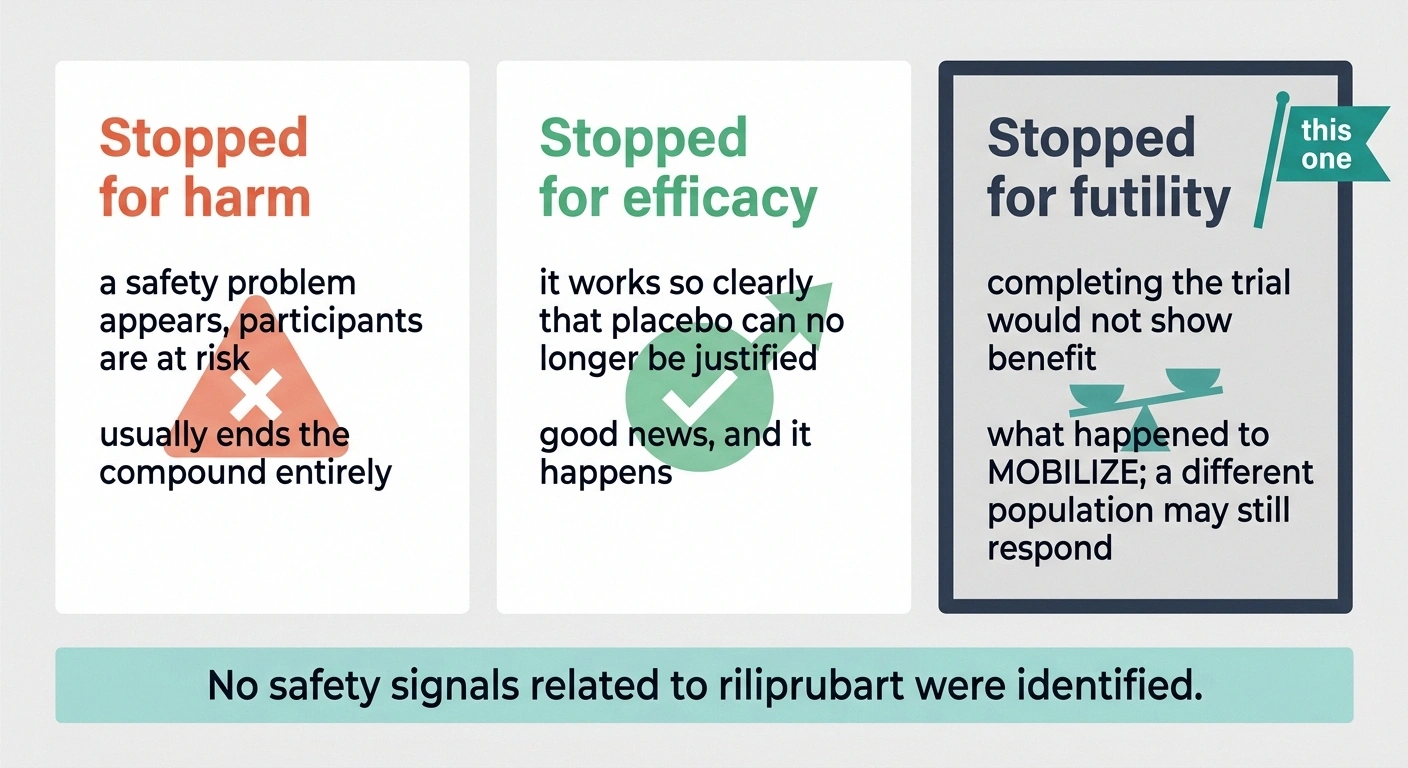
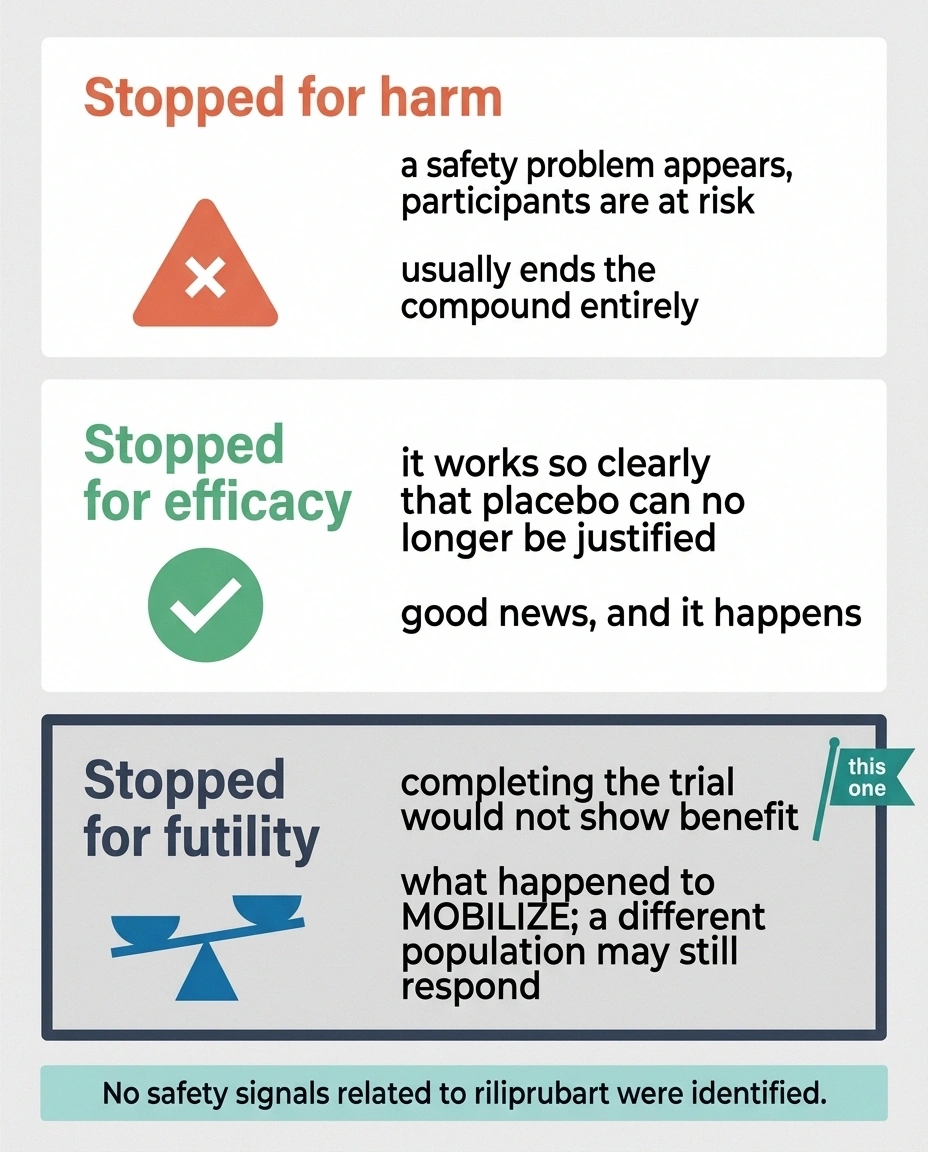
Stopped for harm
A safety problem appears. Continuing would put participants at risk.
Usually ends the compound, often across every indication.
Stopped for efficacy
It works so clearly that keeping people on placebo is no longer defensible.
Good news, and it does happen.
Stopped for futility
Running to completion would not show benefit, so the answer is already visible.
This is what happened to MOBILIZE. A different population may still respond.
Stopped for harm. The monitoring committee sees a safety problem. Participants are at risk, and continuing is unethical. This is the outcome people picture when they read that a trial was halted.
Stopped for efficacy. The drug is working so clearly that withholding it from the placebo group can no longer be justified. This is good news and it happens.
Stopped for futility. The interim data show that even if the trial ran to completion with the results continuing on their current trend, it would not demonstrate benefit. Continuing would ask people to keep taking injections and attending visits for an answer already visible.
MOBILIZE was the third kind. Stopping for futility is a monitoring committee doing its job properly, and it protects the people still enrolled.
The distinction matters practically. A drug stopped for harm is generally finished in that indication and often in every indication. A drug stopped for futility in one population may still have a role in a different one, provided there is a real reason to expect a different answer.
VITALIZE Is Still Recruiting
Sanofi’s June statement said continuation of other ongoing riliprubart studies, including VITALIZE, “will be evaluated accordingly.” That is a company reserving its options, and it left the obvious question open.
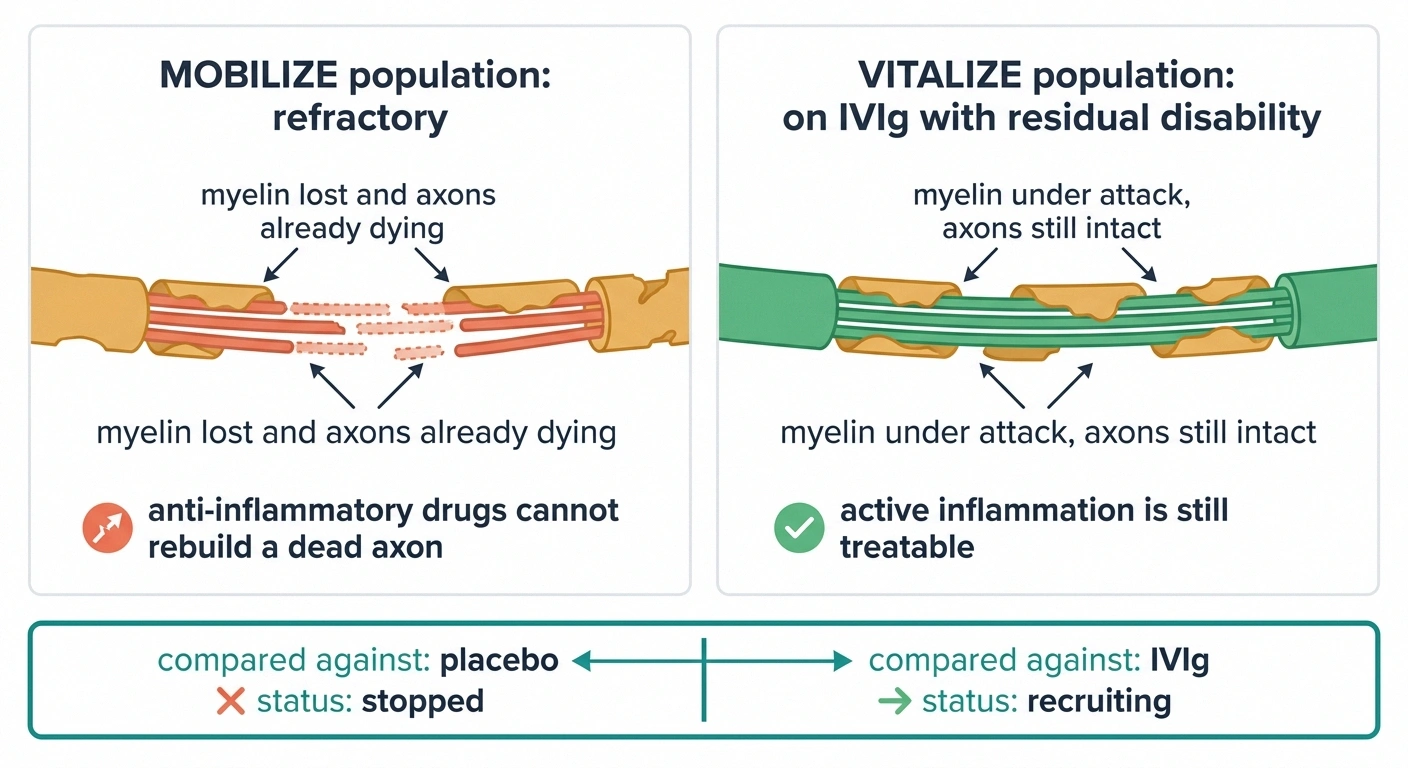
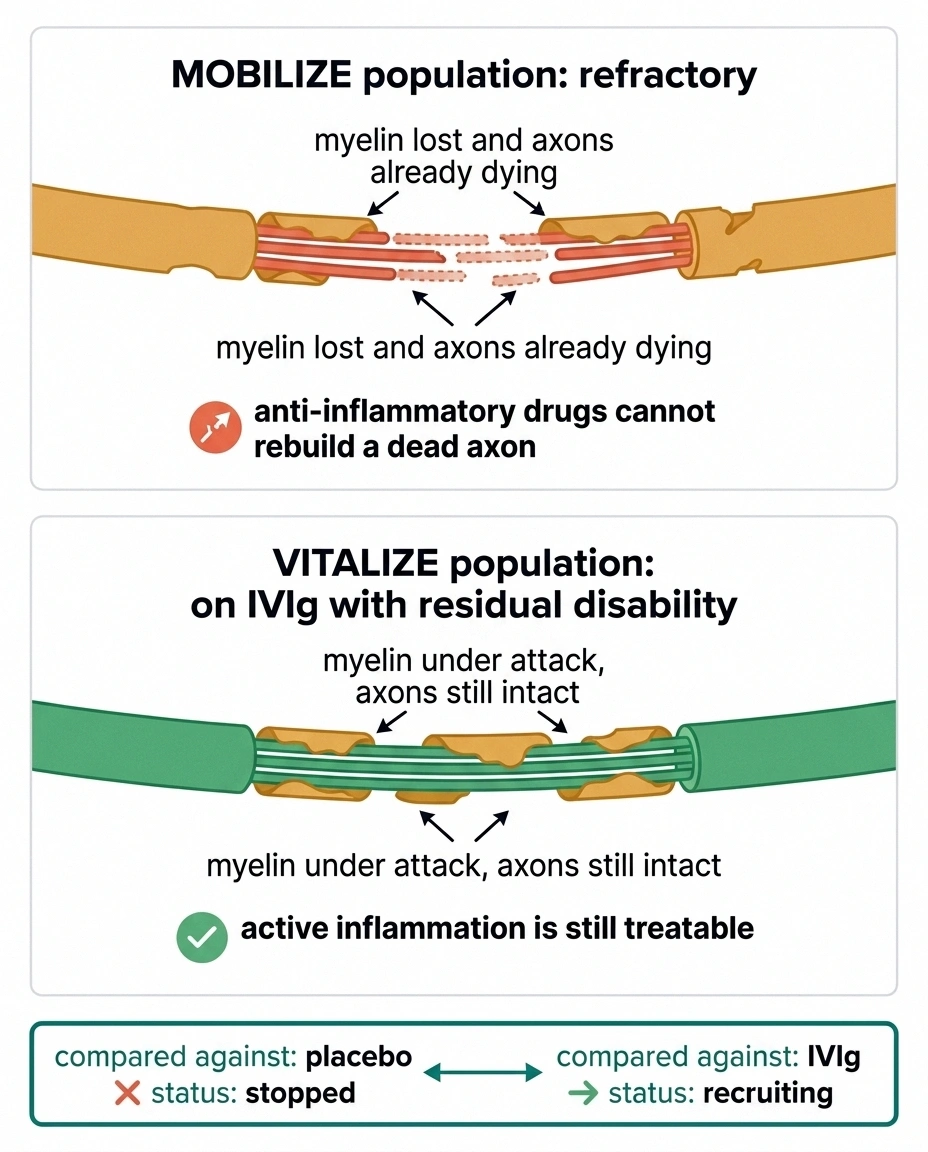
| MOBILIZE (stopped) | VITALIZE (recruiting) | |
|---|---|---|
| Who enrolled | Refractory to every standard treatment | On IVIg and benefiting, but incompletely |
| Compared against | Placebo | IVIg, double-dummy |
| Likely disease state | More accumulated axonal loss | Active, treatment-responsive inflammation |
| Enrollment | 109 actual | 160 estimated |
| Status | Winding down | Recruiting, record updated 29 July 2026 |
Once axons have died rather than merely lost myelin, no anti-inflammatory drug rebuilds them. That may be much of what separates these two rows, and it is why a failure in the first population does not settle the second. Registry statuses change; this one was current at the time of writing.
The public trial registry answers it, at least as of this writing.
VITALIZE, registered as NCT06290141, is listed as recruiting. Its record was verified in July 2026 and last updated on 29 July 2026, roughly seven weeks after the MOBILIZE announcement. Estimated enrollment is 160, with estimated primary completion in July 2027.
A sponsor that had decided to abandon a program does not usually keep updating a recruiting record seven weeks later. No decision to stop VITALIZE has been publicly announced.
Treat that as a snapshot with a date attached rather than a permanent state. Registry statuses change, sometimes well after the underlying decision.
Why VITALIZE might genuinely differ
VITALIZE tests a different population with a different comparator, and both differences point the same way.
It enrolls people already being treated with IVIg who still have residual disability, defined as a persistent INCAT score of 2 or more. The design is double-dummy: riliprubart plus placebo infusions against IVIg plus placebo injections.
The distinction from MOBILIZE is not cosmetic. MOBILIZE enrolled people in whom every standard treatment had already failed. That is, by construction, the population least likely to respond to anything, and often the population with the most accumulated axonal damage. Once nerve fibers themselves have died rather than merely lost their myelin, no anti-inflammatory drug can rebuild them. The difference between demyelinating and axonal damage may be doing quiet work in explaining this result.
VITALIZE enrolls people who demonstrably respond to immune treatment, since they are on IVIg and benefiting, but not completely. That is a population with active, treatable inflammation still in play.
A drug can fail in burned-out disease and still work in active disease. Whether riliprubart is such a drug is unresolved, and VITALIZE is where that gets settled.
If You Were Enrolled in MOBILIZE

Sanofi’s commitment was to work with investigators and site teams to wind the study down with appropriate transition of care.
In practice that means your site team arranges your return to standard treatment. A few things are worth raising directly with your neurologist:
- Ask which arm you were in. Unblinding normally happens once a trial closes, and it changes how you interpret the last several months of your own experience.
- Do not assume your prior regimen resumes automatically. Restarting IVIg or steroids requires a prescription, scheduling, and often reauthorization. Confirm the date rather than waiting for a call.
- Flag any gap in coverage. The interval between stopping study drug and restarting standard treatment is where relapses happen. If a gap is unavoidable, ask what to watch for and when to call.
- Ask whether your data still counts. It does. Participants in a stopped trial contributed the evidence that produced this answer, which prevented a much larger number of people from taking a drug that was not helping them.
If standard treatment was not controlling your disease well enough to begin with, which is why you were eligible for MOBILIZE, that problem is still there and now needs a different plan. Our guides to what to do when neuropathy medication stops working and to finding other clinical trials cover where to look next.
How to Read the Next Drug Headline
This will happen again, in this condition and in every other. Four questions will tell you most of what a promising result is worth, and they take about a minute to answer.
- Was there a control group? If the study was open-label or single-arm, the response rate includes everything that happens to people in trials, not just the drug. Treat it as a reason to run a proper trial, not as evidence of benefit.
- What was the comparator? Beating placebo and beating the current standard of care are different achievements. A drug can do the first and fail the second.
- Which population? Results in refractory patients, treatment-naive patients and stable maintenance patients do not transfer between groups. MOBILIZE is the demonstration.
- What phase, and how many people? Phase 2 generates hypotheses. Phase 3 tests them. A striking result in 18 people is a reason to look closer, not a reason to change your expectations.
Applied to riliprubart in 2024, those questions would have flagged the Phase 2 result as encouraging but uncontrolled, in a small refractory subgroup, without a comparator. Which is exactly what it was.
None of this argues for cynicism about drug development. IVIg works, and it works because trials like this one eventually sorted the real effects from the apparent ones. The same process that produced this disappointing result is the reason the treatments that do work can be trusted. For the wider view of what remains in development, see our 2026 neuropathy pipeline guide, our overview of new neuropathy treatments, and our guide to CIDP itself.
Frequently Asked Questions
Why was the riliprubart MOBILIZE trial stopped?
An independent data monitoring committee reviewed interim results and concluded the study was unlikely to demonstrate sufficient efficacy. Sanofi announced the decision on 10 June 2026. The trial tested riliprubart against placebo in adults with CIDP refractory to standard treatment.
Was riliprubart found to be unsafe?
No. The announcement stated explicitly that no safety signals related to riliprubart were identified in the interim analysis. The trial was stopped for futility, meaning insufficient benefit, which is a different finding from harm.
Is riliprubart still being studied for CIDP?
As of late July 2026, the VITALIZE trial remains listed as recruiting on the public trial registry, with its record verified in July 2026 and updated on 29 July. It tests riliprubart in people already treated with IVIg who have residual disability, a different population from MOBILIZE. Sanofi said other riliprubart studies would be evaluated following the MOBILIZE decision, and no public decision to stop VITALIZE has been announced.
What does futility mean in a clinical trial?
Futility means an interim analysis indicates that even if the trial ran to full completion, it would be unlikely to show the treatment works. Stopping at that point avoids asking further participants to undergo treatment and assessment for an answer already apparent. It is distinct from stopping for safety concerns and from stopping because a drug is working so well that continuing the placebo arm becomes unjustifiable.
How could Phase 2 show a 50% response rate and Phase 3 fail?
The Phase 2 study was open-label with no placebo group, so its response rate captured the drug plus natural fluctuation of a relapsing condition, the benefits of intensive trial-based care, regression toward the mean among people who enrolled during a bad period, and expectation effects. A placebo-controlled trial isolates how much of that improvement the drug itself produces, and in MOBILIZE that difference proved too small.
What happens to patients enrolled in a stopped trial?
The sponsor works with investigators to wind the study down and transition participants back to standard care. Participants are typically unblinded once the trial closes. Practical points to confirm with your team include when standard treatment restarts, whether any coverage gap exists, and what symptoms warrant an earlier call.
What is the difference between riliprubart and empasiprubart?
Both block the complement cascade, but at different points. Riliprubart inhibits activated C1s at the top of the classical pathway only. Empasiprubart binds C2, which sits at a junction shared by the classical and lectin pathways, so it blocks both while leaving the alternative pathway intact. They are separate drugs from separate companies at separate stages of development.
Does this mean complement inhibition does not work in CIDP?
Not necessarily. MOBILIZE tested one specific drug at one point in the cascade in the single hardest population, people in whom every standard treatment had already failed. Those patients often have accumulated axonal damage that no anti-inflammatory drug can reverse. The result is informative about that combination rather than about the whole approach, and other complement programs in CIDP are continuing.
About the Author