
A clinic thirty minutes from you may be quoting somewhere between $4,000 and $12,000 for an intravenous exosome infusion, describing it as regenerative medicine for nerve damage, and showing you a slide about how the treatment delivers healing signals directly to injured tissue.
The slide is not fabricated. The underlying biology is real, the animal studies are legitimately encouraging, and the researchers doing that work are serious scientists.
None of that means the clinic should be selling it to you.
The distance between what the science shows and what is being marketed is the entire subject worth understanding here, because that gap is where the money goes and where the risk sits. So this walks through both sides properly. What exosomes are, what the studies genuinely found, what the FDA has said and to whom, what it costs, and the specific questions that separate a legitimate research setting from a sales pitch.
What an Exosome Actually Is
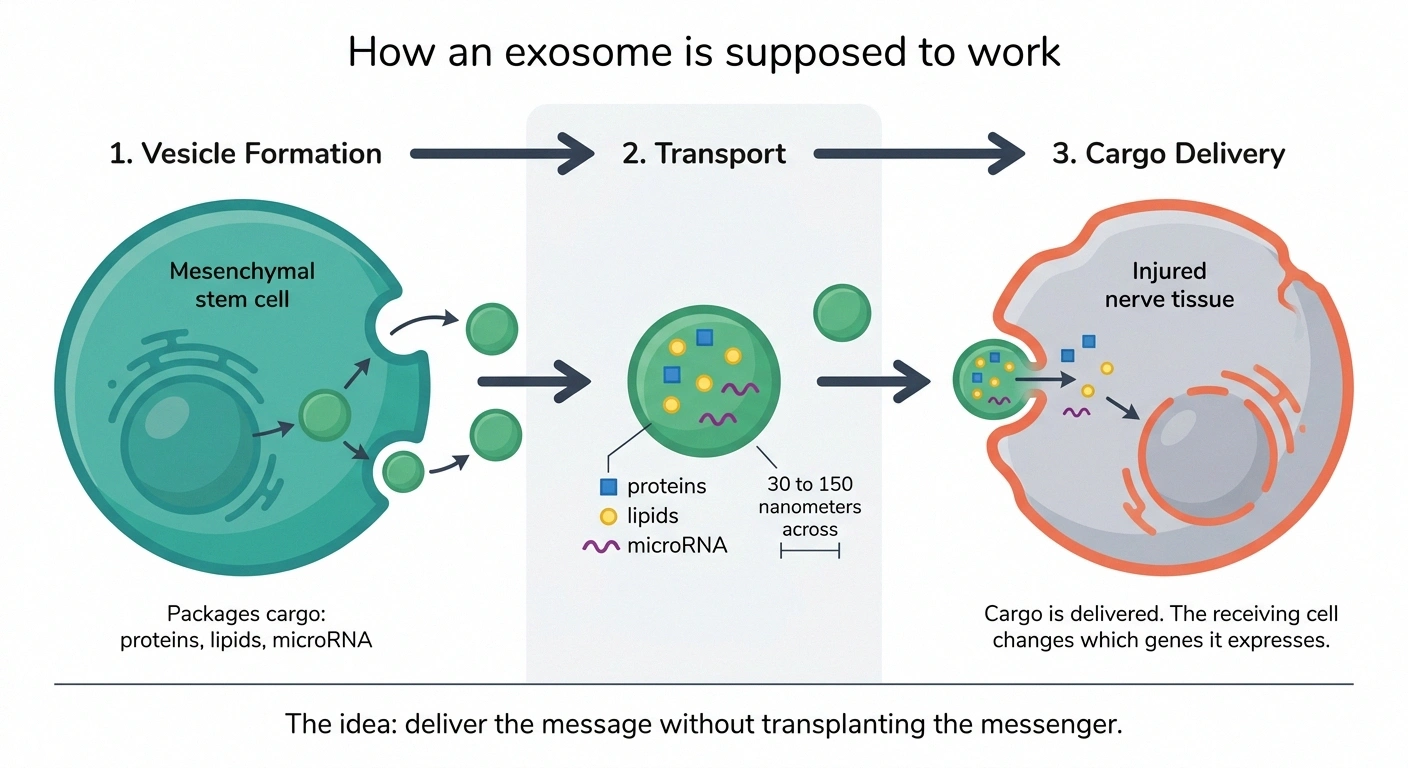
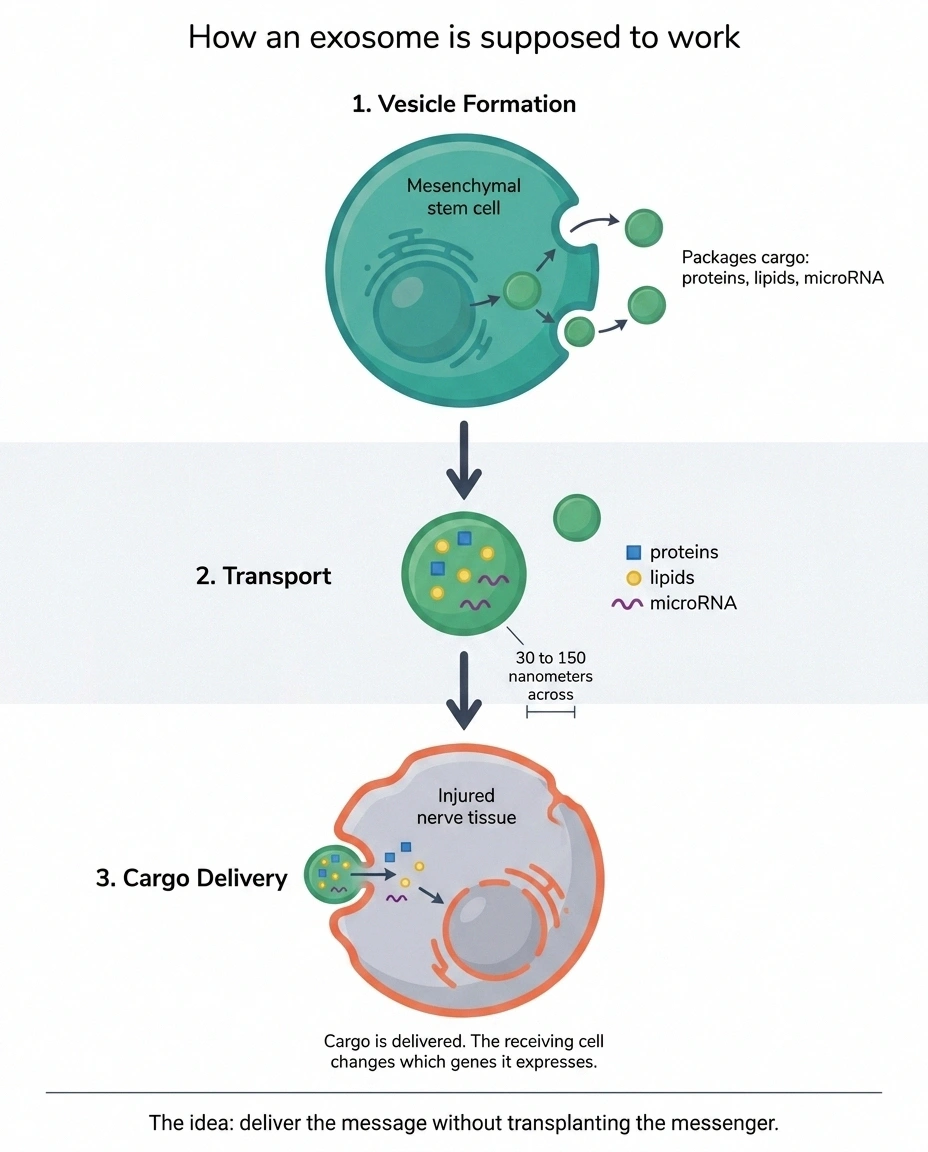
Cells talk to each other. Some of that conversation happens through direct contact, and some of it happens through small packages the cell releases into the surrounding fluid.
Three things clinics offer that get confused with each other
Worth knowing which one you are being quoted for, because the regulatory position differs.
| What is injected | Source | US regulatory position | |
|---|---|---|---|
| PRP | Concentrated platelets in your own plasma | Your own blood, same visit | Generally permitted as a same-day autologous procedure |
| Stem cells | Living cells | Your own tissue, or a donor | Depends heavily on processing; expanded or donor cells are regulated as drugs |
| Exosomes | Vesicles secreted by cells, no living cells present | Almost always donor-derived and lab-cultured | Regulated as a biologic drug; no approved product exists |
The word autologous, meaning from your own body, does a lot of work in clinic marketing. Exosome products are essentially never autologous, because producing them requires culturing cells in a laboratory over days or weeks.
Exosomes are those packages. They are tiny membrane-bound vesicles, roughly 30 to 150 nanometers across, budded off from the inside of a cell and released. Inside each one is cargo the parent cell loaded deliberately: proteins, lipids, and short strands of genetic material called microRNA.
When an exosome reaches another cell and fuses with it, the cargo gets delivered. Those microRNAs then adjust which genes the receiving cell is expressing. In practical terms, one cell has changed the behavior of another without ever touching it.
The therapeutic logic follows straightforwardly. Mesenchymal stem cells appear to do much of their repair work through exactly this signaling rather than by turning into new tissue. So why transplant the cells at all? Harvest what they secrete, purify the vesicles, and deliver the message without the messenger. No living cells, no rejection risk, no worry about transplanted cells behaving unpredictably.
It is an elegant idea. That is worth saying plainly, because the argument here is not that exosomes are nonsense. The argument is about what stage of validation they have reached.
What the Studies Actually Found
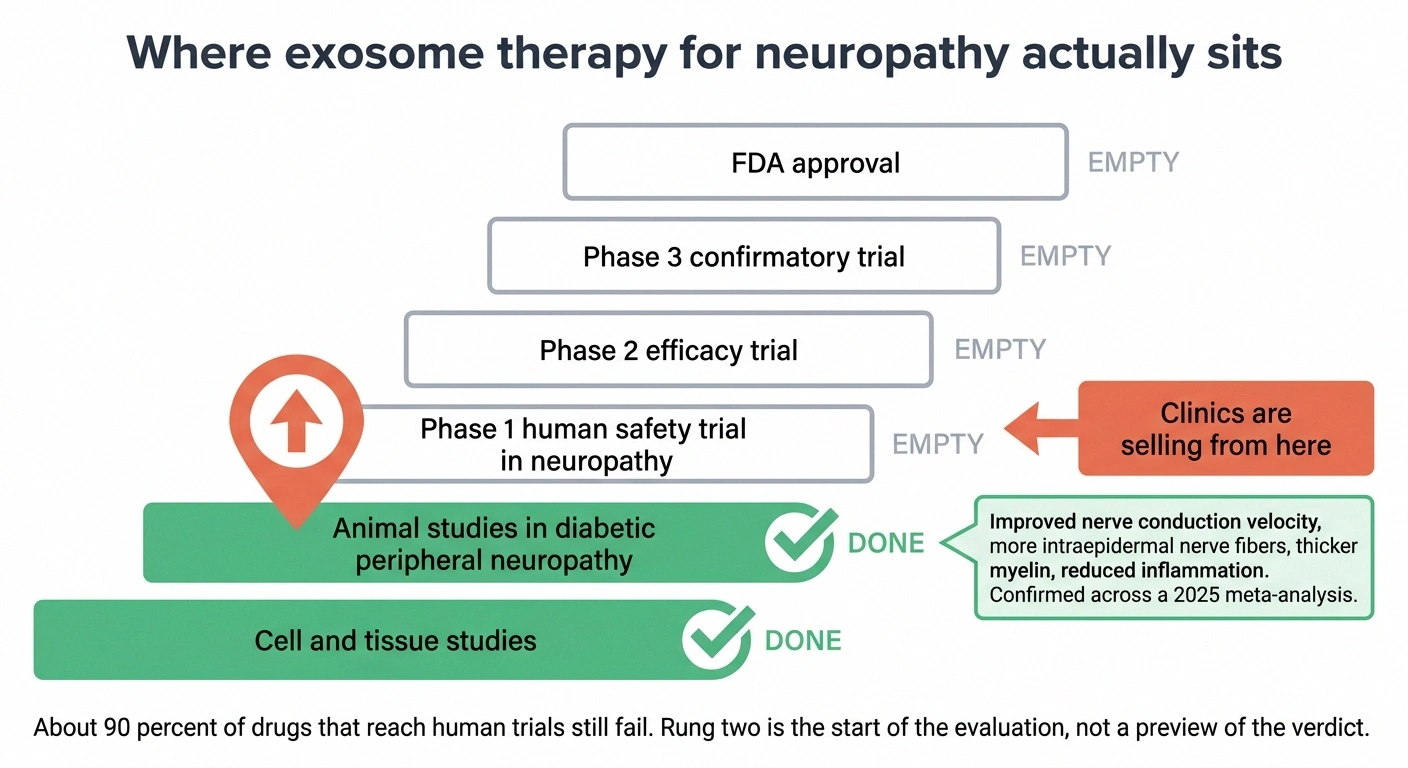
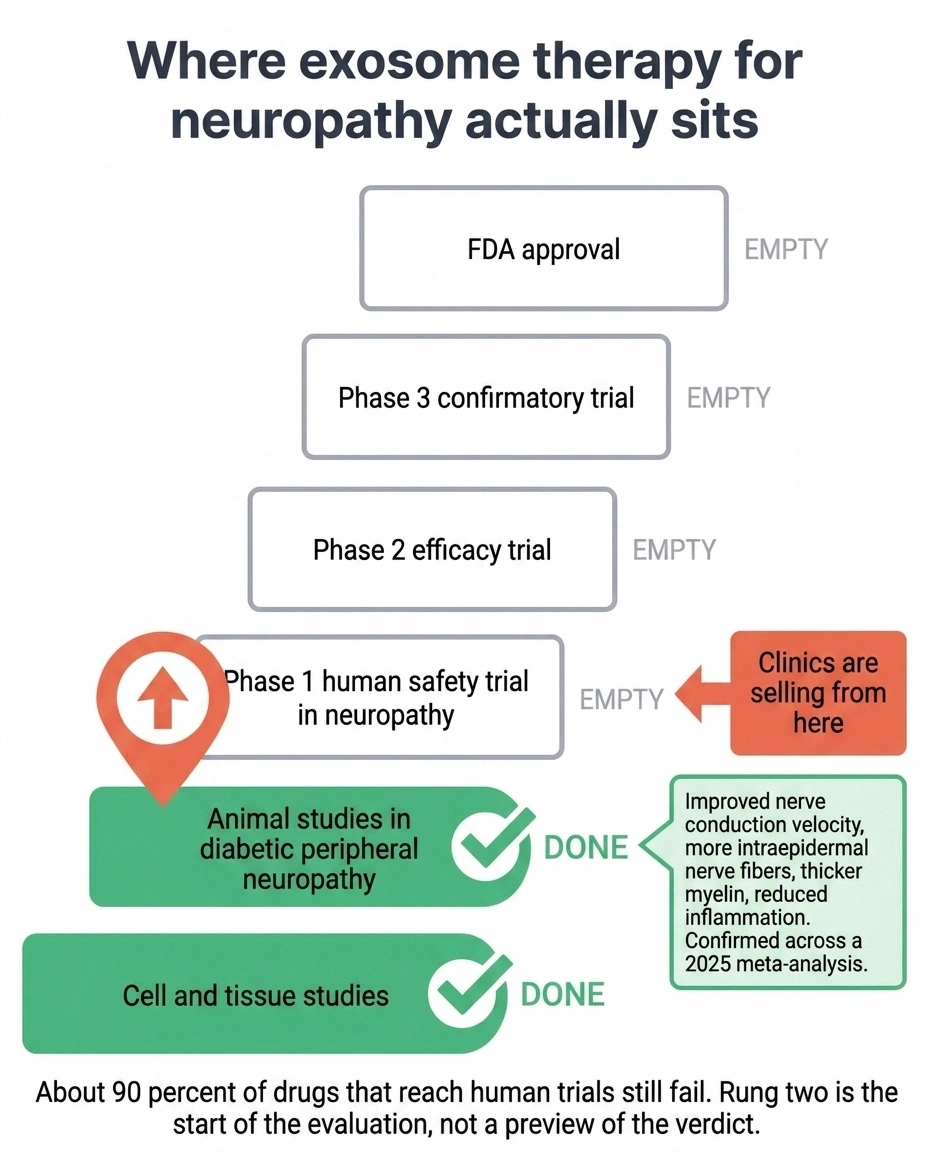
The research base is real and it is worth describing accurately, including the part that gets left out.
The animal that improved, and the person reading this
| Study mouse | Typical human patient |
|---|---|
| Diabetes induced 8 to 12 weeks earlier | Nerve damage accumulating over 10 to 20 years |
| Genetically uniform, same age, same sex | Every possible variation, often several causes at once |
| No other medications | Frequently on five or more |
| Dose calculated per gram of body weight under lab control | Dose set by the clinic, from an unstandardized product |
| Outcome measured by nerve conduction and tissue examination | Outcome measured by how you say you feel afterward |
None of this makes the animal work invalid. It is the standard distance between a preclinical result and a treatment, and closing it is exactly what the trials that have not happened would do.
In a mouse model of diabetes, treatment with mesenchymal stem cell derived exosomes produced measurable improvement across several outcomes at once. Nerve conduction velocity increased. Thresholds for thermal and mechanical stimuli shifted. On tissue examination, the sciatic nerves showed greater myelin thickness and larger axon diameters, blood vessel density increased, and the number of intraepidermal nerve fibers went up.
That last one matters. Intraepidermal nerve fiber density is the same measurement used to diagnose small fiber neuropathy in humans by skin biopsy. These animals grew fibers back.
The mechanism work points to inflammation. Exosome treatment shifted macrophages away from the M1 inflammatory phenotype toward the M2 repair phenotype and suppressed proinflammatory cytokines. The exosome cargo contained microRNAs targeting the TLR4 and NF-kB signaling pathway, which is one of the central switches for inflammatory response.
A 2025 systematic review and meta-analysis pooled the preclinical animal literature in diabetic peripheral neuropathy and found a consistent improvement in nerve conduction velocity across studies, with the strongest effects where exosomes had been engineered or modified rather than used as harvested.
Read that paragraph again and notice the word that appears in it. Preclinical. Animal.
There is no completed randomized controlled trial of exosome therapy for peripheral neuropathy in human beings. Not a positive one, not a negative one. The human evidence base for this specific use is essentially empty.
This is not an unusual situation and it is not a scandal. Most therapies live in the animal stage for years. The scandal is that the animal stage is being sold at $9,000 a course.
The translation gap, in numbers
Across therapeutic areas, roughly 90 percent of drugs that enter human trials fail before approval, and that figure counts only compounds that already cleared the animal stage. A promising mouse result is the beginning of the evaluation, not a preview of the verdict. Diabetic mice are also given diabetes for eight to twelve weeks under laboratory conditions, while the person reading this has often had nerve damage accumulating for a decade or more.
Where the FDA Stands
This part is unambiguous and easy to verify.
Four terms you will hear in the consultation
- Minimally manipulated
- A tissue product processed only in limited ways and used for the same basic function it served in the donor. Products meeting this bar face lighter oversight. Culturing cells and isolating their secreted vesicles does not meet it.
- Homologous use
- Using the tissue for the function it originally performed. Infusing vesicles from cultured donor cells to repair nerves is not the function those cells performed in the donor, which is a second reason the lighter pathway does not apply.
- Allogeneic
- Derived from a donor rather than from you. This word appeared explicitly in the FDA’s warning letter to New Life Medical Services.
- IND
- Investigational New Drug application. This is the legal mechanism that lets an unapproved biologic be given to human beings in the United States. A clinic operating legitimately with an experimental product has one and can give you the number.
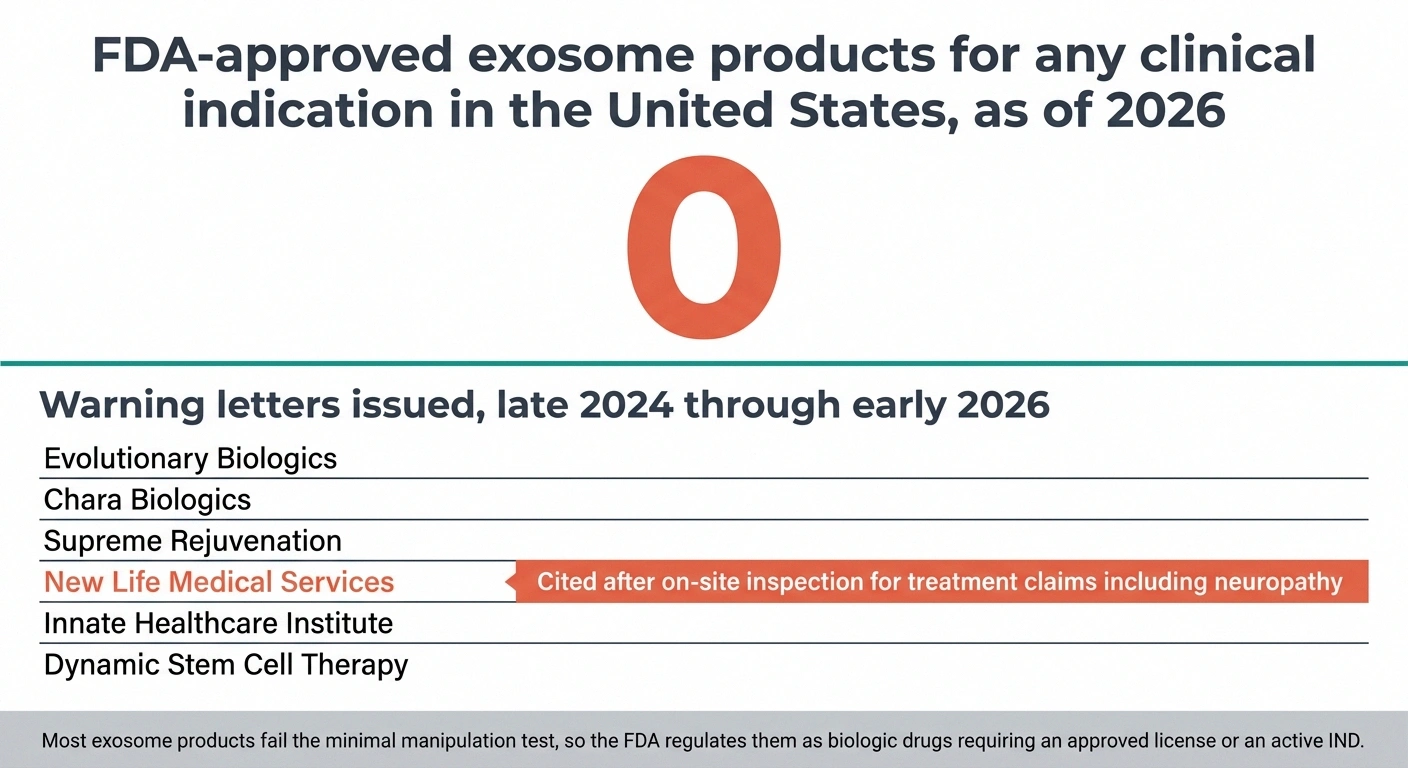
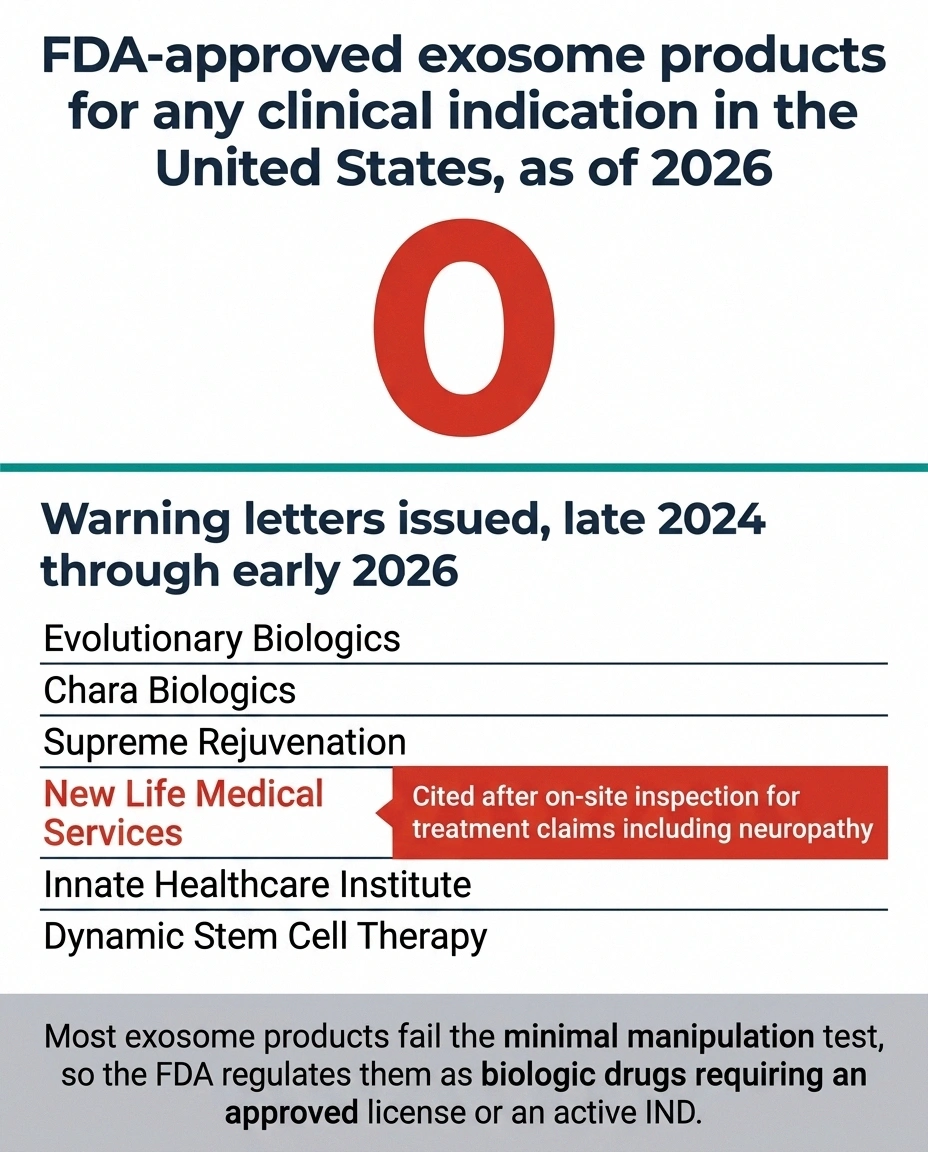
No exosome product is approved by the FDA for any clinical indication in the United States. Not for neuropathy, not for joints, not for hair, not for anything. Zero approvals as of 2026.
The regulatory reasoning centers on a concept called minimal manipulation. Certain human tissue products can be used clinically under lighter oversight if they are minimally manipulated and used for the same basic function they served in the donor. Isolating exosomes from cultured cells, concentrating them, and infusing them intravenously to treat a disease does not fit inside that category. So the FDA treats them as biologic drugs, which means a clinic administering one needs either an approved license or an active investigational new drug application. Most have neither.
Enforcement has followed. Between late 2024 and early 2026, the agency issued warning letters to a series of companies marketing exosome products, including Evolutionary Biologics, Chara Biologics, Supreme Rejuvenation, New Life Medical Services, Innate Healthcare Institute, and Dynamic Stem Cell Therapy.
One of those is directly relevant. Following an on-site inspection, the FDA’s warning letter to New Life Medical Services cited the company for selling exosome products for allogeneic use and specifically noted treatment claims appearing on its website and Instagram page for neuropathy, along with bone spurs, pain, and inflammation.
That is not an inference. A regulator inspected a facility, found exosomes being marketed for neuropathy, and issued a documented enforcement letter about it.
The Safety Question Nobody Raises in the Consultation
Absence of approval is a regulatory fact. The manufacturing situation is a practical one, and it is the part that should give a prospective patient real pause.
Quality, purity, and potency are not standardized across manufacturers. There is no required assay, no mandated release testing, no agreed definition of what a dose even means. Two vials from two suppliers labeled identically may contain substantially different material.
Independent analyses have found that some products marketed as exosomes contain minimal actual exosome content. You may be paying five figures for cell culture supernatant.
And documented contamination risks with poorly manufactured products include bacterial contamination, endotoxin contamination, and viral transmission. Endotoxin is worth pausing on, because it is the one people have never heard of. Bacterial endotoxin can survive processing that kills the bacteria themselves, and infusing it produces fever, chills, and in serious cases a systemic inflammatory response. An intravenous route delivers whatever is in the vial to your whole body at once.
Compare that to the risk profile of the things a neuropathy patient is usually weighing. The considerations around stem cell therapy for neuropathy are similar and equally worth reading before committing money. Whereas photobiomodulation and established natural approaches may or may not help a given person, but their downside is measured in wasted time rather than in sepsis.
What It Costs
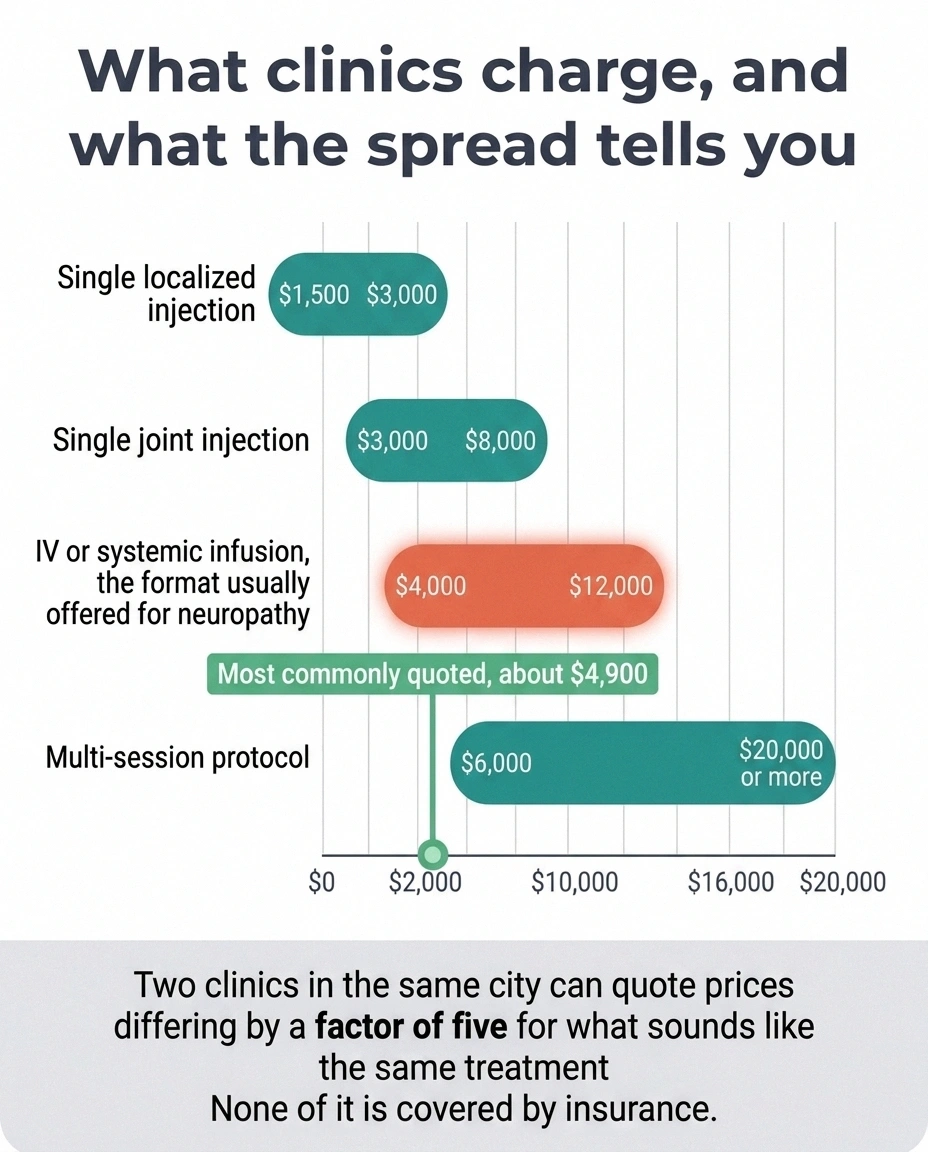
Pricing in this sector is worth seeing laid out, because the spread itself tells you something.
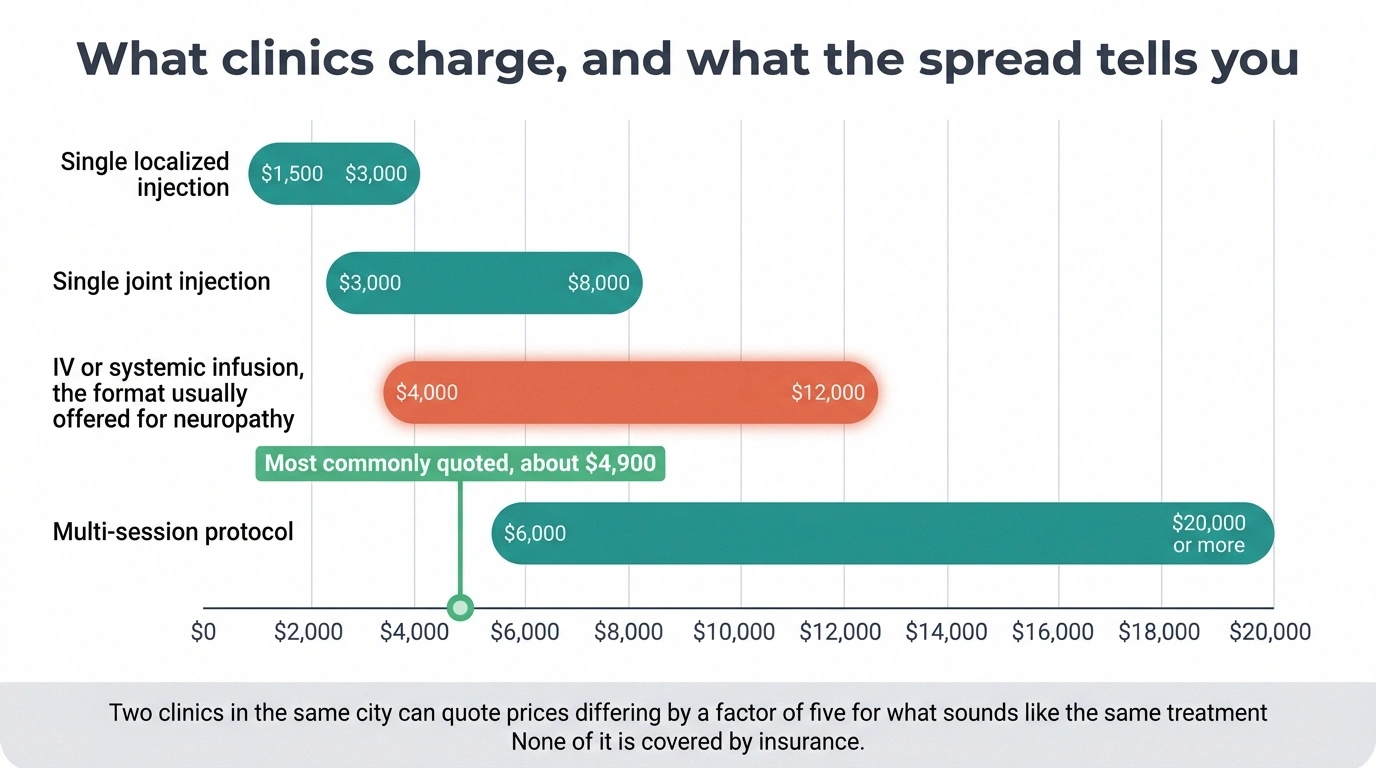
Across the United States, exosome treatments average roughly $3,500 to $6,500, with the most commonly quoted figure landing near $4,900. The full range runs from about $1,500 for a single localized injection to more than $20,000 for a multi-session protocol.
Because peripheral neuropathy is not a single joint, the format usually pitched is intravenous or systemic infusion. That tier runs $4,000 to $12,000 per infusion depending on the stated dose and the provider, and protocols frequently call for more than one.
Here is the detail that reveals the most: two clinics in the same city can quote prices differing by a factor of five for what sounds like the same treatment. In a market with standardized products and measurable outcomes, prices converge. A fivefold spread within one metro area indicates that nobody is pricing against a defined product, because there is not one.
None of it is covered by insurance, since experimental status excludes it from coverage. There is no appeal, no partial reimbursement, and no recourse if nothing happens.
Questions That Separate Research From Sales
If you are considering this, or if someone you love is, these are the questions to ask. Write them down and ask them in this order.
Four responses that answer the question by not answering it
“We operate under an exemption, so an IND is not required.” There is no exemption that covers administering a cultured donor-derived biologic for an unapproved indication.
“The FDA is behind on this, it is approved in other countries.” Ask which country and which regulator, then check it. Medical tourism destinations for this therapy generally have looser oversight rather than earlier approval.
“We have hundreds of satisfied patients, let me show you the testimonials.” Testimonials are the format used when outcome data does not exist. A clinic tracking results systematically would lead with the numbers.
“This price holds if you book today.” Genuine clinical research does not use expiring discounts.
You are allowed to take the paperwork home and decide later. Any operation that makes that difficult has told you what it is.
“Are you operating under an active FDA investigational new drug application? What is the IND number?” A legitimate clinical investigation has one and will provide it. Discomfort with this question answers it.
“Is this study registered on ClinicalTrials.gov? What is the NCT number?” You can then look it up yourself in under a minute and read the actual protocol.
“Am I being charged to participate?” This is the single cleanest signal available. Legitimate clinical trials do not generally bill participants for the experimental treatment. When a study charges you thousands of dollars to receive the intervention, it is a commercial transaction wearing research vocabulary.
“Who manufactures the product, and can I see the certificate of analysis?” Ask for the particle count, the purity assay, and sterility and endotoxin testing results for the specific lot.
“Where is the published human trial in peripheral neuropathy?” There is not one. What you learn is how the person in front of you handles being asked.
“What happens if this does not work? Is any of this refundable?”
“What is your adverse event reporting process?” A research operation has a defined one and can describe it immediately.
A genuine research site answers all seven without hesitation and often volunteers the information first. A sales operation redirects to testimonials, urgency, or a discount that expires soon.
If You Want the Real Version
The reasonable position is not that exosomes are worthless. It is that the honest way to access an unproven therapy is through a trial that is designed to find out whether it works, rather than through a purchase that assumes it does.
Searching ClinicalTrials.gov for exosome studies in peripheral neuropathy is free and takes a few minutes. Understanding how neuropathy clinical trials actually select and enroll participants is worth doing first, because eligibility criteria are strict and applications go better when you know what the site is looking for.
Meanwhile, the regenerative field is not standing still, and some of it is considerably further along. Gene therapy approaches have reached human trials with published data. The broader field of nerve regeneration research contains several programs at a stage where a patient decision might actually be informed by evidence.
And there is an unglamorous point worth making. The interventions with the strongest evidence in diabetic neuropathy remain glucose control, footcare, and appropriate pain management. In chemotherapy-induced neuropathy, the strongest evidence is for exercise and for duloxetine. These are boring. They are also the things a $9,000 infusion would have to outperform, and there is currently no human data suggesting it would.
The Honest Summary

Exosome biology is a legitimate and active area of research. The animal data in diabetic peripheral neuropathy are real, reproducible enough to survive a meta-analysis, and mechanistically coherent. If the effect translates, it would matter enormously.
No exosome product is FDA-approved. No randomized human trial in peripheral neuropathy has been completed. Manufacturing is unstandardized, contamination risks are documented, the FDA has issued warning letters including one that specifically cited neuropathy marketing claims, and clinics are charging four and five figures for it out of pocket.
Both paragraphs are true simultaneously. Anyone presenting only the first is selling. Anyone presenting only the second is dismissing science that deserves to be taken seriously.
The version that serves you is holding both: watch this space with genuine interest, and keep your money until the trials read out.
Frequently Asked Questions
What is exosome therapy?
Exosome therapy involves administering tiny membrane-bound vesicles released by cells, most often mesenchymal stem cells. These vesicles carry proteins, lipids, and microRNA that can alter the behavior of receiving cells. The approach aims to deliver the repair signals stem cells produce without transplanting the cells themselves.
Is exosome therapy FDA-approved for neuropathy?
No. As of 2026 there are no FDA-approved exosome products for any clinical indication in the United States. The FDA generally regulates exosome products as biologic drugs, requiring either an approved license or an active investigational new drug application, and has issued warning letters to multiple companies marketing them.
Does exosome therapy work for peripheral neuropathy?
This is unknown in humans. Animal studies in diabetic peripheral neuropathy have shown improved nerve conduction velocity, increased intraepidermal nerve fiber density, greater myelin thickness, and reduced inflammation. No completed randomized controlled trial has tested exosome therapy for peripheral neuropathy in people.
How much does exosome therapy cost?
US pricing averages roughly $3,500 to $6,500, with a common quote near $4,900. The full range spans about $1,500 for a single localized injection to more than $20,000 for a multi-session protocol. Intravenous infusion, the format typically offered for neuropathy, runs about $4,000 to $12,000 per infusion. Insurance does not cover it.
Is exosome therapy safe?
The safety profile is not established. Quality, purity, and potency are not standardized between manufacturers, some products marketed as exosomes contain minimal exosome content, and bacterial contamination, endotoxin contamination, and viral transmission have all been documented with poorly manufactured products. Intravenous administration means anything present in the vial reaches the whole body.
What is the difference between exosome therapy and stem cell therapy?
Stem cell therapy administers living cells. Exosome therapy administers the vesicles those cells secrete, with no living cells present. Proponents argue this avoids rejection risk and unpredictable cell behavior. Both remain unapproved for neuropathy in the United States and both have been the subject of FDA enforcement action.
Has the FDA taken action against clinics offering exosomes for neuropathy?
Yes. Warning letters were issued to multiple companies between late 2024 and early 2026. The letter to New Life Medical Services followed an on-site inspection and specifically cited treatment claims for neuropathy, bone spurs, pain, and inflammation appearing on the company’s website and Instagram page.
What questions should I ask a clinic offering exosome therapy?
Ask for the FDA investigational new drug application number, the ClinicalTrials.gov registration number, whether you are being charged to participate, who manufactures the product and whether you can see a certificate of analysis for the lot, where the published human trial in peripheral neuropathy is, what the refund policy is, and what the adverse event reporting process is. Being charged thousands of dollars to receive an experimental treatment is the clearest sign that a commercial transaction is being presented as research.
Are there legitimate exosome trials for neuropathy I could join?
Registered studies can be searched free of charge on ClinicalTrials.gov by condition and intervention. Legitimate trials generally do not bill participants for the experimental treatment, are registered with an NCT number, and operate under an investigational new drug application.
About the Author