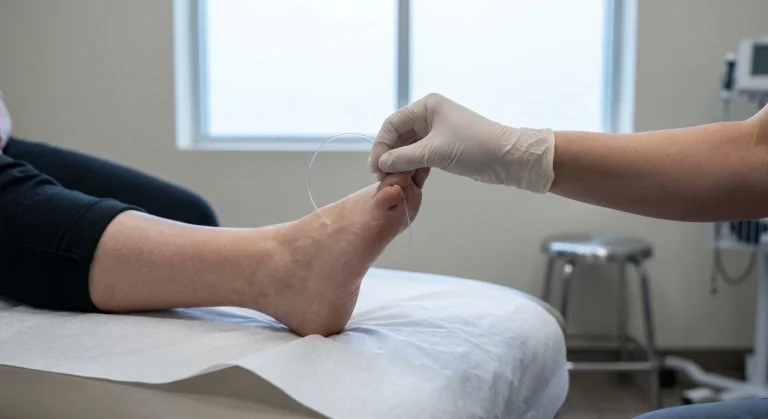
The neurologic risks of CAR-T therapy get explained carefully before infusion. Confusion, trouble finding words, tremor, handwriting that changes. You are told what to watch for, a caregiver is required to stay nearby, and for the first month somebody is checking.
Then the monitoring window closes, everyone exhales, and you go home.
The median onset of peripheral neuropathy after one of the most widely used CAR-T products is day 62.
That gap is the reason this page exists. The nerve problems that show up in the second and third month after infusion are a different category from the ones covered in the consent conversation, they arrive after the intensive watching has stopped, and a fair number of people experiencing them do not connect the symptom to the treatment at all.
Two Different Nerve Problems, and Only One Gets Explained
CAR-T therapy takes your own T cells, reengineers them to recognize a marker on cancer cells, and returns them to your bloodstream. The reengineered cells expand and attack. That process releases a large volume of inflammatory signaling molecules, and the collateral effects of that signaling are where the neurologic risk originates.
The category you were warned about, and the one you probably were not
Both are labeled neurologic toxicities. They behave nothing alike.
| ICANS | Non-ICANS nerve events | |
|---|---|---|
| Where | Brain | Peripheral nerves, cranial nerves, spinal cord, movement circuits |
| Typical onset | First two weeks | Weeks 6 to 10, sometimes later |
| Who is watching | Inpatient team, daily assessments | You, at home, between spaced-out visits |
| Usual course | Days, with established protocols | Months. Median duration 256 days for peripheral neuropathy |
| Rate, cilta-cel | 13% | Peripheral neuropathy 7%, cranial nerve palsy 7%, parkinsonism 3% |
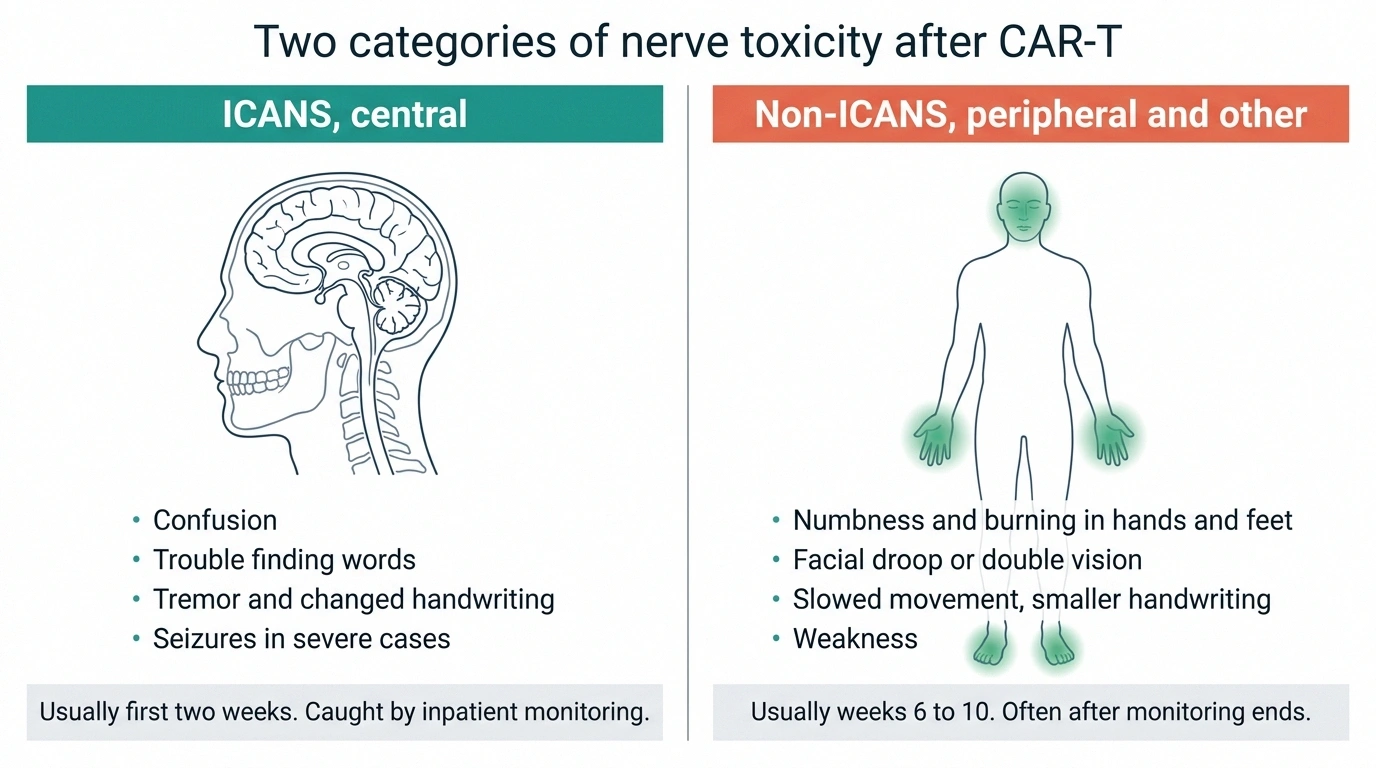
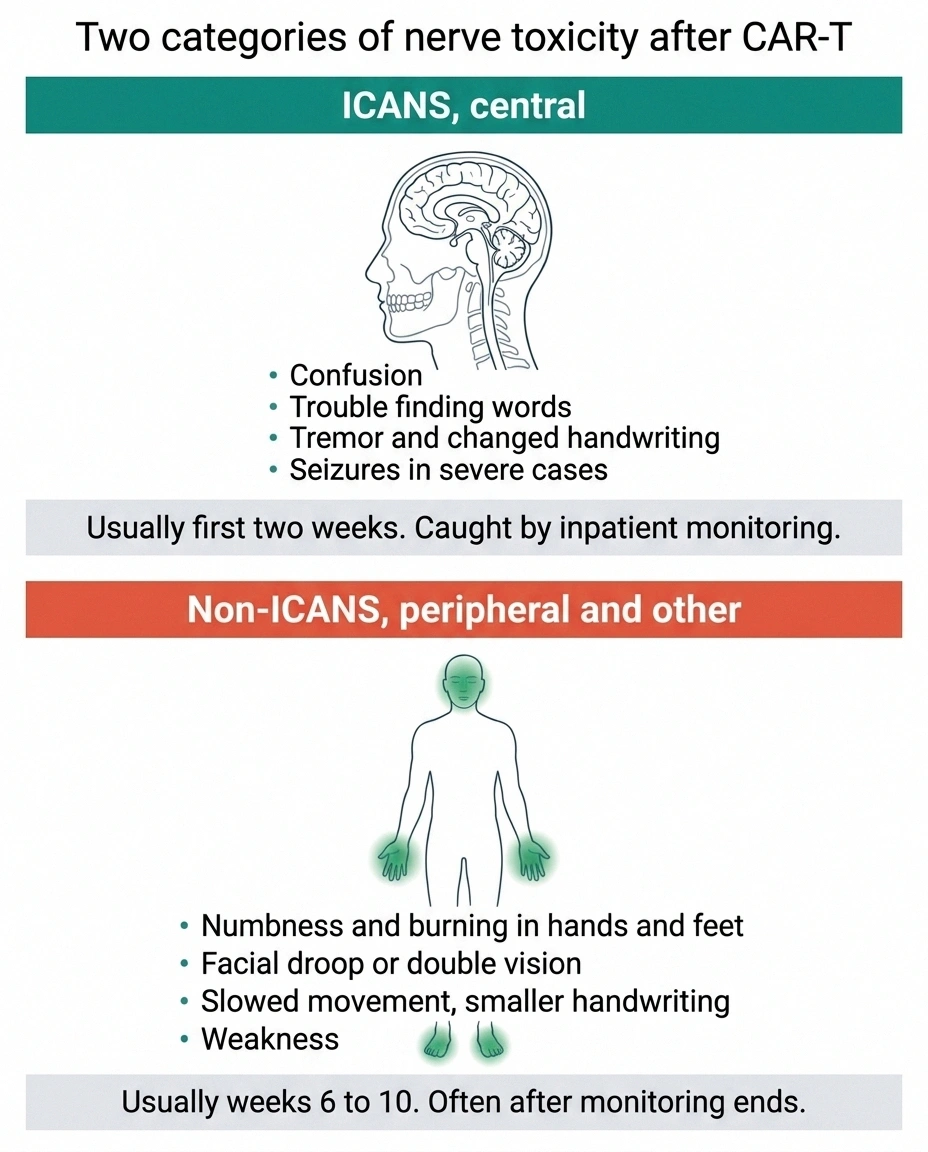
The first category is ICANS, immune effector cell-associated neurotoxicity syndrome. It is a brain event. Confusion, difficulty with language, tremor, impaired handwriting, and in severe cases seizures or swelling. It typically appears within the first two weeks, it is what the inpatient monitoring is designed to catch, and there are established grading scales and treatment protocols for it. In the cilta-cel labeling data, ICANS occurred in about 13 percent of patients.
The second category has no clean name. The literature calls it non-ICANS neurotoxicity, which tells you it was defined by what it is not. It includes peripheral neuropathy, cranial nerve palsies, parkinsonian movement symptoms, and immune-mediated myelitis. It behaves differently: later onset, longer duration, and different mechanisms that are still being worked out.
If you were told about neurologic risk and understood it to mean the confusion thing, you were told about the first category. That is the more common presentation and the more immediately dangerous one, so the emphasis makes sense. It is also incomplete.
What the Numbers Say
The most detailed figures come from ciltacabtagene autoleucel, a BCMA-directed product used in relapsed or refractory multiple myeloma. Its labeling breaks neurologic toxicity into subtypes:
- ICANS: 13 percent
- Peripheral neuropathy: 7 percent
- Cranial nerve palsy: 7 percent
- Parkinsonism: 3 percent
- Immune-mediated myelitis: 0.4 percent
The CARTITUDE-4 trial reported cranial nerve palsies in 16 patients, about 9 percent, and peripheral neuropathy in 5 patients, about 2.8 percent. Rates vary by trial, by line of therapy, and by how carefully investigators were looking, which is itself informative. When people look harder, they find more.
These figures apply to one BCMA-directed product in myeloma. CD19-directed products used in lymphoma and leukemia have their own profiles, and the peripheral and cranial nerve events appear less prominently in that setting. Do not carry the myeloma numbers across to a different product without asking your own team what applies to yours.
Two framing points before moving on. Ninety-three percent of patients did not develop peripheral neuropathy. And these figures come from people with relapsed or refractory disease, where the alternative to treatment is not a neutral option.
Why Day 62 Is the Number That Matters
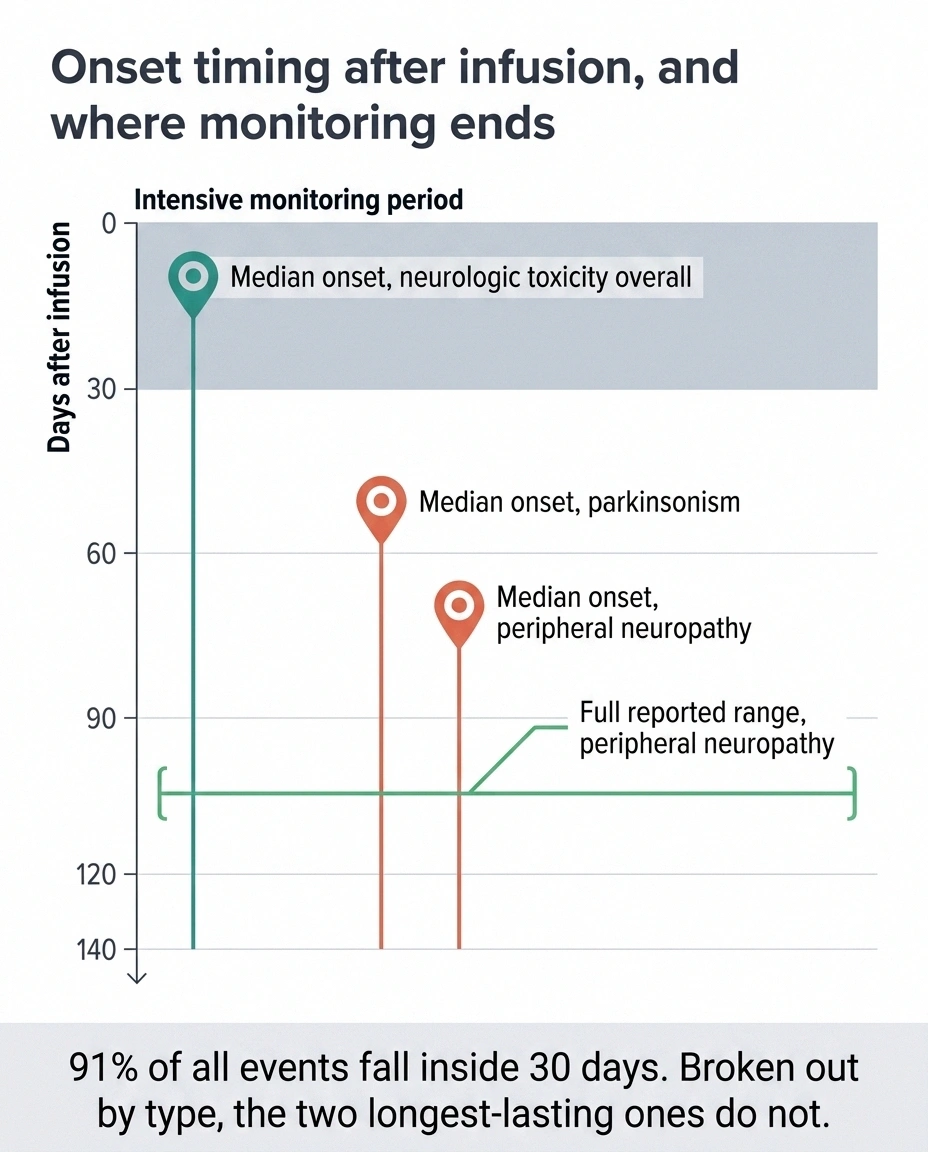
Percentages tell you how likely. Timing tells you what to do about it, and timing is where this diverges sharply from what most patients are prepared for.
Where the watching stops and the risk does not
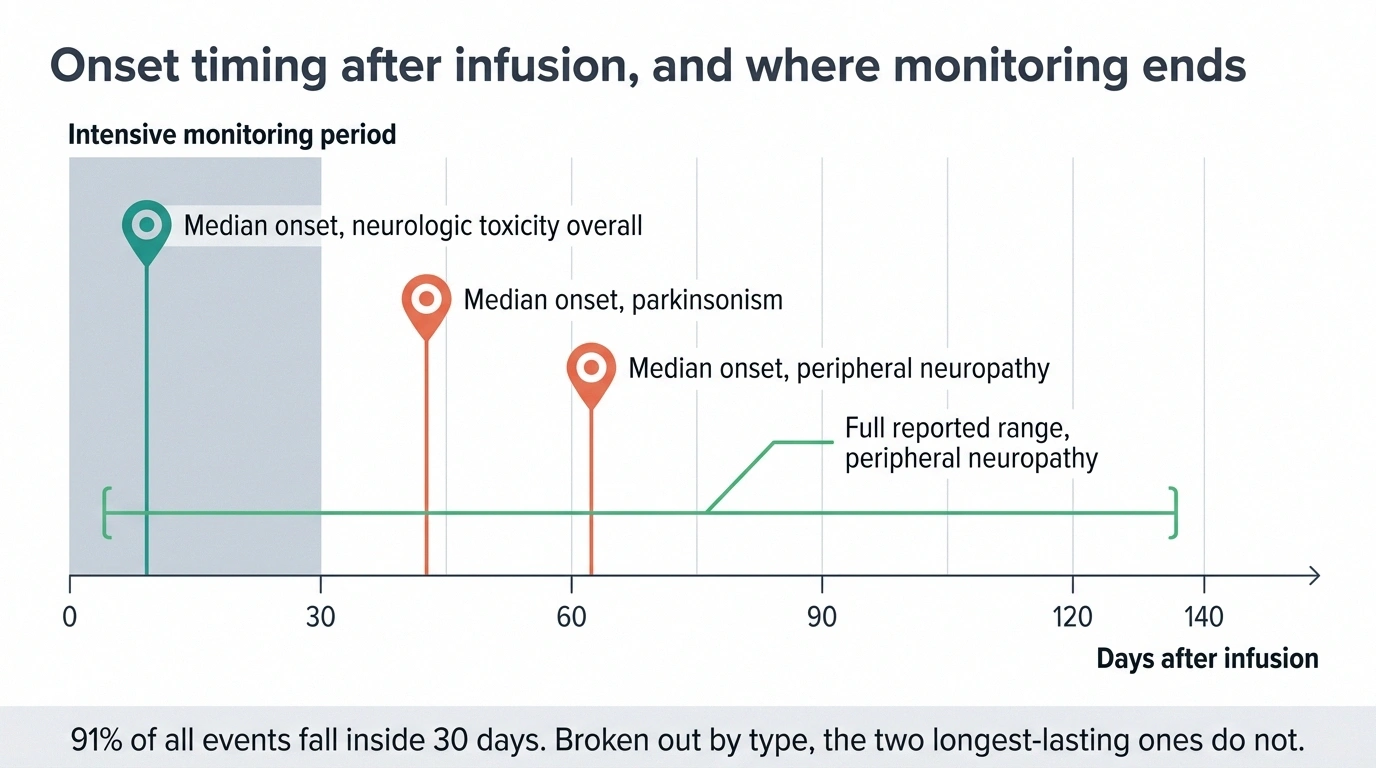
Standard intensive monitoring covers roughly the first 30 days, which captures 91 percent of all neurologic toxicity events counted together. Broken out by type, the picture is less reassuring:
- Day 10, median onset of neurologic toxicity overall. Inside the window.
- Day 30, intensive monitoring generally ends.
- Day 43, median onset of parkinsonism. Outside the window.
- Day 62, median onset of peripheral neuropathy. Well outside the window.
- Day 136, the far end of the reported peripheral neuropathy onset range.
Keep the symptom list in mind through month six, not month one. Set a recurring reminder if that helps, because by week nine most people have stopped thinking about the infusion at all.
Overall neurologic toxicity after cilta-cel has a median onset of 10 days, with 91 percent of cases appearing within 30 days. That statistic is what the monitoring period is built around, and for ICANS it fits well.
Break it out by subtype and the picture changes:
- Peripheral neuropathy: median onset day 62, with a reported range of 4 to 136 days. Median duration 256 days, with a range extending to 465.
- Parkinsonism: median onset day 43, range 15 to 108.
- Cranial nerve palsy: reported across the trials with a similarly delayed pattern.
Read the duration figure again. A median of 256 days means half of the people who developed peripheral neuropathy still had it more than eight months later. This is not a transient infusion reaction. It is a persistent condition that begins after the acute phase is over.
The practical problem this creates is attribution. On day 62, you are home. Your visits have spaced out. You may be feeling better than you have in a year, because the treatment worked. Numbness starting in your toes at that point competes with a dozen other explanations, several of which are true for you anyway, and the natural instinct is to wait and see whether it settles.
Waiting is the wrong instinct here, because a subset of these events are immune-mediated and immune-mediated nerve injury generally responds better to earlier intervention.
The Cranial Nerve Events Nobody Expects

Cranial nerve palsy is the finding that surprises people most, partly because the symptoms do not read as nerve damage.
Most people picture neuropathy as feet and hands. Cranial nerves serve the face, eyes, tongue, and throat, and when one stops conducting properly the result can be one-sided facial droop, double vision, difficulty swallowing, altered taste, or a change in speech. Bilateral facial nerve palsy has been reported in this setting.
A face that has stopped moving correctly does not announce itself as a nerve problem. It reads as a stroke, and it should be treated as an emergency until someone qualified has said otherwise. That is the correct response regardless of CAR-T history.
Parkinsonism is the other unexpected one. Slowness of movement, small handwriting, reduced facial expression, tremor, and a shuffling gait, appearing at a median of six weeks. It is uncommon at around 3 percent, and it can be difficult to reverse, which is why it receives attention disproportionate to its frequency. Research into whether cyclophosphamide can mitigate these delayed non-ICANS events is underway, though it is early and not established practice.
The Baseline Problem in Myeloma

Here is the complication specific to the population most affected.
Write this down the week before infusion
Six lines on a piece of paper. It is the only thing that makes a day-62 change provable rather than arguable.
- Where numbness stops on each foot, measured against a landmark. Base of the toes, across the whole sole, at the ankle bone, mid-calf.
- Whether the hands are involved, and if so how far up the fingers.
- Pain type and severity right now, zero to ten. Burning, stabbing, aching, or none.
- Balance: do you hold anything getting out of the shower, and can you stand with feet together and eyes closed.
- Any weakness. Can you rise from a chair without using your arms, and can you walk on your heels.
- Today’s date, and the date of infusion.
Photograph the page and email it to yourself. Paper migrates during a treatment course; a timestamped email does not.
People receiving BCMA-directed CAR-T for multiple myeloma have almost always been treated with bortezomib, thalidomide, or lenalidomide first. Bortezomib in particular is a well-known cause of painful peripheral neuropathy. On top of that, the disease itself can damage nerves directly, through amyloid deposition, through paraprotein effects, or through compression. Nerve damage in multiple myeloma has multiple independent routes, and a patient reaching CAR-T has usually traveled at least one of them.
So a great many people arrive at infusion day already carrying numb toes. Then something changes two months later, and nobody can say whether it changed, or by how much, because no one wrote down where it started.
This is fixable, and it is the single most useful thing a patient can do about this entire topic.
Get a documented sensory baseline before infusion. Not a general impression. Specifics. Where exactly the numbness reaches on each foot, whether it is present in the hands, what the pain is like and how bad on a zero to ten scale, whether balance has changed, and whether there is any weakness. If there is time, ask whether a formal nerve conduction study makes sense, since a pre-treatment tracing gives a neurologist something objective to compare against later.
If a formal study is not practical, write it down yourself. A simple symptom record made the week before infusion, marking on a foot outline where sensation ends, is worth more later than any recollection. Memory reconstructs. Notes do not.
People who have been through chemotherapy-induced neuropathy already know how quickly a baseline blurs. Two months of a difficult treatment course and you genuinely cannot recall whether the tingling used to stop at the ankle or the mid-calf.
What Happens If It Occurs

Management depends on what the nerves are actually doing, which is why the evaluation matters before any treatment decision.
Assessment usually involves a neurologic examination, nerve conduction studies and EMG to characterize the pattern, and sometimes a lumbar puncture or imaging. The key question is whether the picture is immune-mediated and actively progressing, or established damage that is now stable.
Some cases have shown a pattern consistent with acute motor and sensory axonal neuropathy, a severe variant related to Guillain-Barré syndrome. In a published case series, some patients improved partially over six to twelve months following IVIG treatment while others deteriorated rapidly despite it. That is a genuinely serious range of outcomes and worth stating honestly rather than softening.
The interventions used are the ones used across immune-mediated nerve conditions generally: corticosteroids, IVIG, and in some cases plasma exchange. Symptom management for neuropathic pain runs in parallel and is a separate track from treating the underlying process.
The recurring theme in every published account is the same: earlier recognition produces better outcomes than later recognition. Which brings this back to what you do at home.
What to Watch For After You Go Home
Not a monitoring burden. A short list of things that should trigger a call rather than a wait, held loosely across the first six months.
Two lists, sorted by urgency
Call the same day
- Facial droop or weakness on one side
- New double vision
- Trouble swallowing, or a changed voice
- New weakness in a hand or foot
- Trouble passing urine, or new bowel problems
- Band-like tightness around the trunk
Facial droop is treated as a possible stroke until proven otherwise. Emergency services, not a callback.
Report at the next contact
- Numbness that is new or has spread upward
- Burning pain in feet or hands
- More stumbling, worse balance
- Handwriting getting smaller
- Movements feeling slower
- Changed taste or facial sensation
Say it as a change with a timeframe: what it was, what it is now, over how long.
Call the same day for: new facial weakness or droop on one side, new double vision, difficulty swallowing or a change in your voice, new weakness in a hand or foot including foot drop, any difficulty passing urine or new problems with bowel control, or a band-like tightness around the trunk. Several of these can indicate spinal cord involvement and are time-sensitive.
Report at the next contact, and do not wait to be asked: numbness or tingling that is new or has spread further up than before, burning pain in the feet or hands, worsening balance or new stumbling, handwriting that has become noticeably smaller, a general slowing of movement, or a change in taste or facial sensation.
Report changes as changes, not as absolutes. “The numbness that used to stop at my ankles now reaches mid-calf, and it moved over about three weeks” is a clinically useful sentence. “My feet feel bad” is not, particularly when your feet already felt bad before any of this started.
If symptoms persist past the acute window and are being managed as a chronic condition, a neurologist rather than the transplant team usually becomes the right home for that care. There are reasonable signals for when a neurology referral is warranted, and progressive weakness is near the top of every version of that list.
Where This Leaves a Decision

None of this is an argument against CAR-T therapy.
These treatments are used in relapsed or refractory disease, after other options have been exhausted. CARTITUDE-4 reported a 74 percent reduction in risk of disease progression or death compared with standard regimens. The comparison is not between accepting a neuropathy risk and avoiding it. It is between a treatment with meaningful nerve risk and a disease that is progressing.
What the data supports is narrower and more useful than a yes or no. Ask your team which product you are receiving and what its specific neurologic profile looks like, because the numbers here come from one product in one disease. Get your sensory baseline documented before infusion. Understand that the monitoring window is calibrated to ICANS and that the peripheral events tend to arrive after it closes. Know the short list of symptoms that mean call today rather than mention it next month.
Seven percent is a small number until it is you, and the difference between a good and a poor outcome in the reported cases often came down to how fast someone said something. That part is within your control, and it costs nothing but a phone call you might have talked yourself out of making.
Frequently Asked Questions
Can CAR-T therapy cause peripheral neuropathy?
Yes. Peripheral neuropathy is a recognized and labeled neurologic toxicity of BCMA-directed CAR-T therapy, reported in about 7 percent of patients treated with ciltacabtagene autoleucel and in 2.8 percent of patients in the CARTITUDE-4 trial. Cranial nerve palsies, parkinsonism, Guillain-Barré syndrome and immune-mediated myelitis have also been reported. Rates differ between products and between diseases, so ask your treatment team about the specific product you are receiving.
What is the difference between ICANS and peripheral neuropathy after CAR-T?
ICANS is a central nervous system event affecting the brain, causing confusion, language difficulty, tremor and in severe cases seizures. It typically appears within the first two weeks and is what inpatient monitoring is designed to catch. Peripheral neuropathy affects the nerves outside the brain and spinal cord, producing numbness, tingling, burning pain or weakness in the hands and feet. It appears later, at a median of about 62 days, and tends to last much longer.
How long after CAR-T does neuropathy usually start?
For ciltacabtagene autoleucel, peripheral neuropathy had a median onset of 62 days after infusion, with a reported range of 4 to 136 days. Parkinsonism had a median onset of 43 days. This is substantially later than ICANS, which usually appears within two weeks, and later than the period of most intensive monitoring.
Does neuropathy after CAR-T therapy go away?
Sometimes, but not quickly. Reported median duration of peripheral neuropathy after ciltacabtagene autoleucel was 256 days, with a range extending to 465 days. In published case reports of severe immune-mediated presentations, some patients improved partially over six to twelve months with IVIG treatment while others deteriorated despite treatment. Outcomes vary considerably, and earlier recognition is consistently associated with better results.
What is cilta-cel parkinsonism?
Parkinsonism is a delayed movement disorder reported in about 3 percent of patients receiving ciltacabtagene autoleucel. Symptoms include slowness of movement, tremor, reduced facial expression, smaller handwriting and a shuffling walk, with a median onset around 43 days after infusion. It is uncommon but can be difficult to reverse, which is why it receives clinical attention out of proportion to its frequency.
I already have neuropathy from bortezomib. Does that change anything?
It makes documentation more important rather than changing the risk itself. Most people reaching BCMA-directed CAR-T for myeloma already have some degree of nerve damage from prior treatment or from the disease. Without a written record of exactly where sensation ends and how severe symptoms are before infusion, it becomes very difficult to establish later whether anything changed. Ask whether a baseline nerve conduction study is appropriate, and write down your own detailed description in the week before infusion regardless.
Which symptoms mean I should call the same day?
New facial weakness or droop, new double vision, difficulty swallowing or a change in voice, new weakness in a hand or foot, difficulty passing urine or new bowel control problems, or a band-like tightness around the trunk. Several of these can indicate cranial nerve or spinal cord involvement and are time-sensitive. New facial droop should be treated as a possible stroke and evaluated urgently regardless of CAR-T history.
Should nerve risk change whether someone accepts CAR-T therapy?
That is a conversation for the treating hematology team, who know the individual disease status and the alternatives. What the published data supports is that these therapies are used in relapsed or refractory disease where the comparison is against a progressing cancer rather than against a neutral option, and that CARTITUDE-4 reported a 74 percent reduction in risk of progression or death versus standard regimens. The nerve risks are real, affect a minority of patients, and are more manageable when recognized early.
About the Author