A reader sent me a link to a device called Walkasins and asked a fair question: is this real, or is it a six thousand dollar pair of vibrating leg cuffs?
The honest answer sits in between, and the space between those two positions is where the useful information lives. There is a published clinical trial. The numbers in it moved in the right direction and stayed there for six months. There is also a study design problem large enough that no one can tell you how much of that improvement came from the device.
Both things are true at once. Here is the whole picture, including the parts the marketing pages leave out.
What the Device Actually Does
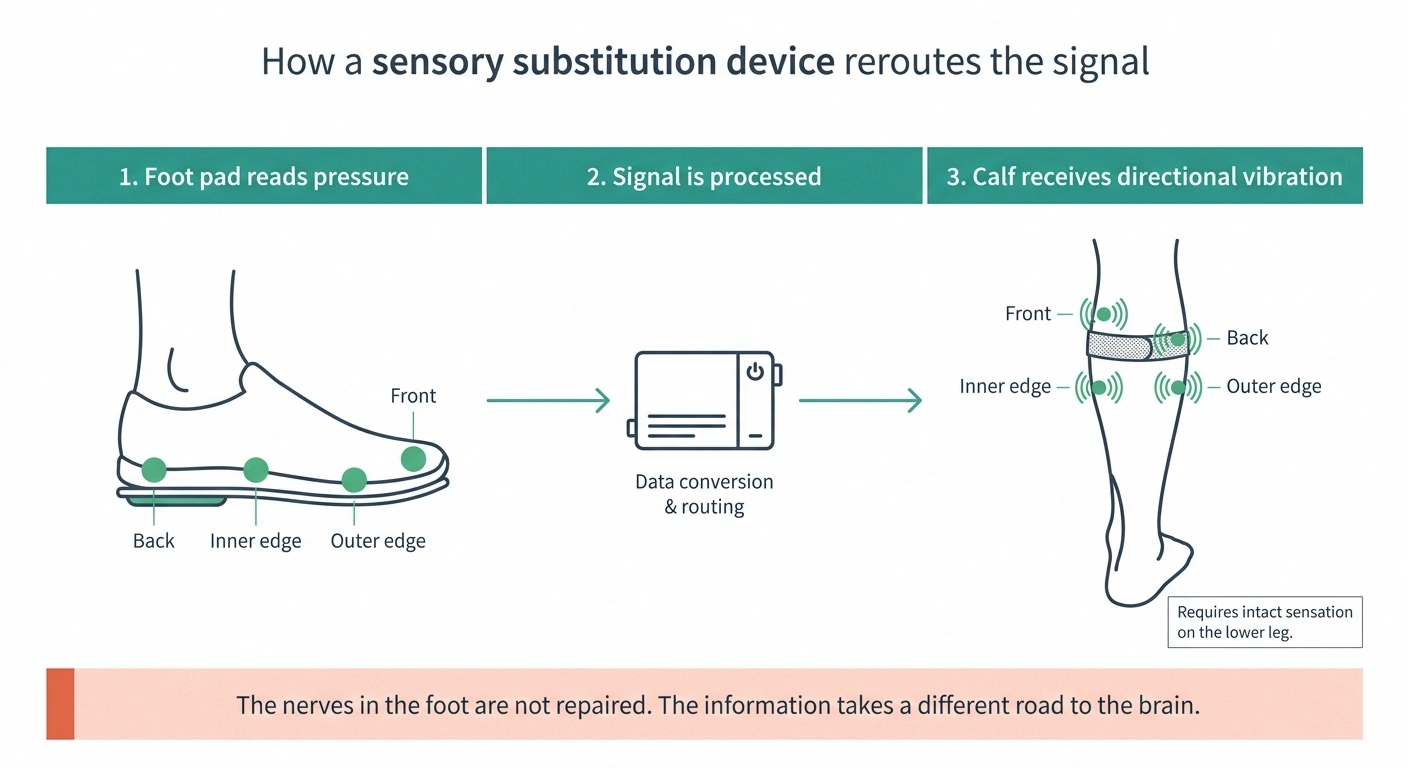
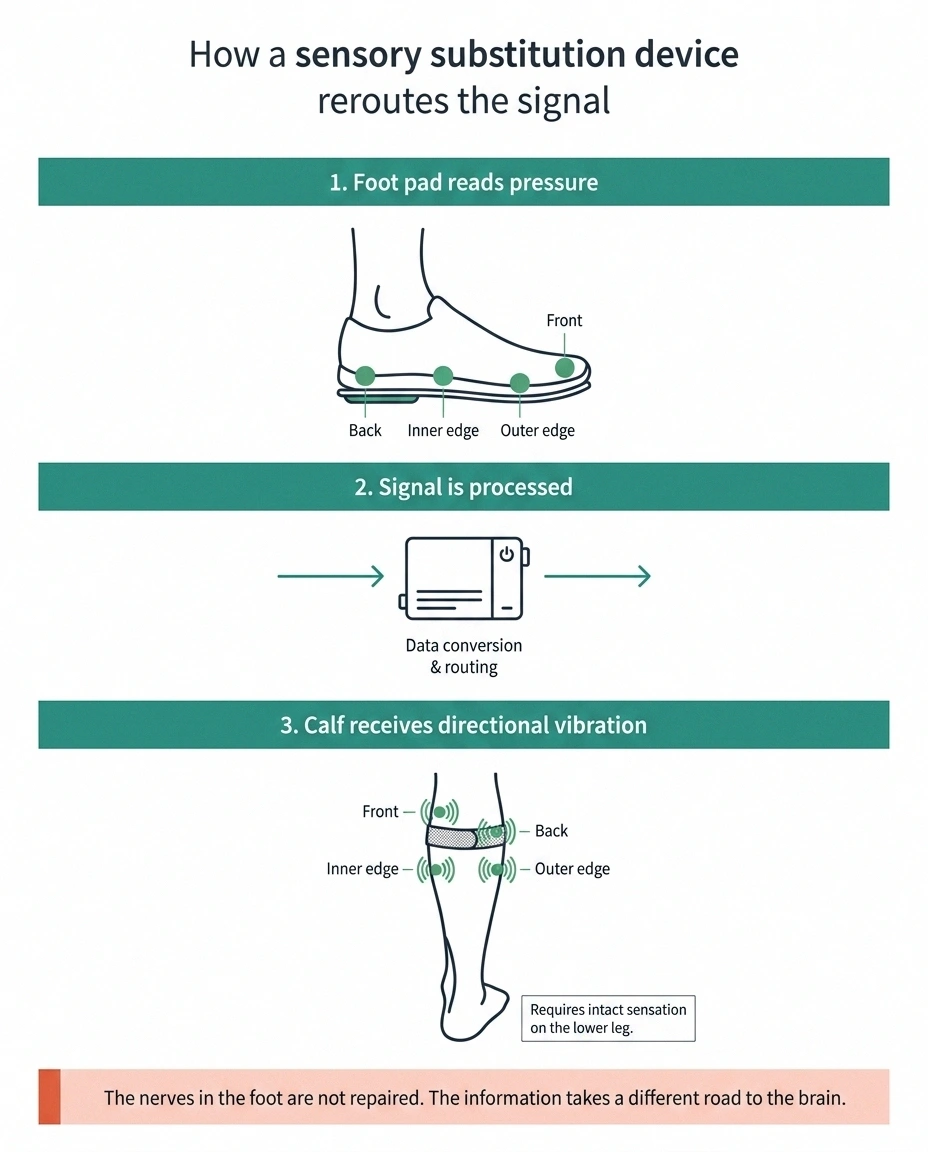
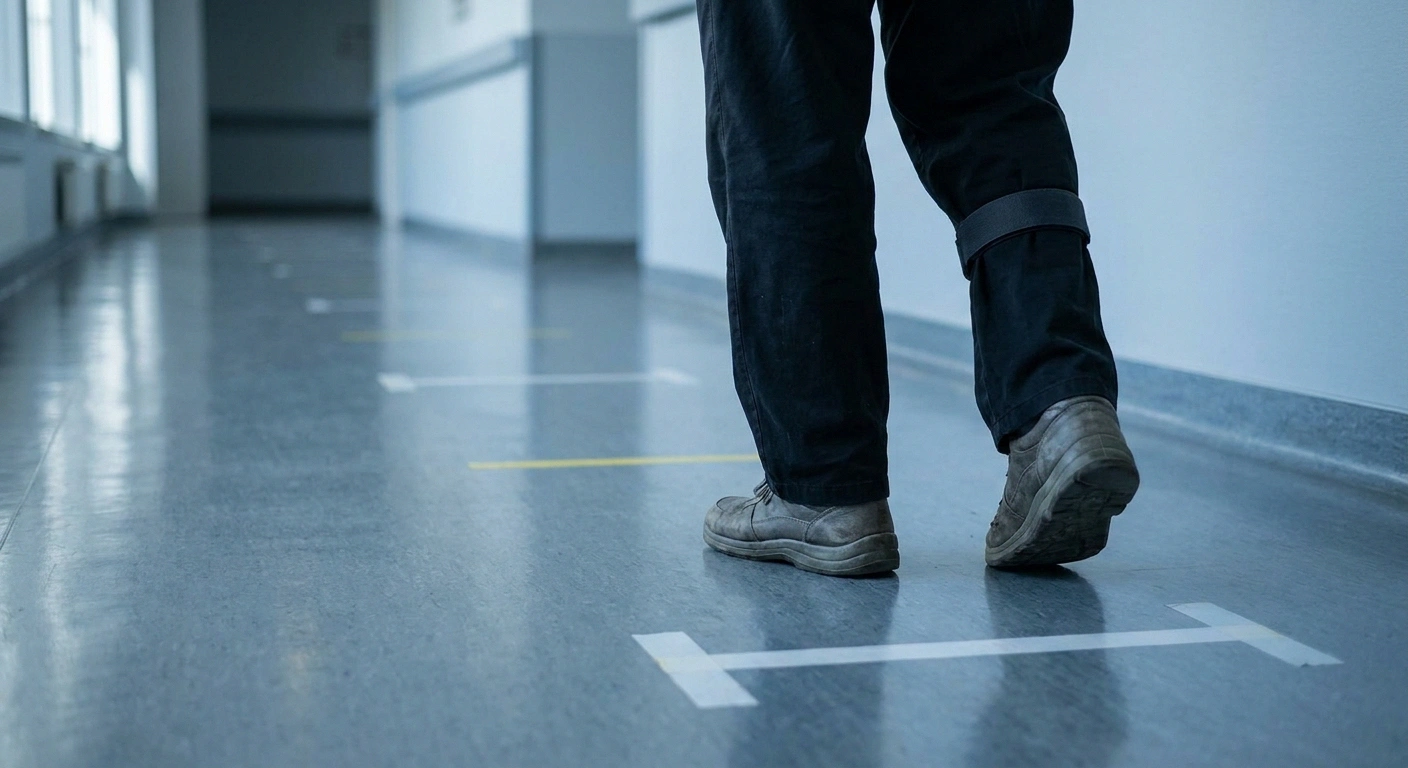
Walkasins is a wearable sensory neuroprosthesis. Two pieces: a thin instrumented pad that sits inside your shoe, and a small unit strapped around your lower leg, just below the knee.
The pad reads pressure across the bottom of your foot many times per second. As your weight shifts forward, backward, or to one side, the leg unit responds with a gentle vibration on the corresponding side of your calf. Lean forward, you feel a buzz at the front. Drift to the outside edge, you feel it on the outside.
Your foot is no longer telling your brain where your weight is. The device tells your calf instead, and your brain learns to read it.
That learning curve is genuine. Users describe the first week or two as noisy and distracting, followed by a point where the vibration stops feeling like a signal you interpret and starts feeling like information you simply have. It is closer to learning to drive with a backup camera than to putting on glasses.
Substituting a Signal Is Not the Same as Healing a Nerve
This distinction gets blurred constantly in coverage of the device, and it changes what you should expect.
Three inputs keep you upright. Neuropathy removes one of them.
This is why a dark hallway is harder than a lit one, and why closing your eyes in the shower feels dangerous.
Inner ear
Reports head tilt and acceleration. Usually unaffected by peripheral neuropathy.
Vision
Reports where the floor and horizon are. Quietly does double duty once the feet go quiet.
Foot sensation
Reports weight distribution and ground texture. This is the channel that fails, and the one Walkasins reroutes to the calf.
Practical consequence: anything that degrades vision temporarily, including dim light, new glasses, or dilating eye drops, costs you more than it costs someone with working feet.
Nothing about Walkasins touches the damaged nerves in your feet. It does not encourage regrowth, it does not reduce burning or tingling, and it does not restore sensation. Take the device off and your feet are exactly as numb as they were that morning.
What it addresses is the downstream consequence. When the feet stop reporting position, the body loses one of the three systems it uses to stay upright. The inner ear still works. Vision still works, and most people with proprioception loss from neuropathy lean on it heavily without realizing, which is why the bathroom at 2am is so much harder than the same route at noon. The foot channel is the one that went quiet. Walkasins reopens a version of it, routed through skin on the calf that still has intact sensation.
If your main complaint is pain, this is not the product for that problem. If your main complaint is that you no longer trust yourself on a curb, it is at least aimed at the right target.
What the Trial Measured, and What the Numbers Were
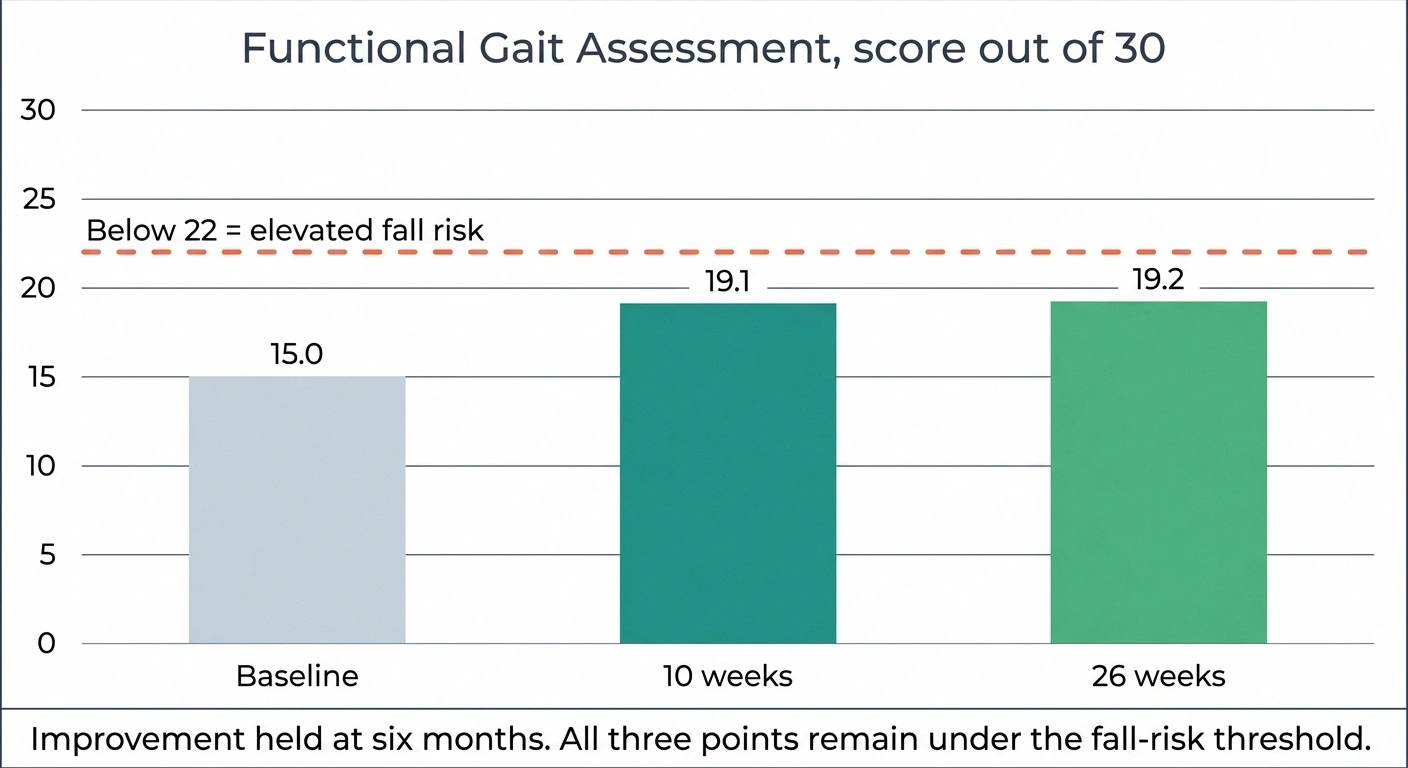
The evidence base is a study called walk2Wellness, run across four sites in people with sensory peripheral neuropathy and high fall risk. Results were published at ten weeks and again at twenty-six weeks.
The primary measure was the Functional Gait Assessment, or FGA. It is a ten-item walking test scored out of 30, and it is a standard tool rather than something the manufacturer invented. Walking with head turns, walking with a narrow base, stepping over an obstacle, walking with eyes closed.
At ten weeks, across 45 participants who completed in-clinic testing:
- FGA improved from 15.0 to 19.1
- Comfortable walking speed rose from 0.86 to 0.95 meters per second
- Fast walking speed rose from 1.24 to 1.33 meters per second
- Timed Up and Go dropped from 13.8 to 12.5 seconds
At twenty-six weeks, the gains held rather than fading. FGA sat at 19.2. Comfortable gait speed was 0.97 meters per second. The 4-Stage Balance Test improved from 25.6 to 28.4 seconds.
Among participants who had fallen in the six months before enrolling, the fall rate dropped from 11.8 falls per 1000 patient-days to 6.7 during the study, a decrease of about 43 percent.
Those are real, respectable numbers. A gait speed increase of 0.1 meters per second is roughly the threshold researchers treat as meaningful in older adults, and this crossed it. Sustained at six months is better than most balance interventions manage.
The Number That Did Not Get a Press Release
Here is the part I had to read the papers to find.
walk2Wellness results, with the threshold included
Every column here appears in the published papers. The last one rarely appears anywhere else.
| Measure | Start | 26 weeks | Reference point |
|---|---|---|---|
| Functional Gait Assessment (of 30) | 15.0 | 19.2 | Below 22 = elevated fall risk |
| Comfortable gait speed | 0.89 m/s | 0.97 m/s | 0.1 m/s is the usual meaningful-change mark |
| 4-Stage Balance Test | 25.6 s | 28.4 s | 30 s is a full pass |
| Falls, prior-faller group | 11.8 per 1000 days | 6.7 per 1000 days | Baseline came from recall, which undercounts |
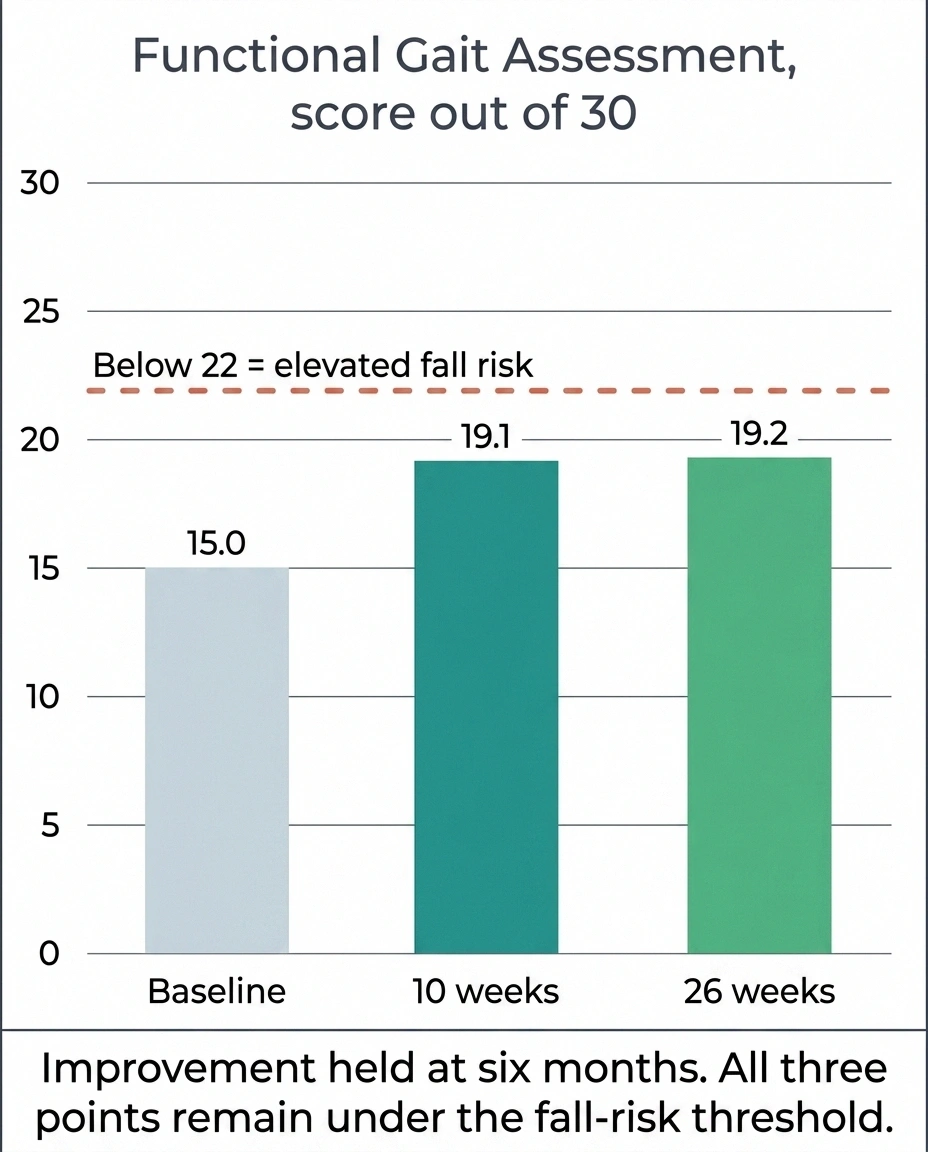
Read the first row twice. The improvement is real and the endpoint is still inside the at-risk band.
An FGA score below 22 out of 30 is the accepted cutoff for elevated fall risk. Participants started at 15.0 and finished at 19.2.
They improved. They did not exit the at-risk category. After six months of daily use of a six thousand dollar device, the average participant was still, by the study’s own primary measure, a person at elevated risk of falling.
That is not a reason to dismiss the device. Moving from 15 to 19 on that scale is the difference between struggling with head turns and managing them, and the fall-rate drop in the prior-faller group was substantial. But it reframes the promise. This is a device that appears to make a high-risk person somewhat less high-risk. It is not one that makes a high-risk person safe, and anyone selling it that way has gone past the evidence.
Three of the participants who made it to week ten dropped out afterward specifically because they were dissatisfied with the device. Out of 44 people continuing, that is a small but real number of users who tried it properly and decided it was not worth wearing.
What an Uncontrolled Trial Cannot Tell You
The study authors state the limitation plainly, and I will repeat it plainly. walk2Wellness was unblinded and single-arm. There was no control group.
Claims this trial supports, and claims it does not
- Supported
- People who wore this device for six months walked faster, scored higher on a standard gait test, and fell less often than they reported falling before. The gains did not fade between week 10 and week 26.
- Not supported
- That the device caused those gains. With no control group, six months of deliberate walking, repeated clinical assessment, and study participation are baked into the same result.
- Also not supported
- That it beats physical therapy, a fitted cane, or better home lighting. No head-to-head comparison exists against any of them.
Every participant knew they had the device. Everyone in the study also received repeated in-clinic gait assessment, structured attention from clinicians across six months, and the implicit encouragement of being enrolled in something. Then they walked, deliberately and regularly, for twenty-six weeks.
Ask yourself what happens to a 73-year-old’s Functional Gait Assessment score if you give them six months of regular walking practice, professional attention, and a reason to pay attention to their balance, and give them no device at all. Nobody ran that arm. So nobody knows.
The authors are candid that blinding is genuinely difficult here. You cannot give someone a placebo vibration and expect them not to notice. That is a real methodological constraint rather than an evasion. It still leaves the central question open.
There is one more soft spot. Fall counts from before the study relied on participant recall, and recall reliably undercounts falls. If baseline falls were undercounted, the in-study reduction is smaller than it appears.
None of this means the device does nothing. It means the trial cannot separate the device from everything that came packaged with it, and you should price that uncertainty into a six thousand dollar decision.
Who Appeared to Benefit Most
The trial population is worth knowing, because it tells you who the results apply to.
Average age was 73.5. Participants carried an average of 8.3 chronic conditions and substantial polypharmacy. Fifty-seven percent were already using a cane, walker, or similar aid. This was not a group of mildly affected people looking for a performance edge.
Within that group, the people who had already fallen in the previous six months improved more in absolute terms than those who had not. They started worse, at 0.83 meters per second compared to 0.97, and they gained more ground. That pattern makes intuitive sense: the more of your foot sensation you have lost, the more a substitute channel has to offer.
The reasonable read is that this device is aimed at people with significant sensory loss and a demonstrated balance problem, not at someone in the early stages who is mostly dealing with pain and tingling. If you are still walking confidently and your complaint is nighttime burning, you are not the trial population.
Six Thousand Dollars and the Insurance Problem

The system runs approximately $6,000.
Before you call about pricing, know these four things
- FDA-listed is not FDA-endorsed. Listing and premarket-notification exemption are administrative statuses. No agency reviewed and blessed a fall-reduction claim.
- There is no Medicare code for this. Claims are argued under the prosthetic device benefit, decided individually, and often denied. The 2026 Part B deductible of $283 only matters if you get that far.
- Get the return policy in writing before ordering. Three of 44 continuing trial participants quit because they disliked wearing it.
- Measure yourself first. A Functional Gait Assessment or Timed Up and Go from a physical therapist takes ten minutes and gives you the only honest way to judge the result later.
Two facts about its regulatory status matter and are easy to misread. Walkasins is FDA-listed and legally sold in the United States, and the receptor sole component is exempt from premarket notification. Listing and exemption are administrative categories. Neither one means the FDA reviewed and endorsed a claim that the device reduces falls. A reader who sees “FDA” on a page and assumes an efficacy verdict has been handed one is making an understandable mistake.
Medicare has no dedicated coverage category for it. There is no line item, no established code that simply pays. Coverage attempts generally run through the prosthetic device benefit, which requires documentation arguing that the device substitutes for a lost bodily function. That argument is at least conceptually sound here, since substitution is precisely what the device does. It is still a case-by-case fight requiring physician documentation and prior authorization work.
If coverage is granted, standard Part B cost-sharing applies after the annual deductible, which is $283 in 2026. The manufacturer maintains a reimbursement team, which tells you something about how routine the process is not.
Plan on this taking weeks and possibly ending in a denial. Ask about a trial period and the return policy before anything is ordered, and get the answer in writing.
What to Ask Before You Commit
If you are seriously considering this, these are the questions that determine whether it is a reasonable purchase for you specifically.
Can I try it before I buy it, and what happens if I return it? Three trial participants who used it for ten weeks decided against continuing. A device you find intrusive is a device that lives in a drawer.
What is my baseline FGA or Timed Up and Go score? Get measured before you start. Without a baseline you will be judging by feel six months from now, and feel is not reliable about slow change. Any physical therapist can administer these.
Will it fit the shoes I actually wear? The pad goes inside the shoe. If you wear wide or deep footwear for foot comfort, or custom orthotics, that interaction is a real question rather than a detail. This is worth raising alongside whatever you have already worked out about footwear that works for neuropathic feet.
Can I feel vibration on my lower leg reliably? The device assumes intact sensation on the calf. In length-dependent neuropathy the damage climbs upward over time. If your numbness has already reached mid-calf, the channel the device depends on may be compromised.
Have I actually exhausted the cheaper options? Which brings us to the comparison that never appears on the product page.
The Comparison Nobody Runs
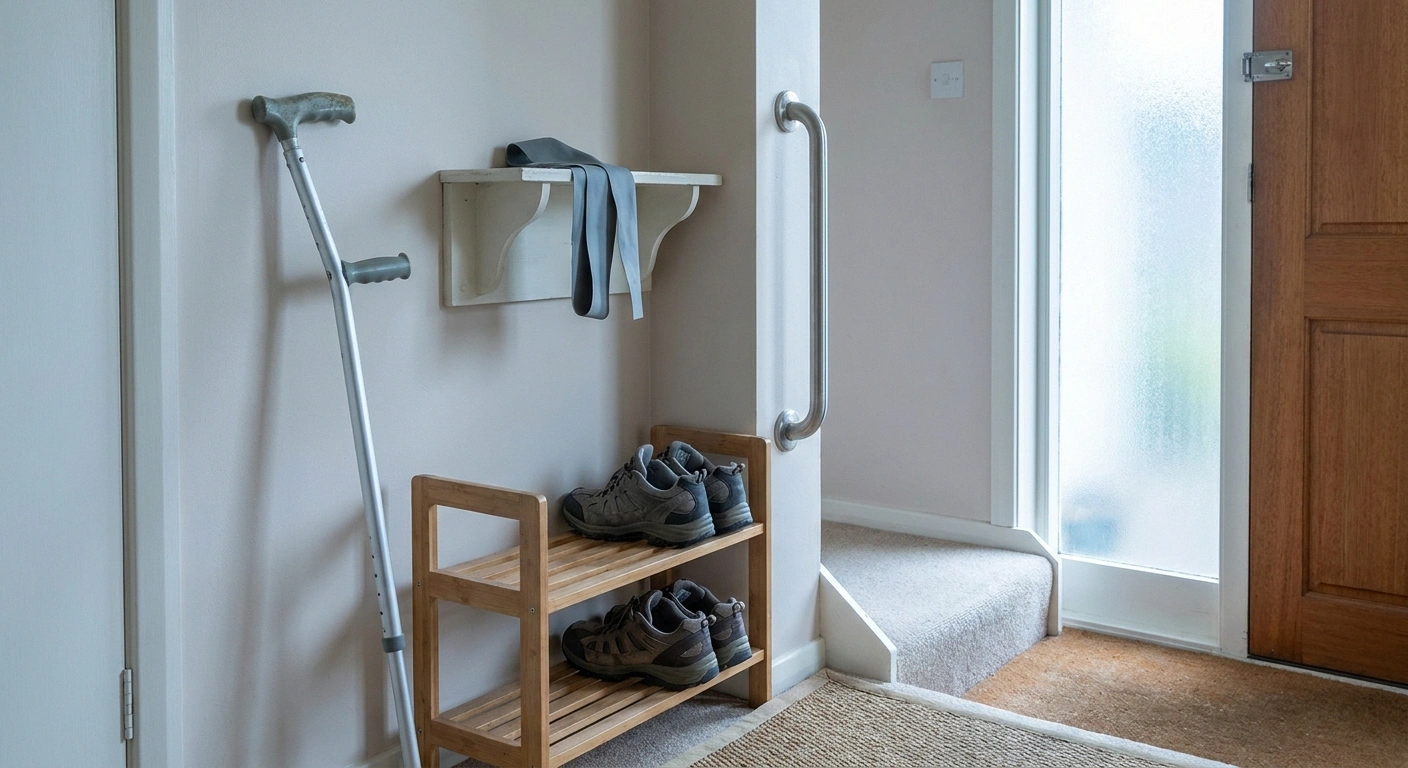
There is no head-to-head trial of Walkasins against balance-focused physical therapy. There should be, and until there is, you are comparing across studies, which is a weak comparison. But the gap in cost and access is wide enough to be worth naming.
Structured balance and gait training has a considerably larger evidence base for reducing falls in this population, including randomized controlled trials, which is precisely what walk2Wellness lacks. Physical therapy for neuropathy is generally covered by insurance, costs a fraction of six thousand dollars out of pocket, and produces a home program you keep after discharge.
The other reference points are cheaper still. A properly fitted cane changes your base of support immediately and costs under fifty dollars, and there is a real body of guidance on choosing and fitting walking aids that most people never receive. Home modifications, lighting, and grab bars address the environments where falls actually happen. And regular walking itself remains the most consistently supported intervention for maintaining function, which is worth remembering when reading a study whose participants walked regularly for six months.
None of this rules the device out. It positions it. Walkasins is reasonable to consider after the standard measures have been tried properly, for someone with severe sensory loss, ongoing falls despite therapy, and either the means to self-pay or the persistence for an insurance appeal. As a first move it is an expensive place to start.
It also fits into a broader shift worth watching. Devices that route around damaged nerves rather than repairing them are one of the more active areas in current neuropathy research, and the honest assessment of the category right now is that the engineering is ahead of the trial design. That will likely change. A controlled trial of this device would settle a lot.
In the meantime, if you are dealing with the specific problem this device targets, the underlying issue is worth understanding on its own terms. The pattern of unsteadiness that comes from sensory loss rather than weakness has a name and a set of strategies, and sensory ataxia responds to more than one approach. So does fall risk in neuropathy generally. Start there, measure where you are, and let the six thousand dollar question wait until you know whether you still need to ask it.
Frequently Asked Questions
Does Walkasins restore feeling in your feet?
No. The device does not treat nerve damage or return sensation to the feet. It reads foot pressure with a pad in your shoe and delivers that information as vibration to your lower leg, where sensation is usually still intact. Your brain learns to use the vibration as a substitute for the signal your feet no longer send. Remove the device and your feet feel exactly as they did before.
Is Walkasins covered by Medicare?
There is no specific Medicare coverage category for it. Some claims are pursued under the prosthetic device benefit, on the argument that the device substitutes for a lost bodily function, but this requires physician documentation and is decided case by case rather than approved automatically. If a claim is approved, standard Part B cost-sharing applies after the annual deductible, which is $283 in 2026. Expect a process measured in weeks, and confirm the return policy before ordering.
How much does the Walkasins system cost?
Approximately $6,000, though pricing varies and should be confirmed directly with the manufacturer or an authorized provider. For comparison, a course of balance-focused physical therapy is usually covered by insurance, and a properly fitted cane costs under fifty dollars.
How strong is the evidence behind it?
Moderate, with a significant caveat. The walk2Wellness trial showed improvements in gait and balance scores at ten weeks that were sustained at twenty-six weeks, and a 43 percent reduction in fall rate among participants who had fallen before enrolling. However, the trial was unblinded with no control group, so it cannot separate the effect of the device from six months of regular walking, clinical attention, and repeated assessment. The authors state this limitation themselves.
Did participants stop being at risk of falling?
No. Functional Gait Assessment scores improved from 15.0 to about 19.2 out of 30. The standard cutoff for elevated fall risk is a score below 22. Participants improved meaningfully but remained in the at-risk range on average. This is a device that appears to reduce risk rather than remove it.
Would it help with burning or tingling pain?
It is not designed for pain and was not studied for it. The target is balance and walking function in people who have lost foot sensation. If pain rather than unsteadiness is your main problem, this device is aimed at a different symptom entirely.
Who is the best candidate for it?
Based on the trial population, someone with substantial sensory loss in the feet, a demonstrated balance problem or fall history, and intact sensation on the lower leg where the vibration is delivered. Trial participants averaged 73.5 years of age and more than half already used a walking aid. Someone in the early stages of neuropathy whose main complaint is tingling is not the group this was tested in.
What should I do before spending the money?
Get a baseline balance measurement such as a Functional Gait Assessment or Timed Up and Go from a physical therapist, so you can tell later whether anything actually changed. Work through the standard measures first, including balance-focused therapy, an appropriately fitted walking aid, footwear, and home lighting and safety changes. Then ask about a trial period and the return policy in writing before anything ships.
About the Author