Ask a pain clinic whether a spinal cord stimulator is worth it and you will get a number. Ask three clinics and you will get three numbers, all of them good, none of them about you.
The number is not the problem. The question is. “Is it worth it” has no answer in the abstract, because a stimulator is not competing against nothing. It is competing against whatever you are doing now, and the honest comparison depends entirely on how well that is going and what specifically about it is failing.
So this article does not try to talk you into or out of anything. It lays out both columns, including the parts that rarely make it into the consultation, and then gives you the situations where each choice is the sensible one. If you want the mechanics of how the device works before you weigh any of this, we cover that separately in our patient guide to spinal cord stimulation. This page is only about deciding.
What You Are Actually Choosing Between
People frame this as device versus pills. That framing loses almost immediately, because most people who get a stimulator keep taking something, and most people who stay on medication end up changing what they take anyway.
The real choice is between two different bets.
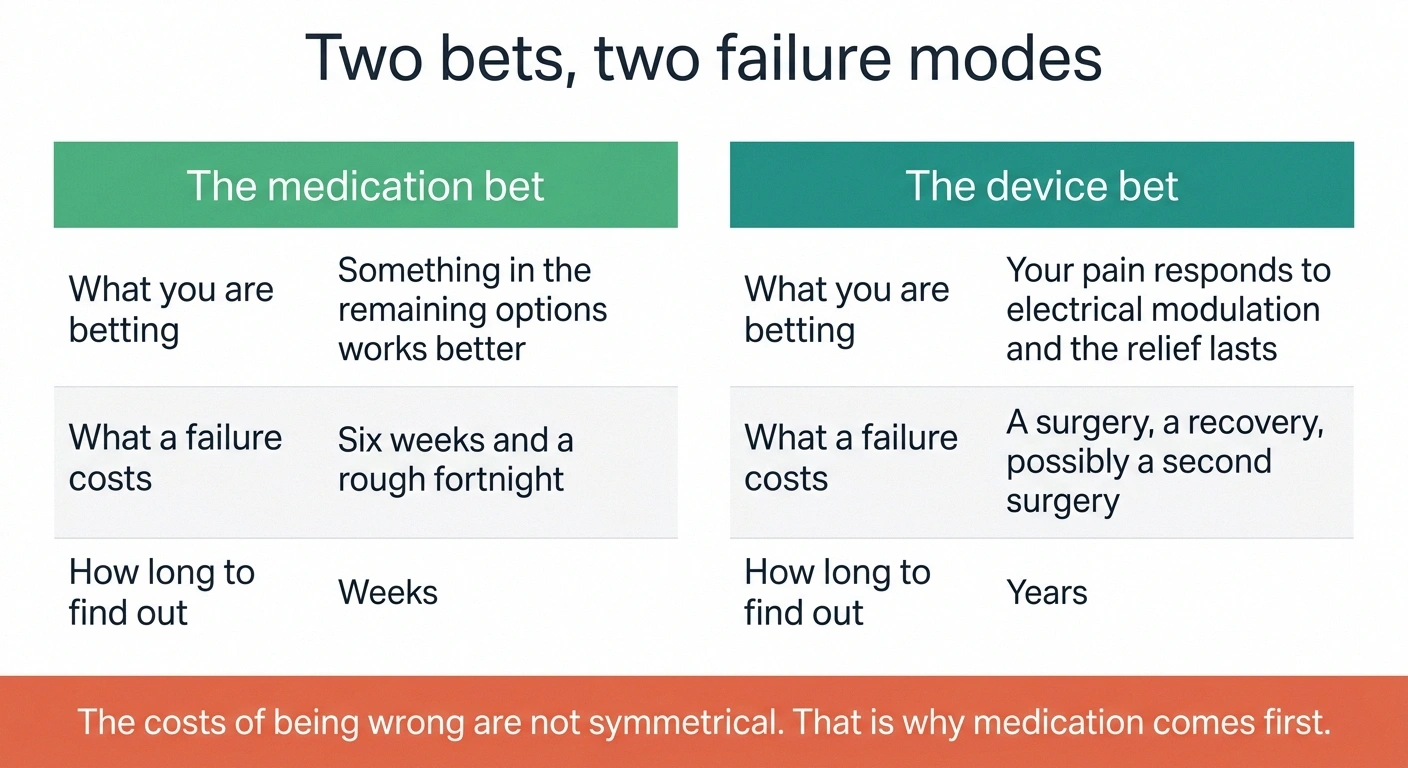
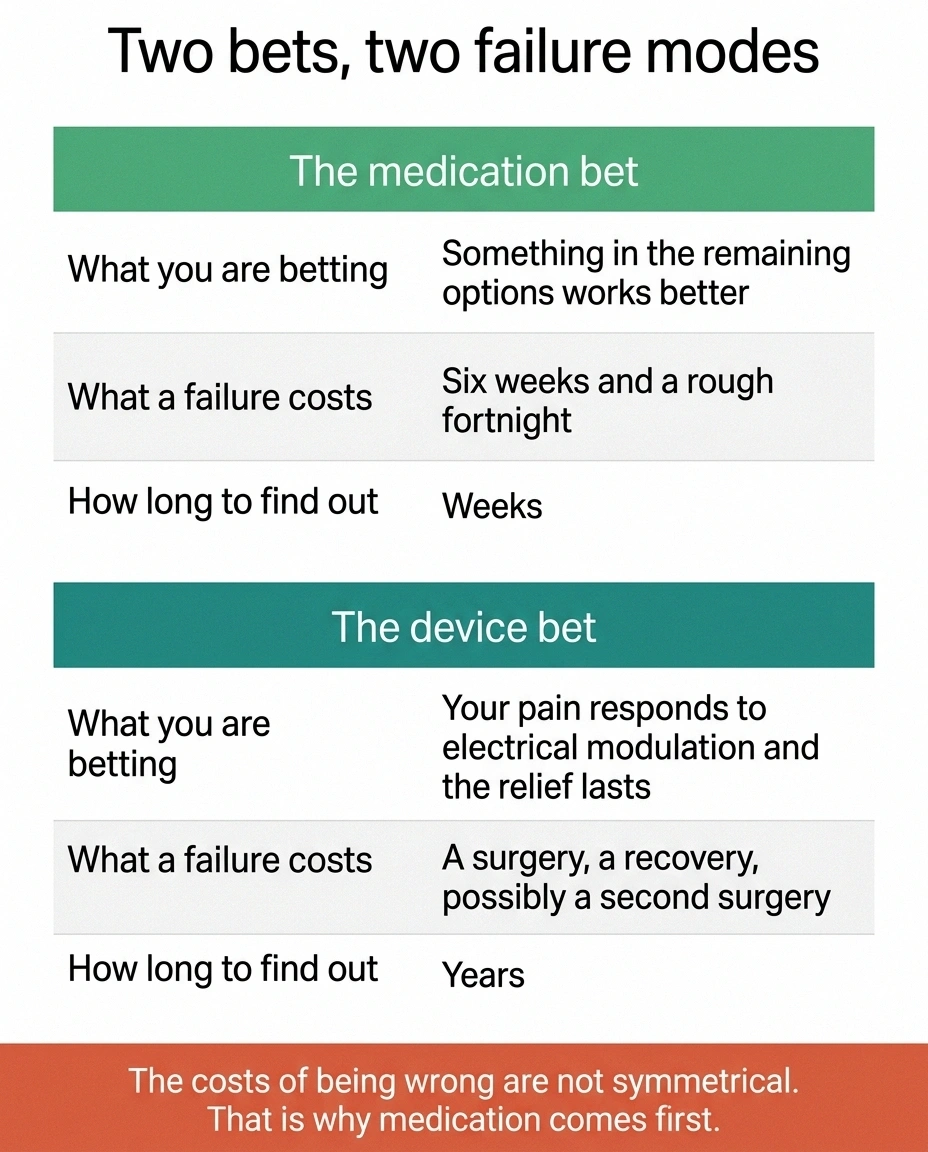
The medication bet is that somewhere in the remaining options is a drug, a dose, or a combination that works better than what you have tried. It is reversible. It is cheap by comparison. It costs you time, and it costs you the daily side effect load of whatever you land on.
The device bet is that your pain will respond to electrical modulation, that you will tolerate an implant, and that the relief holds up over years rather than months. It is a surgical procedure. It is not easily undone. It buys you, if it works, relief that does not come with morning grogginess or a dose ceiling.
Notice that these bets fail differently. A failed medication trial costs you six weeks and a rough fortnight. A failed implant costs you a surgery, a recovery, and possibly a second surgery to take it out. That asymmetry is why the order matters, and it is why nearly every guideline and insurer puts medication first.
The Threshold Question Nobody Asks Out Loud

Before anything else, one question decides whether this conversation is even live: have you actually run out of medication options, or have you run out of patience with the process?
What “already tried it” has to mean before it counts
Insurers ask for this in writing, and so should you. Fill it in for each drug you have taken before the consultation.
- Reached an adequate dose
- Pushed until it either helped or produced side effects you could not accept. A starting dose that was never increased is not a trial, it is an introduction.
- Held long enough to judge
- Most nerve pain drugs need several weeks at a working dose. Nine days tells you about the settling-in period and nothing about the drug.
- Stopped for a reason you can name
- “It did not help at 900 mg after six weeks” is a data point. “I think I stopped it in 2023” is not, and it will be treated as an untried option.
- Came from more than one class
- Two gabapentinoids is one class tried twice. A gabapentinoid, an SNRI and a tricyclic is three genuinely different mechanisms.
These feel identical from the inside. They are not the same thing at all.
Running out of options means you have had genuine trials of drugs from more than one class, at doses that were pushed to either benefit or intolerable side effects, held long enough to judge. Running out of patience means you tried two drugs, one of them for nine days, both at starting doses, and stopped because week two was miserable.
That distinction is not a scolding. It is arithmetic. A stimulator trial requires you to have exhausted reasonable alternatives, and insurers check. But more importantly, if there is a straightforward medication answer you have not reached yet, a surgical device is a very expensive way to skip it. Our guide to what to do when neuropathy medication stops working walks that ladder, and our overview of neuropathy medication options lays out which classes exist.
Where the conversation becomes genuinely live is different, and specific: you have had real trials across classes, the ones that helped brought side effects you cannot live with, the ones you tolerated did not help much, and you have arrived at a stable, unsatisfying floor of pain that nothing is moving.
The Numbers, With Their Fine Print Attached
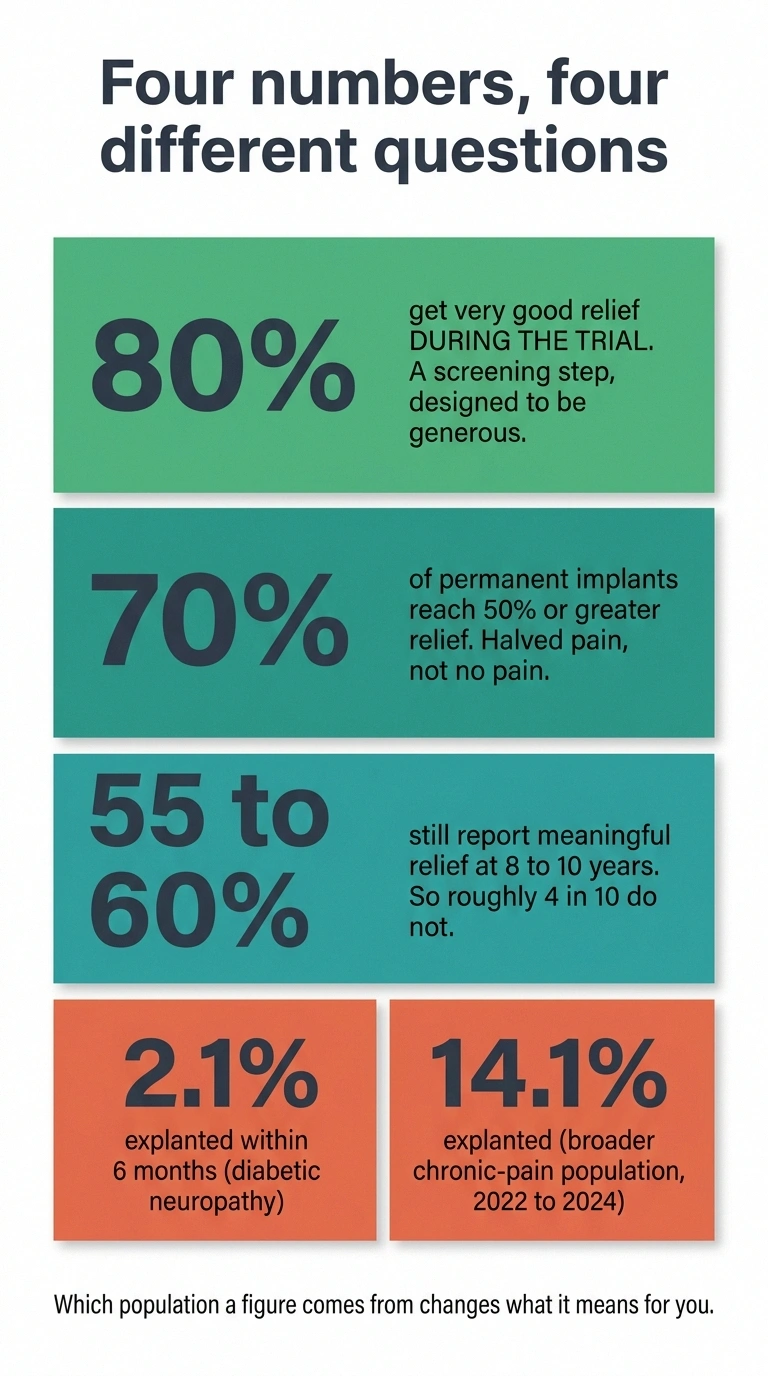
Here is what the published figures say, and what each one is quietly measuring.
Two cautions before the numbers. Most of them come from device manufacturers and implanting centres rather than from independent registries, and they pool different devices, stimulation patterns, implant years and patient groups into single headline percentages. So treat them as the rough shape of the evidence rather than as your personal odds, and ask the centre assessing you what its own results look like for people with your diagnosis.
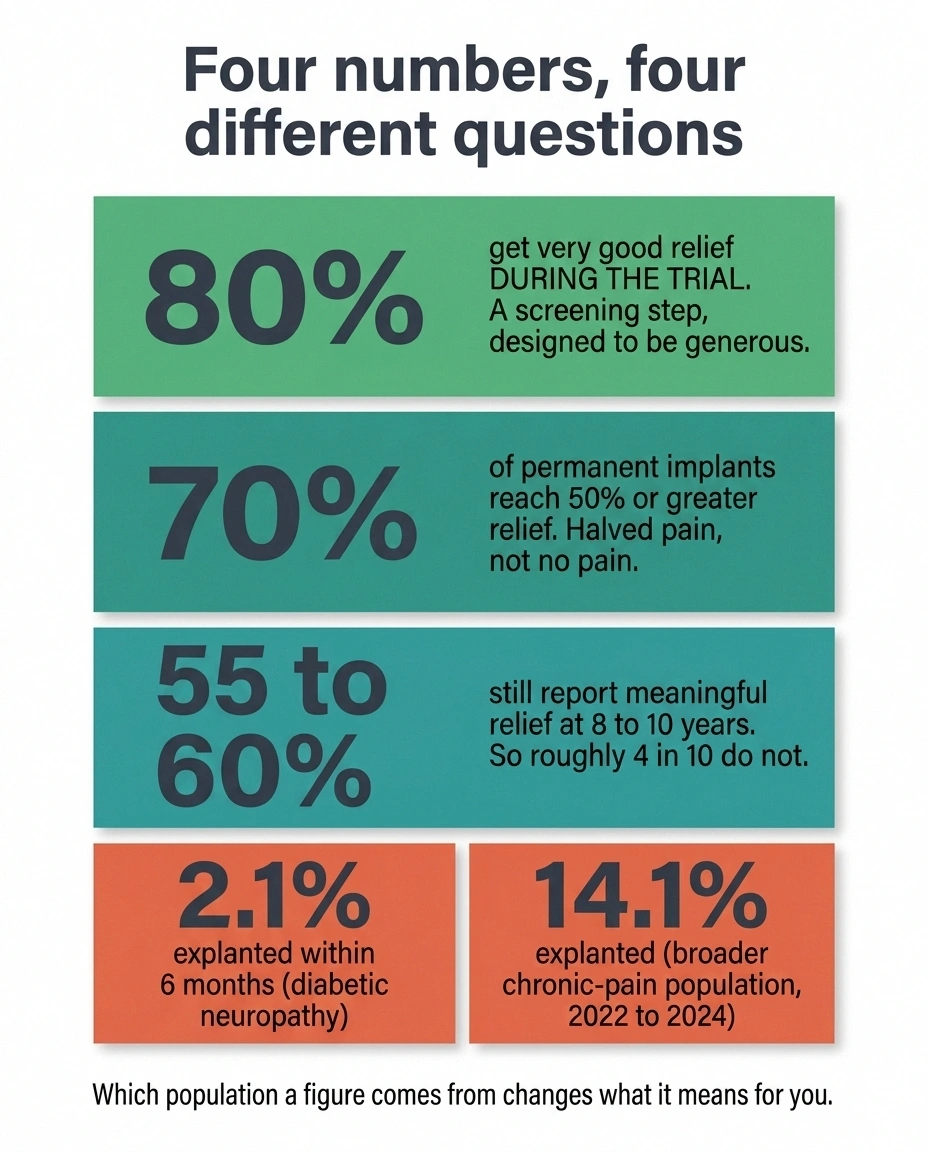
Around 80% of people get very good relief during the trial period. Read that carefully. It describes the trial, which is a short window with external hardware and a great deal of attention on you. It is a screening step, and a generous one by design.
Roughly 70% of people with a permanent system report at least 50% pain relief. This is the number that matters most, and it is worth understanding what 50% relief actually means. It does not mean pain-free. It means the pain is roughly halved. For someone at an eight, that is a four. A four is a very different life from an eight. It is still a four.
Somewhere between 55% and 60% still have meaningful relief eight to ten years later. Which is the same as saying that around four in ten do not, over that span. Some of that is the condition progressing, some is the body adapting to the stimulation, some is hardware.
Explant rates depend heavily on which population you look at. In diabetic neuropathy specifically, 2.1% had the device removed within six months. In a broader mixed-pain population studied between 2022 and 2024, 14.1% were explanted. The gap between those two figures is real and it is informative: stimulators appear to do better in painful diabetic neuropathy than in the general chronic-pain population they were originally built for. If your neuropathy is diabetic in origin, the more favourable figure is probably the more relevant one for you, and our overview of diabetic neuropathy covers why this pain pattern responds differently.
Devices last about nine to ten years depending on how hard the programming works them. Plan on the replacement, not on the device being permanent.
The Trial Week Is the Whole Decision, and Most People Waste It

This is the part worth reading twice.
Four lines a day, morning and evening
Written at the time, not recalled at the end. Recall drifts toward whatever you were hoping for, and by day six you will not be able to separate Tuesday from Thursday.
- Pain now, 0 to 10
- What I did today that usually costs me
- What I took, and whether I reached for extra
- One thing I could do that I could not do last week, or could not do that I usually can
Line 4 is the one people leave out and the one that decides things. Pain scores compress sleep, balance, standing tolerance and independence into a single digit, and that digit is not what you are actually buying.
Very few medical decisions of this size let you test the outcome before committing. The stimulator trial does. For three to seven days you wear external leads and live with the stimulation, and then you decide. Medicare and most insurers want to see at least 50% relief during that window before approving a permanent implant.
The mistake people make is treating the trial as a waiting period rather than an experiment. They spend the week resting, because they have wires taped to their back and it feels like a medical event. Then they report that they felt better, and of course they did. They also did not do anything.
A trial week only tells you something if it contains your real life. Not a careful version of it.
Put your difficult activities into that week on purpose. The grocery trip. The stairs. The evening when you are on your feet longer than you should be. The 3 a.m. stretch where the burning is at its worst. If the stimulation holds up through the parts of the week that usually break you, that is a signal. If you only tested it on the sofa, you learned nothing you can act on.
Write it down as it happens, not afterward. Memory for pain is unreliable and it drifts toward whatever you were hoping for. A simple morning-and-evening number plus one line about what you did that day is enough. If you already keep a symptom diary, use the same format so you have a before and after that actually match.
Note what changed besides pain. Sleep, balance, how much medication you reached for, whether you could stand long enough to cook. Pain scores compress a lot of important information into one digit.
Two things the trial cannot tell you, and it is worth knowing this before you weigh its result too heavily. It cannot tell you how the relief will hold up in year three, because durability is the one variable a week cannot measure. And it cannot tell you how you will feel about a permanent implant in your body, because a taped-on external unit is not the same experience as a device under the skin.
What the Device Costs You That Is Not Money
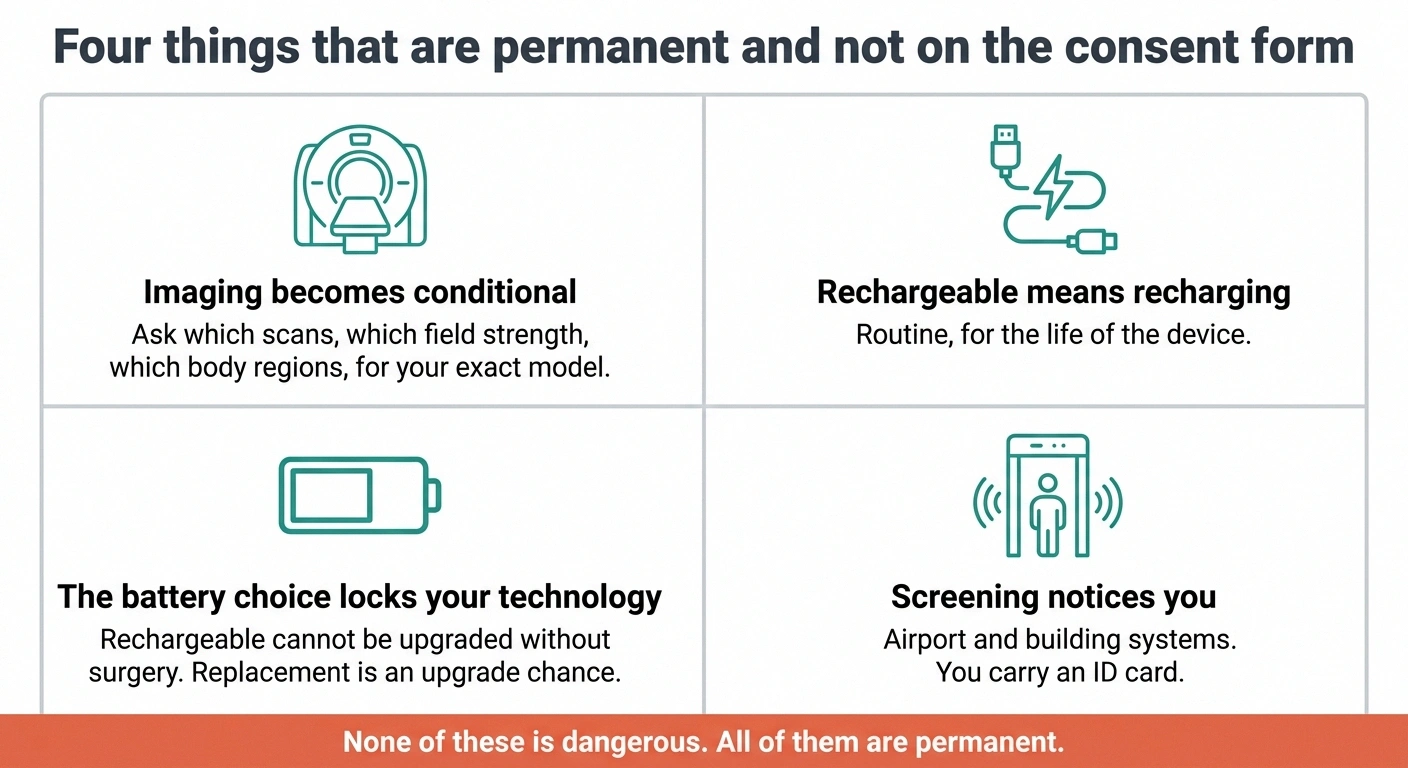
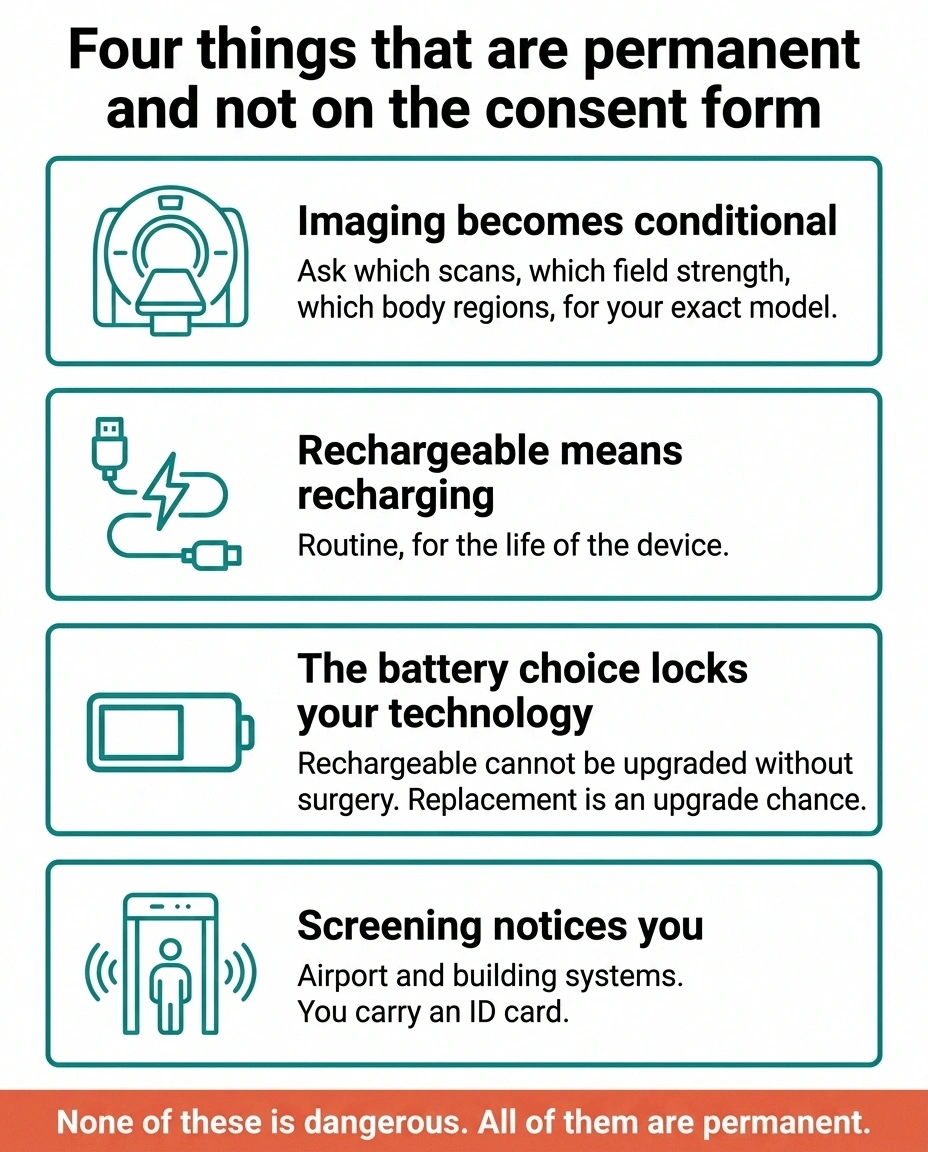
The consent form covers infection, bleeding, lead migration and hardware failure. These are real and your surgeon will discuss them. What tends to get less airtime is the set of ordinary daily frictions that come with the implant, none of which is dangerous and all of which are permanent.
Ask this before you sign, in these words
“Which MRI scans can I still have with this exact model, at what field strength, and for which parts of my body? Can I have the manufacturer’s MR-conditional labelling in writing?”
Field strength is the word that makes the difference. A device cleared at 1.5 tesla and refused at 3 tesla is a common situation, and “MRI compatible” gets said in consultations when “conditional at 1.5 tesla, lumbar spine only” is what is meant. Keep the paperwork with your insurance documents, not in a drawer.
Imaging becomes complicated. This is the one people most regret not asking about. Many stimulator systems restrict or prohibit MRI scanning, and newer systems are generally MR-conditional rather than simply MR-safe, meaning a scan is possible only under specific settings, specific scanner strengths, and sometimes only for certain body regions. The concern is heating at the lead electrodes. If you are someone who is likely to need spine or brain imaging in the coming decade, and neuropathy patients often are, ask exactly which scans your specific model permits and get it in writing. Our notes on getting through an MRI with neuropathy assume you can have one at all, which after an implant is no longer automatic.
Rechargeable systems require you to charge them. Routinely, for the life of the device. For many people this is a non-event, a strap-on charger during a television programme. For someone with hand involvement, memory difficulty, or an already crowded daily routine, it is a genuine ongoing task that nobody mentions during a consultation about pain relief.
The battery choice locks in your technology. A rechargeable unit cannot be upgraded without another surgery, so whatever generation you implant is the generation you live with. A non-rechargeable unit needs a replacement procedure when it runs down, which sounds worse but comes with a hidden benefit: the replacement is an opportunity to move to newer technology or switch battery types entirely.
Security screening notices you. Stimulators can trigger airport and building screening equipment. You will be given an identification card. It is a minor irritation rather than a problem, but it is a permanent one.
Six Situations Where Staying on Medication Is the Better Call
These are not absolute rules. They are patterns where the device bet is unlikely to pay.
1. You have not had a fair trial of at least two drug classes. Fair means adequate dose, adequate duration, stopped for a reason you can name. Two short attempts at starting doses is not a ladder you have climbed.
2. Numbness bothers you more than pain does. Stimulators modulate pain signalling. They do not restore sensation. If your main complaint is that you cannot feel the floor, an implant aimed at pain will not address the thing that is actually limiting you.
3. Your pain is diffuse and shifting rather than located. Stimulation works by covering a territory. Pain that moves around your whole body, or that includes significant pain outside the legs and feet, is harder to cover well.
4. You are likely to need repeated spinal imaging. Existing spine disease under active surveillance, or a cancer history requiring periodic scans, changes this calculation substantially.
5. There is an untreated driver still running. Blood glucose that is not controlled, a B12 deficiency nobody has checked, alcohol intake, a medication that is itself causing nerve damage. A stimulator masks the signal while the cause continues. Fix what is fixable first.
6. The daily maintenance would not fit your life. Charging, programming adjustments, follow-up appointments. If those are realistically going to be missed, the device will underperform for reasons that have nothing to do with whether it could have worked.
Six Situations That Tilt Toward the Device
1. Medications work but the side effects have made them unusable. This is the strongest case there is. If gabapentinoids controlled your pain and left you too foggy to drive or function, you have a pain that responds to intervention and a delivery problem. That is exactly the gap a device is meant to fill.
2. Your pain is concentrated in the feet and lower legs and it is burning or electrical in character. This is the pattern with the most supportive data behind it, particularly in painful diabetic neuropathy.
3. You have hit a ceiling and it is not high enough. A stable, well-managed, fully optimised regimen that still leaves you at a seven is a different situation from an unfinished medication search.
4. Your medication list is already long. Every drug you add interacts with the ones already there, and the risk compounds with age and with kidney function. Relief that does not come through the bloodstream removes an entire category of that risk.
5. You are motivated and reliable about the technical side. People who engage with programming, who report what is and is not working, and who go back for reprogramming rather than giving up, do measurably better with these devices than people who do not.
6. A trial has already given you a clear answer. If you did the week properly and lived your real life through it and the relief was substantial, that is the best evidence anyone can give you about your own body.
The Money, Plainly
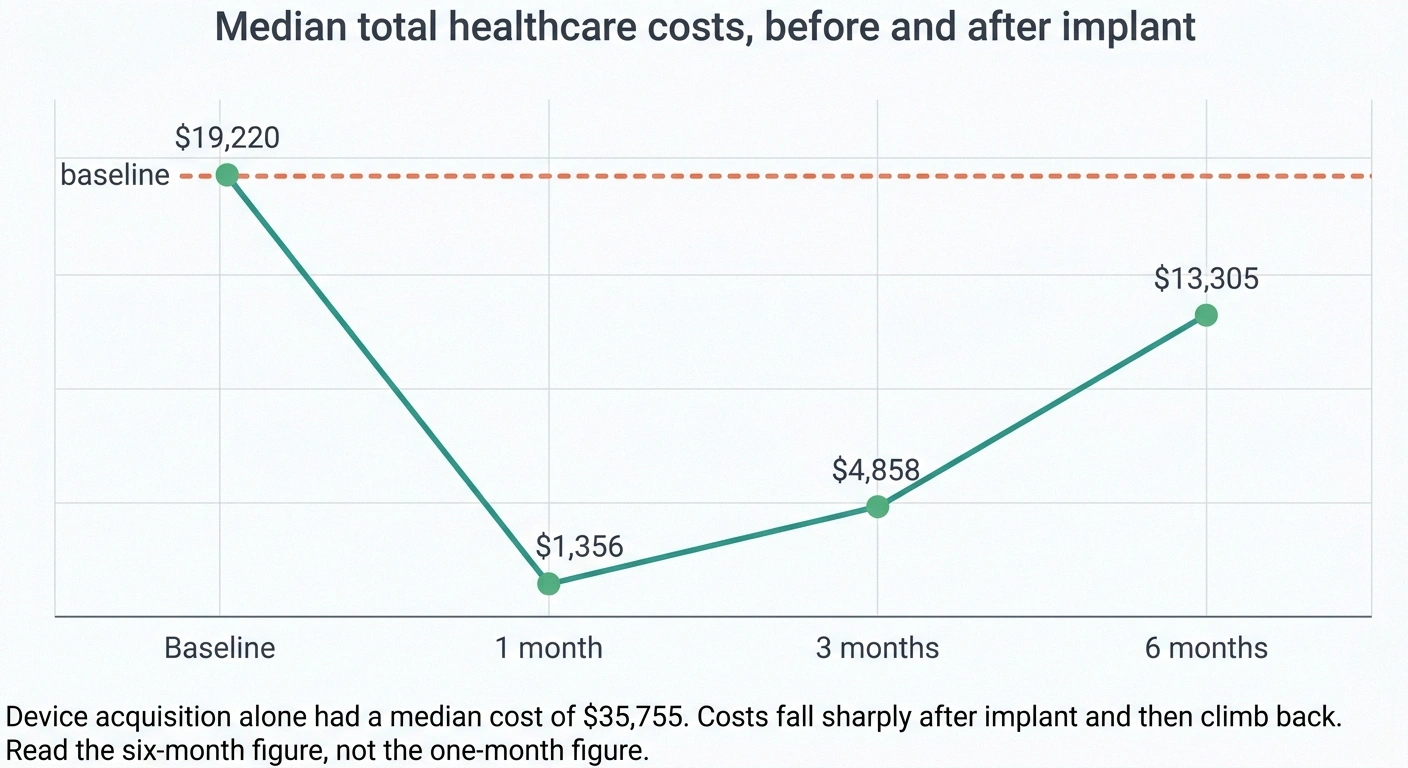
Device acquisition cost in the painful diabetic neuropathy studies ran to a median of about $35,755. That is the hardware alone, not the procedure, the facility, or the follow-up.
Settle these three before the trial, not after it
| Question | Why it bites later |
|---|---|
| What do I owe if the trial fails? | A failed trial still generates facility, procedure and device-time charges. People assume nothing implanted means nothing billed. |
| Is removal covered, and by whom? | Explant coverage varies by plan and the manufacturer does not typically pay for it. This is the bill nobody discusses on the way in. |
| Who programs it, how often, at what cost? | Outcomes track programming and follow-up closely. A centre that implants well but supports poorly produces a worse result than the published figures suggest. |
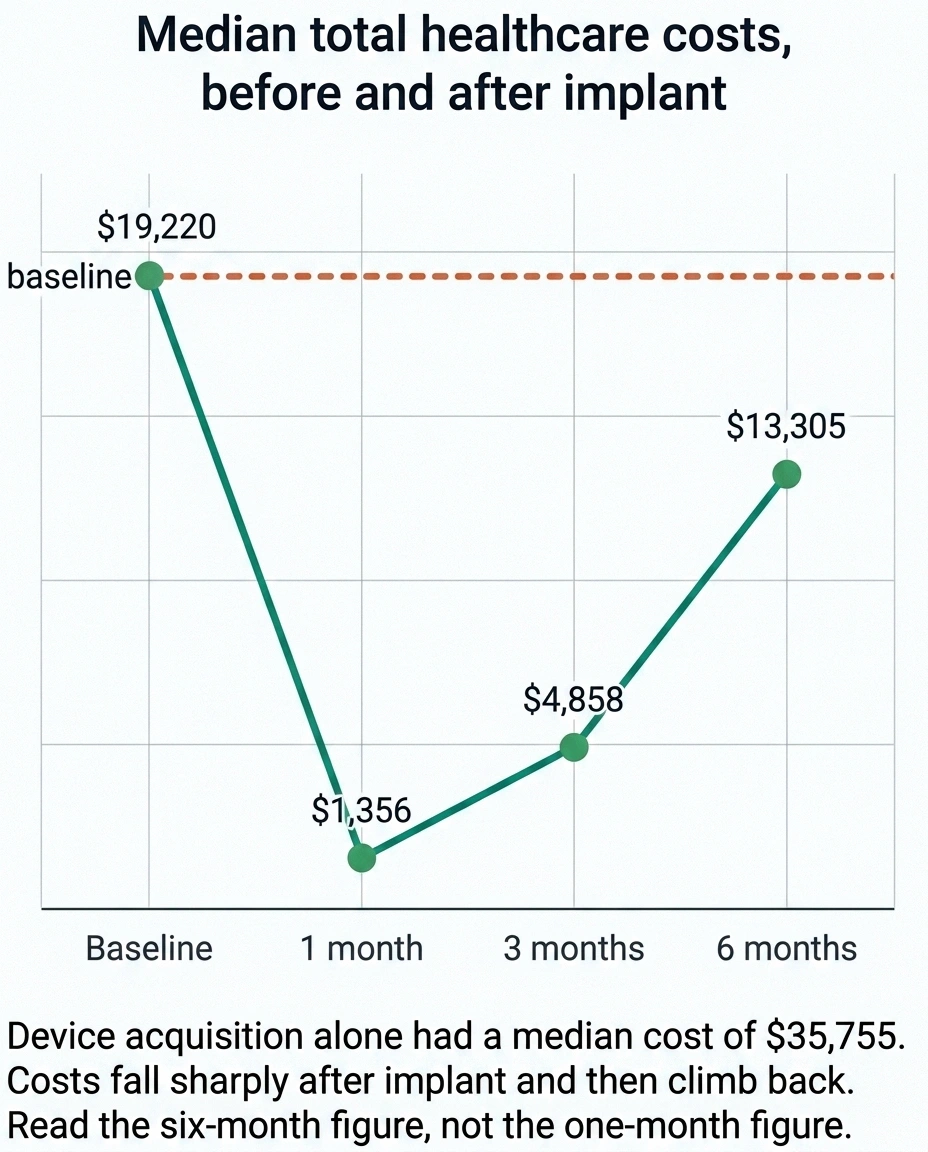
The more interesting figures are what happens to overall healthcare spending afterward. In that same analysis, median total costs were $19,220 at baseline, dropped to $1,356 in the first month after implant, then rose to $4,858 at three months and $13,305 at six months. Those numbers are usually presented as a cost-savings argument. Read plainly, they show something more useful: costs fall sharply right after implant and then climb back toward baseline as the months pass. Whatever you are told about long-run savings, treat the six-month figure as the honest one, not the one-month figure.
On coverage, Medicare has a longstanding national determination for electrical nerve stimulators that treats implantation as a late resort, requiring that other treatments have been tried and found unsatisfactory. In practice that means documentation: which drugs, which doses, how long, why each was stopped. Then the trial, then at least 50% relief demonstrated during it. Our guide to neuropathy insurance coverage and appeals covers how those determinations are argued when the first answer is no.
Two things to establish before the trial rather than after. Ask what happens financially if the trial fails, because a failed trial still generates bills. And ask whether removal is covered, because explant coverage varies and the manufacturer does not typically pay for it.
What to Take Into the Appointment
Written down, because these conversations move fast and the answers matter.
- Which of my medication options do you consider still untried, and why is the list finished?
- Given my specific pain distribution, what coverage would you expect to achieve?
- Which model, rechargeable or not, and what is your reasoning for my case?
- Exactly which MRI scans remain available to me with that model?
- What is your own explant rate, and at what point do you consider a device to have failed?
- If the trial gives a partial result, say 30% relief, what do you recommend then?
- What happens to my current medications if this works? Reduced, stopped, unchanged?
- Who programs the device afterward, how often, and what does that cost?
That last cluster matters more than it looks. Stimulator outcomes depend heavily on programming and follow-up, and a centre that implants well but supports poorly will produce a worse result than the published figures suggest. Our list of questions to ask before starting any neuropathy treatment covers the ground that applies to both paths.
If the Answer Is Not Yet

Deciding against a stimulator now is not deciding against it forever, and it does not leave you with nothing.
There is a middle tier between oral medication and a spinal implant that people frequently skip past. Peripheral nerve stimulation targets a specific nerve rather than the spinal cord and is a smaller procedure. Topical options act only where they are applied and carry none of the systemic burden. Non-drug approaches will not match a device on pain scores, but they stack, and they cost you nothing you cannot take back.
The one thing worth avoiding is drifting. A decision deferred without a plan tends to become a decision made by exhaustion two years later. If the answer today is not yet, write down what would have to change for the answer to become yes, and put a date on revisiting it.
Frequently Asked Questions
Is a spinal cord stimulator worth it for neuropathy?
It depends almost entirely on why your current treatment is failing. If medications helped but their side effects made them unusable, a stimulator addresses exactly that gap and is worth serious consideration. If you have not yet had adequate trials of medications from more than one class, or if numbness rather than pain is your main problem, the answer is more likely no for now. The published figures are that around 70% of people with a permanent implant get at least 50% pain relief, and 55 to 60% still have meaningful relief eight to ten years on.
What happens if the stimulator trial does not work?
The temporary leads are removed, which is a simple office procedure, and you are back where you started with no implanted hardware. A failed trial is a normal outcome and it is the entire reason the trial exists. Ask in advance what a failed trial costs you financially, because it still generates bills for the procedure and the device time even though nothing is implanted.
Can you have an MRI with a spinal cord stimulator?
Sometimes, and only under conditions specific to your model. Many systems restrict or prohibit MRI entirely, and the newer ones are described as MR-conditional, meaning scanning is permitted only at certain field strengths, with certain settings, and sometimes only for certain body regions. The hazard is heating at the lead electrodes. Ask which scans your exact device permits before implantation rather than after, and keep the manufacturer documentation somewhere you can find it.
Do you still take medication after getting a stimulator?
Many people do, at lower doses. Reducing or eliminating medication is a common goal and it is frequently achieved in part, but going in expecting to stop everything sets up disappointment. Treat any reduction as a bonus rather than the plan, and never reduce a nerve pain medication abruptly on your own, since several of them require a taper.
How long does a spinal cord stimulator last?
Most systems run about nine to ten years, with the exact figure depending on the programming and how much energy your settings demand. Rechargeable units generally last longer between surgeries but require regular charging. Non-rechargeable units need a replacement procedure sooner, though that procedure is also a chance to move to newer technology.
Does Medicare cover spinal cord stimulators for neuropathy?
Medicare has a national coverage determination for electrical nerve stimulators that treats implantation as a late resort, requiring that other treatment approaches have been tried and found unsatisfactory or unsuitable. In practice, approval usually requires documented medication trials and a successful stimulator trial showing at least 50% pain relief. Coverage for removal, if it ever becomes necessary, varies and is worth confirming separately.
How common is it to have the device removed?
It varies a great deal by condition. In studies of diabetic peripheral neuropathy, 2.1% of devices were removed within six months. In a broader chronic-pain population studied between 2022 and 2024, the explant rate was 14.1%. Reasons include loss of effectiveness over time, infection, hardware problems, and the need for imaging that the device does not permit.
Should I try peripheral nerve stimulation first?
It is a reasonable question to raise, since peripheral nerve stimulation targets a single nerve rather than the spinal cord and is a smaller procedure with a lower barrier to reversal. Whether it suits you depends on whether your pain maps to one identifiable nerve territory or is spread across both feet, which is a question for the specialist assessing you.
About the Author