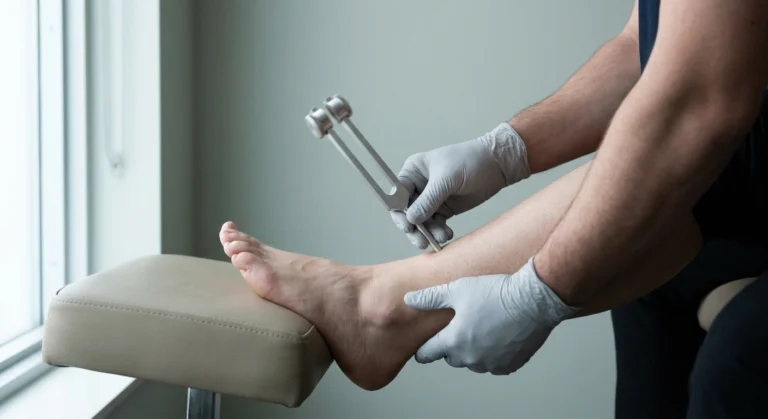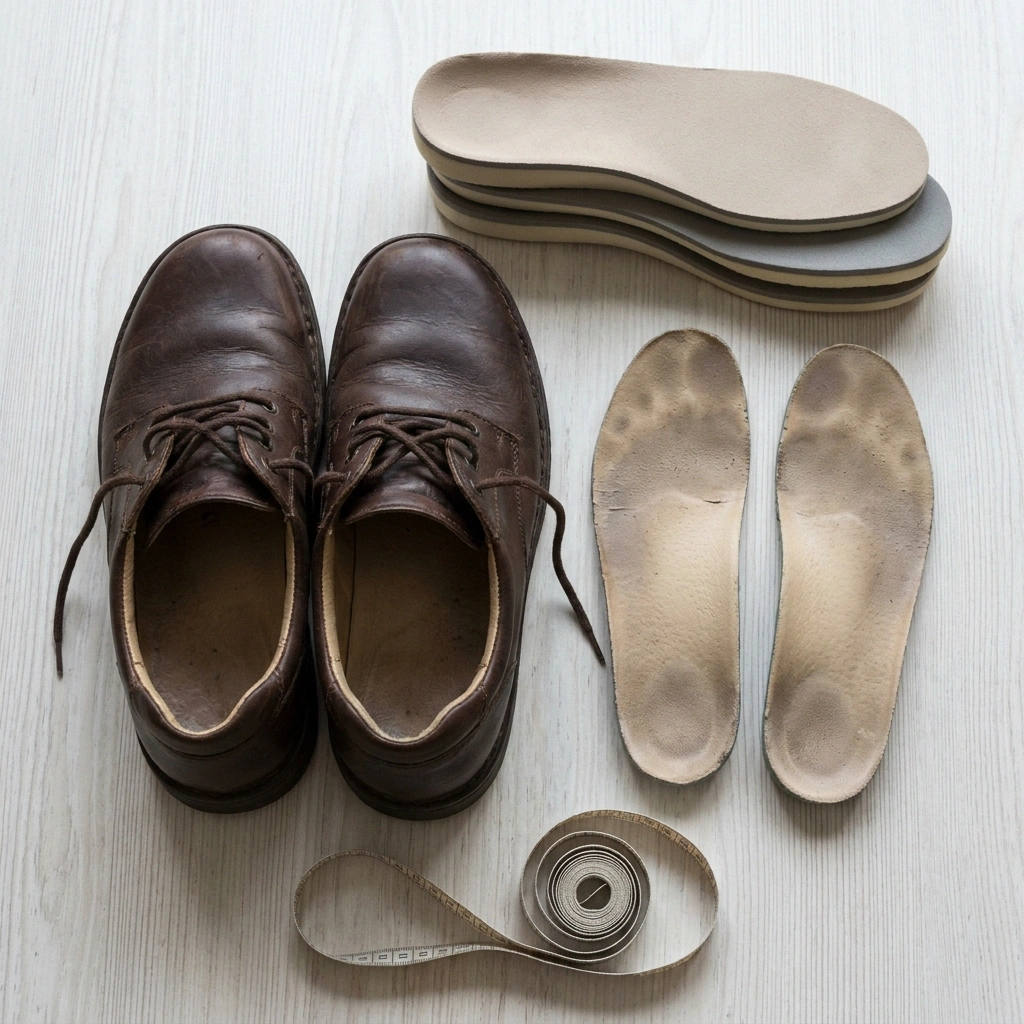
In the most recent reporting period, 85.5% of improper Medicare payments for diabetic shoes came down to one thing: insufficient documentation.
Not fraud. Not people claiming a benefit they were not entitled to. Paperwork. A signature in the wrong order, a visit note that did not say the right sentence, a form completed by someone who was not allowed to complete it.
That statistic tells you what kind of problem this benefit actually is. Medicare will buy you a pair of shoes and several pairs of custom inserts every single year, and the reason so many people with diabetes and neuropathy never get them is not that they fail to qualify. It is that the claim depends on a chain of signatures the patient never sees, collected by people who are not the patient, in an order that matters.
So this page is organized around the chain rather than around the eligibility list. If you understand who has to sign what, and in what order, you can steer the process instead of waiting to find out whether it worked.
What the Benefit Pays For in a Calendar Year
The formal name is the Therapeutic Shoes for Persons with Diabetes benefit, and it sits under Medicare Part B, not Part D. Each calendar year it covers one of two packages.
Pick one package per calendar year, not both
| Extra-depth route | Custom-molded route | |
|---|---|---|
| Shoes | One pair, production shoe built with extra vertical room | One pair, built from a cast or scan of your foot |
| Additional inserts | Three pairs, on top of the pair that comes in the shoe | Two pairs, on top of the pair that comes in the shoe |
| Best suited to | Feet that a production shoe can accommodate once the insert is in | Significant deformity that no off-the-shelf shoe will fit |
| Fitting | Covered either way, including follow-up adjustments. Fitting by a qualified supplier is a coverage requirement, not an extra. | |
- One pair of custom-molded shoes, plus two additional pairs of inserts. Custom-molded means built from a cast or scan of your foot. This is the route for feet with significant deformity that no off-the-shelf shoe will accommodate.
- One pair of extra-depth shoes, plus three additional pairs of inserts. Extra-depth means a production shoe built with additional vertical room so a thick multi-density insert fits without cramping the toes. This is the more common route.
Note what “additional” means. The shoes come with one pair of inserts already. The two or three additional pairs are on top of that, so an extra-depth year is really one pair of shoes and four pairs of inserts. The fitting itself is covered too, along with follow-up adjustments.
It resets every calendar year, not every twelve months from your last pair. Somebody who gets shoes in November can get another pair in January. Almost nobody does this, because almost nobody knows.
The Eligibility Line Most People Trip Over
To qualify you need diabetes, a comprehensive plan of care for it, and at least one of six specific foot conditions. Here is that list, and I want you to read the fourth item slowly.
You need one of six. Five are unconditional.
Prior partial or complete foot amputation, previous foot ulceration, history of a pre-ulcerative callus, foot deformity, and poor circulation each qualify on their own with nothing attached. Two of those are historical, which means they qualify you permanently. A healed ulcer from six years ago still counts.
The sixth is the only one with a rider on it, and it is the one most readers of this site will be relying on: peripheral neuropathy with evidence of callus formation.
If you are relying on that route, the callus has to appear in a clinician’s examination note. Your own account of it does not satisfy an auditor. Book the foot exam first and the certification second, in that order.
- Partial or complete amputation of a foot
- History of previous foot ulceration
- History of a pre-ulcerative callus
- Peripheral neuropathy with evidence of callus formation
- Foot deformity
- Poor circulation
Peripheral neuropathy on its own is not on that list. It is neuropathy with evidence of callus formation. Those last four words are load-bearing, and they are the single most common reason a reader of this site is told they qualify by a supplier’s website and then finds out they do not.
The logic behind the rule is sound, even if the effect is frustrating. Medicare is not buying shoes for numbness. It is buying shoes for feet that are demonstrably being damaged by pressure the person cannot feel. Callus is the visible evidence that damage is happening. Numbness alone, with clean skin and normal pressure distribution, has not yet produced the thing the shoe is meant to prevent.
What this means practically: if you have neuropathy and you have callusing, that has to be documented in your medical record by someone who examined your feet. Not mentioned in passing. Written down, at a visit, in a note. If you have never had a proper foot exam, that is the missing step, and our guide on when to see a podiatrist for neuropathy covers what that visit involves.
It also means the other five doors exist. Foot deformity qualifies on its own, and it is broader than people assume. Hammertoes, bunions, and the structural changes of Charcot foot all count. Poor circulation qualifies on its own. A single healed ulcer from four years ago qualifies on its own, permanently, because the criterion is history of ulceration rather than current ulceration.
Three Signatures, and Who Owns Each One
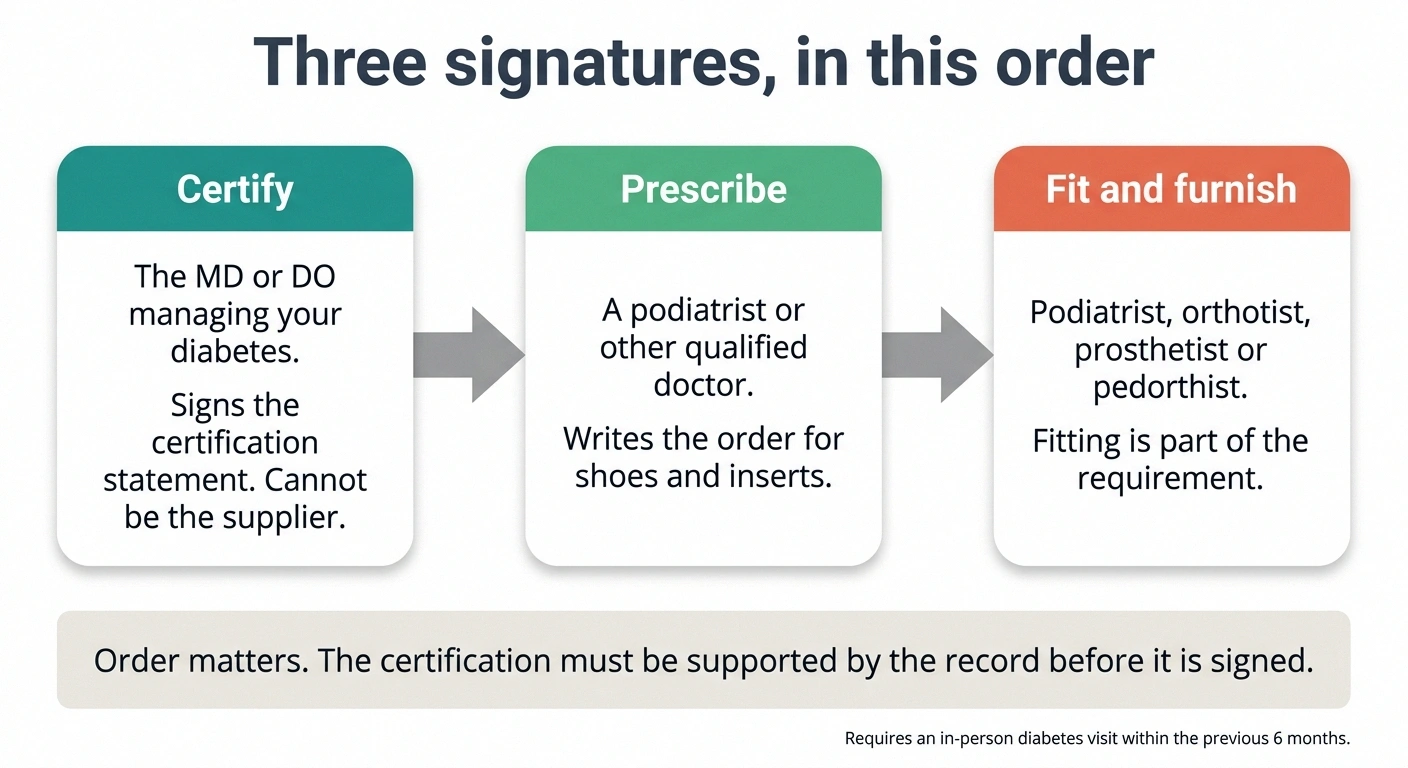
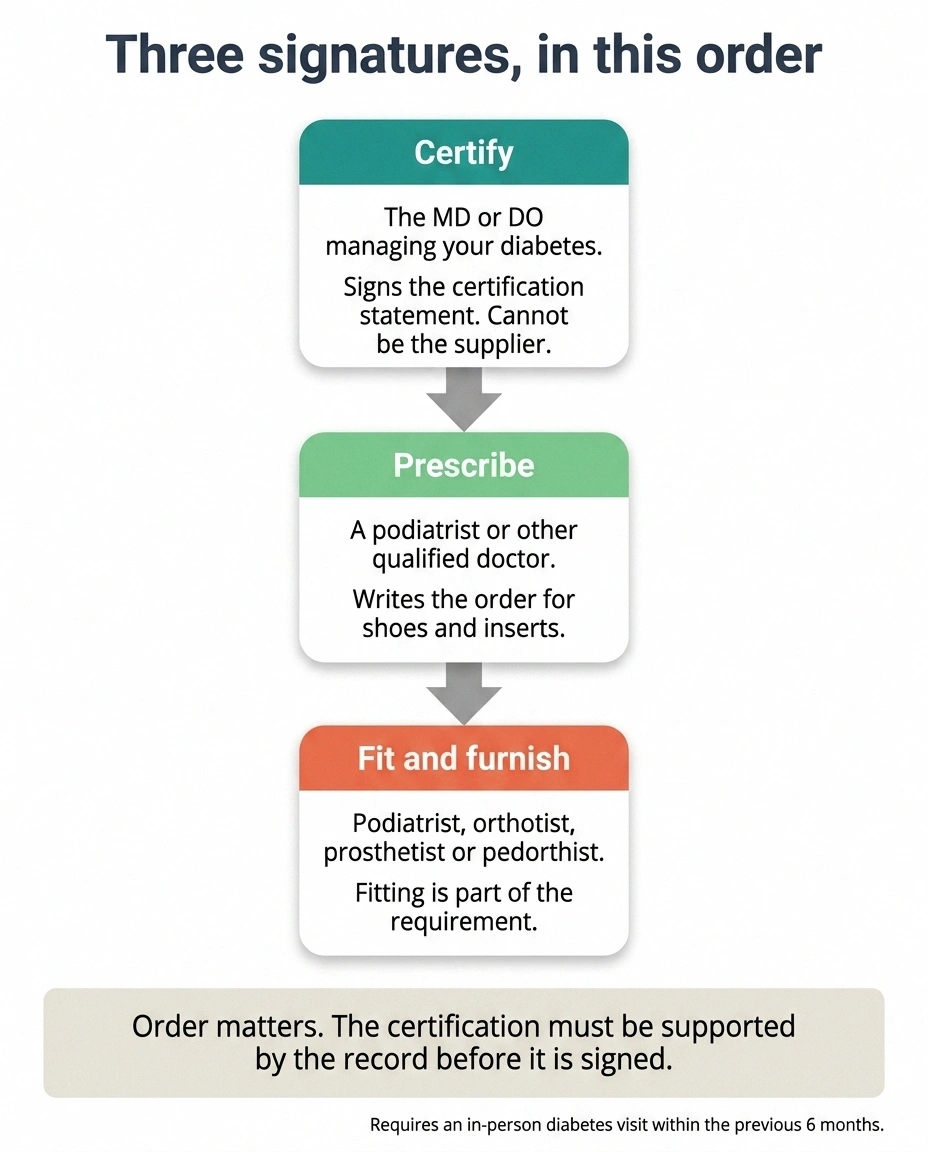
Three separate people have to do three separate things, and they cannot be collapsed into fewer.
Signature one: the certifying physician. This must be the MD or DO who manages your diabetes under a comprehensive plan of care. Usually your primary care doctor or endocrinologist. This person signs a certification statement saying you have diabetes, that you have one or more of the six qualifying conditions, that you are being treated under a comprehensive diabetes care plan, and that you need therapeutic footwear because of the diabetes.
The certifying physician cannot be the supplier. A podiatrist who is also going to sell you the shoes cannot certify. This trips up practices that do both.
Signature two: the prescriber. A podiatrist or other qualified doctor writes the actual order for the shoes and inserts. In many cases this is a podiatrist rather than the certifying physician.
Signature three: the supplier. A podiatrist, orthotist, prosthetist, pedorthist, or other qualified individual fits and furnishes the footwear. Fitting is part of the benefit and part of the requirement. Ordering shoes from a website is not this.
The order matters. The certification has to be properly supported by the medical record before it is signed, which brings us to the rule that quietly kills more claims than any other.
The Six-Month Visit Rule
The certifying physician must have had an in-person visit with you that addressed your diabetes management, and that visit must have occurred within six months before the shoes are delivered.
What has to be true about that visit
- In person
- A telehealth visit does not satisfy this requirement on its own. Check before assuming a video appointment counted.
- Within six months of delivery
- The clock runs to the date the shoes are handed over, not the date they were ordered. A slow supplier can push a compliant visit out of the window while you wait.
- Addressing diabetes management
- The note has to show the diabetes was actually managed at that encounter. A visit for something unrelated, with diabetes sitting inertly in the problem list, does not qualify.
- Attributed correctly
- If a nurse practitioner or physician assistant wrote the note, the certifying physician must initial it, date it and indicate agreement before signing the certification. This single step is one of the most cited denial reasons in the audit data, and it takes about ten seconds to perform.
Two things about this catch people out.
First, the visit has to be about diabetes management. A visit for a sinus infection where diabetes appears in the problem list does not satisfy it. The note has to show the diabetes was actually managed at that encounter.
Second, and this is the one nobody explains: if the in-person visit was documented by somebody other than the certifying physician, such as a nurse practitioner or a physician assistant in the same practice, the certifying physician must initial the note, date it, and indicate agreement with it before signing the certification statement. A certification signed without that step is a denial, and it is a denial that surfaces months later during an audit.
If your diabetes care is mostly handled by an NP or PA, which is increasingly common, this is the specific thing to ask about. It costs nothing to raise and it is the difference between a paid claim and a recouped one.
What You Actually Pay in 2026
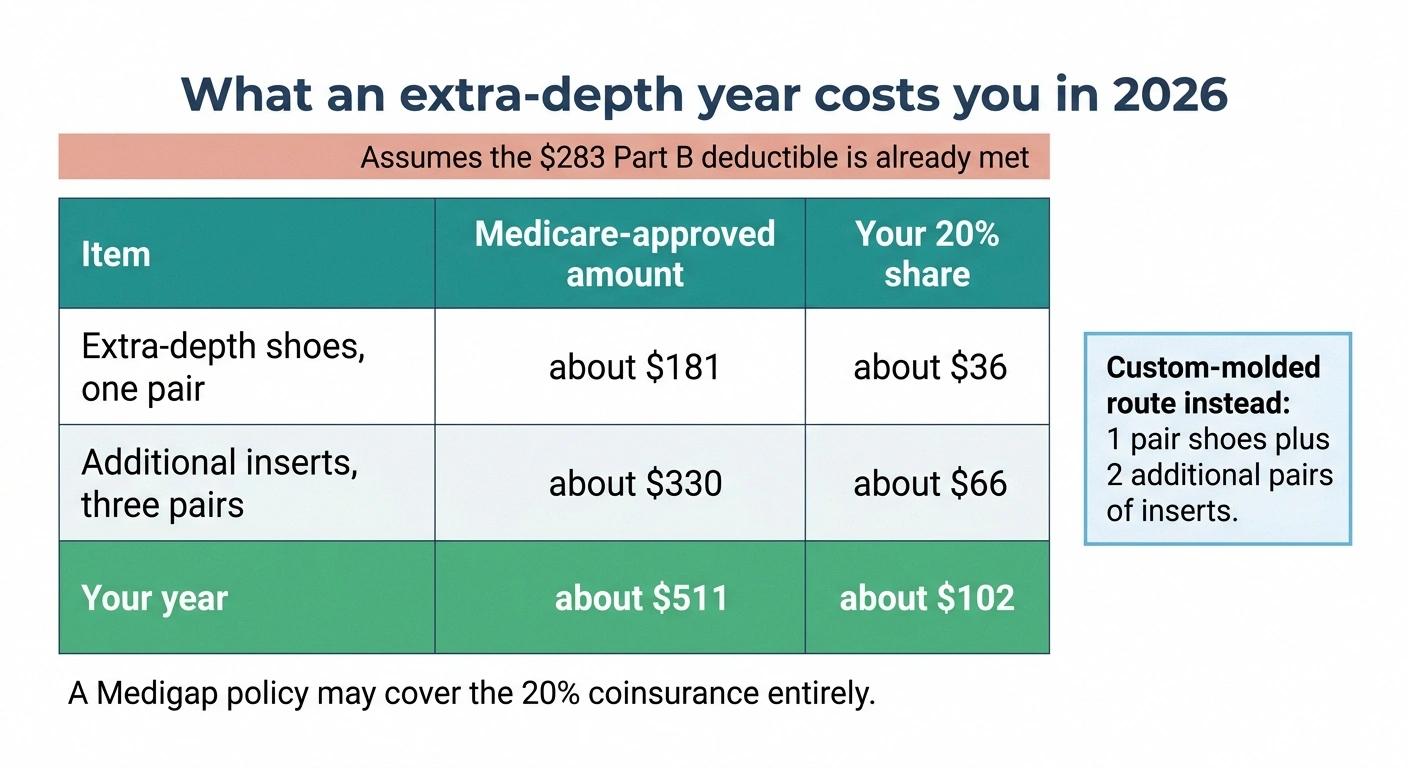
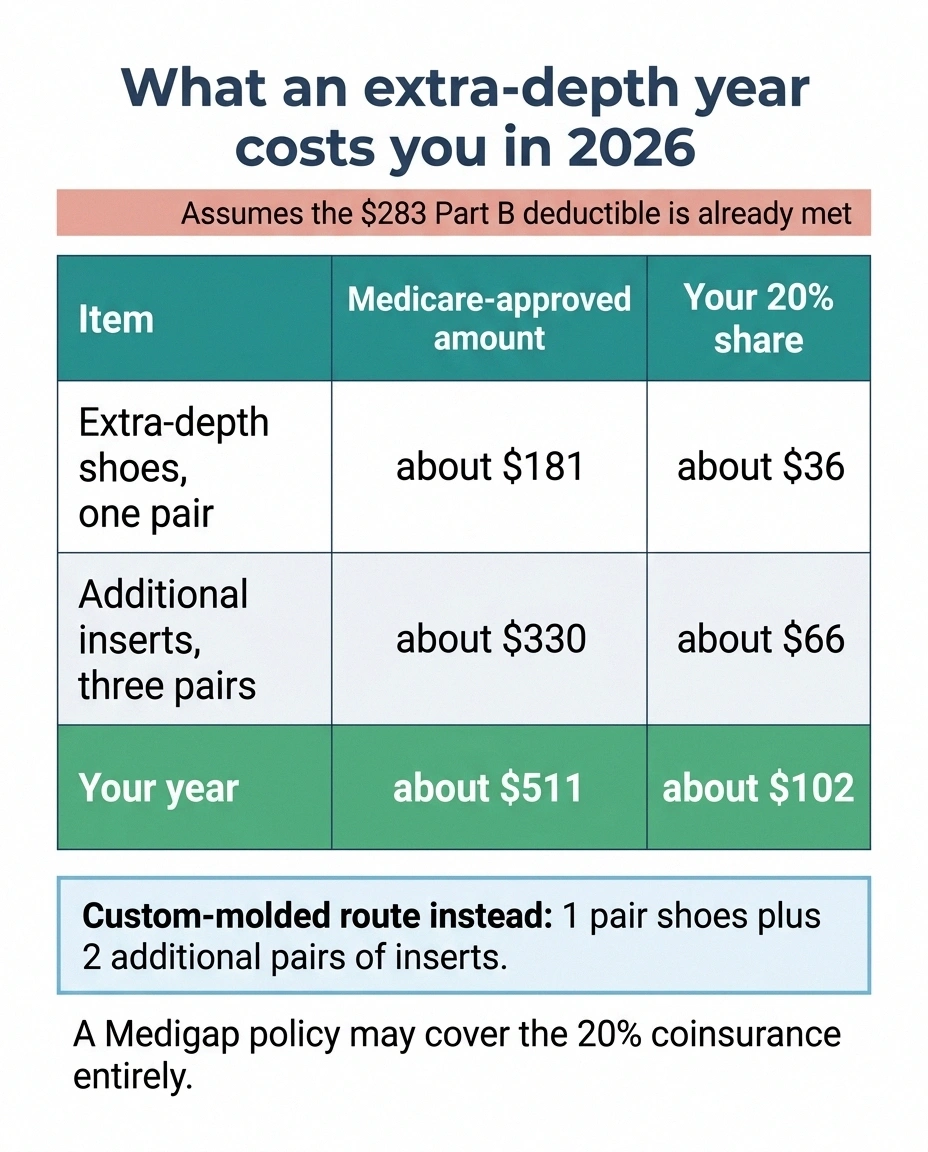
Part B rules apply. You pay the annual deductible, then 20% coinsurance on the Medicare-approved amount.
For 2026 the Part B deductible is $283. The approved amount for a pair of extra-depth shoes runs around $181, and custom-milled inserts run around $110 per pair.
Work that through for a typical extra-depth year, assuming your deductible is already met by other care, which it usually is by the time somebody is managing diabetes and neuropathy:
- Shoes at roughly $181, your 20% share is about $36
- Three additional insert pairs at roughly $110 each, $330 total, your 20% share is about $66
- Roughly $102 for the year
If the deductible has not been met, the first $283 of your Part B spending for the year is yours, and that spending counts toward it. If you have a Medigap plan, it may cover the coinsurance entirely.
Compare that to buying comparable footwear retail, where a single pair of well-built diabetic shoes runs $130 to $250 and custom inserts run $200 to $400 a pair, and the benefit is worth real money. It is worth more than that if it prevents one ulcer, which is the actual point. Our page on diabetic foot ulcers covers what one of those costs in ways that have nothing to do with dollars.
Why Claims Get Denied, and It Is Almost Never You

Back to that 85.5% figure. Here is what the audit reviewers actually cite when they deny these claims:
- The medical record does not demonstrate a qualifying condition. The certification says the patient has neuropathy with callus formation. The chart has no foot exam documenting callus. The certification is an assertion; the chart is the evidence, and the evidence has to exist.
- No documented in-person visit addressing diabetes management. Either it did not happen in the window, or the note does not show diabetes was addressed.
- The certifying physician did not initial, date and indicate agreement with a visit note written by another practitioner before signing.
- The shoe was not PDAC-verified. Suppliers billing code A5500 have to supply a shoe model that appears on the PDAC verified product list. Billing that code for an unverified shoe is an automatic denial and can trigger recovery of money already paid.
Three of those four are entirely inside the clinic. You cannot fix them by wanting the shoes more. You can fix them by asking two specific questions before anything is ordered, which is the section below.
Where You Get the Shoes
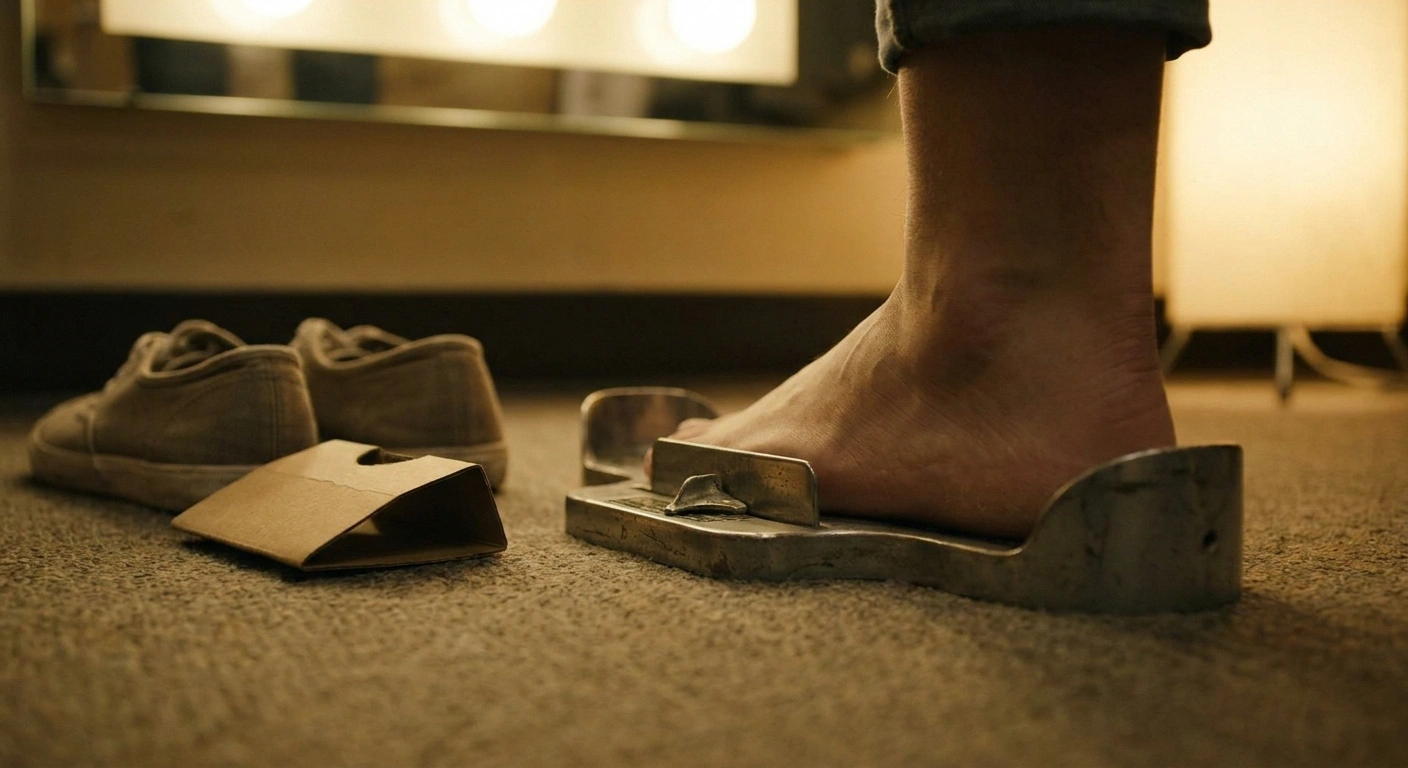
The supplier has to be a qualified individual, which in practice means a podiatry office that dispenses, a certified pedorthist, an orthotics and prosthetics practice, or a durable medical equipment supplier enrolled with Medicare for this benefit. They must accept Medicare assignment for you to pay only the 20%.
The selection is narrower than the retail world, and this is where expectations need managing. These are medical shoes. They are built around depth and a removable insert, and the range runs from perfectly acceptable to genuinely unattractive. If appearance matters to you, and it is allowed to matter to you, ask what brands the supplier carries before you commit, because the range varies enormously between suppliers.
Fit is the whole game here, and a covered shoe that fits badly is worse than a retail shoe that fits well. Our shoe shopping guide covers the fitting checks worth insisting on, and they apply just as much when Medicare is paying. If you end up deciding to buy outside the benefit for a second pair, our roundup of shoes for neuropathy is the retail-side companion.
One thing worth knowing: you can use the benefit and still own other shoes. Nothing about accepting covered footwear obligates you to wear it exclusively. Many people use the covered pair for the hours they are on their feet most and keep something else for short trips.
If You Have Medicare Advantage
Medicare Advantage plans must cover everything Original Medicare covers, so the therapeutic shoe benefit exists in your plan. What changes is the administration.
Call the number on your card and ask exactly this
- Is prior authorization required for therapeutic footwear for diabetes, and who submits it?
- Which suppliers within twenty miles are in network for this benefit? Ask for names, not a website.
- Is my cost share a flat copay or 20% coinsurance, and does this benefit sit inside or outside my annual out-of-pocket maximum?
Write down the reference number for the call. If the plan later disputes what you were told, that number is the only evidence the conversation happened.
Expect network restrictions on which supplier you can use, possible prior authorization before anything is ordered, and a cost-sharing structure that may be a flat copay rather than 20% coinsurance. Some plans also fold in additional footwear or foot-care allowances that Original Medicare does not offer.
Call the number on your card and ask three things: whether prior authorization is required, which suppliers in your area are in network for therapeutic footwear, and what your cost share is. Do it before the appointment, not after the shoes are ordered. For the wider set of coverage questions this raises, our neuropathy insurance coverage guide and our Medicare coverage guide go further than this page does.
If You Are Denied
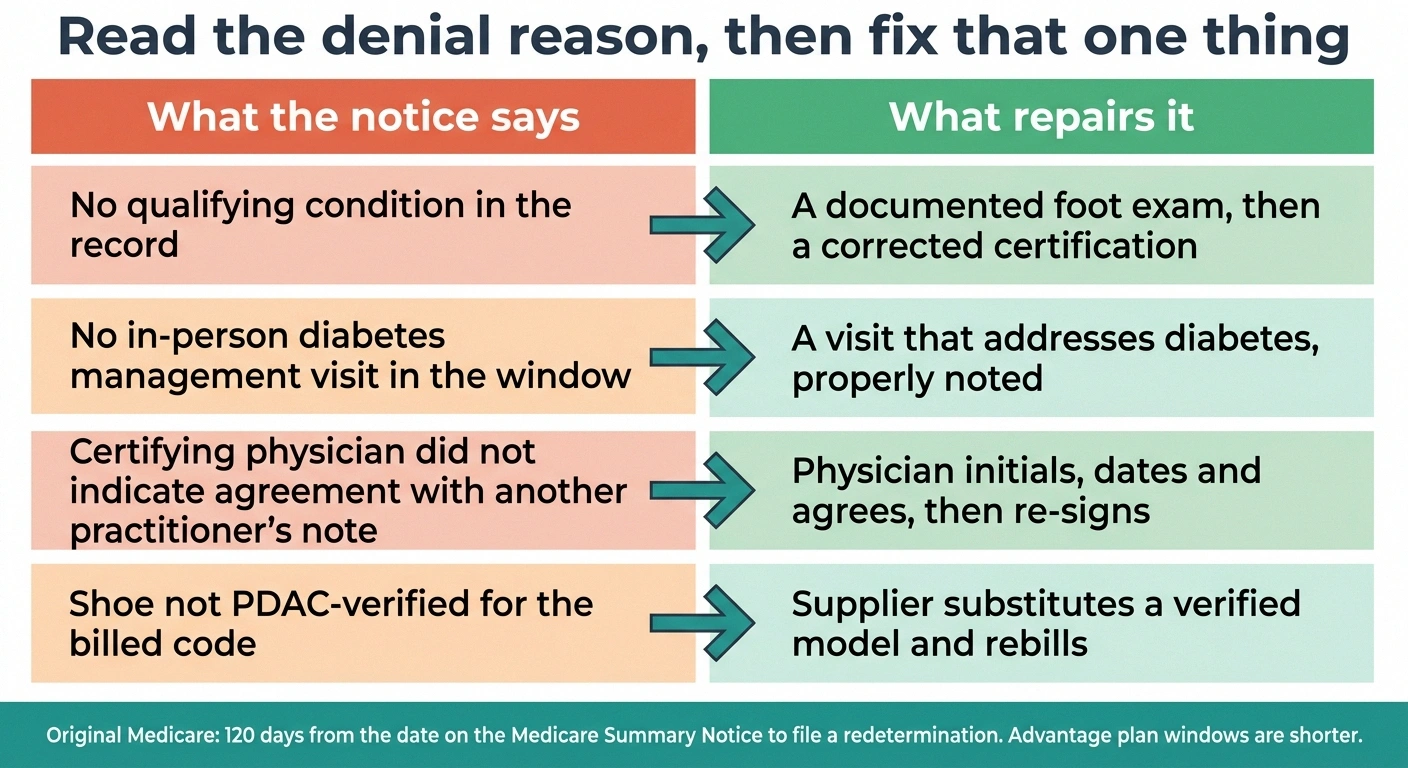
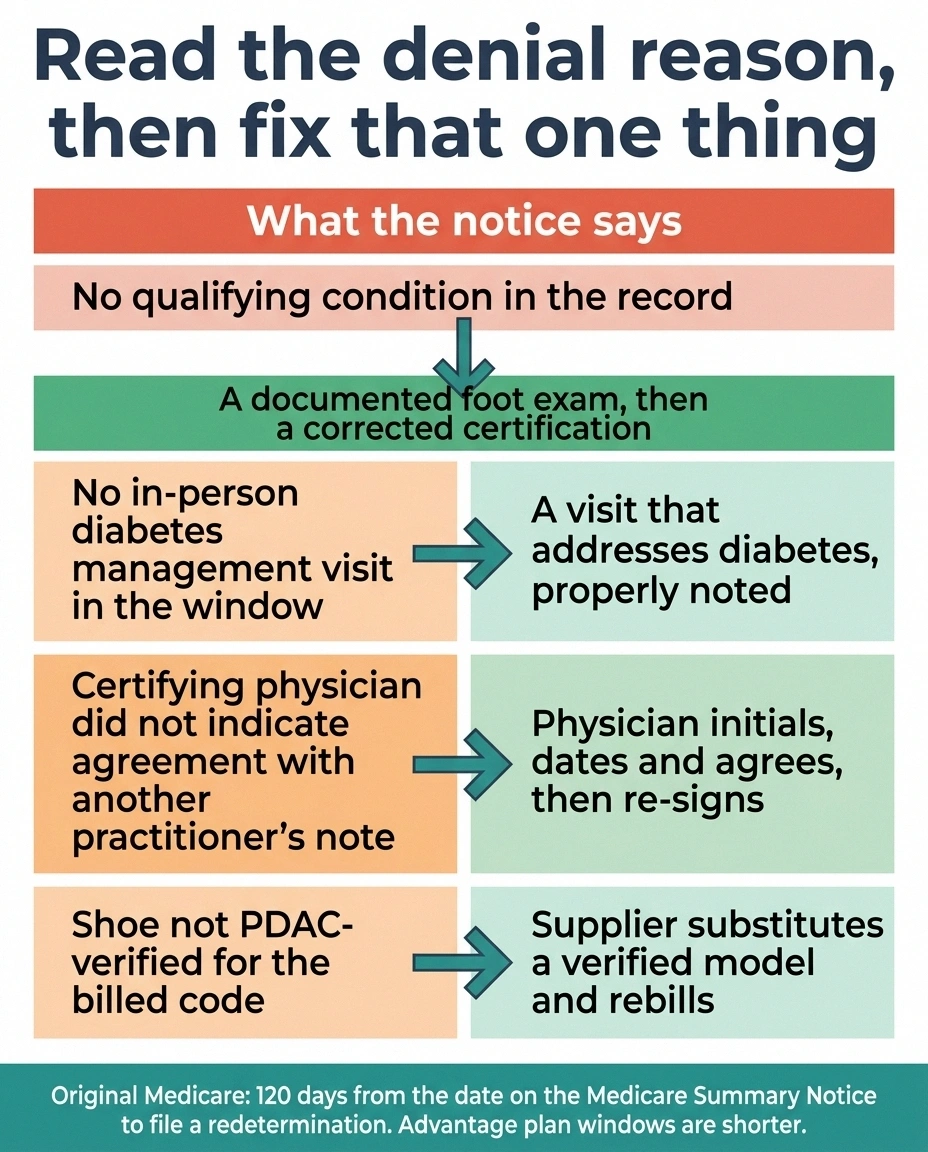
A denial on this benefit is usually a documentation problem, which means it is usually fixable, which means appealing is often worth it.
Start by getting the actual reason. The Medicare Summary Notice or the plan’s Explanation of Benefits will carry a denial code and a stated reason. That reason tells you which link in the chain broke, and the repair is different for each one.
If the reason is a missing qualifying condition, the repair is a documented foot exam and a corrected certification. If it is the in-person visit, the repair is a visit that addresses diabetes management, properly noted. If it is the co-signature rule, the repair is the certifying physician doing the initialing step and re-signing.
In many cases the cleanest path is not a formal appeal at all. It is a corrected claim resubmitted after the underlying documentation is fixed. Ask the supplier’s billing staff which route they recommend, because they handle these constantly and they know which of the two moves faster in your region.
Original Medicare gives you 120 days from the date on the Medicare Summary Notice to file a redetermination. Medicare Advantage appeal windows are typically shorter and are stated in your plan documents. Note the date the day you get the notice.
What to Say at Your Next Appointment

This is the part that actually moves things. Two conversations, two scripts.
To the doctor who manages your diabetes:
“I want to use the Medicare therapeutic shoe benefit this year. I need you to certify it. Can you check that my chart documents a qualifying foot condition, and that we have an in-person diabetes management visit inside the last six months? And if the last visit note was written by someone else in the practice, I understand you need to initial and date it before you sign the certification.”
That last sentence will surprise them, and that is fine. It signals you know where the failure point is, and it makes it far more likely that the step gets done.
To the podiatrist or supplier:
“Are you a Medicare-enrolled supplier for therapeutic footwear, and do you accept assignment? Are the shoes you would fit me with PDAC-verified for the code you will bill? And are you taking extra-depth with three additional insert pairs, or custom-molded with two?”
Write both down. Take them with you. Nobody has ever been thought less of for arriving at an appointment with a list.
The benefit has been sitting in Part B for decades. It is not new, it is not obscure, and it is not discretionary. It just requires four people to do four small things in the right sequence, and the only one of those people who is guaranteed to care about the outcome is you. Keeping a proper daily foot care routine going is what makes the documentation exist in the first place, and it is the part that keeps working long after the shoes wear out.
Frequently Asked Questions
How often can I get diabetic shoes through Medicare?
Once per calendar year. Either one pair of custom-molded shoes with two additional pairs of inserts, or one pair of extra-depth shoes with three additional pairs of inserts. The clock resets in January rather than running twelve months from your last pair.
Does Medicare cover diabetic shoes if I only have neuropathy?
Not by itself. The qualifying criterion is peripheral neuropathy with evidence of callus formation, and the callus has to be documented in your medical record by a clinician who examined your feet. Neuropathy with no callusing and no other qualifying condition does not meet the requirement. Five other conditions qualify independently, including foot deformity, poor circulation, a history of ulceration, a history of pre-ulcerative callus, and prior amputation.
Who has to sign for Medicare diabetic shoes?
Three people. The MD or DO managing your diabetes signs the certification statement. A podiatrist or other qualified doctor writes the prescription. A qualified supplier, such as a podiatrist, orthotist, prosthetist or pedorthist, fits and furnishes the footwear. The certifying physician cannot also be the supplier.
What will I pay out of pocket in 2026?
After the $283 Part B deductible, you pay 20% of the Medicare-approved amount. For a typical extra-depth package that works out to roughly $102 for the year. A Medigap policy may cover that coinsurance.
Does Medicare Advantage cover this?
Yes. Every Medicare Advantage plan must cover what Original Medicare covers. Expect network restrictions on suppliers, possible prior authorization, and cost sharing that may be a flat copay instead of 20%. Call your plan before the appointment.
Can I pick my own podiatrist?
Under Original Medicare, any podiatrist enrolled as a Medicare supplier for therapeutic footwear who accepts assignment. Under Medicare Advantage, only suppliers in your plan’s network.
Are inserts covered separately from the shoes?
The additional insert pairs are part of the same annual benefit, not a separate one. The shoes arrive with one pair included, and the two or three additional pairs come on top of that.
What is the six-month visit rule?
The certifying physician must have seen you in person for a visit addressing diabetes management within six months before the footwear is delivered. If that visit was documented by a nurse practitioner or physician assistant, the certifying physician must initial, date and indicate agreement with the note before signing the certification.
About the Author