Some days the walk costs you everything and the watch says 2,100 steps.
You went to the store. You did a loop of the block afterward because the weather was decent. Your feet burned by the end and you sat down in the car for a minute before driving home, and when you checked the number that evening it was so low it felt like an insult.
That number was almost certainly wrong. Not a little wrong. Wrong in a specific, measurable, well-documented direction, and wrong by more on your bad days than your good ones.
Once you understand how these devices actually count, a tracker goes from being a small daily discouragement to being genuinely useful. It just is not useful in the way the box suggests.
How a Step Counter Decides You Took a Step
There is no sensor in your watch that detects feet. What is in there is an accelerometer, a tiny device that measures movement in three directions many times a second, producing a continuous squiggle of motion data.
Software then looks at that squiggle for a pattern it recognises as walking: a rhythmic bounce, at a certain cadence, with a certain sharpness, repeating for long enough to look deliberate. When the pattern matches, it adds a step.
That pattern was defined by watching a lot of people walk. Mostly younger people, mostly at ordinary speed, mostly with a normal stride and a normal arm swing.
Which means the device is not counting your steps. It is counting how closely your movement resembles a reference walk that nobody with painful feet has ever produced.
Why Slow Walking Breaks It
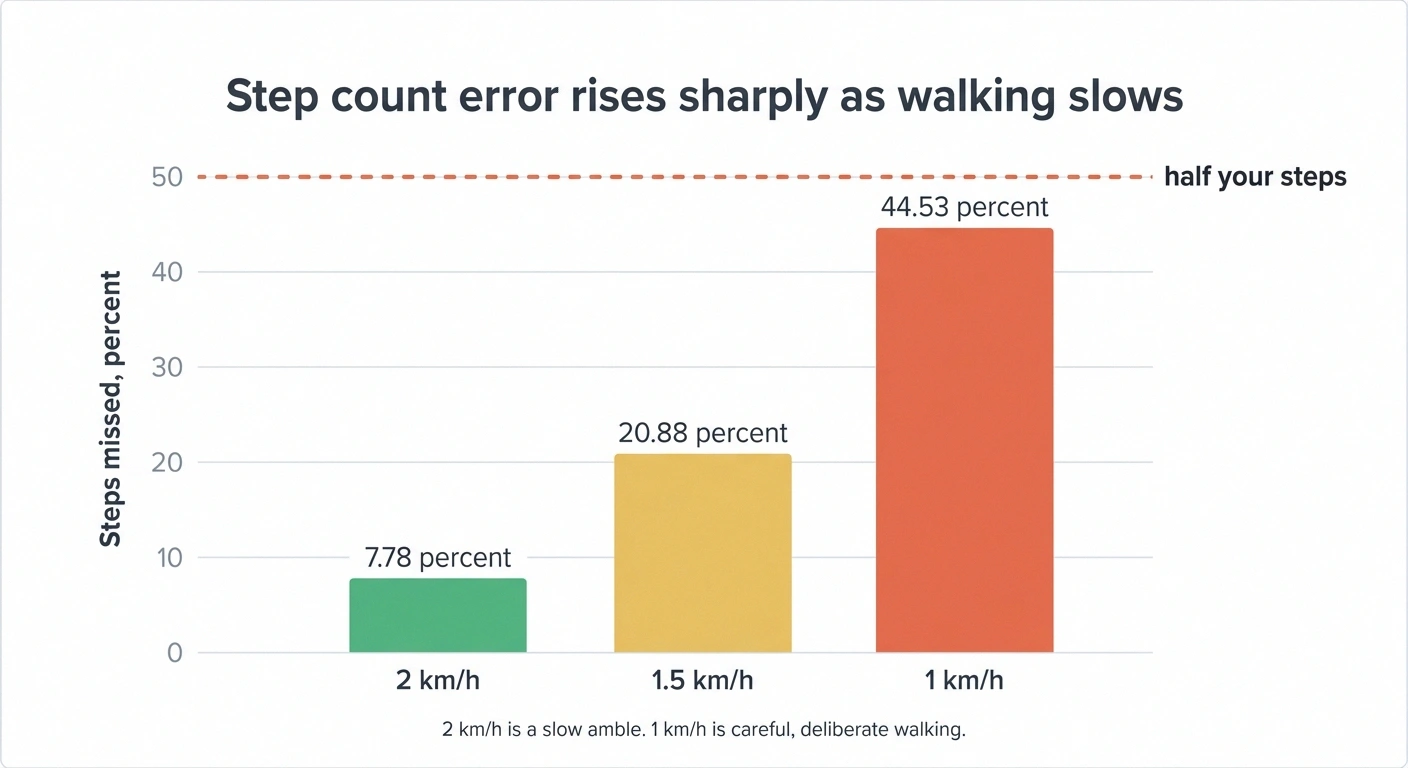
Walking speed turns out to be the single largest factor in step counting accuracy, and the numbers are startling.
How much the count degrades as you slow down
For scale, 2 km/h is a slow amble and 1 km/h is roughly the pace of someone picking their way carefully across a car park.
| Walking speed | Step count error | What that means for 3,000 real steps |
|---|---|---|
| 2 km/h | 7.78% | Roughly 230 steps missing |
| 1.5 km/h | 20.88% | Roughly 630 steps missing |
| 1 km/h | 44.53% | Roughly 1,340 steps missing, nearly half the walk |
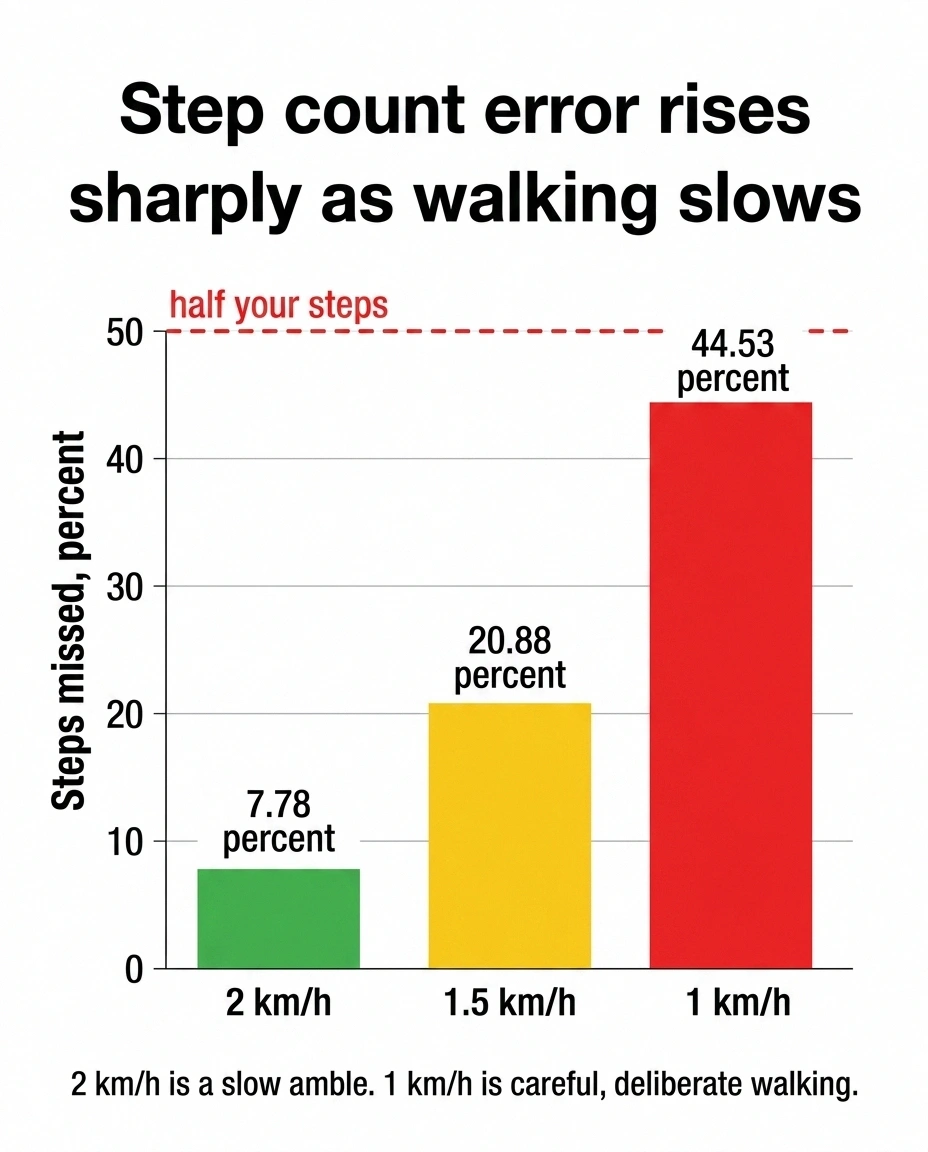
Testing across trackers found error rates of about 7.78 percent at a walking speed of 2 km/h, rising to 20.88 percent at 1.5 km/h, and reaching 44.53 percent at 1 km/h. The slower the walk, the worse the count, and the deterioration is steep rather than gradual.
Forty-four percent error means that on a slow walk, nearly half your steps can go uncounted.
Neuropathy walking hits several of the failure conditions simultaneously. The pace is slower, because pain and uncertain footing both slow you down. The stride is shorter, which softens the impact the accelerometer is looking for. And if you are using a cane, a walker, or a hand on the rail, your arm swing is gone, which matters enormously for a device on your wrist that is largely reading arm motion.
Trackers may register no steps at all with a shuffling gait or a limp. Not undercounting: nothing. The movement simply never matches the pattern.
Even in general use, consumer trackers have been found to underestimate steps in older adults by around 25 percent compared with research-grade devices. Among research devices, the spread is wide too: one comparison put a specialised ankle-worn monitor at 99.0 percent accuracy, another device at 93.7 percent, and a third at 51.4 percent.
None of this is a defect in your particular watch. It is what these devices do.
The Cruelty of the Feedback Loop
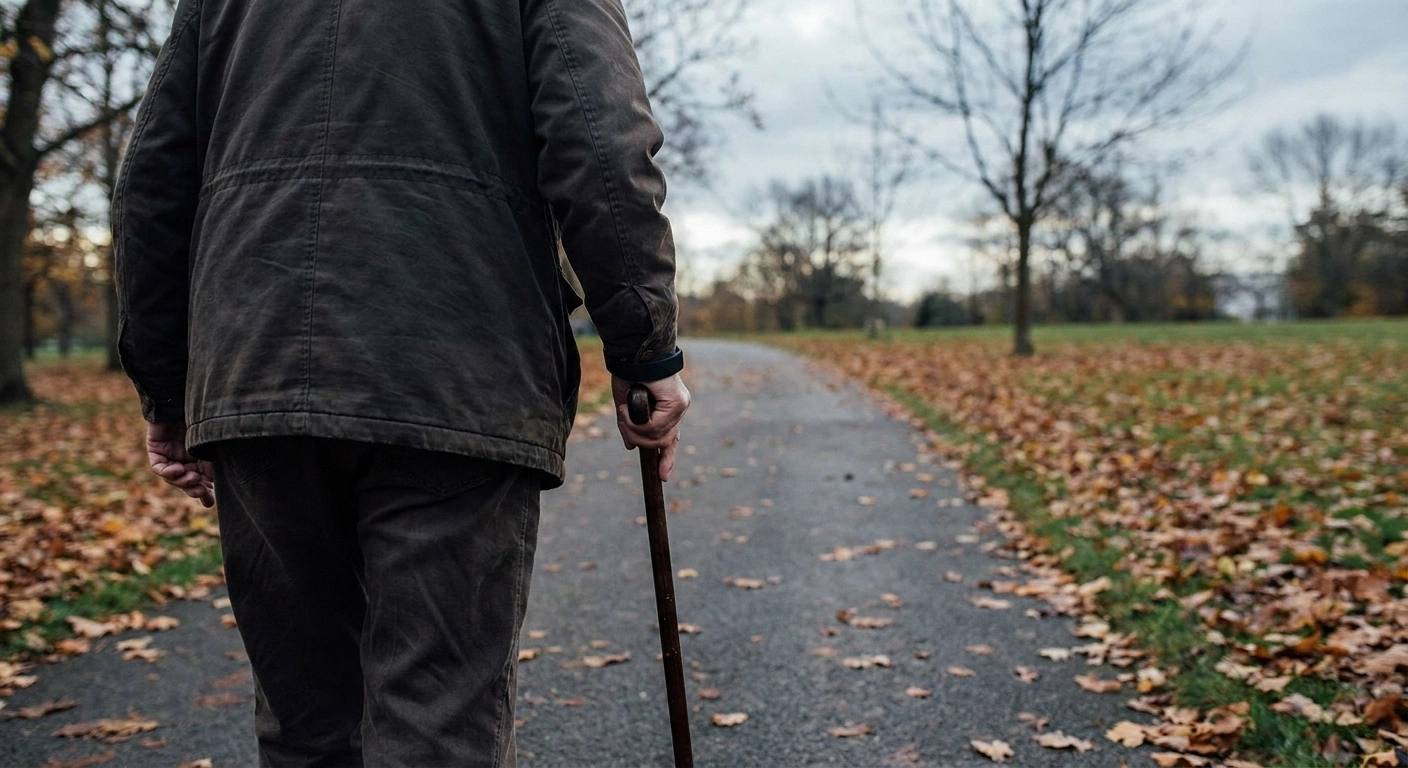
Notice which direction the error runs, because this is the part that actually matters for how you feel.
The error is always downward, and it grows as you slow down. So on your worst days, when pain is high and you are moving cautiously and every step is deliberate work, the tracker undercounts you the most. On your best days, when you are moving closer to a normal pace, it counts you most accurately.
The result is a feedback system that systematically punishes effort. The days that took the most out of you produce the smallest numbers. Do that for a few months and it becomes very easy to conclude that you are doing almost nothing, when what is actually happening is that your device cannot see the work.
That is worth naming plainly, because a lot of people quietly give up on walking after a season of discouraging numbers, and walking is one of the better things available for nerve health and circulation.
Move the Device
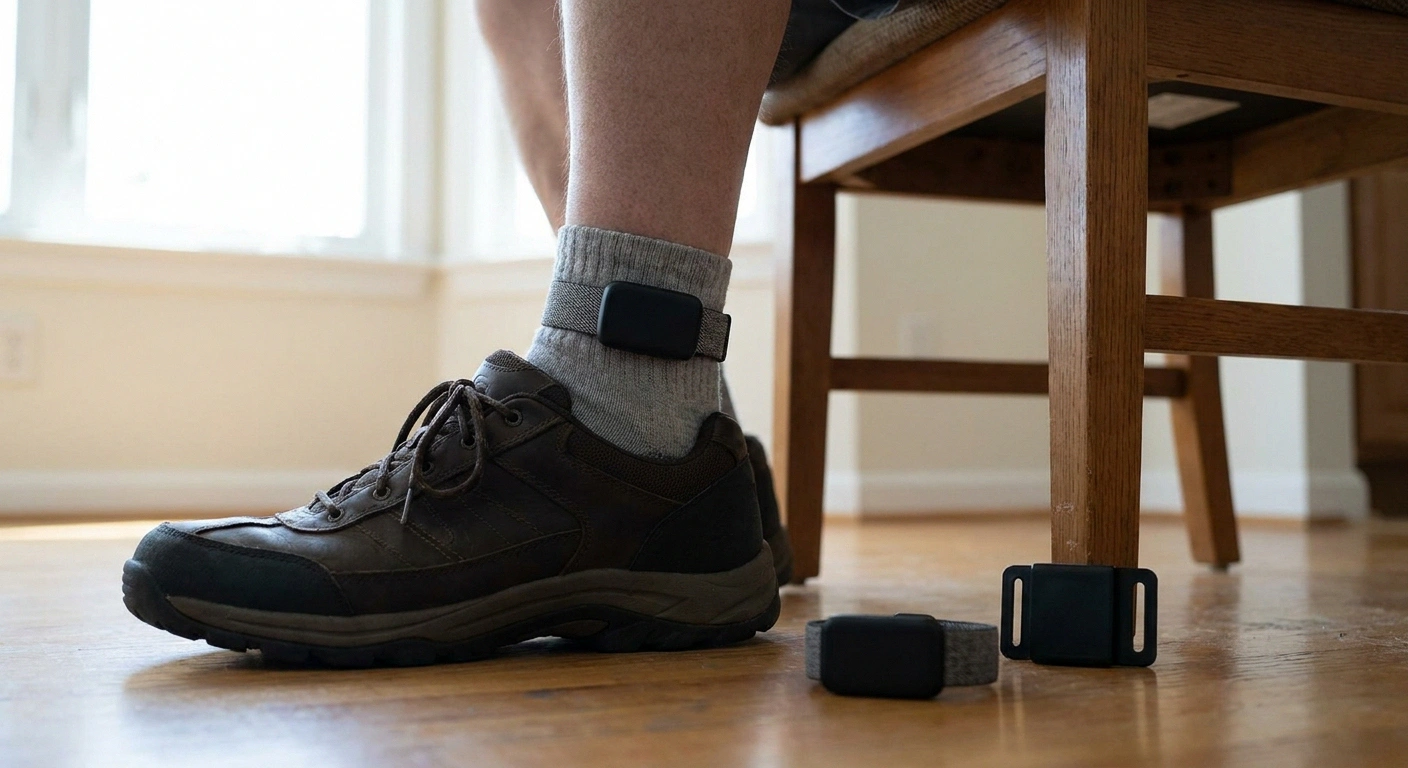
Placement matters more than brand, and this is the highest-leverage change available to you.
Where to wear it, best to worst for slow walking
- Ankle
- Reads the stepping limb directly. One device held within about 5 percent error down to 0.5 m/s here. This is where the most accurate research monitors are worn.
- Waist or belt clip
- Reads torso movement rather than arm swing. Good, though the same device that stayed accurate at the ankle started losing steps here below 0.9 m/s.
- Wrist, free arm
- Workable if you walk unaided and your arms swing normally. This is where nearly everyone wears one, and where the accuracy problems are largest.
- Wrist, hand on a cane or rail
- Close to useless. The arm is not swinging, so the signal the device depends on is not there to read.
Wrist tracking depends heavily on arm swing. Ankle and hip placement read the movement of the limb that is actually stepping, which is far more reliable when the gait is slow or the arms are occupied.
The evidence is fairly direct. One tracker worn at the ankle stayed within about 5 percent error at speeds as slow as 0.5 m/s, while the same device at the waist lost accuracy below 0.9 m/s. Ankle placement is also what the most accurate research monitors use.
In practice, three options are worth trying:
- A clip-on pedometer at the waistband or belt. Cheap, reads torso movement rather than arm movement.
- A small tracker on an ankle strap. Closest to how research devices are worn, and best for slow or shuffling gait.
- Your watch moved to the non-cane hand, if you use a walking aid. A modest improvement, but free.
If you use a walker, where both hands are occupied, wrist tracking is close to useless and ankle or waist placement is not optional. Our guide to canes and walking aids covers the wider question of using them well.
Forget 10,000
The 10,000-step target has no scientific basis whatsoever. A Japanese company invented it in 1965 as a marketing figure, chosen partly because the written character for ten thousand looks like a walking person.
Replacing the default goal with a real one
Takes about three weeks and produces a target that belongs to you rather than to a 1965 advertising campaign.
- Week one: wear it and change nothing. Do not chase a number.
- Average those seven days. That is your baseline, whatever it says.
- Add about 10 percent and hold that level for two weeks before adding more.
- If the increase costs you the following day every time, go back a step. You found the ceiling, which is a useful answer.
It has been repeated so consistently for sixty years that it now reads as medical advice, and it is arbitrary for anyone, let alone for someone whose feet hurt.
What is worth doing instead is establishing your own baseline. Wear the device for a week without trying to change anything. Whatever the average turns out to be, that is your starting number, and it is the only number that means anything to you.
Then aim for small increases from there, in the range of 10 percent at a time, holding each new level for a couple of weeks before going further. That approach respects the pacing reality that governs most of life with neuropathy, which we went through in managing fatigue and pacing.
Read It as a Trend, Not a Truth

Here is the reframe that makes the whole device worth keeping.
Your tracker is a bad instrument for measuring how much you walked. It is a decent instrument for measuring whether this week resembles last week, because the errors are reasonably consistent for the same person doing the same kind of walking with the device in the same place.
So stop reading the daily number and start reading the shape of the week.
Consistency beats total. Five days of moderate movement does more for nerve health and circulation than one big day and six recovering ones. If your week is one tall bar and six short ones, that pattern is worth changing regardless of the sum.
Watch the day after. If a higher day is reliably followed by a much lower one, you have found your ceiling, and it is more useful than any target. Pairing your step data with a symptom diary is where this genuinely pays off, because the diary supplies the cost that the step count leaves out.
And compare like with like. Winter numbers and summer numbers are different animals. Compare this February with last February.
When the Tracker Becomes the Problem
Worth saying, because it happens: these devices are designed to encourage, and the encouragement mechanisms can work against a person who needs to pace.
A streak is a reason to walk on a day you should not
These features were designed for people whose main obstacle is motivation. If your main obstacle is a body that charges you for yesterday, a thirty-day streak stops being encouragement and becomes an obligation.
Most devices let you switch off goal alerts and streak notifications while still recording every step. Keep the record, drop the pressure.
Streaks are the main offender. A device that congratulates you for thirty consecutive days of hitting a goal creates real pressure to walk on the day your body is asking you not to. That is precisely the mechanism that produces flare-ups.
Move goals and nudges to stand up can do the same on a bad afternoon.
If you notice yourself walking to protect a streak rather than because you want to walk, turn the streak off. Most devices allow goal notifications to be disabled entirely while still recording data. The record is the useful part. The cheerleading is optional, and for pacing-sensitive people it is frequently harmful.
One more caution. Do not let a good step number talk you out of paying attention to your feet. Steps taken in poorly fitting shoes with reduced sensation is exactly how injuries go unnoticed, which is why footwear and a daily foot check matter more than any number on a screen. Balance deserves the same care, and our guide to balance and fall prevention covers what actually reduces risk.
What to Actually Do
Move the device off your wrist, to your ankle or your waistband. Wear it for one ordinary week and take that average as your baseline, ignoring every default target. Read weeks rather than days, and pay more attention to how many days you moved than to how far. Note what the next day costs you. Turn off streaks and goal alerts if they are pushing you.
And when the number looks small after a walk that felt hard, remember which direction the error runs. Your device did not see nearly half of what you did. You know what that walk took. The watch does not.
Frequently Asked Questions
Why does my fitness tracker not count my steps?
Step counters work by matching your movement against a pattern of what walking is supposed to look like, and slow, short-strided or shuffling gait often does not match closely enough to register. Accuracy falls sharply as walking speed drops, with error rates rising from around 8 percent at 2 km/h to over 44 percent at 1 km/h. Wrist-worn devices are especially affected because they rely heavily on arm swing, which is reduced or absent when you use a cane, a walker, or a handrail.
Where should I wear a step counter if I walk slowly?
The ankle is generally the most accurate placement for slow walking, followed by the waist or hip. One tracker held within about 5 percent error at the ankle at speeds as slow as 0.5 m/s, while the same device worn at the waist lost accuracy below 0.9 m/s. Ankle placement is also what the most accurate research-grade monitors use. If you use a walker, ankle or waist placement is essential because both hands are occupied.
Is 10,000 steps a day a real target?
No. The figure originated with a Japanese company in 1965 as a marketing decision, partly because the written character for ten thousand resembles a walking person. It has no scientific basis for any population, and it is particularly unhelpful as a goal for someone with painful feet. Establishing your own baseline over an ordinary week and increasing gradually from there is far more useful.
How accurate are consumer trackers for older adults?
Less accurate than most people assume. Consumer trackers have been found to underestimate steps in older adults by around 25 percent compared with research-grade devices, and the gap widens as walking speed decreases. Older adults tend to face a compounding problem, since slower pace, shorter stride and reduced arm swing each degrade accuracy independently.
Which numbers on my tracker actually matter with neuropathy?
Consistency across the week matters more than any single day total, since regular moderate movement generally serves nerve health and circulation better than one large effort followed by several recovery days. It is also worth noting what the following day costs you, because a high day reliably followed by a very low one indicates you have found your current ceiling. Comparing the same season year on year avoids being misled by weather.
Can a fitness tracker make my neuropathy worse?
Indirectly, yes. Streak counters, daily goals and movement reminders are designed to encourage activity, and that encouragement can push someone toward walking on a day their body is signalling rest, which is a common route into a flare. If you find yourself walking to protect a streak rather than because you want to, turning off goal notifications while continuing to record data removes the pressure and keeps the useful part.
About the Author