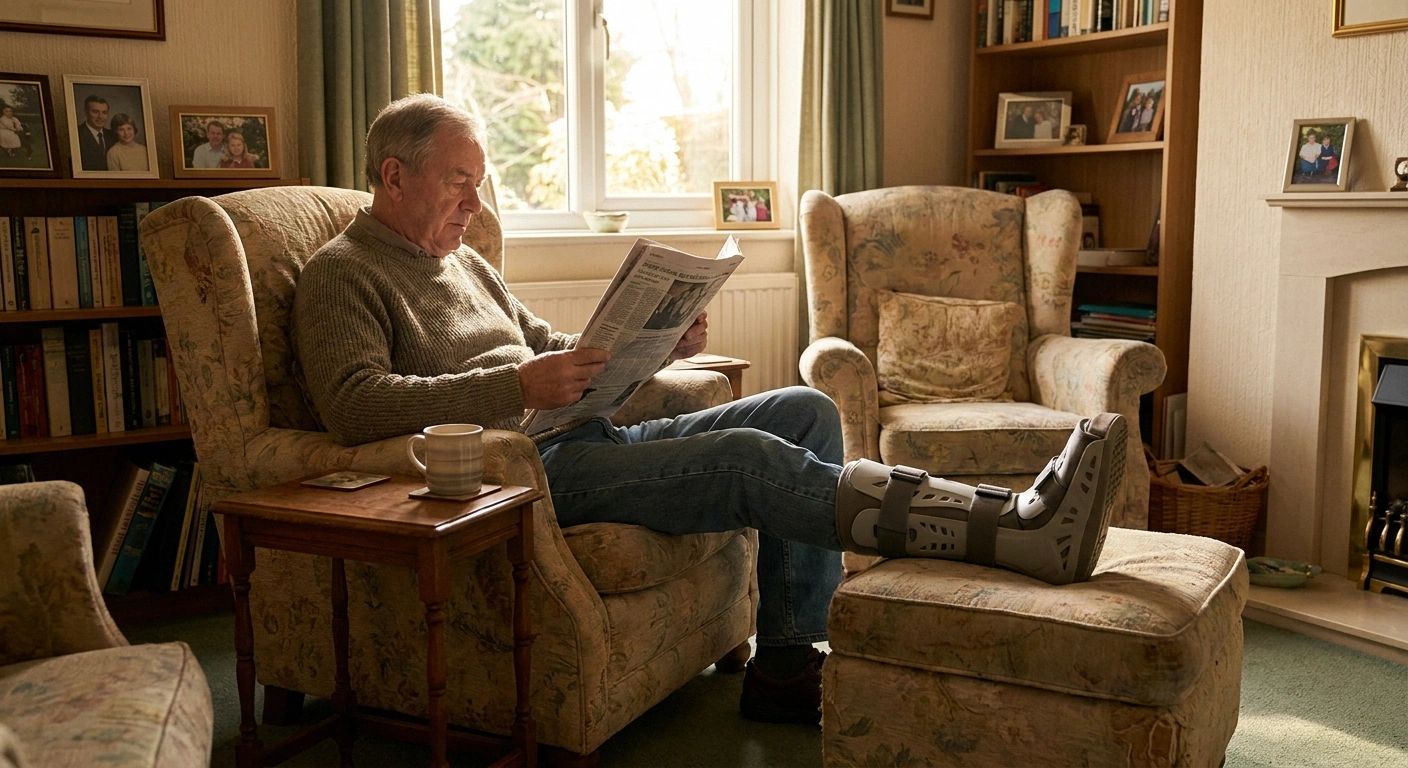
A man in our group named Wendell spent eleven months with an ulcer under the ball of his left foot.
Eleven months of dressings, of antibiotics, of appointments. He had a removable boot the entire time. He wore it faithfully, by his own honest account, except when he showered, except overnight, except walking from the bedroom to the bathroom at two in the morning, and except in his own kitchen where the floor was clean and he was only going to be a minute.
His podiatrist eventually cast the foot. It closed in seven weeks.
Nothing about the wound had changed. What changed was that the exceptions became impossible.
The Physics Nobody Explains at the Appointment
A neuropathic foot ulcer is, at its core, a pressure injury. Sensation is gone, so the foot never receives the message to shift its weight. Load lands on the same square inch thousands of times a day, tissue breaks down from the inside, and a wound opens where the pressure concentrated.
Which means the wound care itself, the dressings and the debridement and the topical agents, is secondary. Those manage a wound that is being re-injured. Remove the pressure and a well-perfused foot will generally close on its own. Leave the pressure and no dressing on earth will keep up.
Offloading is the treatment. Everything else is support.
And here is the part that reframes the entire subject: pressure damage is cumulative, and it does not care about your reasons. Fifteen minutes barefoot on a kitchen floor delivers real load to the wound bed. Your foot has no way to register that it is happening and no way to tell you afterward. There is no such thing as a minute that does not count.
What a Total Contact Cast Is
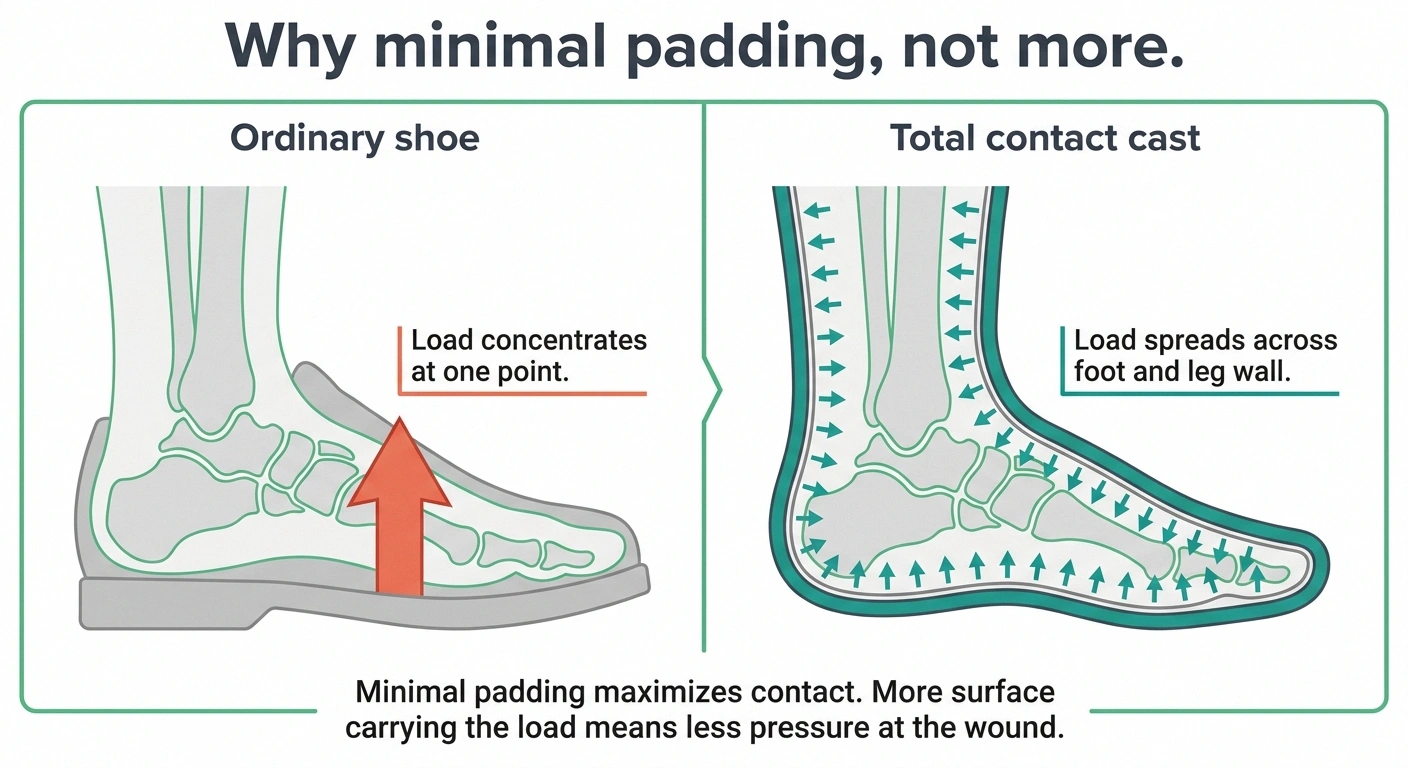
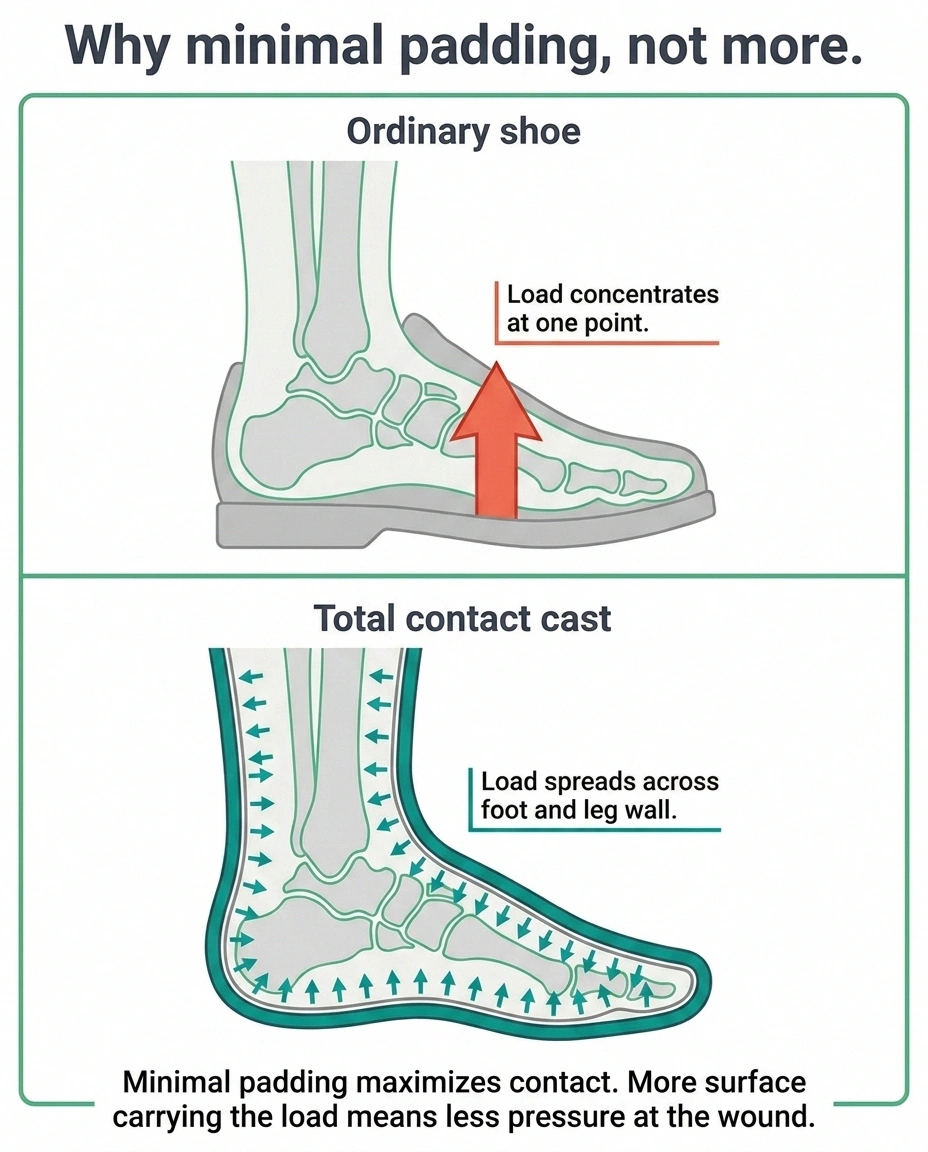
A total contact cast is a fiberglass or plaster cast applied over the foot and lower leg with minimal padding, molded to follow every contour of your foot.
The minimal padding is deliberate and counterintuitive. Ordinary casts are padded to protect against pressure. A total contact cast instead maximizes contact, so load spreads across the entire surface area of the foot and lower leg rather than concentrating at the wound. Pressure at the ulcer site drops substantially, and a portion of your body weight transfers into the cast wall itself.
It is applied by trained personnel, typically changed weekly at first, and it cannot be removed by you. That last property is not a limitation of the design. It is the design.
The Numbers, and What Actually Produces Them
The evidence here is unusually consistent for wound care.
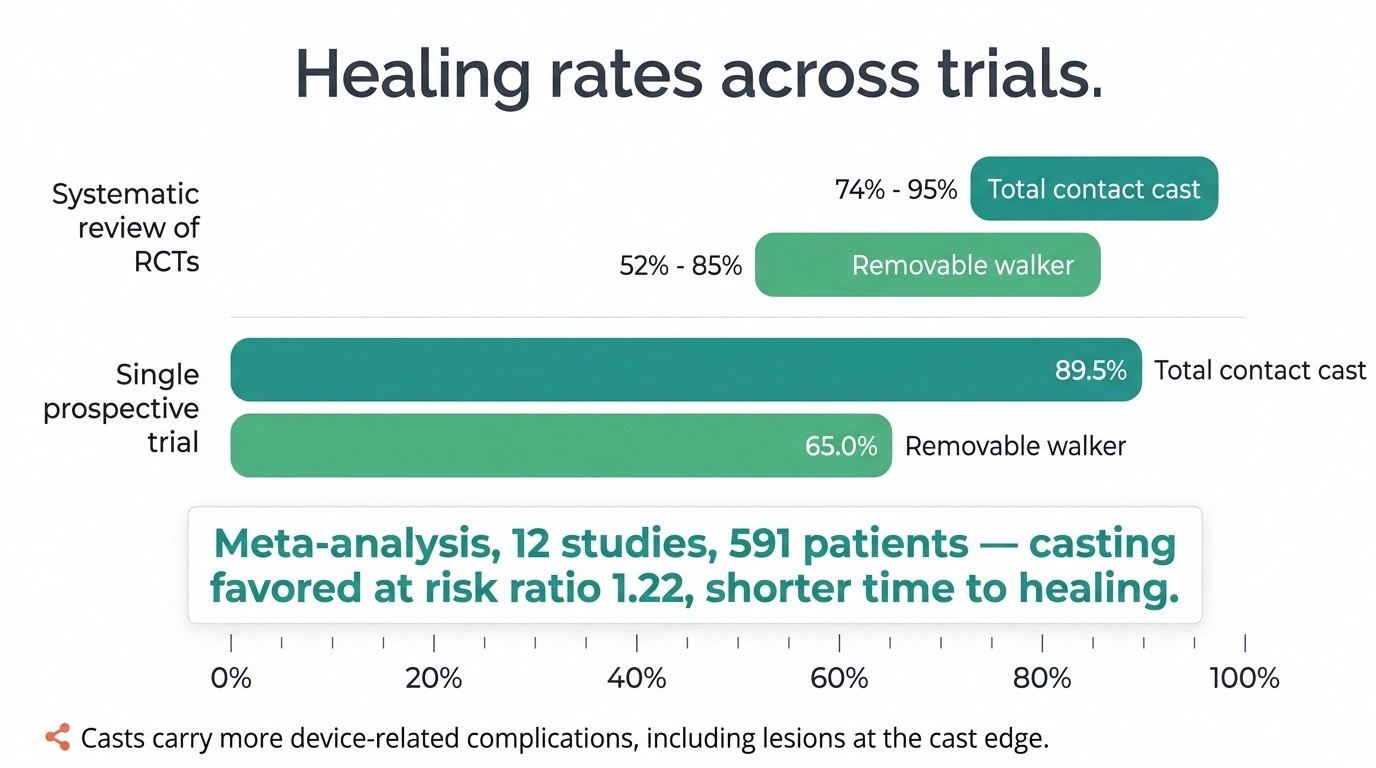
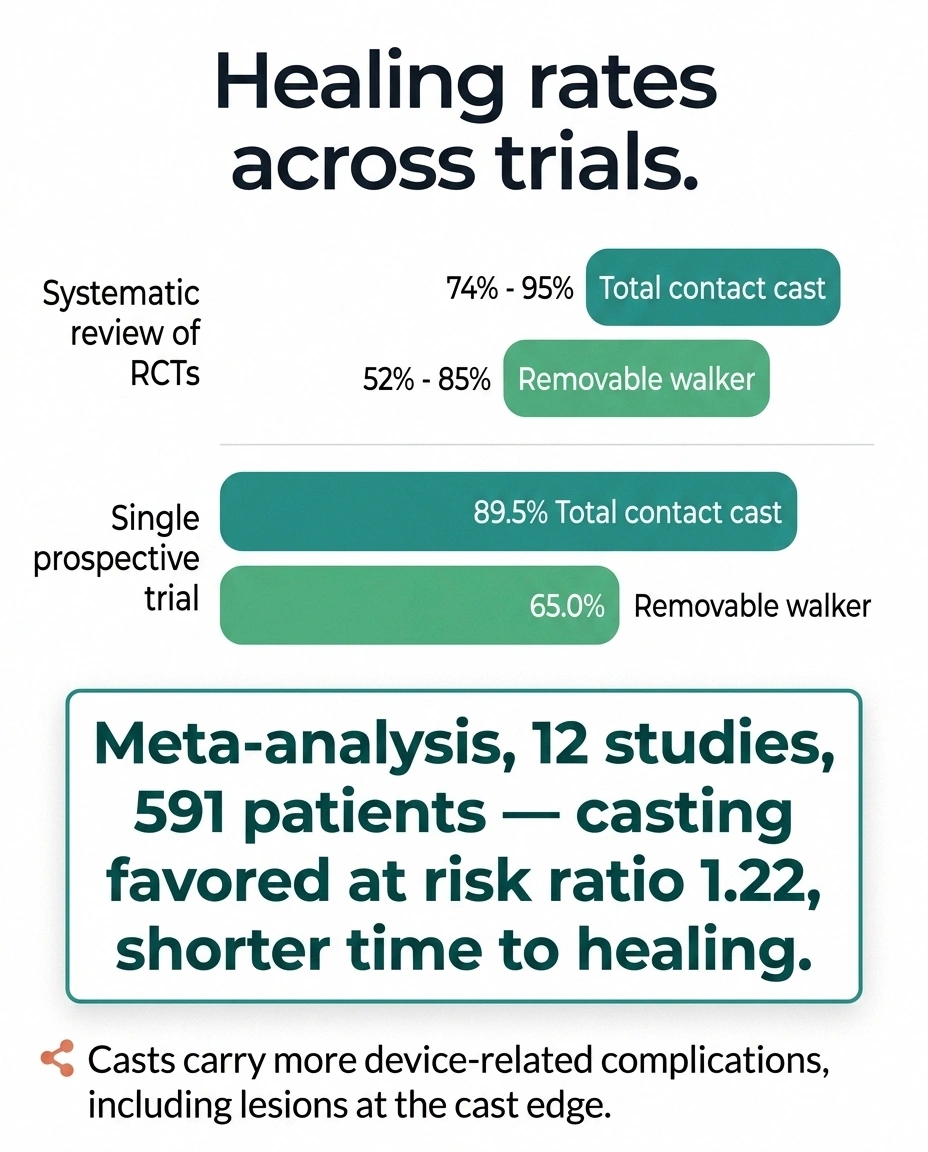
Healing rates across trials
Ranges are wide because trial populations differ in wound severity and circulation. The gap between the two columns holds in every comparison.
| Evidence source | Total contact cast | Removable walker |
|---|---|---|
| Systematic review of RCTs | 74% to 95% healed | 52% to 85% healed |
| Single prospective trial | 89.5% healed | 65.0% healed |
| Meta-analysis, 12 studies, 591 patients | Casting favored at risk ratio 1.22, with shorter time to healing | |
| Tradeoff | Casts carry more device-related complications, including lesions at the cast edge | |
Systematic reviews of randomized trials put healing rates for total contact casting between 74 and 95 percent, against 52 to 85 percent for removable cast walkers. One prospective trial recorded 89.5 percent healing with casting versus 65.0 percent with a removable walker. A meta-analysis pooling twelve studies and 591 patients found casting produced both higher healing rates, at a risk ratio of 1.22, and shorter healing times.
Total contact casting is the reference standard against which every other option is measured.
Now the interesting question. Why does it win?
Not because the biomechanics are dramatically superior. A good removable walker redistributes pressure impressively well, and in laboratory measurement the two devices are far closer than the healing outcomes suggest. Researchers looking at this gap keep landing on the same explanation: the difference is adherence. A removable device only offloads during the hours it is actually worn.
Studies that have measured wear time rather than asking about it find that people wear removable devices for a fraction of their walking activity, often much less than they sincerely believe. Not through carelessness. Through showers, sleep, quick trips, and a hundred reasonable-feeling exceptions like Wendell’s.
A cast has no exceptions available. That is the entire mechanism of its advantage.
The Compromise Most People Have Never Heard Of
Between the cast and the boot sits an option that almost never appears in patient-facing material, which is a shame, because it is often the practical answer.
An instant total contact cast is a standard removable walker made irremovable, usually by wrapping it in cohesive bandage or a layer of fiberglass so the patient cannot take it off between visits.
The logic is direct. If the cast’s advantage is irremovability rather than superior mechanics, then take an ordinary boot and remove the option of removing it. Studies bear this out, with irremovable walkers performing close to true casting.
Its practical merit is availability. True total contact casting requires trained personnel, takes real time to apply, and carries genuine skill requirements, which is a substantial part of why it remains underused despite being the gold standard. An instant cast can be produced in most clinics that own a boot and a roll of wrap.
If a cast has been ruled out for logistical reasons rather than medical ones, this is a fair thing to ask about by name.
Where Casting Is the Wrong Choice
Casting is not universally appropriate, and the exclusions are meaningful.
Significant peripheral arterial disease is the most important. A cast makes the foot difficult to inspect, and an ischemic foot can deteriorate quickly. Circulation generally needs assessing before anyone casts anything.
Active deep infection or osteomyelitis usually needs to be addressed first, because sealing a foot away from daily observation while infection is spreading is a poor trade. Heavily draining wounds present a similar problem, since a cast cannot be changed daily.
Then there are the practical exclusions. Poor balance makes a cast a fall risk, and a fall is a worse outcome than a slow-healing ulcer. Vision too poor to inspect the skin around the cast edges matters. So does whether a person can genuinely keep it dry.
Casts also carry their own complication rate. The literature is clear that they produce more device-related problems than removable options, including new lesions caused by the cast itself, particularly at the edges. This is why the weekly changes exist and why they are not optional.
The Full Ladder
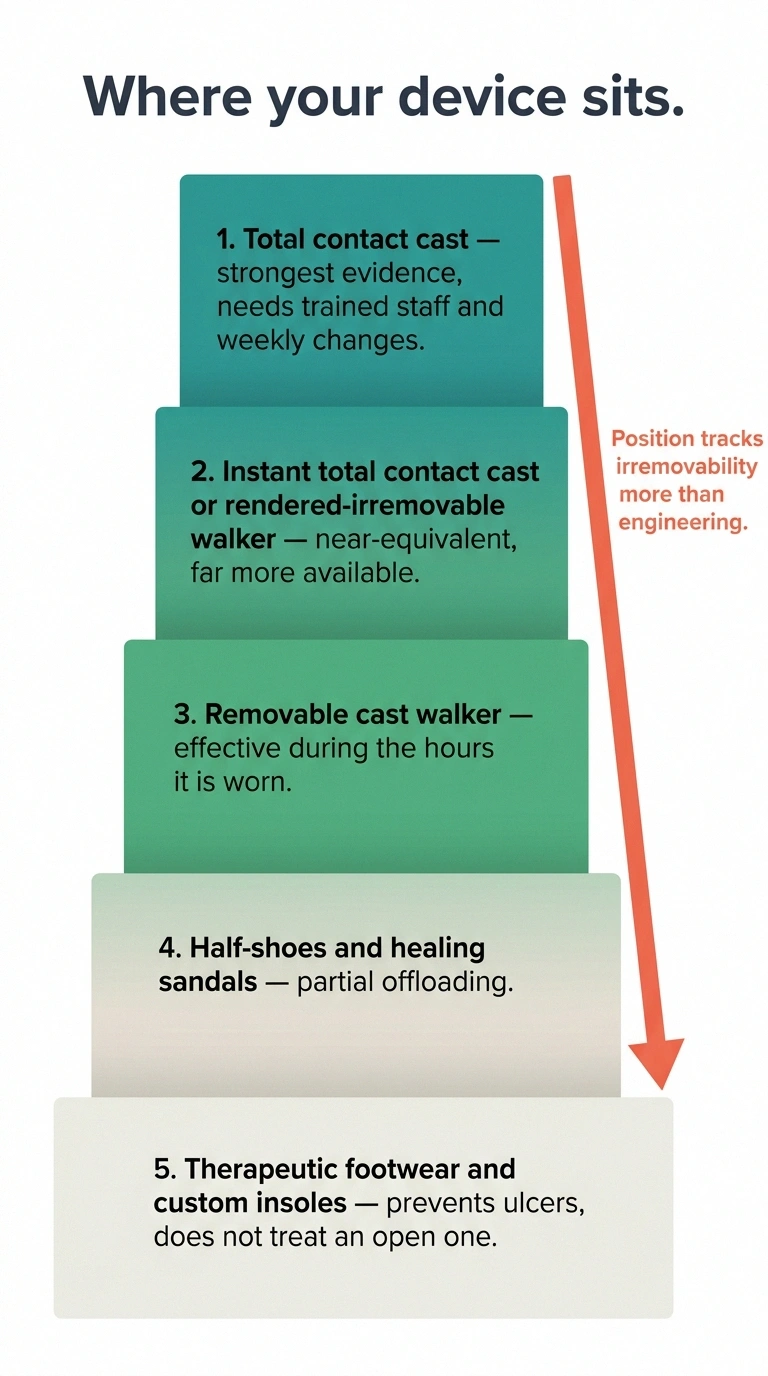
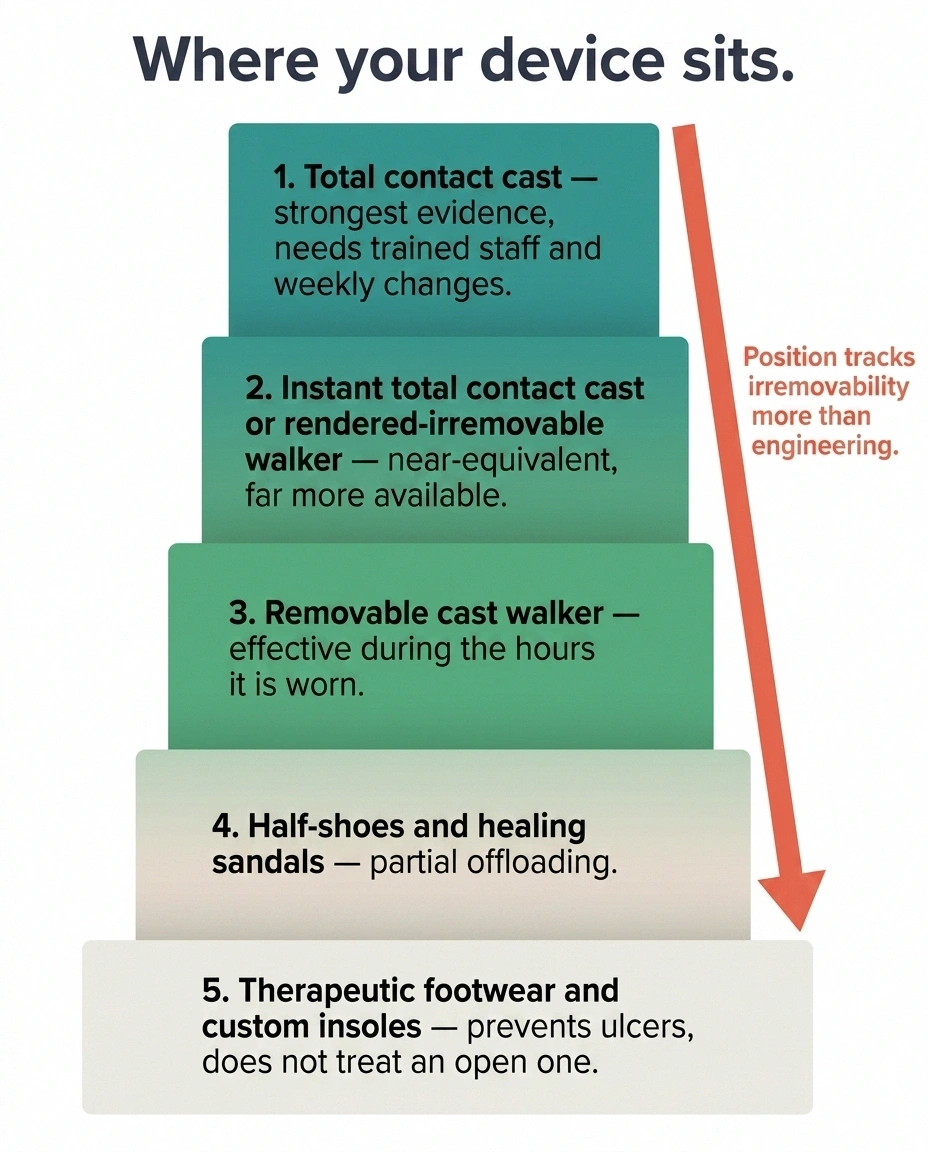
Offloading is a hierarchy, and knowing where your device sits on it tells you what to expect.
Where your device sits on the ladder
Position on this ladder tracks irremovability more closely than it tracks engineering.
- 1. Total contact cast
- Strongest evidence, highest healing. Needs trained staff and weekly changes.
- 2. Instant total contact cast or rendered-irremovable walker
- Near-equivalent outcomes, far more widely available. Ask for it by name.
- 3. Removable cast walker
- Effective during the hours it is genuinely worn, and measured wear time runs well below reported wear time.
- 4. Half-shoes and healing sandals
- Partial offloading. Usually a compromise for people who cannot manage a boot.
- 5. Therapeutic footwear and custom insoles
- Prevents ulcers and maintains remission. Not treatment for a wound that is already open.
Total contact casting sits at the top, with the strongest evidence and the highest healing rates. Instant total contact casting or a rendered-irremovable walker sits just below, near-equivalent and far more widely available. A removable cast walker follows, effective when genuinely worn and considerably less so otherwise. Below that sit half-shoes and healing sandals, which offload partially and are usually compromise choices for people who cannot manage a boot. At the bottom, therapeutic footwear and custom insoles do a real job in preventing ulcers and maintaining remission, but they are not treatment for an ulcer that is already open.
That last distinction gets muddled often enough to be worth stating plainly. Good diabetic shoes prevent wounds. They do not heal them. Our shoe shopping guide covers what belongs on your feet after the wound has closed.
The Foot Nobody Warns You About
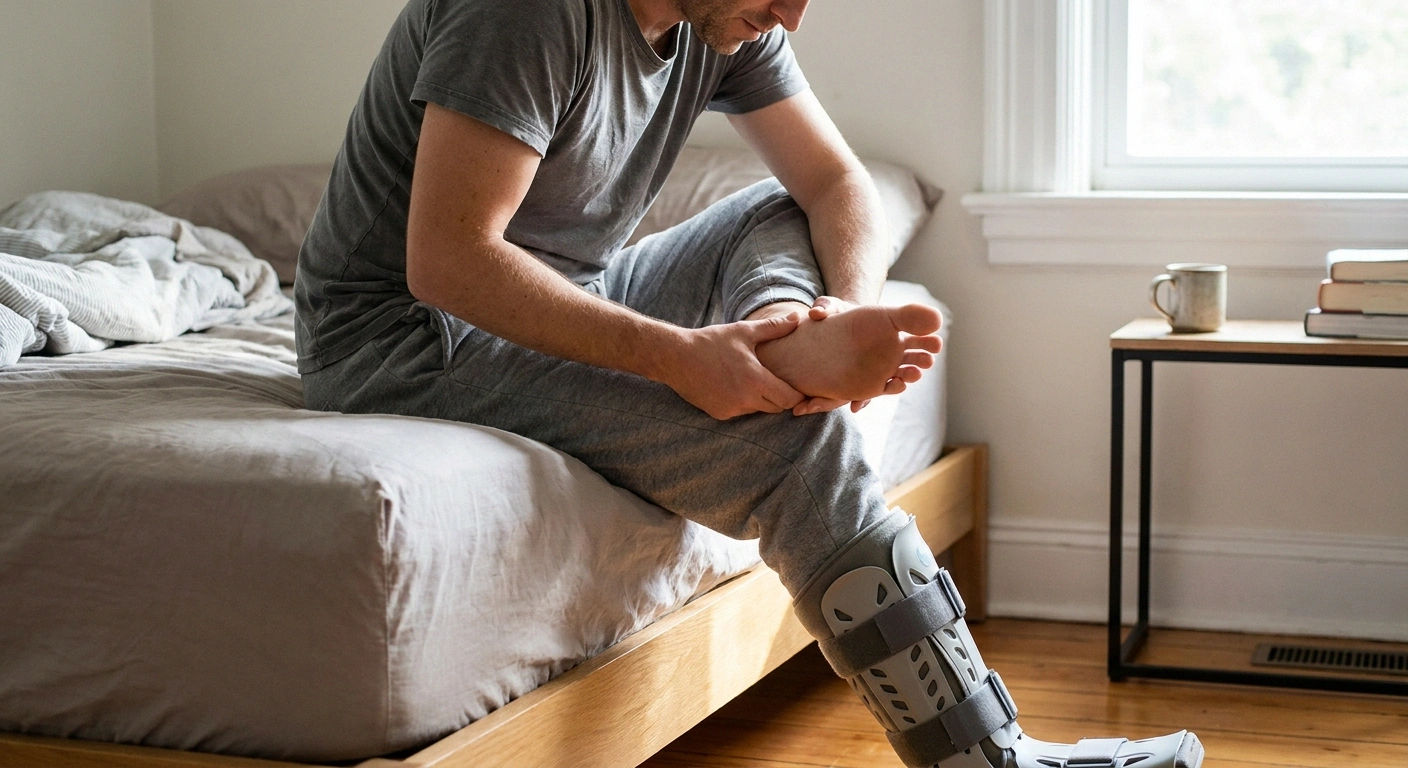
Here is the detail that rarely appears anywhere outside podiatry literature, and it deserves your attention.
The other foot is working overtime
For the entire treatment period your uninvolved foot absorbs extra load, extra steps, and altered mechanics. It has the same neuropathy and the same silence. Healing one ulcer only to open one on the opposite foot is a common and thoroughly demoralizing outcome.
The fix nobody mentions: a cast or boot makes one leg effectively longer, sending asymmetry up through knee, hip, and lower back. A shoe balancer or even-up lift worn on the unaffected foot restores leg length and prevents a secondary problem entirely.
While one foot is protected, the other one is absorbing everything the protected foot is not.
Your uninvolved foot takes extra load, extra steps, and altered mechanics for the entire treatment period. It has the same neuropathy. It has the same silence. And a meaningful number of people heal one ulcer only to discover a new one on the opposite foot, which is a genuinely demoralizing outcome after months of effort.
So inspect the other foot with the same diligence you apply to the treated one. Every day, sole and between the toes, exactly as covered in our guide to daily foot inspection.
There is a related mechanical problem worth raising. A cast or boot is taller than a shoe, which leaves you walking with one leg effectively longer than the other for weeks or months. That asymmetry travels up through the knee, hip, and lower back, and it is a common source of new pain during treatment that people rarely connect to the device.
The fix is a shoe balancer or an even-up lift worn on the unaffected foot to restore leg lengths. Many people are never told these exist. Asking for one is reasonable and it prevents a secondary problem entirely.
Living in It
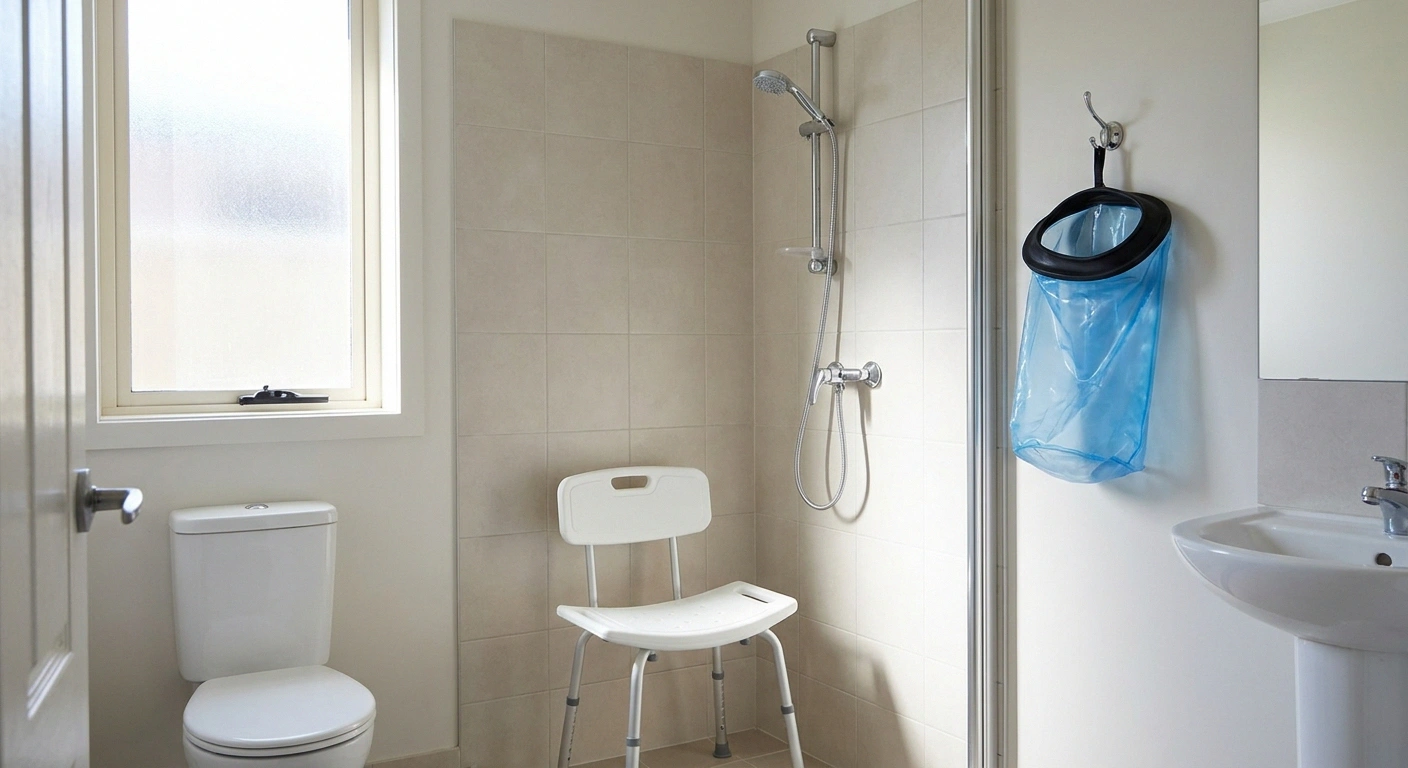
The clinical literature stops at healing rates. The daily reality is where people actually struggle.
The five things that go wrong at home
Clinical literature stops at healing rates. These are what actually derail treatment between appointments.
- Showering. A sealed cast cover beats a bag and tape, which leaks often enough to cause unscheduled cast changes. Add a shower chair.
- Sleeping. Pillow under the calf, not the heel, or you create a new pressure point where you were trying to avoid one.
- Driving. Never with a cast on the right foot. Braking is compromised and coverage may be affected.
- Itching. Nothing goes inside the cast, ever. A numb foot cannot report the wound your scratching just made. Cool air from a hair dryer instead.
- Balance. Gait changes substantially in a cast, so fall risk rises. A properly fitted cane during this period is not overcautious.
Showering. A cast must stay dry, and a plastic bag with tape is unreliable enough to ruin casts regularly. Purpose-made waterproof cast covers with a rubber seal work far better and cost very little. A shower chair paired with a handheld sprayer makes the whole business safer, since standing on one leg on wet tile is a genuinely bad idea with impaired balance.
Sleeping. The cast is heavy and warm, and most people find the first few nights difficult. A pillow under the calf, not under the heel, keeps the leg supported without creating a new pressure point.
Driving. Never drive with a cast on the right foot. Braking is compromised, and beyond the safety issue, insurance coverage may be affected. A cast on the left foot with an automatic transmission is usually workable, but it is worth confirming rather than assuming.
Stairs and general movement. Gait changes substantially in a cast, and fall risk rises accordingly. A cane or walker used properly is worth having during this period, and our article on canes and walking aids covers the fitting. For anyone whose balance was already unsteady, balance and fall prevention with neuropathy is directly relevant here.
Itching. It is common, it is maddening, and the one rule is absolute: nothing goes down inside the cast. Not a ruler, not a knitting needle, not a coat hanger. A numb foot cannot report the injury caused by the scratching, and people have created new wounds inside a cast placed to heal one. Cool air from a hair dryer on its no-heat setting is the standard remedy.
When to Call, Not Wait
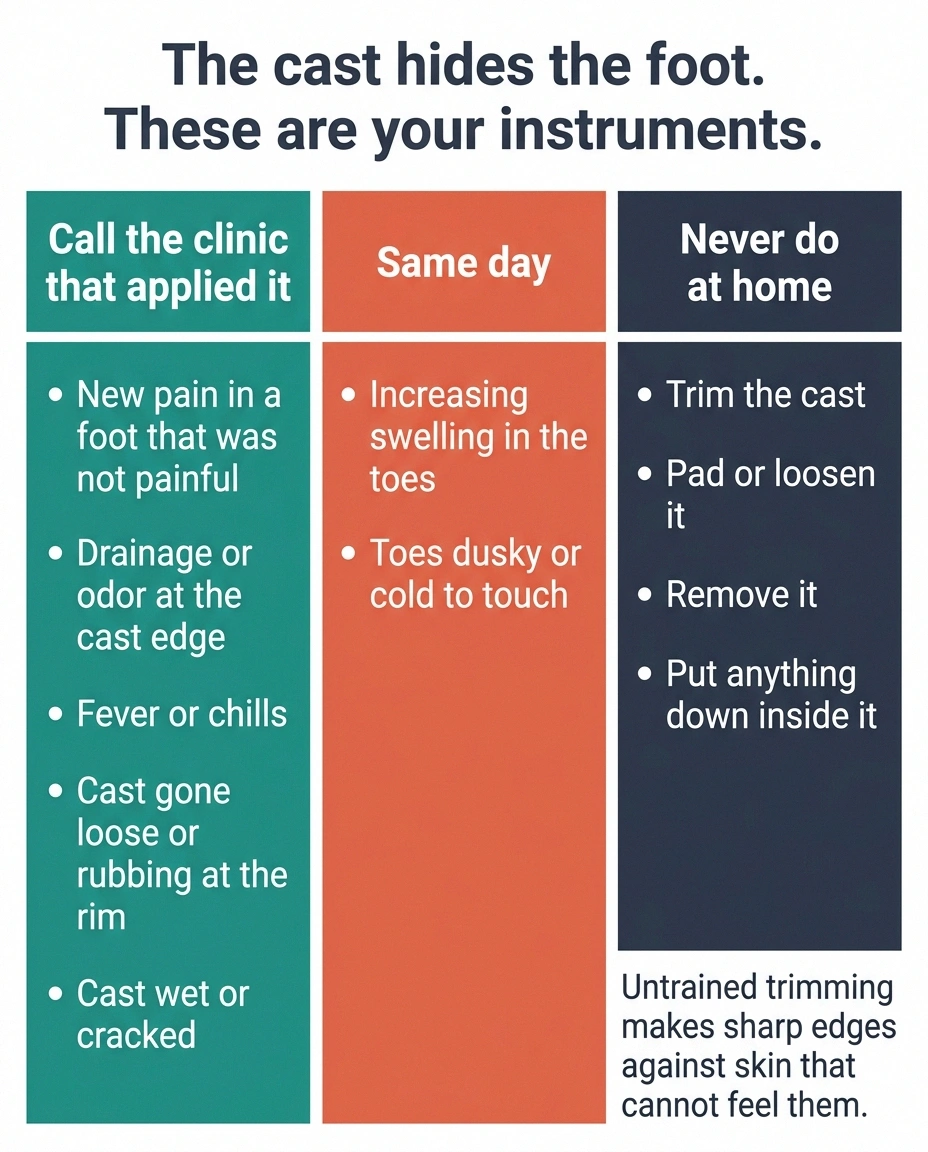
Because a cast hides the foot, the warning signs shift to what you can perceive from outside it.
Because the cast hides the foot, these are your instruments
Call the clinic that applied it: new pain in a foot that was not painful, drainage or odor at the cast edge, fever or chills, a cast gone loose or rubbing at the rim, a cast that got wet or cracked.
Same day: increasing swelling in the toes, or toes that look dusky or feel cold.
Never do at home: trim, pad, loosen, or remove the device. Untrained trimming produces sharp edges against skin that cannot feel them.
New pain in a foot that had not been painful deserves a call. So does drainage appearing at the cast edge, any foul odor, fever or chills, a cast that has become loose or is rubbing at the rim, and a cast that has gotten wet or cracked. Increasing swelling in the toes, or toes that look dusky or feel cold, needs same-day attention.
None of these are wait-until-Monday problems, and none of them are situations where you should try to remove or adjust the device yourself. The clinic that applied it wants the call.
What Wendell Would Tell You
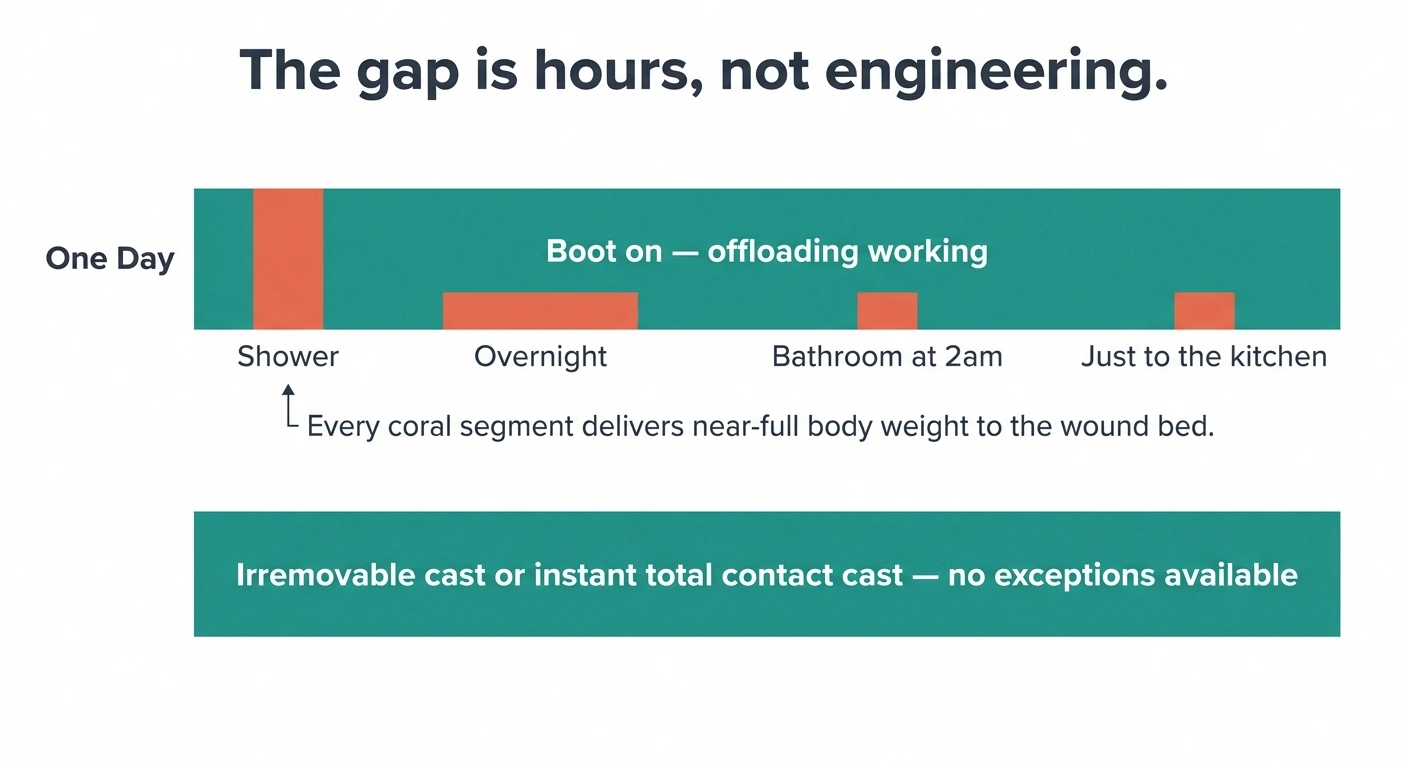
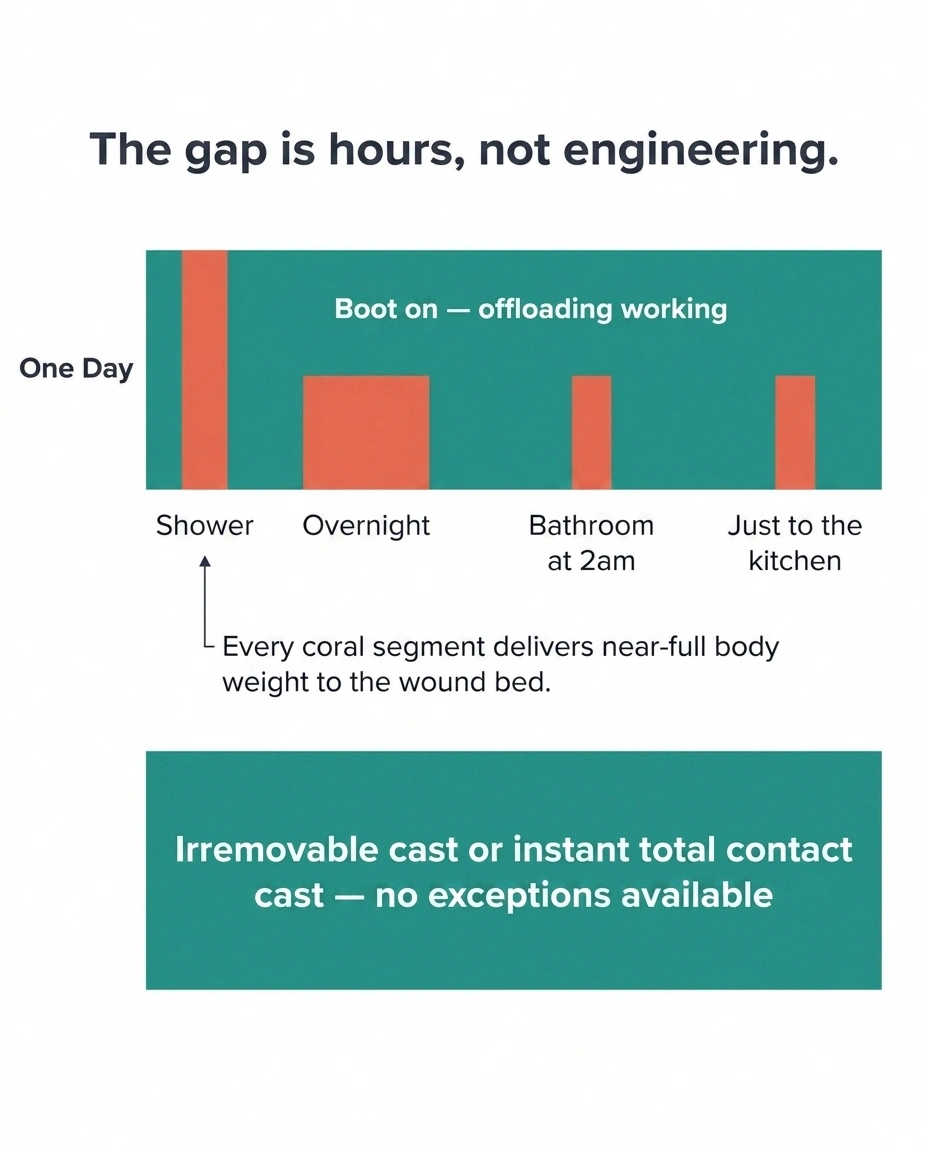
He talks about the eleven months with some frustration, and not at his boot. At the fact that nobody sat him down and explained that his adherence, which was sincere, was not the same as continuous offloading, and that the gap between those two things was the whole reason his foot was not closing.
If he had understood the physics, he says, he would have asked for the cast in month two.
Which is the practical takeaway. If you are in a removable device and your wound is not measurably smaller after several weeks, the useful question is not whether you need a stronger dressing. It is whether the pressure is genuinely coming off, and whether an irremovable option belongs on the table. Our article on diabetic foot ulcers covers the wider treatment picture, and Charcot foot is the other condition where casting plays a central role.
Frequently Asked Questions
How long do you wear a total contact cast?
Until the ulcer closes, which for most uncomplicated wounds means somewhere between six and twelve weeks. The cast itself is changed regularly rather than worn continuously, usually weekly at first and sometimes stretching to longer intervals as healing progresses. These changes exist to inspect the wound, check the surrounding skin for cast-related irritation, and re-mold as swelling decreases. A cast that fit well when applied can become loose within days as edema resolves, and a loose cast both offloads poorly and rubs.
Is a total contact cast better than a boot?
By healing rates, yes, consistently. Trials put casting at 74 to 95 percent healing against 52 to 85 percent for removable walkers, and pooled analysis shows both higher healing rates and shorter healing times. The advantage comes mainly from irremovability rather than superior pressure distribution, since a removable boot only works during the hours it is worn. A boot worn with genuine discipline can perform well, which is precisely the difficulty, because measured wear time tends to fall well short of what people report.
Can you walk in a total contact cast?
Yes, and walking is expected. The device is designed to allow ambulation while redistributing pressure away from the wound, which is a large part of its appeal compared with strict bed rest or non-weight-bearing crutch use. Activity should still be moderated, since total step count contributes to the load the wound experiences. Gait changes noticeably, so a cane or walker is often sensible, particularly for anyone whose balance was already affected by neuropathy.
How do you shower with a total contact cast?
A purpose-made waterproof cast cover with a rubber seal at the top is the reliable approach, and these are inexpensive and widely available. Plastic bags with tape leak often enough that they regularly result in unscheduled cast changes. A shower chair and a handheld sprayer make the process considerably safer, given that standing on one leg on wet tile with impaired sensation and altered balance is a real fall risk. If a cast does get wet, it needs reporting rather than drying out on its own, since trapped moisture against skin creates its own problems.
Why can’t I take a removable boot off for just a minute?
Because pressure damage accumulates and the foot cannot report it. A neuropathic ulcer forms from repeated loading of the same tissue, and every unprotected step adds to that total regardless of how brief or how safe the surface feels. Kitchen floors and carpeted hallways deliver essentially full body weight to the wound bed. The measured gap between casting and boot outcomes is largely built from exactly these small exceptions, accumulated across months.
What is an instant total contact cast?
A standard removable walker that has been made irremovable, typically by wrapping it with cohesive bandage or a layer of fiberglass so it cannot be taken off between clinic visits. It captures most of the benefit of true total contact casting because irremovability is the main active ingredient, while requiring far less specialized skill and time to apply. This makes it a practical option in clinics without staff trained in cast application, and it is worth asking about by name if casting has been declined for logistical reasons.
What if the cast hurts or feels loose?
Both warrant a call to the clinic rather than waiting for the scheduled visit. New pain in a previously painless foot may indicate a pressure point created by the cast, and a loose cast both fails to offload properly and can rub at the edges, potentially creating a new wound. Nothing about the device should be adjusted, padded, or removed at home. Trimming or loosening a cast without training frequently produces sharp edges that cause further injury to skin that cannot feel it happening.
Will I need special footwear after the ulcer heals?
Almost certainly. Recurrence rates after a healed neuropathic ulcer are high, and the foot mechanics that produced the wound in the first place have not changed. Therapeutic footwear with custom insoles is the standard approach for maintaining remission, redistributing pressure away from the site that broke down before. This is the specific role footwear plays well, and it should not be confused with treating an active wound, which requires proper offloading instead.
About the Author