Every retirement community tour follows the same route. The dining room with the good lighting. The fitness center. The theater, the salon, the woodworking shop. A model apartment with nothing in it. Then a folder, a coffee, and a very pleasant conversation about deposits.
Nothing on that route touches the things that will determine whether the place works for you.
Because if you have neuropathy, the variables that matter are the floor surface in the corridor, the distance from your door to the dining room, whether the shower has an anti-scald valve, and whether a podiatrist ever sets foot on the property. None of that is in the brochure. All of it is findable in one afternoon if you know what you’re looking at.
Here’s how to run the tour on your own terms.
Floors Matter More Than Floor Plans
Start here, because it’s the variable with the widest gap between how much it affects you and how little anyone discusses it.
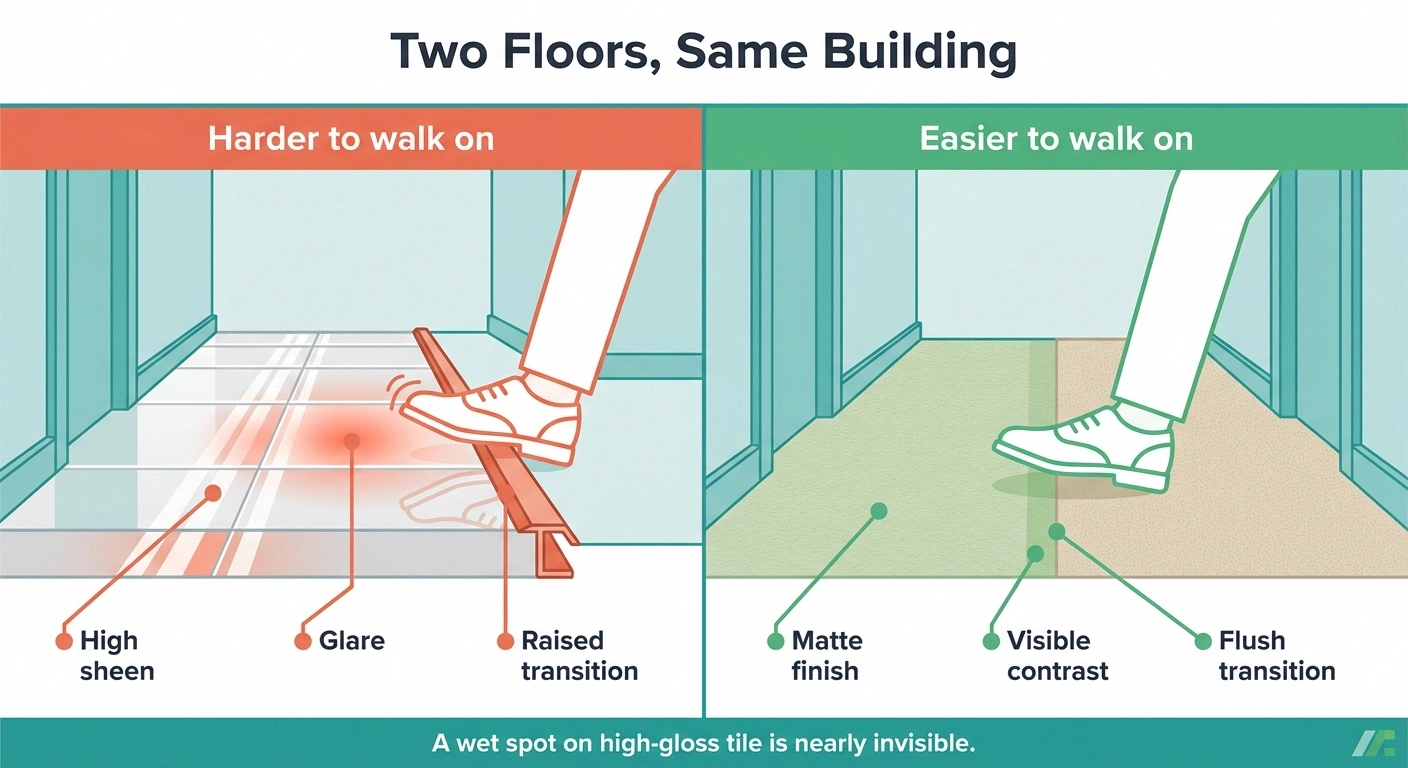
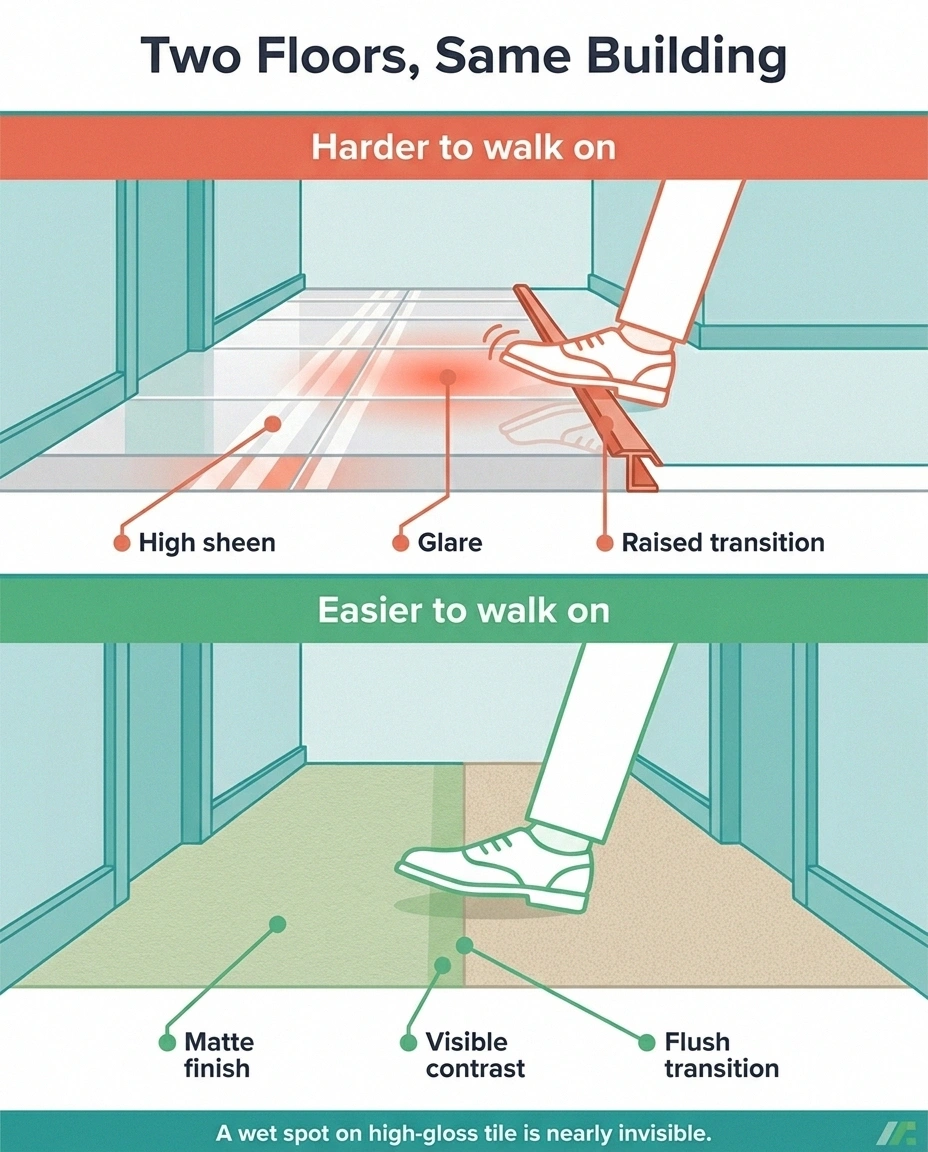
Senior living developments love hard, glossy surfaces. Polished porcelain tile in lobbies. High-sheen luxury vinyl plank in corridors. Buffed hardwood in dining rooms. They photograph beautifully, they clean easily, and they’re close to the worst possible choice for someone whose feet report back with reduced accuracy.
A glossy floor gives you less friction underfoot and less texture information coming up through the shoe. It also produces glare, which matters a great deal when vision is doing part of the balance work your feet used to handle. Add the fact that a wet spot on high-gloss tile is nearly invisible, and you’ve got a surface that removes information at exactly the moment you need more of it.
What to look for instead: matte or low-sheen finishes, some surface texture, and short dense carpet in the areas you’ll cross most often. Then check the transitions. Every place where one flooring type meets another is a potential toe catch, and the good ones are flush with a visible color change while the bad ones have a raised metal strip you can feel with a cane but not with a numb foot.
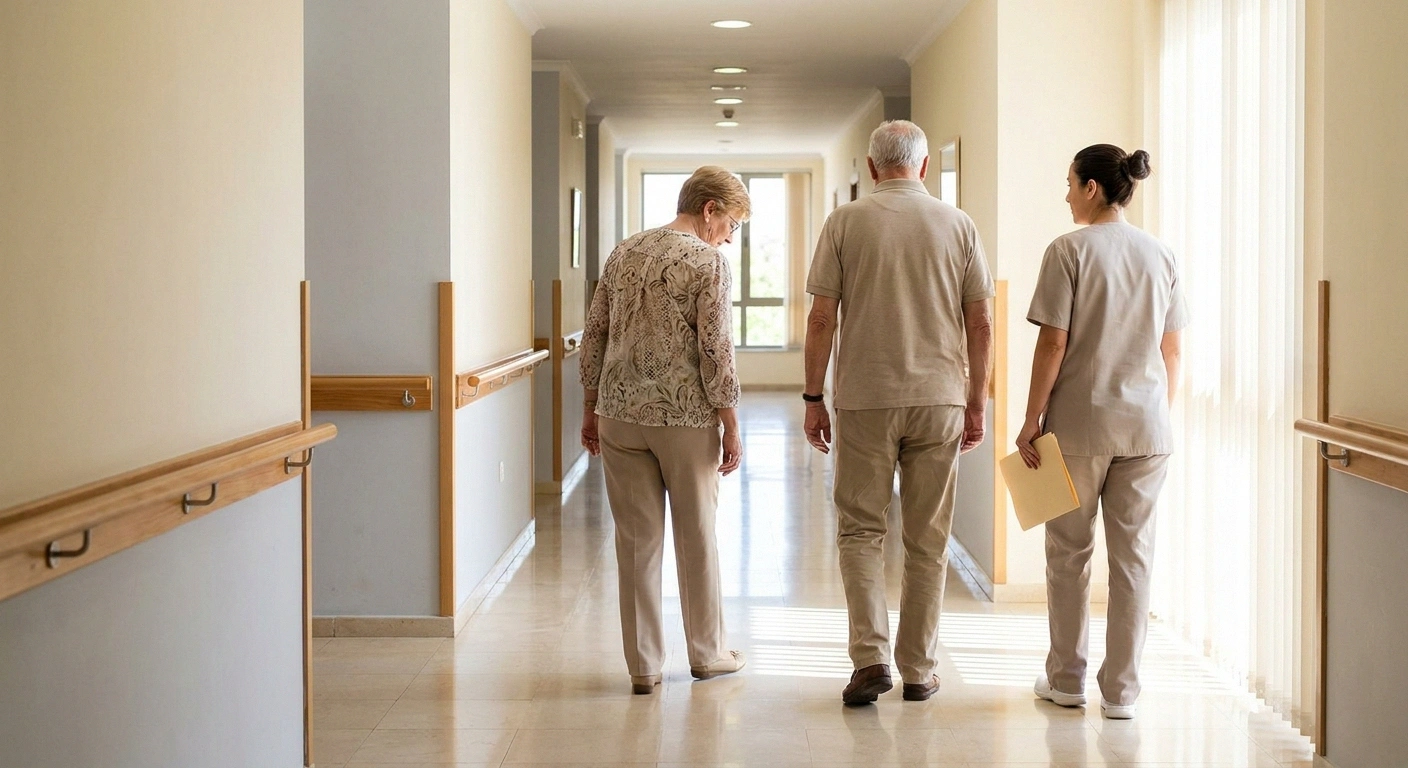
Walk a corridor. Actually walk it, in your own shoes, not the golf cart the tour guide offers. Then walk the same corridor after the floor crew has been through, if you can arrange it, because that’s the condition that produces falls.
The Bathroom Is the Whole Ballgame
You’ll spend more high-risk minutes in that room than anywhere else in the unit. Five things to check, and only one of them appears on standard accessibility checklists.
- Water temperature at the outlet
- Ask what the delivered temperature is capped at and whether the cap is set at the valve or at the heater. A commonly used ceiling is around 120 degrees Fahrenheit. If nobody on site knows the answer, that is itself the answer.
- Shower threshold height
- Zero is best. Anything you have to lift a foot over is a step you will take twice a day for years.
- Grab bar anchoring
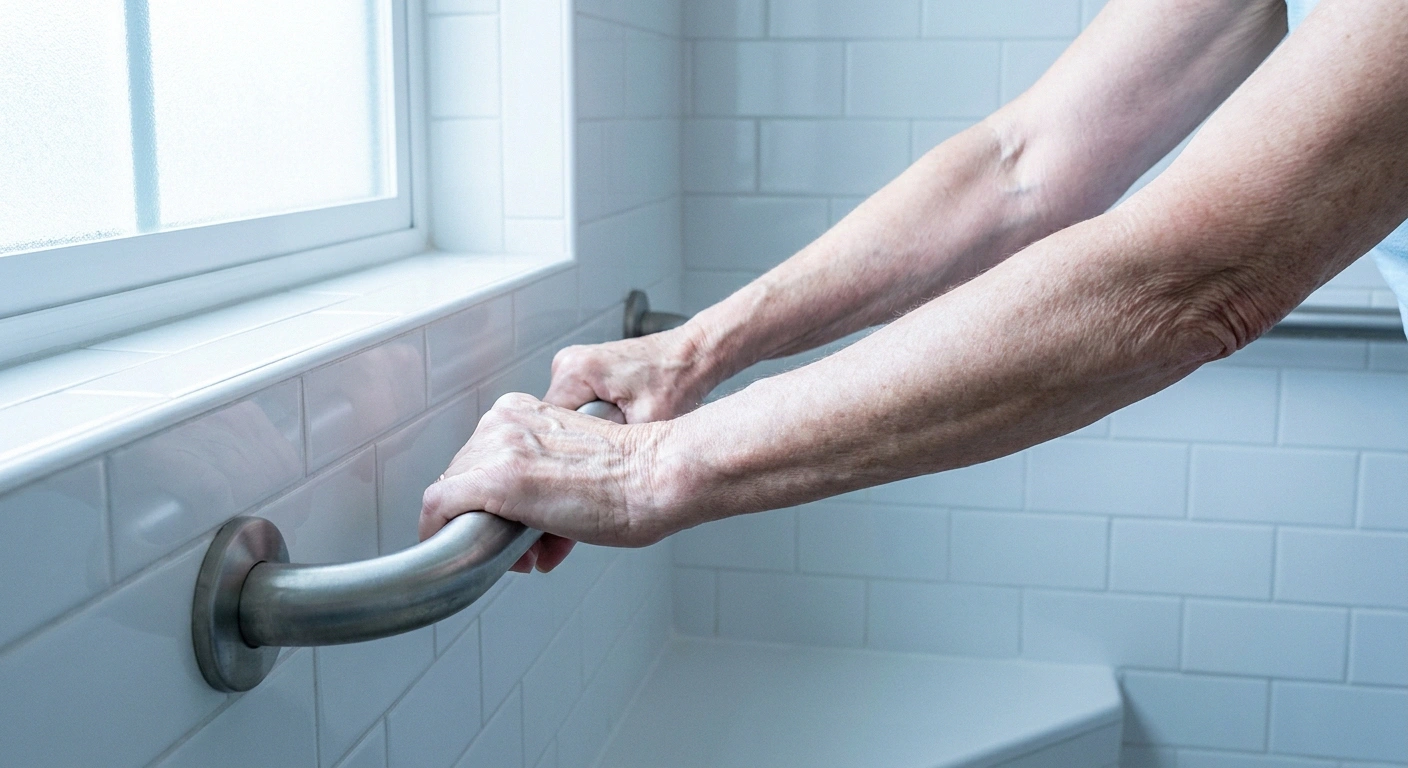
- Ask whether the walls have continuous blocking behind the tile. Blocking means a bar can later go where you need it. Without it you are limited to the two the builder installed.
- Turning space
- Ask whether the bathroom allows a full turning circle for a walker or wheelchair. Many units are technically accessible at the doorway and unusable once you are inside.
- Emergency call placement
- There should be one reachable from the floor, not only from standing height. Ask where it is and then crouch down and see whether you could reach it.
Water temperature control. This is the one nobody asks about and it’s arguably the most important. Ask whether the building has thermostatic mixing valves, or whether you can set your own water heater. A foot that can’t judge temperature can be scalded in a shower that feels merely warm to your hands, and burns on insensate feet heal badly and slowly. If you can’t get a straight answer, the fallback is a bath thermometer and a fixed rule about testing with your elbow — but a building that has this engineered in is telling you something about how it was designed.
Curbless or low-threshold shower. Stepping over a tub wall while balancing on a foot that can’t feel the floor is the single most avoidable hazard in the unit. A roll-in or curbless shower removes it entirely.
Real grab bars, properly anchored. Take hold with both hands while you are standing steady, or sitting on the shower seat if there is one, and lean some weight into it. A bar that flexes is decoration. Do this from a stable position or not at all, and if that feels awkward, ask a staff member to test it while you watch. Also ask whether the walls have blocking behind them so bars can be added later where you actually need them, which is often not where the builder put them.
Contrast. A white grab bar on a white tile wall is difficult to locate quickly. Contrast between floor, wall and fixtures is a genuine safety feature, not a design preference.
A seat, and space for one. Even if you don’t need a shower chair now, check that one fits.
The room-by-room detail behind all of this is in the bathroom safety guide, which is worth reading before the tour rather than after, and the broader home safety modifications guide covers what can be retrofitted and what can’t.
Distances Nobody Measures
Here’s a number the marketing folder will never give you: how far is it from your front door to the dining room?
Pace the route once on the tour and multiply. Two communities that feel identical on the tour can differ by half a mile a day.
| Trip | Times per day | At 150 ft each way | At 400 ft each way |
|---|---|---|---|
| Dining room | 2 to 3 round trips | 600 to 900 ft | 1,600 to 2,400 ft |
| 1 round trip | 300 ft | 800 ft | |
| Car and back | 1 round trip | 300 ft | 800 ft |
| Daily total, before anything optional | About 1,200 to 1,500 ft | About 3,200 to 4,000 ft |
Around 2,000 walking paces make a mile for most adults. The right-hand column is close to three quarters of a mile before you have chosen to go anywhere.
In a large community it can be several hundred feet, and you’ll walk it two or three times a day. Add the mailroom, the parking lot and the trash room, and a person who walks comfortably for two hundred feet can find themselves doing well over half a mile a day just existing there.
That’s not automatically bad — movement is good for nerve health and for balance. It’s bad when it’s unavoidable, unbroken and involuntary. The distinction between walking you choose and walking you’re forced into by a floor plan is enormous when your feet have a daily budget.
So measure it. Count your steps from the model unit to the dining room. If walking that distance isn’t safe or realistic for you, don’t push through it to prove a point: send whoever came with you to pace it, or ask the community for the figure. What matters is having a number rather than an impression. Ask which units are closest to what you’ll use most, and ask what those cost, because proximity is often priced. Then look for benches: a community that has placed seating at intervals along its corridors has thought about residents who need to stop, and one that hasn’t, hasn’t.
Two more distance questions. How far is the parking from the entrance you’d use, and is that route covered? And where does the shuttle actually go — most run to the grocery store and the medical park, and specialists like neurology and podiatry are frequently outside the radius.
Lighting, and the Path You’ll Walk at Two in the Morning
When position sense from the feet degrades, vision takes over the job. That makes lighting into functional equipment.
Check the corridors at night, not just during the daytime tour. Ask whether hall lighting dims after hours, which many communities do for atmosphere and energy costs. Look at the bedroom-to-bathroom route in the unit and ask whether night lighting is built in or whether you’ll be adding plug-ins. Check for glare from windows and polished surfaces, since glare is as disabling as darkness.
And look at stair and level-change markings. Contrast striping on step edges is cheap, effective, and absent more often than it should be. The stairs safety guide covers what good looks like, and the balance and falls guide explains why lighting does so much of the work here.
Grounds, Weather, and the Walk From the Car
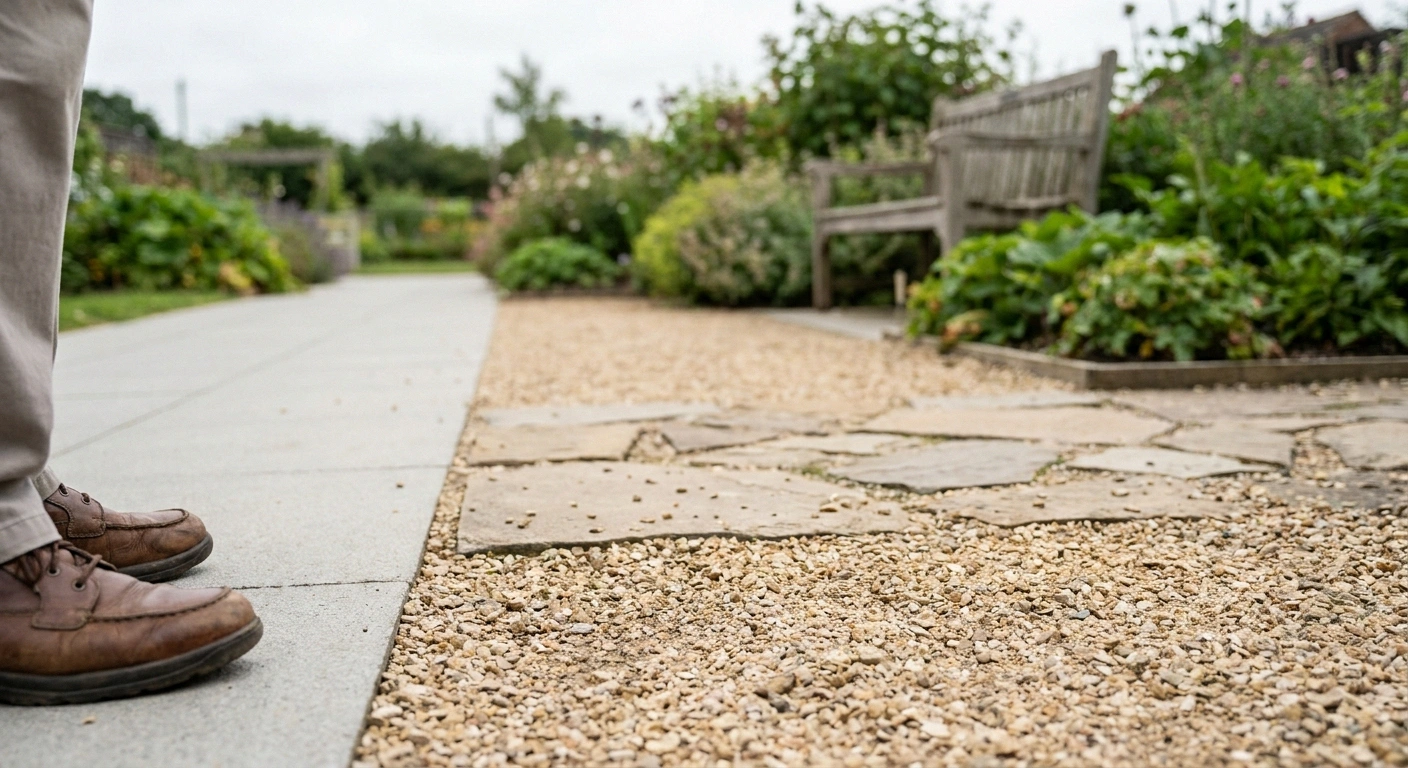
Communities sell their grounds hard, and the photography is always taken in good weather. Walk them anyway, and look down rather than out.
Decorative gravel, cobbled pavers, bark-mulch borders and flagstone paths are common in this market and all of them are uneven underfoot. On a foot with reduced sensation, an uneven surface demands the visual attention that a smooth one doesn’t, which turns a pleasant garden loop into work. Look for at least one continuous paved circuit with a consistent surface, because that’s the path you’ll actually use daily.
Then ask about weather. In northern communities the questions are about ice: who clears the walkways, how early, is the route from the parking area treated first, and is there a covered path to the main building. In southern ones the questions are about heat and pool decks — surfaces that get hot enough to burn a foot that can’t feel it, and shade along the routes people walk. Anyone considering splitting the year between two locations should read the piece on snowbird living with neuropathy before signing anything in either place, since the two-household version of this decision has its own arithmetic.
The Medical Question Everyone Forgets
Communities market their fitness centers and their dining programs. For this reader, the questions that matter are duller and much more consequential.
Sales staff answer these optimistically because they genuinely do not know. Ask for the wellness or health services director by name and put the same questions to them.
- Which visiting clinicians actually come on site, and on what schedule? Ask for the last three months, not the intention.
- If a resident needs a dressing changed daily for six weeks, who does it and what does it add to the monthly bill?
- How many residents currently use a walker or wheelchair? A low number in a large community can mean people are moved out early.
- What is the staffing level overnight, and how long does a call bell typically take to answer at three in the morning?
- How many residents moved to a higher level of care in the past year, and what were the most common reasons?
Does a podiatrist visit the property, and how often? Plenty of people manage their own nails perfectly well. It stops being a job to do yourself when sensation is reduced, circulation is poor, or vision and reach make it hard to see what you are cutting, and at that point routine foot care is not a luxury service. On-site podiatry, or a reliable arrangement with a nearby practice, is worth more than most amenities on the list.
Who does nail care, and are they trained for neuropathic feet? Some communities have a visiting nail technician. That is not the same thing, and it matters.
Is there physical therapy on site? Being able to do balance and strengthening work without arranging transport substantially raises the odds you’ll actually do it.
How do prescriptions arrive? Delivery, on-site pharmacy, or your problem.
What happens if you can’t walk for six weeks? This is the question that separates the communities that have thought about it. A foot ulcer requiring offloading, a Charcot episode, or post-surgical non-weight-bearing all mean weeks in a boot or a wheelchair. Ask specifically: are meals delivered to the unit, is there help getting to the bathroom, does that trigger a temporary care charge, and what does that cost per day.
Levels of Care, and What Actually Triggers a Move
Independent living gives you an apartment and services. Assisted living adds help with daily personal care. A continuing care retirement community, sometimes called a life plan community, contracts to move you along that spectrum as needs change, usually in exchange for a large entry fee.
Most people assume the trigger for moving up a level is memory loss or repeated falls. For someone with neuropathy the more likely trigger is a wound. A non-healing foot ulcer requiring daily dressing changes, or an infection requiring intravenous antibiotics, can move a person to a higher level of care faster than years of gradual mobility decline. Given how directly that flows from the skin and sensation problems in the daily foot check routine, it’s the scenario worth asking about by name.
Questions that get real answers: What specific conditions require a resident to move from independent to assisted living? Who makes that determination, and can it be appealed? If I need temporary skilled care, do I keep my apartment? What is the cost difference between levels, and how much can it rise annually?
Get the annual increase cap in writing. It’s the number that determines whether the place is still affordable in year eight.
Money, Plainly

Medicare does not pay for room and board in independent living, assisted living, or a continuing care community. It pays for medical services delivered to you wherever you happen to live, and it covers short-term skilled nursing after a qualifying hospital stay. That’s the whole of it, and being clear-eyed about it early prevents an expensive misunderstanding — the specifics of what is and isn’t covered are laid out in the Medicare coverage guide.
The money comes from savings, home sale proceeds, long-term care insurance, veterans benefits, or in some cases a state Medicaid waiver for assisted living. Working the numbers against your actual timeline is the substance of retirement planning with neuropathy.
One trap specific to continuing care communities: the entry fee is often partially refundable, and the terms vary enormously between contract types. Have someone read the contract who isn’t selling it to you.
How to Run the Visit

Compress everything above into a plan for the day.
Trying to do all of it in one appointment is why people miss things. Split it deliberately, and let the second visit be the one nobody prepared for.
| Visit one, scheduled, daytime | Visit two, unannounced, evening or bad weather |
|---|---|
| Pace the routes and record the distances | Walk the same routes after dark and see what the lighting does |
| Test grab bars and check the shower threshold | Look at the entrance and parking surface in rain, snow or heat, from the car if underfoot conditions are poor |
| Ask the six questions and get the contract | Talk to residents with no staff member present |
| Eat a meal and time the walk back | Notice how long the corridors stay empty and how visible staff are |
Go twice. Once on the scheduled tour, once unannounced, in the evening or on a wet day. The second visit is the honest one. You do not need to walk on ice to learn what you came for: looking at the entrance, the drop-off and the parking surface from the car tells you most of it, and if you do get out, bring someone with you.
Wear your own shoes and walk what you can of the routes. The golf cart hides exactly the information you came for. Walk the parts you can manage safely, bring someone with you, and stop when you have learned what you needed rather than when you reach the end.
Eat a meal there. Then walk back to the unit and notice how your feet feel about it.
See an occupied unit, not just the model. Models have no rugs, no furniture and no clutter. Real units tell you what the space becomes when someone lives in it.
Ask residents, not staff, where people trip. Find someone in the mail room. They’ll tell you about the ramp by the west entrance and the tile outside the salon that stays wet.
Check the corridors at night.
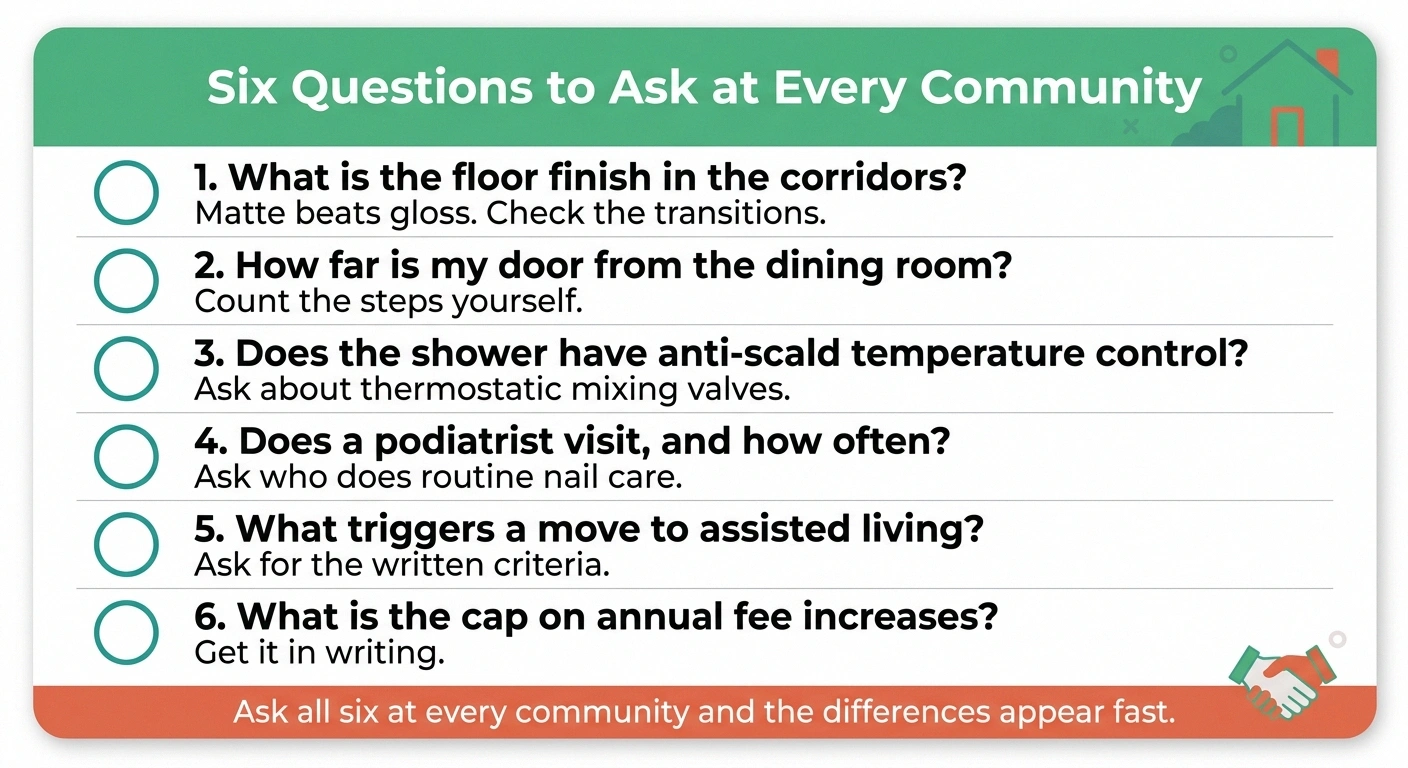
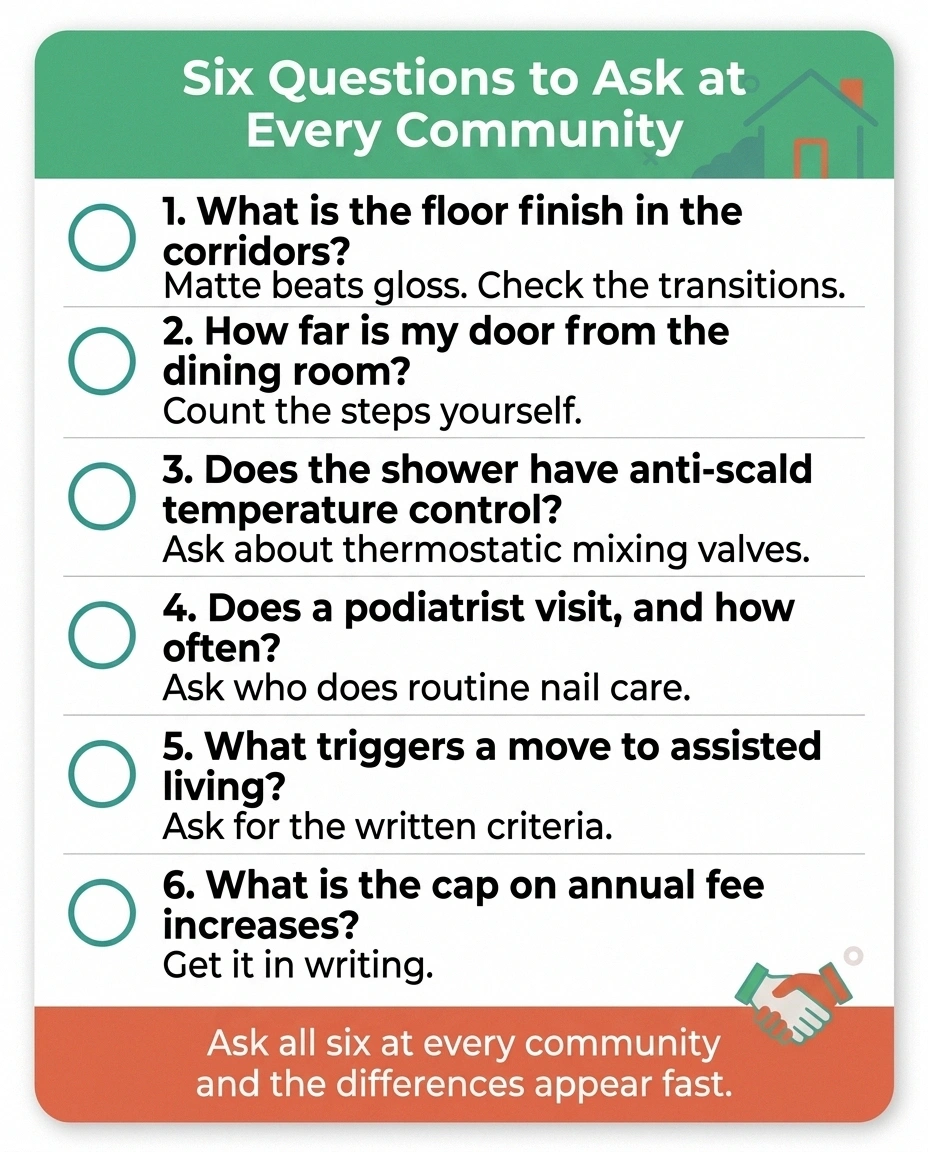
Bring your list. Anti-scald valves, floor finish, distance to dining, podiatry, level-of-care triggers, annual increase cap. Six items. Ask them all every time, and the differences between communities become obvious quickly.
And if this move is happening, the practical mechanics of the transition itself — unpacking order, safety-proofing before the first night, relearning a building your feet don’t know — are covered in the guide to moving to a new home with neuropathy.
The tour is designed to sell you a lifestyle. You’re there to inspect a floor. Both can be true, and only one of them is your job.
Frequently Asked Questions
What should I look for in a retirement community if I have neuropathy?
The highest-value items are floor surface and finish, distance from the unit to the dining room and other daily destinations, water temperature control in the shower, night lighting along the bedroom-to-bathroom route, and whether podiatry and physical therapy are available on site. These matter more for neuropathy than the amenities most tours emphasize, and none of them appear in standard senior living checklists.
What flooring is best for someone with neuropathy?
Matte or low-sheen surfaces with some texture, and short dense carpet in heavily used areas. High-gloss tile and polished vinyl reduce friction, produce glare, and hide wet spots. Transitions between flooring types should be flush and visually contrasting rather than raised, since a raised metal strip is a toe catch that a numb foot will not detect.
Is independent living safe with balance problems?
It can be, and the building matters more than most people expect. A single-level unit, a curbless shower, well-anchored grab bars, good lighting, short distances and non-glossy floors make independent living workable for many people with significant balance impairment, and the same person in a poorly designed building may not be safe there. The building is only half of it though. Fall history, current balance, vision, cognition and how much help is available all weigh just as heavily, and that side of the question is better answered by a clinician or an occupational therapist doing a proper assessment than by anyone judging from a tour.
Does Medicare pay for a retirement community?
No. Medicare does not cover room and board in independent living, assisted living or a continuing care community. It covers medical services provided to the resident and short-term skilled nursing care following a qualifying hospital stay. Funding usually comes from savings, home sale proceeds, long-term care insurance, veterans benefits, or a state Medicaid waiver where one exists.
What is the difference between independent living, assisted living and a CCRC?
Independent living provides an apartment plus services such as meals, housekeeping and transport, with no personal care. Assisted living adds help with bathing, dressing and medication. A continuing care retirement community, also called a life plan community, contracts to provide the whole range as needs change, generally in exchange for a substantial entry fee that may be partially refundable depending on the contract type.
What would force a move from independent to assisted living?
Communities set their own criteria, typically involving the need for regular help with personal care, safety concerns, or medical needs beyond what independent living supports. For people with neuropathy, a non-healing foot wound requiring daily care or a period of non-weight-bearing is a common and often unanticipated trigger. Asking for the specific written criteria and the appeals process before signing is worthwhile.
Should I ask about foot care specifically?
Yes, and directly. Ask whether a podiatrist visits the property and how often, who performs routine nail care and what their training is, and what the arrangement is for wound care if it becomes necessary. Routine professional foot care is a functional need rather than a comfort service when sensation is reduced, and availability varies widely between communities.
How many times should I visit before deciding?
At least twice, with one visit unscheduled and outside normal tour hours. Evening or bad weather reveals lighting, floor conditions and staffing levels that a midday appointment does not. Eating a meal and walking the routes in your own shoes gives more useful information than any amount of time spent in the sales office.
About the Author