When I first heard someone suggest meditation for nerve pain, I'll be honest — I was skeptical. I was dealing with burning feet, tingling hands, and the kind of pain that makes you want to crawl out of your own skin. The idea of sitting quietly and “being present” felt almost insulting when every nerve ending was screaming.
But after more than a decade of living with peripheral neuropathy, I've learned that some of the most powerful tools for managing this condition aren't always the ones that come in a prescription bottle. Mindfulness meditation has become one of the most meaningful additions to my pain management routine, and the research backing it up has grown remarkably in recent years.
Let me share what I've learned — both from personal experience and from the science — about how meditation may help you find some relief from neuropathy pain.
Understanding the Connection Between Your Mind and Nerve Pain
Before we dive into specific techniques, it helps to understand why meditation might work for something as physical as nerve pain. After all, neuropathy isn't “in your head” — it's a real, measurable condition involving damaged nerves. So how could a mental practice make a difference?
The answer lies in how your brain processes pain signals. When peripheral nerves are damaged, they send pain signals to your brain. But here's what many people don't realize: your brain doesn't just passively receive those signals — it actively interprets and amplifies them. Your emotional state, stress levels, attention focus, and past experiences all influence how intensely you feel pain.
Think of it this way: have you ever noticed that your neuropathy symptoms seem worse when you're stressed, anxious, or exhausted? That's not coincidence or imagination. Stress hormones like cortisol increase inflammation and heighten your nervous system's sensitivity to pain signals. When you're anxious or focused on your pain, your brain essentially “turns up the volume” on those nerve signals.
Meditation works by addressing this brain-level processing. It doesn't fix damaged nerves, but it may help change how your brain interprets and responds to the pain signals those nerves are sending. And for many of us living with neuropathy's impact on mental health, that shift can be genuinely meaningful.
What the Research Says About Meditation and Neuropathy
I'm not one to recommend something based on anecdotes alone, so let's look at what scientists have found.
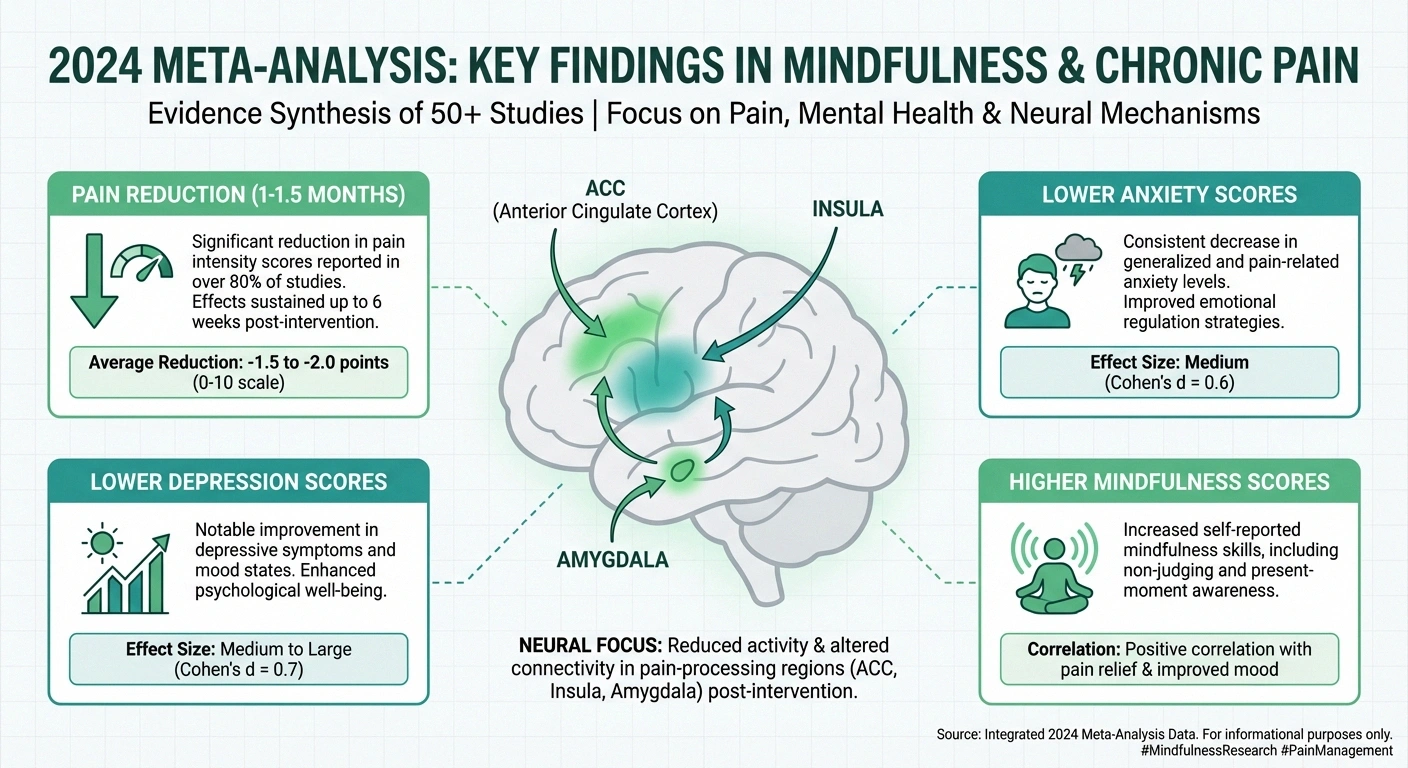
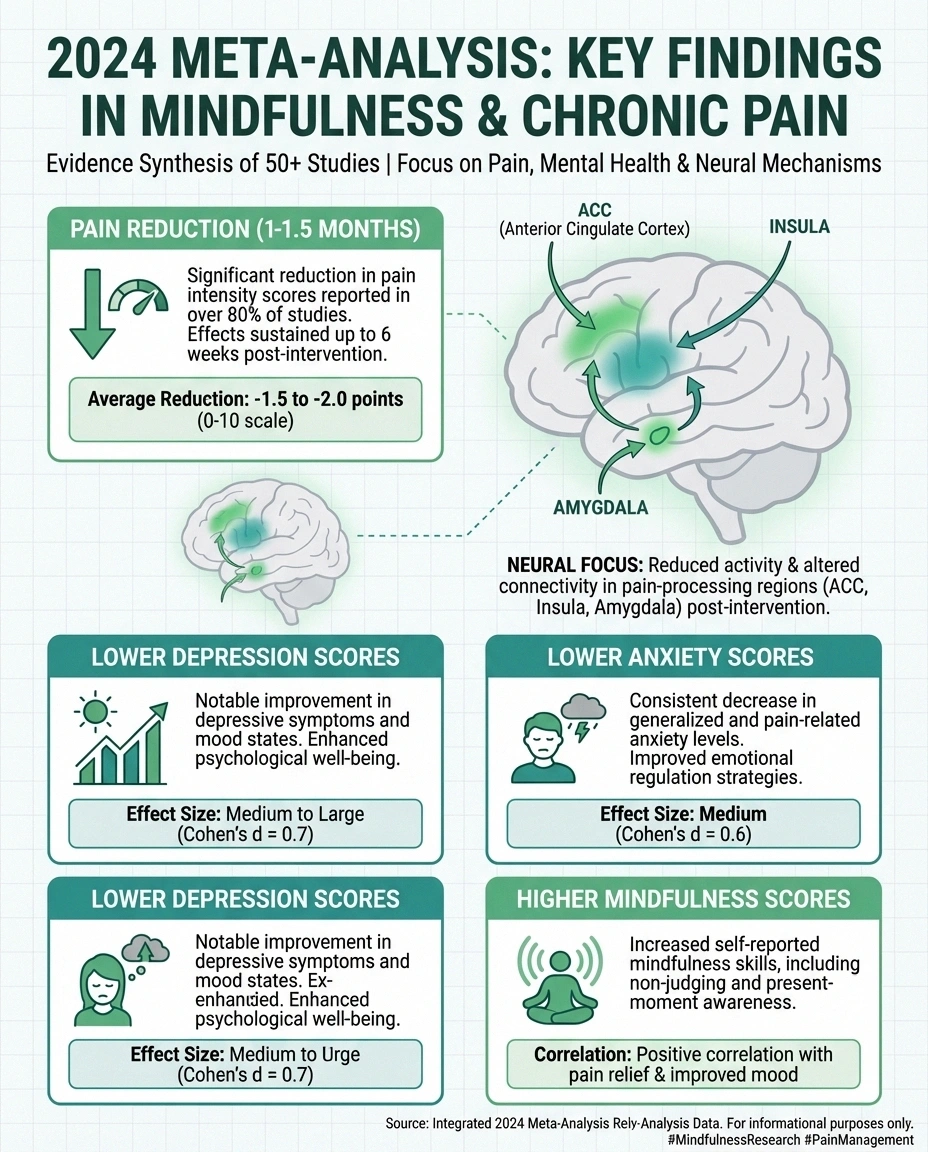
A comprehensive 2024 systematic review and meta-analysis published in Cureus examined ten randomized controlled trials involving meditation-based therapies for chronic neuropathic pain. The findings were encouraging:
- Pain reduction: Participants who meditated had significantly lower pain scores at 1 to 1.5 months of follow-up compared to control groups
- Anxiety relief: The meditation groups showed significantly lower anxiety scores
- Depression improvement: Depression scores dropped significantly in the meditation groups
- Mindfulness gains: Participants developed measurably greater mindfulness skills over time
Another study specifically examining Mindfulness-Based Stress Reduction (MBSR) for painful diabetic peripheral neuropathy found that participants experienced approximately a 30% reduction in pain severity and a 46.5% drop in catastrophizing scores — that tendency we all have to think “this will never end” or “I can't take this anymore.”
Research using brain imaging has also revealed something fascinating: regular meditation practice actually changes the structure and function of brain regions involved in pain processing. The anterior cingulate cortex, which helps regulate how strongly you feel pain, shows increased activity and density. Meanwhile, the amygdala — your brain's alarm system — becomes less reactive, meaning your brain stops treating every pain signal as an emergency.
These aren't minor changes. They represent genuine neuroplasticity — your brain physically rewiring itself in response to consistent practice. And that's something I find genuinely hopeful for anyone dealing with the relentless nature of neuropathy-related anxiety.
Types of Meditation That May Help Neuropathy
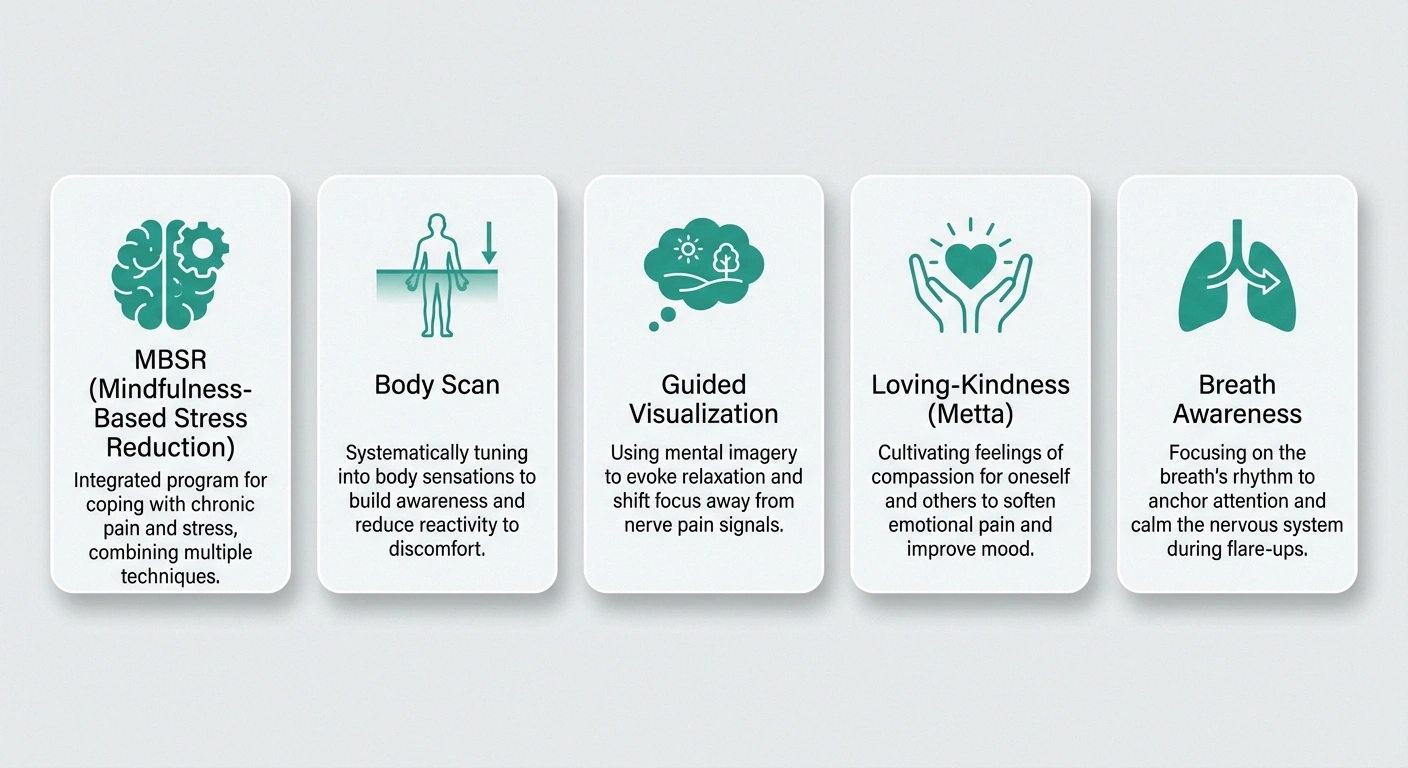
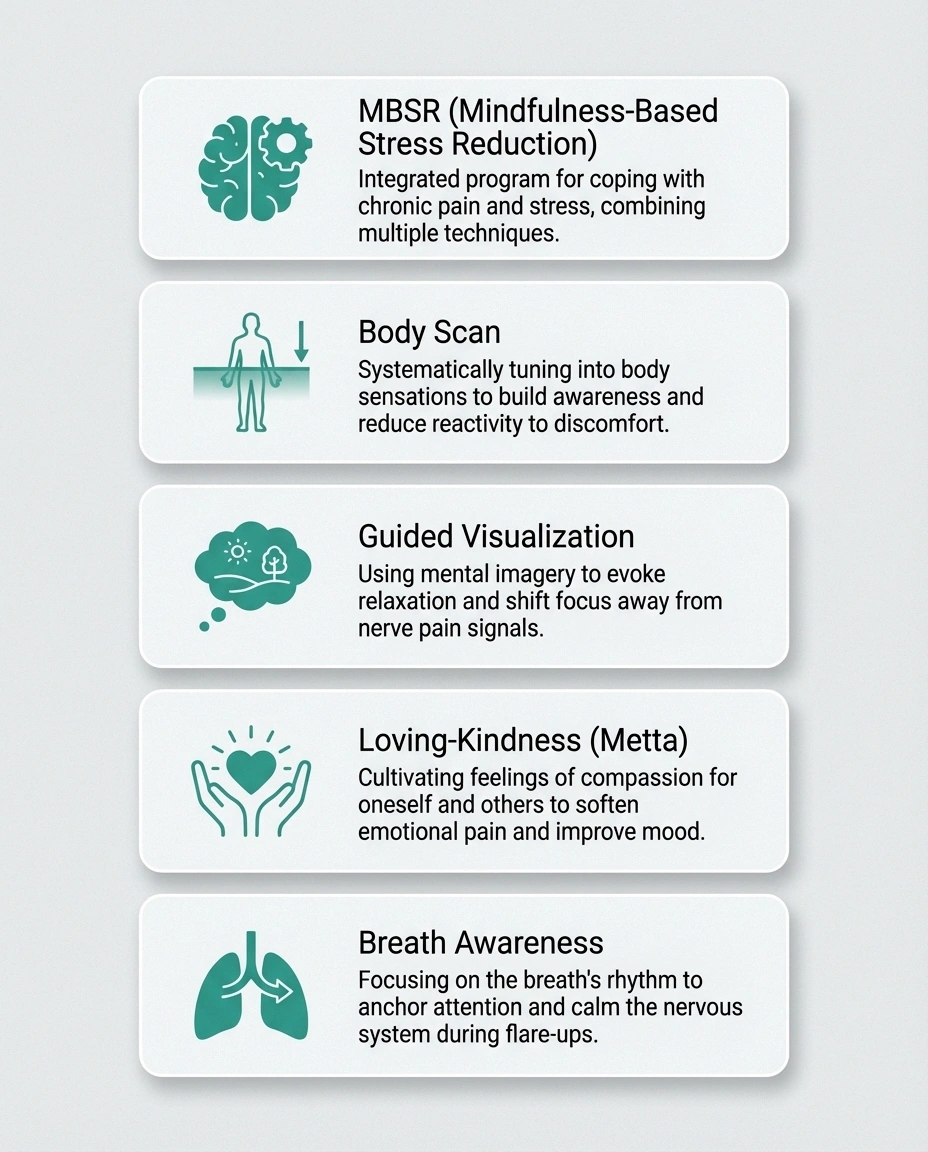
Not all meditation is the same, and different approaches may work better depending on your specific symptoms and preferences. Here are the types that have shown the most promise for nerve pain:
Mindfulness-Based Stress Reduction (MBSR)
MBSR is the most studied meditation approach for chronic pain, including neuropathy. Developed by Dr. Jon Kabat-Zinn at the University of Massachusetts Medical School, it's a structured 8-week program that combines mindfulness meditation, body scanning, and gentle yoga.
What makes MBSR particularly effective is its structure. You're not just told to “meditate more.” The program includes weekly group sessions of about 2.5 hours, a full-day retreat, and daily home practice of about 45 minutes. Participants learn specific skills for observing pain without reacting to it, which can feel revolutionary when you've spent years fighting against your symptoms.
Many hospitals and community centers offer MBSR courses, and some insurers now cover the cost. If you're interested, check with your local medical center or search the University of Massachusetts Center for Mindfulness directory.
Body Scan Meditation
This is one of my personal favorites, and it's particularly relevant for neuropathy. In a body scan, you systematically move your attention through different parts of your body, noticing sensations without trying to change them.
I know what you might be thinking: “Why would I want to pay MORE attention to my painful feet?” It sounds counterintuitive, but there's wisdom in it. When we avoid or fight our sensations, we actually increase tension and stress around them. By gently, curiously observing what's happening — “there's tingling in my left foot, there's warmth in my right hand” — you learn to separate the raw sensation from the emotional suffering layered on top of it.
For those of us with neuropathy, the body scan offers another benefit: it helps maintain body awareness in areas where sensation may be reduced or altered. It's a way of staying connected to your body even when your nerves aren't sending reliable signals.
Guided Visualization
Guided visualization involves creating mental images that promote relaxation and pain relief. You might imagine cool, soothing water flowing over your burning feet, or picture your nerve pathways as roads being slowly repaired and renewed.
This approach can be especially helpful for people who find traditional sitting meditation difficult. You can practice it lying down, and many free apps and YouTube channels offer guided sessions specifically designed for chronic pain.
Loving-Kindness Meditation (Metta)
Chronic pain can make you feel angry at your own body, frustrated with your limitations, and isolated from others. Loving-kindness meditation addresses this by guiding you through phrases of compassion directed first toward yourself, then toward others.
Research has shown that self-compassion practices may reduce the emotional suffering associated with chronic pain. For those of us dealing with pain catastrophizing, this gentle approach to our own experience can be a powerful counterweight to the harsh self-talk that often accompanies chronic conditions.
Breath Awareness Meditation
The simplest form of meditation — and a great starting point for beginners — is breath awareness. You simply focus your attention on the natural rhythm of your breathing, returning to it each time your mind wanders (which it will, constantly, and that's completely normal).
Breath awareness activates your parasympathetic nervous system — the “rest and digest” response that counteracts the stress-driven “fight or flight” mode. For people with neuropathy, this shift may help reduce the cortisol levels that contribute to inflammation and heightened pain sensitivity.
How to Start Meditating When You're in Pain
Here's something most meditation guides don't address: starting a meditation practice when you're already in significant pain is genuinely hard. Your nerves are firing, your body is uncomfortable, and the idea of sitting still feels impossible. I get it — I've been there.
These practical tips come from years of trial and error:
Start Small — Really Small
Forget the idea that you need to meditate for 30 or 45 minutes. When you're dealing with active neuropathy pain, start with just 3 to 5 minutes. That's it. You can build from there over weeks and months, but the most important thing is simply beginning.
Find a Comfortable Position
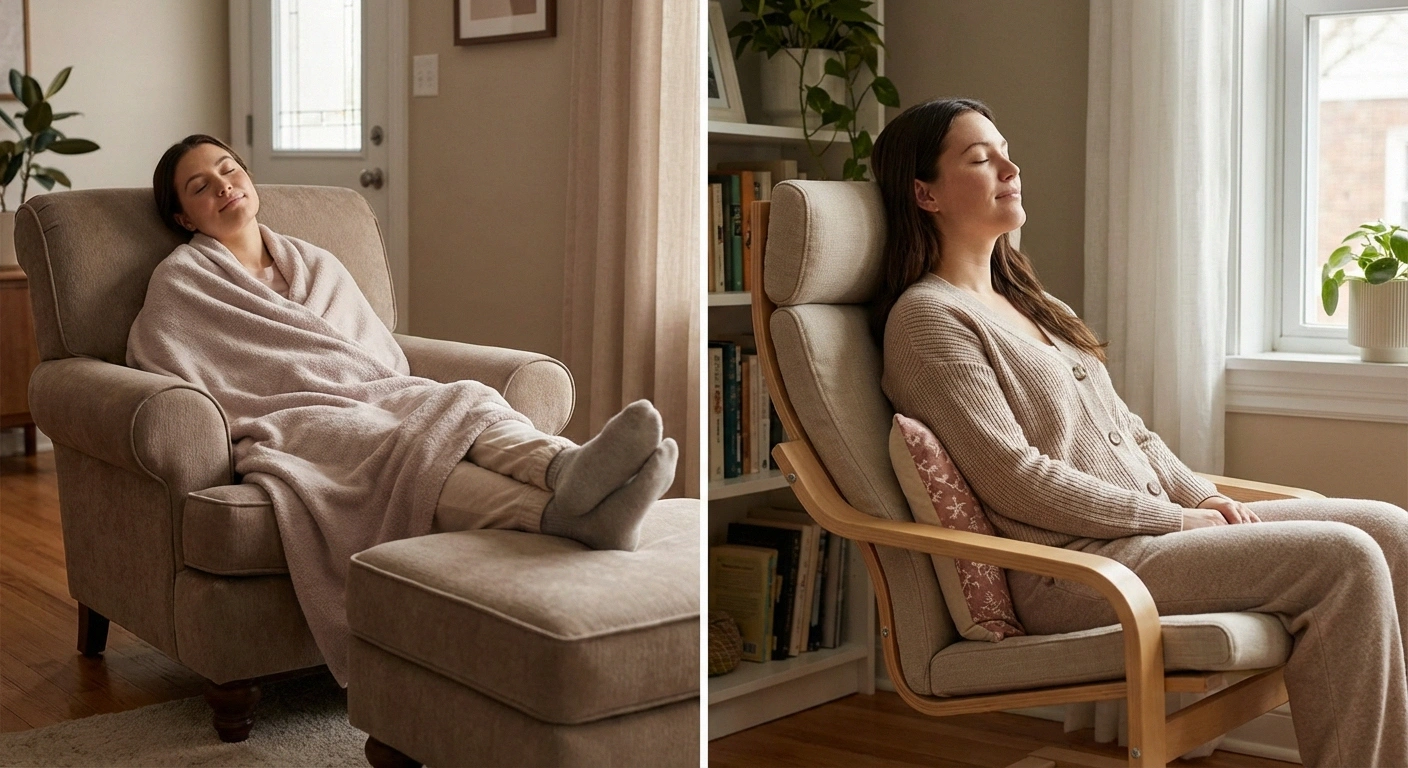
You do not need to sit cross-legged on the floor. Meditate in whatever position causes you the least discomfort:
- Sitting in a supportive chair with your feet elevated
- Lying down on your back with a pillow under your knees
- Reclined in a recliner or propped up with pillows
- Even standing or slowly walking if sitting is too painful
If your feet are particularly painful, experiment with different positions. Some people find that elevating their feet slightly reduces the burning sensation enough to allow them to focus.
Use Guided Meditations
When you're new to meditation — or when pain makes it hard to stay focused — guided meditations give your mind something to follow. Some apps I've found helpful include Insight Timer (free, with thousands of guided sessions), Calm, and Headspace. Look for sessions specifically labeled for chronic pain or body awareness.
Time It Strategically
Pay attention to when your symptoms are at their lowest point during the day and try to practice then. For many of us, mornings are better than evenings (since neuropathy often worsens at night). Building the habit when conditions are more favorable makes it easier to eventually practice during harder times too.
Don't Fight the Pain
This is perhaps the hardest lesson: the goal isn't to make the pain disappear during meditation. It's to change your relationship with it. When pain arises during your practice, try to observe it with curiosity rather than frustration. Notice its qualities — is it burning? Tingling? Sharp? Dull? — without adding the layer of “I hate this” or “when will it stop?”
This isn't resignation. It's strategic. By reducing the emotional charge around pain, you reduce the total suffering experience, even when the raw sensation remains.
Adapting Meditation for Specific Neuropathy Symptoms
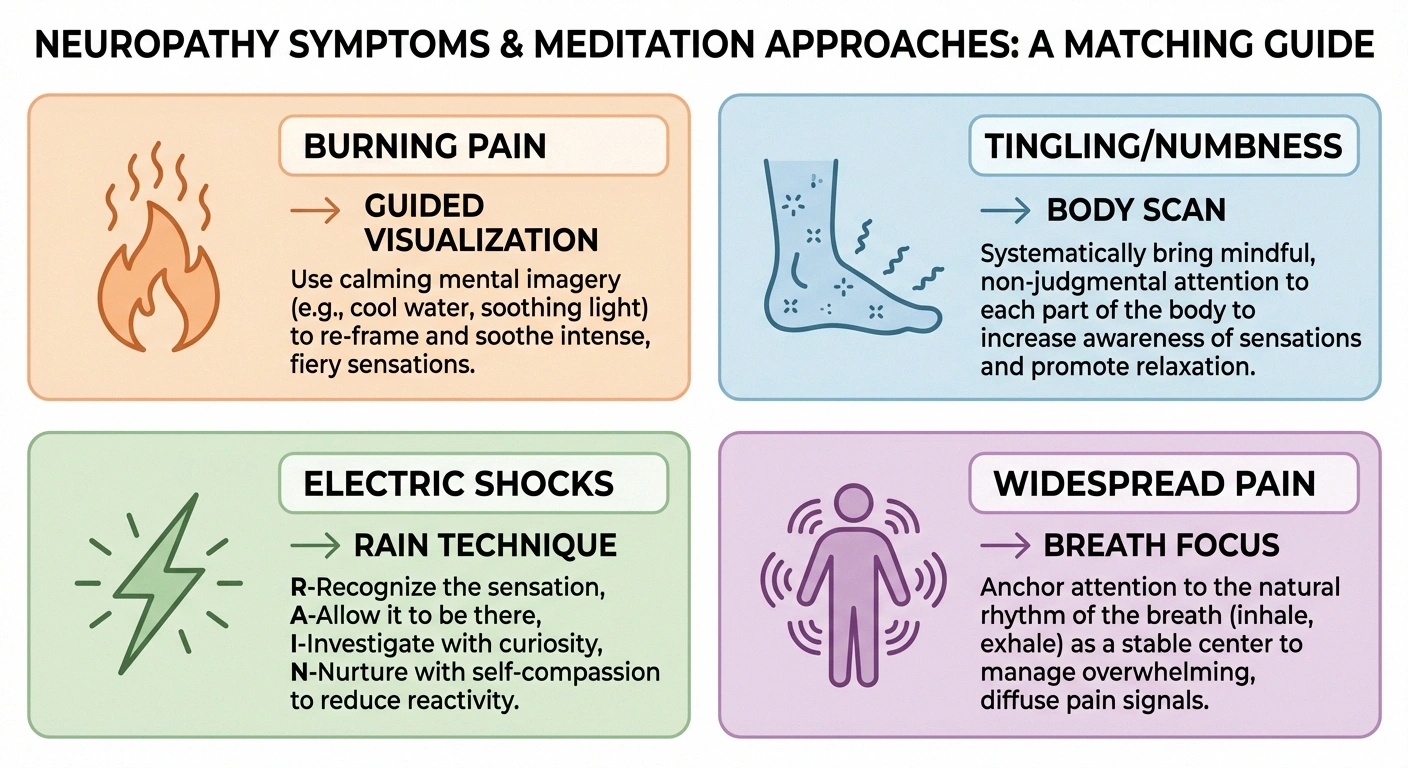
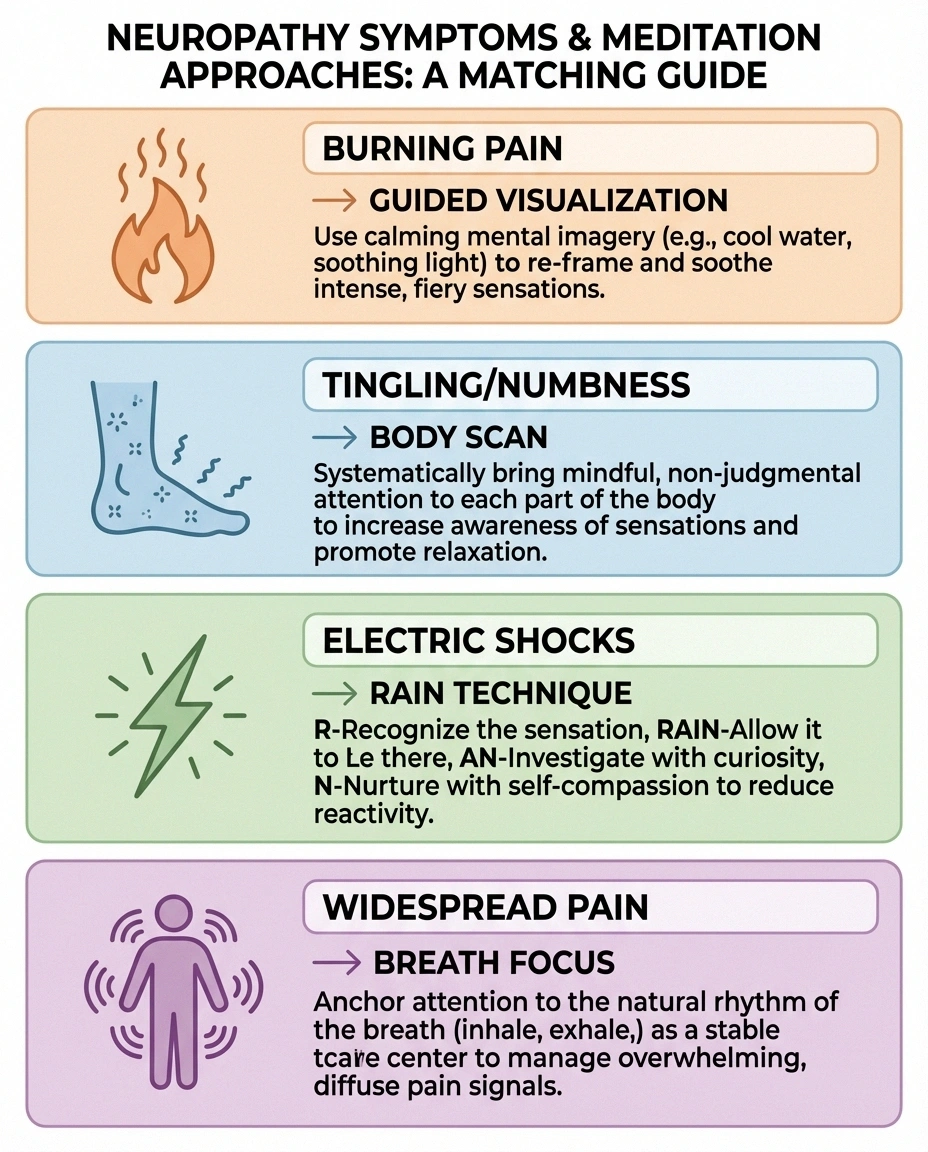
Different neuropathy symptoms may require different meditation adaptations. Here are some approaches based on what you're experiencing:
For Burning Pain
Guided visualization with cooling imagery may be particularly helpful. Imagine your feet or hands immersed in cool (not cold) water, or picture a gentle breeze flowing over the affected areas. Some people find it helpful to combine this with actual cool compresses before or during meditation.
For Tingling and Numbness
Body scan meditation can help you stay connected to areas where sensation is altered. Rather than trying to “feel” normally, practice noticing whatever sensation IS there — even if it's different, strange, or muted. This non-judgmental awareness may actually help improve your body awareness over time.
For Electric Shock Sensations
When sudden, unpredictable pain jolts hit during meditation, practice the RAIN technique: Recognize the sensation, Allow it to be there, Investigate it with gentle curiosity, and Non-identify (remind yourself “I am having a pain sensation” rather than “I am in pain”). This brief framework can help you recover your focus after a pain spike without spiraling into frustration.
For Widespread Pain
When pain is everywhere and a body scan feels overwhelming, breath-focused meditation may be the best starting point. Your breath is a neutral anchor — it's always available and it's not painful. You can always return to it when other sensations become too intense.
Combining Meditation with Other Neuropathy Treatments
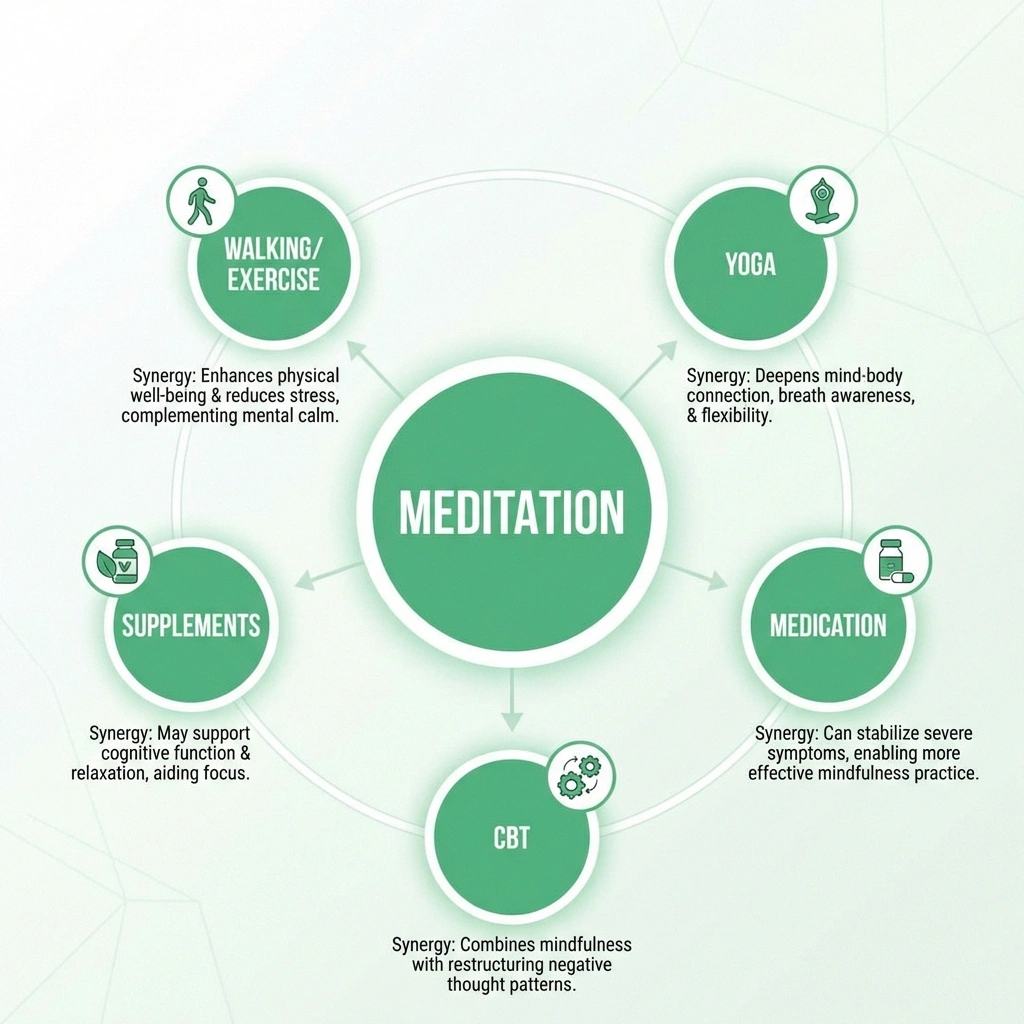
Meditation works best as part of a comprehensive approach to neuropathy management, not as a standalone treatment. Think of it as one tool in a well-stocked toolbox.
Here are some combinations that many people find effective:
Meditation + Physical Activity: Research shows that gentle walking combined with pet interaction works similarly to mindfulness can be particularly powerful. Walking meditation — where you pay close attention to each step and the sensations in your feet — gives you both the physical and mental benefits simultaneously.
Meditation + Yoga: Yoga for neuropathy naturally combines physical movement, breath work, and stress management for neuropathy gut symptoms. Many of the studies showing benefits for neuropathy pain used yoga-inclusive programs.
Meditation + Medication: mindfulness reducing central sensitization for both conditions practice may enhance the effectiveness of pain medications by reducing the anxiety and stress that can undermine their effects. Never reduce or stop medications without consulting your healthcare provider, but know that adding meditation may help you get more from your current treatment plan.
Meditation + Supplements: Some people combine their meditation practice with nerve-supporting supplements as part of a holistic approach. The key is working with your healthcare team to find the combination that works for you.
Meditation + Cognitive CBT for neuropathy pain management Therapy: If you're working with a therapist on cognitive impacts of neuropathy, meditation can reinforce the awareness skills you develop in therapy sessions.
Setting Realistic Expectations
I want to be honest with you about what meditation can and cannot do, because unrealistic expectations are the fastest way to abandon a practice that might genuinely help you.
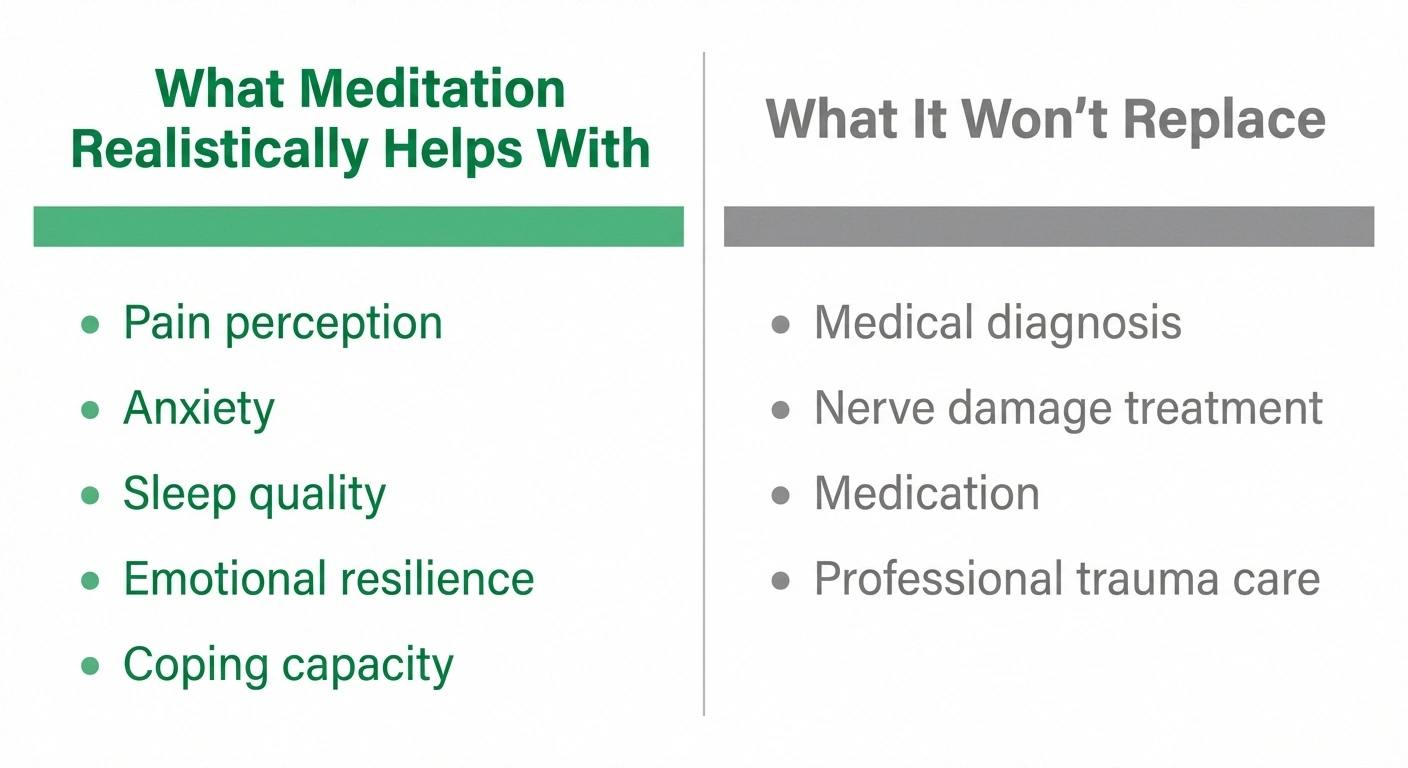
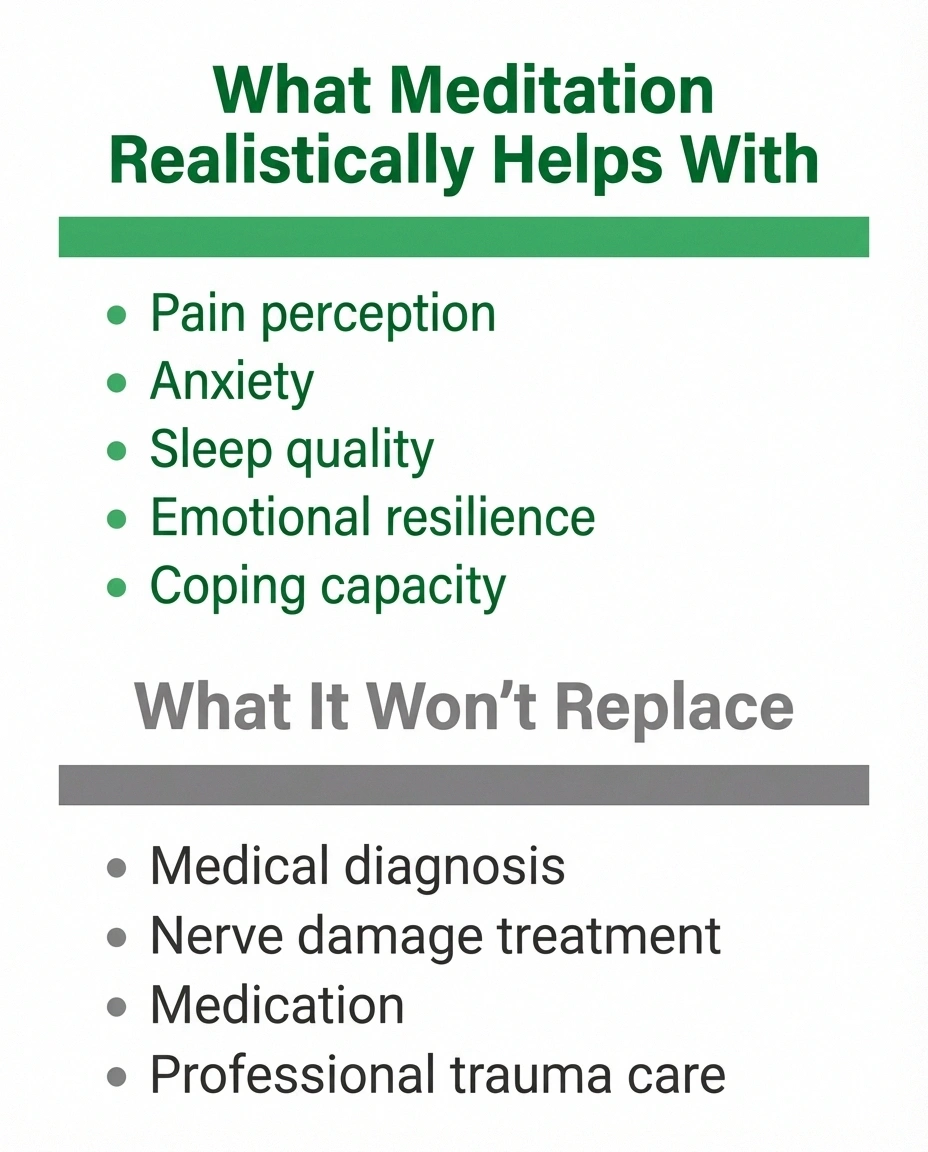
What Meditation May Help With
- Reducing the emotional suffering layered on top of physical pain
- Improving your ability to cope with pain flares
- Reducing anxiety and depression associated with chronic neuropathy
- Improving sleep quality (when practiced regularly)
- Providing a sense of agency and control over your pain experience
- Reducing pain catastrophizing — those spiraling “worst case” thoughts
What Meditation Probably Won't Do
- Eliminate your neuropathy pain entirely
- Repair damaged nerves
- Replace medical treatment
- Work immediately — benefits typically build over weeks of consistent practice
The research suggests that meaningful benefits often emerge around 4 to 8 weeks of regular practice, though some people notice small shifts sooner. Patience and consistency matter far more than perfection.
Building a Sustainable Meditation Practice
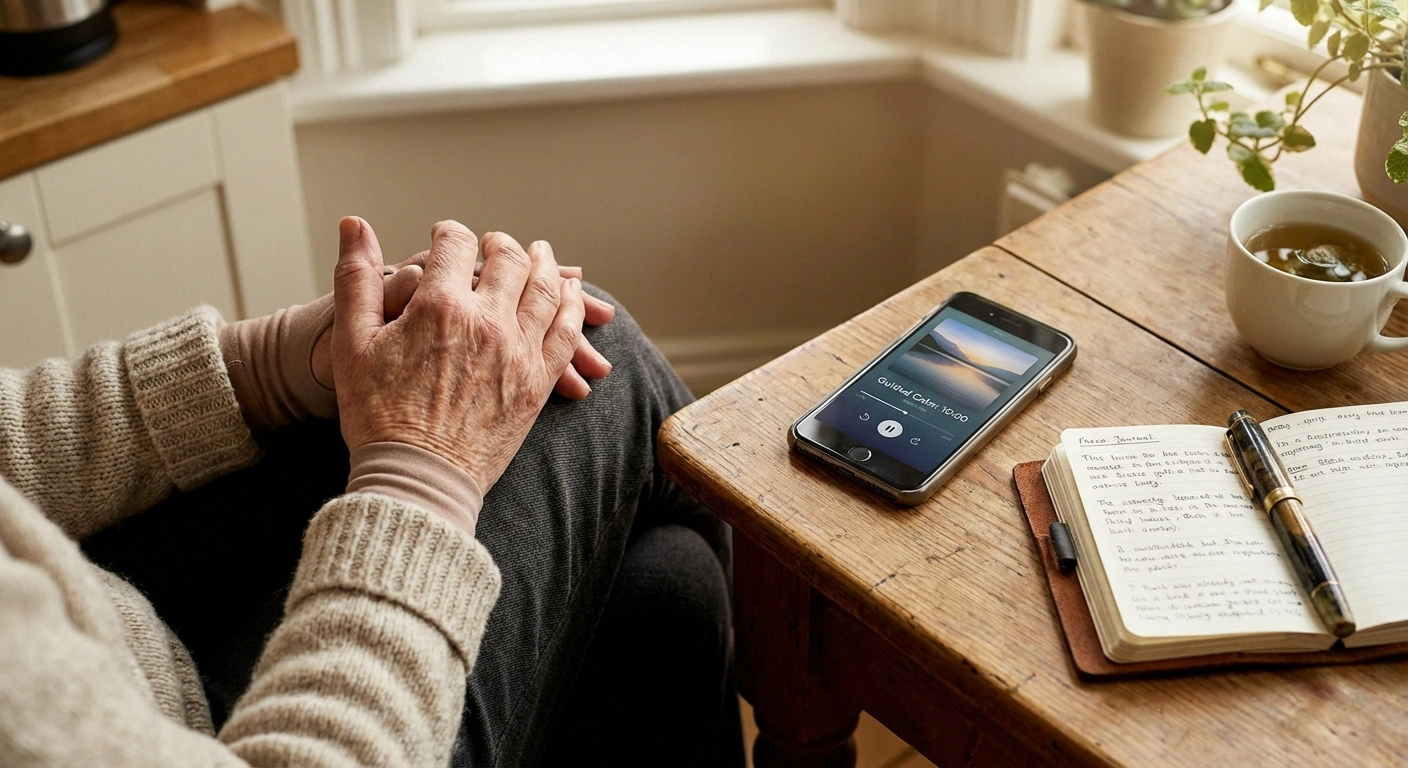
The biggest challenge with meditation isn't learning the techniques — it's making them a regular part of your life. Here's what has helped me and many others in neuropathy support groups maintain a consistent practice:
Create a Routine
Attach your meditation practice to something you already do every day. Maybe it's right after your morning coffee, or just before bed. The habit stacks onto existing routines more easily than floating as a standalone activity.
Track Your Progress
Keep a simple journal noting your pain levels before and after each session, along with your mood and sleep quality. Over weeks and months, you may notice patterns that motivate you to continue. Many meditation apps also have built-in tracking features.
Be Kind to Yourself
You will miss days. Your mind will wander constantly during sessions. Some days, your pain will make it nearly impossible to focus. None of this means you're “bad at meditating.” It means you're human, living with a challenging condition, and doing your best. That's enough.
Connect with Others
Consider joining a meditation group for people with chronic pain, either locally or online. Sharing the practice with others who understand what you're going through can be deeply motivating. Some physical therapy programs now incorporate mindfulness components, which can be a great entry point.
When Meditation Might Not Be the Right Fit
While meditation is generally safe and accessible, there are situations where it may not be appropriate or where extra guidance is needed:
- Severe depression or suicidal thoughts: If you're experiencing severe mental health symptoms, please seek professional help first. Meditation can complement treatment but shouldn't be your only intervention for serious mental health conditions.
- Trauma history: For some people, particularly those dealing with PTSD, certain types of meditation (especially body scans) can trigger difficult emotional responses. If you have a trauma history, consider working with a trained meditation teacher or therapist who can guide you through the process safely.
- Dissociation: If your neuropathy is accompanied by conditions that cause dissociation, some meditation techniques may worsen this. Grounding techniques may be more appropriate — consult a mental health professional.
None of these situations mean you can't eventually benefit from meditation. They simply mean you may need more support getting started, and that's perfectly okay.
Frequently Asked Questions
Can mindfulness meditation actually reduce neuropathy pain?
Research suggests that regular mindfulness meditation practice may reduce the perception of neuropathy pain by changing how the brain processes pain signals. A 2024 meta-analysis of ten clinical trials found significantly lower pain scores at 1 to 1.5 months follow-up in meditation groups. However, results vary from person to person, and meditation works best as part of a comprehensive pain management approach rather than a standalone treatment.
What type of meditation is best for nerve pain?
Mindfulness-Based Stress Reduction, or MBSR, has the strongest research support for neuropathic pain specifically. Body scan meditation and breath awareness meditation are also well-studied. The best type is ultimately the one you can practice consistently. Many people benefit from trying several approaches and using different techniques depending on their symptoms that day.
How long does it take for meditation to help with neuropathy symptoms?
Most research shows meaningful benefits emerging after 4 to 8 weeks of regular practice. Some people notice small improvements in sleep quality or anxiety levels sooner. The key is consistency rather than session length. Practicing for 5 to 10 minutes daily is more effective than one long session per week. Benefits tend to build and deepen over months of practice.
Can I meditate if my neuropathy pain is too severe to sit still?
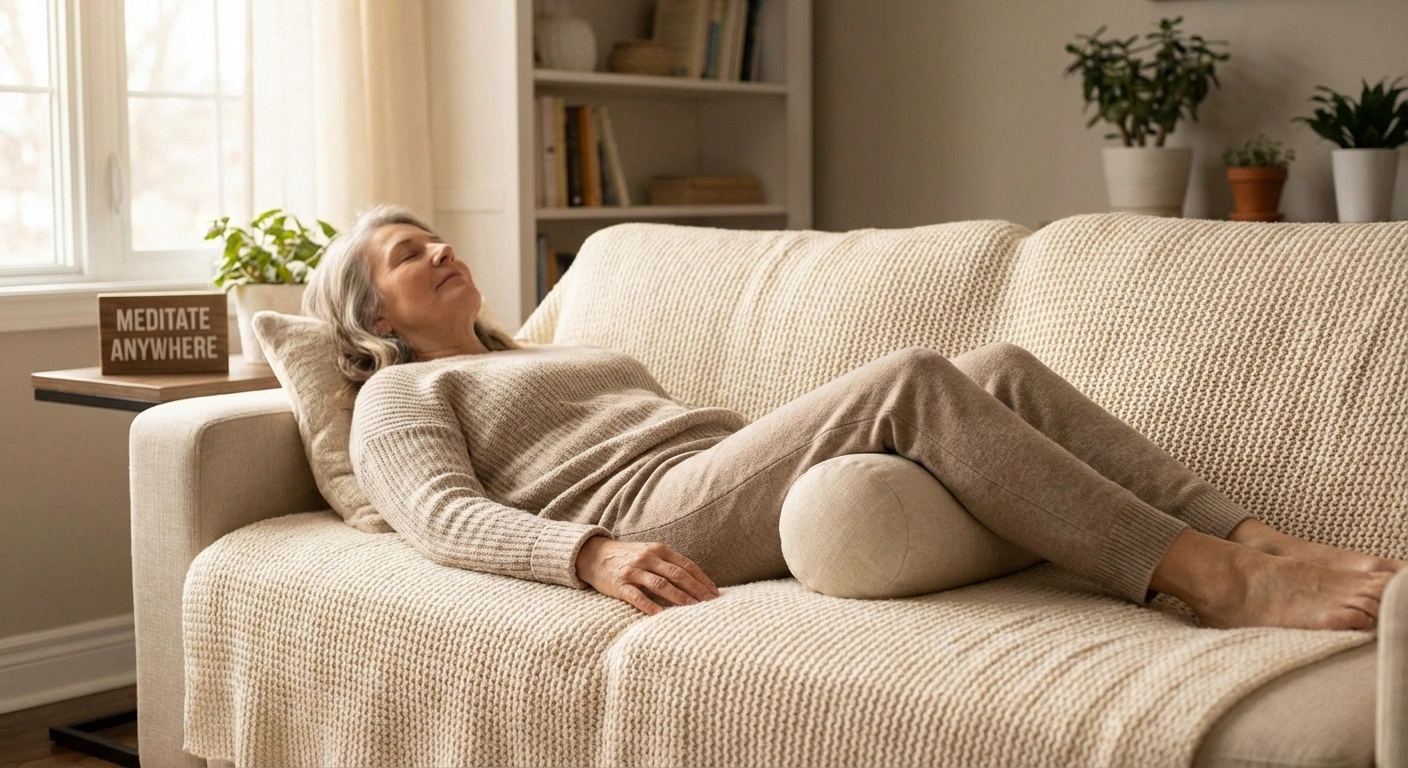
You do not need to sit still to meditate. You can practice lying down, reclined in a chair, or even during slow walking. Many people with severe neuropathy find that guided visualization or breath awareness meditation works well because these techniques do not require you to focus on painful areas of your body. Start with very short sessions of 3 to 5 minutes and build gradually.
What is MBSR and how does it help neuropathic pain?
Mindfulness-Based Stress Reduction is a structured 8-week program developed by Dr. Jon Kabat-Zinn that combines mindfulness meditation, body scanning, and gentle yoga. Research in patients with painful diabetic peripheral neuropathy showed approximately 30 percent reduction in pain severity and 46.5 percent reduction in catastrophizing. MBSR works by activating the parasympathetic nervous system, reducing stress hormones, and changing how the brain processes pain signals through neuroplasticity.
Does meditation replace medication for neuropathy?
No. Meditation should complement your existing treatment plan, not replace it. Never stop or reduce medications without your doctor's guidance. Many people find that meditation enhances the effectiveness of their medications by reducing the stress and anxiety that can amplify pain. Think of meditation as one tool in your neuropathy management toolbox that works alongside medical treatment, physical activity, and nutritional support.
How often should I meditate to see benefits for nerve pain?
Research suggests that daily practice produces the best results, but even 3 to 4 sessions per week may provide meaningful benefits. Most clinical studies used programs with daily practice of 20 to 45 minutes, but starting with 5 to 10 minutes is perfectly appropriate when you are in pain. Consistency matters more than duration. A shorter daily practice is generally more beneficial than occasional long sessions.
Meditation for neuropathy isn't about achieving some perfect state of calm. It's about developing a different relationship with your pain — one where you have more choices in how you respond to it. After years of practice, I still have neuropathy. But I suffer less with it, and that difference matters more than I ever expected it would.
As always, please discuss any new wellness practices with your healthcare provider, especially if you're managing multiple health conditions. This information is shared from my experience as a patient advocate and is not intended to replace professional medical advice.
About the Author