
The collagen aisle has gotten enormous. Walk into any vitamin store these days and you'll see scoops, capsules, gummies, ready-to-drink shots, bone broth concentrates, and powders flavored like vanilla and chocolate — all promising to support skin, joints, hair, gut, and increasingly, nerves. Some bottles even mention nerve repair on the label.
I started getting questions from our support group about collagen the moment a wellness influencer mentioned it during a “neuropathy reversal” video. People wanted to know: was this real? Could collagen actually help damaged nerves? Or was it just the next kale-and-turmeric trend dressed up in scientific language?
The honest answer is more nuanced than yes or no — and it's worth understanding, because the science behind collagen and nerves is genuinely fascinating, even if the supplement industry has gotten ahead of what the evidence actually supports.
What Is Collagen and Why Are People Talking About It for Nerves?
Collagen is the most abundant protein in the human body. It's the structural scaffolding for skin, bone, cartilage, tendons, blood vessels — and yes, peripheral nerves. There are about 28 different types of collagen, but Types I, II, and III make up the vast majority of what's in our connective tissues.
Key Takeaway
Collagen is structurally critical to peripheral nerves — but that doesn't mean oral collagen supplements help neuropathy. Surgical collagen scaffolds (a medical device) and dietary collagen powders (a food protein) are completely different things, and the evidence for the two is not interchangeable.
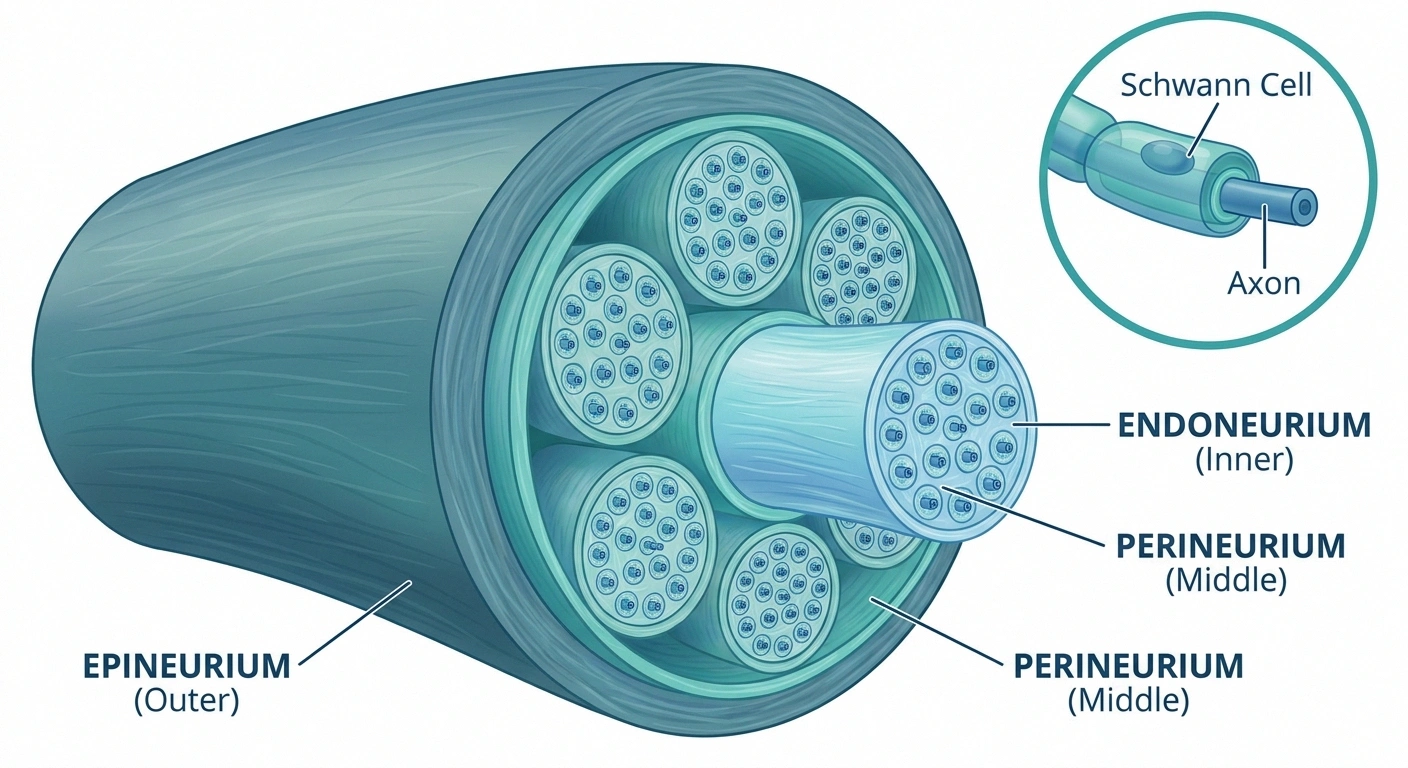
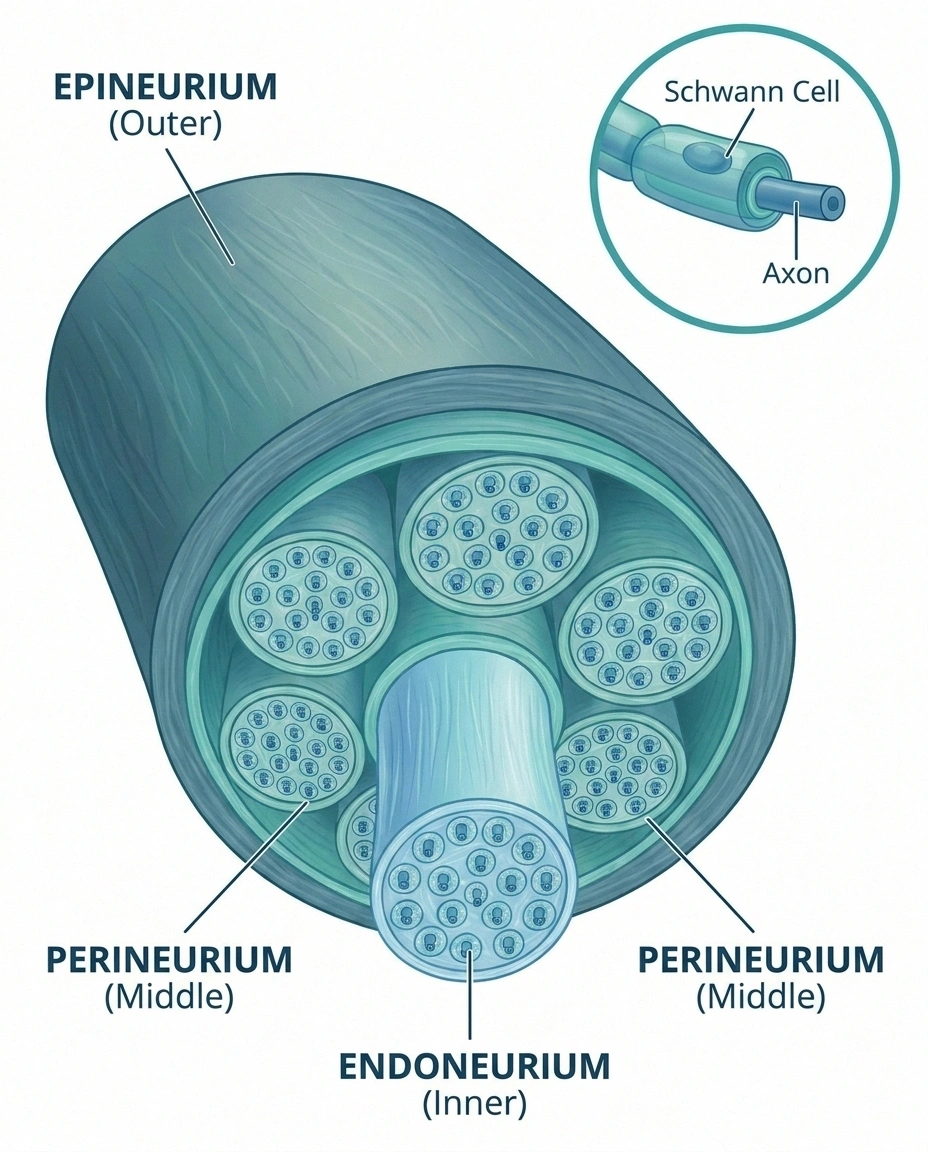
The reason collagen has entered the nerve conversation comes from real biology. Peripheral nerves aren't just a single fiber — they're elaborate structures with multiple layers of connective tissue wrapping around the nerve fibers themselves. The endoneurium, perineurium, and epineurium — the three protective sheaths around peripheral nerves — are heavily collagen-based. Schwann cells, the support cells that produce myelin and help nerves regenerate, sit on a basement membrane that's rich in collagen.
So nerves DO depend on collagen structurally. That much is settled science. The question is whether eating or drinking collagen helps damaged nerves recover.
The Two Different Conversations About Collagen and Nerves
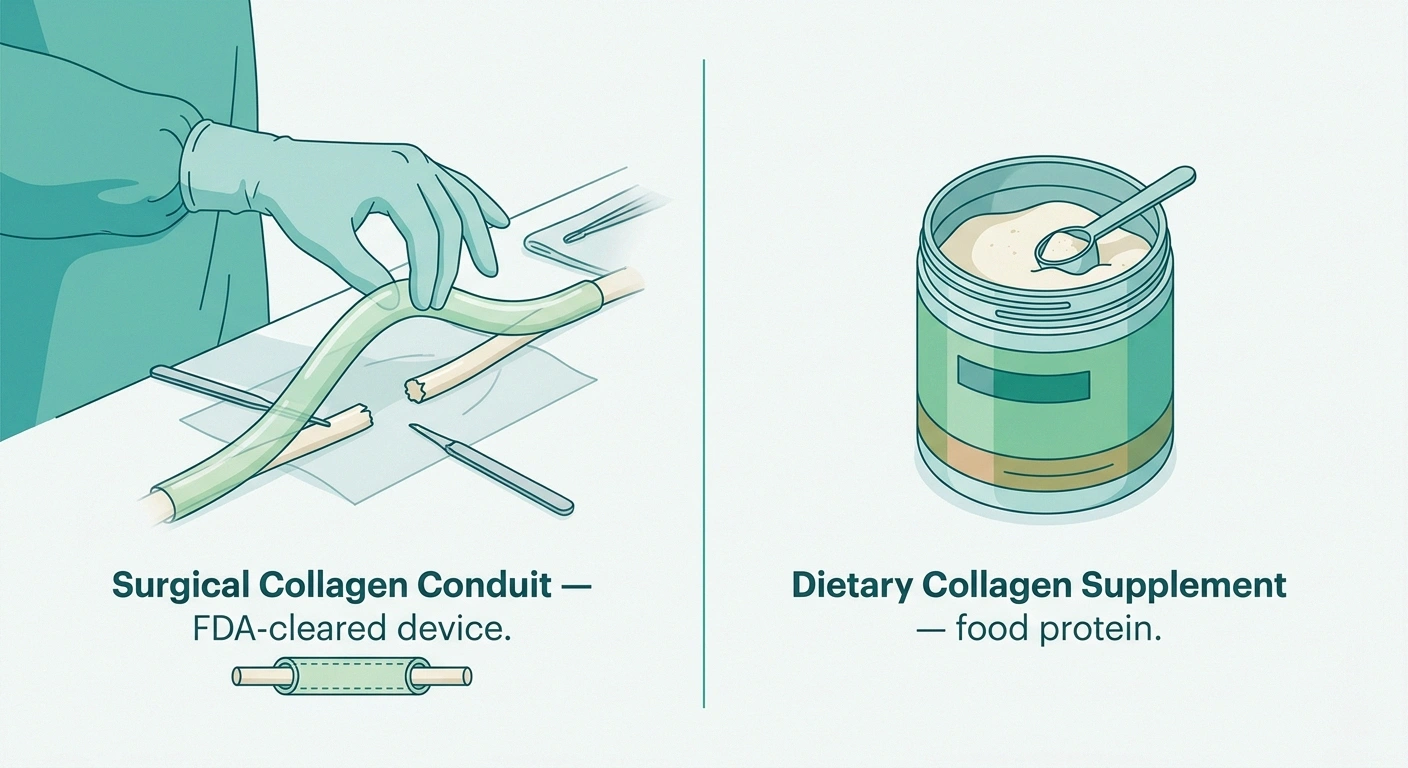
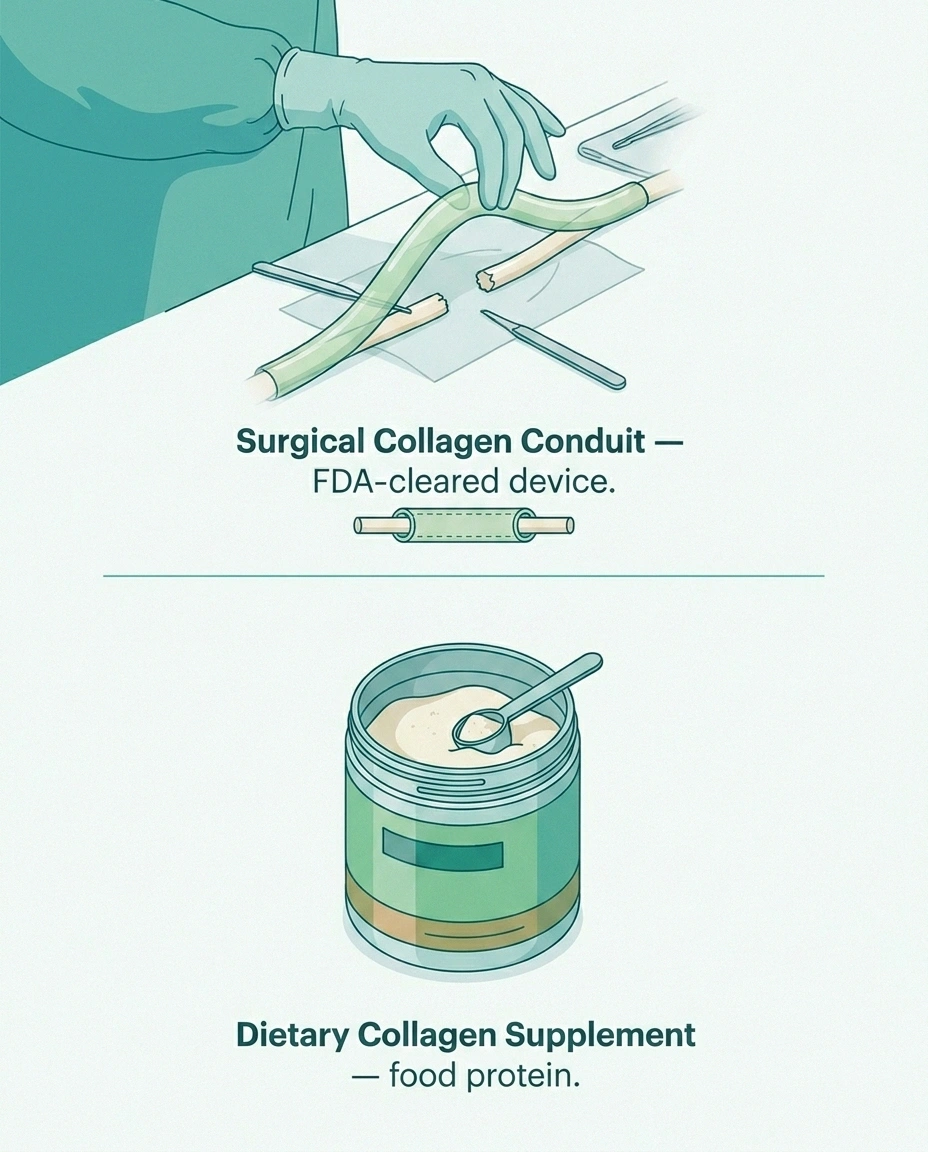
Here's where the confusion starts. There are two completely different conversations happening under the same word “collagen,” and they get blurred constantly in marketing material.
Two Different Things With the Same Name
| Aspect | Surgical Collagen Conduit | Dietary Collagen Supplement |
|---|---|---|
| What it is | FDA-cleared medical device | Food protein powder/capsule |
| Delivery | Implanted by surgeon | Ingested orally |
| Use case | Bridges severed nerve | Skin, joint, hair support |
| Evidence for nerve repair | Strong (RCT-level) | None published in humans |
| Available where | Operating room only | Drugstore / online |
Conversation 1: Collagen as a medical device for nerve surgery. When a surgeon needs to bridge a gap in a severed nerve — say, after a traumatic injury — they sometimes use a collagen nerve conduit. These are FDA-cleared medical products like NeuraGen and NeuraWrap. They're tubes made of purified collagen that act as a scaffold, guiding the regenerating nerve fibers across the gap. The evidence here is genuinely strong. Surgical collagen scaffolds work, and they're standard tools in peripheral nerve repair.
Conversation 2: Collagen as a dietary supplement. A scoop of collagen peptides in your morning coffee is fundamentally different. It's a food protein. When you eat collagen, your digestive system breaks it down into amino acids — primarily glycine, proline, and hydroxyproline — and those amino acids enter the general protein pool that your body uses to build whatever it needs.
The issue is that the marketing for supplement collagen often borrows the legitimacy of surgical-collagen research. “Collagen helps nerve regeneration!” — citing a paper on surgical conduits, but selling you a powder. The leap from “implanted collagen scaffolds work” to “drinking collagen powder helps neuropathy” is enormous, and the evidence doesn't make it.
What the Research Actually Shows
Let me walk through what's actually been studied, because the picture is interesting.
🔎 Research Says
A PubMed search for clinical trials of oral collagen supplements in peripheral neuropathy returns no published randomized trials. Strong evidence exists for collagen-based surgical conduits and engineered scaffolds — but these are operating-room devices, not consumer supplements.
Surgical collagen conduits — strong evidence. Multiple randomized trials have shown that collagen tubes used to bridge nerve gaps during surgical repair produce comparable functional outcomes to nerve grafts in many cases. This is established medicine. If you ever need surgery for a peripheral nerve injury, your surgeon may use one.
Engineered collagen-based scaffolds with stem cells, growth factors, or peptides — promising lab evidence. Recent research has tested collagen combined with chitosan, with neuroepithelial stem cells, with PRP, and with cod-derived collagen peptides delivered in PEG hydrogels. In rat sciatic nerve gap models, these advanced scaffolds promote axonal regeneration and remyelination, sometimes comparable to the gold-standard autograft. This is exciting bench science. None of these are oral supplements — they're surgical implants or engineered constructs.
Oral collagen peptide supplements for peripheral neuropathy — no published clinical evidence. I've searched for what I would expect to find: a randomized trial of collagen peptides in patients with diabetic peripheral neuropathy, idiopathic neuropathy, or chemotherapy-induced neuropathy, with measurable outcomes like nerve conduction velocity or symptom scores. I haven't found one in PubMed. There simply isn't a published clinical trial answering this question in humans.
What collagen supplements do have evidence for. To be fair, oral collagen peptides have legitimate evidence for skin elasticity, joint comfort in osteoarthritis, and possibly tendon recovery in athletes. These benefits are real, even if modest. They just aren't nerve regeneration.
The Schwann Cell Angle (And Why It's Tempting to Believe)
Here's the part that explains why the collagen-for-nerves story feels so plausible — and why it's still not enough to justify the supplement marketing.
Beware Marketing Borrowed Authority
Watch for collagen brands citing surgical-scaffold or rat-model nerve research to sell consumer powder. The leap from “implanted collagen scaffolds work” to “drinking collagen helps neuropathy” is not supported by clinical evidence.
Schwann cells are the unsung heroes of peripheral nerve recovery. After a nerve injury, Schwann cells dedifferentiate, clear away debris, and form what are called Bands of Bungner — collagen-based tracks that guide regenerating axons back to their targets. They literally build a collagen highway for nerve regrowth. Type I and Type IV collagen are critical to this process.
So you can see why someone might reason: “Schwann cells use collagen to repair nerves. If I supplement with collagen, I'll give them more material to work with.” It's an intuitive leap.
The problem is the human body doesn't work like a 3D printer with a hopper of raw materials. When you eat protein, it's digested into amino acids that all go into one pool. Your body draws from that pool to make whatever proteins it needs. There's no evidence that flooding the system with collagen-derived amino acids translates into more collagen at the site of nerve damage. And — interestingly — there's evidence that EXCESS collagen at injured nerves is actually a PROBLEM, not a benefit. Fibrotic scarring (excess Type III collagen) impedes axon regrowth. Collagen biology is bimodal: structurally essential, but excess collagen creates scar tissue that blocks regeneration.
What About Bone Broth?

Bone broth has become a wellness icon — simmered for hours from bones and connective tissue, full of gelatin (which is denatured collagen), and marketed as “liquid healing” for everything from leaky gut to joint pain to nerve damage.
The evidence for bone broth and nerves is exactly the same as for collagen powder: there isn't any. It's a food. It contains protein, some minerals, and some glycine. If you enjoy it and it fits your diet, there's no harm. But there's no clinical evidence that drinking bone broth helps neuropathy any more than eating any other complete protein source.
If the warm, comforting ritual of sipping bone broth makes the day feel more manageable when you're living with chronic pain — that's real, and it matters. Just don't expect the broth itself to repair nerves.
What Supplements Actually Have Evidence for Neuropathy?

If you're looking for a supplement to add to your neuropathy management plan, there are options with much stronger evidence than collagen. I cover most of these in detail elsewhere on the site, but here's the short list of supplements where actual clinical research has been done:
Supplements With Stronger Evidence Than Collagen for Neuropathy
Alpha-Lipoic Acid (ALA)
Multiple meta-analyses for diabetic neuropathy. Typical dose 600 mg daily.
Vitamin B12
Essential for myelin sheath. Deficiency directly causes neuropathy — supplementation reverses it.
Benfotiamine
Fat-soluble form of vitamin B1. Evidence in diabetic neuropathy.
Acetyl-L-Carnitine
Evidence in chemotherapy-induced and diabetic neuropathy.
Magnesium
When deficiency is documented. Helps with nerve excitability and cramping.
- Alpha-lipoic acid (ALA) — multiple meta-analyses showing benefit in diabetic neuropathy at 600 mg daily
- Vitamin B12 — essential for myelin; deficiency causes neuropathy directly
- Benfotiamine — fat-soluble vitamin B1 form with diabetic neuropathy evidence
- Acetyl-L-carnitine — evidence in CIPN and diabetic neuropathy
- Magnesium — particularly when deficiency is documented
For a fuller picture, the best neuropathy supplements for nerve health guide ranks options by evidence quality. Notice that collagen isn't on that list — not because it's harmful, but because the clinical evidence simply isn't there.
If You're Already Taking Collagen — Should You Stop?
Honestly, no, not necessarily. There's no evidence collagen supplements harm peripheral nerves, and they have legitimate (if modest) benefits for skin and joints. If you're already taking collagen and you like how it makes you feel, you don't need to throw the tub away.
The conversation I'd want you to have with yourself is this: Am I spending money on collagen because I believe it will repair my neuropathy? If yes, that's the belief that needs revisiting. There are better-evidenced supplements where the same dollars do more for your nerves. Collagen as a “nice general protein supplement that supports skin and joints” is different from collagen as “nerve regenerator.” One is honest framing; the other is marketing that's gotten ahead of the science.
If money is unlimited and you're stacking everything that might possibly help, sure, keep the collagen. If you're being thoughtful about which supplements give you real value, this is one to deprioritize.
Could Collagen Help Indirectly?

One last fair point: collagen supplements are protein. Adequate protein intake matters for nerve health (as it does for everything else). If your overall diet is low in protein and you're using collagen peptides to bump up your daily intake, you're getting a benefit — not because it's collagen specifically, but because it's adequate protein.
0
Published Clinical Trials
…showing oral collagen supplements improve peripheral neuropathy in humans. The biology is plausible. The clinical evidence is absent.
The same effect comes from eating a serving of fish, chicken, eggs, dairy, beans, or any other complete protein source. There's nothing magic about collagen-derived amino acids vs. amino acids from other proteins. Your body breaks them all down to the same pool.
For someone with neuropathy whose appetite is poor — say, due to nausea from medications, depression that comes with chronic pain, or general decline — a flavored collagen scoop in coffee or oatmeal might be a practical way to get more protein in. That's a legitimate use. It's just not nerve regeneration.
What I'd Want a Friend to Know

If a friend at our support group asked me about collagen for neuropathy — which has happened more than once — here's roughly what I'd say:
The Bottom Line
If your goal is nerve health, your supplement budget is better spent on alpha-lipoic acid, B12, benfotiamine, or acetyl-L-carnitine — all of which have actual clinical evidence. Collagen for skin and joints is fine. Collagen as a nerve-repair strategy is wishful thinking dressed up in marketing.
The science around collagen and nerves is real, but most of it is about surgical scaffolds and engineered medical devices, not the powder you can buy at the drugstore. Oral collagen supplements have evidence for skin and joints, not for nerve regeneration. There's no published clinical trial showing they help peripheral neuropathy. If you have the money to spend on supplements, alpha-lipoic acid, B12, benfotiamine, and acetyl-L-carnitine all have stronger evidence. If you're already taking collagen and like it, that's fine — just understand what it is and isn't doing.
And whatever you take, please don't stop your prescribed neuropathy medications without talking to your doctor. Supplements aren't substitutes for medication, and “natural” doesn't mean “more powerful.” It means less-studied, often less-regulated, and harder to dose precisely.
Frequently Asked Questions
Does collagen help nerve regeneration?
Surgical collagen nerve conduits used during nerve repair surgery have strong evidence for helping nerves regrow across gaps. Oral collagen supplements, in contrast, have no published clinical evidence for repairing peripheral nerve damage in humans. The two are very different things — implanted collagen scaffolds versus a digested protein powder. Marketing materials sometimes blur this distinction, citing surgical research to sell consumer supplements.
What is the best type of collagen for nerve health?
If we're talking about the structural collagen in nerves themselves, Types I and IV are most relevant — but those types are made by your body, not extracted from supplements in a way that targets nerves. Most consumer collagen supplements are Types I and III sourced from bovine or marine sources, marketed for skin, joint, and gut health. There is no specific collagen supplement type proven to help neuropathy.
Can collagen supplements heal damaged nerves?
No published clinical research supports the claim that oral collagen supplements heal damaged peripheral nerves. The biology that makes the claim plausible — Schwann cells and the collagen-based scaffolding around nerves — does not translate into a benefit from eating collagen. Your digestive system breaks collagen down into amino acids that enter the general protein pool. There is no evidence those amino acids preferentially go to nerve repair.
Is bone broth good for neuropathy?
Bone broth contains protein, gelatin (denatured collagen), some minerals, and amino acids like glycine. There is no clinical evidence specifically linking bone broth to neuropathy improvement. As a comforting ritual or a source of protein and electrolytes, it can have a place in a healthful diet, but it should not be expected to repair nerve damage.
Does collagen help diabetic neuropathy?
There is no published randomized trial showing oral collagen supplements improve diabetic neuropathy outcomes. Supplements with stronger evidence for diabetic peripheral neuropathy include alpha-lipoic acid (especially at 600 mg daily), benfotiamine, and ensuring adequate B12 levels. Blood sugar control remains the foundation of diabetic neuropathy management.
How long does it take for collagen to work?
For its evidenced uses (skin elasticity, joint comfort), collagen supplement studies typically show effects after 8 to 12 weeks of daily use at doses of 5 to 15 grams. For neuropathy specifically, there is no established timeline because there is no established benefit. If you're considering a supplement timeline for nerve symptoms, supplements with better evidence — like alpha-lipoic acid or acetyl-L-carnitine — typically need 8 to 12 weeks of consistent use to assess response.
Are collagen peptides better than gelatin for nerves?
Hydrolyzed collagen peptides are easier to digest and absorb than gelatin because they are broken down into smaller chains. For neuropathy specifically, this distinction doesn't matter — neither has clinical evidence for nerve regeneration. For skin and joint benefits, peptides are generally preferred for absorption efficiency.
Should I take collagen if I have neuropathy?
You can if you want to — there is no evidence that collagen supplements harm nerves. But understand that the supplement is unlikely to help your neuropathy specifically. If your goal is nerve health, your supplement budget is better spent on options with clinical evidence: alpha-lipoic acid, B12 if deficient, benfotiamine, or acetyl-L-carnitine. Collagen for skin and joint benefits is fine alongside these. Collagen as a primary nerve-repair strategy isn't supported by the science.
About the Author