The first time I really understood that a public restroom was one of the most dangerous places in my week, I was standing in a truck stop bathroom outside Roanoke. The floor was wet near the sinks, the stalls were narrow, and the only stall with a grab bar was occupied. I remember standing there doing the math: how steady I felt, what would happen if I went down on that tile. I made it through fine. But that bathroom is the reason I started paying real attention to how I use restrooms away from home.
If you live with neuropathy, you already know this. The home bathroom you can control. Public restrooms give you whatever they give you. So today I want to share what I have learned from years of using public bathrooms with bad balance, numb feet, and a stubborn refusal to stop traveling.
Why Public Restrooms Are a Hidden Risk for Neuropathy Patients
Bathrooms are already one of the highest fall-risk rooms in any building. Hard surfaces, water on the floor, tight spaces, a lot of sitting and standing. Now add a public bathroom. You do not know the layout. The lighting may be poor. The floor may be wet and you do not know it until your shoe slides. People are hurrying in and out, so you feel pressure to move faster than your feet can handle.
For those of us with neuropathy, the problem is the combination of an unfamiliar room, a body that does not give good feedback from the feet, and a sense that we should not “make a fuss.” That mix is how falls happen. I have written before about why proprioception loss in neuropathy changes how your brain reads the floor, and a slippery tile restroom is where that loss bites hardest.
The good news: public restrooms are also one of the easiest places to plan for. Almost every public building in this country is required by law to have at least one accessible stall, designed for exactly the kind of help our bodies need.
What ADA Stalls Actually Give You (and Why You Should Use Them)
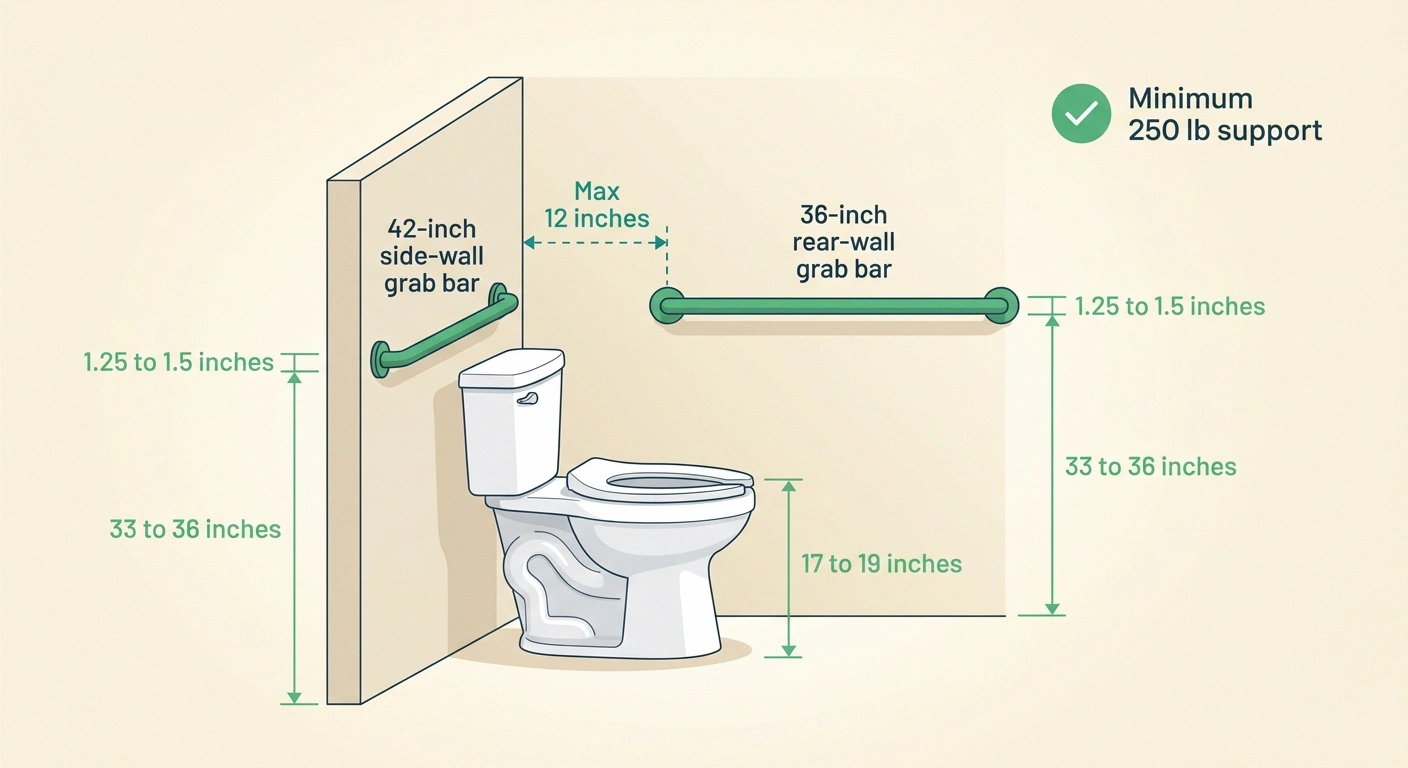
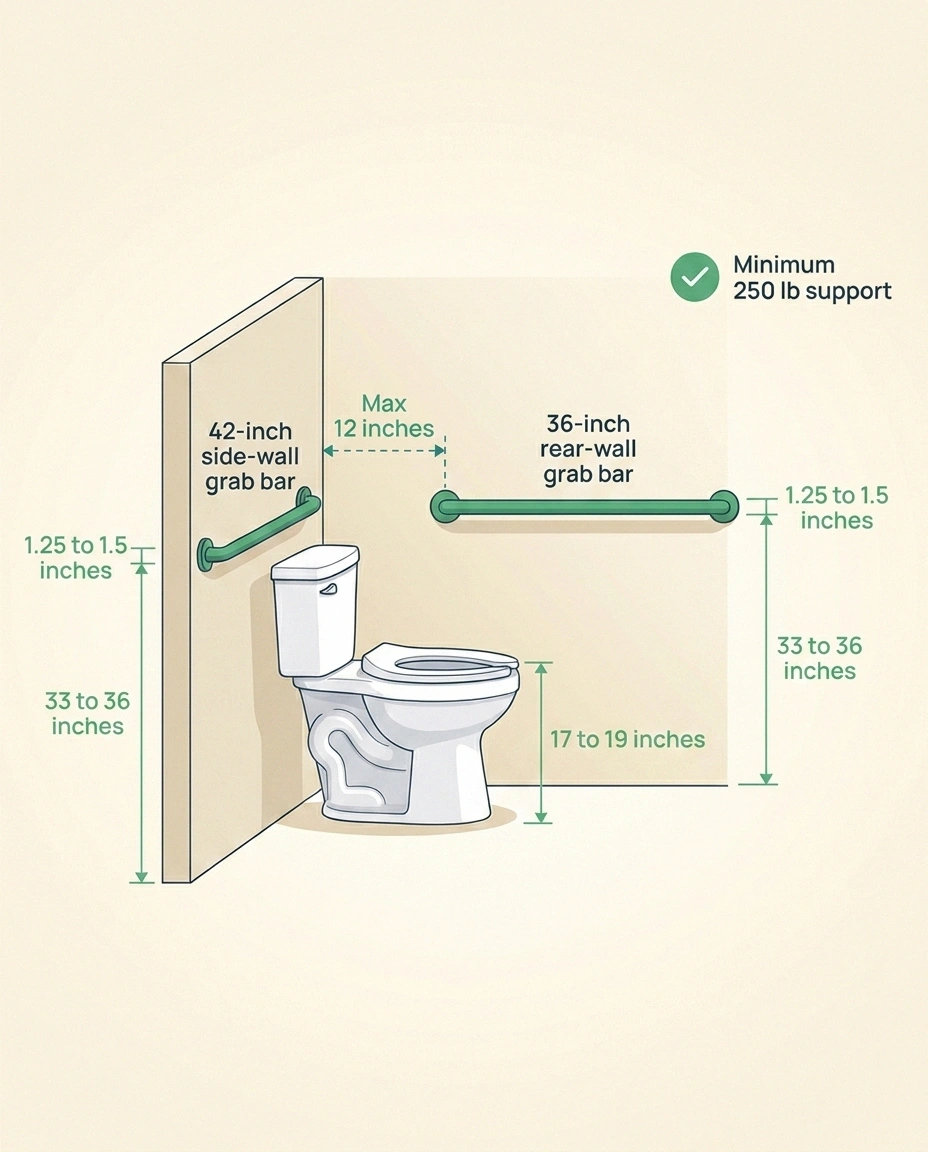
The ADA sets the rules for accessible stalls in public buildings. The reason I want you to know the specs is so you can walk into a strange bathroom and know exactly what you are looking for.
An accessible stall has to give you these things:
- Two grab bars. One on the side wall (42 inches long, no more than 12 inches from the back wall), one on the rear wall (36 inches long).
- Grab bars that hold real weight. Legal minimum is 250 pounds. Properly installed bars usually hold much more.
- The right height. 33 to 36 inches above the floor, the same as a kitchen counter.
- The right thickness to grip. 1.25 to 1.5 inches in diameter.
- A non-slip surface. Properly built bars are knurled or peened, not polished chrome.
- A taller toilet. 17 to 19 inches off the floor, 2 to 4 inches taller than residential. That matters to tired legs.
- A wider door and more floor space. So you can turn, position yourself, and use a cane without bumping anything.
Now the dignity part. I have watched people walk past the accessible stall because they did not feel “disabled enough” to use it. Neuropathy is a mobility-impairing condition. If your balance is unreliable, the accessible stall is for you. You are not taking it from someone “more deserving.” You are taking what you need to stay safe.
The 10-Second Stall Scan Before You Sit Down
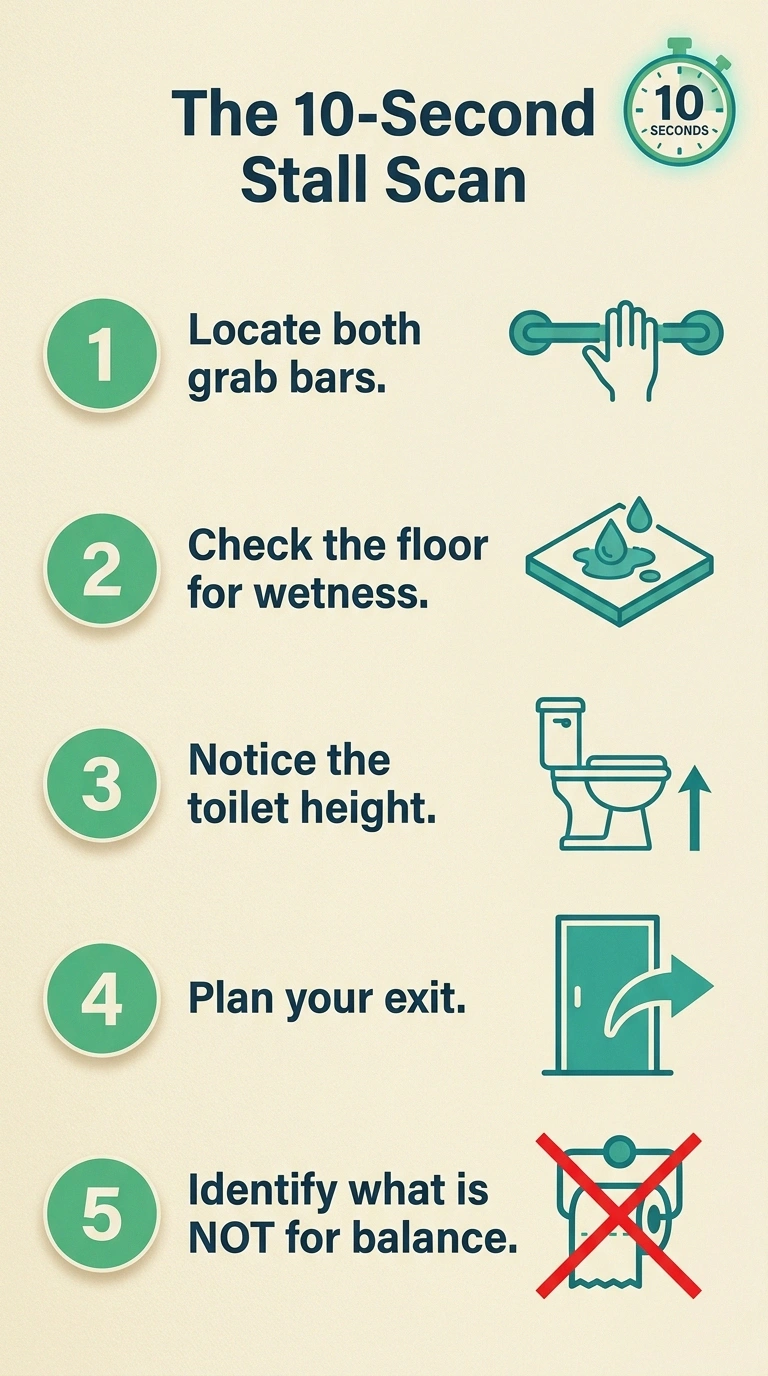
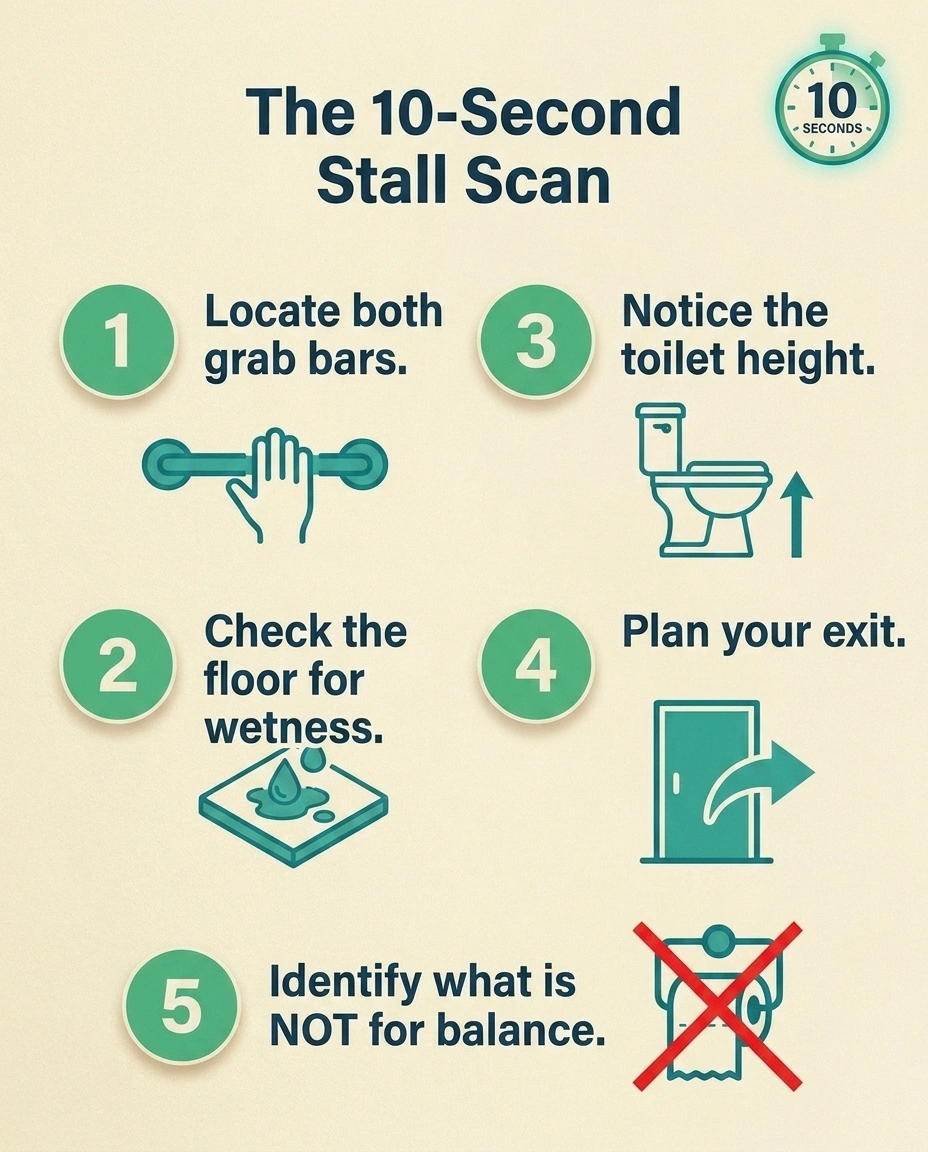
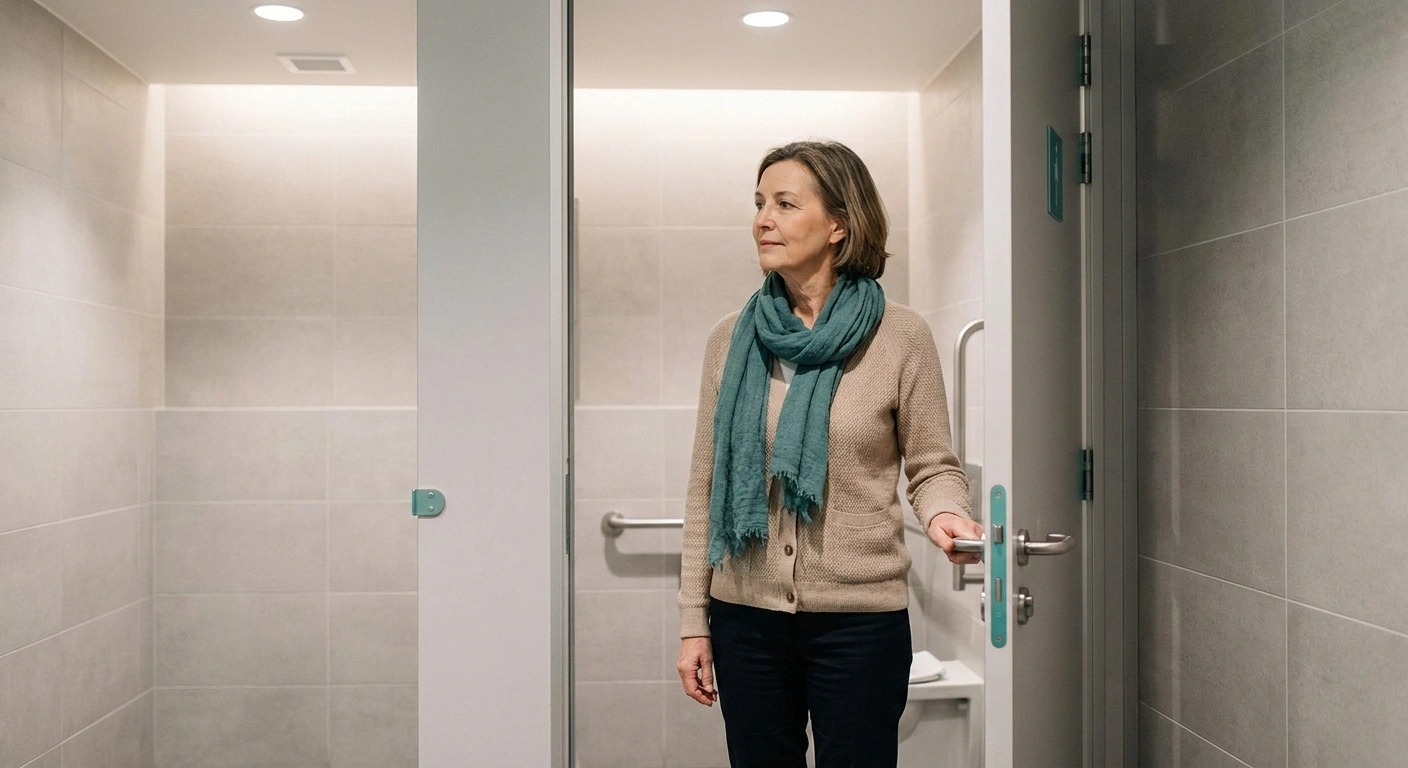
I do the same thing in every public restroom now. It takes about ten seconds. I started doing it after a close call in a restaurant bathroom where I sat down and only then realized the only thing within reach was a toilet paper holder, which will not hold your weight. So now I scan first, sit second.
Here is the scan I run:
- Locate both grab bars. Side wall and rear wall. Touch them if you are not sure they are sturdy. If there is no real grab bar, that changes the plan.
- Check the floor. Any wet spots? Toilet paper on the tile? Anything that could slide under your shoe? If yes, take the next stall.
- Notice the toilet height. A taller toilet is much easier to rise from. If you have a choice between a low standard toilet and the accessible one, the accessible one is the safer choice every time.
- Plan your exit. Where is the door swing? Will you have to step over your own purse to get out? Move things now, while you are still standing.
- Identify what is NOT for balance. Toilet paper holders pull out of the wall. Hand-dryer covers are flimsy. Sanitary product dispensers are not anchored for body weight.
Ten seconds. The scan does not change what I do in the bathroom. It changes whether I have a plan when something goes sideways.
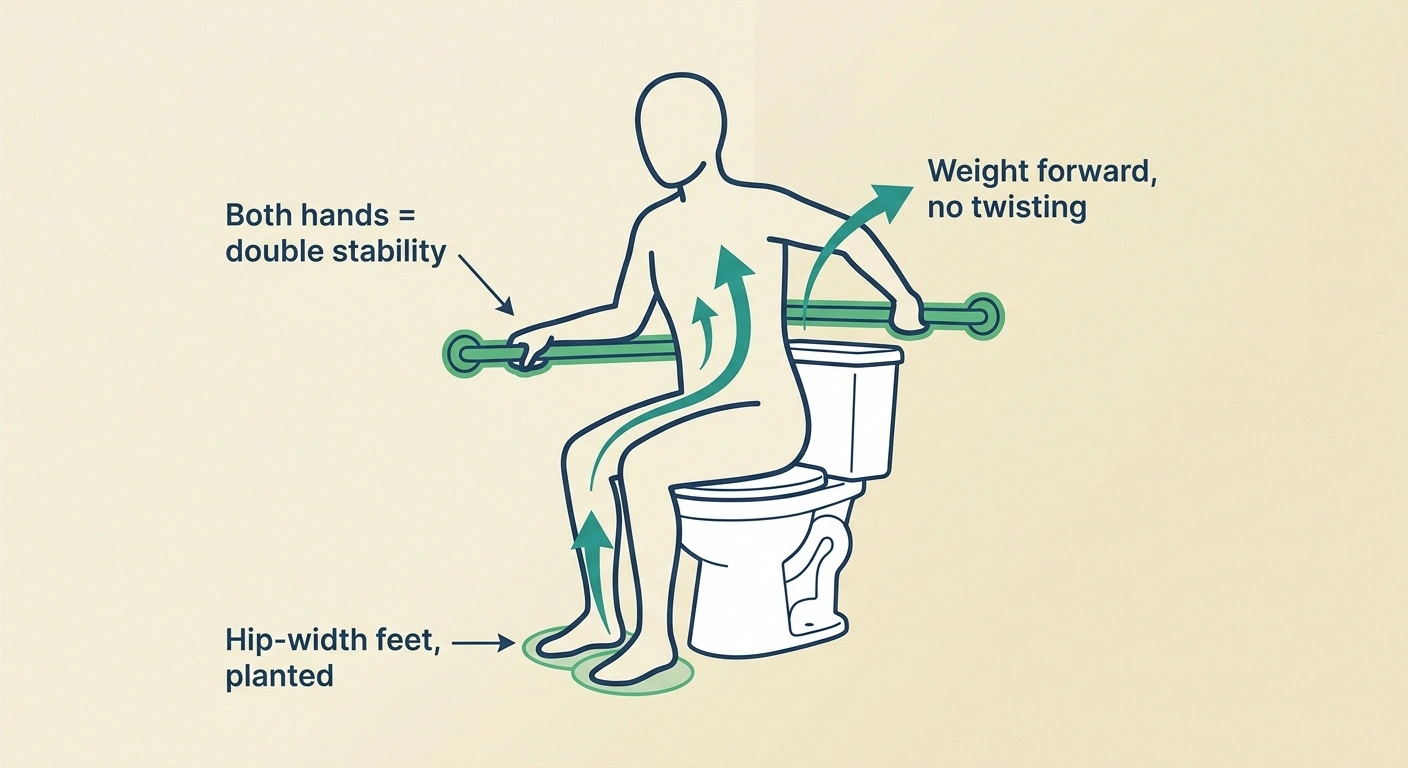
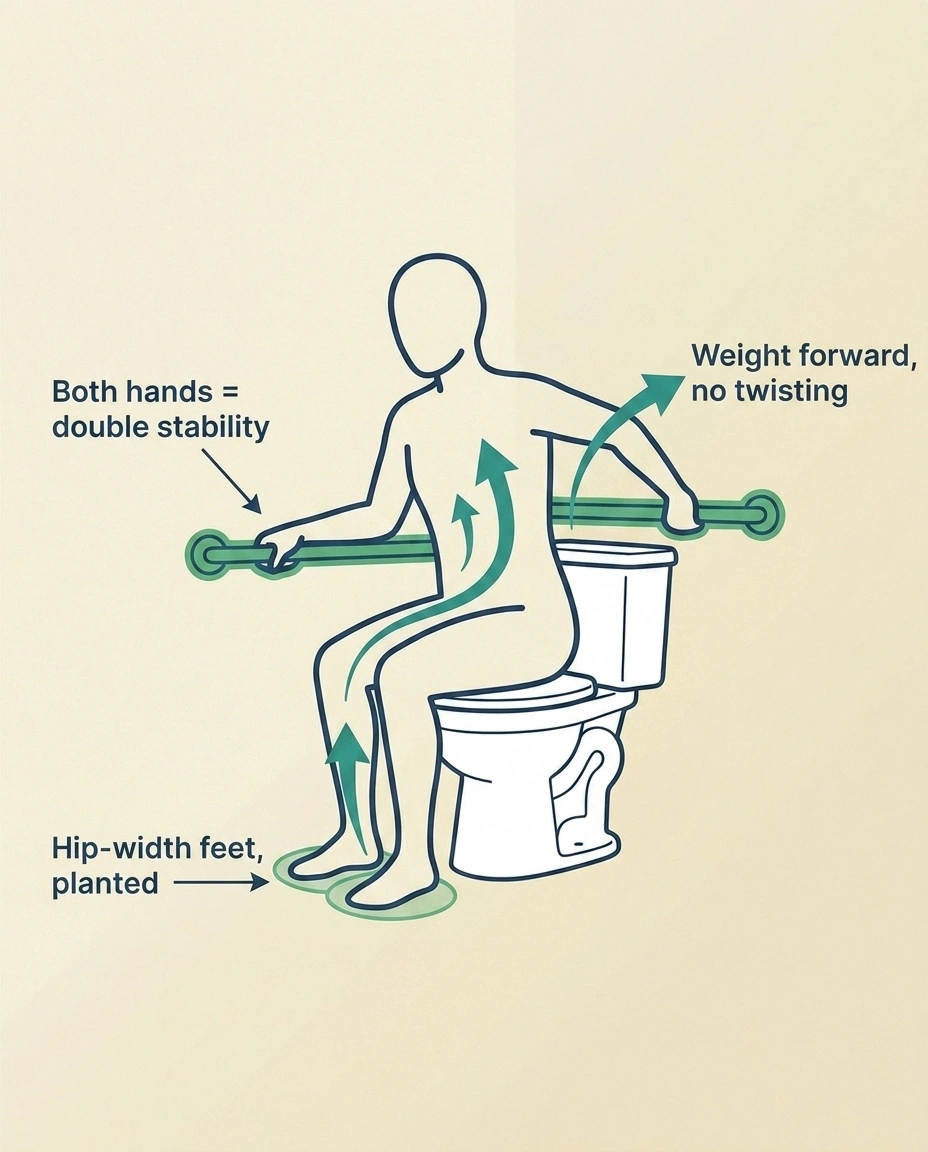
How to Use Grab Bars Safely (Both Hands, Hip-Width Feet, No Twisting)
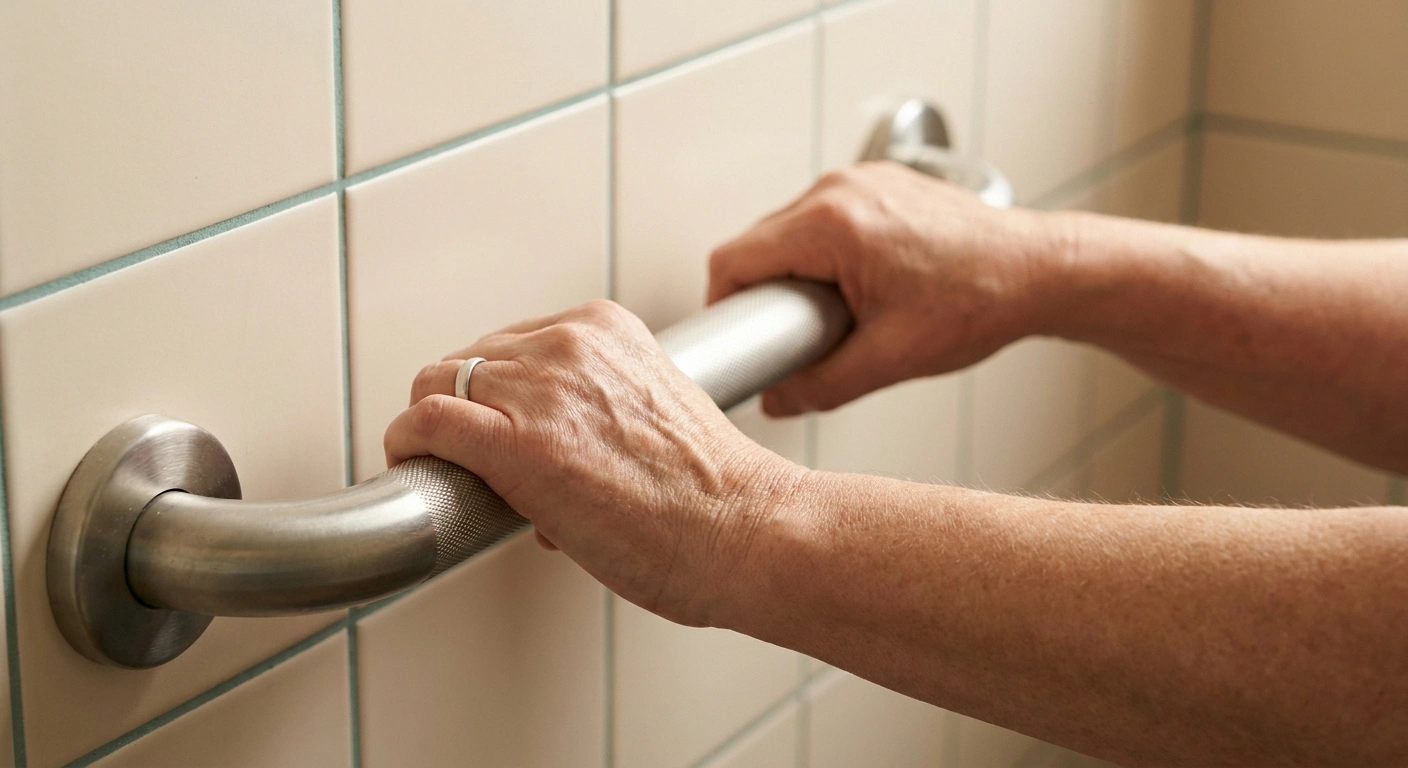
Most people use grab bars with one hand. With healthy balance, one hand is enough. With neuropathy, one hand is roughly half the stability of two. That is a big difference when your feet are already lying to you.
Here is how I use grab bars now:
- Both hands on the bars. Side wall gets one, rear wall gets the other. You become a tripod. If one foot slides, you have two upper-body anchors.
- Feet planted, hip-width apart. Not too close, not too wide.
- Lower yourself slow, knees over toes. Let your hips travel back, not down. Weight over feet as long as possible.
- To rise: lean forward first, then push up. Hips come up before shoulders.
- No twisting on the way up. Get fully upright before turning toward the door. Rising and twisting is one of the most common fall patterns.
My piece on home bathroom safety for neuropathy walks through the same mechanics with your own toilet, a good place to build muscle memory before you need it in a strange restroom.
When There’s No Grab Bar: A Backup Plan
It happens. Older restaurants, small shops, rural gas stations. The accessible stall is occupied or does not exist. Here is what I do.
- Position close to the wall. Sit close to a side wall so you can brace a forearm against it when standing.
- Use the stall partition. Sometimes the partition is sturdier than the back wall. Test with a gentle push.
- Use the door frame. In a very narrow stall, I sometimes turn 180 degrees and sit facing the door, then brace both hands on the frame to rise.
- Weight forward, rise slow. Hips back, then forward, then up.
- Skip the twist. Get all the way upright before reaching for the latch.
If no-grab-bar stalls feel scary, that is real information. A folding cane in your bag, or a chat with your PT about portable supports, can turn an unsafe situation into a manageable one.
Restroom Trouble Spots to Plan For
Not all public restrooms are equally risky. After years of paying attention, I have a short list of places where I plan ahead.
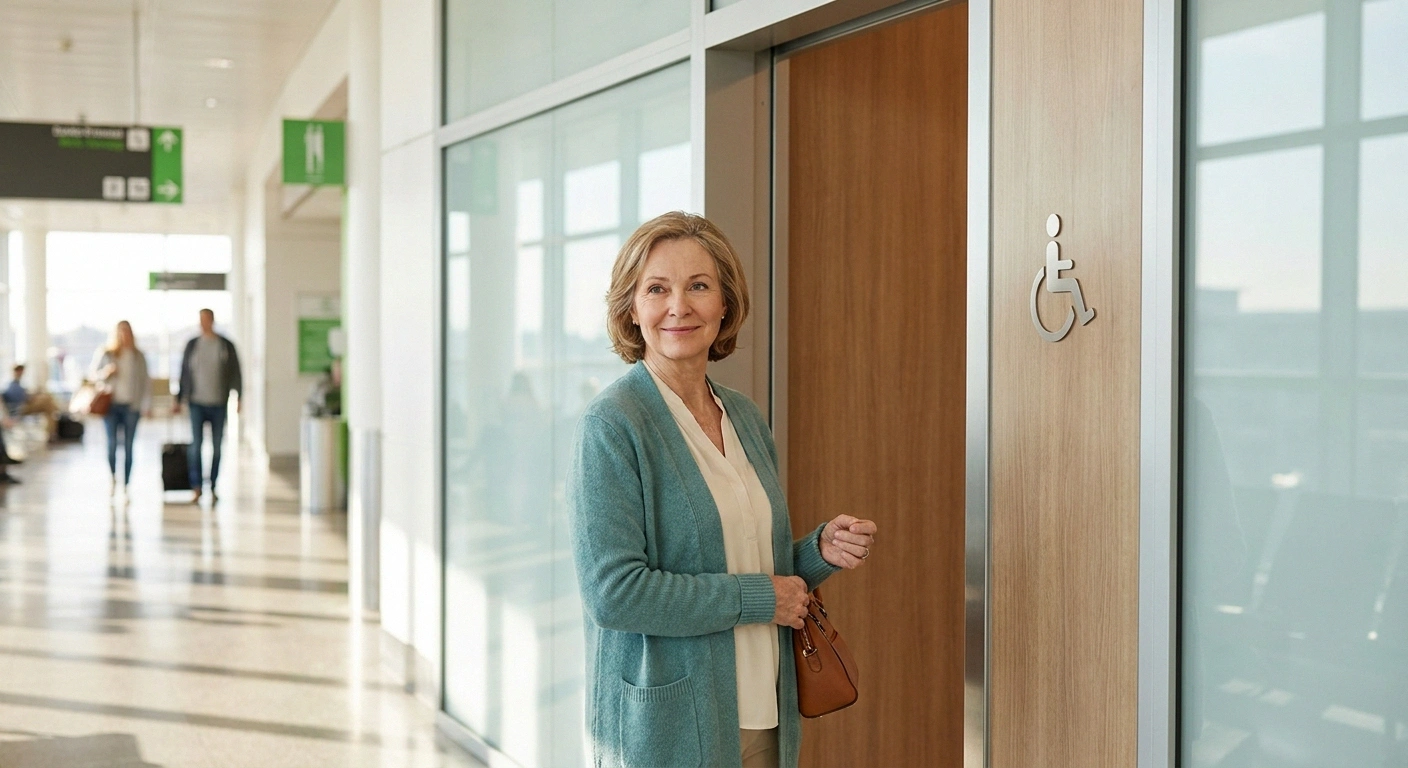
Airport restrooms. Busy, hurried, and suitcases everywhere. I build in extra time and pick a restroom past the rush of arriving passengers. I use the family restroom if there is one.
Restaurant bathrooms. Often older, often small, sometimes downstairs. When I am traveling, I ask the host before being seated whether there is a ground-floor restroom. Nobody has ever been weird about it.
Highway rest stops and gas stations. Quality varies a lot. The big truck-stop chains (Pilot, Love’s, TA) almost always have accessible stalls and decent grab bars. Small independent gas stations are a coin flip. On a long drive, I plan stops at the big chains.
Festivals and outdoor port-a-potties. Standard port-a-potties have no grab bars and a narrow door. Most events have at least one ADA portable unit, which is much wider and has grab bars inside. If you do not see one, ask staff.
Hospitals and medical office restrooms. The unexpected good news. These usually have the best grab bars in the building, plus a call button. Use them with confidence.
For longer driving days, my piece on driving safely with neuropathy covers route planning and pull-over timing, which feed into restroom planning too.
A Quick Word on Companion Care / Family Restrooms
Companion care restrooms (sometimes called family restrooms) are one of the best-kept secrets for people with neuropathy. Single-occupancy, locking door, more floor space, a grab bar, and almost always a fold-down baby table that can serve as a stable lean point.
You will find them in newer airports, big-box stores, most malls, and many newer restaurants. If you are traveling with a spouse, they can come in with you, which helps if your balance has been off that day. No stigma. They are made for situations like ours.
Should You Carry a Folding Cane?
A folding cane breaks down into three or four sections and fits in a purse or backpack pocket. In a restroom, it gives you a third point of contact, sometimes the difference between a near-miss and a fall.
I am not saying you need a cane. I am saying that if your balance has gotten worse over the last year, or you have had even one fall, it is worth a conversation with your PT. My write-up on walking aids and canes for neuropathy covers types, fit, and use in tight spaces.
The restroom move: set it leaning against the side wall, within easy reach, before you sit. When you rise, pick it up before your first step.
If You Slip or Fall in a Public Restroom
Even with every habit and every scan, sometimes a fall happens. The worst thing you can do is panic and try to bounce up. The right response is the same in a public restroom as it is anywhere else.
- Stay where you are for a moment. Breathe. Take stock. Are you hurt? Can you move your hands and feet?
- Call for help if you need it. In a busy bathroom, someone will hear you. If you have your phone in your pocket (and you should), you can call the person waiting for you outside.
- Get up using a structure, not your legs. A toilet, the wall, a stable bench. My piece on how to get up after a fall with neuropathy walks through the full method, step by step.
- Do not refuse help out of pride. If a stranger offers a hand, take it.
- Follow up afterward. Even a small fall is information. If you have had two falls in a year, that is a signal. Ask your doctor about a PT referral for balance work and an OT evaluation for your home.
My broader piece on balance and falls with neuropathy goes into prevention in more depth, and the home safety modifications guide is a good companion piece if your last few near-misses have been at home, not out in public.
Frequently Asked Questions
Are restaurants required to have grab bars in their restrooms?
Restaurants and other public accommodations built or significantly renovated after 1992 are required by the ADA to have at least one accessible stall with two grab bars. Very old un-renovated buildings may be grandfathered in.
What is the proper toilet height in an ADA-compliant stall?
17 to 19 inches above the finished floor, 2 to 4 inches taller than a standard residential toilet. The extra height makes it noticeably easier to rise from a seated position.
Can I use the accessible stall if I do not look disabled?
Yes. Accessible stalls are for anyone who needs them, not just wheelchair users. Neuropathy is a mobility-impairing condition. If your balance is unreliable or rising from a low toilet is hard, the accessible stall is exactly where you should be.
Are toilet paper holders strong enough to use as a grab bar?
No. They are not designed to support body weight and will pull out of the wall under any real load. Hand-dryer covers, sanitary product dispensers, and trash can lids are also unsafe.
How much weight can a properly installed grab bar hold?
The ADA minimum is 250 pounds. A properly anchored bar often holds far more. If one feels loose or wobbly, do not rely on it.
Should I carry a folding cane just for public restrooms?
It depends on how stable you feel day to day. A folding cane gives you a third point of contact and can be the difference between a near-miss and a fall. If you have fallen in the last year, talk to your physical therapist about whether one makes sense for you.
What should I do if I fall in a public restroom?
Stay where you are, breathe, and take stock before trying to move. Call for help if you are hurt or unsure. Use a stable structure (toilet, wall, bench) to get back up, not your legs alone. Two falls in a year is a pattern a PT can usually help break.
About the Author