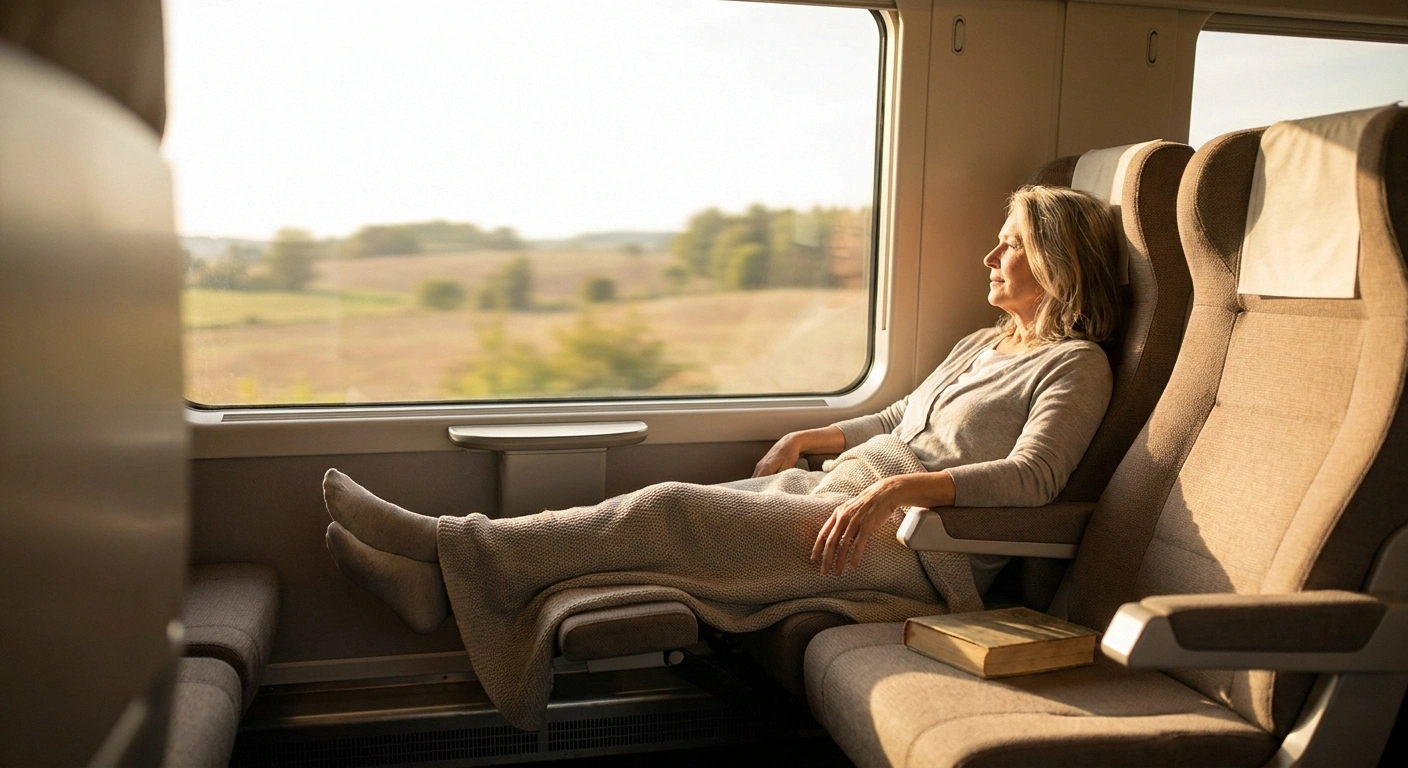
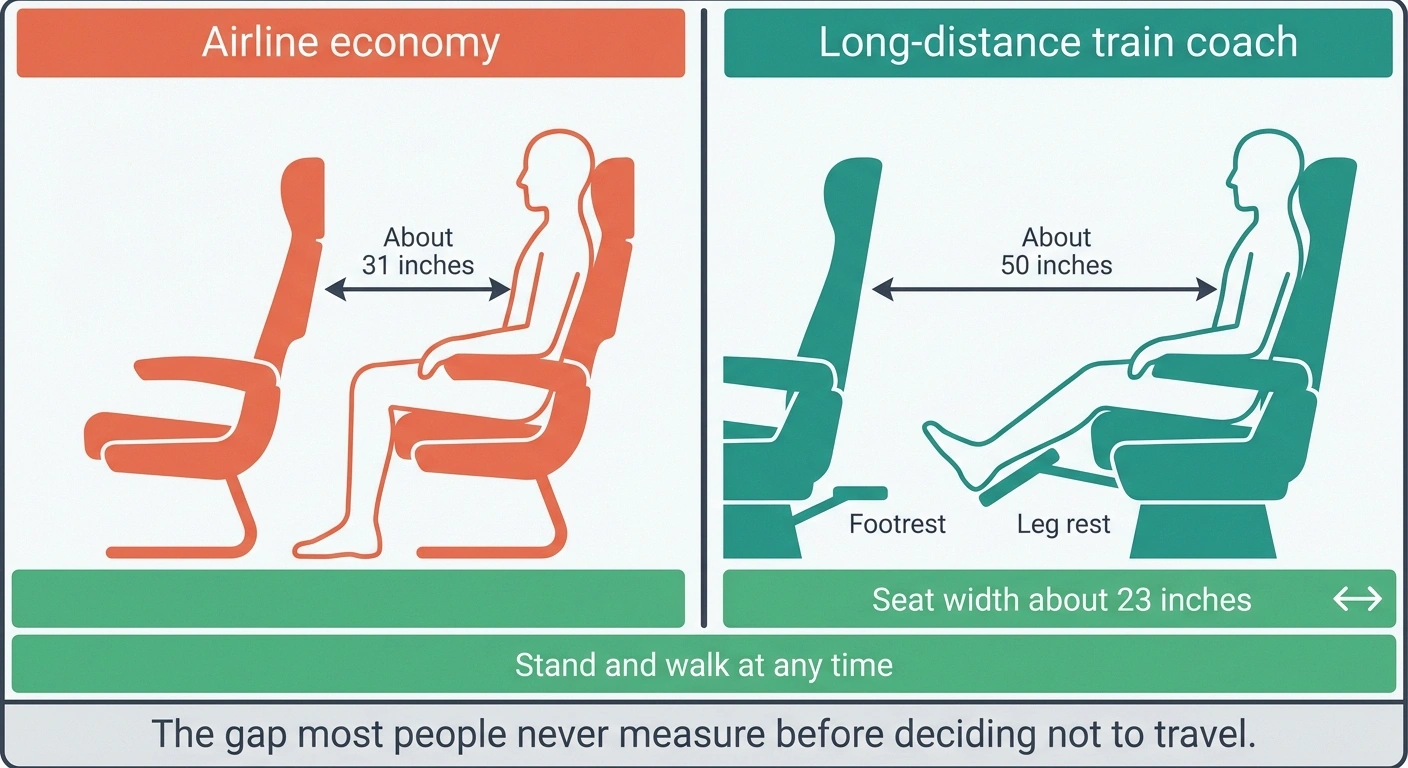
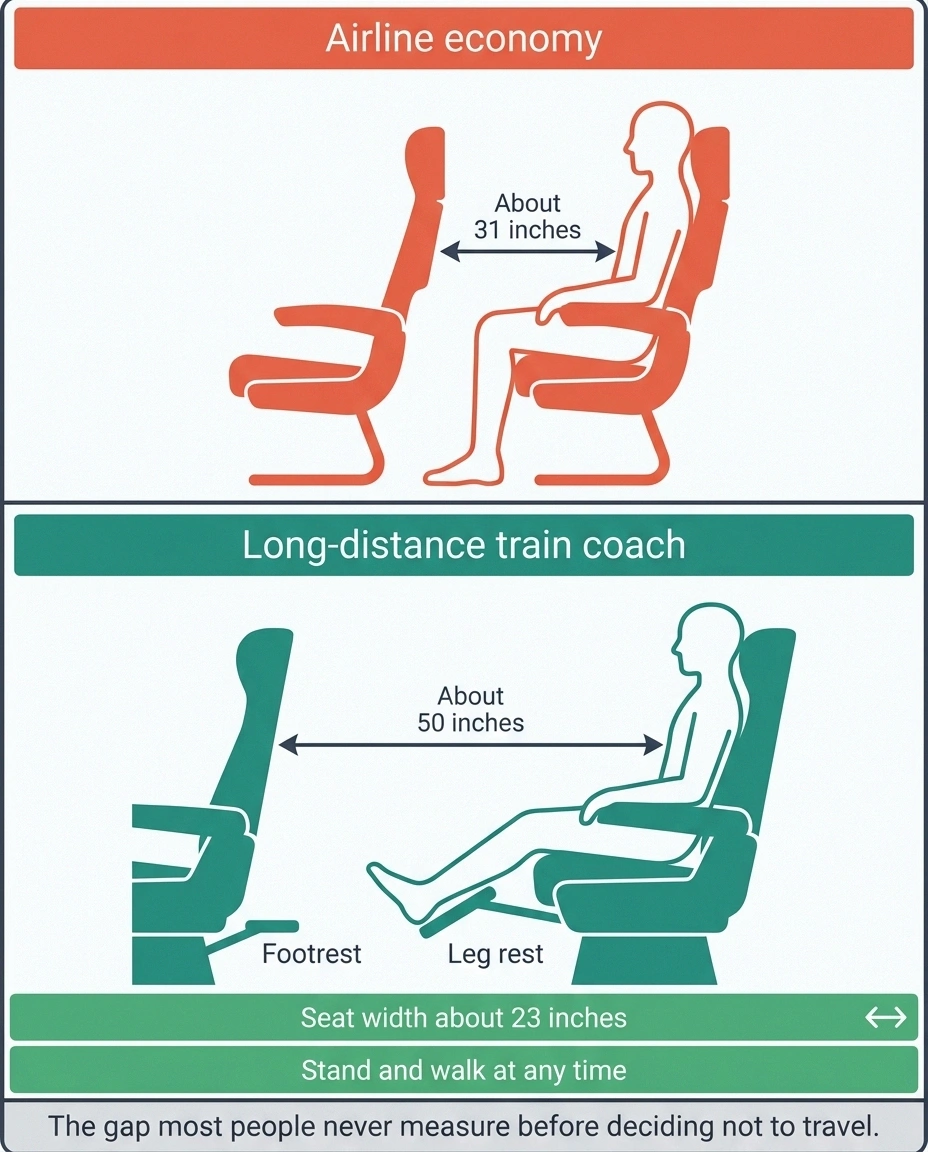
Airline economy gives you about 31 inches between your seat and the one in front. Long-distance train coach gives you roughly 50, with a footrest and a leg rest, in a seat about 23 inches wide that genuinely reclines.
Then there is the part that matters more than any measurement. On a train, you can stand up and walk whenever you feel like it. There is no seatbelt sign, no beverage cart pinning you in, nobody asking you to remain seated for the next two hours.
For anyone whose feet start protesting after forty minutes of stillness, that is a considerable difference, and it is a comparison most people never think to run. Trains are slower. They are also, for a lot of us, dramatically more comfortable.
What follows is the practical version: where trains genuinely help, and the handful of places they catch people out.
The Numbers Nobody Runs
The case for the train comes down to four things.
Space. Long-distance coach seating on Superliner and Viewliner equipment is built for overnight travel, and it shows. Deep recline, a footrest that flips up from below, and a separate leg rest that extends. You can get your legs genuinely elevated, which matters if your feet swell.
Freedom to move. This is the real advantage. Getting up every half hour is normal train behavior, not a disruption. Amtrak's own guidance actively encourages passengers to stand and stretch during the journey.
No shoe removal at a checkpoint. Anyone who has stood barefoot on an airport floor with numb feet knows exactly why this counts. Boarding a train is closer to boarding a bus than to clearing airport security. Our guide to getting through airport security with neuropathy covers the flying version if you have both trips ahead of you.
Somewhere to go. Most long-distance trains have a café car or a lounge car, which means there is a destination to walk to. Having a reason to get up beats intending to get up.
The trade-off is time. A trip that flies in two hours takes most of a day by rail. Whether that is a cost or a feature depends on how the day after a flight usually goes for you.
Booking: Three Decisions That Matter
Most of the comfort of a train journey is determined before you leave the house.
The two-minute phone call that decides the trip
Booking online cannot tell you what your particular station looks like on the day. Booking by phone can. Say roughly this:
“I can walk, but I have reduced sensation in my feet and my balance is not great. I am travelling from [station] to [station]. Can you tell me whether either station has level boarding or whether I will be climbing steps? And is there lower-level seating available so I am not using the interior stairs?”
Naming what you can do, not only what you cannot, gets you a more useful answer than asking for “assistance” in the abstract.
Check your specific stations, not the route. This is the single most important thing on the page. Accessibility is a property of individual stations, not of the railroad. Larger stations often have level or lifted boarding. Smaller and historic stations frequently do not, and older equipment on some regional routes lacks newer features. Look up your departure station and your arrival station individually. A route that is easy at one end can be awkward at the other.
Consider accessible seating even if you would not describe yourself as disabled. These seats carry extra room and are intended for passengers who use a walker, need additional legroom, or have other accessibility needs. They sit near an accessible restroom, which shortens the walk that matters most. On Superliner equipment they are on the lower level, meaning no interior stairs at all. Book early, because availability is genuinely limited.
Ask for lower-level seating if stairs are a concern. Superliner cars are double-deck. Coach seating sits upstairs while the exits and most restrooms are downstairs, so the standard experience involves a narrow interior staircase on a moving train, potentially several times overnight. Lower-level seating exists and sidesteps that entirely.
If your needs are at all specific, phone or use live chat rather than booking online. Staff can confirm what your particular train and stations actually offer, and they need lead time to arrange anything.
Coach or a Roomette
A roomette is a small private compartment with two facing seats that convert into a bed, plus a fold-down upper bunk. Bedding is included, and on long-distance routes so are dining car meals.
Where the line actually falls
Under 4 hours
Coach, comfortably. The reclining seat and footrest do everything a roomette would, and you will be up walking anyway.
4 to 12 hours, daytime
Still coach for most people. Spend the money on lower-level or accessible seating instead, which buys more than privacy does.
Anything overnight
Roomette, if the budget allows. Lying flat is the only position that fully unloads the feet, and meals arriving removes several trips through moving cars.
If two of you are travelling, book the roomette as a pair and take the lower berth. The upper bunk needs a ladder, which is the one part of the compartment that does not suit numb feet.
It costs considerably more than coach. Whether it is worth it depends on a few things that are specific to neuropathy rather than to comfort in general.
Reasons a roomette earns its price here:
- You can lie flat, which is the only position that fully unloads the feet
- You control your own space, so elevating your legs does not require negotiating with a seatmate
- Meals come to you, removing several trips through moving cars
- Some configurations include a toilet in the room, which removes the nighttime walk entirely
- There is a door, so you can do stretches or foot exercises without an audience
Reasons coach may be the better call:
- Roomettes are compact, and the floor space is small if you want to stand and move in place
- Getting into an upper bunk involves a ladder, which is not a good match for poor foot sensation
- Long-distance coach seats already recline substantially with leg rests, so the gap is smaller than the price difference suggests
A reasonable middle path: coach for daytime trips of any length, a roomette for anything that requires sleeping.
Getting On Is the Hardest Part
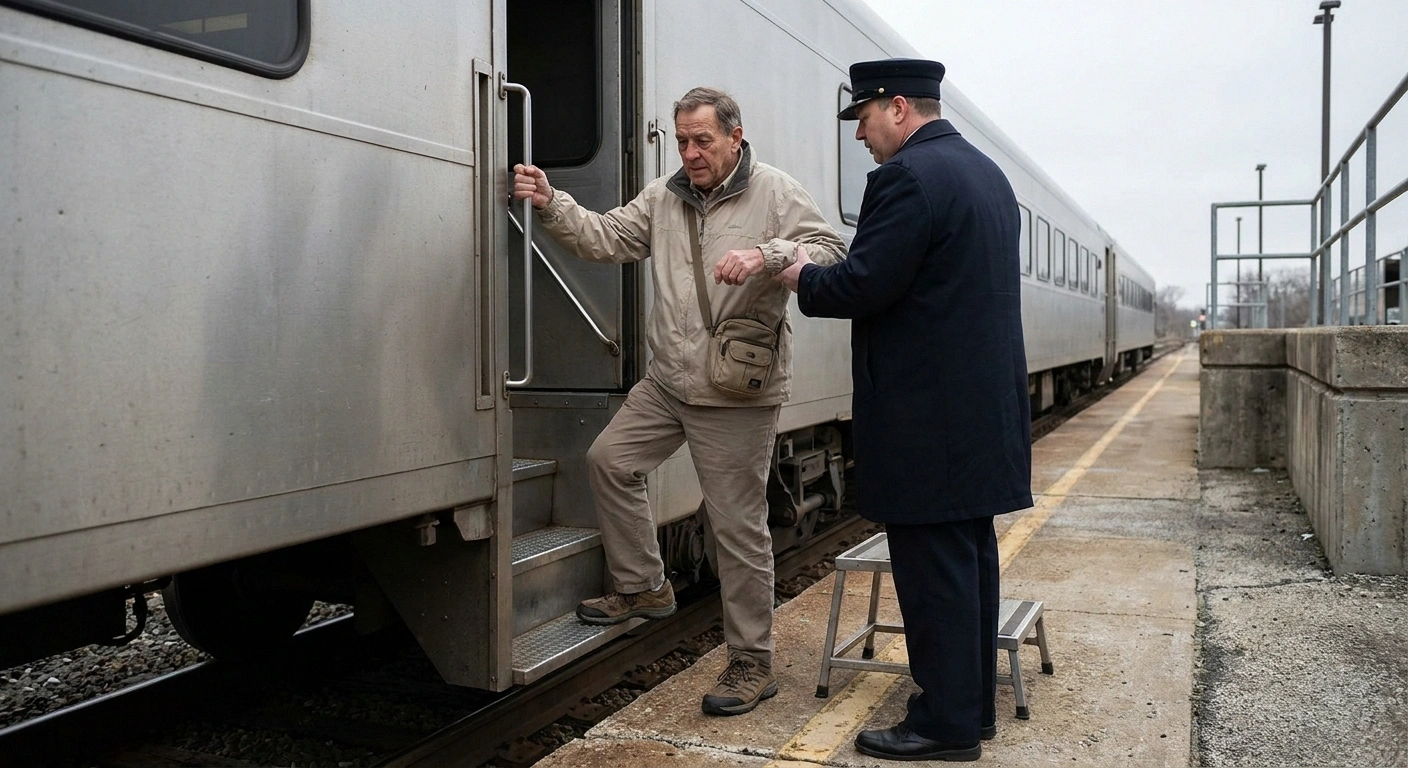
Boarding is where the trouble concentrates, and it is worth thinking about in advance.
At stations with high platforms, you step straight across, roughly level. Easy. At stations with low platforms, and there are many, you climb steep steps from ground level with a conductor placing a metal stepbox at the bottom. Those steps are taller than household stairs and the handrails are at an awkward angle.
What helps:
Arrive early. Thirty to forty-five minutes ahead is the standard guidance if you want any assistance, and it lets staff have equipment ready. It also means you are not doing the steps in a queue with people behind you.
Ask, even if you feel you should not need to. Conductors do this all day. A hand on the elbow going up three steep steps is a completely ordinary request and nobody will think twice.
Keep one hand free. Both hands full on those steps is how falls happen. A bag that goes over a shoulder or onto your back leaves a hand for the rail, which matters more when your feet are not reliably telling you where the step edge is. Our guide to balance and fall prevention covers why that handhold does so much work when sensation is reduced.
Check bags you will not need. Where checked baggage is offered, use it. Dragging a large case up boarding steps and then through a narrow aisle is the least necessary risk of the whole trip.
Moving Around a Train That Is Moving
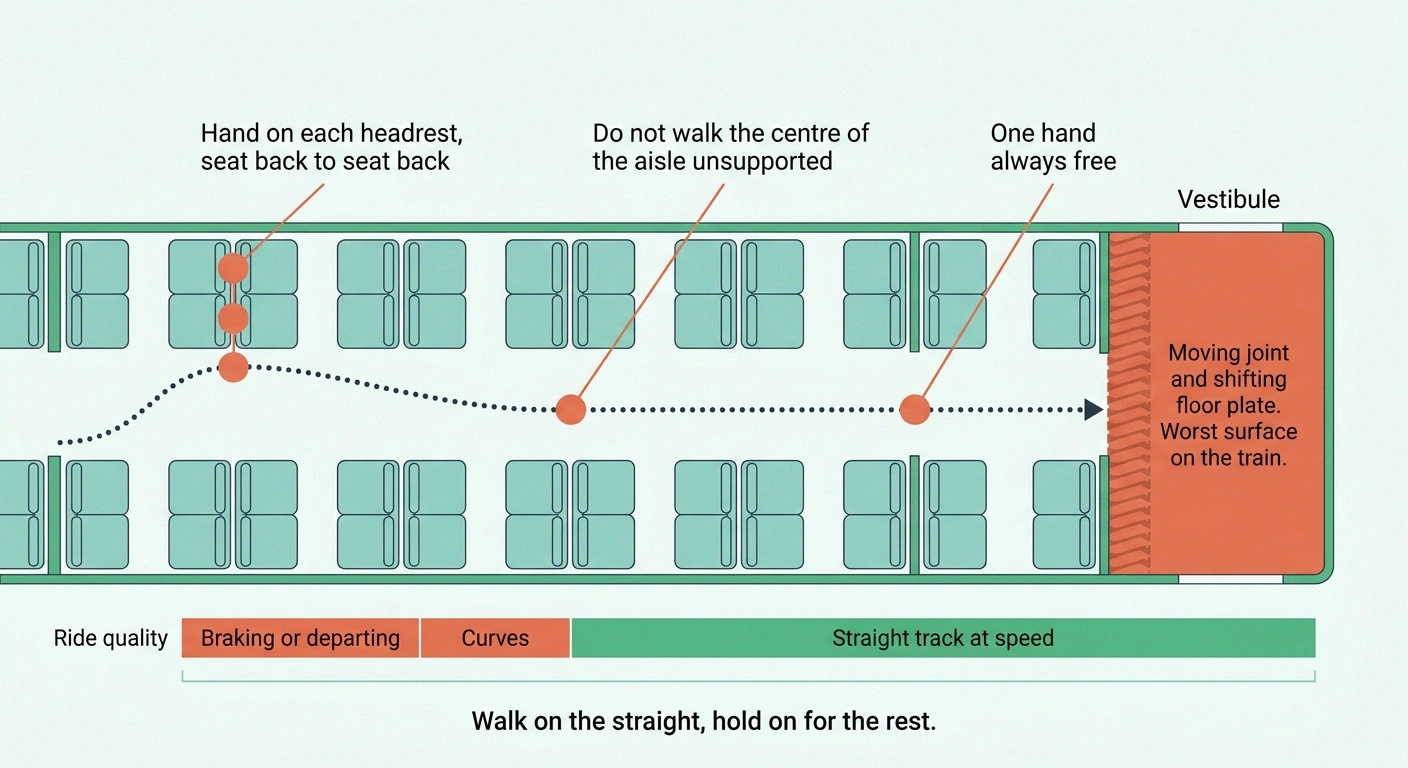
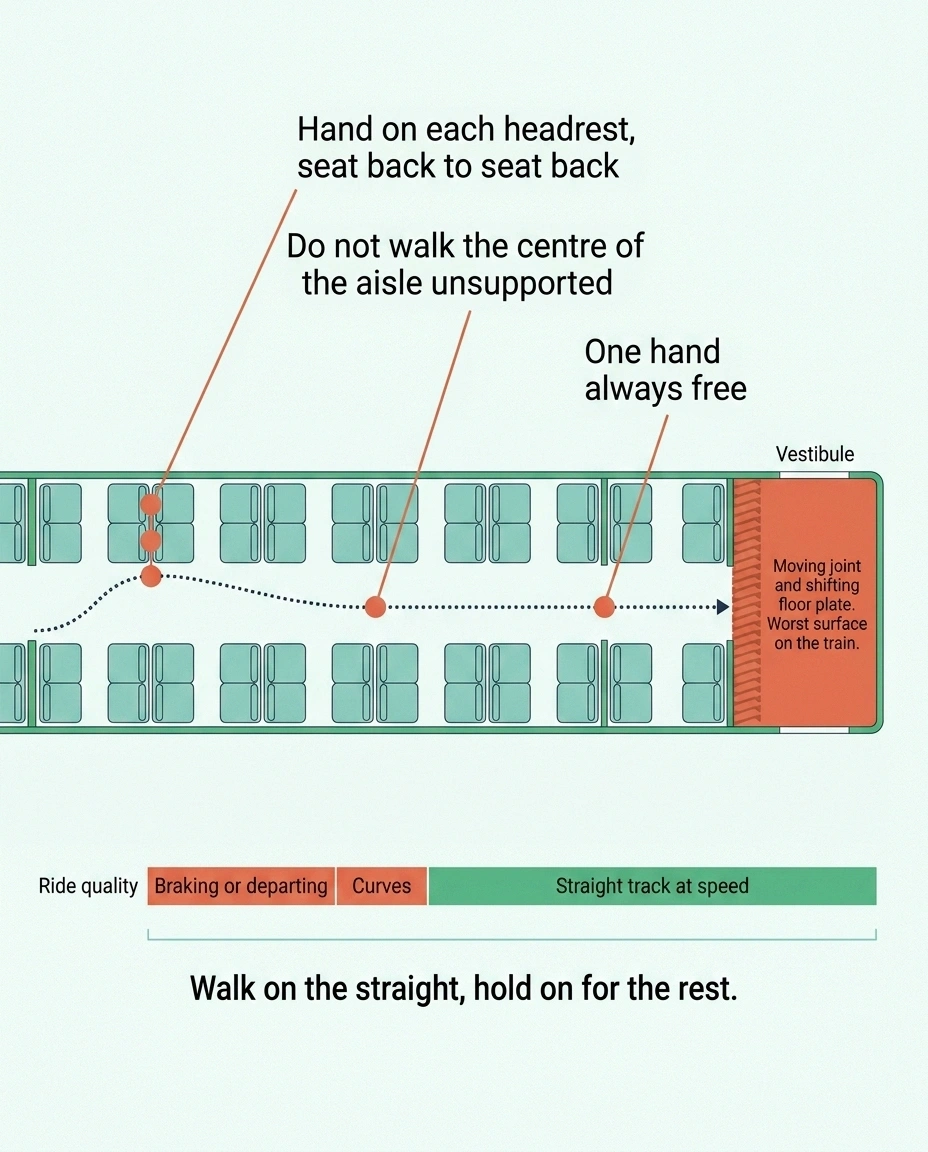
A train sways continuously, and it does so unpredictably. Walking down a swaying aisle uses balance information that your feet may not be supplying reliably, which makes it a genuinely different act from walking down a hallway at home.
Pick your moment to get up
Ride quality changes constantly. These are the phases, worst to best.
Braking into a station, and the first minute out of one. The sharpest lurches of the entire journey. Stay seated.
Curves, switches and yard track. Side-to-side movement you cannot anticipate. If you are already up, hold on and wait it out.
Vestibules between cars, at any speed. A moving joint and a shifting metal plate underfoot. Cross deliberately, both feet planted, one hand always holding.
Straight track at cruising speed. The calm window. This is when to make the trip to the café car or the restroom.
Things that make it easier:
Move seat back to seat back. Keep a hand on a headrest and shift to the next one. Do not walk up the middle of the aisle unsupported, however steady you feel.
Time it. Trains sway most on curves, over switches, and while accelerating out of a station. Long straight stretches at cruising speed are the calmest. If you are unsure, wait a few minutes for the ride to settle.
Treat vestibules with respect. The connections between cars are the loudest, most mobile part of the train, with a moving joint underfoot and a metal plate that shifts as you cross. It is the worst possible surface for feet that do not report clearly. Cross deliberately, hold something, and do not cross with your arms full.
Do not walk during station stops or right after departure. Braking and starting produce the sharpest lurches of the whole journey.
One more thing, which surprises people: keep your shoes on. The temptation to slip them off for six hours is strong, and it is a bad idea. Numb feet do not report a stubbed toe or a dropped object, aircraft-style floors are not clean, and feet swell during long journeys, which makes shoes hard to get back on when you need to move quickly. Something roomy and easy to fasten is the right answer here, and our guide to choosing shoes for neuropathy covers what to look for. Compression socks are worth considering for a long seated journey too, for the same reason they are on a flight.
The Overnight Question
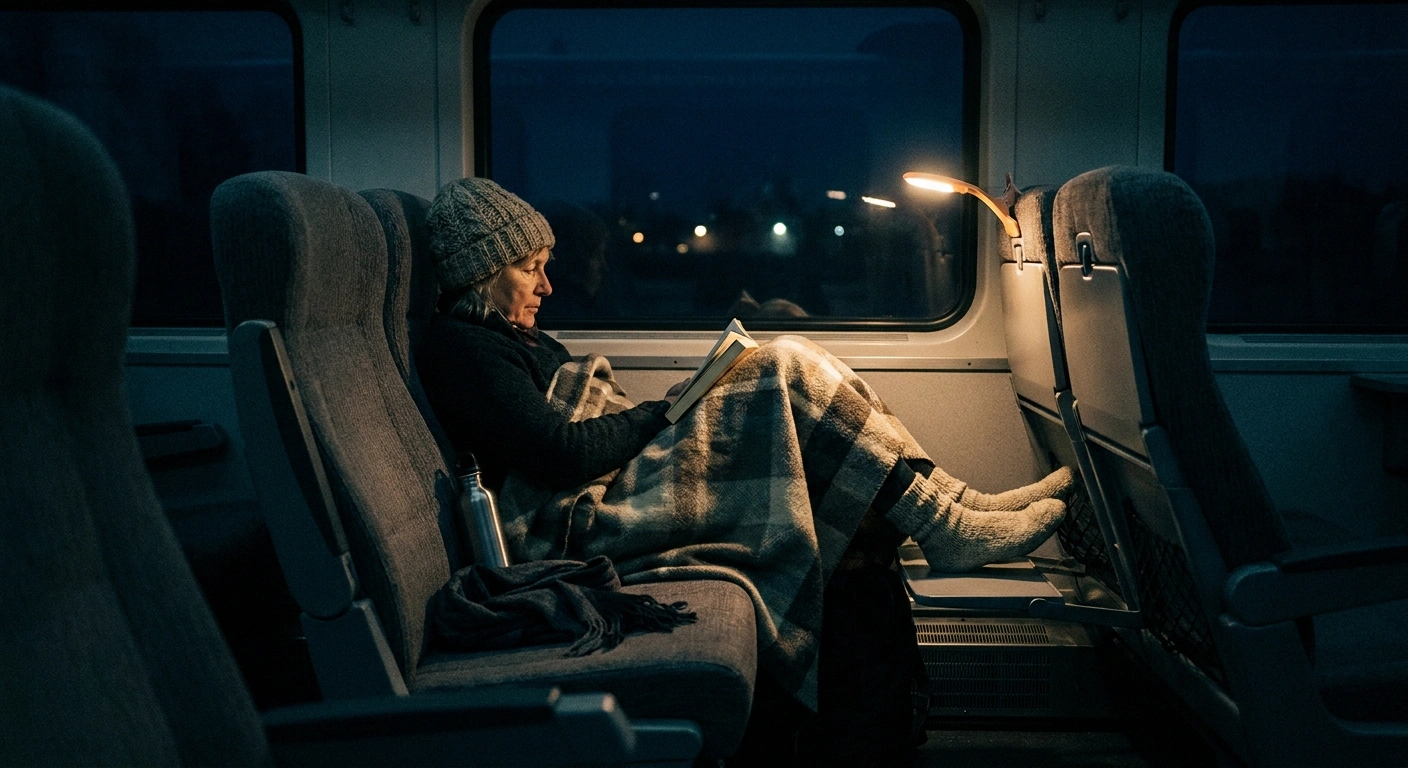
Overnight travel is where trains either shine or fall apart, and the difference is mostly preparation.
An overnight run, set to your own clock
Last walk of the evening, the full length of the car and back. Do it while the lights are still up and people are still moving.
Change into the dry warm socks. Stretch calves and ankles now rather than later. Move anything you might need at 3 a.m. into one reachable pocket.
Take whatever you normally take at the time you normally take it. Time zones and long journeys quietly shift routines, and evening medication is the worst one to drift.
Fully reclined, feet on the footrest, knees relaxed rather than locked straight. Shoes loosened but on. Small light within arm's reach.
Train cars run cold, and the temperature is not adjustable at your seat. Cold reliably makes nerve pain worse for a lot of people. Bring more warmth than seems necessary: a blanket regardless of class, warm socks to change into, and layers you can add without getting up.
If you are in coach, the recommended sleeping posture is fully reclined with your feet on the footrest and knees relaxed rather than locked. Stretch before you settle rather than after, because getting up mid-sleep on a moving train in low light is exactly the situation you want to minimize.
Nerve pain that is already worse at night does not improve because you are on a train. If evenings are your difficult time, plan for it deliberately: take whatever you normally take at your normal hour rather than drifting off schedule, and know where your things are without needing to search a dark bag. Our article on why neuropathy gets worse at night explains the mechanism, and most of what helps at home helps here.
Set a small light within reach. A phone screen is workable, but a clip light or a headlamp leaves both hands free, and on a moving train both hands matter.
What Goes in the Bag at Your Feet
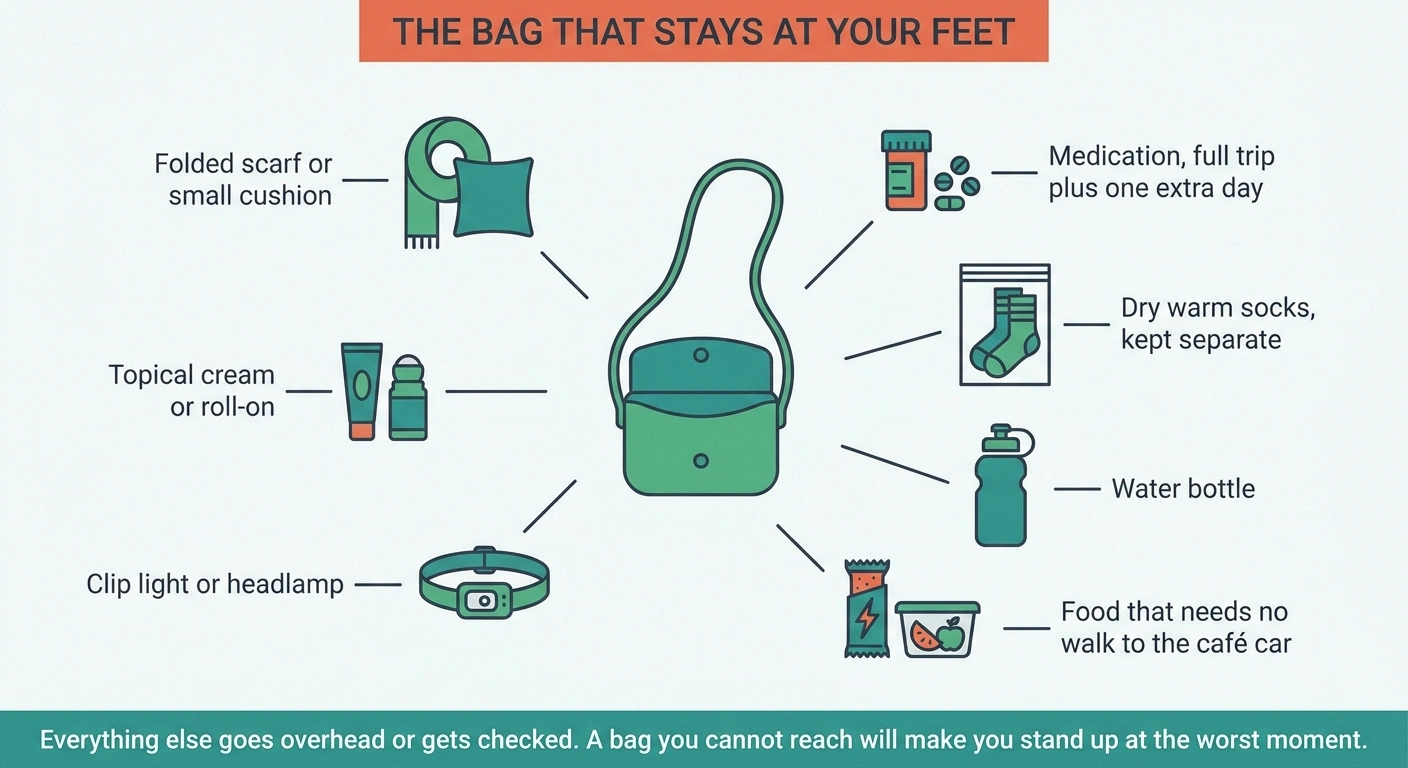
One small bag stays with you. Everything else goes overhead or into checked baggage, because a bag you cannot reach without standing up is a bag that will make you stand up at the worst moment.
What earns its place:
- Medication for the full journey plus one extra day, in the bag at your feet rather than overhead
- A pair of warm socks, kept dry and separate
- Water, since train air is dry and dehydration makes cramping worse
- Something to eat that does not require a walk to the café car
- A small light
- Any topical cream or roll-on you use, so applying it is not a production
- A folded scarf or small cushion, useful behind the lower back or under the ankles
Long-distance trains also make servicing stops of fifteen to thirty minutes where passengers may step down onto the platform. These are genuinely worth taking. A short walk in fresh air resets legs that have been still for hours, and walking is one of the few things that reliably helps circulation in exactly this situation. Two cautions: stay near your own car door, and remember that re-boarding means the same steep steps, this time with a departure time attached. Give yourself a few minutes of margin.
Do a foot check at the end of the journey, the same as you would after any long day out. Numb feet accumulate small injuries without announcing them, and a blister found the same evening is a different problem from one found three days later. Our foot care routine covers what to look for. If the trip is taking you to an event where you will be on your feet, our guide to managing long periods of standing is the natural next read.
The broader point is worth holding on to. Plenty of people with neuropathy have quietly stopped traveling because flying became genuinely miserable, and never seriously considered that a different mode of transport might not be. The train is slower. It is also roomier, more forgiving, and it lets you move whenever your body asks you to.
Frequently Asked Questions
Is train travel easier than flying with neuropathy?
For most people, yes. Long-distance train coach offers roughly 50 inches of legroom with footrests and leg rests, compared with about 31 inches in airline economy, and passengers can stand and walk at any point in the journey. There is no seatbelt sign and no shoe removal at a security checkpoint. The trade-off is journey time, which is usually several times longer.
Should I book accessible seating if I can walk?
It is worth considering. Accessible seats are intended for passengers who need additional legroom or have other accessibility needs, not solely for wheelchair users. They carry extra room and are positioned near an accessible restroom, which shortens the walk you will make most often. On double-deck cars they sit on the lower level, avoiding interior stairs entirely. Book early, since availability is limited.
Is a roomette worth the extra cost with neuropathy?
For overnight journeys, often yes. Lying flat is the only position that fully unloads the feet, meals are brought to you rather than requiring trips through moving cars, and some configurations include a toilet in the room. For daytime trips the case is weaker, because long-distance coach seats already recline deeply with leg rests. The upper bunk requires a ladder, which is a poor match for reduced foot sensation.
How do I safely walk around a moving train?
Move from seat back to seat back with a hand on each headrest rather than walking up the middle of the aisle. Trains sway most on curves, over switches, and while accelerating or braking, so wait for a straight stretch at cruising speed. Cross the vestibules between cars deliberately and with a handhold, since the moving joint underfoot is the least stable surface on the train.
Can I take my shoes off on a long train ride?
Better not to. Numb feet will not reliably report a stubbed toe or something dropped on the floor, train floors are not clean, and feet swell during long seated journeys, which can make shoes difficult to get back on when you need to move. Roomy, easy-to-fasten footwear is the practical answer, with a change of warm socks for overnight.
What if my station has no level boarding?
Many stations require climbing steep steps from a low platform with a conductor placing a stepbox. Arrive 30 to 45 minutes early so staff can prepare, ask for a hand rather than managing alone, and keep one hand free for the rail by wearing your bag rather than carrying it. Check both your departure and arrival stations individually, since accessibility varies station by station rather than by route.
Should I get off at station stops?
Yes, when the stop is long enough to allow it. Servicing stops on long-distance trains typically run 15 to 30 minutes, and a short walk in fresh air genuinely helps circulation after hours of sitting. Stay near your own car door, watch the time, and remember that re-boarding involves the same steps you came down, now with a departure deadline.
About the Author