
The first time Ellen described her symptoms to me at our support group, she used a phrase I'd heard a dozen times before: “It feels like a stripe of fire down the outside of my thigh — and then, right underneath the fire, a numb patch the size of a paperback book.” She had already been to two doctors. The first told her it was probably a pinched nerve in her back. The second wondered if it was early diabetic neuropathy, even though her blood sugars were fine. Nobody had said the words that would eventually change everything for her: meralgia paresthetica.
If you have burning, tingling, or numbness along the outside of one thigh — the kind that gets worse when you stand for a long time or wear tight pants, and better when you sit down — this is your article. Meralgia paresthetica is one of the most missed and most mistreated nerve conditions I run across in my community. It is not a scary illness. It is not a sign of something more serious most of the time. But it is genuinely miserable if you have it, and the fixes are often surprisingly simple once someone finally names it correctly. I am not a medical professional; I am a patient advocate who has spent years listening to people describe this exact set of symptoms and being sent home with the wrong label. My hope is that this article gives you the vocabulary and the framework to have a better conversation with your provider than Ellen did the first two times.
What Meralgia Paresthetica Actually Is
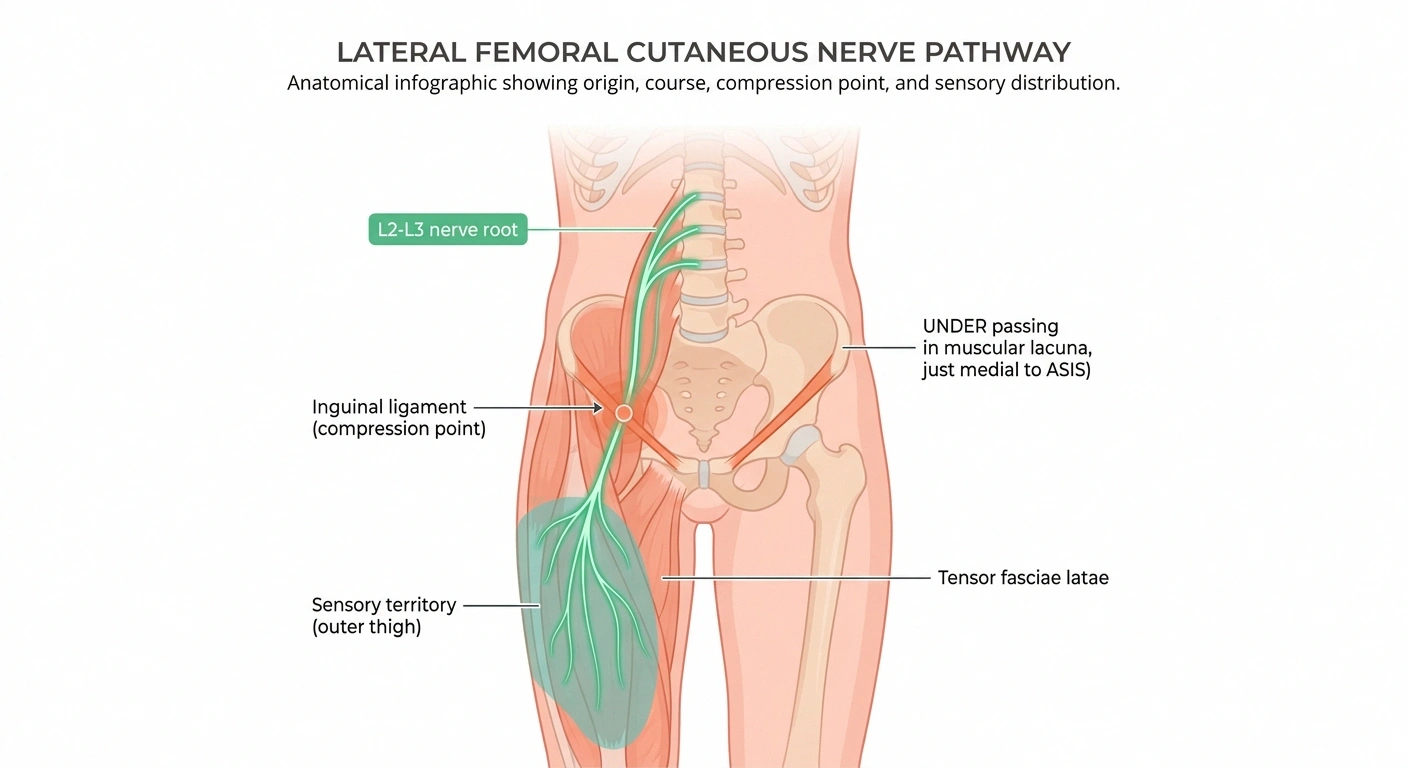
The name comes from Greek — meros for thigh, algos for pain, paraisthetica for altered sensation. What is happening underneath the skin is a specific nerve — the lateral femoral cutaneous nerve (LFCN) — being compressed or irritated as it passes from the abdomen into the upper thigh. That single nerve has one job: it carries sensation from a roughly rectangular patch of skin on the outer thigh, from just below the hip to just above the knee. It does not move any muscles. It does not control any organs. It is purely a sensory nerve. That is why the symptoms are so specific to one skin territory and never involve weakness.
Key takeaway
Meralgia paresthetica is a compression neuropathy — the lateral femoral cutaneous nerve being squeezed at the inguinal ligament. This is a plumbing problem, not a nerve-disease problem. The nerve itself is healthy; it is being pinched at a specific spot. Take the pressure off, and the symptoms often ease within months.
The nerve travels from the lumbar spine down through the pelvis, and then it makes a tight turn under a very specific ligament called the inguinal ligament — the diagonal band you can feel at the crease where your leg meets your torso. In most people, the nerve slips underneath the ligament near the front of the hip bone and continues into the thigh without any trouble. But in some people, the anatomy is a little tighter, or the nerve takes a sharper turn than usual, or the ligament sits differently, and the nerve gets squeezed at that pinch point. It is a plumbing problem, not a nerve-disease problem — the nerve itself is healthy, it is just being squeezed at a specific spot.
That distinction matters. Compression neuropathies, which is what meralgia paresthetica is, are fundamentally different from the metabolic neuropathies like diabetic or chemo-induced neuropathy that most of my community deals with. In a metabolic neuropathy, the nerves themselves are being damaged by a system-wide process. In a compression neuropathy, a mechanically healthy nerve is getting pinched at one location, and if you relieve the pinch, the symptoms often go away entirely. This is genuinely good news, and I want you to hold onto it as we walk through the rest.
The Signature Symptoms — What This Feels Like
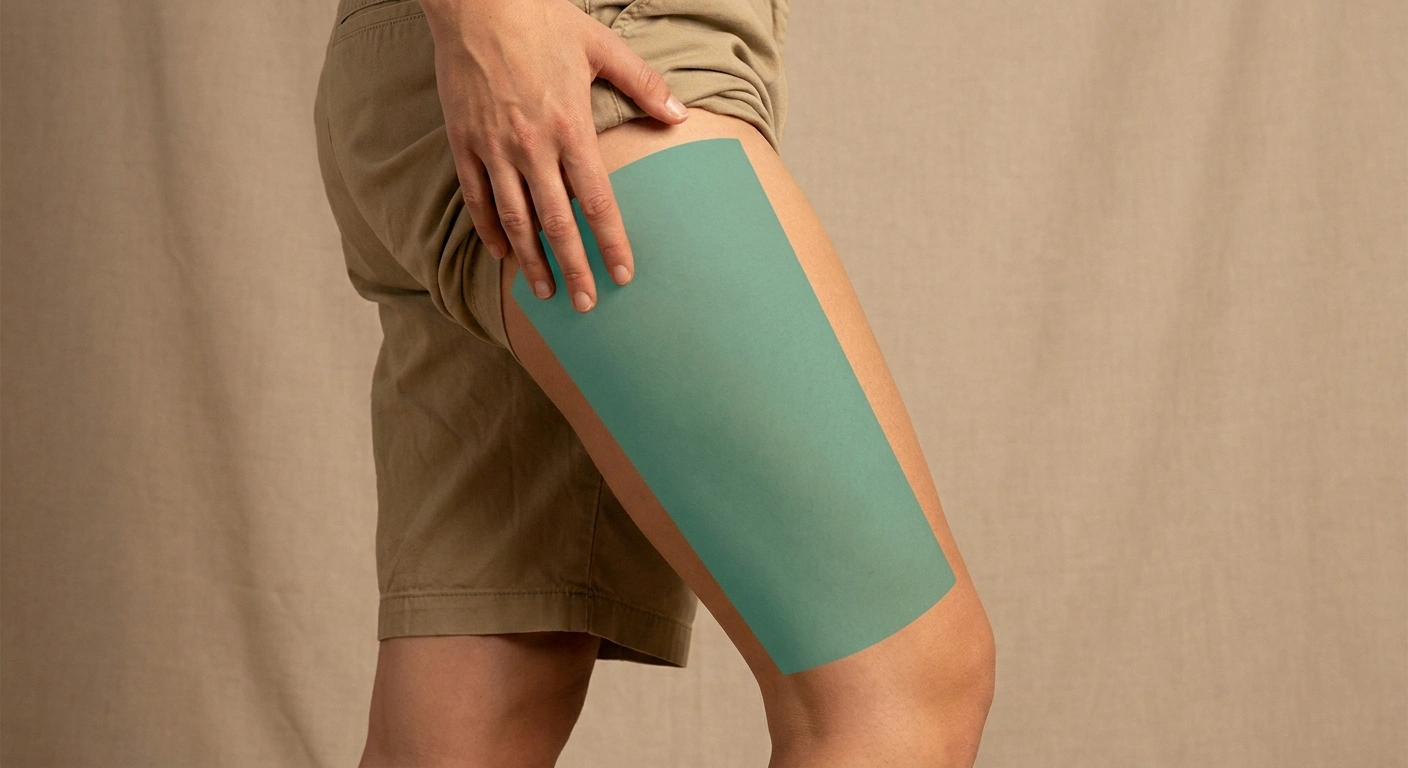
The classic presentation is a stripe of altered sensation on the outer thigh, on one side only. People describe it in remarkably consistent language once they finally hear the name. Burning is the most common word. Tingling, prickling, and “pins and needles” come next. Some people report a strange crawling sensation, or a feeling like water is trickling down the leg when it is not. Almost everyone reports some degree of numbness in the same area — the outer thigh feels dulled, or as though a piece of clothing is bunched under the skin, or as though the leg is not quite yours.
The meralgia paresthetica pattern — does yours fit?
- ☐ Symptoms confined to the outer thigh, on one side
- ☐ Rectangular strip from hip to just above the knee
- ☐ Burning, tingling, or “pins and needles” over the strip
- ☐ Numbness or dulled sensation in the same area
- ☐ Worse with standing, walking, tight clothing
- ☐ Better with sitting, lying down, loose clothes
- ☐ No weakness — knee doesn't buckle, no foot drop
Five or more checked, and the pattern is worth bringing up as meralgia paresthetica at your next appointment.
What people almost universally miss is the position dependence. Meralgia paresthetica gets worse when the inguinal ligament pinch point is under more tension. Standing for a long time makes it worse. Walking, especially uphill or briskly, makes it worse. Wearing tight jeans, a heavy tool belt, a snug work-uniform waistband, or a compression garment across the hips makes it worse. Being pregnant, or carrying extra weight around the middle, makes it worse. And relief comes from doing the opposite: sitting down, lying on the unaffected side, wearing loose pajama pants, taking off the belt. When people describe symptoms that get worse with standing and clothing pressure and better with sitting and loose clothing, that is the signature of a mechanical compression at the front of the hip. It is not the signature of a spinal nerve problem, or of a diffuse neuropathy.
The other thing worth noting is that meralgia paresthetica does not cause muscle weakness. Because the lateral femoral cutaneous nerve is a pure sensory nerve, it cannot make you weak, cannot cause you to trip, and cannot cause your thigh to twitch. If your outer-thigh symptoms come with real weakness — buckling knees, difficulty climbing stairs, foot drop, or a slapping gait — that is a strong signal that the problem is not meralgia paresthetica but something involving motor nerves that needs a different workup, most often at the lumbar spine.
The Triggers — Why Some People Develop It and Others Do Not
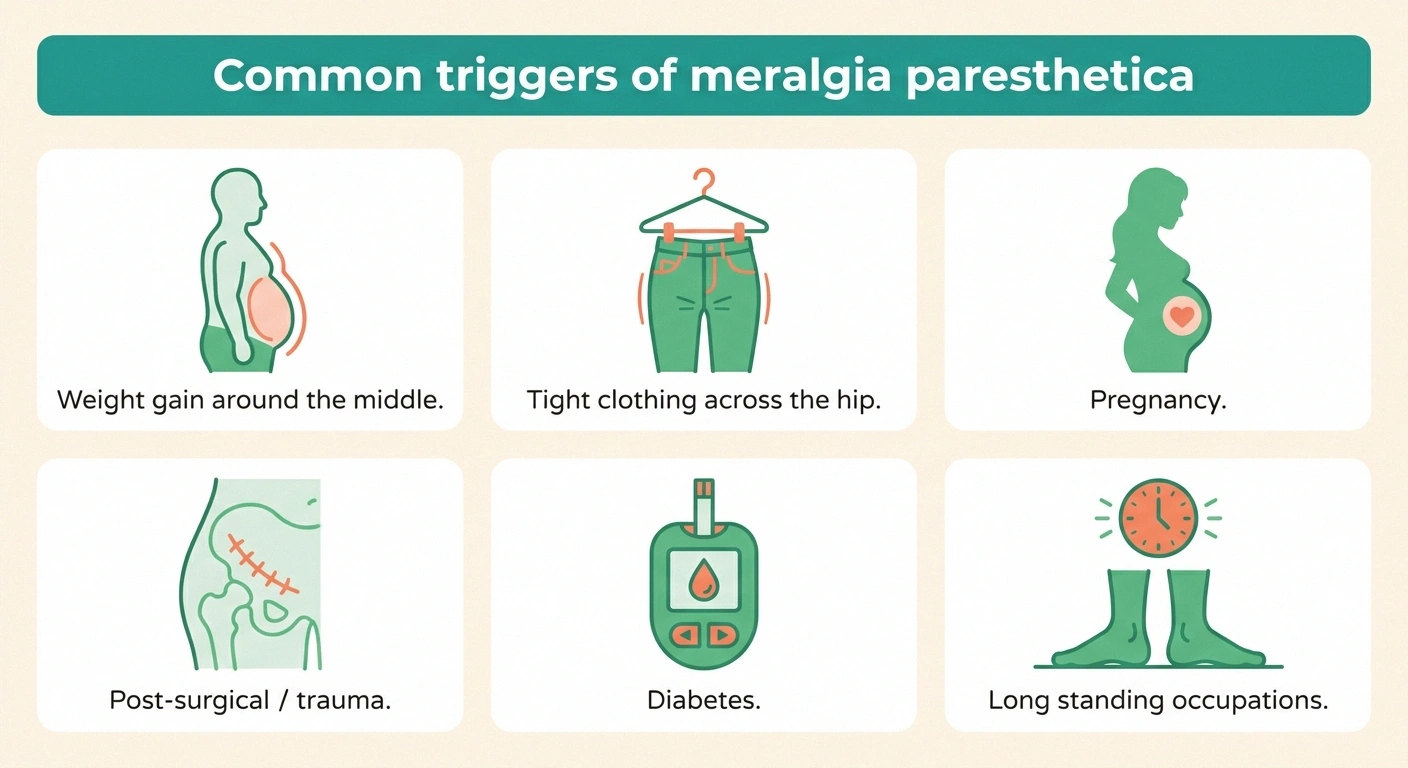
Meralgia paresthetica is what neurologists call a positional or compressive mononeuropathy — a single-nerve problem caused by mechanical pressure. There are a handful of common triggers I hear about in my community, and knowing them helps you figure out whether making a small change might solve most of your problem.
Weight gain around the middle. Extra abdominal weight pushes down on the inguinal ligament and increases the tension across the compression zone. In one study of primary care presentations, weight gain over the prior year was the single most common trigger. This is not about blaming anyone for their weight; it is about giving you a mechanism to understand why symptoms started when they did.
Tight clothing across the hip. Skinny jeans, shapewear, tight work uniforms, corsets, tool belts, and duty belts (police, security, construction) are common culprits. The condition even has a nickname in the fashion press — “skinny jean syndrome.” Any garment that puts sustained pressure across the front of the pelvic bone can compress the nerve.
Pregnancy. The growing uterus and the natural weight distribution changes of the third trimester put more tension on the inguinal ligament, and about one in twenty pregnant women develop meralgia paresthetica somewhere in the second or third trimester. It almost always resolves within a few months of delivery.
Post-surgical or post-trauma. Hip surgeries, spine surgeries in the prone position, C-sections, hernia repairs, and even long procedures where you were lying on a firm operating table can irritate the nerve. So can seatbelt injuries, direct blows to the front of the hip, or falls onto that area.
Diabetes. This is where the confusion with other neuropathies often creeps in. People with diabetes are somewhat more prone to compression neuropathies in general because their nerves are more sensitive to pressure. Meralgia paresthetica in someone with diabetes is real meralgia paresthetica — a compression at the inguinal ligament — but the diabetes may be making the nerve more vulnerable. It does not mean it is diabetic neuropathy, which is a different diffuse process affecting many nerves at once.
Prolonged standing occupations. Nurses, teachers, retail workers, factory workers, and anyone else who is on their feet six or eight hours a day are overrepresented. Adding a heavy hip belt to that occupation compounds the risk.
The Diagnostic Journey — What Providers Should Do
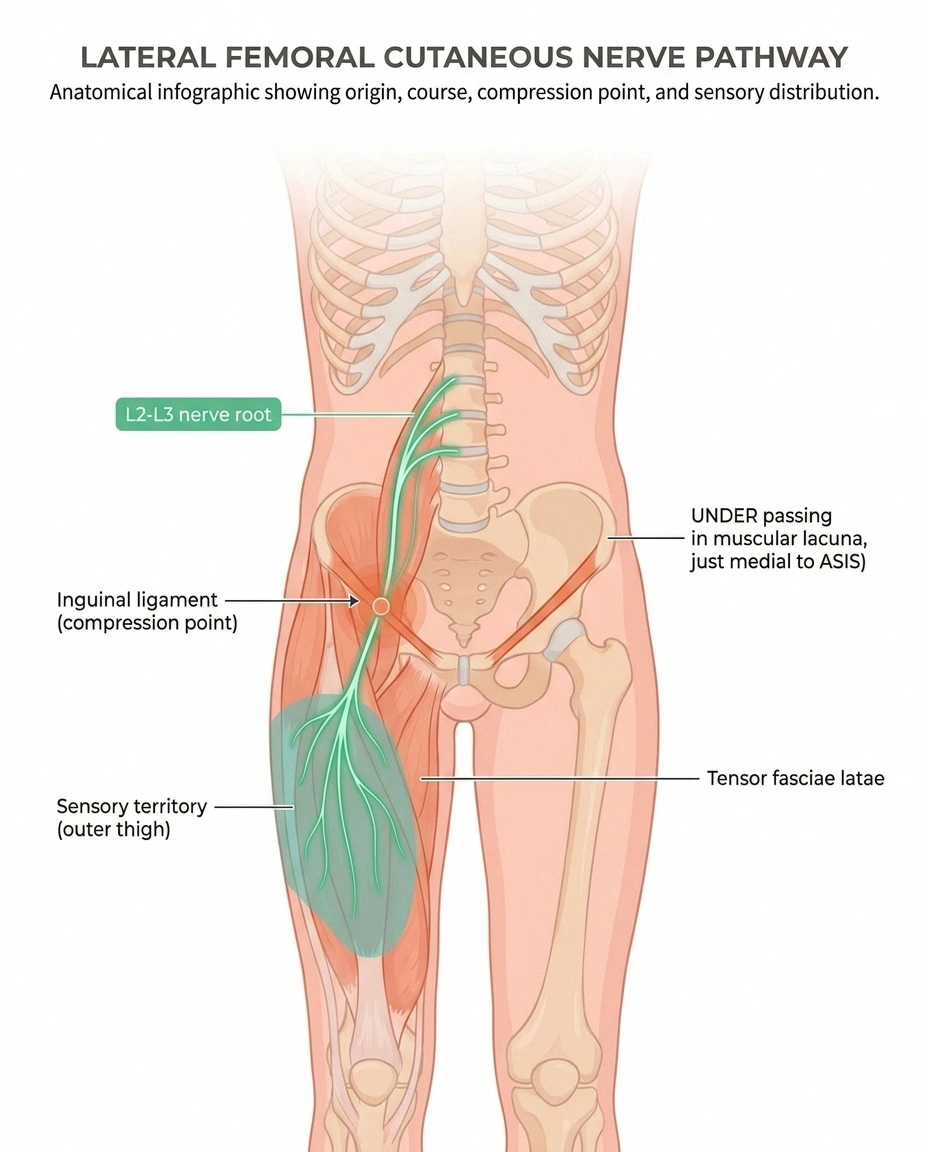
Here is where I want you to pay attention if you have been sent home with the wrong label, because the diagnosis of meralgia paresthetica is often clinical, and the workup is straightforward when someone is looking in the right direction.
Warning — outer-thigh symptoms + weakness are NOT meralgia paresthetica
The lateral femoral cutaneous nerve carries only sensation. It cannot make you weak. If your outer-thigh symptoms come with real muscle weakness — a buckling knee, difficulty climbing stairs, foot drop, or a slapping gait — the diagnosis is not meralgia paresthetica and a broader workup is needed. Common alternatives include lumbar radiculopathy, femoral neuropathy, or an upper motor neuron condition. Ask your provider directly.
The history. A good provider will take a history that focuses on: where exactly the symptoms are (outer thigh, one side, in a rectangular strip); what triggers or relieves them (standing, tight clothing, weight, position); and whether there is any weakness or symptoms elsewhere. A history that ticks the meralgia paresthetica boxes — outer thigh, one side, worse with standing and tight clothing, no weakness — is often enough to make a working diagnosis on the spot.
The physical exam. The provider should map out the numb and tingly zone with a soft touch and, ideally, a pinprick sensation test. In meralgia paresthetica, the abnormal sensation is confined to the outer thigh, does not cross the midline, does not extend below the knee, and does not include the inner thigh or the back of the thigh. The provider will also press or tap over the inguinal ligament near the front hip bone; if pressing there reproduces the symptoms, that is called a positive Tinel sign at the inguinal ligament and is very supportive of the diagnosis.
The differential — what else could this be. This is where the missed diagnoses happen. A good provider considers and rules out: small-fiber neuropathy (usually bilateral and involves the feet); diabetic polyneuropathy (usually bilateral, starts in the feet, and typically comes with symptoms elsewhere); lumbar radiculopathy from a herniated disc (usually causes pain that shoots from the back down the leg, may cross the outer thigh but usually goes below the knee, and often causes some weakness or reflex changes); hip osteoarthritis or bursitis (localized to the joint, not in a nerve distribution); femoral neuropathy (weakens the quadriceps, causes knee-buckling); and, in older adults or people with weight loss, occasionally an intra-abdominal or retroperitoneal mass pressing on the nerve upstream.
Nerve conduction studies and EMG. These tests can sometimes confirm the diagnosis, but the lateral femoral cutaneous nerve is a small sensory nerve that is technically difficult to test, and a normal study does not rule out meralgia paresthetica. Studies are more useful for excluding the alternatives — a normal EMG makes lumbar radiculopathy and femoral neuropathy less likely.
Imaging. A dedicated MRI of the pelvis is not routinely required for straightforward cases with a classic story and exam, but it is reasonable when the story is atypical, when weight loss or systemic symptoms are present, or when the symptoms fail to respond to standard treatment. High-resolution MRI can occasionally visualize the nerve directly. An MRI of the lumbar spine may be added if radiculopathy is a real consideration. Getting formal neuropathy diagnostic testing in place matters most when the story is not the classic one.
The diagnostic nerve block. When the diagnosis is in doubt, some providers will inject a small amount of local anesthetic around the nerve at the inguinal ligament. If your symptoms melt away for the duration of the anesthetic, that is very strong evidence you have meralgia paresthetica and that the pinch point is exactly where the injection was placed. It can be both diagnostic and, when combined with a small dose of steroid, therapeutic.
Living With It — What Actually Helps
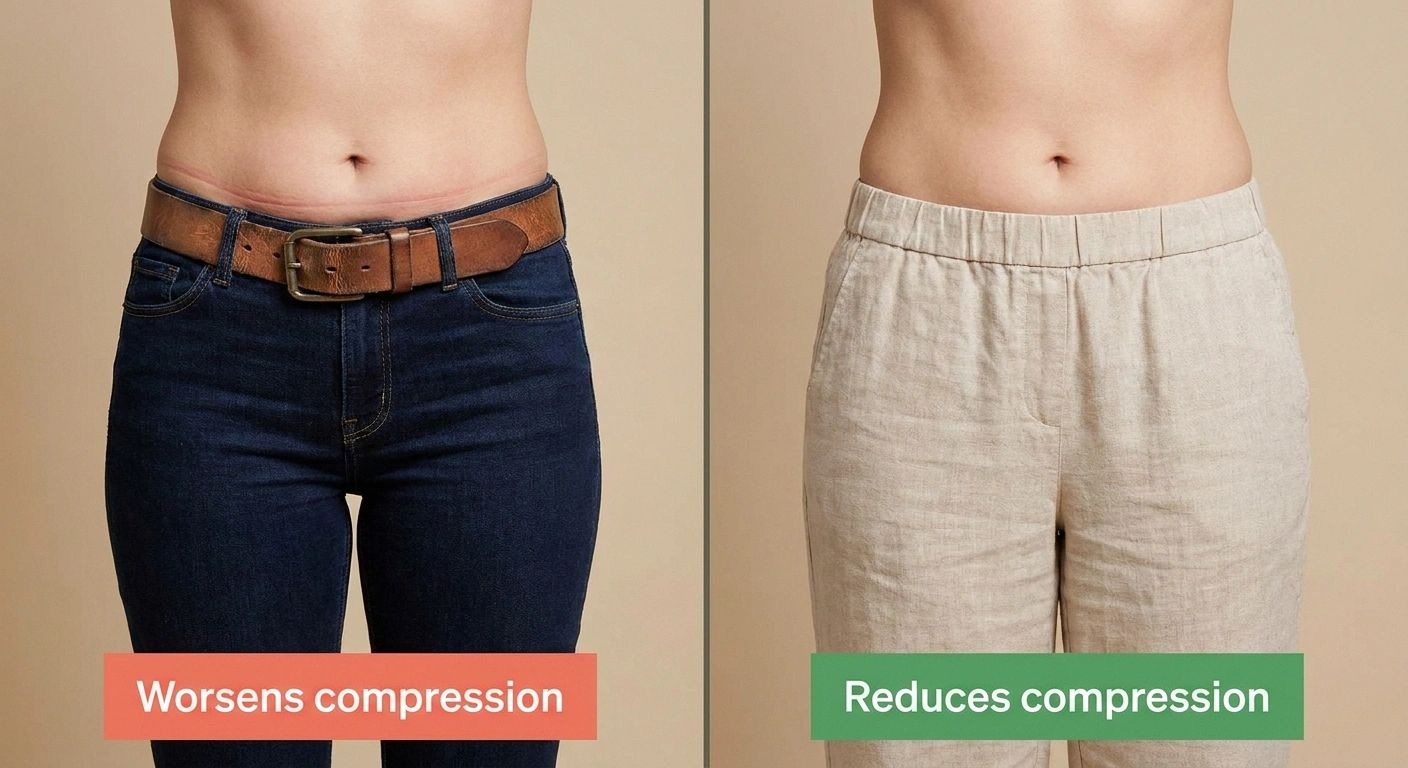
The good news I promised at the start of this article comes now. In most people, meralgia paresthetica is highly responsive to some very ordinary changes. The published outcomes are honestly encouraging: roughly two-thirds of people improve substantially with conservative measures alone within a few months, and among the remainder, the vast majority get sustained relief with a single well-placed nerve block or, occasionally, a minor procedure. Only a small fraction of people end up needing surgical release.
Research says: most people improve without surgery
Figures reflect the published range of outcomes reported across primary care and neurology cohorts. Your individual response depends on how well the mechanical trigger can be removed.
Take pressure off the front of the hip. This is the first and most important thing. Loose-fitting pants. No belts across the front of the pelvis. If your work requires a duty belt or tool belt, ask whether a suspender system can shift the load to your shoulders. If you carry a phone or wallet in a front pocket, take it out. If your work uniform pinches, get a size up or advocate for a different cut.
Lose weight if extra abdominal weight is a factor. Even ten to fifteen pounds of intentional weight loss is enough to substantially reduce inguinal ligament tension in many people, and studies have documented dramatic symptom improvement in patients who lose weight after a meralgia paresthetica diagnosis. This is not about aesthetics; it is about mechanics. I know weight loss is not simple. It is worth mentioning to your provider as a treatment target rather than a lifestyle nag.
Sit down more often, and elevate the hip on the affected side slightly. Sitting bends the hip forward and reduces the tension across the inguinal ligament, which is why symptoms usually ease when you sit. During flare-ups, prop the affected hip slightly higher with a folded towel under the buttock — this can further slack the ligament.
Sleep on the unaffected side, or on your back with a pillow under the knees. Side-sleeping on the affected side, or lying flat with the hips straight, tends to worsen symptoms overnight for many people.
Physical therapy targeting the hip flexors and abdominal wall. A PT who understands nerve entrapment can help you release chronically tight hip flexors, strengthen the deep abdominal muscles that support the pelvis, and adjust your posture to reduce the tension across the front of the hip. Not every physical therapist is fluent in this diagnosis, so it is worth asking specifically whether they treat compression neuropathies.
Medications. Over-the-counter anti-inflammatories can help with the discomfort in the short term. For the burning and tingling that many people find most distressing, providers sometimes prescribe the same nerve pain medications used for other neuropathies — gabapentin or pregabalin, or a low dose of a tricyclic antidepressant. Duloxetine is another option that some clinicians use for compression-related nerve pain. These do not fix the compression, but they can turn the volume down while the mechanical measures work. Topical lidocaine patches placed over the affected area can also help significantly for some people.
Nerve blocks. When conservative measures are not enough, an ultrasound-guided injection of local anesthetic (with or without a small dose of steroid) at the inguinal ligament can provide weeks to months of relief for many patients. Some people need only one; some benefit from a small series. This is generally considered before any surgical option is on the table.
Surgery. For the small minority of people with persistent, disabling symptoms despite everything above, two surgical options exist. Neurolysis or decompression frees the nerve from the ligament without cutting it, and preserves sensation if it succeeds. Neurectomy cuts the nerve entirely; this ends the pain but leaves a permanent numb patch on the outer thigh. Both are outpatient procedures with good published outcomes when performed by surgeons who do them regularly. This is a real conversation, not a rushed one, and the person doing it should be experienced in nerve surgery.
What NOT to Do — Common Mistakes I See
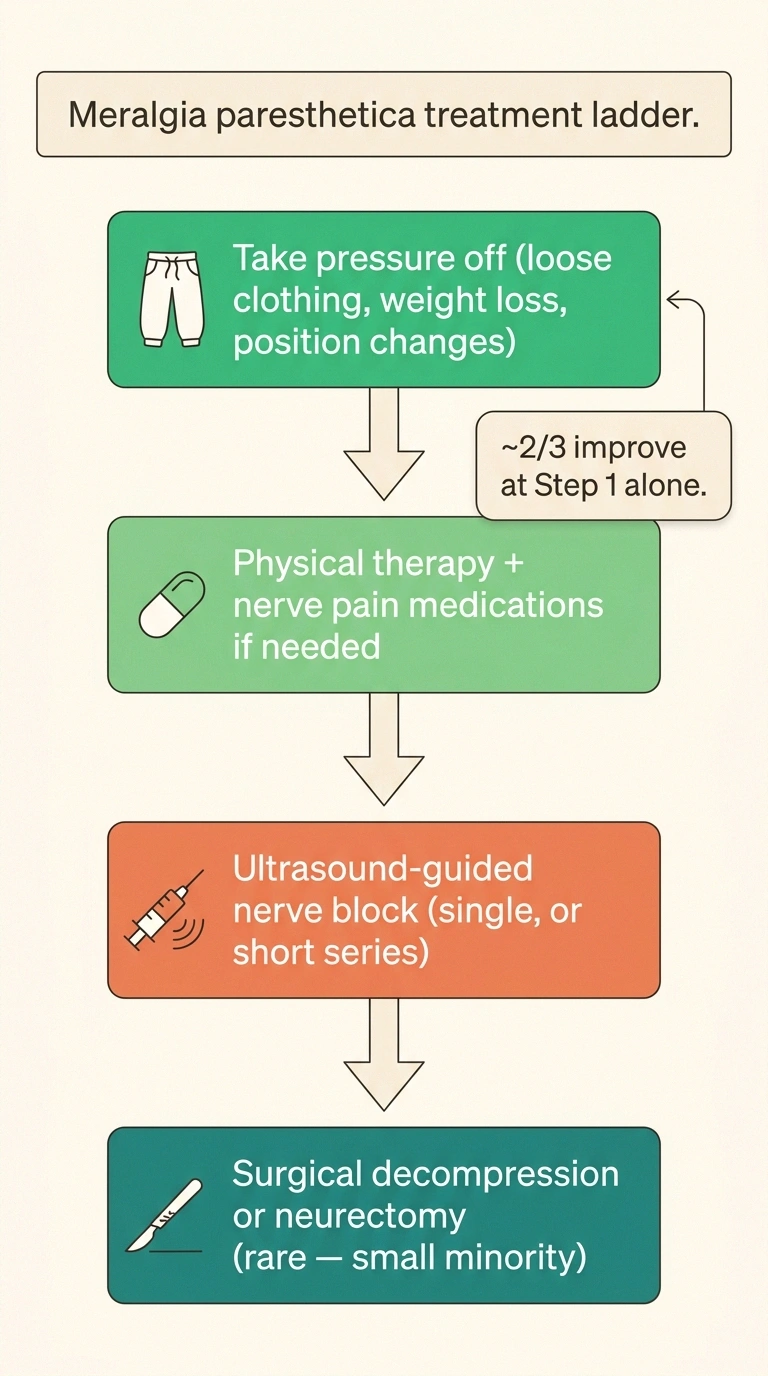
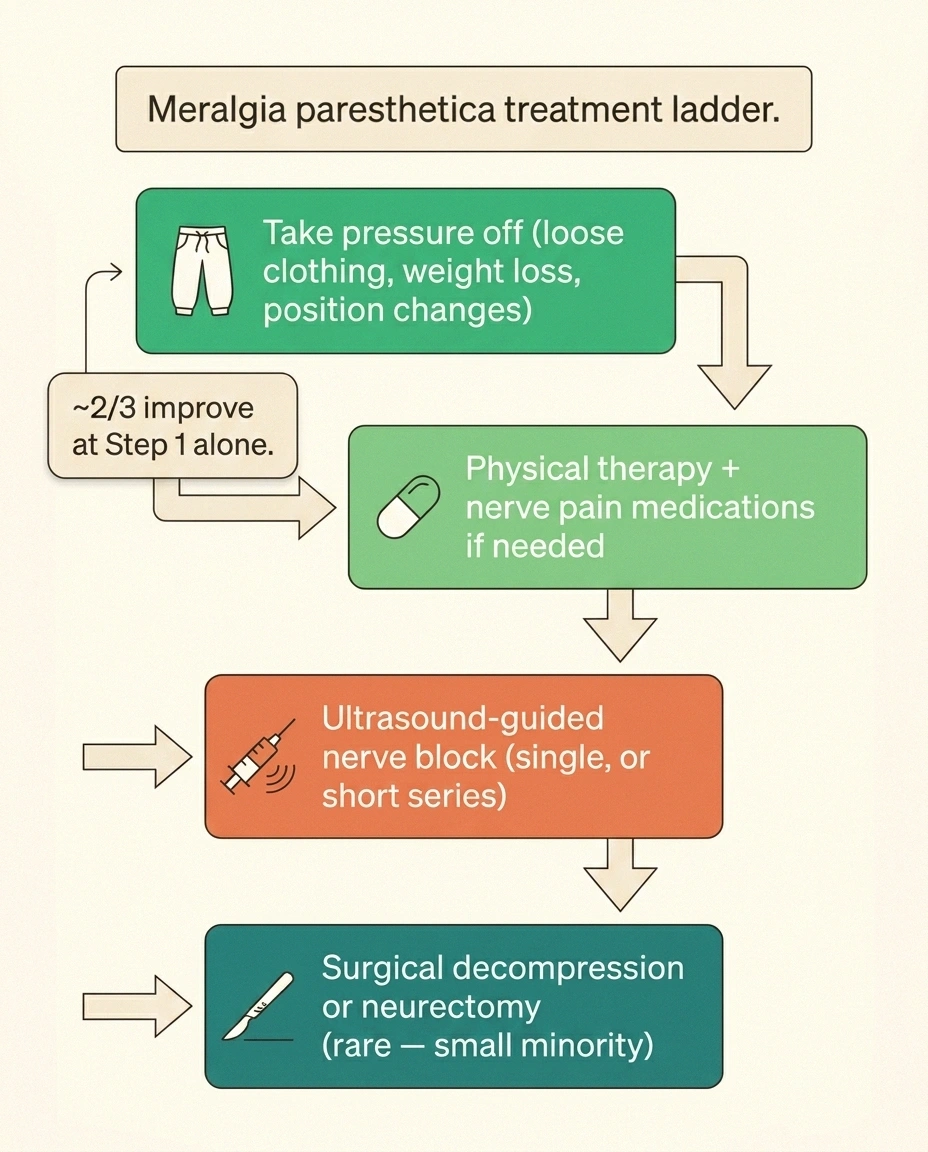
Because meralgia paresthetica is often misdiagnosed as something else, people end up treating the wrong problem. Here are the mistakes I see most often in my community:
Treating it as a back problem. If your outer-thigh symptoms are meralgia paresthetica, back-focused physical therapy, spinal injections, and even back surgery will not address them. I have talked with several people who had lumbar procedures for symptoms that turned out to be pure meralgia paresthetica, and who continued to have thigh symptoms after the back was operated on. A specialist who understands the difference — often a physiatrist or a neurologist familiar with peripheral nerve disorders — is worth the effort to find.
Trying to stretch the leg or the ligament aggressively. Some people try aggressive hip-flexor stretches on the theory that they need to “release” the compression. This can actually flare the symptoms by putting more tension across the nerve. Gentle mobility work is fine; forceful stretching often is not.
Deep tissue massage or foam rolling directly over the nerve. Some well-meaning bodyworkers dig aggressively into the front of the hip. This is exactly the area of the compression, and heavy direct pressure can inflame the nerve rather than release it.
Assuming it is going to become a systemic neuropathy. Meralgia paresthetica is a local mechanical problem. It does not spread to the other leg unless the mechanical trigger becomes bilateral (bilateral tight clothing, bilateral surgery, pregnancy). It does not become idiopathic neuropathy or diabetic neuropathy. It is a different animal.
Ignoring the trigger while chasing the symptom. Nerve pain medication that lets you keep wearing the tight belt is treating the wrong thing. Take the belt off first. Same with any of the postural or clothing triggers — the medication is the backup plan, not the main plan.
Special Situations Worth Knowing About
Pregnancy meralgia paresthetica. Very common in the second and third trimester. Almost always resolves within a few months of delivery. Loose maternity clothing, avoiding tight belly bands, sleeping on the unaffected side, and warm packs on the outer thigh (only if you have normal sensation there — never on numb skin without testing the temperature first) all help. Pregnancy limits your medication options; talk to your OB about anything you take.
Bilateral meralgia paresthetica. Uncommon but possible, usually from bilateral triggers like a very tight uniform waistband or bilateral hip surgeries. If both sides come on together in someone with new-onset weight loss, that is a story that warrants a bit more workup to rule out an intra-abdominal cause.
Meralgia paresthetica after abdominal or hip surgery. Post-surgical presentations are common — the nerve can be irritated by retraction during a hip replacement, by the surgical positioning during a spinal case, or by scarring near a hernia repair. Most cases resolve within weeks to a few months. Discuss with the surgeon who did the operation, because in some cases the irritation can be reduced by physical therapy or by a well-placed local injection.
Meralgia paresthetica with weight loss and abdominal symptoms. This is the atypical presentation that warrants imaging. An intra-abdominal or retroperitoneal mass pressing on the nerve as it courses through the pelvis is rare, but it is worth ruling out when the story does not fit the usual triggers.
The Conversation to Have With Your Provider

Ellen finally got her diagnosis from a physiatrist — a rehabilitation medicine physician who specializes in nerve and musculoskeletal problems — after her primary care doctor referred her. Within one appointment, the physiatrist mapped her symptom zone, tapped over the inguinal ligament, watched her wince, and told her exactly what was going on. Ellen lost twelve pounds over the following six months and swapped her go-to skinny jeans for looser-cut pants. Six months in, the burning was almost gone. Two years in, she says she has to actively remember what the symptoms felt like.
A ready-to-use script for your appointment
Copy this into a note on your phone and read it out at your next visit:
If you think you have meralgia paresthetica, here is what to bring to your appointment. First, a clear map of where the symptoms are — the outer thigh, one side, in a specific patch. Second, a list of what makes them worse (standing, tight clothing, walking) and better (sitting, loose clothes). Third, any recent changes — weight, pregnancy, new job requiring standing, new tight belt or uniform. Fourth, a request: “Can we consider whether this is meralgia paresthetica, a compression of the lateral femoral cutaneous nerve at the inguinal ligament?” Just knowing the term and using it out loud can shorten the diagnostic journey by months.
If your primary provider is not sure, ask about a referral to a neurologist who is comfortable with peripheral nerve entrapments, or to a physiatrist. Both are good routes. A pain medicine specialist or an interventional radiologist may be a next step if a diagnostic block is being considered.
A Realistic Look at the Long Road
I want to give you a realistic picture of what this looks like over months and years. The majority of people with meralgia paresthetica improve significantly with conservative measures alone, often within three to six months. A smaller group does well after one nerve block. A minority need repeated blocks or, rarely, a surgical release.
What I have watched in my community, though, is that even the people whose symptoms resolve completely often have a “vulnerable side” for years afterward. A weekend of tight jeans, a long weight-lifting session that involves a snug hip belt, an unusually long car trip — sometimes those set off a mild recurrence. Learning to notice the trigger and back off from it quickly means most recurrences fade within days. This is not a life sentence. It is a nerve that has become sensitive at one particular anatomic pinch point, and once you know that, you can work around it.
The numb patch — the small dulled zone on the outer thigh — is often the last thing to change, even after the burning is gone. Some people are left with a permanently reduced-sensation area the size of a hand. That is not dangerous. It does not cause skin problems. It is just the visual reminder that this nerve had to work hard for a while, and that certain things — tight belts, big weight gains, long standing on hard floors — will be worth being careful about going forward.
When It Is Not Just Meralgia Paresthetica
Very rarely, outer-thigh symptoms are a warning sign of something else. Please do not read this section and panic; the vast majority of outer-thigh burning is what we have been talking about. But a small number of situations do warrant a fast escalation.
When outer-thigh symptoms need faster escalation
Same-week call to your provider or a same-day visit: outer-thigh symptoms that come with unexplained fever, night sweats, or weight loss; new sudden weakness in the leg (buckling knee, difficulty climbing stairs); a rapidly growing lump in the groin; new bowel or bladder problems; or symptoms that came on in hours rather than weeks. These do not describe simple meralgia paresthetica, and they warrant a different level of urgency.
Emergency: sudden severe pain in the outer thigh with pallor, coldness, or a foot that has lost pulses (this can indicate an acute vascular problem, not a nerve problem); or new saddle-region numbness with loss of bladder or bowel control (this is called cauda equina syndrome and is a spine emergency). These are extremely uncommon presentations of “outer thigh symptoms,” but they are worth naming so you know.
Frequently Asked Questions
Is meralgia paresthetica the same as sciatica?
No, but they are often confused. Sciatica is pain that travels along the sciatic nerve from the lower back, through the buttock, and down the back or outside of the leg, usually below the knee. Meralgia paresthetica is confined to the outer thigh above the knee and is caused by compression of a different nerve at the front of the hip. Sciatica is usually a back-related nerve root problem; meralgia paresthetica is a compression problem at the inguinal ligament. The two require different treatments, so getting the correct label matters.
Will my outer-thigh numbness go away completely?
Often yes, especially if you catch the compression early and remove the triggers. The burning and tingling tend to resolve first, sometimes within weeks to months of taking pressure off the nerve. The numb patch often takes longer to recover and, in some people, does not fully resolve. A residual dulled area of skin the size of a hand or paperback is not uncommon, and it is not dangerous. Ongoing sensation loss is the trade-off some people accept in exchange for the pain being gone.
Can weight loss actually cure this?
For many people whose meralgia paresthetica started with weight gain, yes — even a modest ten to fifteen pounds of intentional weight loss can substantially reduce inguinal ligament tension and improve symptoms. Studies have documented dramatic symptom improvement in patients who lose weight after diagnosis. This is not always achievable or the whole story, but it is a real treatment target rather than a lifestyle add-on.
How can I tell if my thigh symptoms are meralgia paresthetica or a herniated disc?
The most useful clues are location, distribution, and the presence of weakness. Meralgia paresthetica stays on the outer thigh above the knee, does not cross into the inner thigh or below the knee, and does not cause weakness. Lumbar radiculopathy from a herniated disc more often shoots from the back through the buttock and down the leg past the knee, may involve reflex changes at the knee or ankle, and can cause weakness in specific muscle groups. Meralgia paresthetica is often position-triggered by standing and tight clothing; a herniated disc is often position-triggered by sitting, bending forward, coughing, or sneezing. Only a proper exam and, if needed, imaging can distinguish them for sure — but the story usually points strongly in one direction.
Do I need an MRI to diagnose meralgia paresthetica?
Usually not, in a straightforward case with a classic story and physical exam. The diagnosis is often made clinically. MRI becomes more appropriate when the story is atypical, when there are systemic symptoms like weight loss or fever, when the symptoms fail to respond to conservative measures, or when the physical exam suggests weakness or reflex changes that would not fit pure meralgia paresthetica. Your provider will decide based on your specific presentation.
Is meralgia paresthetica dangerous or permanent?
Meralgia paresthetica by itself is not dangerous, though the discomfort can be significant. In most people it improves substantially or resolves completely with conservative measures within three to six months. A small subset of people need injections or, rarely, a minor surgical procedure. Even in people whose symptoms fully resolve, a residual patch of reduced sensation on the outer thigh sometimes remains. That patch does not cause skin problems and is not a sign of anything worsening.
Can meralgia paresthetica happen on both sides at once?
It is possible but uncommon, and usually points to a bilateral trigger — tight uniform waistbands worn every day, bilateral hip surgeries, pregnancy, or occasionally a shared compression source further upstream. Bilateral symptoms combined with unexplained weight loss or abdominal symptoms warrant a broader workup than one-sided meralgia paresthetica.
Are nerve blocks safe, and how many can I have?
Ultrasound-guided injections at the lateral femoral cutaneous nerve are generally low-risk when performed by experienced clinicians. A small dose of steroid may be combined with the local anesthetic to extend the duration of relief. Most clinicians will do one to three injections spaced weeks to months apart before moving to a different strategy. Repeated frequent steroid injections in the same area are avoided because the steroid itself can weaken nearby tissues over time.
About the Author