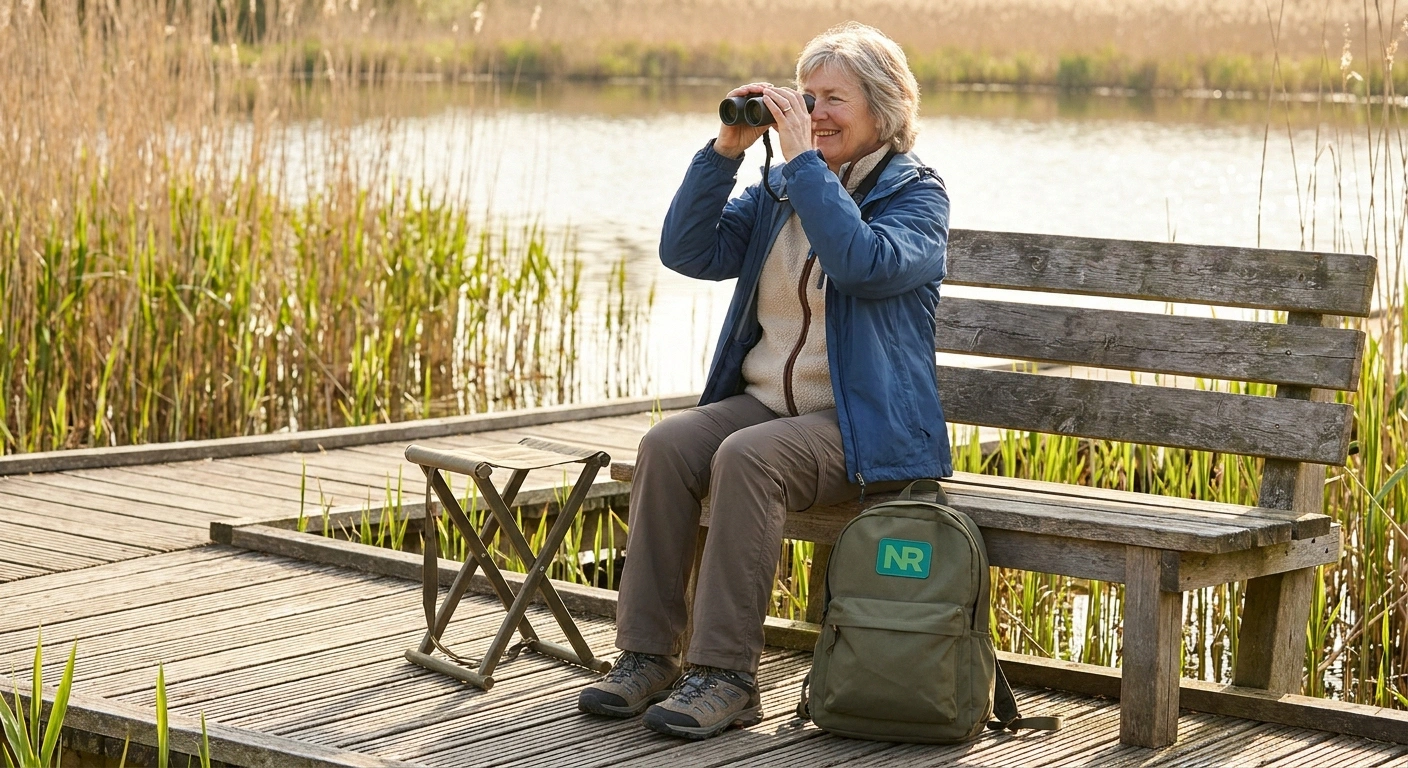
Two springs ago I nearly went over sideways into a drainage ditch because a scarlet tanager landed in a sycamore about forty feet ahead of me.
I was walking. I raised my binoculars while still walking. And in the half-second it took my eyes to fill with magnified leaves, my feet — which had not reliably told me what they were standing on in about six years — lost the last thread of information they had. I caught myself on a fence post, heart hammering, feeling equal parts foolish and lucky.
I did not stop birding. I stopped birding badly.
That is really what this whole article is. Birding is one of the best hobbies I know of for people living with neuropathy — it is quiet, it can be entirely stationary, it gets you outdoors, and it rewards patience rather than stamina. But almost everything written about accessible birding is aimed at wheelchair users or general seniors, and neuropathy has its own specific hazards that nobody addresses. Numb feet on uneven ground. Hands that cannot feel a cold binocular barrel. Not noticing a pebble in your shoe for two hours.
So here is the version I wish someone had handed me before the sycamore incident.
Why Birding Suits Neuropathy So Well
Most hobbies ask you to move. Birding asks you to be still and pay attention, which happens to be exactly what a lot of us can do best.
The birds come to you. That is not a consolation-prize version of the hobby — it is a legitimate and often superior strategy. Sitting still in one good spot for forty minutes routinely produces more species than walking two miles, because walking announces you to everything within a hundred yards and stillness does not.
It also scales down infinitely without losing its pleasure. A feeder outside a kitchen window is real birding. A bench at the edge of a pond is real birding. A car parked at a wildlife refuge overlook is real birding, and among serious birders “car birding” is a respected technique, not a compromise — a vehicle is one of the best blinds ever invented, because birds treat it as scenery rather than a person.
And on the days when your feet are having a conversation with you that you did not ask for, the hobby does not evaporate. It relocates to the porch.
The One Rule That Matters Most: Stop, Plant, Then Lift
If you take nothing else from this article, take this.
Stop. Plant. Then lift.
Balance runs on three inputs: inner ear, vision, and position sense from your feet. Neuropathy degrades the third, so your brain quietly leans harder on vision. Raising binoculars takes that away too — two of three inputs gone at once, while you are mid-stride on uneven ground. The fix costs two seconds.
Never raise binoculars while your feet are moving. Stop walking. Get both feet planted and stable. Then lift the glass.
Here is why this matters more for us than for other birders. Balance is built from three inputs: your inner ear, your vision, and the position sense coming up from your feet and legs. When neuropathy degrades that third input, your brain quietly leans harder on the other two — and most of that extra weight lands on vision. You are compensating with your eyes without knowing it.
Binoculars take vision away. They fill your visual field with a magnified circle of leaves forty feet away, remove your peripheral view of the ground entirely, and add a small amount of disorienting motion. In that moment you have lost two of your three balance inputs simultaneously.
That is the sycamore incident in one paragraph. It is also completely preventable with a habit that costs about two seconds. Our guide to neuropathy, balance, and fall prevention goes into the underlying mechanics in more depth, and the principle it teaches applies to a lot more than birding.
Choose Sitting as the Strategy, Not the Fallback
The biggest mental shift is to stop thinking of sitting as what you do when you get tired, and start treating it as the plan.
Choose a wide, four-leg base. Tripod stools are light but tippy — a poor match for feet that cannot feel the ground you set it on.
Rolling walker with seat
Genuinely excellent birding gear. Carries your kit, supports you on the way in, becomes a chair with a backrest when you arrive.
Scouted benches
Find them on a short first visit, then build the whole outing around where they are.
Your car
One of the best blinds ever invented. Birds treat a vehicle as scenery, not a person.
Set the seat up before you get the binoculars out. Fumbling with gear while lowering yourself onto an unsteady stool is the second most common way this goes wrong.
Pick a spot. Sit in it. Let the morning come to you. Serious birders do exactly this and call it a stakeout.
What works for a seat:
- A folding stool with a wide, stable base. Tripod stools are light but tippy; a four-leg camp stool or one with a broad footprint is far more forgiving when your feet cannot feel the ground you are setting it on.
- A rolling walker with a seat is genuinely excellent birding equipment — it carries your gear, gives you support on the way in, and turns into a chair with a backrest when you arrive.
- Existing benches. Scout them first, then build your outing around them.
- Your car. More on this below, because it deserves its own section.
One practical detail people miss: set the seat up first, then get your binoculars out. Fumbling with gear while lowering yourself onto an unstable stool with numb feet is the second most common way this hobby goes wrong.
Car Birding, Which Is Better Than It Sounds
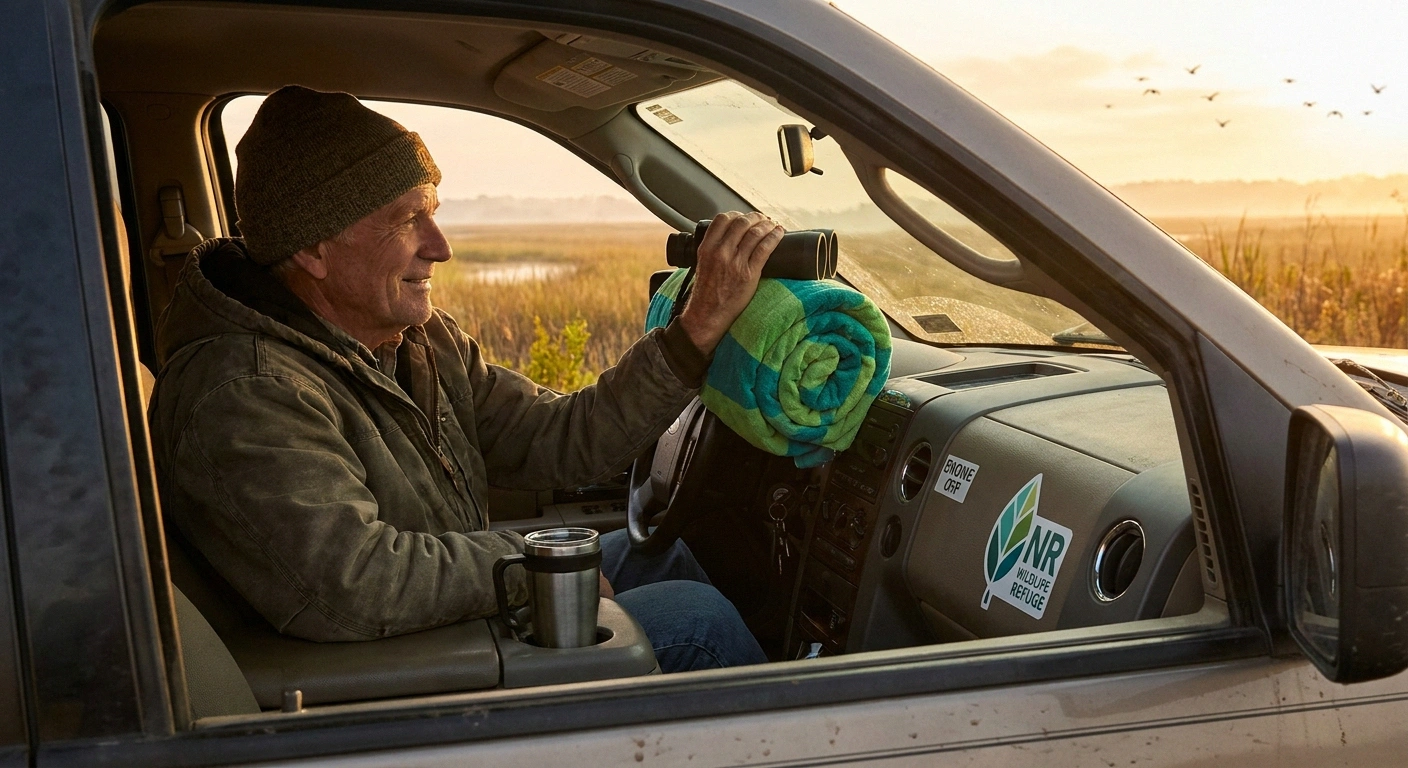
Many national wildlife refuges have auto tour routes — gravel or paved loops designed to be driven slowly with frequent stops. They exist precisely so people can watch wildlife from a vehicle, and they are some of the best birding in the country.
What makes the car so effective:
- Birds tolerate vehicles far better than people. You will get closer sitting in your car than you ever will on foot.
- You are seated, supported, out of the wind, and climate controlled — which matters enormously when your hands and feet cannot regulate or report temperature well.
- Your gear is right there. Water, snacks, an extra layer, your phone.
- Zero terrain risk.
A rolled-up towel or a small bean bag on the window ledge steadies your binoculars beautifully and costs nothing. Window mounts exist for spotting scopes if you go deeper into the hobby. Turn the engine off when you stop — vibration ruins the view, and the silence lets you hear what you cannot see.
Binoculars: Lighter and Wider Beats Bigger
This is where a lot of well-meaning gift-givers go wrong. Bigger numbers are not better for hands that are numb, weak, or shaky.
8×42 for most people · 8×32 if weight is the problem
- Textured rubber armor — smooth barrels are a dropping hazard when you cannot feel grip pressure
- Large, smooth center focus wheel — small stiff wheels are miserable with reduced dexterity
- Under about 24 ounces if you can manage it
Skip anything over 10x unless it goes on a tripod. Higher magnification amplifies every tremor and turns holding steady into a strength task.
Go with 8×42. Eight-power magnification is more forgiving of hand tremor than ten-power, and it gives a wider field of view, which means you find the bird faster and spend less time holding your arms up hunting for it. The 42 refers to lens diameter and gives you good low-light performance for dawn and dusk.
If weight is the main problem, 8×32 drops several ounces and remains genuinely capable. I would rather someone carry an 8×32 comfortably than leave an 8×42 in the closet.
What actually matters for neuropathy hands:
- Textured rubber armor. Smooth metal barrels are a dropping hazard when you cannot feel your grip pressure.
- A large, smooth center focus wheel. Tiny stiff wheels are miserable with reduced fine motor control.
- Weight under about 24 ounces if you can manage it.
Skip anything over 10x unless it is going on a tripod. High magnification amplifies every tremor, and holding it steady is a strength task your hands may not want.
Get a Harness, Not a Neck Strap
This is the single cheapest upgrade on this list and the one that changes the most.
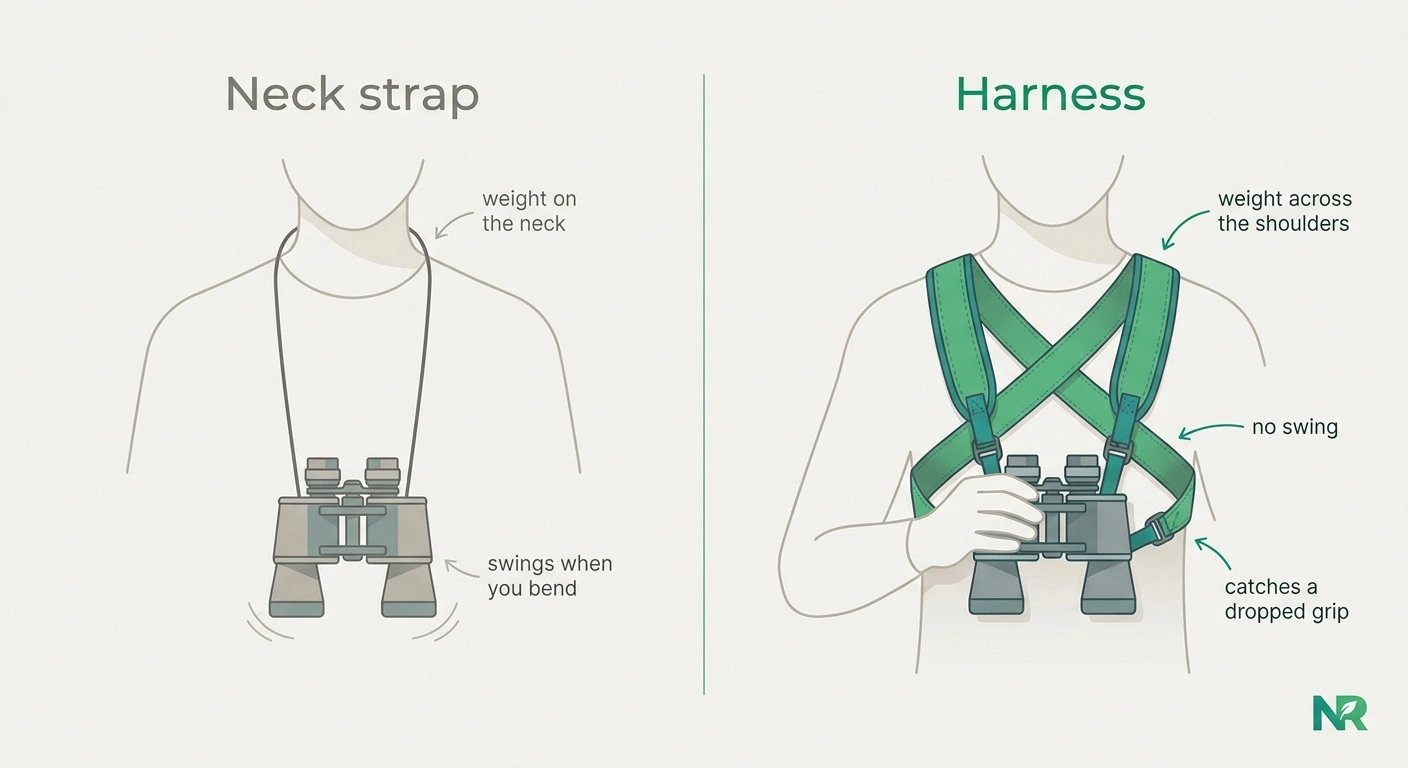
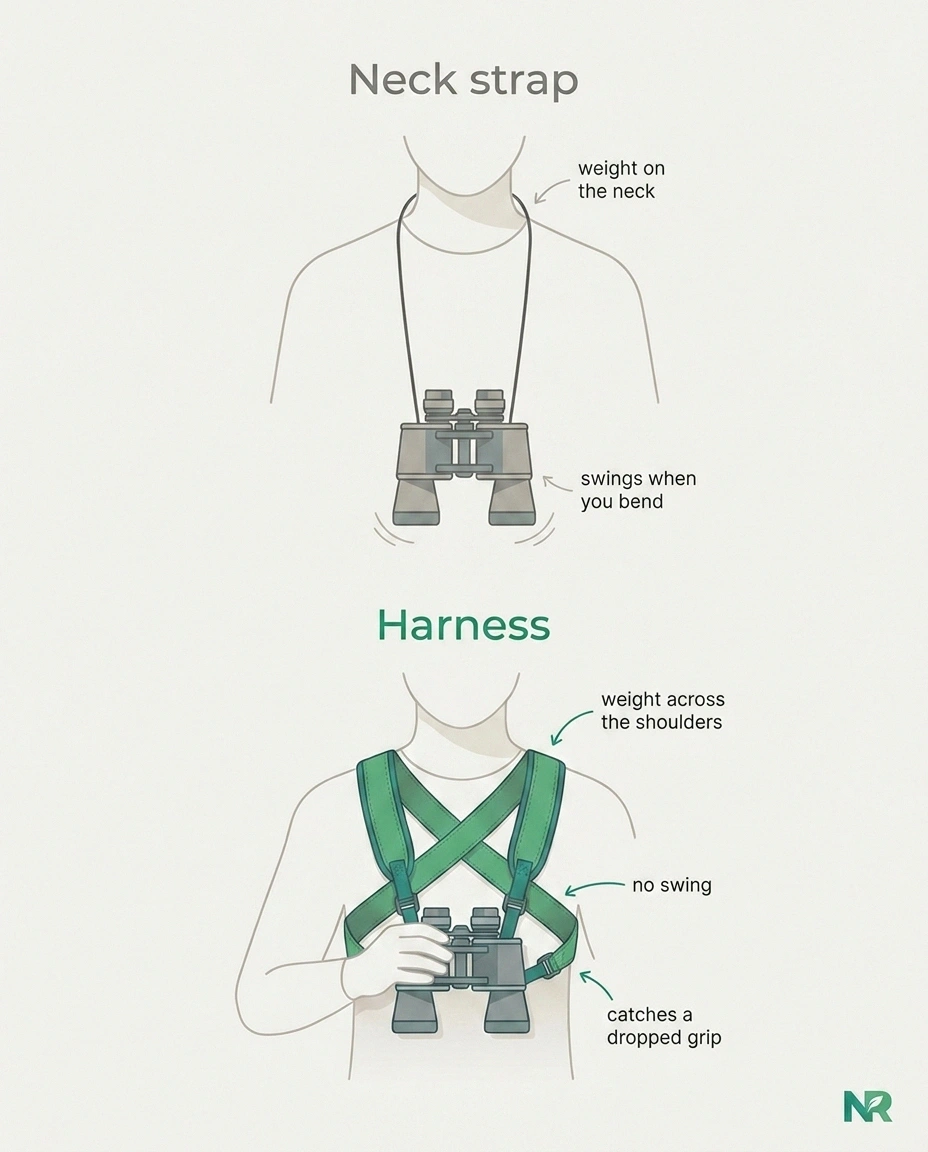
A standard neck strap hangs the full weight from your cervical spine and lets the binoculars swing when you bend over. A binocular harness — two padded straps over the shoulders in an X across the back — distributes the weight across your shoulders, holds the binoculars against your chest so they do not swing, and, most importantly for us, means a dropped binocular does not hit the ground.
If your grip fails momentarily, the harness catches it. That is worth thirty dollars all by itself.
Add a wide neoprene strap if you prefer a traditional setup, and consider a wrist loop as backup. Some people also wrap a bit of self-adhesive grip tape around the barrels for extra purchase — cheap, effective, and no more slippery when damp.
Feet: The Part Nobody Writes About
Here is the neuropathy-specific danger that no general birding guide mentions.
Two to three hours in the same shoes, standing still, on uneven ground — and no pain to warn you. A pebble, a sock fold, a rubbing seam or a developing blister can become a real injury without one moment of discomfort.
- Inspect both feet before you go and again when you get home — all surfaces, between the toes
- Shake out both shoes before putting them on
- Smooth your socks deliberately; seamless socks are worth the premium
- Wear broken-in shoes — a birding trip is the worst place to break in new boots
- Sit and check again at the one-hour mark
Call your doctor the same day for any wound, redness, warmth or swelling you find.
A typical birding outing means two to three hours in the same footwear, often on uneven ground, frequently standing still for long stretches. If your feet cannot report a pebble, a fold in your sock, a rubbing seam, or a developing blister, you can accumulate a genuine injury without a single moment of discomfort to warn you.
The routine that prevents it:
- Check your feet before you go and again when you get home. Every time. All surfaces, between the toes.
- Shake out both shoes before putting them on, and again if you have taken them off at any point.
- Smooth your socks deliberately — seamless socks are worth the small premium.
- Wear the same broken-in, properly fitted shoes you trust. A birding trip is the worst possible place to break in new boots. Our guide to choosing shoes for neuropathy covers fit specifics.
- Set a mid-outing check at the one-hour mark if you are somewhere you can sit down and look.
Our neuropathy foot care guide covers the full daily routine. On birding days it matters more than usual, not less, because you are standing longer than you think and paying attention to something else entirely.
Terrain: Pick It Deliberately
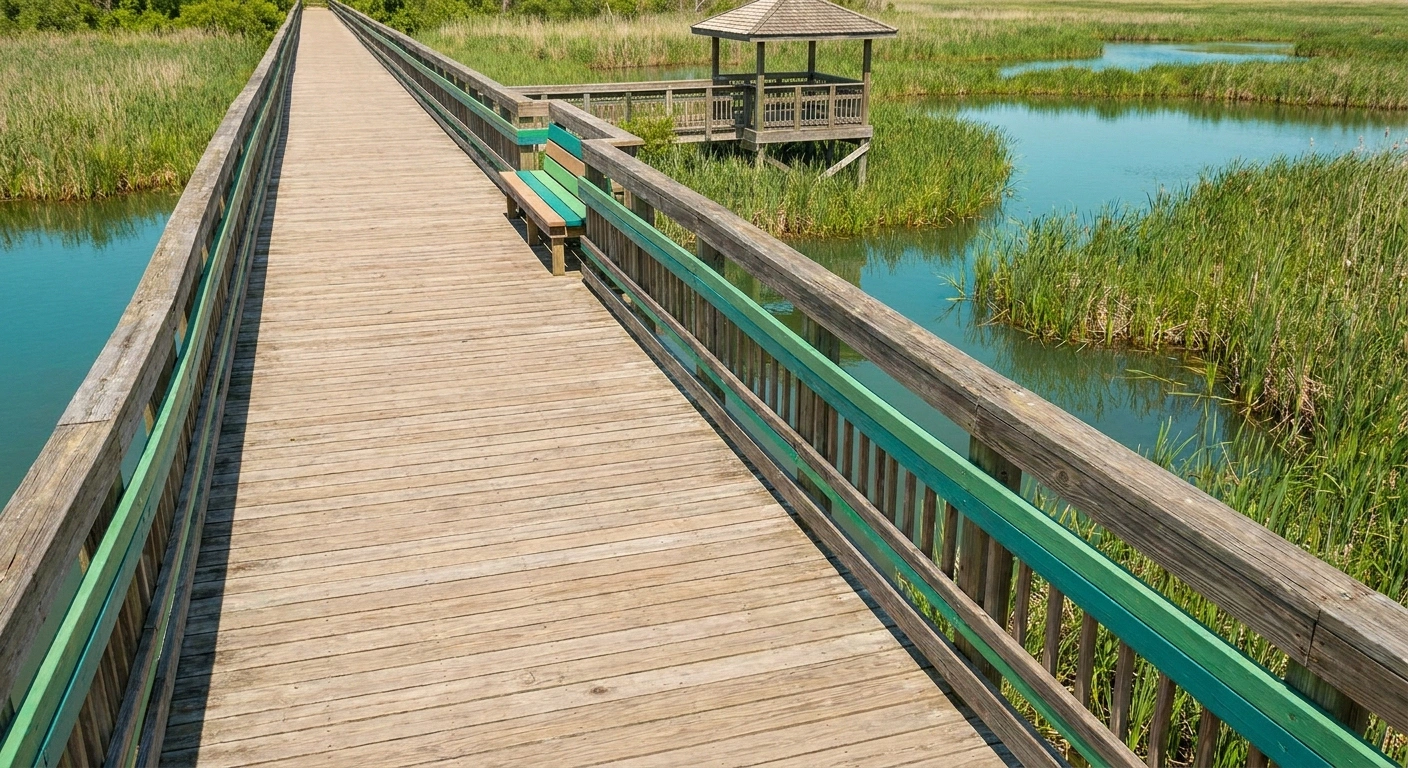
Not all birding locations are equal, and the good ones for us are often the good ones generally.
Look for: boardwalks over marsh and wetland, paved loop trails, refuge auto routes, observation decks and platforms, and pond-edge benches. Boardwalks are the gold standard — flat, even, predictable, usually railed, and they run through some of the richest bird habitat there is.
Approach carefully or skip: loose gravel, exposed roots, stream crossings, steep grades, tall grass hiding uneven ground, and anything described as “rugged.” Wet leaves over roots are the specific combination that has caused the most trouble for people I know.
Accessibility resources exist and are genuinely useful — organizations focused on birding with disabilities have mapped accessible trails, and the criteria they use (traversable surfaces, benches, shade, water, and restrooms large enough for mobility devices) are exactly the criteria that make an outing work for numb feet too. Bird blinds designed for accessibility have viewing windows starting around thirty inches off the floor so a seated person can see out, doors that are not heavy, and entrances at least thirty-two inches wide.
Scout new locations with a short first visit rather than committing to a three-hour outing on unknown ground.
The Dawn Problem, and the Honest Answer
Bird activity peaks in the first two hours after sunrise. Neuropathy pain and stiffness also frequently peak in the early morning, and plenty of us do not sleep well the night before an early start.
Dawn — from the window
Feeders cover the peak hours while your body wakes up. This is not cheating.
8:30–9:00 a.m.
Not the peak, but plenty to see — and a body that actually cooperates. This is the sweet spot.
Late afternoon
A genuine second activity peak before dusk, and you are warmed up and moving well.
The people who burn out are the ones who insist on 5:30 a.m. every Saturday and quit entirely after six weeks. The hobby is long. Pace it.
Those two facts are in direct conflict, and I am not going to pretend otherwise.
What I have settled on:
- Mid-morning is still excellent. Eight-thirty or nine is not the peak, but you will see plenty. The trade for a body that actually cooperates is worth it.
- Feeders cover dawn. Watch from the window with coffee while your body wakes up. This is not cheating.
- Late afternoon is underrated. There is a real second activity peak before dusk, and by then you are warmed up and moving well.
- Save true early starts for special occasions — a migration fallout, a specific target bird — and give yourself the following day off.
The people who burn out are the ones who insist on 5:30 a.m. every Saturday and then quit entirely after six weeks. The hobby is long. Pace it.
Temperature: Your Skin Is Not Reporting Accurately
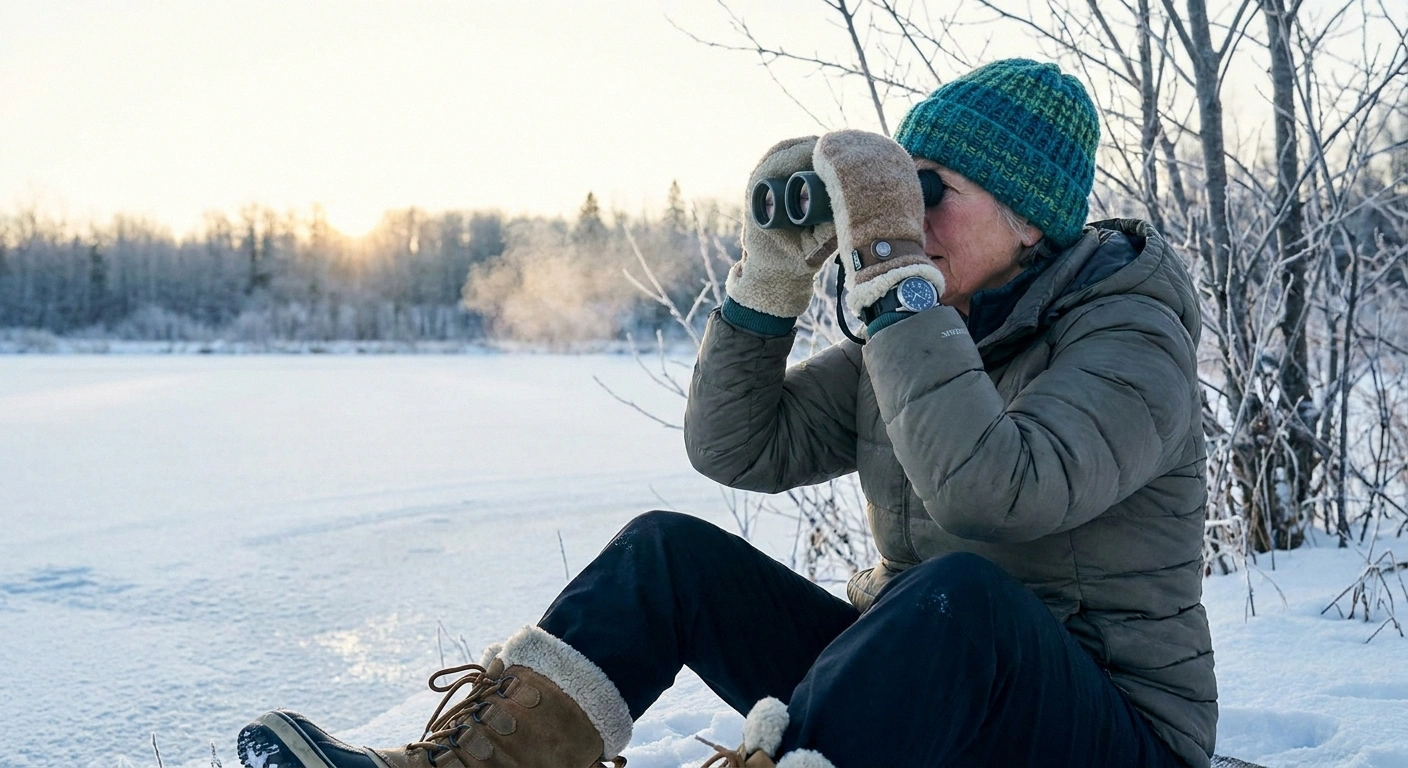
This one is genuinely a safety issue and it runs in both directions.
Cold. Winter birding is fantastic — waterfowl, raptors, no leaves blocking the view. It is also when hands and feet that cannot feel cold are at real risk. You will not get the normal warning ache that tells everyone else to go inside. Use the clock instead: set a limit before you go, and honor it whether or not you feel cold. Insulated boots with room for thick socks, mittens over gloves, chemical hand warmers in your pockets between looks, and a hard stop when the timer says so.
Heat. A boardwalk or observation deck in July can get genuinely hot underfoot, and thin soles plus numb feet is a burn risk that people do not think about. Never stand barefoot on a sun-heated surface. Seek shade, hydrate, and remember that heat also makes many people's nerve symptoms noisier for the rest of the day.
Compression socks help some people with circulation and swelling during long stationary stretches, though they are not right for everyone — worth asking your doctor about if you find your feet swelling on longer outings.
Working Around Fumbling Hands
Small adjustments that remove a surprising amount of frustration:
- A harness, not a neck strap. Spreads the weight, stops the swing, and catches the binoculars if your grip lets go.
- An ID app instead of a field guide. No thin pages to flip, and sound ID hears what you would miss.
- Phone on a lanyard. Retrieving it from a jacket pocket while holding binoculars is how phones end up in ponds.
- Voice memos instead of writing. Speak the list rather than fighting a pen in the cold.
- Pack the night before. Decisions made while tired and rushed are the ones you regret at the trailhead.
- Use an ID app instead of a field guide. Merlin is free and excellent, it identifies birds by sound as well as sight, and it eliminates flipping thin pages with fingers that cannot feel paper edges. The sound ID in particular is a gift — it hears things you would miss.
- Put your phone on a lanyard. Around the neck, not in a pocket. Retrieving a phone from a jacket pocket while holding binoculars is how phones end up in ponds.
- Voice memos instead of writing. Speak your list rather than fighting a pen in cold weather with reduced dexterity.
- Pre-load the car. Pack the night before, when you are not tired and rushed.
- Rainguards and lens caps that stay attached. Anything that has to be removed and pocketed will eventually be dropped and lost.
Feeders: The Highest Return for the Least Effort
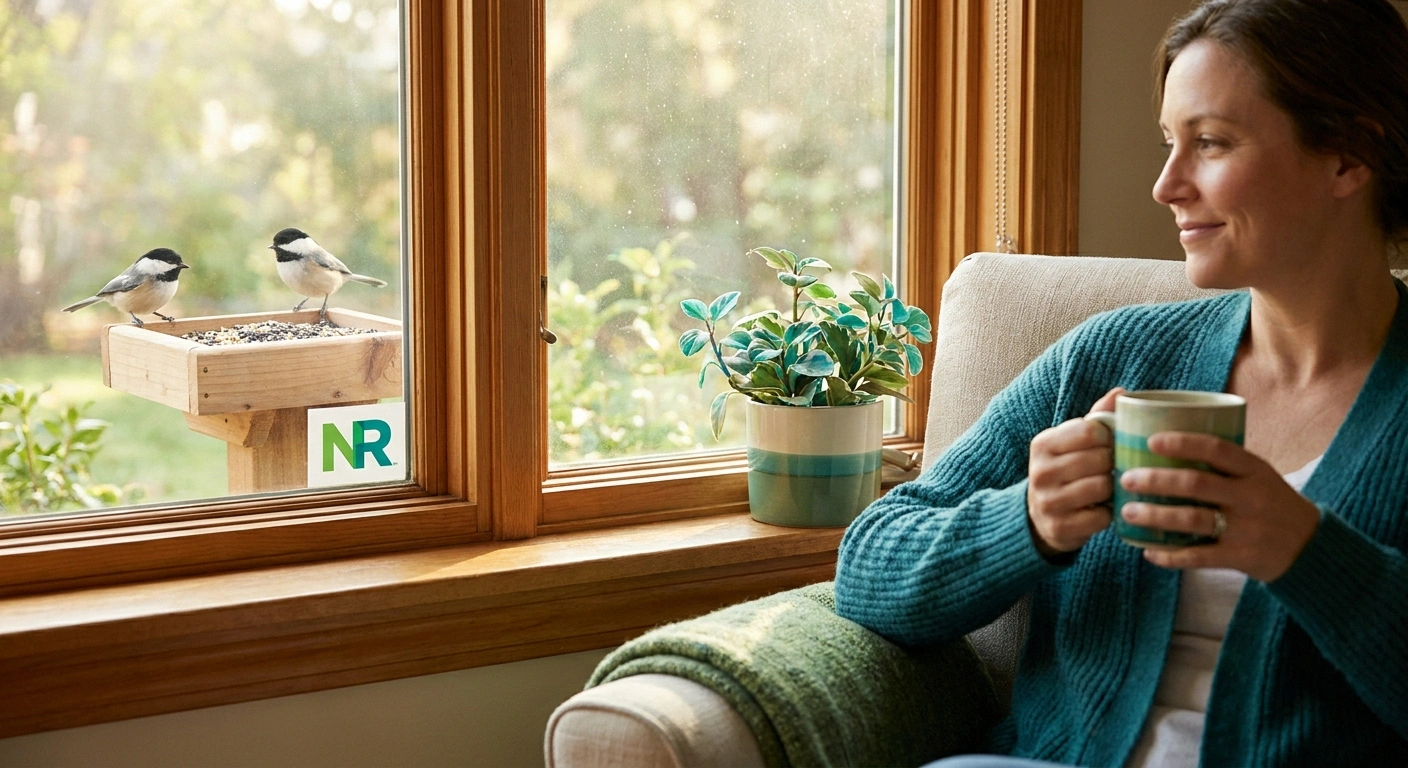
If you do one thing from this article, hang a feeder where you can see it from a comfortable chair.
It converts every ordinary day into a small birding opportunity with zero terrain risk, zero temperature exposure, and zero energy cost. It is also how you learn your local common birds well enough to recognize them instantly in the field, which makes actual outings far more satisfying.
Practical notes for hands with reduced grip: choose feeders with wide openings that do not require precise pouring, or use a scoop and funnel. Set them up so refilling does not require a ladder or reaching overhead — a shepherd's hook at a comfortable height beats a hanging branch every time. A window-mounted feeder brings birds within a few feet, which needs no binoculars at all.
A shallow water source draws more species than seed does, particularly in dry weather. A moving-water dripper is the closest thing to a magnet in this hobby.
Going With Other People
The social barrier is as real as the physical one, and it stops more people than terrain does.
The fear is straightforward: everyone else will walk faster, you will hold up the group, and you will spend the whole morning apologizing.
Two things worth knowing. First, most local Audubon chapters and bird clubs run walks that are already slow — birding groups stop constantly, and the pace is set by what people are looking at rather than by fitness. Second, group leaders who lead accessible walks explicitly modulate pace so nobody is straining to keep up, and that practice has spread well beyond formally designated accessible outings.
Call ahead and ask two specific questions: how far the walk goes, and whether there are benches. Most leaders answer honestly and gladly, and many will suggest a better-suited outing if the one you asked about is not right.
If group walks are not your thing, a single birding friend is plenty — someone who will happily sit on a bench with you for an hour is worth more than a whole club.
Building an Outing That Actually Works
Here is the shape of a good one, start to finish.
Before you leave
- Scouted spot, known seat, known surface
- Foot check, seamless socks, broken-in shoes
- Stool, water, snack, extra layer, phone on lanyard
- Two-hour cap set on an alarm
While you're there
- Bird from the car for the first 15 minutes
- Walk to the seat, set it up, sit down, stay put
- Stop, plant, then lift — every time
- Foot check at the one-hour mark
Going home
- Leave before you are exhausted, not after
- Final foot check
- Log the day's list in your app
Pick a location you have scouted, with a known seat and a known surface. Go mid-morning. Bring the folding stool, water, a snack, an extra layer, and your phone on a lanyard. Wear the broken-in shoes and the seamless socks; check your feet before you put them on. Set a two-hour cap and an alarm, especially in cold weather.
Drive in, park, and spend the first fifteen minutes birding from the car before you get out — you will be surprised how often that is the best fifteen minutes of the trip. Then walk to your seat, set it up, sit down, and stay put. Let the birds come. Stop, plant, then lift, every single time.
Go home before you are exhausted rather than after. Check your feet again. Put the day's list in your app.
That is it. It looks modest on paper and it is genuinely wonderful in practice.
What This Hobby Gives Back
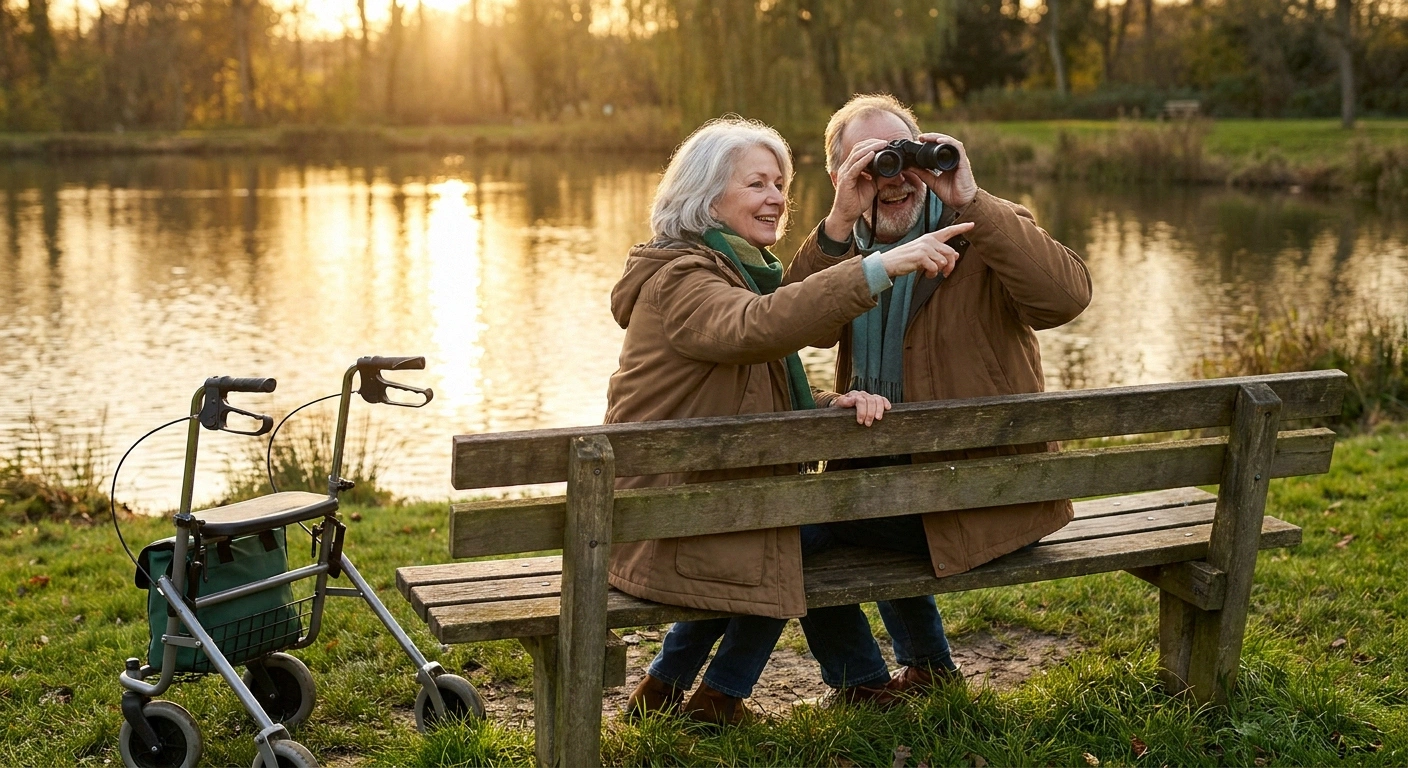
I want to close with the part that is not logistics.
Chronic conditions shrink your world by inches, and the losses are so gradual you often do not notice them until something you used to love has quietly fallen off the list. Birding pushed back against that for me in a way I did not expect. It gave me a reason to be outside that did not depend on how far I could walk, a form of attention that pulled my focus outward instead of inward toward my feet, and a slowly growing sense of competence at a time when a lot of things felt like they were being taken away.
It also turns out that sitting still and looking closely is a genuine skill, and it is one that people with limited mobility often develop faster than everyone else — because we are already doing it.
Movement in whatever form you can manage matters for a lot of reasons, and walking helps neuropathy for most people who can do it safely, with gentler seated and standing routines available when walking is hard. A slow morning at a marsh boardwalk counts. So does the walk from the car to the bench. And if all you can manage is the chair by the window with the feeder outside it — that counts too, and the birds do not know the difference.
Start where you are. The tanagers will still be there.
Frequently Asked Questions
Can you go bird watching if you have trouble walking?
Yes, and the hobby is unusually well suited to it. Birding works entirely from a seated position, whether that is a bench, a folding stool, a rolling walker with a seat, a vehicle, or a chair by a window with a feeder outside. Sitting still in one good location often produces more sightings than walking, because movement announces your presence to birds within a wide radius while stillness does not. Many wildlife refuges have auto tour routes designed specifically for viewing from a vehicle, and boardwalks and paved loop trails provide even, predictable surfaces where walking is manageable.
What binoculars are easiest to hold with weak or numb hands?
An 8×42 configuration is the general recommendation, and 8×32 is a good lighter alternative. Eight-power magnification is more forgiving of hand tremor than ten-power and provides a wider field of view, so you locate birds faster and hold your arms up for less time. Look for textured rubber armor rather than smooth barrels, a large smooth center focus wheel rather than a small stiff one, and a total weight under roughly 24 ounces. Avoid magnifications above 10x unless you are using a tripod, because higher magnification amplifies every tremor.
Why is it dangerous to use binoculars while walking with neuropathy?
Balance depends on three inputs: the inner ear, vision, and position sense from the feet and legs. Neuropathy degrades that third input, so the brain compensates by relying more heavily on vision, often without the person realizing it. Raising binoculars removes that visual reference, fills the visual field with a magnified distant image, and adds disorienting motion. In that moment two of three balance inputs are compromised at once. The rule that prevents this is to stop walking, plant both feet securely, and only then lift the binoculars.
How do I protect my feet on a long birding outing?
Because reduced sensation means an injury can develop without any pain to warn you, use a clock-based routine rather than relying on how your feet feel. Inspect all surfaces of both feet, including between the toes, before leaving and again on returning. Shake out both shoes before putting them on. Smooth your socks deliberately, and consider seamless socks. Wear broken-in, properly fitted footwear rather than new boots. On outings longer than about an hour, sit down and check your feet partway through. Call your doctor the same day for any wound, redness, warmth or swelling you find.
Is winter bird watching safe with neuropathy?
It can be, with precautions, and winter offers excellent birding for waterfowl and raptors with no foliage blocking the view. The specific risk is that hands and feet with reduced sensation do not deliver the normal warning ache that tells other people to go indoors, so cold injury can develop unnoticed. Manage it with a timer rather than sensation: decide your time limit before you go and honor it regardless of how you feel. Use insulated boots sized to accommodate thick socks, mittens layered over gloves, and chemical hand warmers kept in your pockets between viewing sessions.
What is the best time of day to go birding if mornings are difficult?
Bird activity peaks in the first two hours after sunrise, but mid-morning outings around eight-thirty or nine still produce plenty of sightings, and the trade is worth it if early mornings are when your pain and stiffness are worst. Late afternoon has a genuine second activity peak before dusk, and by then most people are warmed up and moving more easily. A backyard feeder covers the dawn window from a comfortable chair indoors. Reserve true early starts for special occasions and plan a lighter day afterward.
Do I need to join a group to enjoy birding?
Not at all, though groups help with learning. If the concern is holding people up, most local bird club and Audubon walks are already slow, because the pace is set by what people are looking at rather than by fitness. Walk leaders commonly modulate pace so nobody is straining to keep up. Calling ahead to ask how far the walk goes and whether there are benches usually gets an honest and helpful answer. A single birding friend who is happy to sit on a bench for an hour is just as good as a club, and solo birding from a car or a porch is a complete version of the hobby on its own.
About the Author


