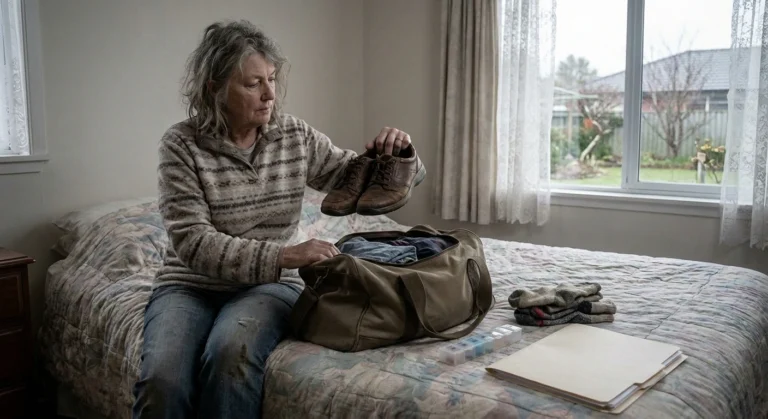
The first time someone in my support group suggested a cruise, I laughed out loud. My feet hurt walking from the car to the front door — how on earth was I supposed to manage a giant ship? But then a friend who'd been managing neuropathy for years told me it was actually her favorite kind of vacation. “You unpack once,” she said. “Your hotel goes to the destinations. The hardest day is embarkation, and after that it's basically your couch with a view.” I came home from that conversation and started researching.
I'm Janet. I'm a patient advocate, not a travel agent. But I've taken a few cruises since being diagnosed and helped a lot of friends plan theirs, and there's a real art to making one of these work when your feet, balance, and energy aren't what they used to be. This is the practical version — what to book, what to pack, what to ask for, and where the genuine pitfalls hide.
Why a Cruise Can Actually Be Easier Than a Land Trip
For most people I know with neuropathy, the hardest part of any vacation isn't the destination — it's the transitions. Pack, unpack, lug bags to a new hotel, find a new restaurant, learn a new neighborhood, walk too much on day one, pay for it on day two. A cruise removes most of that. You unpack one time. Every dinner is in the same room down the hall. The bathroom is the same bathroom every night. If you have a bad foot day, you can stay in your cabin or on a quiet deck instead of being trapped on a tour bus eight hundred miles from your bed.
Key Takeaway
A cruise can be one of the easiest vacations with neuropathy because you unpack once, your hotel travels with you, and rest days don't waste the trip. The big variables are cabin location (midship-low + accessible if possible), the cruise line's mobility-services team, smart shore-excursion selection, and knowing which ports tender vs. dock.
The trade-offs are real too — long ship corridors, occasional motion under foot, lots of standing in lines if you're not careful about timing, and pool decks that get blazing hot. None of that is a deal-breaker. It just means a little more planning than a younger, abler version of yourself would have done.
Booking Your Cabin: Location Matters More Than You Think
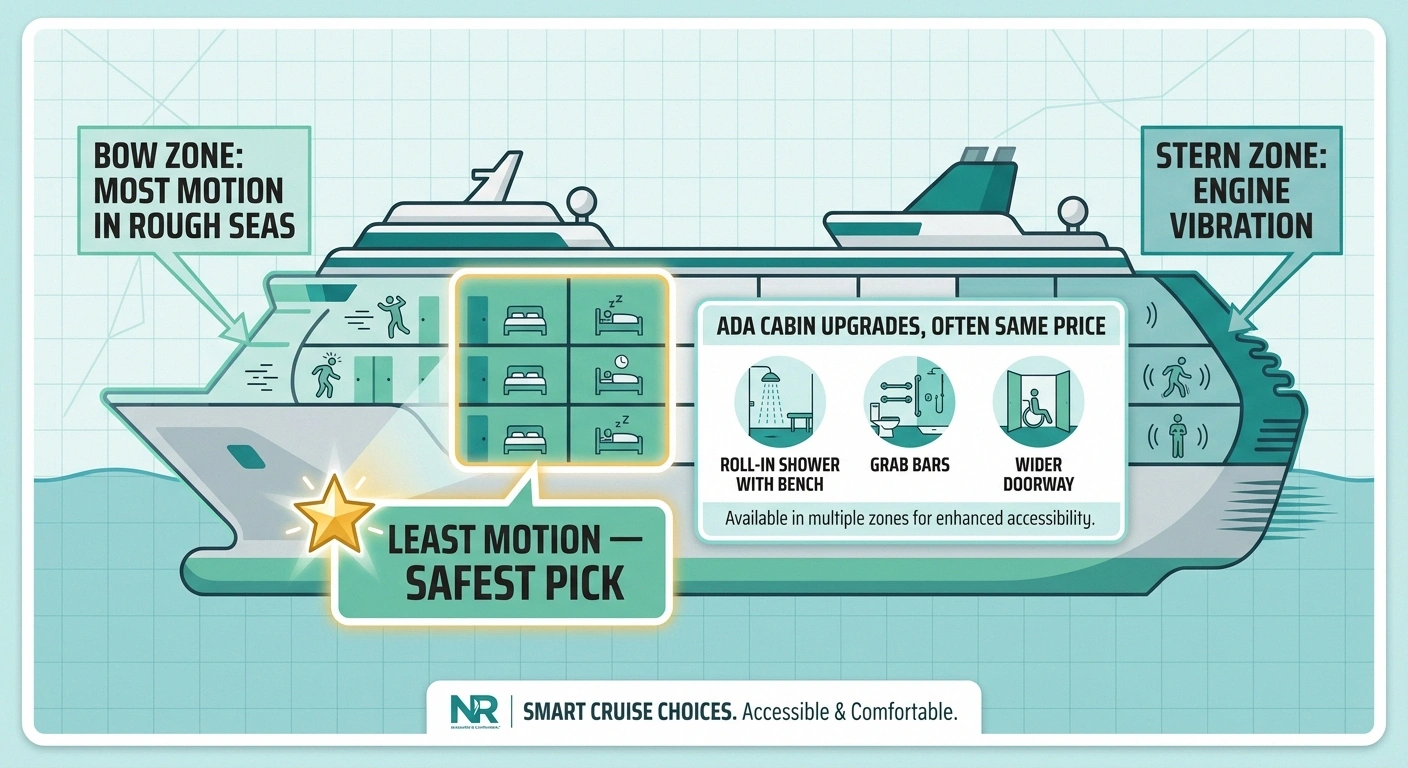
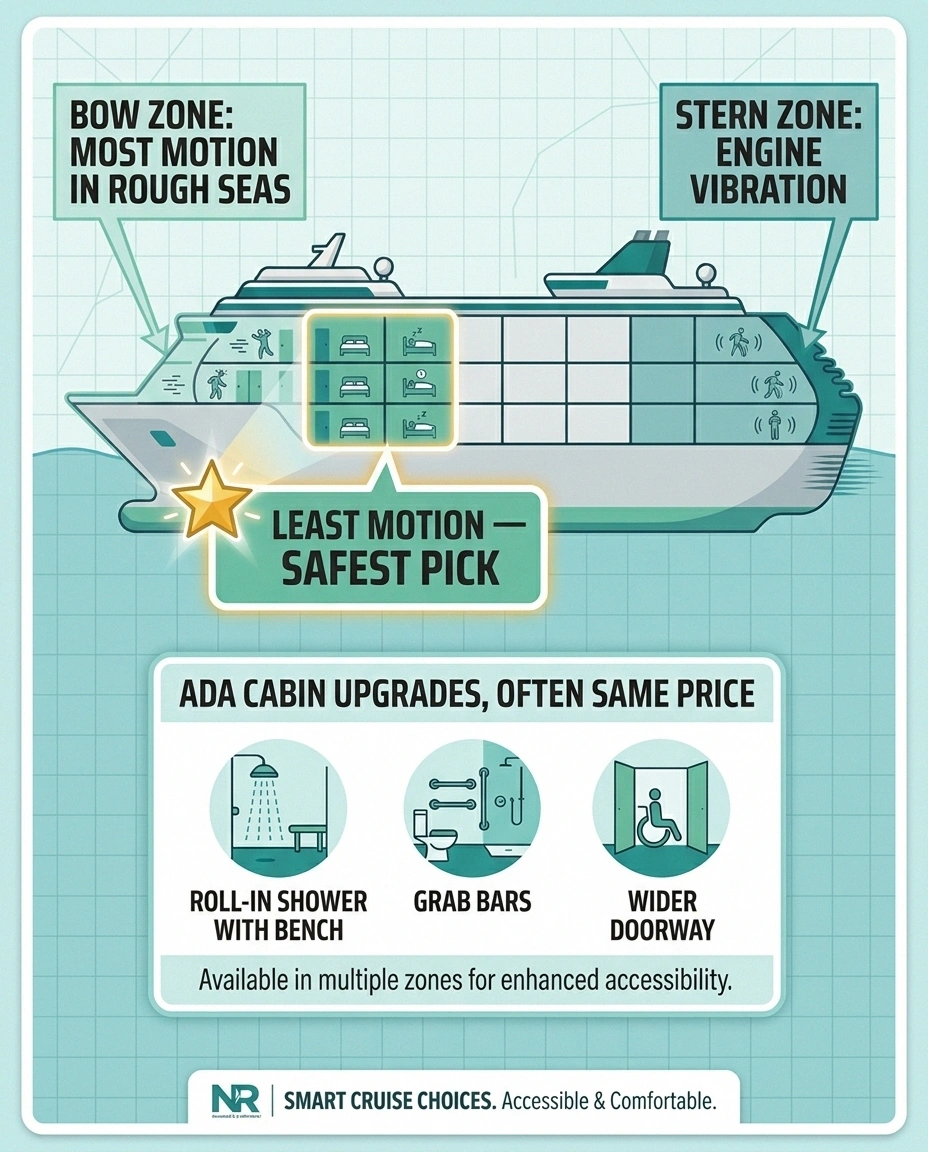
The single most important choice you'll make is your cabin. Two things matter most.
Cabin Location — Where Motion Matters
Bonus: book an accessible (ADA) cabin — roll-in shower with bench, wider doorways, grab bars. Same price on most lines.
First, where it sits on the ship. Midship cabins on a lower deck feel the least motion. The bow rocks more in big seas, the stern vibrates more from the engines, and high-deck cabins sway more during turns and rough water. If you've never cruised before and you have any concern about motion sensitivity, midship-low is the safe pick.
Second, whether you book an accessible (ADA) cabin. These cost the same as standard cabins on most lines and come with meaningful upgrades: a wider doorway, more turning space, a roll-in shower with a fold-down bench, grab bars, and a lower threshold. You don't need to use a wheelchair or walker every day to benefit. If you have any balance issue, fall risk, or just want a real bench in the shower, the accessible cabin is a quiet luxury. They sell out early — book six to twelve months ahead.
Two smaller details worth asking about:
- Distance to elevators. Ships are long. A cabin three doors from the elevator is dramatically less walking over a week than one halfway down the corridor. Ask the booking agent.
- Self-serve vs. attended embarkation port. Some lines and itineraries offer pier-side wheelchair assistance even if you don't normally use one. Request it. The first day, with bags and crowds and the long walk through the terminal, is the hardest day. Save your feet for the actual vacation.
Tell the Cruise Line About Your Mobility Needs
Every major cruise line has a department called something like “Access Services,” “Accessible Travel,” or “Special Needs.” They exist specifically to coordinate with passengers who have any kind of mobility, vision, hearing, dietary, or medical consideration. They are not for people in wheelchairs only. Neuropathy counts.
What to Ask Access Services For
- Pier-side wheelchair assistance for embarkation and disembarkation
- A shower bench delivered to a non-accessible cabin
- Room-service breakfast on busy port days
- A list of ports requiring tendering on your itinerary
- Coordination with the medical center for refrigerated medications
- Dietary notes for the dining room staff
Call within two weeks of booking. Call again two weeks before sailing to confirm.
What they can arrange, often weeks before sailing:
- Pier-side wheelchair assistance for embarkation and disembarkation.
- A shower bench delivered to a non-accessible cabin if the accessible cabins are sold out.
- Room-service breakfast on busy port days so you don't have to navigate the buffet.
- Notes to your dining staff about dietary preferences or restrictions.
- A list of which ports require tendering (the small-boat transfer; more on this below) so you can plan accordingly.
- Coordination with the medical center if you take medications that need refrigeration.
Call them yourself, even if you booked through a travel agent. Two weeks before sailing is a good time to confirm any arrangements they've made.
Shore Excursions: Read the Activity Level, Not Just the Description
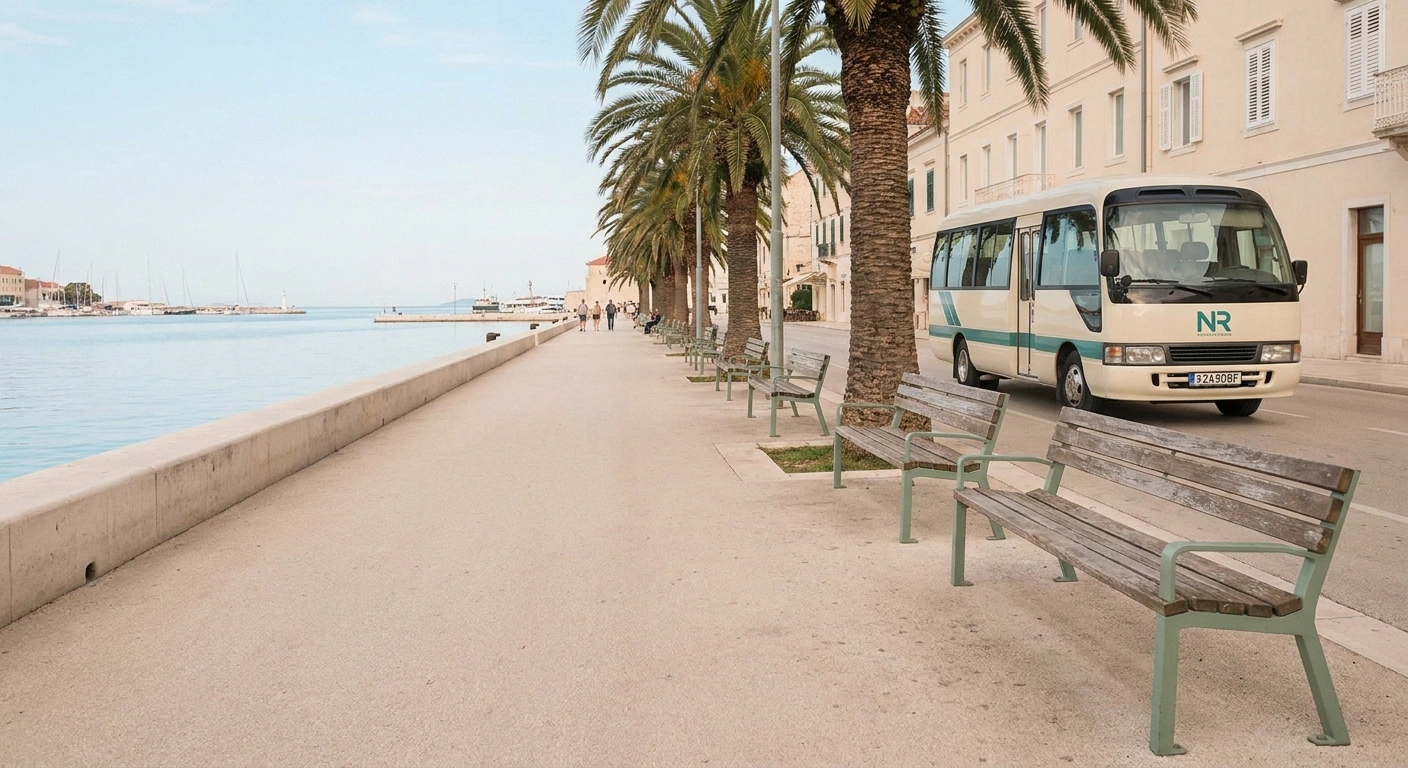
Most cruise lines rate their shore excursions on a difficulty scale — typically minimal, moderate, or strenuous. The “easy” tier is the one you want. Excursions in that tier are typically motorcoach-based, involve short walks on flat surfaces, and have wheelchair-accessible buses available on request.
What to look at carefully:
- Total walking distance and surface. “Two-hour walking tour” can mean strolling a flat museum or climbing a hill of cobblestones. If the description doesn't tell you, the shore excursion desk on board will.
- Whether stops include stairs or uneven ground. Ancient ruins are gorgeous and almost universally hostile to anyone with balance issues. Ask before booking.
- Bathroom availability along the route. Autonomic neuropathy can mean less predictable bathroom needs. Excursions that include indoor bathroom stops every couple of hours are kinder than open-air tours.
- Time you'll spend on your feet vs. seated. A four-hour bus tour that includes one twenty-minute walking stop is different from a four-hour walking tour with a short bus transfer.
If a port really matters to you and no easy excursion is offered, you can almost always hire a private accessible-tour operator in advance — sometimes through the cruise line's accessible-travel partners. More expensive, but a much better fit.
The Tender Boat Issue (Read Before You Book)
Some ports — particularly Mediterranean, Caribbean island, and Alaskan — don't have piers large enough for cruise ships. Instead, the ship anchors offshore and ferries passengers to land in small boats called tenders. To board a tender, you step from a moving ship onto a moving boat, often via a small ramp that's bobbing several inches up and down. Then the tender ride itself can be choppy.
Tendering — Read This Before Booking
Tendering = ship anchors offshore, small boat ferries you to land. You step from one moving vessel to another. The small boat ride can be choppy.
- Ask which ports tender vs. dock on your specific sailing
- Some lines restrict tender access for guests using wheelchairs at certain ports
- If a port tenders and you're unsure — plan to stay aboard. The ship is wonderfully quiet
- If you do tender — let the crew help; they're trained. Don't rush the transfer.
For anyone with balance issues, foot numbness, or motion sensitivity, tendering is the hardest part of cruising. Some cruise lines won't allow guests using wheelchairs or walkers to tender at certain ports for safety reasons; the result is you stay aboard while the ship visits. That's worth knowing before you book.
How to handle this:
- Ask the booking agent which ports on your itinerary tender vs. dock. The same itinerary can be different on different sailings or with different ships.
- If you really want to visit a tender port and balance is a worry, plan to stay on board that day and enjoy the quiet ship.
- If you do choose to tender, ask the crew to wait for calmer water between transfers and let them help you on and off. They're trained for this.
Packing: A Neuropathy-Specific Cruise Kit
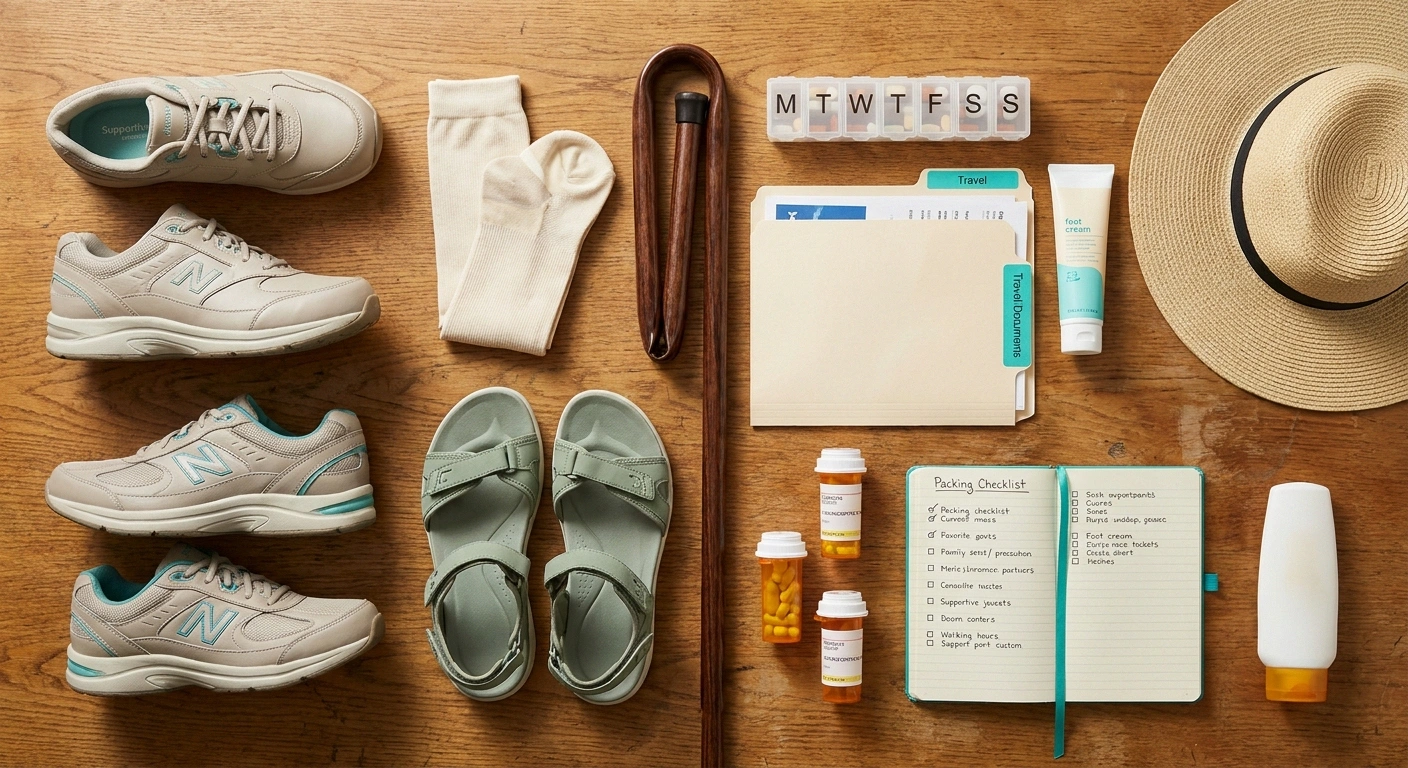
The general cruise packing list misses a few things that matter for nerve patients. Here's what I never sail without:
Neuropathy Cruise Packing Kit
- Two pairs of supportive walking shoes with closed toes and a roomy fit — one for daytime, one in case the first pair gets wet. The general principles in best shoes for neuropathy all apply on a ship.
- Backstrap sandals for the pool deck — never flip-flops you can shed without noticing. Pool decks get blazing hot, and tripping on a sandal you can't feel is a real risk.
- Compression socks for the flight or drive to the embarkation port. Sitting still on a plane is a real DVT risk for older adults; compression socks reduce it.
- A cane or walking stick if you sometimes use one. Take it even if you don't use it every day. Ship corridors are long and you'll thank yourself.
- Two weeks' worth of every medication you take, in carry-on luggage, in the original prescription bottles, plus a printed list of all medications with doses. Never put medications in checked luggage. If your bag gets lost or delayed, the ship's pharmacy may not stock your specific drug.
- A copy of your prescriptions in case of loss — and a doctor's letter listing your diagnoses and the reasons you take what you take. Useful at customs and at the ship medical center.
- Your usual foot cream and supplements. The ship store sells a small selection at marked-up prices.
- A small pill organizer sorted by day. Time zones can scramble routine dosing.
- A folding shower bench if you don't have an accessible cabin and your line can't deliver one. Available from camping stores, fits in a checked bag.
- Sunscreen and a wide-brimmed hat. Sun protection is more important when neuropathy can disguise the early sting of a burn.
- Travel insurance with medical evacuation coverage. Not optional for international cruises. A medical emergency abroad can cost tens of thousands of dollars to evacuate without it.
Daily Rhythm on the Ship
The cruise day is long. Some practical pacing tips that have made my trips much easier.
A Neuropathy-Friendly Cruise Day
Eat breakfast in your cabin or in a quiet dining room rather than the buffet. The buffet first thing in the morning is a long, slow standing line. Most cruise lines offer free room service breakfast — fill out the card the night before and hang it on the door.
Use the indoor promenade or theater for walking. Many ships have an indoor jogging track or open promenade that lets you get steps in without the heat of the outdoor deck. Walk early or late when the deck cools.
Pre-book dining at fixed times. Open seating sounds flexible but often means standing in line. A reserved table at a fixed time means you walk in, sit down, eat.
Build in rest days. If your itinerary has six port days in a row, plan to skip at least one. The ship is at its most peaceful and uncrowded when most passengers are off exploring. That's a feature.
Use the spa thoughtfully. A foot massage or a warm-water hydrotherapy pool can be a real comfort. Be cautious with hot tubs — autonomic dysfunction can cause blood pressure to drop in hot water; never alone, never for more than a few minutes if you're new to it. The principles in our piece on autonomic neuropathy apply.
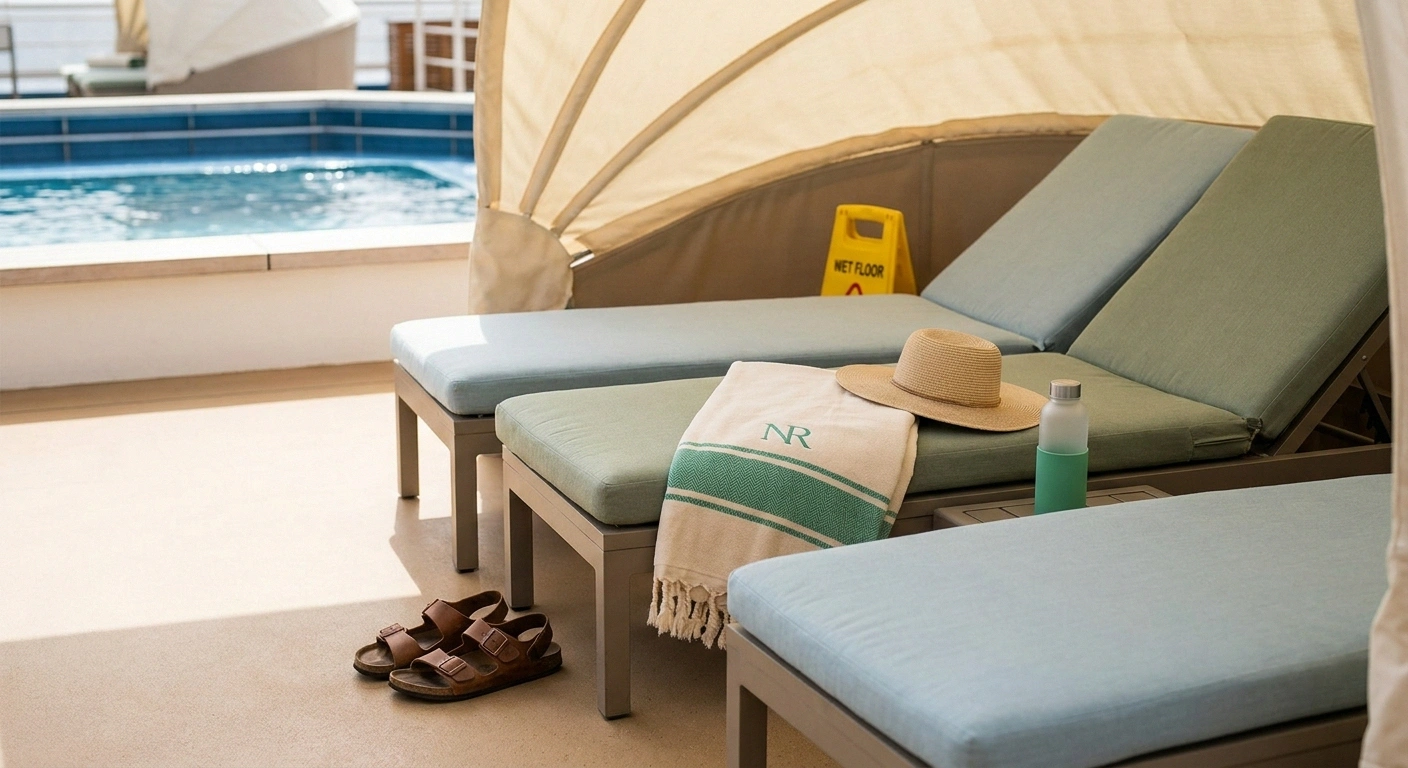
Pool-deck reality check. A wet pool deck plus numb feet is a fall risk. Use the deck chairs farther from the pool, walk in your backstrap sandals not barefoot, and don't sit so long in direct sun that you don't realize you're overheating.
Motion Sickness and Sea Legs
Even calm seas have some motion, and the first day or two can feel a bit off-balance even for experienced cruisers. For people with autonomic neuropathy or balance issues, this is a bigger deal.
Strategies that help:
- Midship-low cabin (covered above).
- Watch the horizon when standing on deck — it grounds your eyes and reduces motion sickness.
- Ginger, in chewable form or candied, helps many people. Not a drug interaction concern for most.
- Over-the-counter Bonine or Dramamine work for prevention but cause drowsiness. Take the first dose before boarding.
- Scopolamine patches (prescription, behind the ear) are very effective and lasted me well, but they're anticholinergic and can interact with several common medications — confusion, dry mouth, urinary retention. Discuss with your doctor before the trip if you've never used one.
- Use handrails everywhere. Ship corridors all have them for a reason. The motion is most noticeable when you stop and start walking.
The Medical Center: Knowing What's Available
Every major cruise ship has a medical center staffed by one or more doctors and nurses. It's a small clinic, not a hospital. It's well-equipped for common problems — falls, mild infections, gastroenteritis, medication refills for short-term needs — but anything serious means a port-side hospital or evacuation.
Three things worth knowing:
- The medical center is expensive. It usually doesn't accept insurance directly — you pay at the time of visit and submit for reimbursement when you get home. Charges can run several hundred dollars for an office visit, more for tests.
- For nerve-pain medications, bring your own supply. The ship may not stock your specific drug, and a “we'll prescribe something similar” answer is not what you want.
- Travel insurance with medical evacuation is the real safety net. A medical evacuation from a remote port can cost $50,000 to $150,000 without it.
Consider a River Cruise If Mobility Is the Bigger Concern
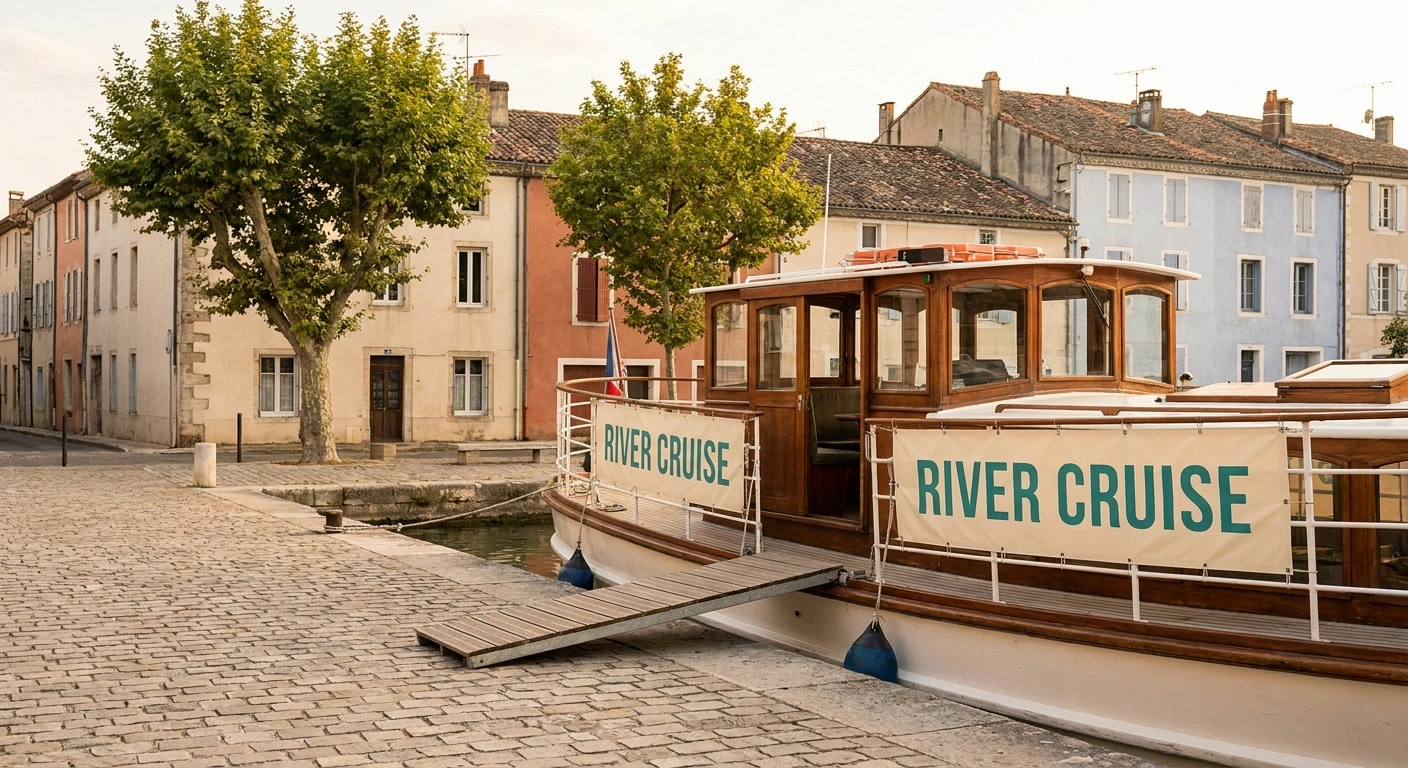
If you've ruled out cruising because the ships felt too big, the buffets too crowded, or the shore excursions too demanding, river cruises are worth a look. River boats hold a few hundred passengers instead of a few thousand. Embarkation is usually a single stretch of dock rather than a long terminal. Most ports tie up right in the center of historic towns, so you walk off the ship and into the destination — no tendering, no long bus rides. The pace is slower, the crowds are smaller, and the average passenger age skews older.
The trade-off: river ships are usually older European designs that weren't built for accessibility. Few have true ADA cabins or elevators that go to every deck. Ask specifically about your needs before booking — some newer ships are much better than others.
What I'd Tell a Friend Booking Her First Post-Diagnosis Cruise
If a friend called and asked me how to plan her first cruise with neuropathy, I'd say:
- Pick a 5–7 day Caribbean cruise on a major line for the first one. Short enough to test the waters, warm enough that footwear is simple, calm enough that motion isn't a big concern. Holland America, Princess, Royal Caribbean, NCL, and Celebrity all have accessible-travel departments and decent ADA cabins.
- Book midship, lower deck, accessible cabin if possible. Six to twelve months out, the choices are wide; closer in, you take what's left.
- Call the cruise line's accessibility department within two weeks of booking and again two weeks before sailing.
- Buy travel insurance with medical evacuation. Same week you book the cruise.
- Pre-research the ports. Note which require tendering, which have a level walking area near the pier, and what easy-tier excursions exist.
- Pack the neuropathy-specific kit above. Then leave the dressy shoes at home — comfortable always wins on a ship.
- Plan one rest day in the middle. Stay on the ship while everyone else is off; it's blissful.
- Eat thoughtfully. Buffets are heavy on salt and easy to overeat at. The dining room is calmer and lets you sit down. Watch for puffy ankles — that's our piece on balance and falls staring you in the face.
If everything goes well, you'll be calling me from a deck chair with a book in your lap, asking why you didn't try this years ago. That's how it went for me.
Frequently Asked Questions
Is a cruise a good vacation choice with neuropathy?
For many people, yes — possibly the best vacation choice. You unpack once, your hotel travels with you, and you can take rest days without losing the trip. The trade-offs are long ship corridors, occasional motion, and tender-port logistics. With smart cabin selection and modest planning, those are manageable for most people with peripheral neuropathy.
What's the best cruise cabin location for someone with balance issues?
Midship on a lower deck. The ship moves least in this location. Stay close to an elevator if walking distance is a concern. Booking an accessible (ADA) cabin gives you a roll-in shower with a fold-down bench, wider doorways, and grab bars — useful even if you don't normally use a wheelchair.
How do I get help boarding the ship with bags?
Every major cruise line offers pier-side wheelchair assistance at embarkation and disembarkation. You don't need to use a wheelchair every day to request it. Call the cruise line's access services department two to four weeks before sailing and ask them to arrange it. Day one of a cruise is the hardest day; save your feet.
What is tendering and why does it matter?
Tendering is when the ship anchors offshore and ferries passengers to land in small boats. The transfer involves stepping from one moving vessel to another and the small boat itself can be choppy. For people with balance issues, foot numbness, or motion sensitivity, tendering is the hardest part of cruising. Some lines restrict tender access for guests using wheelchairs at certain ports. Check which ports on your itinerary tender vs. dock before booking.
Should I pack my neuropathy medications in my checked luggage or carry-on?
Always carry-on. If checked bags are lost or delayed, you don't want to be without your daily medication. Pack at least two weeks more than the trip length, keep pills in their original prescription bottles, and bring a printed list of every medication with doses. A copy of the prescriptions and a doctor's letter help at customs.
What about motion sickness?
Many people with neuropathy do fine, especially in calmer waters. Helpful tools include a midship-low cabin, ginger candy, over-the-counter Bonine or Dramamine started before boarding, and prescription scopolamine patches behind the ear. Scopolamine is very effective but is anticholinergic — discuss with your doctor first if you're on any medications, as it can interact with several common drugs and cause confusion or urinary retention.
Do I need travel insurance?
For any international cruise, travel insurance with medical evacuation coverage is essentially required. The ship's medical center is a small clinic, not a hospital, and anything serious means a port-side hospital or evacuation that can cost $50,000 to $150,000 without insurance. Even for domestic cruises, the cancellation protection alone often pays for itself the one time a flare-up forces a change.
Is a river cruise better than an ocean cruise for someone with neuropathy?
Often yes, with caveats. River cruises have smaller crowds, slower pacing, and no tendering — most dock right in the center of historic towns. The trade-off is that river ships, especially older European ones, often lack true accessible cabins and elevators to every deck. Ask the line specifically about your needs before booking. Newer river ships have better accessibility than older ones.
About the Author