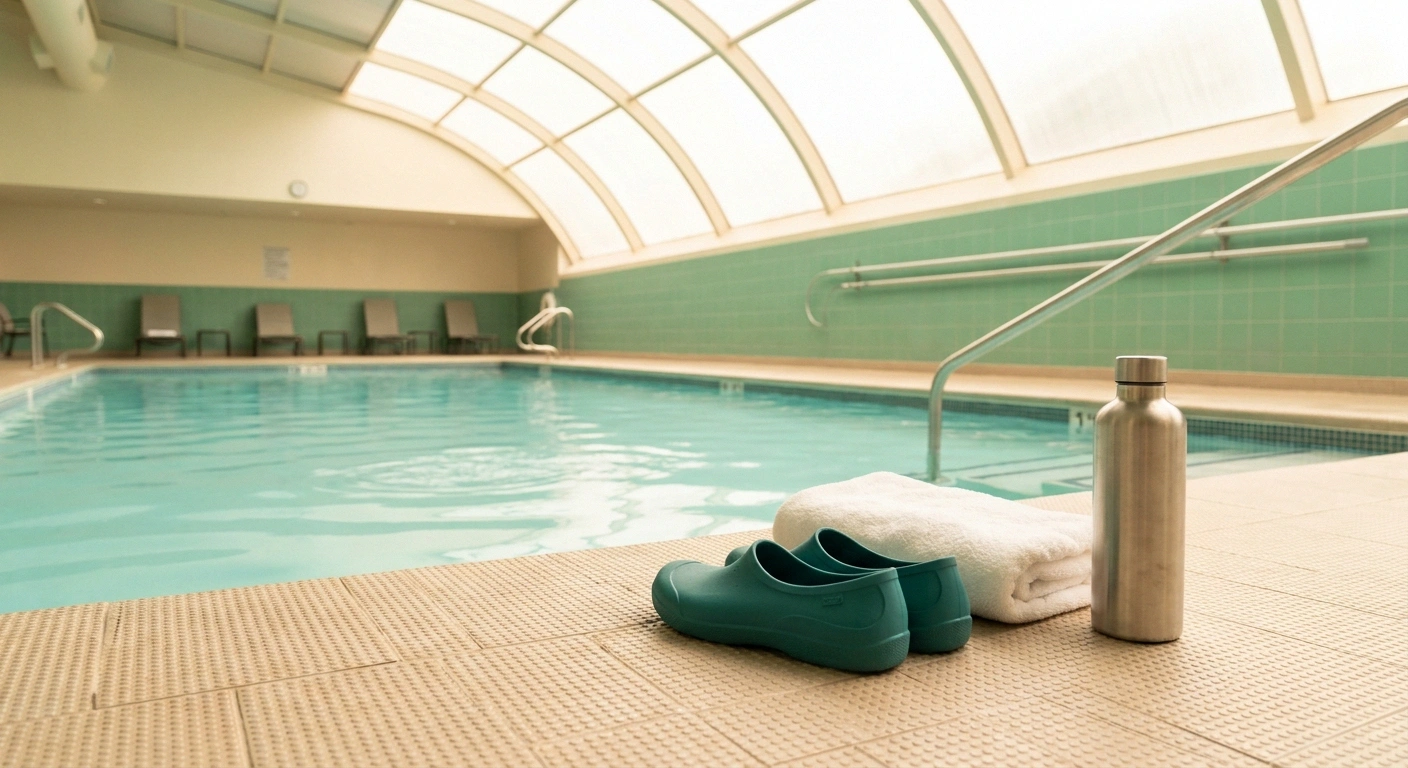
The first time my friend Margaret took her grandkids to the community pool after her neuropathy diagnosis, she did everything right — picked a quiet afternoon, sat near the steps, kept her water bottle full. What she didn't think about was the walk from the locker room to the deck. Five steps in, she hit a wet patch in flip-flops, her right foot didn't tell her brain she was sliding until it was already happening, and she went down hard. Bruised hip, a small cut she didn't notice until that evening, and an infection a few days later that needed antibiotics.
That story is why I write articles like this one. The pool is one of the best places in the world for people with neuropathy — buoyancy takes the load off our feet, the resistance of the water is gentle on our joints, and a good swim leaves us feeling more like ourselves than almost anything else we can do. But the pool deck, the locker room, and the shower stalls between them are some of the most hazardous floors you'll cross in any given week. Wet tile, chlorine puddles, slick benches, hot water you can't feel, and warm damp surfaces crawling with fungus — it's a small obstacle course, and your feet are the part of you least equipped to navigate it.
The good news: with a small amount of planning, the pool stays in your life. You just need a system. Let's build one together.
Why Pool Decks and Locker Rooms Are So Risky With Neuropathy
Most fall-prevention advice for neuropathy focuses on the home — the bathroom, the stairs, the rugs you should pick up. The pool environment combines almost every hazard at once, in a place you don't control.
Key Takeaway
The pool environment combines three risks at once: slippery wet floors your numb feet can't feel slipping on, hot water that can burn skin you won't notice, and warm damp floors crawling with fungus. A few targeted habits — water shoes, foot inspections, a shuffle gait, and wrist-checked water temperature — handle all three.
Tile floors are smooth by design, which is fine when they're dry. Add a thin film of chlorinated water, sunscreen, and shower runoff, and the friction drops dramatically. If your feet still gave you good sensory feedback, you'd feel the slip the instant it started and adjust. With neuropathy, that feedback is delayed or missing entirely. By the time your brain registers a problem, your hip is already on the way down.
The second category of risk is invisible: temperature. Public showers, whirlpools, and hot tubs are often hotter than what your skin can safely tolerate, and a numb foot is a terrible thermometer. Plenty of neuropathy patients have stepped into a foot bath or shower stall, found it pleasant, and walked out with a serious thermal burn they only noticed an hour later when the skin started to blister.
The third category is microbial. Pool decks and locker room floors are warm, damp, and walked on by hundreds of strangers a week. Athlete's foot fungus, plantar warts (caused by HPV), and various bacteria thrive in exactly those conditions. A small unnoticed cut between your toes — picked up from a sharp edge on the deck — is an open door for an infection that can turn serious quickly in people with diabetes or compromised circulation.
None of this is meant to scare you off. It's meant to give you a clear picture of what you're walking into, so the plan we build actually solves the right problems.
Your Feet — The Most Important Gear at the Pool
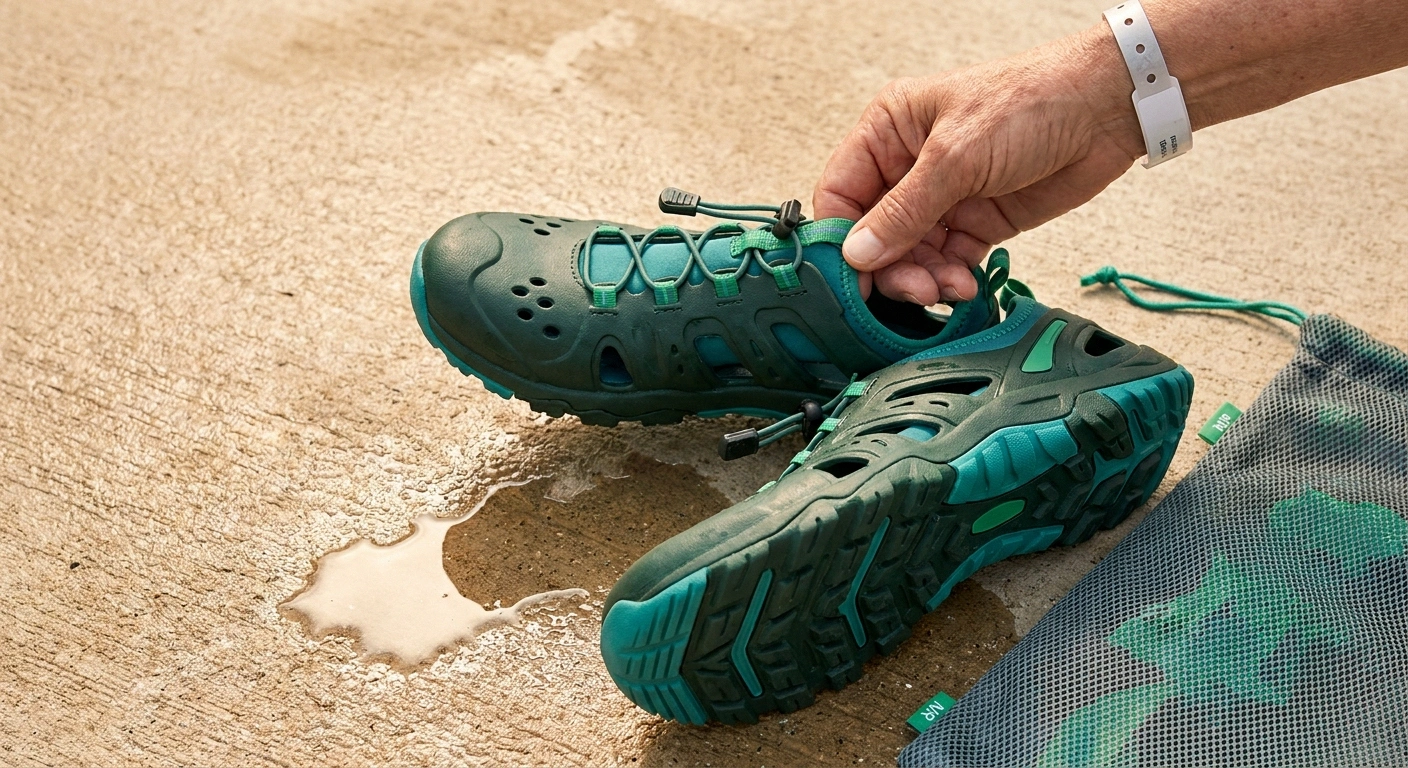
If you remember nothing else from this article, remember this: do not walk barefoot in a public pool area. Not from the locker room to the deck. Not from the deck to the shower. Not anywhere.
Roughly the cheapest fall-prevention insurance you'll buy this summer. Closed toe, aggressive rubber tread, drainage holes, snug fit. Required equipment — like a seatbelt.
The right footwear for the pool environment is what most people call water shoes or aqua shoes — closed-toe rubber or neoprene shoes designed to be worn wet. The features that matter:
- Closed toe and heel. Flip-flops and slides leave your toes exposed to stubbed corners, dropped objects, and fungal contact. Closed-toe water shoes protect every surface of your foot.
- Aggressive rubber tread. The sole should have deep, multi-directional grooves designed to channel water away from the contact surface. Smooth-bottom pool shoes are dangerous on wet tile.
- Drainage holes. Good water shoes drain quickly so water doesn't pool inside and macerate your skin.
- Snug but not tight fit. A loose water shoe shifts on a wet foot, which can throw your balance. Choose a fit you'd describe as “secure.”
- Easy on, easy off. If your hands also have neuropathy, look for elastic laces or pull tabs rather than tie-up laces or buckles.
I keep a dedicated pair of water shoes in a mesh bag inside my pool bag. They never go anywhere else, so I'm not tracking gym germs into the pool or vice versa. A decent pair runs $15 to $30 — call it the cheapest fall-prevention insurance you'll buy this summer.
One more note: the closed-toe rule applies to your regular footwear choices too. The “open-toe sandals for summer” instinct is the opposite of what your feet need.
Inspecting Your Feet — Once Before, Once After
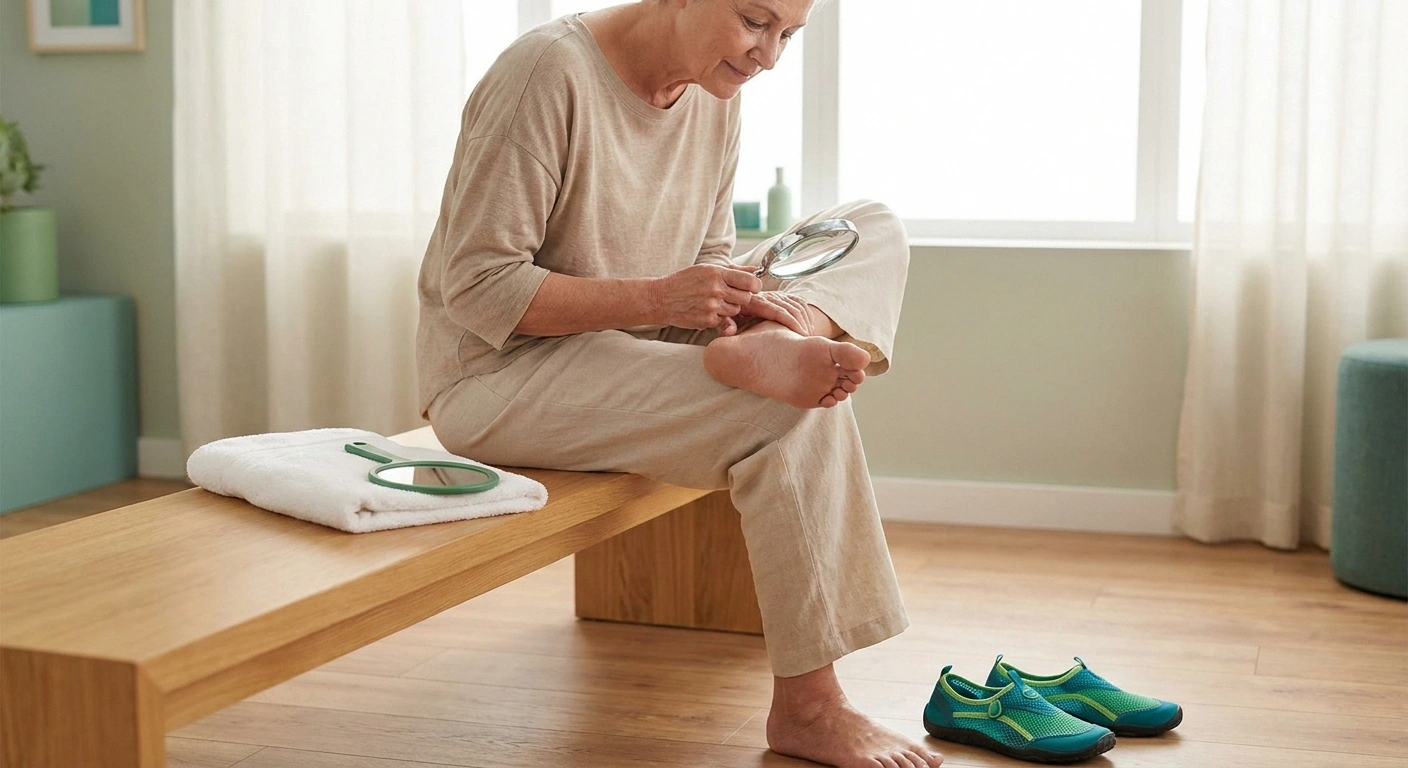
Every pool day should include two foot checks. The whole routine takes about ninety seconds total, and it's the single highest-leverage habit you can build.
Skip the Pool If You Have an Open Wound
Pool chlorine does not sterilize broken skin — it irritates it, and the bacteria still present in chlorinated water (especially community pools) can settle into even a tiny cut. With diabetic or neuropathy-related circulation issues, a minor infection can escalate fast. Cover wounds with waterproof tape or skip the day.
Before you leave the house, take your shoes off, sit somewhere with good light, and look at the bottoms of your feet, between every toe, and around the heels. You're checking for anything you didn't know was there: a small cut, a blister starting, a fungal patch, a hangnail that's gone red. If you find an open break in the skin — even a tiny one — that's a sign to either cover it carefully with waterproof tape and a clean sock under your water shoes, or to consider skipping the pool today. Chlorinated water carries bacteria deep into any opening it finds.
After you swim, before you put your regular shoes on, do the same inspection. You're looking for new cuts you didn't feel (decks have grit and rough edges), pruney skin that's starting to crack, or anything caught between toes. Dry every surface — especially between the toes — with a clean towel before putting socks back on. Fungal infections love a damp environment, and your between-toe spaces will be the dampest part of your body for the next thirty minutes if you don't actively dry them.
If your eyes or your back make it hard to inspect your own feet, a small handheld mirror with a long handle costs about $10 and changes the game. Some people also use their phone camera — open the camera app, point it at the bottom of your foot, and you've got a magnified view you can zoom in on.
Wet Floors, Slick Tile, and the Walk Between the Locker Room and the Deck
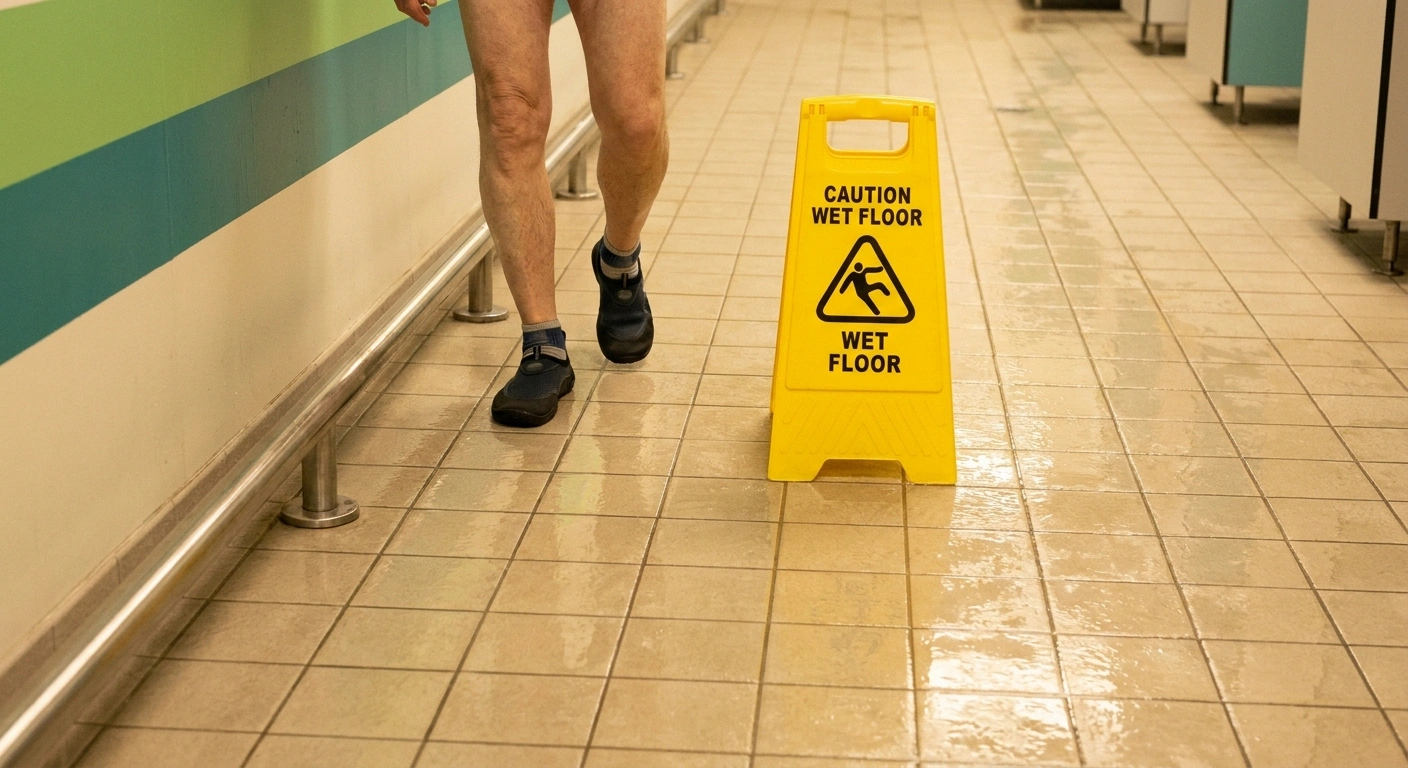
The single most dangerous part of a pool visit is the transition zones — the spots where you're walking on wet tile and your weight is shifting fast. The locker room, the shower stall floor, the doorway from the locker room to the deck, and the edge of the pool itself are where falls happen.
The Wet-Floor Walk: 6 Habits That Prevent Falls
Short deliberate steps. Slide forward, place flat.
Visible water hazards need an active path change.
Doorways, corners, dry-to-wet edges shift friction.
One-foot balancing on wet floor = fall coming.
Backpack or shoulder bag. Catch yourself if you slip.
A few habits that have saved Margaret since her fall, and that I follow every time:
- Walk like you're carrying a full coffee mug. Short, deliberate steps. Don't lift your foot high — slide it forward and place it flat. The “shuffle” gait gives you better contact with the floor and a much shorter fall distance if you do slip.
- Use the handrails. If there's a rail along the wall, hold it. Pride costs falls. If your locker room doesn't have rails, ask the facility — most will install grab bars in priority areas when patrons request them.
- Avoid the puddles you can see. Sounds obvious. With neuropathy and slightly reduced peripheral vision (common at our age), it's easy to walk straight through a puddle you registered visually but didn't process as a hazard. Train yourself to make the small detour.
- Slow down in the doorway and at corners. The transitions between dry carpet, wet tile, and the deck itself are where the friction changes most. Your gait should change with it.
- Sit down to change shoes. Standing on one foot to swap from water shoes to street shoes — on a wet floor — is a fall waiting to happen. Find a bench. If there isn't one, sit on the edge of the pool ladder or the locker room floor.
- Don't carry too much. Both hands occupied means you can't catch yourself. Use a backpack or a shoulder bag so your hands are free.
When the pool deck is crowded with kids running and splashing, give yourself even more margin. Wait an extra moment before crossing. Pick a path along the edges where the foot traffic is lighter. It's not glamorous, but neither is a hip fracture.
Hot Showers, Hot Tubs, and the Burn You'll Never Feel
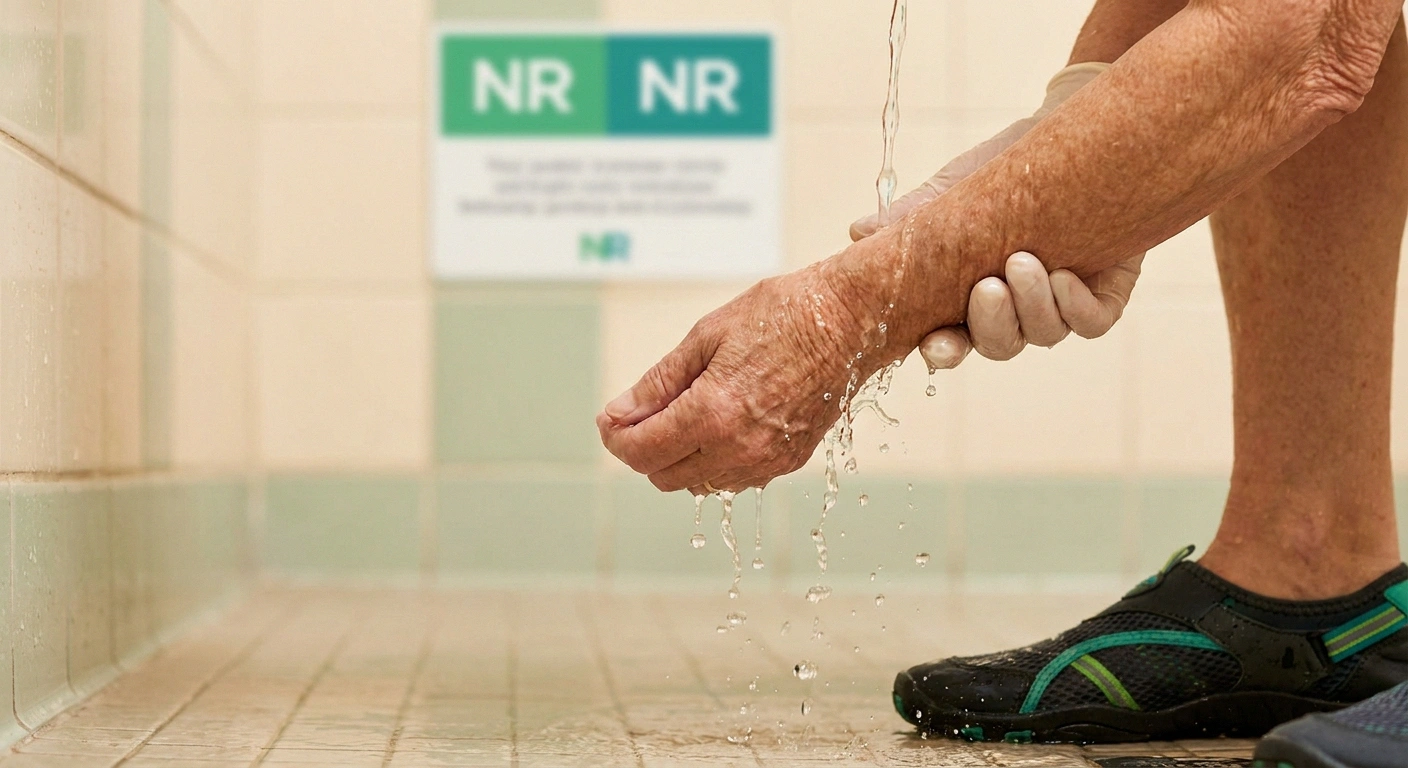
Public pool facilities almost always have showers — sometimes a few hot-water shower stalls, sometimes a single cold rinse next to the pool — and many have a hot tub or whirlpool. All three need a different approach when your feet can't reliably feel temperature.
Why Wrist-Testing Works When Foot-Testing Doesn't
Most peripheral neuropathy is length-dependent — it damages the longest nerves first and most severely, so the nerves running to your feet are usually impaired well before the nerves to your wrists and forearms. That's why the inside of your wrist remains a reliable thermometer when your soles can no longer tell you the water is dangerously hot. Use it consistently — even on days your feet feel “okay.”
For showers: never test the temperature with your foot. Use the back of your wrist, the inside of your forearm, or your elbow — places that still have reliable temperature sensation. Run the water until it feels comfortably warm on the inside of your wrist, and only then step in. If the shower has a single mixing knob with no temperature indicator, ask a staff member how hot the system runs at maximum. Many facilities have hot water hot enough to scald.
For hot tubs and whirlpools: this is one I take seriously. American hot tubs are typically set at 100–104°F (38–40°C), which sounds reasonable but is hotter than your body's core temperature and can cause serious problems for people with neuropathy and people with diabetes. The risks: burns on the soles and lower legs that you don't feel, dangerously low blood pressure (especially if you're on blood pressure medication or have autonomic neuropathy), and the fact that getting out of a hot tub with neuropathic legs is much harder than getting in.
If you want to use the hot tub, my suggestion: check with your doctor first, limit yourself to ten minutes, keep the water at the lower end of the temperature range if you can control it, and have someone watch the clock for you. Get out slowly, sit on the edge for a minute before standing fully, and check your feet and lower legs visually as soon as you're out. If the skin looks bright red anywhere — that's a thermal burn warning sign, even if it doesn't hurt.
The general rule for water and your feet with neuropathy is the same here as it is at home: temperature is something you measure with your sense of touch in your hands and arms, never with your feet.
Your Pre-Pool, At-Pool, and Post-Pool Plan
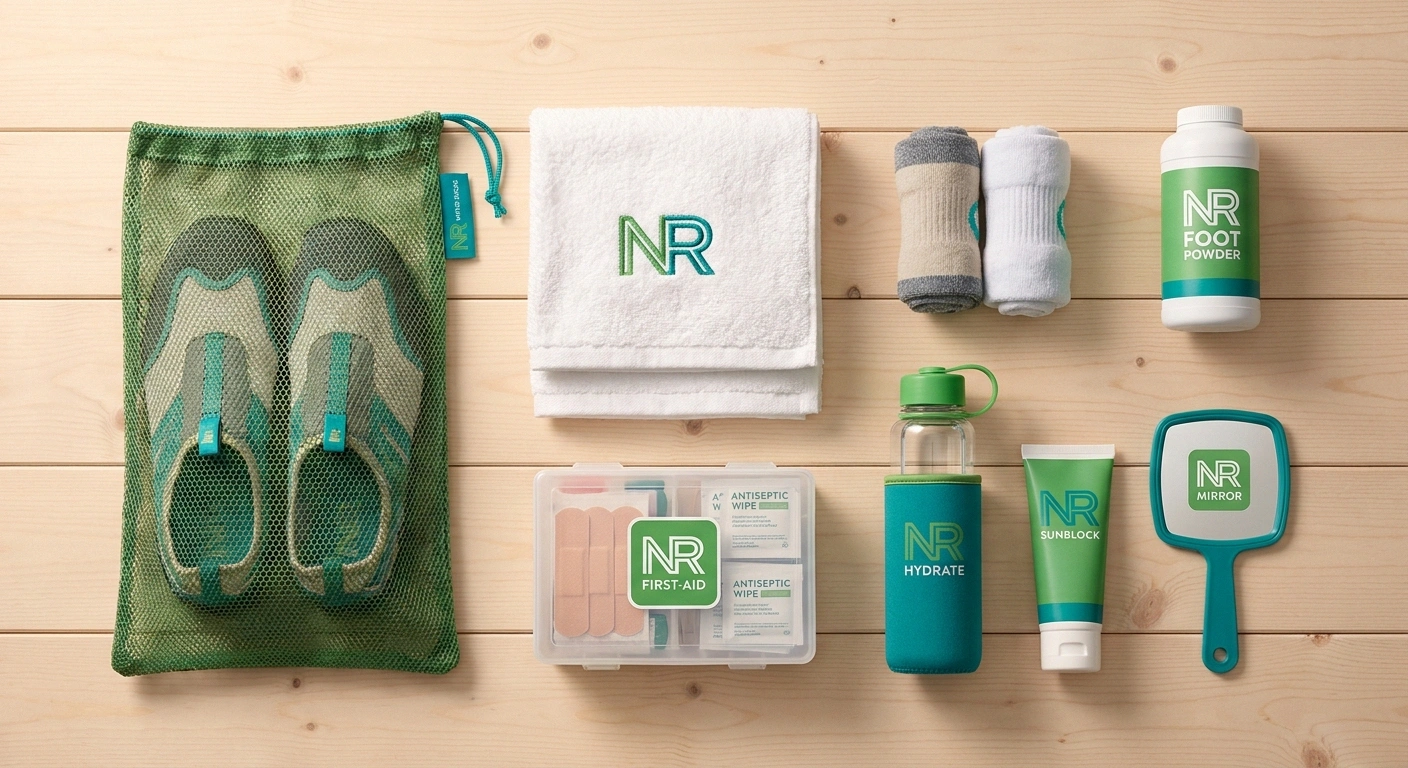
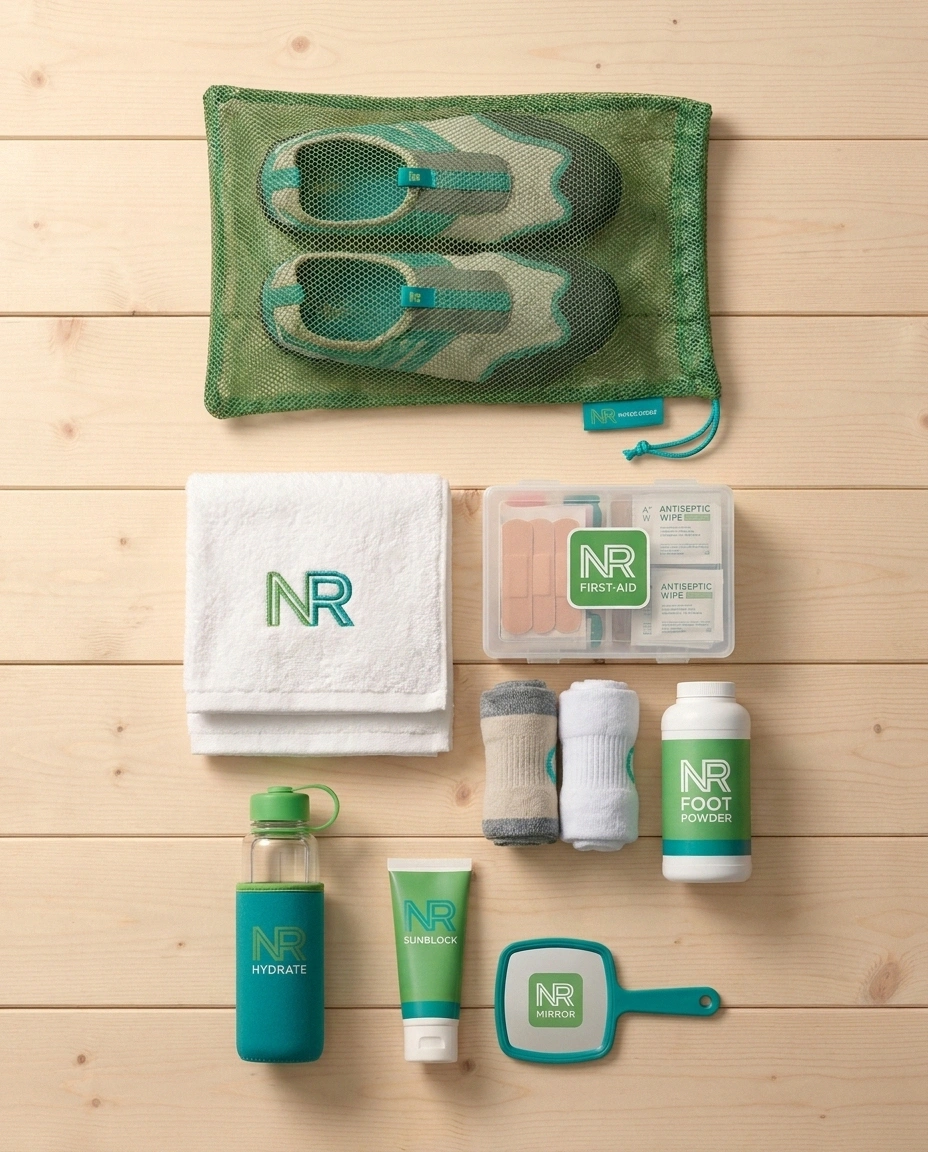
Here's the system Margaret and I both use now. The whole thing adds maybe ten minutes to a pool visit and prevents the things that go wrong.
The 90-Second Pool Day Cost
The whole system adds about ten minutes to a pool visit and prevents the things that go wrong. Two ninety-second foot inspections, water shoes on at the locker (not the deck), wrist-tested water, and a bench for changing — that's the whole protocol. The goal isn't to make pool day a chore. It's to keep pool day in your life for years.
The night before:
- Charge your phone and put it in your pool bag.
- Pack: water shoes in a mesh bag, two towels (one for body, one for feet), a clean pair of dry socks, your usual foot powder if you use one, a small first-aid kit (bandages, antiseptic wipes), a refillable water bottle.
- If you take heart, blood pressure, or blood sugar medication, plan your dose timing so you're not at peak effect during the swim. (Don't change your dosing on your own — ask your prescriber when the right window is for activity.)
Pool day morning:
- Do your foot inspection. Treat anything you find before you leave.
- Eat something. Swimming on an empty stomach is harder on your blood sugar than you'd think, especially if you have diabetes.
- Tell someone where you're going and roughly when you'll be back.
At the pool:
- Water shoes on the moment you take off your street shoes. They go on at the locker, not at the deck.
- Shuffle gait everywhere — locker room, shower, deck.
- Sit down to change clothes and shoes.
- Get in and out of the pool using the steps and the handrail, not by sitting on the edge and pushing off. Edge entries are how people slip.
- If you're going in deeper than your usual comfort level, swim near the lane line or the wall where you can grab support quickly.
- Hydrate. Pool air dehydrates you faster than you'd expect.
After the swim:
- Find a bench in the locker room before changing.
- Use a clean towel to dry every surface of your foot, especially between the toes.
- Second foot inspection. Anything new? Cover it now with antiseptic and a clean bandage.
- Dry socks before street shoes.
- Walk out at your normal pace, not the post-swim “I just want to get to the car” rush.
When to Skip the Pool — and Why That's the Brave Choice
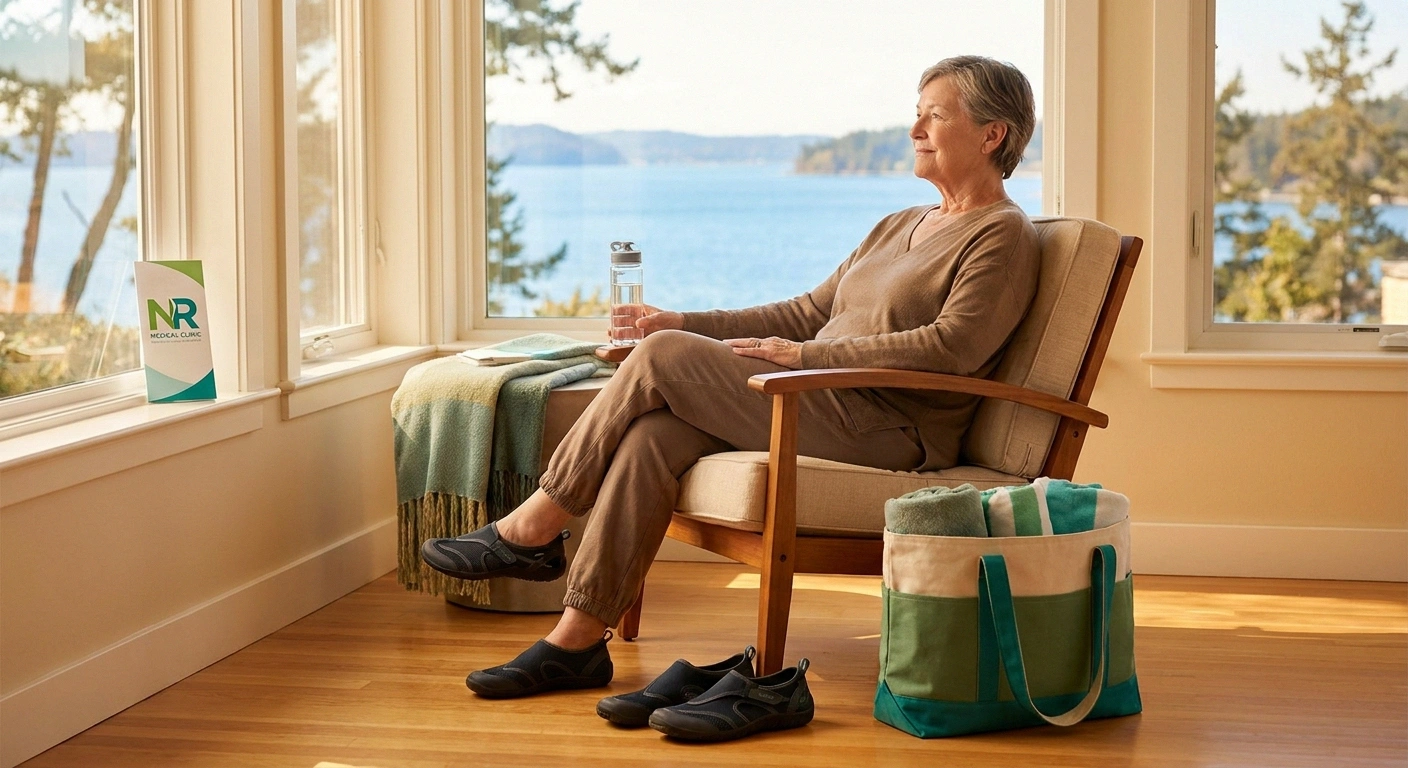
There are days the pool is not the right call. Knowing when to skip is just as important as knowing how to go.
Five “Skip the Pool” Signals
- Any open wound on feet or legs that hasn't fully healed
- A fall in the last few days — even a minor one
- Unstable blood sugar or a new medication started this week
- A sudden change in your neuropathy symptoms in the last few days
- Lightheadedness, weakness, or unusual fatigue before you even arrive
Skipping is not giving up. It's how the pool stays in your life for years.
Skip the pool if you have an open wound anywhere on your feet or legs that hasn't fully healed. Chlorine doesn't sanitize broken skin — it irritates it, and the bacteria in pool water (yes, there are still bacteria in chlorinated water, especially community pools) can settle in.
Skip if you've had a fall in the last few days, even a minor one. Your body is still adjusting and your balance is shakier than usual. Give yourself a week to recover before adding the wet-floor challenge.
Skip if your blood sugar has been unstable, if you're starting a new medication, or if you've had a major change in your neuropathy symptoms in the last few days. A normal Tuesday is a different physiological state than a recovery Tuesday.
Skip if you're feeling lightheaded, weak, or unusually tired before you even get there. Pool environments are physically demanding — heat, exertion, fluid shifts — and the deck doesn't get easier when you're at half strength.
Choosing not to go is not giving up. It's the same kind of self-awareness that lets us keep doing the things we love over years and decades instead of pushing through one bad day into a fall that takes us out for months. Margaret still swims twice a week. She also skips two or three days a month because the morning didn't feel right. Both choices come from the same place — wanting to be in that water for years to come.
The pool deck and locker room don't have to be the place neuropathy steals from you. With water shoes, a shuffle gait, two foot checks, and a healthy respect for temperature, they're just rooms you walk through to get to one of the best things you can do for a body with damaged nerves. Plan the small stuff, and the big things — swimming laps with your grandkids, floating on your back and feeling weightless, the deep tired-good feeling after a swim — those come back to you.
Frequently Asked Questions
Are flip-flops or shower sandals enough at the pool, or do I really need closed-toe water shoes?
Flip-flops and slides do almost nothing for neuropathy safety at the pool. They don't grip wet tile reliably, they leave your toes exposed to stubbed corners and dropped objects, and they don't protect you from fungal or bacterial contact with public floor surfaces. Closed-toe water shoes with aggressive rubber tread are the safer choice and they're inexpensive — usually $15 to $30. Treat them as required equipment, like a seatbelt.
Is the pool's chlorine safe if I have small cuts on my feet?
It's not as protective as people think. Pool chlorine is set at levels to control most bacteria in the water, but it doesn't sterilize broken skin, and high chlorine levels can actually irritate small cuts and slow healing. If you have an open wound, even a tiny one, either cover it with waterproof tape under a clean sock and water shoe, or skip the pool day. For wounds that are red, warm, or weeping, see your provider before swimming — that's a possible infection brewing.
Can I use a hot tub if I have neuropathy?
This is one to discuss with your doctor before assuming yes. Hot tubs raise three real concerns for people with neuropathy: thermal burns on numb skin you don't feel, blood pressure drops that can cause fainting (especially if you have autonomic neuropathy or take blood pressure medication), and difficulty getting out of the tub safely once you're warm and your legs are weaker than usual. If your doctor okays it, keep sessions short (under ten minutes), check the water temperature first with the back of your wrist (not your foot), and have someone with you who can help if you need it.
What's the best way to check water temperature in a public shower if my feet are numb?
Use the back of your wrist, the inside of your forearm, or your elbow. These spots still have reliable temperature sensation in most neuropathy patients because the nerve damage is “length-dependent” — it affects the longest nerves (the ones running to your feet) first and most severely. Let the water run on your wrist for ten seconds; if it feels comfortably warm there, it's safe for the rest of your body. Never check shower temperature with your foot.
How do I avoid athlete's foot from the locker room?
Three habits handle it. First, never walk barefoot — water shoes on from locker to shower to deck and back. Second, dry every surface of your foot when you're done, especially between the toes, with a clean towel. Fungus needs damp environments to take hold; dry feet are inhospitable. Third, switch to dry socks before street shoes, and consider an antifungal powder if you're prone to fungal infections (your provider can recommend one). If you do develop athlete's foot — itchy, peeling, sometimes red skin between toes — treat it immediately with an over-the-counter antifungal cream; in neuropathy, untreated fungal infections can crack the skin and let in worse bacteria.
What if I fall on the pool deck — how do I handle it?
If you fall, don't rush to get up. Sit still for thirty seconds and assess: any sharp pain, dizziness, or confusion? If yes, signal for help — a lifeguard, a staff member, the person nearest to you. If you feel okay to move, roll onto your hands and knees, crawl to a wall or a sturdy chair, and use it to push yourself up slowly. Have someone check the bottoms of your feet (and your hands, hips, and head if you hit them) for cuts you can't feel. Even a small unnoticed cut on a pool deck warrants antiseptic and a bandage, and any fall that involved hitting your head should get a same-day call to your provider, not a “wait and see.”
Should I swim alone if I have neuropathy?
The honest answer: ideally, no. Even strong swimmers can have an episode in the water — a cramp, a dizzy spell, a sudden weakness — and at our age with nerve damage, the margin gets thinner. A buddy doesn't have to be a swim partner; it can be your spouse reading on the deck, a friend doing laps in the next lane, or even a lifeguard you've made eye contact with and chatted with. Public pools with active lifeguards are the safest place to swim solo. If you're swimming in a private pool, always have someone in the house who knows you're in the water.
How often should I swim with neuropathy?
For most people with stable neuropathy, two to three swim sessions a week of twenty to thirty minutes is a good target. It's enough to get the cardiovascular and joint-mobility benefits without exhausting you. Pay attention to how you feel for 24 hours after each swim — if you're more tingly, more painful, or more fatigued than usual, that's your body asking for a longer recovery between sessions. Like walking, the right amount is the amount you can sustain weekly for years, not the amount you can push through this week.
About the Author