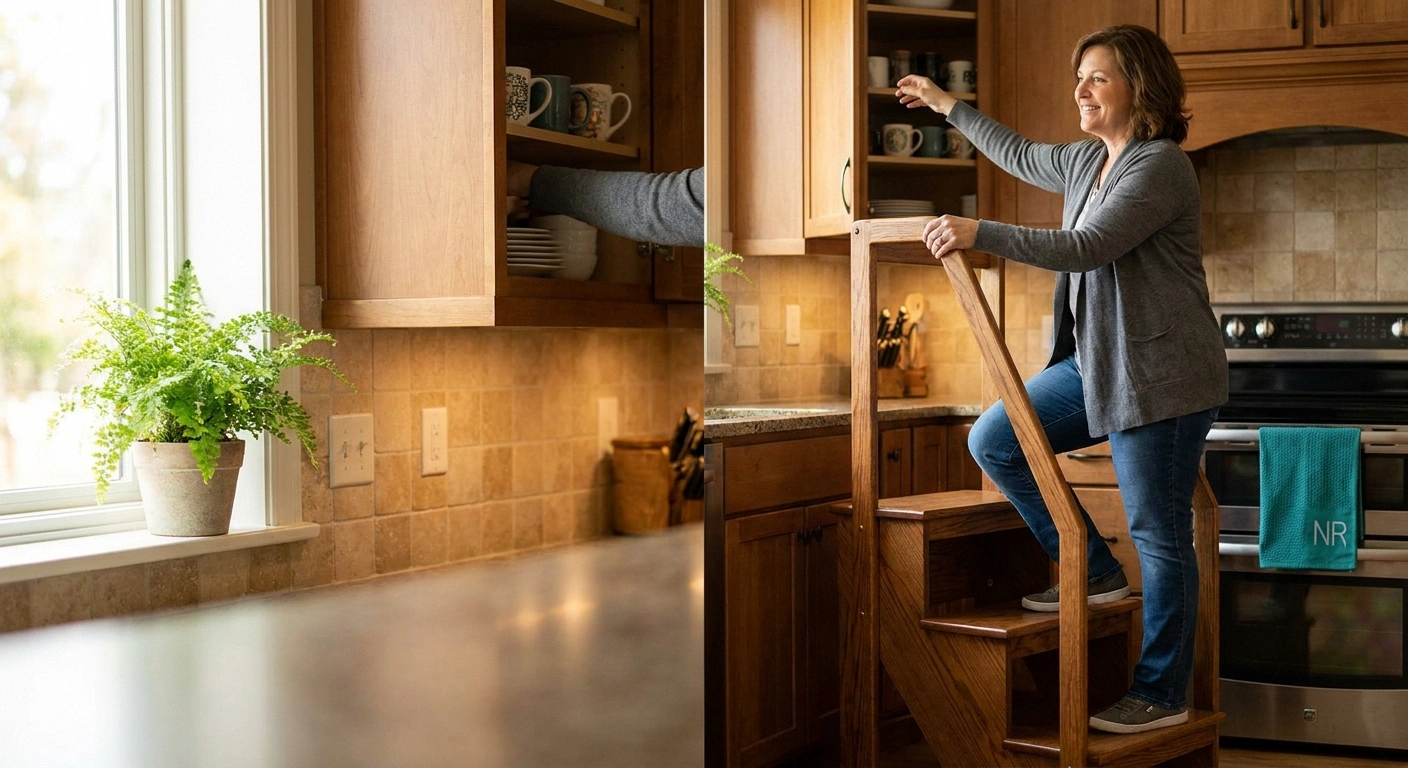
Neuropathy doesn’t mean you have to move to a single-story ranch and never change a light bulb again. It does mean the step stool that sat in the back of your closet for twenty years is no longer a piece of furniture you can trust without a second thought. There’s a real difference between the two, and it’s the difference between deciding you’re helpless and deciding you’re going to be smart about it.
I still change light bulbs. I still reach for the roasting pan I only use at Thanksgiving. I still hang wreaths on the front door in December. What I don’t do anymore is casually step onto a folding kitchen chair in socks to grab something off a top shelf, and I’ll never do that again. This article is about how to keep doing the things you need to do at height without ending up in the emergency room. If you take falls seriously enough to have read our full guide on neuropathy and fall prevention, this piece is the ladder-and-step-stool chapter you didn’t know you needed.
Why Ladders and Step Stools Are Especially Risky With Neuropathy
Ordinary fall-prevention advice treats “climbing on things” as risky for everybody over 60. That’s true. But neuropathy stacks a very specific set of problems on top of that general risk, and understanding them is the whole reason a step stool needs a different set of rules than it used to.
Key Takeaway
Never climb barefoot. Never climb without shoes. Never climb without three points of contact. Everything else in this article builds on those three rules.
First, your feet can’t feel the rung. A rung or step tread on a ladder is often only two to three inches deep, which means the front half of your foot is hanging in space. Healthy feet know exactly where the edge is because pressure sensors in the sole tell the brain constantly. Neuropathic feet don’t. You think you’re centered on the step. You might have most of your foot hanging off the front.
Second, proprioception is unreliable. Proprioception is your body’s internal sense of where your limbs are in space, and it takes a hit with neuropathy in a way that’s especially dangerous a few feet off the ground. Even if your foot did land in a safe spot, your brain can’t confirm it without looking. If you want a deeper dive on this, our article on proprioception loss and neuropathy explains the mechanism.
Third, balance corrections come late. When your body starts to tip on a step stool, healthy nerves fire a correction in milliseconds. Neuropathic nerves fire slowly, sometimes not at all, and by the time your leg gets the message to stabilize, you’re already sideways. Combined with the height, this is the combination that turns a small wobble into a broken hip.
None of this means “never climb.” It means the casual step-onto-a-chair-to-grab-something instinct is no longer safe, and the ladder in the garage needs to be treated like a piece of equipment that can hurt you — because at your current sensation level, it can.
The Non-Negotiables Before You Ever Climb
The Three Non-Negotiables
- Shoes always. Never in socks. Never barefoot. Never in backless slippers.
- Someone knows you’re climbing. Housemate in the next room, spouse home, or a phone call actively in progress.
- Three points of contact. Two feet and one hand, or one foot and two hands. Always.
Before your foot ever leaves the floor, these three things need to be true.
Wear real shoes. Closed-back, snug, with a firm sole and a slip-resistant tread. Our guide on the best shoes for neuropathy covers what to look for in a shoe that grips a step. Backless slippers slide off mid-step, socks slip on smooth rungs, and going barefoot removes the small amount of protection you have if a foot slides sideways. (We wrote a whole article on the barefoot risk in why going barefoot at home is riskier than it feels — the same rules apply to climbing, with the stakes raised.)
Make sure someone knows. Solo climbing is the single most dangerous variable you can control. If someone else is home, tell them what you’re doing before you start. If you live alone, put the phone on speaker with a family member or friend, or wait until a housemate is around. A fall from four feet with no one to help you get up is a genuinely dangerous situation — cold floor, possible fracture, and hours before anyone finds you.
Phone in your pocket. Not on the counter. If you fall and can’t reach the counter, the phone might as well be in the next state. A pocket-clipped phone, or one in a small crossbody bag, stays with you.
Dry floor, dry rungs. Water on the floor makes the ladder slip out from under you. Water on the rung makes your foot slip off. If either surface is wet, wait.
Three points of contact. Two feet plus a hand, or one foot plus both hands, at all times. If the task requires two free hands, the task is too much for a ladder. Put the item in a small tool belt, use a bucket clipped to a hook, or find another way.
How to Pick a Step Stool You Can Actually Trust
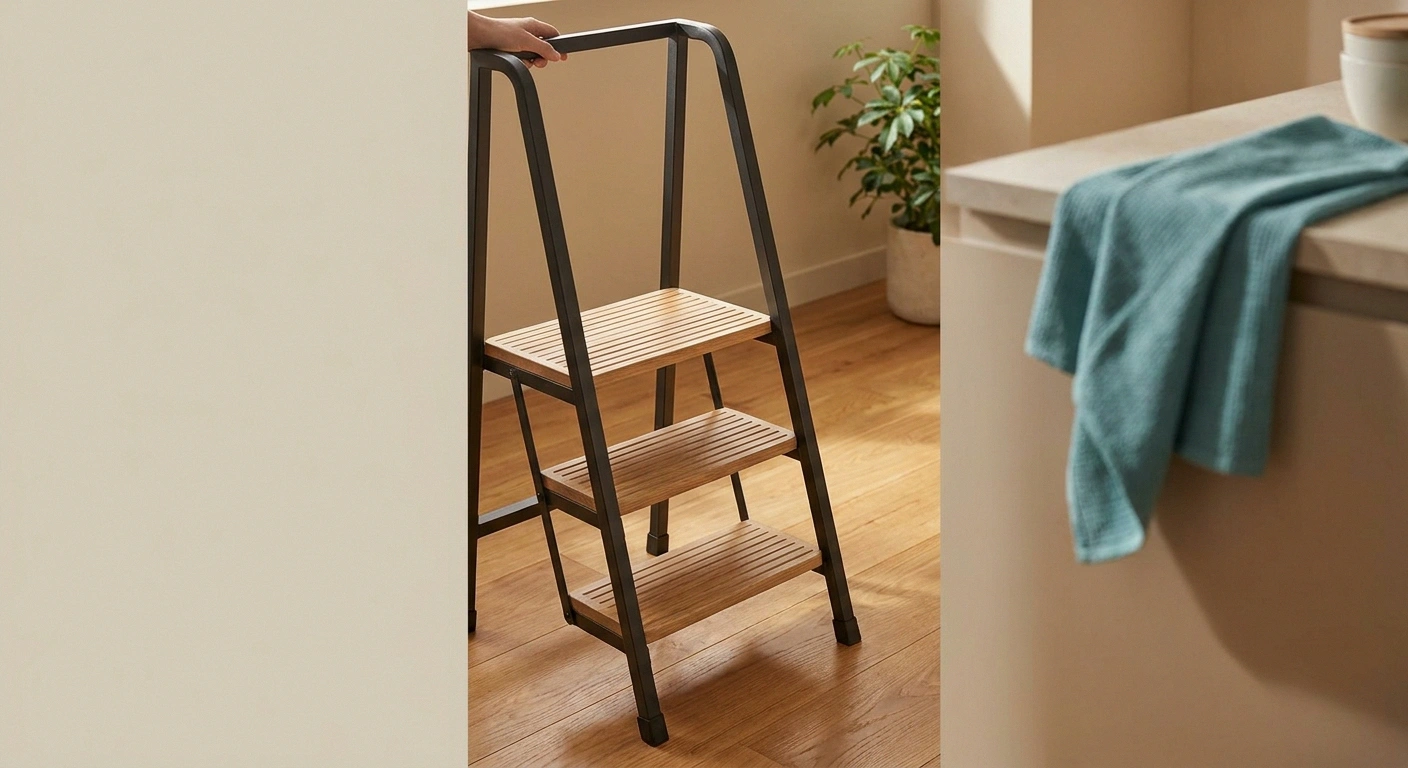
Most of the step stools sold in home stores are designed for people whose feet work. If you have neuropathy, you need to be pickier. Here are the features that actually matter.
Step Stool Features Checklist
Wide steps
At least 6 inches deep so your whole foot lands solid.
Tall handrail
Chest-height when standing on top step. Not just a carry handle.
Non-slip feet
Rubber grip on the floor. Check for wear regularly.
Non-slip treads
Rubber or textured surface on every step.
Weight rating above yours
A 250-lb rated stool for someone under 200. Leave a margin.
3-step sweet spot
Enough for most home tasks. Anything higher is ladder territory.
Wide steps. The tread on each step should be at least six inches deep — ideally more. A wide tread means the whole foot lands on solid surface, not just the ball. Narrow rungs are a nightmare for numb feet because you can’t feel whether you’re centered.
A real handrail, not just a “handle.” Many step stools have a small looped handle at the top, meant for carrying the stool. That’s not what you need. You need a tall handrail that comes up to about waist or chest height when you’re standing on the top step, so you can grip it while you work. If the step stool has a T-bar or U-frame handrail, that’s the design you want.
Non-slip feet. Rubber or textured feet that grip the floor and don’t scoot when you shift your weight. Check them regularly — worn-out rubber loses its grip and needs replacing (or the stool needs replacing).
Non-slip tread on each step. Rubber matting, textured metal, or a molded non-slip pattern. Bare wood or slick painted metal is a bad surface for a foot you can’t fully feel.
Weight capacity well above your body weight. A stool rated for 250 pounds should be used by someone under about 200 pounds — you want a safety margin. And the rating assumes the stool is on a flat, hard floor. On carpet or an uneven surface, the safe capacity drops.
Folding versus fixed. Folding stools are easier to store but have hinges that can develop play over time. Fixed step stools with no moving parts are the most rigid, but you have to have somewhere to keep them. If you go with folding, buy the sturdiest one you can find — the little folding kitchen stools most people own are the ones that fail.
The Three Non-Negotiables
- Shoes always. Never in socks. Never barefoot. Never in backless slippers.
- Someone knows you’re climbing. Housemate, spouse home, or a phone call actively in progress.
- Three points of contact. Two feet and one hand, or one foot and two hands. Always.
The sweet spot for most home tasks: a three-step, fixed or heavy-duty folding step stool with a chest-height handrail and non-slip everything. That’s enough height for most kitchen shelves, most light bulbs, and most closet reaches. For anything higher, you’re moving into ladder territory, and that needs a different conversation.
The Case Against Traditional Ladders (and When You Should Still Use One)
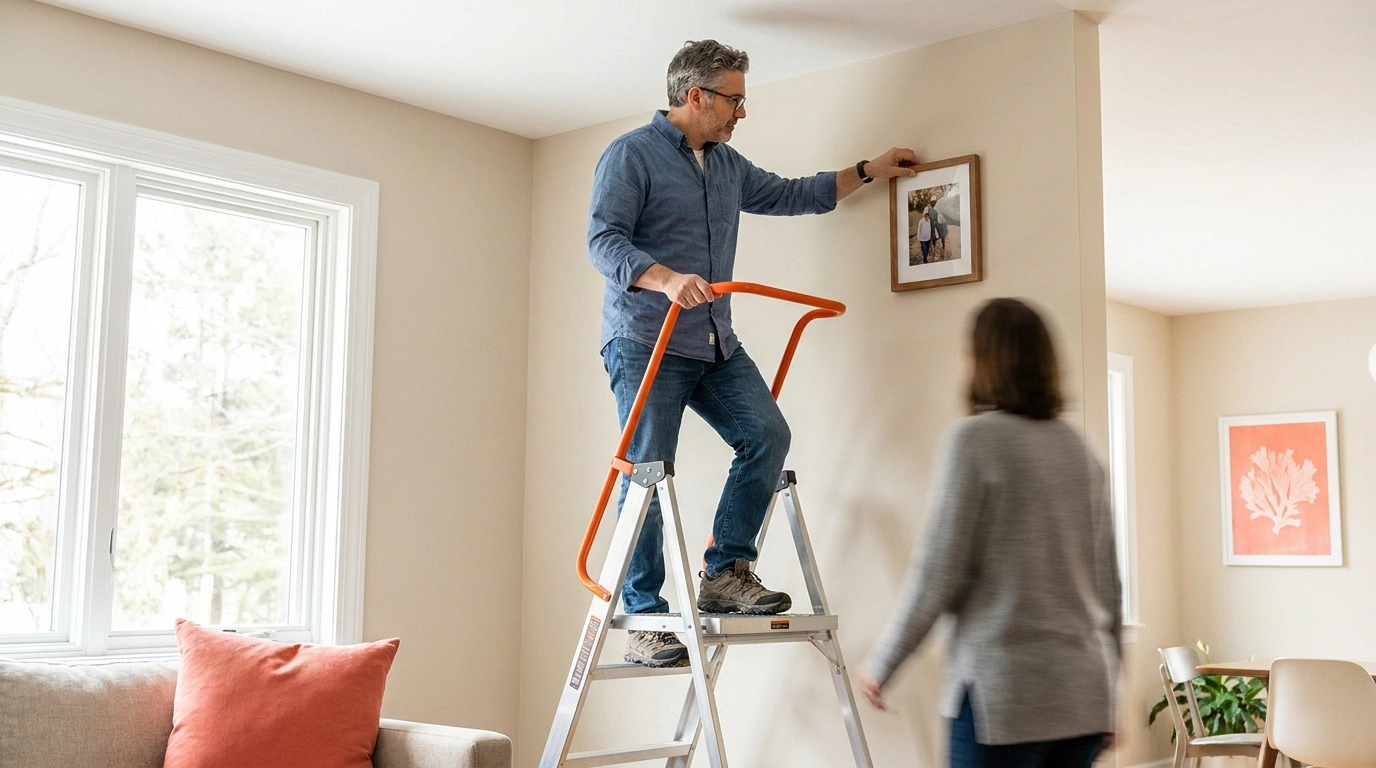
An extension ladder or A-frame ladder is a very different piece of equipment from a step stool. The rungs are narrow (often round metal bars an inch across). There’s no handrail at the top. And the traditional advice — “don’t stand on the top two rungs” — assumes you have the leg strength and the foot feel to work from a lower position. Neuropathy takes both of those away.
For most household tasks that require more height than a step stool, the safer alternative is a platform step ladder: a fold-out ladder where the top step is a wide, flat platform (about a foot square) instead of a rung, usually with a handrail that comes up above the platform. These are what professional painters and electricians increasingly use, and for good reason. You stand on the platform, not on a narrow rung, and you have something to hold that isn’t the wall.
If the task genuinely requires a full extension ladder — think roof gutters, high exterior trim, tall ceilings — the honest answer is usually “hire someone.” A single handyman visit is $50 to $150 in most areas. A hip fracture is $30,000, six weeks of recovery, and often the beginning of a permanent decline in mobility. There is no household chore that math favors doing yourself.
If you absolutely must climb an extension or A-frame ladder, use ladder stabilizers (standoff arms that widen the top of the ladder against a wall) or a tripod ladder designed for uneven ground. And do not climb it alone. Someone stands at the base holding the ladder the entire time.
The 4-Foot Rule and Other Height Limits
Here’s the number I want you to remember: a fall from four feet can still break a hip. Not “might contribute to.” Break. The threshold for a serious fall injury is much lower than most people assume, and it doesn’t require dramatic height.
4 feet
Is Enough To Break A Hip
A fall from four feet can still break a hip. If the task requires more elevation than a three-step step stool, seriously reconsider whether you should be the person doing it.
That means the informal rule I use, and that I encourage every reader with neuropathy to use, is: if the task requires more elevation than a three-step step stool, seriously reconsider whether you should be the person doing it. Above about four feet, the injury math turns against you fast — not because you’re more likely to fall (though you might be), but because the consequences of a fall from that height are dramatically worse than a fall from two feet.
Practical translation:
- One or two steps up (kitchen counter reach, closet shelf): a good step stool with handrail is fine.
- Three steps up (top of tall cabinets, ceiling fan blades): okay with a platform ladder, but this is the upper limit for solo work.
- Higher than that (ceilings, roof edges, gutters, high exterior work): hire it out or ask family.
The reason this rule sounds strict is because it is. Neuropathy is a condition where the consequences of a fall are worse than they would be for someone else your age, and the recovery is longer. A rule that would be overly cautious for someone with fully functional feet is exactly right for someone whose feet can’t confirm they’ve landed safely.
How to Climb Safely When You Do Climb
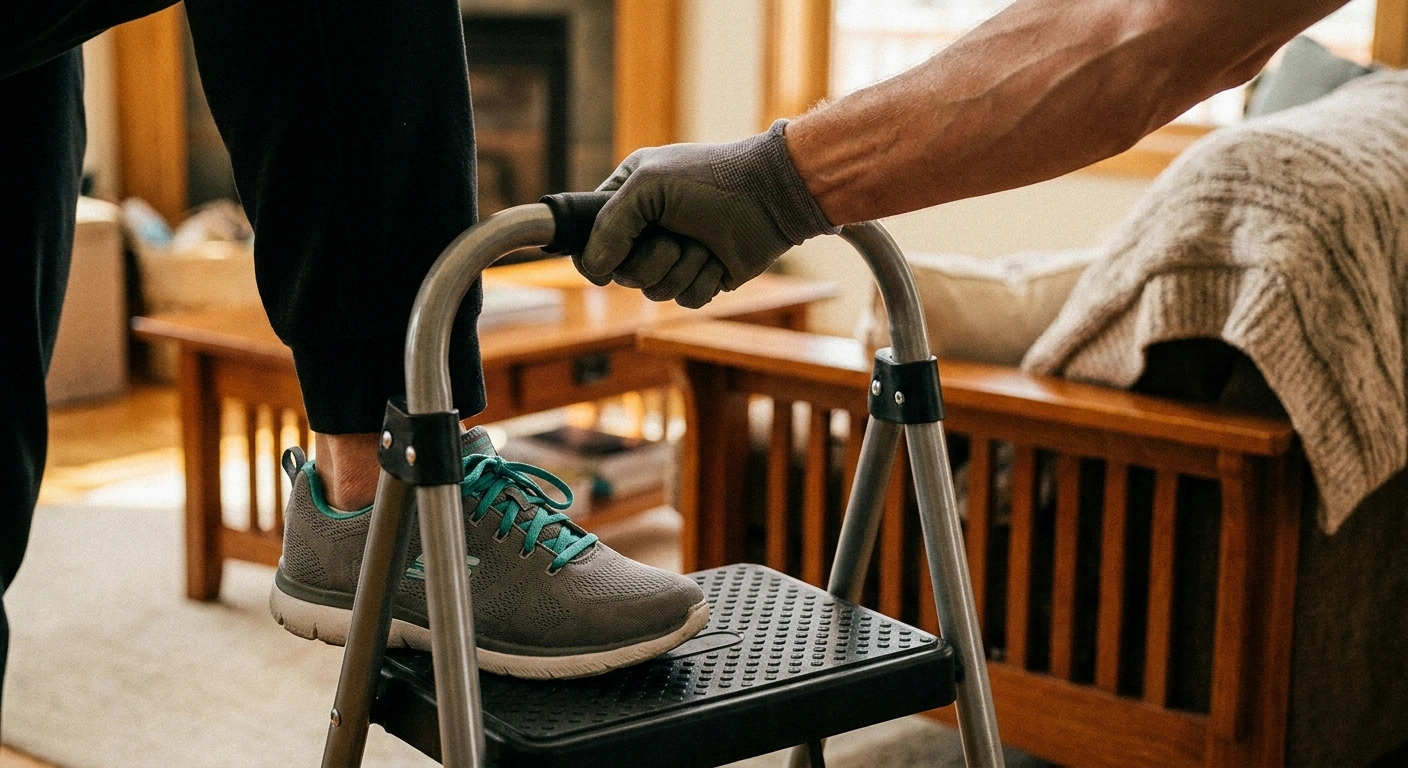
Once you’ve picked the right equipment and cleared the pre-climb checklist, there’s still a right way to actually do the climbing. This is the part I see people get wrong, even after they’ve done everything else correctly.
Three points of contact at all times. Two feet plus one hand on the rail, or one foot plus both hands. Never both feet without a hand somewhere, and never one hand and one foot with nothing else.
One step at a time. Same rule as our guide on stairs: don’t skip a rung, don’t take two at a time, both feet meet on each step before you move to the next. You lose thirty seconds. You gain enormously in stability.
Belt buckle between the rails. Never lean your body outside the vertical line of the ladder’s side rails. If the thing you need is past that line, come down and move the ladder. This is the single biggest cause of ladders tipping.
The pause-and-feel rule. This is the neuropathy-specific step. On each rung, before you shift your weight fully onto the new foot, pause and confirm — visually and by pressing down slowly — that your foot is flat and centered on the tread. Two seconds of confirmation per step. Every time. Your feet can’t do this check for you the way they used to, so your eyes and your slower deliberate pressure have to do it instead.
Come down facing the ladder. Never turn around and climb down like you’re walking down stairs. Face the ladder, hold both rails or the handrail, and step down one rung at a time, feeling for the next rung with your foot before shifting your weight.
Common Mistakes That Cause Neuropathy Falls
Every fall I’ve heard about in our support group started with one of these, and most of them started with several. If you catch yourself about to do any of these, stop and reset.
- Using a kitchen chair or dining chair as a step stool. The seat is too high off the floor, the chair can tip, and there’s nothing to hold. This is the number-one cause of household ladder injuries in older adults, and the temptation is enormous because the chair is right there. Do not do it.
- Standing on the top cap of an A-frame ladder. The very top of an A-frame is not a step. It’s clearly labeled as such. Every year people fall from it.
- Wearing slick socks or slippers. Even indoor climbing needs shoes with grip. The most common ladder fall I hear about starts in the kitchen, in socks, on a folding stool the person has used a hundred times.
- Distracted climbing. Phone conversation, TV playing, thinking about the next thing on your list. Cognitive load reduces your attention to foot placement, which is the one thing you cannot afford to lose focus on with neuropathy.
- Rushing. The extension cord isn’t going anywhere. The light bulb doesn’t need to be changed in the next two minutes. Slowness is the tool.
- Climbing at the end of a long day. Fatigue makes neuropathy symptoms worse across the board — proprioception, balance, foot sensation. Save the climbing for the morning when you’re fresh.
Tools That Extend Your Reach So You Don’t Have to Climb
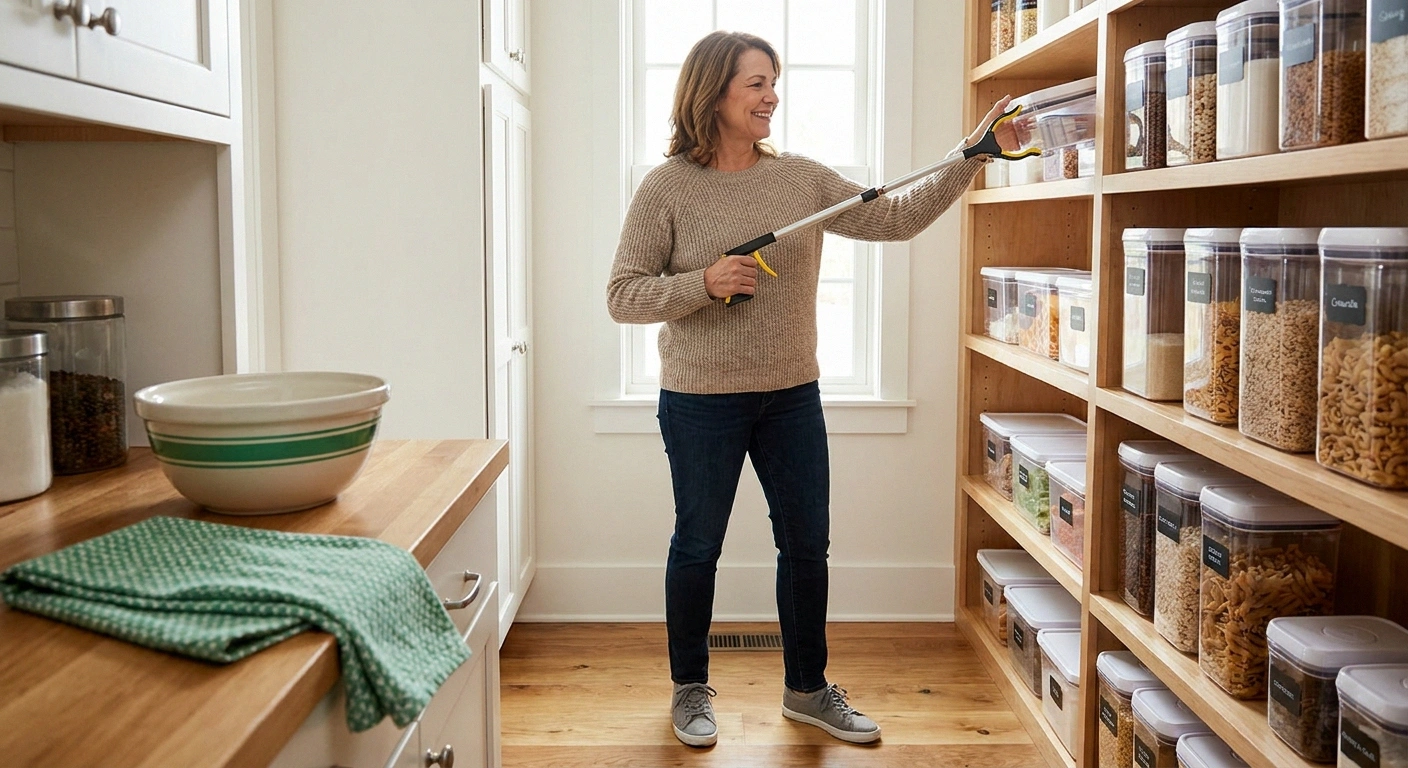
The best fall is the fall that doesn’t happen because you never got off the ground. There is a small industry of reach-extension tools that let you do things from the floor that used to require climbing, and most of them are inexpensive.
Tools That Keep You On The Floor
Reacher/Grabber Tool
Telescoping arm with a squeeze grip. $15-$30. Keep one in every room with high storage.
Telescoping Duster
Extends 6-12 feet. Ceiling fans, high shelves, cobwebs, no climbing.
Light-Bulb Pole
Change bulbs from ground level. Under $40. Game-changer for standard fixtures.
Magnetic Pickup Tool
Long telescoping arm with a magnet. Retrieves dropped screws and small metal.
Smart Bulbs & Remotes
App-controlled ceiling fans and lights. Eliminate a whole category of climbs.
Reacher/grabber tool. The essential one. A telescoping arm with a squeeze-trigger grip at the end, usually two to three feet long. Good for grabbing anything off a high shelf, retrieving something you dropped, pulling a light-weight item out of a top cabinet. Most cost $15 to $30. Keep one in the kitchen, one in the bedroom, one anywhere you have high storage. Some readers with neuropathy tell me the reacher is second only to good shoes in daily impact on their safety.
Telescoping duster. Extends six to twelve feet. Cleans ceiling fans, high shelves, cobwebs in corners, without you needing to leave the floor. The microfiber-head models work better than the feathers.
Light-bulb changer on a pole. A grip head that clamps around a bulb, mounted on a telescoping pole. You unscrew the old bulb and screw in the new one from ground level. For standard ceiling fixtures, this is a game-changer. Under $40 at most hardware stores.
Magnetic pickup tool. Long telescoping arm with a magnet on the end. Retrieves dropped screws, small metal objects behind furniture, anything you’d otherwise have to bend and stretch for.
Remote-controlled ceiling fans. If you have an old-style pull-chain fan and reaching the chain requires climbing, retrofit a remote or a smart switch. A $30 remote kit eliminates a monthly climb.
Smart bulbs and app-controlled lighting. Never change a hard-to-reach bulb again — smart bulbs last for years, and you control them from your phone. Higher initial cost, but if the bulb is in a stairwell or a two-story foyer, the safety math is obvious.
When to Just Ask Someone Else
This is the part most of my readers resist the hardest. We’ve been changing our own light bulbs for fifty years. We are used to being the person who solves the household problem. Asking your kids or your neighbor to come over and hang a wreath feels like admitting something.
Reframe it this way. The cost of a $30 handyman visit is dramatically less than the cost of a hip fracture. Not just financially. A fall recovery takes weeks to months. It reduces your mobility and confidence long-term. It sometimes triggers a cascade — infection, muscle loss, permanent balance decline. There is no home task worth risking that outcome for, and everyone in your life would much rather come over and do the thing than visit you in a hospital.
The list of things to just ask about:
- Hanging holiday decorations (wreaths on high doors, string lights on the roof line, ornaments on the top of a tall Christmas tree).
- Retrieving heavy items from top shelves (roasting pans, storage totes, seasonal dishware).
- Gutter cleaning. Never do this yourself with neuropathy. Ever.
- Replacing high-ceiling light bulbs in stairwells, foyers, or vaulted rooms.
- Taking down curtains, cleaning ceiling fans, changing HVAC filters that are mounted high on a wall.
Sources: family (adult kids, spouse, siblings), neighbors, handyman services (call your local hardware store — they usually have a list), TaskRabbit or similar apps if you’re comfortable with them, and community volunteer programs (many faith communities and senior centers have volunteer help lists). If you’re the sort of person who wants to reciprocate, offer coffee, homemade cookies, or a small cash tip. The transaction goes fine.
Setting Up Your Home to Reduce the Need for Climbing
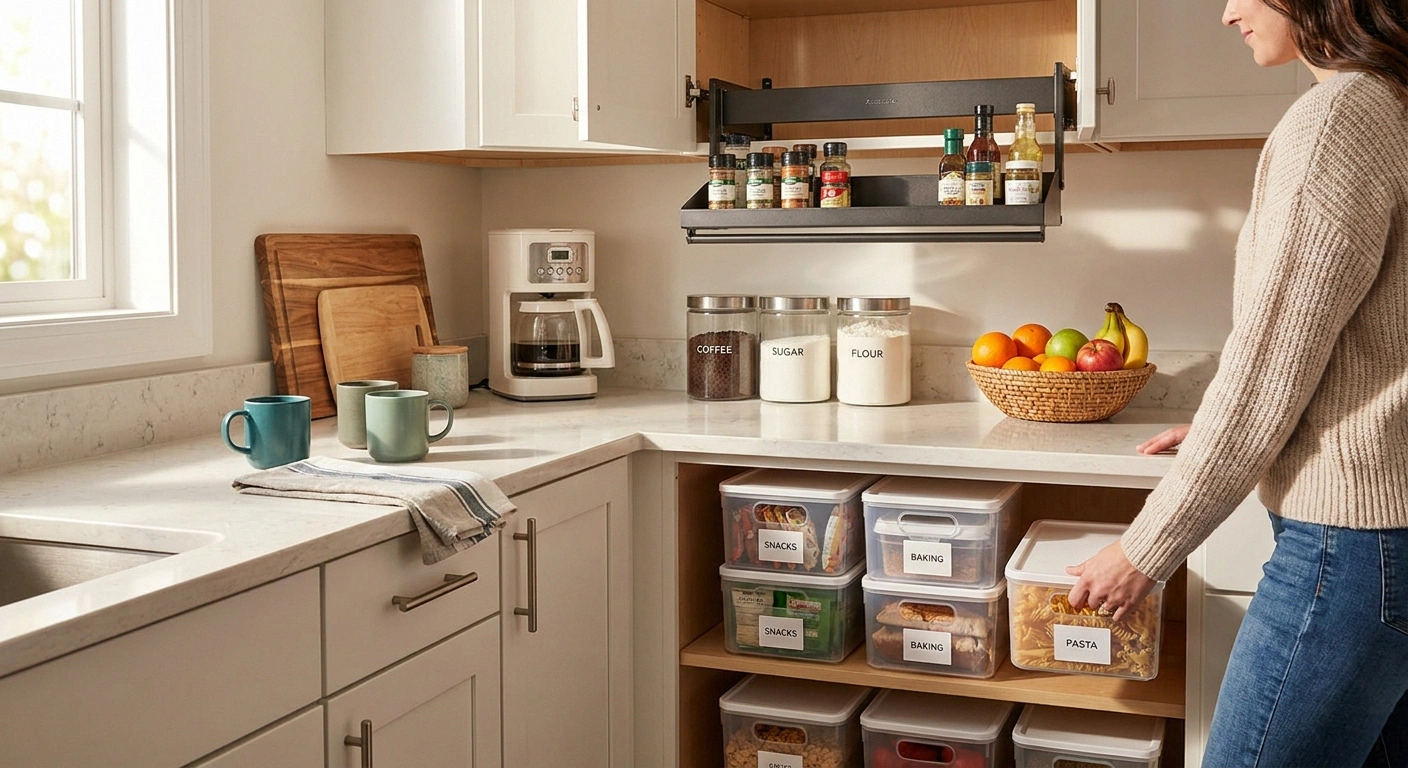
The best long-term fix isn’t a better ladder. It’s a house that requires the ladder less often. This is the same logic as the shower bench and the bathroom grab bars we covered in shower safety with neuropathy — infrastructure changes that make the risky activity unnecessary in the first place.
The Decision Ladder
Do I need to climb at all?
If the item can be moved down permanently, do that first.
Can I use a reacher or extension tool?
Grabber, telescoping duster, bulb pole. Try this before climbing.
Can I ask someone else?
Family, neighbor, $30 handyman. Cheaper than a hip fracture.
If yes to climbing: step stool with handrail.
Not a chair. Not a full ladder. Shoes on. Someone knows. Three points of contact.
Reorganize your kitchen by height. Everything you use daily belongs between waist and shoulder height. Rarely-used items can live up high, but if you find yourself climbing more than once a month for something, move it down. This one change eliminates most kitchen climbing.
Pull-down shelves and pull-out drawers. Kitchen and closet retrofit shelves that come down to counter height on a hinge. Not cheap ($100 to $500 per unit installed), but they turn a “climb into the cabinet” task into a “pull the shelf down to me” task.
Lazy Susans and turntables. Bring the back of a deep shelf to the front with a spin instead of a reach-and-stretch that tempts you onto tiptoes.
Clear bins on lower shelves. If you can see what’s in the bin from ground level, you don’t need to climb to check. This applies to pantries, linen closets, garage storage, and basement shelving.
Motion-sensor lights and remote-controlled switches. No more reaching for a pull chain on a high fixture. No more standing on the couch to hit an inconveniently placed light switch. Smart switches and motion sensors eliminate a category of small daily climbs you probably don’t even count.
Move heavy or seasonal items to a lower storage area. If your holiday decorations live in the attic, they’re a fall risk twice a year. Move them to a lower closet, a hall bench, or a basement bin. The convenience gain plus the safety gain is huge.
If you use a walker or rollator regularly: our rollator and walker guide is a companion piece to this one. Between the two of them you have a complete picture of moving safely around your house, on the level and up.
What to Do If You Fall Anyway
Even with everything above, falls happen. What matters most is what you do in the first few seconds and minutes afterward. The impulse to spring up and pretend you’re fine is exactly the wrong response.
Do not jump up. Stay on the floor for a moment. Take a deep breath. Panic will make you move badly and possibly make an injury worse.
Check for pain. Slowly move each limb. If any movement causes sharp pain, especially in your hip, wrist, back, or head — do not try to get up. Call for help.
If you’re able to get up: roll onto your side first. Push yourself up to your hands and knees. Crawl to a stable low surface — a couch, an armchair, a firm ottoman. Rest your forearms on the surface. Bring one foot forward flat on the floor. Push up slowly, using both the surface and your leg. Sit on the surface for at least five minutes before standing.
If you can’t get up: stay put and call for help. If you have a medical alert device, press it. Otherwise use your phone (which is in your pocket, because you followed the pre-climb checklist). If you have to lie on the floor for a while, keep talking or making noise so a neighbor might hear you.
Get checked even if you feel fine. Hip fractures and small compression fractures in the spine can hurt less than you’d expect at first, especially with neuropathy dulling your pain signals. If you fell from more than about two feet, or hit any part of your body against a hard edge, call your doctor and describe what happened. Better a same-day appointment that finds nothing than a fracture that gets ignored for three days.
Frequently Asked Questions
Is a step stool safer than a chair?
Yes, dramatically. A chair was designed to sit on, not stand on. The seat is too high off the floor, the chair can tip forward or sideways, and there’s nothing to hold. A good step stool has non-slip feet, non-slip treads, a handrail, and is designed to hold body weight in the standing position. The chair-as-step-stool improvisation is the single most common cause of household climbing injuries in older adults, and it’s the one habit worth breaking permanently. If you need to stand on something, get a proper step stool.
How tall of a ladder is safe with neuropathy?
For solo use, no higher than a three-step step stool with a handrail — about three feet of standing height. Above that, the injury math turns against you rapidly, because a fall from four feet can still break a hip. If a task requires more height than a three-step stool, either use a platform step ladder with someone else present to stabilize it, or hire the job out. Full extension ladders should not be climbed alone with neuropathy under any circumstances.
Should I get rid of my ladder if I have neuropathy?
Not necessarily, but you should think honestly about who is using it. If you live with someone else who’s capable of using the ladder safely, keep it around for their use. If you live alone and are the only person who might climb it, and if you can’t imagine a scenario where you’d use it safely, giving it away removes the temptation. Many people compromise by keeping a small step stool for casual tasks and getting rid of the tall extension ladder they used to use.
What kind of shoes should I wear on a ladder?
Closed-back, snug-fitting shoes with a firm sole and a slip-resistant tread pattern. The heel should be low and the sole should be flexible enough that you can feel through it a bit but stiff enough to spread pressure across the rung. Sneakers with grippy rubber soles work well. Avoid: backless slippers of any kind, sandals, high heels, slick-soled dress shoes, socks alone, and bare feet. Many readers keep a dedicated pair of “climbing shoes” — nothing fancy, just a pair of well-gripping sneakers — near their step stool so they never climb in whatever they happened to be wearing.
What’s the safest step stool for someone with neuropathy?
The features that matter most: a three-step design (about three feet of standing height), wide steps at least six inches deep, a tall handrail that reaches chest height when you’re standing on the top step, non-slip rubber feet, non-slip tread material on each step, and a weight capacity well above your body weight. Fixed (non-folding) designs are the most rigid, but a heavy-duty folding stool with those features is fine for most people. The lightweight little folding stools sold cheaply at most stores are not what you want — they’re the ones that tip and slide.
The Bottom Line
Neuropathy changes a lot of things, but it doesn’t have to end your ability to reach the second shelf. What it does is raise the bar for how carefully you approach climbing. Real shoes. Someone knowing you’re up there. Three points of contact. A step stool designed for actual use, not a folded chair. And the honest willingness to hand off the tasks that push past a three-step height.
The people who get hurt aren’t the ones who take this seriously. They’re the ones still stepping onto kitchen chairs in socks the way they did at forty. If you build the small rituals into your routine now — checking your shoes, calling out to your spouse before you climb, keeping the reacher tool where you can grab it — the changes recede into the background and you get on with your life. Just at ground level, mostly. And when you do go up, you go up smart.
About the Author