The first warm Saturday of summer last year, my neighbor Margaret called me in tears. She had spent the morning mowing her front yard — the same routine she had been doing for forty years — and that afternoon her right ankle was red, swollen, and warm to the touch. By the next morning, she was sitting in the emergency room being admitted for cellulitis. Somewhere during the mow, a small grass blade or a sharp piece of mulch had nicked her ankle. With her diabetic neuropathy, she had not felt the cut. By the time she noticed it, the infection was already established.
Margaret recovered fully, with three days of IV antibiotics and several follow-up appointments. But she lost most of her summer to wound care and the trip to the hospital cost more than three years of paying a neighborhood teenager to mow for her would have. She still mows, but smarter — different boots, different ritual, different lines about when she calls for help. This article is the conversation I wish she had read in May rather than learning the lessons in July.
If you have peripheral neuropathy and a lawn that needs mowing, this is for you. We are going to walk through a five-category safety framework — feet, foot inspection, heat illness, mower-deck and hot-engine burns, and the honest skip-the-mow signals — that handles the realistic risks of lawn care with reduced sensation in your feet. I am a patient advocate, not a medical professional, and the goal here is practical wisdom you can act on this weekend, not a substitute for your provider's guidance about what activities are safe for your specific situation.
Why Mowing Is Riskier With Neuropathy Than Most People Realize
Lawn mowing is one of those activities most adults have been doing since they were teenagers. It feels routine. The problem with neuropathy is that the things that used to be routine are no longer routine, and the parts of the activity that used to give you natural feedback (a sharp pain that says “step back,” a hot spot that says “do not touch that”) no longer give you that feedback. The mowing has not changed. Your warning system has.
Key Takeaway
Mowing has not changed. Your warning system has. The small grass cuts you would have felt before now go undetected; the hot muffler you would have jerked away from now produces real burns. A different ritual — sturdy boots, scheduled hydration, twice-daily foot checks, and honest skip-days — handles the risks the mower assumes you can feel.
The CDC tracks roughly six thousand power-mower amputations a year in the United States, mostly to hands and feet, and a much larger number of less-severe lacerations and burns. People with neuropathy are over-represented in mower injury statistics because the small grass-blade cuts that someone with normal sensation would feel and treat immediately are missed entirely, and the hot-engine burns that would make anyone else yank their hand away are sustained for seconds longer than they should be. The injuries are not flukes. They are predictable consequences of doing yard work without the feedback system the activity assumes you have.
The good news is that mowing with neuropathy is not on the no-go list. Millions of older adults with chronic illness mow their yards every weekend safely. The mowers themselves have gotten better — modern blade brakes, deflector chutes, and self-propelled walking models are all safety improvements that benefit neuropathy patients specifically. What needs to change is the ritual around the mowing — what you wear, what you check before and after, what you carry with you, and what days you decide to skip.
Your Feet — Not Sneakers, Not Sandals, Not Crocs
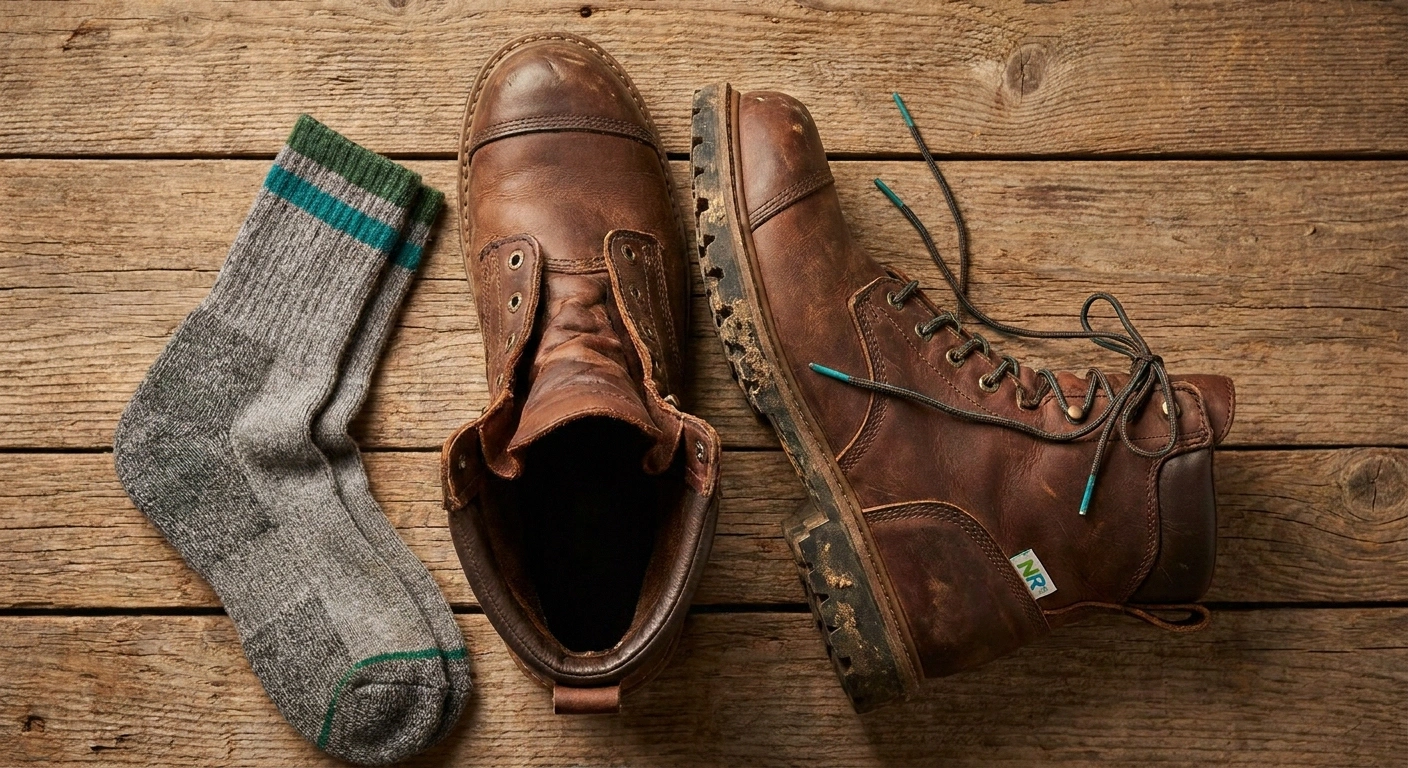
I want to be very direct about this section because it is where most of the avoidable injuries happen. The single most important piece of equipment for mowing with neuropathy is your footwear, and most people are wearing exactly the wrong thing. Sneakers are too thin. Sandals and Crocs are an emergency room visit waiting to happen. Leather slip-ons do not protect the ankle. Garden clogs offer no toe protection.
Mostly to hands and feet, mostly preventable, and people with reduced sensation are over-represented. The single piece of gear that prevents most of them: a sturdy steel-toe or composite-toe lace-up work boot with a high ankle shaft. Treat it as required equipment, like a seatbelt.
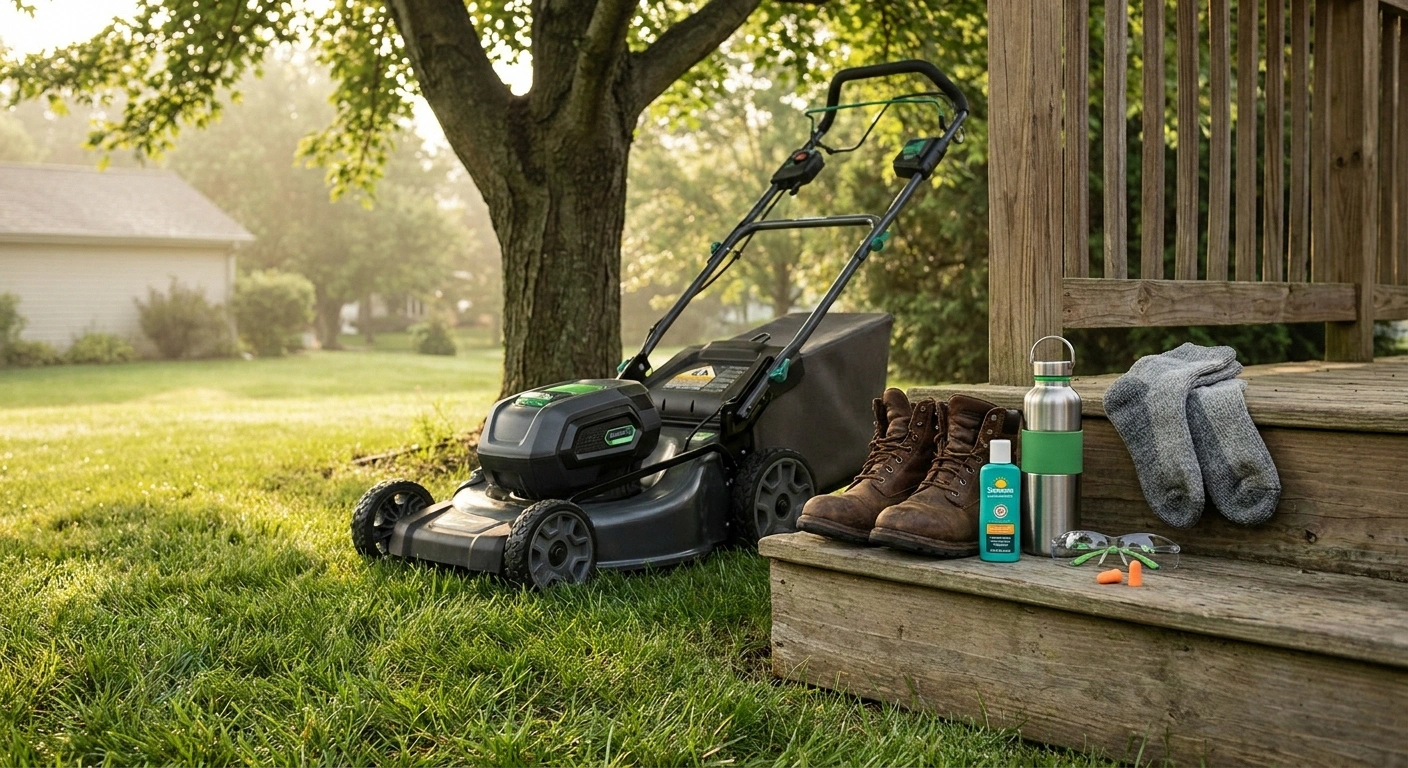
What you actually want is a sturdy, closed-toe, lace-up work boot or hiking boot with a hard toe cap and an ankle-supporting shaft. Steel-toe is best if you have access to a comfortable pair; composite-toe work boots are a fine alternative if steel feels too heavy for you. The point of the hard toe is straightforward: most mower-related toe amputations happen when the foot slides under the mower deck on a slope, on wet grass, or in a moment of lost balance. The hard toe is the only thing between your foot and a spinning blade. If you do not have hard-toed boots, this is the single most worthwhile investment for the summer.
The boot also needs to lace high enough to cover the ankle. Flying debris from a mower deck — pebbles, broken twig fragments, sharp grass clippings — strikes the lower leg and ankle constantly during normal mowing. A high-cut work boot or hiking boot deflects most of this. A low-cut shoe leaves your ankle exposed, which is exactly the area where Margaret picked up the cut that became her cellulitis. The right footwear matters every day for neuropathy, and for mowing it matters extra.
Lace them tight, but not so tight that you cut off circulation. The boots should not be a “I will get used to them” situation; comfortable boots get worn, uncomfortable boots stay in the closet. If your feet swell during the day, lace them in the morning before the swelling sets in. Wear thick, moisture-wicking socks (cotton is the worst material for sweaty feet; wool or synthetic blends are better).
The Pre-Mow Inspection — Five Minutes Before You Start
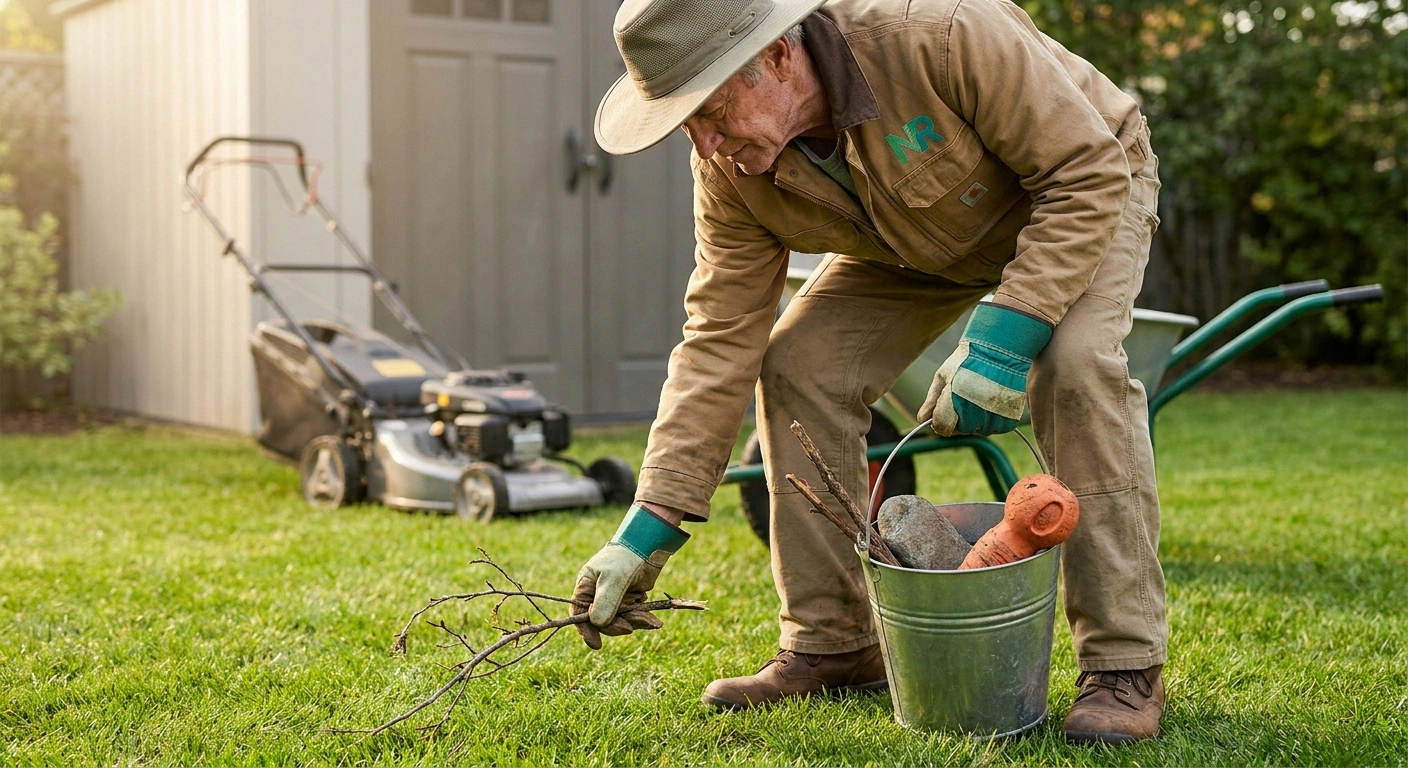
Before you touch the mower, do a five-minute pre-flight check. This ritual seems excessive the first few times you do it and becomes second nature within a month.
Check your feet first. Sit on a chair, take off your socks, and look at the soles of both feet using a handheld mirror if you cannot easily see them. Look for any cuts, blisters, redness, or swelling that you may not have noticed. Daily foot inspection is the cornerstone habit of neuropathy living, and mowing day is not the day to skip it. If you find any open wound — even a small one — the mow does not happen today. Period. We will come back to this.
Hydrate before you start, not after you are thirsty. Drink a full glass of water (or two) twenty minutes before you start. People with autonomic neuropathy have impaired sweat regulation, which means heat illness can come on faster and harder than in people without neuropathy. Thirst is a notoriously unreliable signal in older adults, and even more unreliable when autonomic nerves are damaged. Drink on a schedule, not on demand.
Sunscreen the exposed skin. Face, neck, arms. Patients on certain neuropathy medications (some antibiotics used for chronic conditions, certain antidepressants used for nerve pain) have increased sun sensitivity. Sun damage compounds in skin that has reduced sensation; you can burn badly without feeling it.
Walk the lawn first. Take a slow walk across the yard before you start the mower. Look for sticks, rocks, dog toys, hose ends, sprinkler heads, and any objects that the blade could throw at high velocity. A small rock launched out of a mower deck travels at over a hundred miles an hour. Clearing the yard of debris before you mow is a five-minute investment that prevents both injury to you and damage to whoever is on the other side of the fence.
Check the mower itself. Engine oil, fuel level if it is a gas mower, battery charge if it is electric. Look at the underside of the deck for caked grass from last time — a clogged deck increases the chance you will need to clear it mid-mow. Make sure the blade brake works (engage and release the bail bar a few times before starting; the engine should stop when the bail is released). The discharge chute should be clear and securely attached, with no missing pieces.
Have your water bottle and a chair ready on the porch. Plan your breaks before you need them. A water bottle inside the house is a water bottle you will not drink. A water bottle on the porch step is a water bottle you will drink during the natural pause between the front yard and the back yard.
While You Are Mowing — The Rules That Are Not Optional
These are not “would be nice if you could” suggestions. These are the things that, broken, end up as hospital trips.
Never Clear a Clog With the Engine Running
The grass is going to clump. The chute is going to clog. The instinct will be to nudge it with a foot or reach in with a hand.
Kill the engine. Wait 60 seconds. Then clear the clog with a sturdy stick or a gloved hand. Most finger and toe amputations happen exactly in this moment.
Never approach the discharge chute or the underside of the deck while the engine is running. The grass is going to clump up sometimes. The deflector flap is going to get caught on a stick. Your instinct is going to be to nudge it with a foot or reach in with a hand. Do not do this. Kill the engine. Wait sixty seconds for the blade to fully stop. Then, and only then, clear the clog with a sturdy stick or a gloved hand. Most amputations of fingers and toes happen exactly in this moment.
Mow across slopes, not up and down them, with a walk-behind mower. The reason is that when you mow up and down a slope and your foot slips on wet grass, the mower can roll back over your foot. When you mow across a slope, your foot would have to slide sideways the entire width of the deck to be in the blade path. With neuropathy and reduced balance, the across-the-slope direction is safer.
If you are using a riding mower, the rule reverses. Riding mowers tip on cross-slopes. Mow them up and down. But if you have neuropathy and a yard with significant slope, ask yourself honestly whether a riding mower is the right tool. The fall-from-mower injuries are worse than the lawn looking imperfect for a week.
Never mow wet grass if you can avoid it. Wet grass is slippery underfoot, harder to cut cleanly, and produces clumps that demand more chute-clearing. With neuropathy, your fall risk on wet grass is dramatically higher than on dry. Wait until midday after a morning dew has burned off, or wait a day after rain.
Never mow when you are tired. If you are forty-five minutes into a mow on a hot day and you notice you are starting to drag, stop. Take a break in the shade. Drink water. Sit down. Most decisions to stop come too late, after a stumble or a missed turn. Fall prevention in neuropathy is about catching the small signals before they become events.
Wear hearing protection. Most modern mowers run at decibel levels that cause cumulative hearing damage with regular use. Foam earplugs are inexpensive. Over-ear muffs are sometimes more comfortable for people who wear glasses. Hearing damage is one of the silent costs of decades of mowing without protection, and you cannot get it back.
Take a break every twenty to thirty minutes. Not “when you feel like it.” On a timer. Drink water. Sit. Check that your boots have not loosened. Look at your hands for any cuts. Heat illness builds in increments you may not notice; the scheduled break catches it before it becomes a problem.
The Heat — Why Neuropathy Patients Are Hit Harder
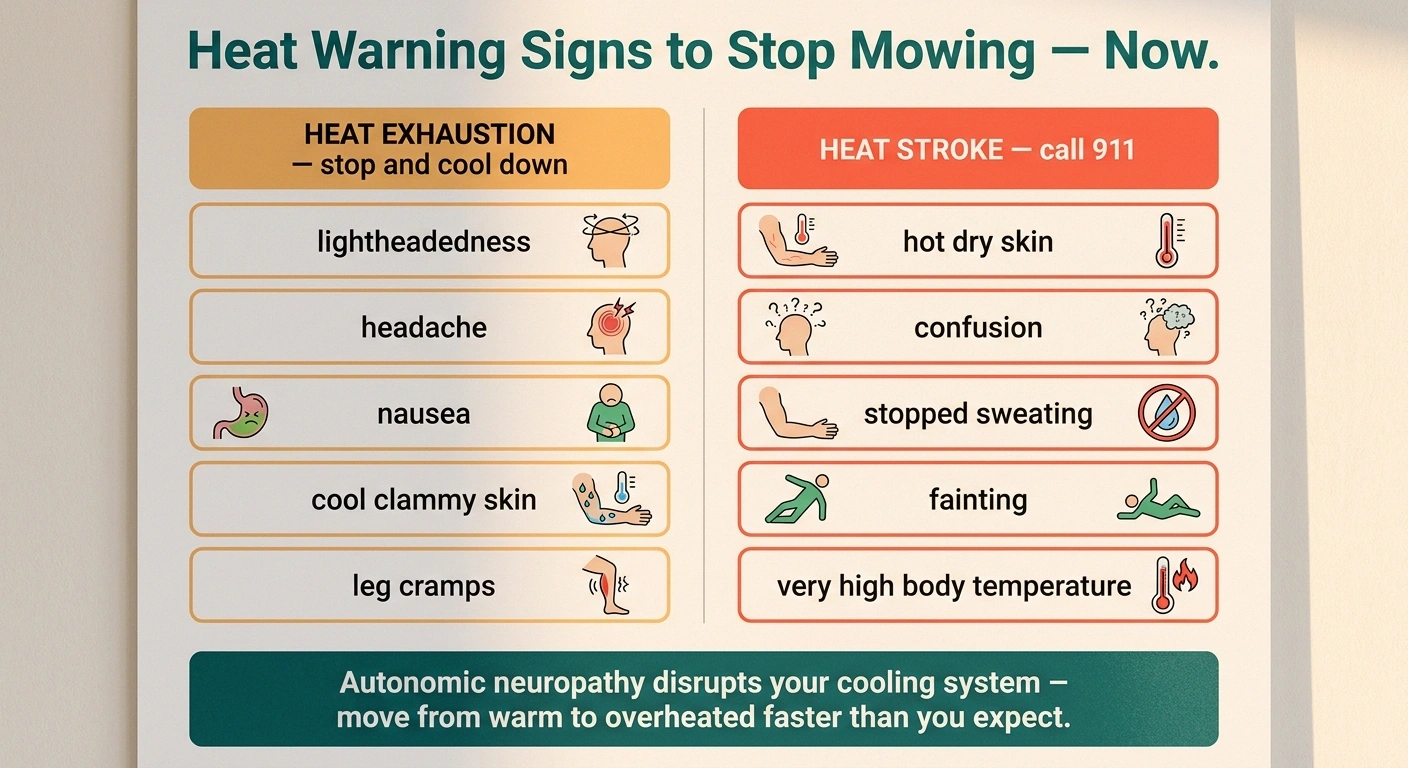
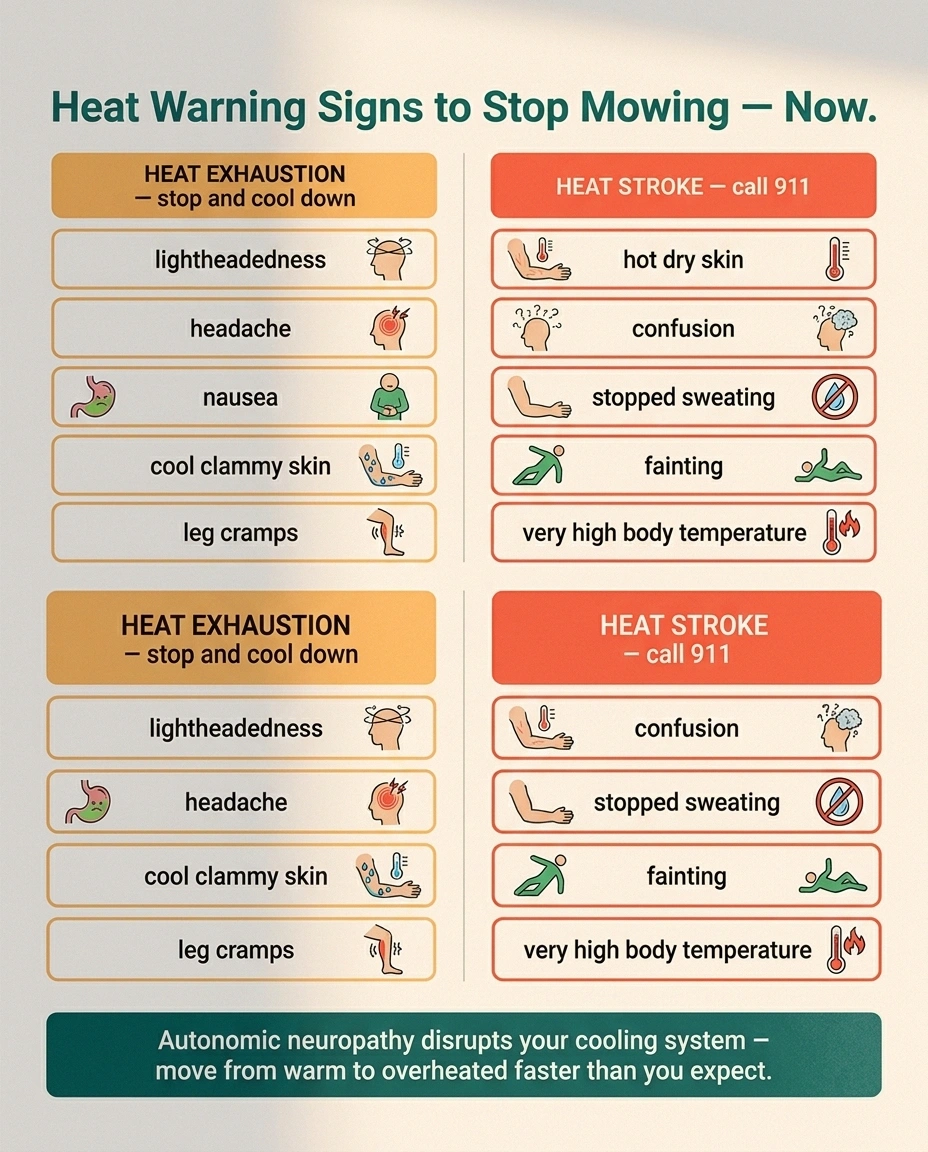
Heat illness is the most underrated risk of summer mowing for people with neuropathy. Let me explain why.
The Hydration Schedule — Not When You Feel Thirsty
Full glass of water (16-20 oz). Hydrate before you sweat, not after.
6-8 oz at each scheduled break. On a timer, not on demand.
Another full glass while you sit in the shade. Replace what you lost.
Add an electrolyte drink. Skip caffeine and alcohol — both impair hydration and judgment.
Your autonomic nervous system regulates sweating, blood pressure, and the dilation of blood vessels in your skin — the three big tools the body uses to cool itself in the heat. When those nerves are damaged by neuropathy, all three tools become less reliable. Sweating may be reduced or absent in some areas and excessive in others. Blood pressure may drop when you stand or strain. Skin blood vessel dilation may be sluggish. The result is that your body is less efficient at dumping heat, and you can move from “warm” to “heat exhaustion” much faster than a person without autonomic neuropathy.
The warning signs of heat illness in mowing are: lightheadedness, especially when you stop and stand still. A headache that came on during the mow. Nausea. Cool, clammy skin (heat exhaustion) or hot, dry skin (heat stroke — emergency). Stopping sweating when you would expect to be sweating. Confusion or a sense of “things feel weird.” Cramping in the legs.
If any of these come on, stop. Get to shade. Sit. Drink cool water. If you have ice nearby, put it under your armpits, on your neck, in your groin — these are the body's heat-dump zones. If your skin is hot and dry, if you feel confused, if you have not been sweating, that is heat stroke and someone needs to call 911. Do not try to drive yourself out of heat stroke; the impairment to your judgment can be substantial and the condition can be fatal.
The simplest prevention is timing. Mow before 10 a.m. or after 6 p.m. on hot days. Mow during the shaded part of your yard during the hottest hours. Skip the mow entirely on a day with a heat index over 95 degrees if you have known autonomic neuropathy. The lawn can wait three more days; you cannot.
Hot Engine Parts — The Burn You Will Not Feel
A gasoline mower's exhaust muffler reaches temperatures of 250 to 300 degrees Fahrenheit during normal operation, and stays that hot for ten to fifteen minutes after the engine is shut off. The engine block itself is in a similar range. People with normal foot or hand sensation jerk away within a fraction of a second if they touch these parts; the small burn they get is painful but minor. People with neuropathy can sustain contact for several seconds without realizing it, producing third-degree burns that destroy skin and soft tissue.
250-300°F Muffler — Hot for 15 Minutes After Shutoff
A gas mower's muffler stays hot enough to cause third-degree burns for 10-15 minutes after you cut the engine. With neuropathy, you can sustain contact for several seconds before realizing it.
Wait 15 full minutes after shutdown before touching any metal part. Battery-electric mowers eliminate this risk entirely — a real safety upgrade for any neuropathy patient buying a new mower.
The rules are simple. Never touch any part of the engine compartment while the engine is hot or recently running. Wait at least fifteen minutes after shutdown before touching any metal part of the mower. If you need to clear a clog, use a wooden stick or wear thick leather work gloves — not garden gloves, work gloves. If you need to refuel a hot mower, do not — wait for it to cool. Hot mufflers ignite gasoline vapors as readily as a lit match.
Battery-electric mowers eliminate most of this hot-engine risk and are, for that reason alone, a significant safety upgrade for many neuropathy patients. They also tend to be lighter, quieter, and easier to start. If you are due for a new mower anyway, the electric option is worth considering specifically for the reduced burn risk and the easier starting.
The Post-Mow Inspection — Twice as Important as the Pre-Mow
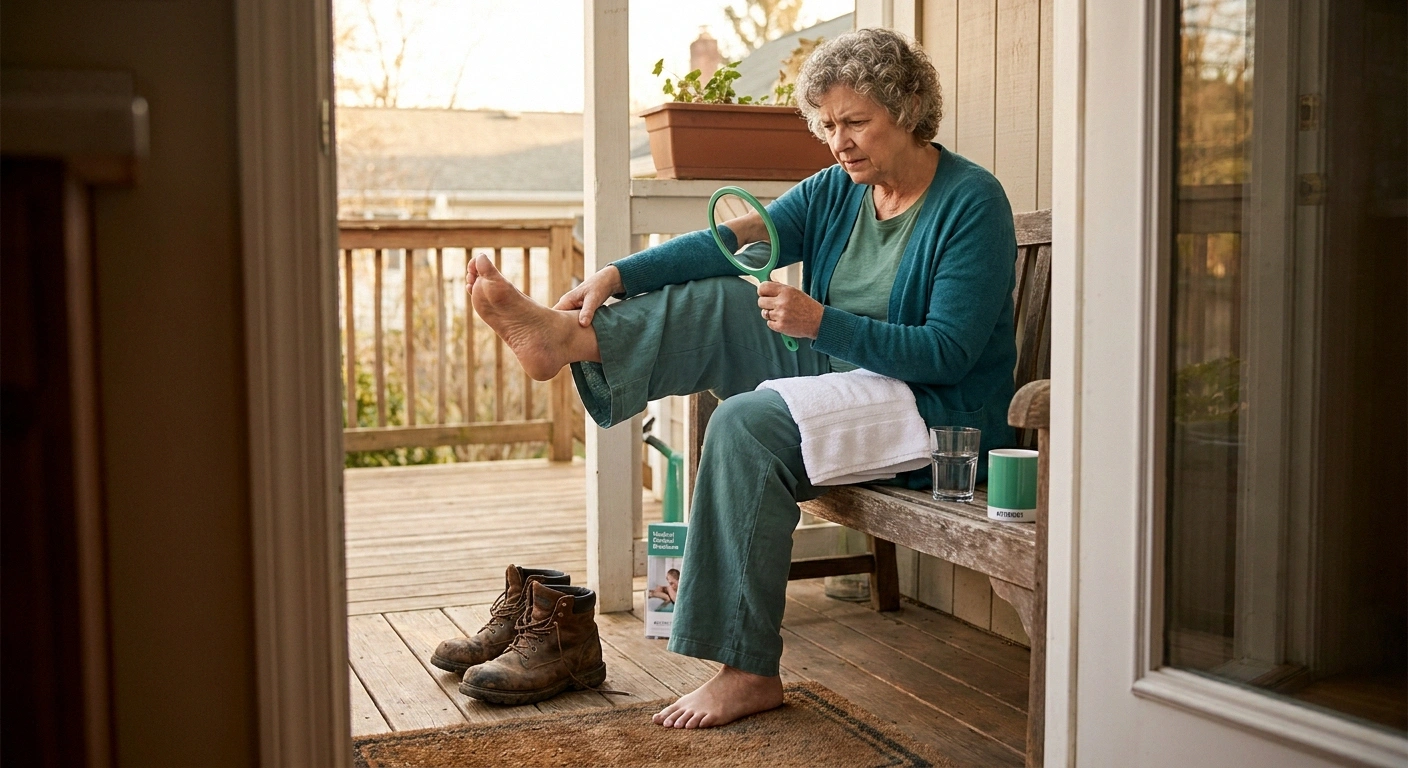
Mowing produces a steady stream of small projectiles — clipped grass, mulched leaves, occasional small stones — that strike the lower legs, ankles, and feet through the day. Most of these produce no visible damage. Some produce small scratches and cuts. With neuropathy, you may have no idea you have been cut until the next morning, when redness and warmth signal an early infection.
The post-mow ritual is non-negotiable. Take your boots off in the garage or on the porch. Walk inside in clean socks. Sit down, take off the socks, and inspect both feet, both ankles, both shins. Use a mirror for the underside of the feet. You are looking for any cut, scratch, redness, bruise, or warm spot that you did not have before the mow. Compare to the other foot.
If you find a cut, even a small one, clean it with soap and water, apply an antiseptic, cover with a clean bandage, and watch it carefully for the next three days. Redness spreading beyond the immediate cut, increasing warmth, swelling, pus, or fever in the days after are signs of cellulitis or worse, and they need a same-day call to your provider. In diabetic neuropathy especially, small foot infections can escalate to serious problems quickly because circulation and immune response are both compromised.
Shower or rinse afterward. Sweat, grass, and lawn chemicals on skin you cannot fully feel are an unnecessary risk. Change into clean socks. Drink water — more than you think you need. Sit down for at least twenty minutes before doing anything else. The combination of heat, exertion, and impaired autonomic regulation often produces a delayed lightheadedness that catches people on the second activity after the mow, not during it.
When to Skip the Mow — The Five Honest Signals
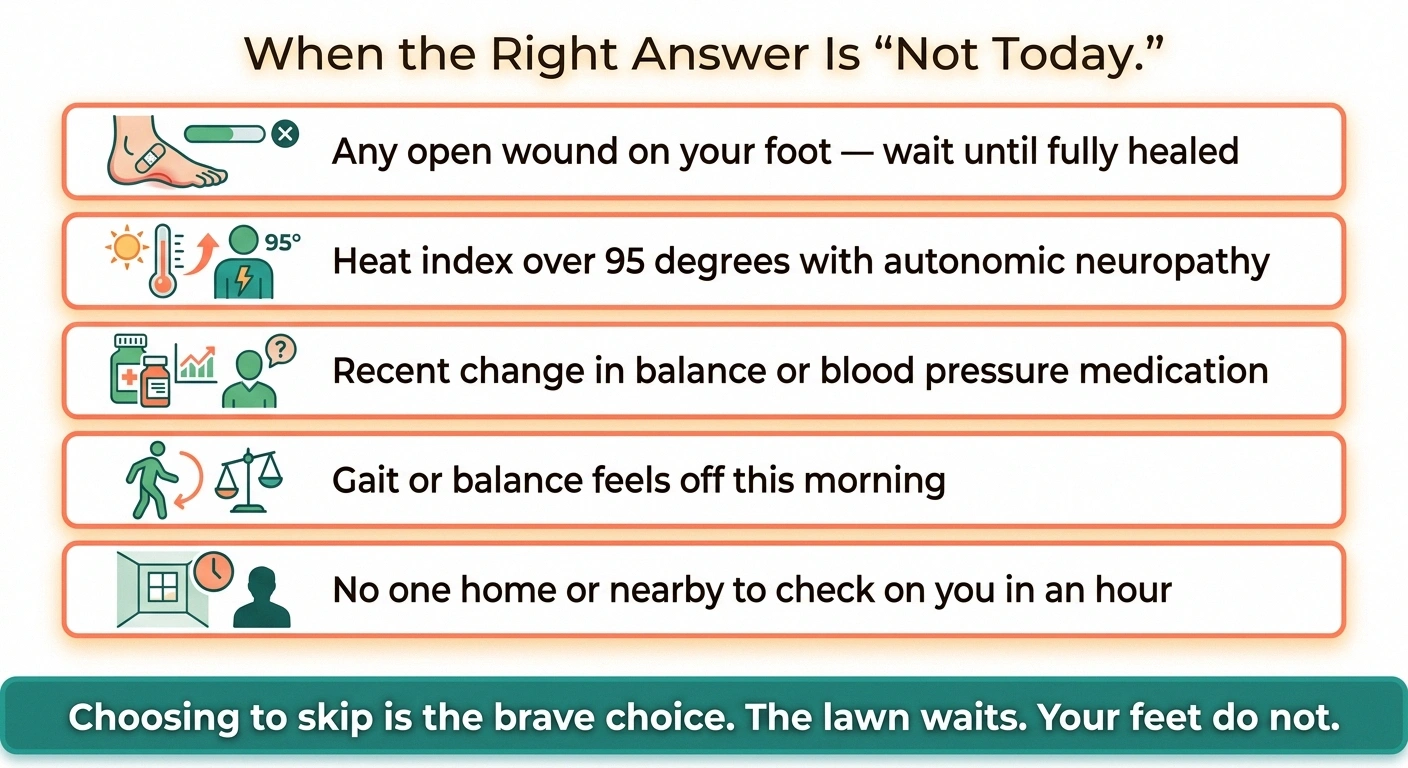
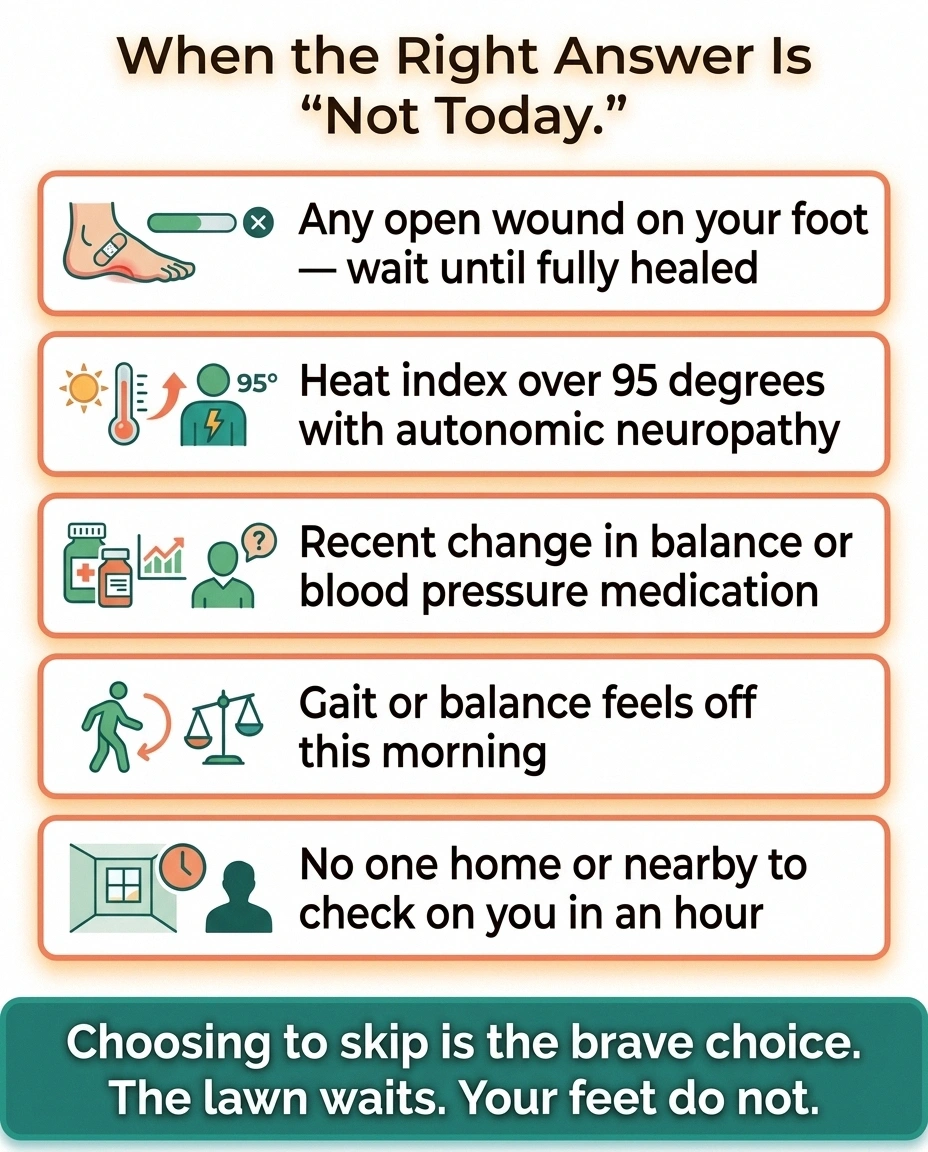
This is the section many people skip and then regret skipping. There are days when the right answer is “the lawn waits until next week.” Knowing which days those are is part of skilled chronic-illness management.
The Five “Skip Today” Signals
Even a small one. Wait until the skin is fully healed. Non-negotiable.
The thermoregulation math is against you. Wait or mow at dawn in segments.
Let the system settle a week before mowing on the new dose.
Inner voice that says “today does not feel quite right” is usually correct.
Tell a neighbor or family member. Phone in your pocket. Medical alert if you have one.
Any open wound on your foot. A blister, a small cut, a hangnail that is open, a healing ulcer that has not fully closed — these are absolute no-mow signs. The combination of dirt, sweat, and pressure inside the boot will turn a minor wound into a serious one. Wait until the skin is fully healed.
Heat index over 95 degrees if you have autonomic neuropathy. The thermoregulation math is against you. Hire it out this week, or wait for a cooler stretch, or mow at 6 a.m. in segments.
Recent change in any medication that affects balance or blood pressure. A new blood pressure medication, a dose change in gabapentin, a new sleep aid that has not fully cleared in the morning — any of these can make today the day your balance is off in ways you have not yet calibrated to. Wait a week for your system to settle.
Anything that makes your gait or balance feel off this morning. A poor night of sleep. A flare of foot pain. A new neurologic symptom you have not yet talked to your doctor about. Listen to the inner voice that says “today does not feel quite right.” It is usually correct.
No one else home or nearby. If you fall in your back yard and cannot get up, having someone in the house who will come looking for you when you do not come back in is a real safety factor. Mowing when you are completely alone in the house, with no neighbor or family within shouting distance, becomes a higher-risk activity as we age. A phone in your pocket is a partial solution; a person who knows you are out there and will check on you in an hour is better.
The Hire-It-Out Conversation
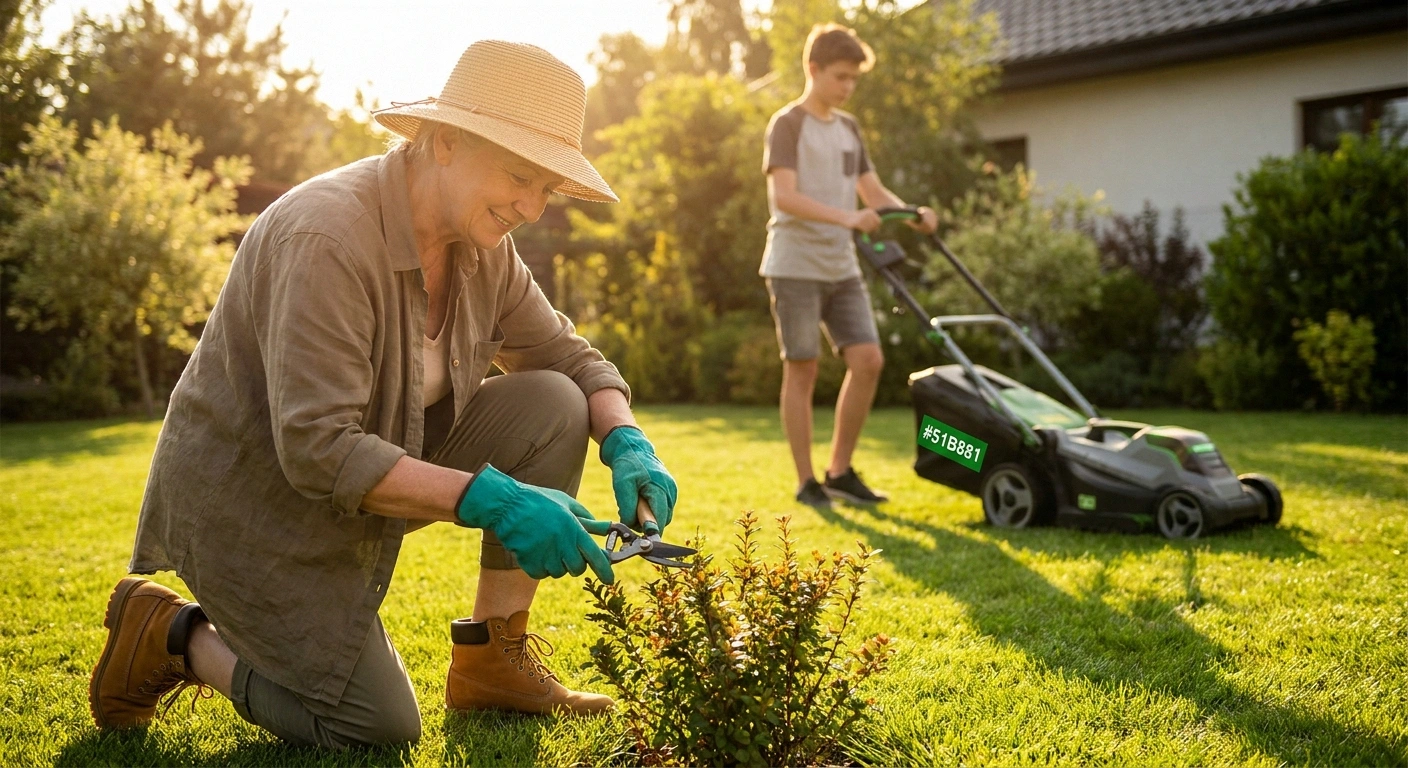
I want to spend a real moment on this because it is the conversation many older adults need to have and avoid. The cost of a neighborhood teenager or a small lawn service to mow every two weeks during the growing season is, in most parts of the country, between fifty and a hundred dollars a month. A single ER visit for a foot infection from a missed grass-blade cut is, depending on insurance, between three hundred and several thousand dollars. The math, before you even account for the time you get back and the falls you avoid, is in favor of hiring help.
This is not weakness. This is not giving up. This is the same calculation you have probably already made about climbing on a ladder to clean gutters, getting up on the roof to clear a tree branch, or shoveling snow in winter. Most of us let go of the gutter-cleaning at some point. The lawn is the same kind of decision, just a few years later.
The conversation with yourself, and possibly with your spouse, is usually less about money than about pride. Margaret kept mowing for years after her arthritis and her neuropathy made it questionable, because the front lawn looking good was something she had been proud of for forty years. She still has pride in the lawn now. But the lawn looks better than it ever did — because the kid she pays uses a sharper blade and cuts in straighter lines than she ever could — and she has her summer back. That is the trade.
If full-service hire feels like a leap, consider hybrid arrangements. Pay a service for the back yard and the slopes, mow the small flat front yard yourself. Pay for mowing during the high-heat months and do it yourself in the cooler shoulder seasons. Pay a neighborhood teenager for the trim work (the weed-eater and edger work) which produces the most flying debris and the highest cut risk, and do the deck-mowing yourself. There are many ways to step down rather than step out entirely.
A Sample Mowing-Day Plan
Here is how a typical mowing day looks when you have peripheral neuropathy and have built the safety habits into the ritual.
The Hire-It-Out Math
$200-500 per full season for a neighborhood teenager or small lawn service. One ER visit for a foot infection: $500-3,000 after insurance — plus the lost summer, the antibiotics, the wound care, the falls avoided, the time you get back.
Hybrid arrangements work too — pay for slopes and trim work, keep the flat front yard. Choosing help is care, not weakness.
The night before: Check the weather. Heat index under 90? Good. Heat index over 95? Skip or move to dawn. Pack a water bottle in the fridge. Put your work boots by the door. Charge your phone fully.
Morning of, before breakfast: Look at your feet in good light. Any new wounds? Any healing wounds still open? If yes, today is not the day. Drink a glass of water. Eat a light breakfast.
Twenty minutes before mowing: Drink another full glass of water. Apply sunscreen. Put on moisture-wicking socks. Lace up your work boots. Grab hearing protection, eye protection, and work gloves.
Pre-mow walk: Five-minute walk of the yard, clearing sticks, rocks, dog toys, hoses. Check the mower — oil, fuel or charge, blade brake working, chute clear.
Mow in segments: Twenty to thirty minutes, then a five-minute shaded break with water. The front yard, break, the back yard, break, the trim work, break.
Engine off, walk away: When you are done, kill the engine and walk away from the mower for at least fifteen minutes before approaching it to clean or move it. The hot muffler is a real burn hazard.
Post-mow inspection: Boots off in the garage. Clean socks on. Sit and inspect both feet, both ankles, both shins with a mirror. Note anything new on a little wall calendar by the back door. Rinse off in the shower or with a hose. Change into clean clothes. Drink water. Sit down for twenty minutes before resuming any other activity.
The Bigger Picture — Your Yard Is Not Worth Your Foot
I want to close with the thing I tell every patient in my support group who asks about this. Your lawn is one of the things in your life. It is not the most important thing. Your feet are the most important thing — your independence, your mobility, your ability to walk your grandchildren around the garden, your years of staying out of the wheelchair you have been working to avoid.
Mowing is part of the broader trade-off conversation every neuropathy patient eventually has to have with themselves. There are things you used to do without thinking that now require thinking. There are things you used to do alone that now go better with help. There are things you used to do every weekend that now happen every other weekend, or that get delegated, or that you let go of entirely. The grief of letting go of certain activities is real. The dignity of choosing which activities to keep, on what terms, is yours.
If you keep mowing — and many of you will — do it with the boots, the inspections, the water, the breaks, and the honest skip-the-mow signals. If you decide to hire it out, do it without shame. If you find a hybrid that works, do that. The lawn will be fine either way. Your feet are what we are protecting.
Frequently Asked Questions
What is the safest type of lawn mower for someone with neuropathy?
For most neuropathy patients, a self-propelled, battery-electric, walk-behind mower with a deflector chute is the safest combination. Self-propelled reduces the physical exertion and the risk of overheating. Battery-electric eliminates the hot muffler burn risk and starts with the press of a button rather than a pull cord. The walk-behind format keeps you upright and balanced rather than seated on a vibrating platform. The deflector chute reduces flying-debris injuries. Riding mowers can be appropriate for very large flat yards but come with fall-from-mower and tip-over risks that are higher for people with balance changes. If you are in the market for a new mower, the battery-electric self-propelled category is the safety upgrade most worth the investment.
How do I check my feet after mowing if I cannot easily see the bottoms?
Get an inexpensive long-handled handheld mirror from a drugstore or online — they cost under ten dollars and last for years. Sit on a chair, prop one foot on the opposite knee or on a low bench, and use the mirror to see the sole, the heel, and between the toes. Take your time — a careful look takes about ninety seconds per foot. If a partner is available, asking them to take a look as well catches anything you might miss. Some people find it useful to take a quick smartphone photo of the bottom of each foot once a month so they have a baseline to compare to if something starts to look different.
Can I mow if I have a healed but recent foot ulcer?
This is a question to discuss specifically with your provider or your podiatrist, because the answer depends on how recently the ulcer healed and how confident your medical team is that the underlying tissue has fully reconstructed. As a general rule, the friction, sweat, and pressure inside a work boot during mowing are exactly the kind of stresses that can reopen a recently-healed ulcer. Most podiatrists prefer at least three to six months of complete healing plus stability before recommending return to activities that stress the foot mechanically. If your provider gives the green light, double down on the post-mow inspection — recently-healed sites are the most likely places for problems to recur.
How much water should I drink during a one-hour mowing session?
A general guideline is sixteen to twenty-four ounces (about one large water bottle) before you start, then six to eight ounces every twenty to thirty minutes during the mowing, then another full glass after you finish. People with autonomic neuropathy should err on the higher end because thermoregulation is impaired. Plain water is fine for most one-hour sessions; if you are out for longer than two hours, an electrolyte drink can help replace what is lost in sweat. Avoid caffeine and alcohol before and during mowing — both impair hydration and judgment.
What should I do if I get burned by the hot engine?
First, get away from the mower and away from any continued contact with the hot part. Run cool (not cold) water over the burned area for ten to fifteen minutes. Do not apply ice, which can damage tissue further. Do not apply butter, oil, or home remedies, which trap heat and increase risk of infection. For small, superficial burns (red, painful, but skin intact), clean with mild soap, cover with a clean non-stick dressing, and watch for signs of infection over the next week. For deeper burns (blistering, white or charred skin, larger than a quarter), or any burn on the foot or ankle in someone with neuropathy and diabetes, get evaluated the same day. Burns on neuropathic feet can deteriorate fast because of impaired healing and infection risk.
Is it dangerous to mow alone with neuropathy?
“Dangerous” is too strong, but it does raise the safety margin in ways worth thinking about. The realistic concerns are a fall in the yard where you cannot get up, heat illness where you cannot get yourself to shade in time, or an injury where you cannot reach the phone. The practical mitigations are: keep a phone in a pocket, not in the house. Tell a neighbor or family member you are mowing and ask them to check on you in an hour. Mow during a time of day when neighbors are likely to see or hear you. If you have a medical alert device, wear it for the mow. None of these eliminate the risk, but they meaningfully reduce it.
How often should I get a new pair of work boots if I mow regularly?
For most people who mow weekly during the growing season, a quality pair of work boots will last two to four years. The tell-tale signs that it is time for a replacement are: the sole has lost its tread (slipping risk), the toe cap has separated from the upper, the laces or eyelets are damaged, the lining has worn through (blister and wound risk against the skin), or the boot has stretched enough that your foot moves around inside it during use. For neuropathy patients, the once-a-year check is worth doing in spring before mowing season starts. A boot that lasts five years for someone with normal feet may need replacement at year three for someone whose feet cannot warn them about lining wear or slipping treads.
When does paying someone else to mow make financial sense?
The honest math: a neighborhood teenager or small lawn service typically costs $25 to $50 per visit, with most lawns mowed every two weeks during the growing season — so somewhere between $200 and $500 for a full mowing season. Compare that to: one ER visit for a foot infection (often $500 to $3,000 after insurance), the time cost of two to three hours per week you would otherwise spend mowing, the cumulative risk of a fall, and the wear-and-tear on your own body. For most older adults with diabetic neuropathy in particular, the math turns favorable somewhere around the time of the first close call — the cut they did not feel, the slip on wet grass, the headache from heat exhaustion. The point at which you are reading articles like this one is usually the point at which it is worth having the conversation honestly with yourself and your family.
About the Author