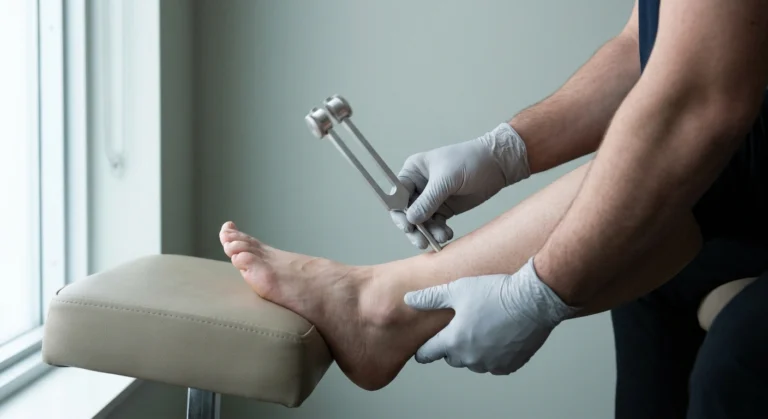
You’ve been told it’s “just neuropathy” — take gabapentin and learn to live with it. But something nags at you. Maybe your symptoms don’t match what you’ve read about typical peripheral neuropathy. Maybe you’ve been on three medications with no real improvement. Maybe your doctor seems unsure of the cause but isn’t pursuing further testing. That feeling? Trust it. Getting a second opinion isn’t an insult to your doctor — it’s one of the smartest things a patient with a complex neurological condition can do.
This guide explains when a second opinion is genuinely warranted, how to find the right specialist, what to bring to make the consultation productive, and how to navigate the sometimes awkward dynamics of seeking another perspective while maintaining your relationship with your current care team.
When a Second Opinion Makes Sense
Not every neuropathy case needs a second set of eyes. Straightforward cases — diabetic neuropathy with clear blood sugar issues, neuropathy that responded well to first-line treatment, or a stable condition with an identified cause — usually don’t require additional opinions. Your primary doctor or neurologist has it handled.
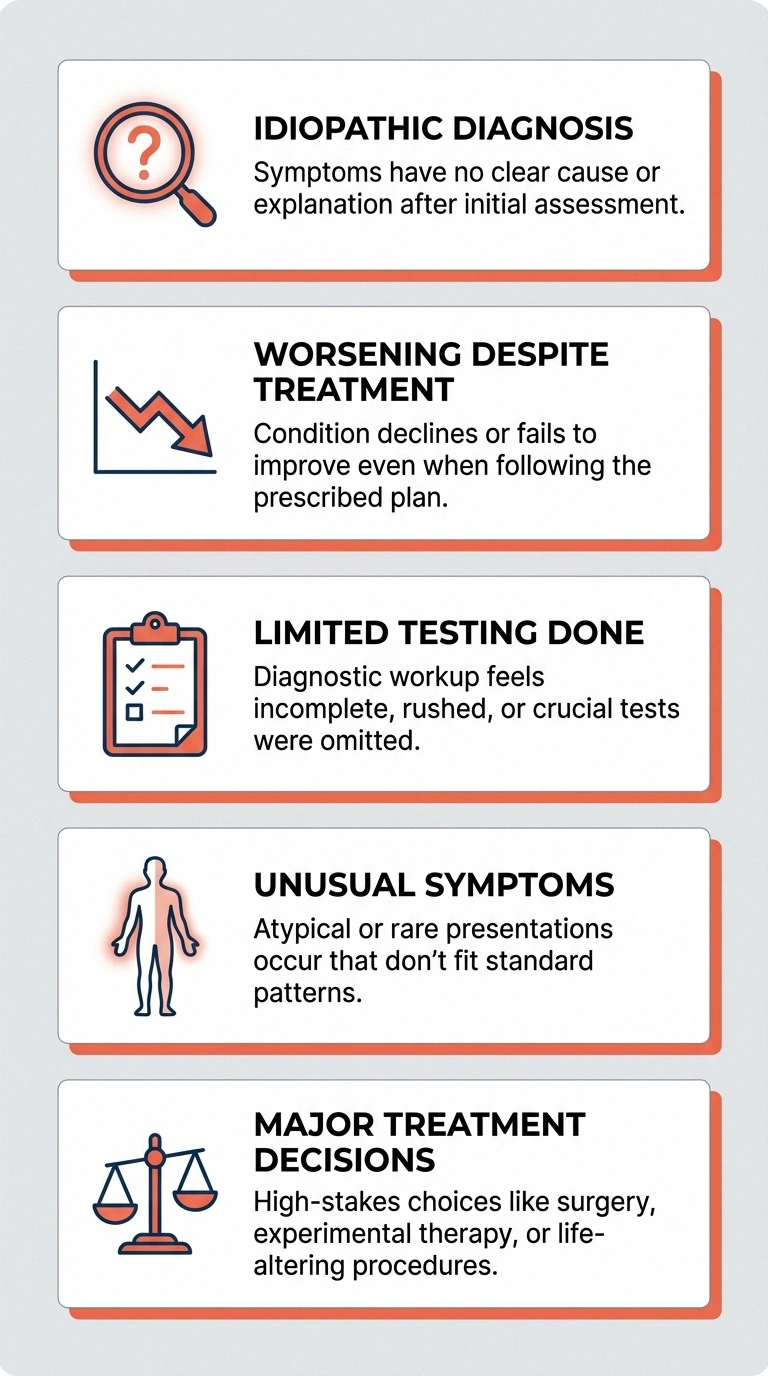
🔍 Signs You Should Seek a Second Opinion
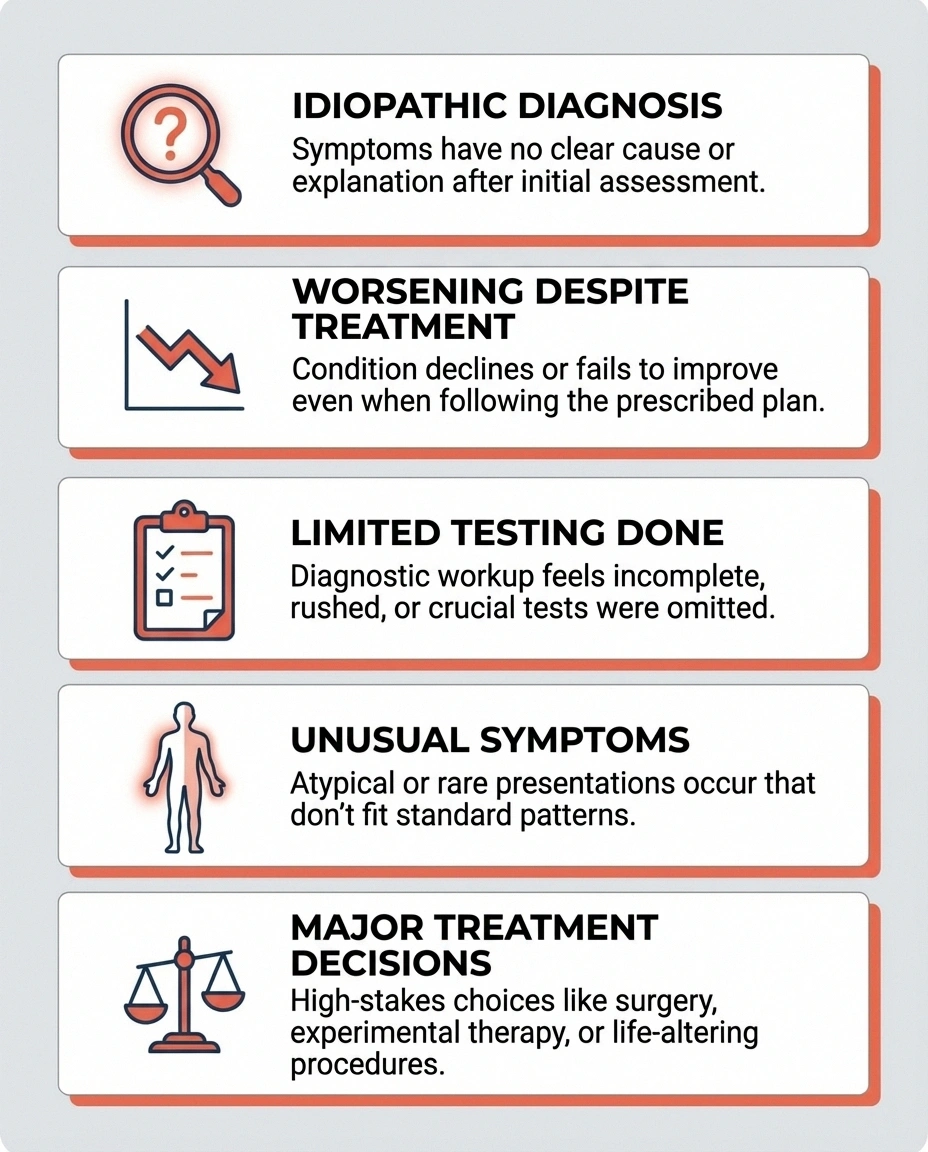
Diagnosed as idiopathic (no cause found) without thorough testing
Symptoms worsening despite 6+ months of treatment
Never had nerve conduction studies or EMG
Unusual or asymmetric symptoms
Major treatment decisions (IVIG, immunosuppression) being discussed
But certain situations should prompt you to seriously consider seeking another perspective. These aren’t edge cases — they’re common scenarios that many neuropathy patients face.
You’ve Been Diagnosed with Idiopathic Neuropathy
Idiopathic neuropathy — neuropathy with no identified cause — accounts for roughly 25-30% of all peripheral neuropathy diagnoses. While sometimes no cause truly exists, other times the workup simply wasn’t thorough enough. A neurologist at a major medical center or a neuromuscular specialist may test for conditions your original doctor didn’t consider: autoimmune neuropathies, paraneoplastic syndromes, genetic conditions like Charcot-Marie-Tooth disease, or rare inflammatory causes that respond to immunotherapy.
The stakes are high because some of these missed causes are treatable — and the window for effective treatment narrows over time.
Your Symptoms Are Getting Worse Despite Treatment
If you’ve been on treatment for six months or more and your neuropathy continues to progress, that’s a signal worth investigating further. Maybe the diagnosis is correct but the treatment approach needs rethinking. Maybe there’s an additional condition contributing to your symptoms that wasn’t initially identified. Or maybe the original diagnosis needs revision. A fresh perspective can separate these possibilities in ways that continuing down the same path cannot.
You’ve Been Offered Limited or No Testing
Neuropathy diagnosis should involve more than a clinical exam and basic blood work for the majority of patients. If you’ve never had nerve conduction studies or EMG, and your neuropathy isn’t clearly explained by an obvious cause like severe diabetes, additional testing may reveal important information. Similarly, if your doctor has dismissed the possibility of small fiber neuropathy — which doesn’t show up on standard nerve conduction tests — a specialist who performs skin biopsies may find what was missed.
Your Symptoms Are Unusual or Asymmetric
Typical peripheral neuropathy affects both sides of the body symmetrically, usually starting in the feet. When neuropathy is one-sided, affects unusual areas (trunk, face, or a single limb), comes and goes in episodes, or started suddenly rather than gradually, the differential diagnosis broadens considerably. These atypical presentations are exactly where subspecialist expertise matters most — and where a generalist or even a general neurologist might miss a treatable cause.
Major Treatment Decisions Are on the Table
If your doctor is recommending IVIG (intravenous immunoglobulin), plasma exchange, long-term immunosuppression, or surgical interventions, a confirmatory second opinion before starting aggressive treatment is both medically prudent and entirely standard practice. These treatments carry real risks and costs — you want to be confident the diagnosis justifying them is correct.
Where to Seek a Second Opinion
The value of a second opinion depends heavily on who you get it from. Seeing a doctor with the same training and experience level as your current provider may not add much. The goal is finding someone who brings a different or deeper perspective.

Virtual Second Opinions
Cleveland Clinic, Cedars-Sinai, and other major medical centers offer remote second opinion services ($500-$1,000). A specialist reviews your records without requiring an in-person visit — particularly valuable if you live far from a major medical center.
University medical centers and academic hospitals are often the strongest choice for neuropathy second opinions. Their neuromuscular divisions see the highest volume of complex and unusual cases, have access to the broadest range of diagnostic tools, and often participate in research that keeps them at the cutting edge of neuropathy diagnosis and treatment. Institutions like the Mayo Clinic, Cleveland Clinic, Johns Hopkins, Massachusetts General Hospital, and many regional university hospitals offer dedicated neuromuscular clinics.
Neuromuscular specialists — neurologists who have completed additional fellowship training specifically in neuromuscular disorders — are the most qualified to evaluate complex neuropathy. Not all neurologists specialize in neuropathy. Some focus on stroke, epilepsy, headaches, or movement disorders. A neuromuscular specialist’s entire practice revolves around nerve and muscle conditions. The Foundation for Peripheral Neuropathy’s specialist directory can help you find one.
Virtual second opinions have expanded access significantly in recent years. Cleveland Clinic, Cedars-Sinai, and several other major medical centers now offer remote second opinion services where a specialist reviews your medical records, test results, and imaging without requiring an in-person visit. These are particularly valuable if you live far from a major medical center. They typically cost $500-$1,000 out of pocket, though some insurance plans provide partial coverage.
How to Request Your Medical Records
A second opinion is only as good as the information the new doctor has to work with. Getting your records organized before the consultation is essential — and it’s your legal right under HIPAA to obtain copies of all your medical records.

Records to Request
All lab work (CBC, B12, A1c, thyroid, autoimmune panels)
EMG and nerve conduction study reports (full technical data)
Imaging reports (MRI of brain or spine)
Any biopsy results
Office visit notes with clinical reasoning
Request the following from your current doctor’s office: all lab work related to your neuropathy workup (complete blood count, metabolic panel, vitamin B12, folate, thyroid function, hemoglobin A1c, and any specialized tests like autoimmune panels or genetic testing), nerve conduction study and EMG reports (the full technical reports, not just the summary), imaging reports (MRI of brain or spine, if done), any biopsy results, and office visit notes documenting your examination findings and the doctor’s clinical reasoning.
Most offices process records requests within 5-15 business days. Start the request well before your second opinion appointment. Many health systems now provide records through online patient portals, which can be faster. If you’ve been tracking your symptoms in a symptom journal, bring that too — it adds patient-level detail that medical records don’t capture.
What to Bring to Your Second Opinion Appointment
Walking into a second opinion appointment well-prepared dramatically increases its value. The specialist is seeing you for a limited time and needs to absorb your entire history quickly. Make it easy for them.

Bring a one-page summary of your neuropathy history. Include: when symptoms started, how they’ve progressed, what testing you’ve had and the key results, what treatments you’ve tried and how you responded, your current symptoms and how they affect your daily life, and the specific questions you want the new doctor to address. This summary prevents you from forgetting important details and helps the doctor use your appointment time efficiently.
Bring a complete, current medication list including doses and any supplements like alpha-lipoic acid, B12, or magnesium. Include medications you’ve tried and stopped, with notes about why (didn’t work, side effects, other reason).
Bring your full medical records or send them ahead of time. Call the office before your visit to ask if they prefer records sent in advance or brought to the appointment. Some specialists require records 1-2 weeks before the visit so they can review them beforehand.
Bring a family member or friend. A second set of ears is invaluable in a medical appointment — especially one loaded with new information and potentially new recommendations. They can take notes, ask questions you didn’t think of, and help you process everything afterward.
Navigating the Relationship with Your Current Doctor
Many patients hesitate to seek a second opinion because they worry about offending their current doctor. This concern is understandable but usually unfounded. Good doctors expect and even encourage second opinions, especially for complex conditions.
What to Say to Your Doctor
“I’d like to get a second opinion just to make sure we’re not missing anything. I value your care and I’m not looking to leave — I just want additional perspective.” Most doctors will not only support this but actively help with referral letters and records.
You don’t need to ask permission. It’s your body and your health care — you have every right to consult another specialist. That said, being transparent generally works better than being secretive. A simple conversation works: “I’d like to get a second opinion at [medical center] just to make sure we’re not missing anything. I value your care and I’m not looking to leave — I just want additional perspective.”
Most doctors will not only support this but actively help by providing referral letters and records. The small number of doctors who react negatively to a second opinion request are, frankly, telling you something important about how they view the doctor-patient relationship.
After your second opinion, share the findings with your primary doctor or neurologist. Even if the second opinion agrees completely with the first, that confirmation has value. And if the recommendations differ, your current doctor needs to know — they may incorporate the new perspective into your treatment plan, or they may have valid reasons for disagreeing. Either way, you’re better informed.
What If the Two Opinions Disagree?
Conflicting opinions happen more often than patients expect, and they don’t necessarily mean one doctor is wrong. Medicine involves judgment calls, and reasonable experts can interpret the same data differently — especially with a condition as variable as neuropathy.

✓ Opinions Agree
Confirmation increases your confidence in the diagnosis and treatment plan. Peace of mind alone is worth the effort. The second doctor may still add useful management tips.
⚖️ Opinions Disagree
Ask each doctor to explain their reasoning — not just their conclusion. Understanding why they disagree helps you evaluate both perspectives and make an informed decision.
If the opinions disagree, first clarify exactly what the disagreement is about. Is it the diagnosis itself (different names for what you have)? The recommended treatment approach? The interpretation of your test results? Understanding the specific point of disagreement helps you evaluate both perspectives.
Ask each doctor to explain their reasoning — not just their conclusion. “Why do you think this is inflammatory rather than idiopathic?” or “What evidence supports this treatment over what my other doctor recommended?” Understanding the reasoning helps you make an informed decision, even if you’re not a medical expert.
In some cases, a third opinion or a multidisciplinary evaluation at a large medical center can break the tie. Neuromuscular conference reviews — where multiple specialists discuss a single complex case — are available at most university hospitals and can be particularly valuable when two experts disagree.
Ultimately, the treatment decision is yours. Consider the evidence each doctor presents, the thoroughness of their evaluation, their experience with cases like yours, and your own comfort level with the recommended approach. Remember that choosing one plan over another doesn’t have to be permanent — you can always reassess if the chosen approach isn’t producing results.
Insurance and Cost Considerations
Second opinions are covered by most insurance plans, including Medicare. However, the specifics matter and checking beforehand prevents unwanted surprises.
Confirm that the specialist you’re seeing is in your insurance network. Out-of-network second opinions can be significantly more expensive, though some plans offer out-of-network exceptions for specialist consultations. Call your insurance company’s member services line and ask specifically: “Is a second opinion consultation with a neuromuscular specialist covered under my plan?”
Some tests may need pre-authorization if the second opinion doctor wants to repeat or order new studies. Ask the specialist’s office about this before the appointment so there are no delays or surprise bills.
Virtual second opinion programs at major medical centers often operate outside of insurance as a direct-pay service. While the cost ($500-$1,000) may seem steep, it can be worthwhile if the alternative is traveling to a distant medical center with associated travel, lodging, and time-off-work expenses.
If cost is a barrier, ask about sliding-scale fees or financial assistance programs. University hospital neurology departments sometimes offer reduced-cost clinics, and some pharmaceutical patient assistance programs include consultation support. Our article on insurance and neuropathy coverage covers additional strategies for managing treatment costs.
What a Good Second Opinion Looks Like
Not all second opinions are created equal. A high-quality consultation should include several specific elements that distinguish it from a casual review.

The doctor should conduct their own neurological examination rather than relying solely on previous exam notes. Different examiners notice different things, and your condition may have changed since your last evaluation.
They should review your actual test results — not just the reports. For EMG and nerve conduction studies, the raw data can tell a different story than the conclusion paragraph. A specialist may spot abnormalities that were within normal limits but trending in a concerning direction.
They should either confirm the existing diagnosis with a clear explanation of why they agree, or offer a specific alternative diagnosis with reasoning. Vague statements like “it’s hard to say” without a plan for clarification aren’t helpful.
They should recommend specific next steps — additional tests to order, treatment modifications to consider, or a timeline for follow-up. A good second opinion is action-oriented, not just academic.
They should provide a written report that you can share with your primary care team. Most second opinion specialists send a detailed letter to your referring doctor summarizing their findings and recommendations.
Frequently Asked Questions
Will my doctor be offended if I seek a second opinion?
Most doctors support second opinions, especially for complex conditions like neuropathy. Good physicians understand that confirmation or additional perspective benefits the patient. If a doctor reacts negatively, that reaction itself may indicate you should reconsider whether they’re the right provider for your care.
How long should I wait before getting a second opinion?
There’s no mandatory waiting period. If you have concerns about your diagnosis, unanswered questions, or worsening symptoms despite treatment, seek a second opinion whenever you feel it’s needed. For rapidly progressing symptoms, don’t wait at all — seek urgent specialist evaluation.
Can I get a second opinion without a referral?
This depends on your insurance plan. HMO plans typically require a referral, while PPO plans often allow self-referral to specialists. University medical center neuromuscular clinics sometimes accept self-referred patients. Virtual second opinion services generally don’t require referrals but may not be covered by insurance.
Should I tell the new doctor what the first doctor said?
Yes, be completely transparent. Share your current diagnosis, treatment history, and the specific reasons you’re seeking another opinion. Withholding information doesn’t give you a more objective opinion — it gives you a less informed one. The second opinion doctor needs your full picture to provide the best assessment.
What if the second opinion is the same as the first?
That’s actually a good outcome. Confirmation from an independent specialist increases your confidence that the diagnosis and treatment plan are correct. It also provides peace of mind — you’re not missing something. Even when the opinions align, the second doctor may offer additional management strategies or lifestyle recommendations.
Is a virtual second opinion as good as in-person?
Virtual second opinions are valuable for reviewing diagnoses, test results, and treatment plans. However, they can’t include a physical neurological examination, which sometimes reveals findings that change the assessment. For complex or unclear cases, an in-person evaluation with a neuromuscular specialist is generally preferable when feasible.
Your Health Deserves the Best Perspective Available
Seeking a second opinion isn’t a failure of trust — it’s an act of self-advocacy. Neuropathy is complex, its causes are numerous, and even excellent doctors can miss things or benefit from a colleague’s perspective. The cost of a missed treatable cause — continued progression, unnecessary suffering, lost function — far outweighs the temporary inconvenience of another appointment.

If you’ve been living with neuropathy questions that haven’t been answered, symptoms that keep getting worse, or a nagging feeling that something was overlooked, give yourself permission to pursue that feeling. A second opinion may confirm everything your current doctor has told you — and that confirmation alone is worth the effort. Or it may open a door to a diagnosis or treatment that changes your trajectory entirely.
You’re not being difficult. You’re being thorough. And when it comes to your nervous system, thorough is exactly what you should be. Browse all our guides for living with neuropathy for more strategies to take control of your care.
About the Author