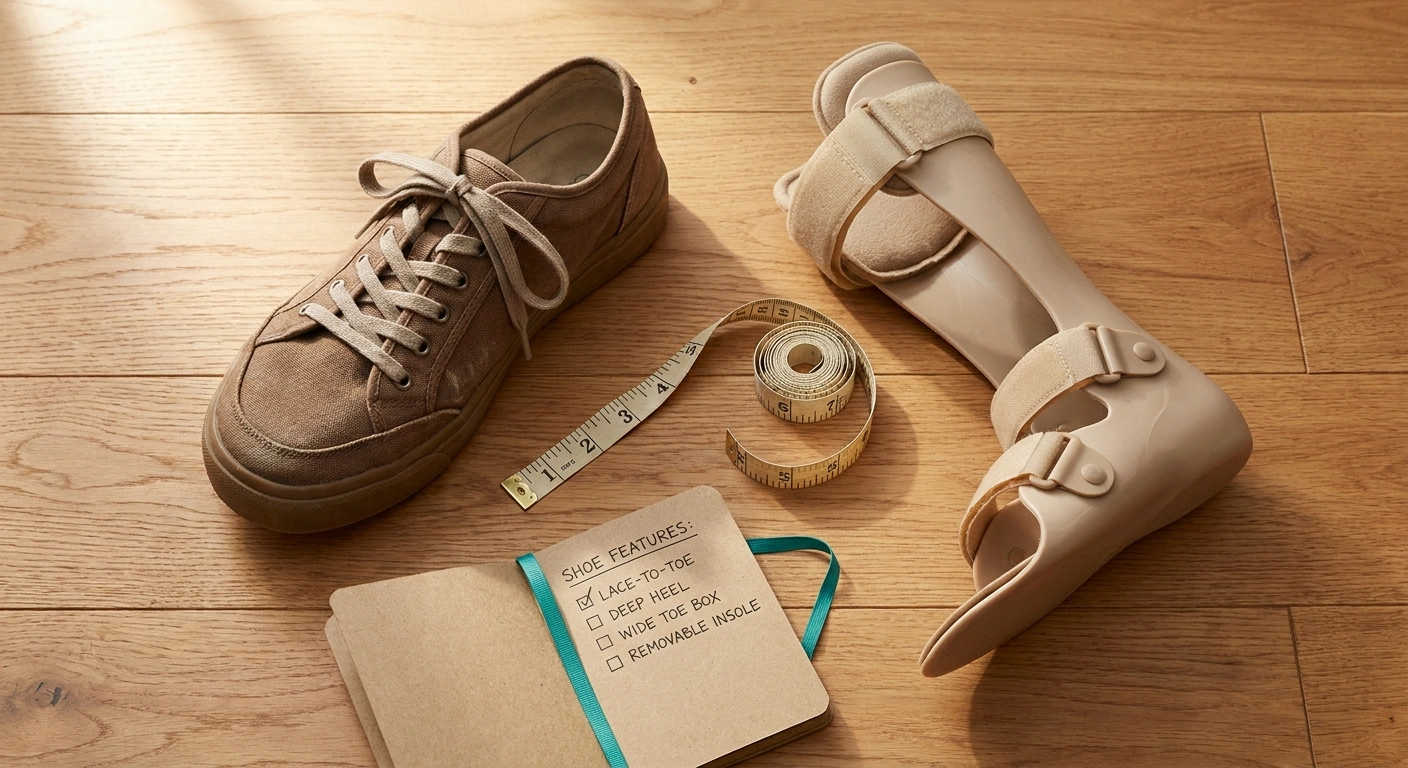
The day my friend Ruth came back from the orthotist with her first AFO brace, she set it on her kitchen table and said, with the calmest possible voice, “Now I have to throw out every shoe I own.” She wasn’t being dramatic. She tried her favorite sneakers — wouldn’t go on. Her work loafers — wouldn’t go on. Her gardening shoes — barely. The orthotist had said, “Go find shoes that fit with the brace,” and then handed her a folded list of brand names and walked away.
If you’re staring at a new AFO and the same problem, I want this article to be the friend who sits down with you and walks through it. I’m Janet — patient advocate, not a doctor or an orthotist — and I’ve watched enough friends and support-group members navigate this that I’ve collected the shopping wisdom into one place. We’ll cover what makes a shoe AFO-friendly, the features to look for on the label, the brands orthotists most commonly recommend, and a shopping protocol that saves you from coming home with a pair you can’t actually wear.
Why Your Normal Shoes Don’t Fit Anymore
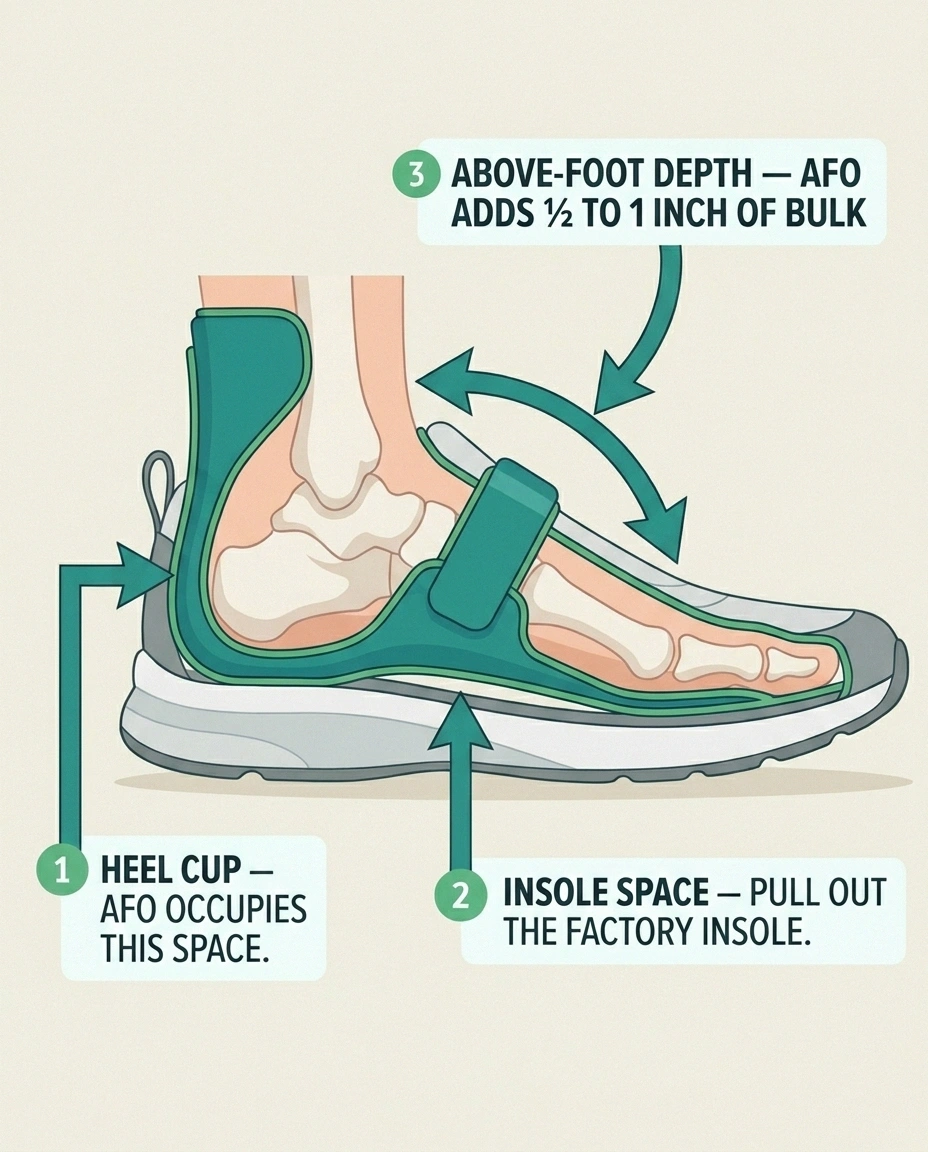
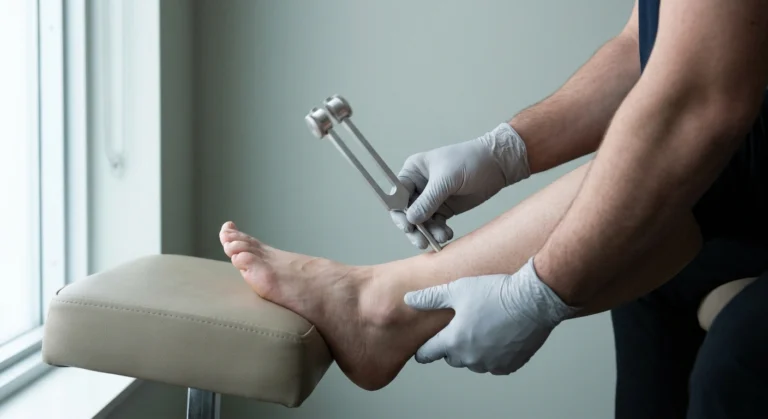
An ankle-foot orthosis — AFO for short — is a brace that wraps the back of your calf, your ankle, and the bottom of your foot. Most folks get one because of foot drop, the inability to lift the front of the foot when walking. That’s a common consequence of diabetic neuropathy, peroneal nerve injury, stroke recovery, multiple sclerosis, and a number of other conditions.
Key Takeaway
Once you know the six features — extra depth, removable insole, wide width, wide-opening closure, firm heel counter, and the right sole stiffness for your AFO style — finding the right shoe stops being trial-and-error and becomes a confident checklist you can take to any store.
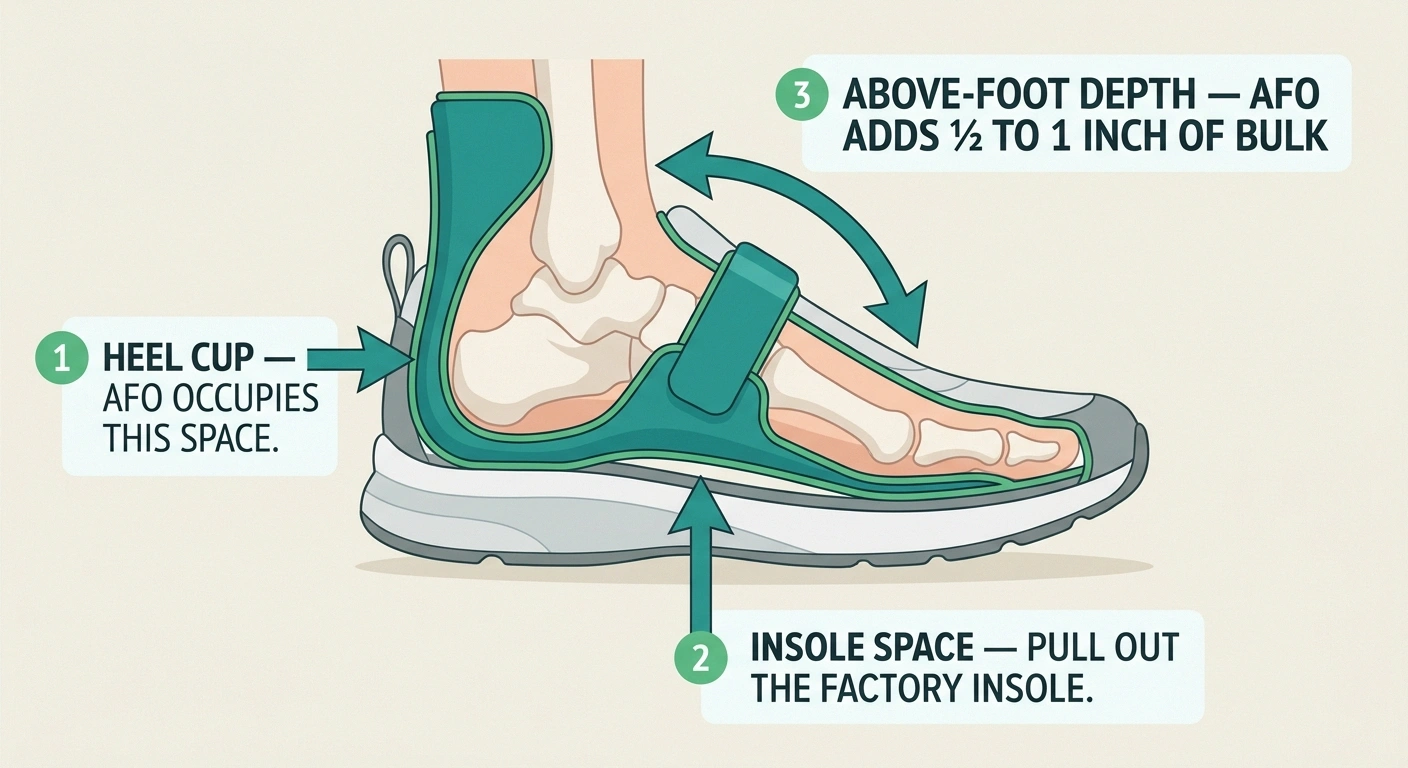
The brace itself takes up real estate inside your shoe. Specifically, it occupies:
- The heel cup — the curved back-and-bottom area where your heel sits
- The insole space — the layer between your foot and the bottom of the shoe
- Some depth above the foot — depending on the AFO style, sometimes an inch or more
Standard shoes are designed for a bare foot. They don’t have the depth, the heel room, or the wide-opening lacing to swallow a foot-plus-AFO and still close comfortably. That’s not a flaw in the shoe — it’s just the wrong tool for the new job. Once you know the features to ask for, the right shoes are findable. And once you find a pair that works, you’ll want to know the brand so you can re-buy when they wear out without going through the discovery process again.
The Six Features Every AFO-Friendly Shoe Has
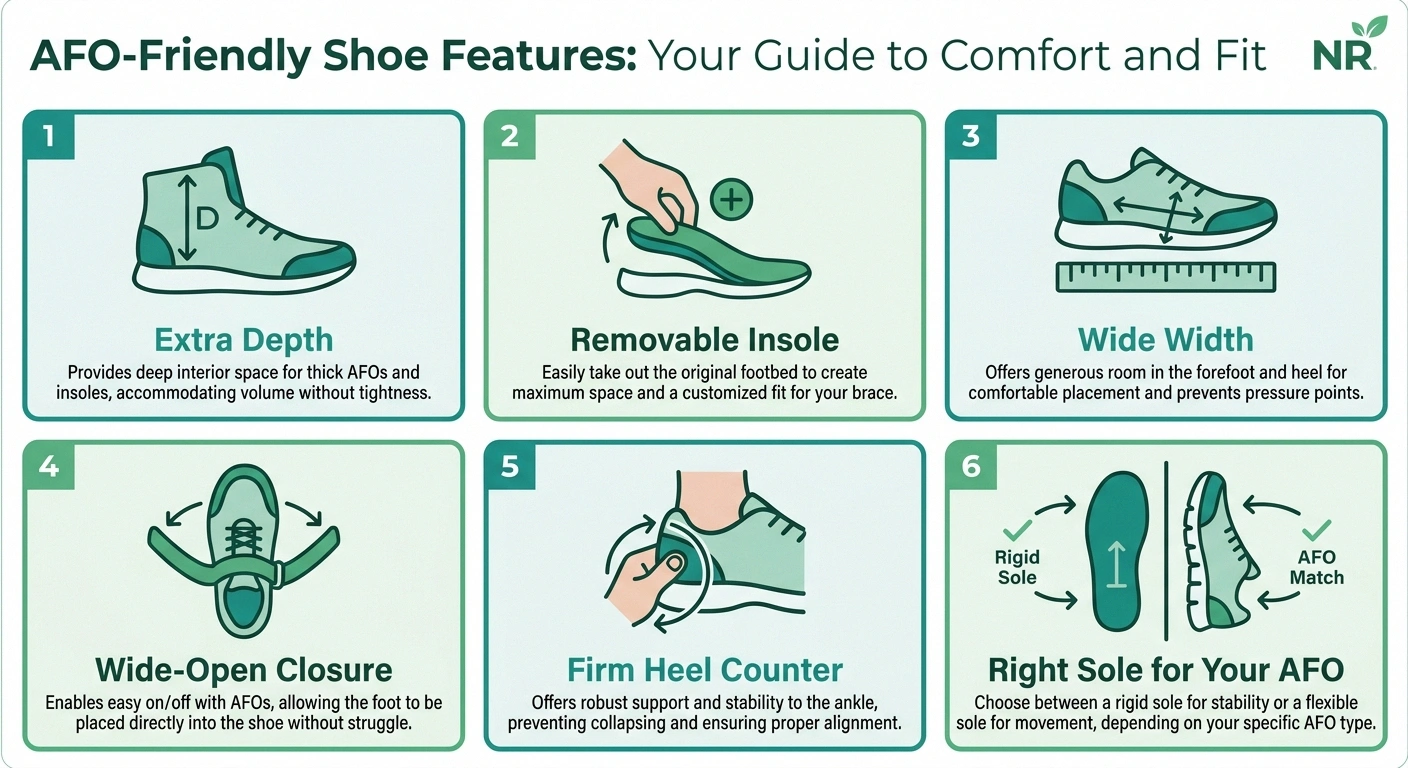
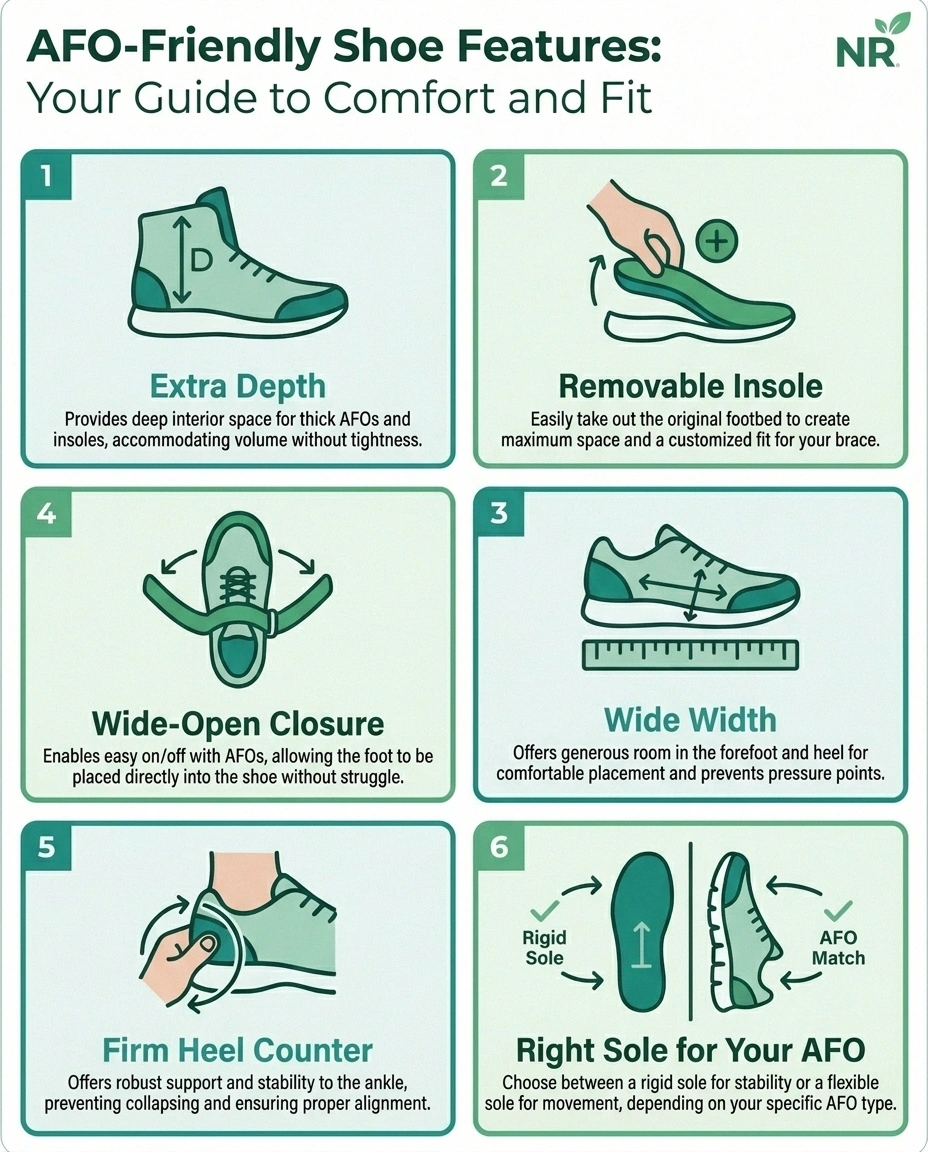
You don’t need to memorize a brand list. If you can spot these six features on a shoe — whether you’re in a specialty store, a big-box retailer, or shopping online — you’re working from real criteria.
The Six-Feature AFO Shoe Checklist
1. Extra Depth
“Extra depth” or “double depth” is a specific shoe-industry term. It means the shoe is taller from the insole to the top opening than a standard shoe, leaving room for an orthotic or a brace. Many therapeutic shoe lines (Drew, Orthofeet, Apex, Brooks Addiction) label their depth right on the box. If you don’t see “extra depth,” look at the shoe’s profile — a tall, blocky look usually means more interior room than a sleek athletic profile.
2. Removable Insole
Pull the factory insole out and you reclaim a quarter-inch to a half-inch of vertical space. That space is often the difference between an AFO fitting and not. Most modern walking shoes have removable insoles; older dress styles often do not. Before buying, lift the insole to check. If it’s glued in, walk away.
3. Wide Width Options
Most adults in standard sneakers wear medium width. AFO users typically need wide (D for women, 2E for men), extra wide (2E for women, 4E for men), or even XX-wide. Width matters more than length in this case — too narrow a shoe will squeeze the AFO into the side of your foot and create pressure sores. Brands that offer multiple widths in the same model are a treasure for AFO users — New Balance, Brooks, Drew, Orthofeet, and Propét all do this consistently.
4. A Wide-Opening Closure
You need to physically get your foot, with the AFO on, into the shoe. Standard six-eyelet sneaker lacing usually doesn’t open wide enough. Look for:
- Lace-to-toe — laces extend all the way down to the toe box so the shoe opens up like a book
- Side zipper — many therapeutic shoes have a hidden side zip you can open to get in, then re-close
- Hook-and-loop straps (Velcro) — three or four wide straps make on-and-off fast and easy, especially with limited hand strength from hand neuropathy
5. A Firm Heel Counter
The heel counter is the rigid back of the shoe that holds the AFO seated in place. Press it with your thumb — it should NOT collapse easily. A soft, squishy heel counter lets the AFO slide and shift inside the shoe, which defeats its whole purpose.
6. The Right Sole for Your AFO Style
This one is more nuanced. A rigid, solid plastic AFO usually pairs well with a moderately stiff rocker sole — the kind that has a gentle curve at the toe to help you roll forward. A dynamic carbon-fiber AFO (like the Allard ToeOFF) prefers a more flexible sole that lets the brace do its springy work. If you’re unsure, ask your orthotist what sole stiffness fits your brace — that one question can save you a return trip.
The Brands Orthotists Recommend Most Often
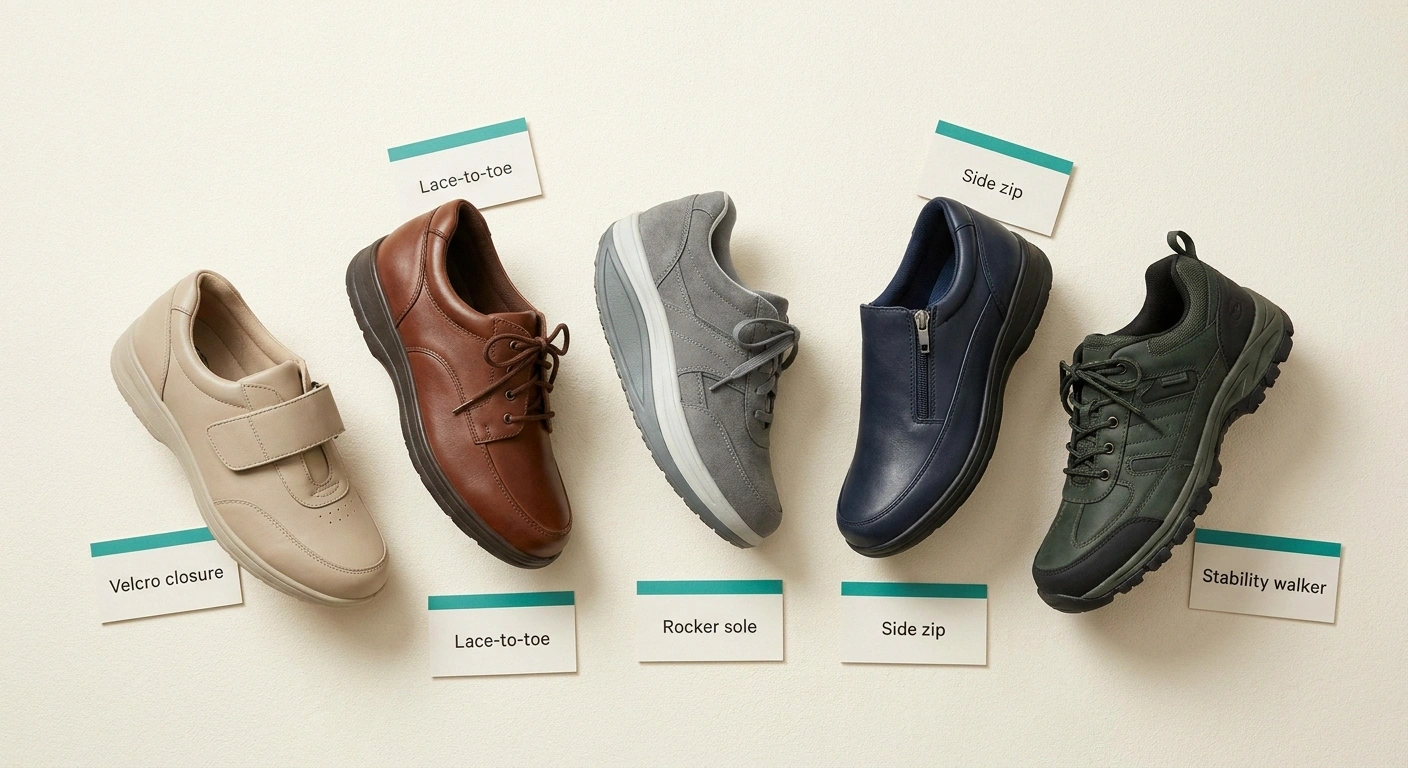
None of these are paid endorsements — they’re the names I hear over and over from orthotists, prosthetists, and AFO users in support groups. Use them as a starting point, then apply the six-feature test.
Brands Most Commonly Recommended by Orthotists
| Brand / Model | Strength | Price Range |
|---|---|---|
| New Balance 928v3 / 1540v3 | Multiple widths to 6E, lace-to-toe option | $130–$180 |
| Brooks Addiction Walker | Heavy stability and motion control | $140–$170 |
| Hubbard Friction-Free | Purpose-built for AFO use, reduces rubbing | $200+ |
| Apex Ambulator | Therapeutic line, often Medicare-eligible | $130–$180 |
| Drew Boast (and others) | Serious heel counter, lace-to-toe | $140–$200 |
| Orthofeet (multiple) | Hook-and-loop options, frequently insurance-eligible | $110–$160 |
| Propét Stability Walker | Affordable extra-depth walker, widely available | $85–$130 |
Prices vary by retailer, size, and width. Use the six-feature checklist regardless of brand.
- New Balance 928v3 and 1540v3. The 928 is the workhorse — extra depth, removable insole, available in multiple widths up to 6E in some sizes, lace-to-toe option. Many orthotists call this their first recommendation. The 1540 is a slightly higher-end stability variant.
- Brooks Addiction Walker. Heavy, supportive, motion-control walker with extra depth and a removable insole. Heavier than the New Balance options but excellent stability.
- Hubbard Friction-Free. Purpose-built for AFO and orthotic users — the interior is specifically designed to reduce the rubbing that creates pressure sores. A favorite of long-time AFO wearers, though pricier than mainstream brands.
- Apex Ambulator. Therapeutic-shoe line designed for orthotic and diabetic use. Extra depth, removable insole, multiple widths, often Medicare-eligible under the therapeutic shoe benefit.
- Drew Boast and other Drew models. Specialty therapeutic shoes with serious heel counters and lace-to-toe construction. Good for difficult fits.
- Orthofeet (various models). A consumer-facing therapeutic brand with extra depth, removable insoles, and hook-and-loop options. Frequently covered under Medicare’s diabetic shoe program.
- Propét Stability Walker. A more affordable extra-depth walker that works for many AFO users. Widely available and often eligible for insurance reimbursement.
If you’ve already read our larger guide on the best shoes for neuropathy, you’ll notice some overlap — many of the same brands work for both general neuropathy comfort and AFO accommodation, because the underlying design priorities (depth, removable insole, multiple widths, rigid heel) serve both needs.
Sizing With an AFO Brace
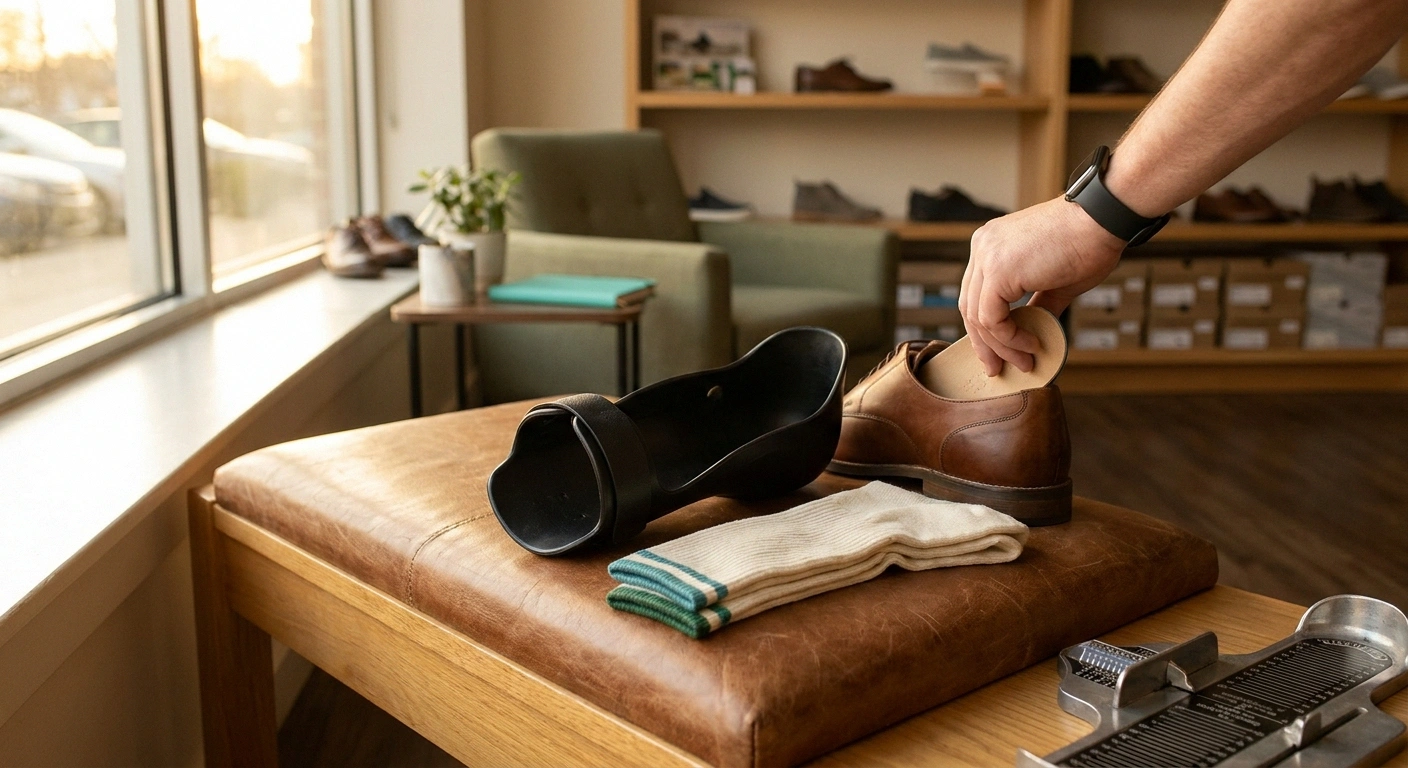
This is where most first-time AFO shoppers get tripped up. The bare-foot size you wore for thirty years is no longer your shoe size.
Sizing Quick Reference
- Go up a half size minimum, sometimes a full size
- Go up in width before going up in length
- Try shoes in the afternoon — feet swell over the day
- Bring your AFO and the socks you wear to the fitting
- Many AFO users wind up needing different sizes left vs. right
- Go up at least a half-size. Sometimes a full size. The AFO adds bulk both under and around the foot.
- Go up in width before you go up in length. If the shoe is the right length but pinches sideways, you need wider, not longer.
- Try shoes in the afternoon. Feet swell over the course of the day. Morning fittings often produce shoes that pinch by 3 p.m.
- Bring your AFO to the store. Don’t try to “guess” the fit. Put the brace on, then try the shoe.
- Bring the socks you’ll actually wear. Thick athletic socks change the fit considerably. Most AFO users wear thin-but-cushioned, seamless socks rather than thick ones — there’s only so much depth to share.
- Test both feet. If you wear the AFO on only one foot, the AFO foot may need a larger or wider size than the other. Some retailers (Hubbard, certain therapeutic shoe programs) will sell mismatched pairs. Most consumer brands won’t, so you’ll buy two pairs and trade.
The Shopping Day That Actually Works
If you set out to shoe-shop without a plan, you’ll come home tired and probably with the wrong pair. Try this rhythm instead.
A Shopping Day That Doesn’t Waste Your Energy
- Call ahead. Ask whether the store carries therapeutic or extra-depth shoes, and whether anyone on staff is a certified pedorthist or has AFO-fitting experience. If the answer is no, save yourself the trip.
- Go in the afternoon, with the AFO on, in the socks you actually wear. Bring your old shoes for size reference. Bring the prescription or paperwork from your orthotist if you have it — some retailers and most Medicare-covered programs need it.
- Try at least three different brands. Walk in the shoes around the store for at least five minutes — not just up and down the carpeted runway. Try a slight incline if possible.
- Check the heel-lift. When you walk, the heel of the shoe should stay snug against your AFO’s heel. If your foot lifts out of the back, the shoe is wrong, even if everything else feels OK.
- Take a photo of the box. Brand, model, size, width. So when these wear out in 18 months, you can re-order without re-doing the whole search.
Insurance, Medicare, and What’s Covered
If you have diabetes and a documented diabetic-foot complication (including peripheral neuropathy with foot deformity), Medicare’s Therapeutic Shoe Benefit covers one pair of extra-depth shoes plus three pairs of custom inserts per calendar year. Many private insurers offer a similar benefit. The shoes must come from a Medicare-approved supplier and require a prescription from the doctor managing your diabetes.
Medicare’s Therapeutic Shoe Benefit covers one pair of extra-depth shoes plus three pairs of custom inserts per calendar year for qualifying diabetic patients with documented foot complications.
If you have an AFO from a non-diabetic cause — say, a stroke or a non-diabetic neuropathy — the shoe coverage is more variable. Many AFO providers know the territory and can guide you. Asking your orthotist’s billing office “What’s my shoe benefit under my plan?” is a 10-minute call that often unlocks a few hundred dollars of coverage.
Beyond the Shoe: Two Often-Overlooked Tools
The right shoe is the main event, but two small additions can transform the daily experience.
- A long-handled shoehorn. Slipping a foot-plus-AFO into a shoe without bending double is genuinely hard if your back, knees, or balance aren’t cooperative. A 24-inch metal shoehorn is the under-$15 quality-of-life upgrade most AFO users wish they’d bought sooner.
- Elastic or coiled “no-tie” laces. If the shoe has standard laces, replacing them with elastic versions means you slip on and off without re-tying. Easier with limited hand dexterity and protects the fit from “loosening” as you re-lace.
If standing in one spot for shoe-shopping has gotten difficult, that’s part of a bigger conversation about balance and fall prevention that deserves your attention regardless of footwear. The AFO solves part of the problem; the right shoe completes the foundation; but proactive fall-prevention habits are what keep you upright on the days the AFO foot has its own opinions.
Caring for Shoes That Carry an AFO
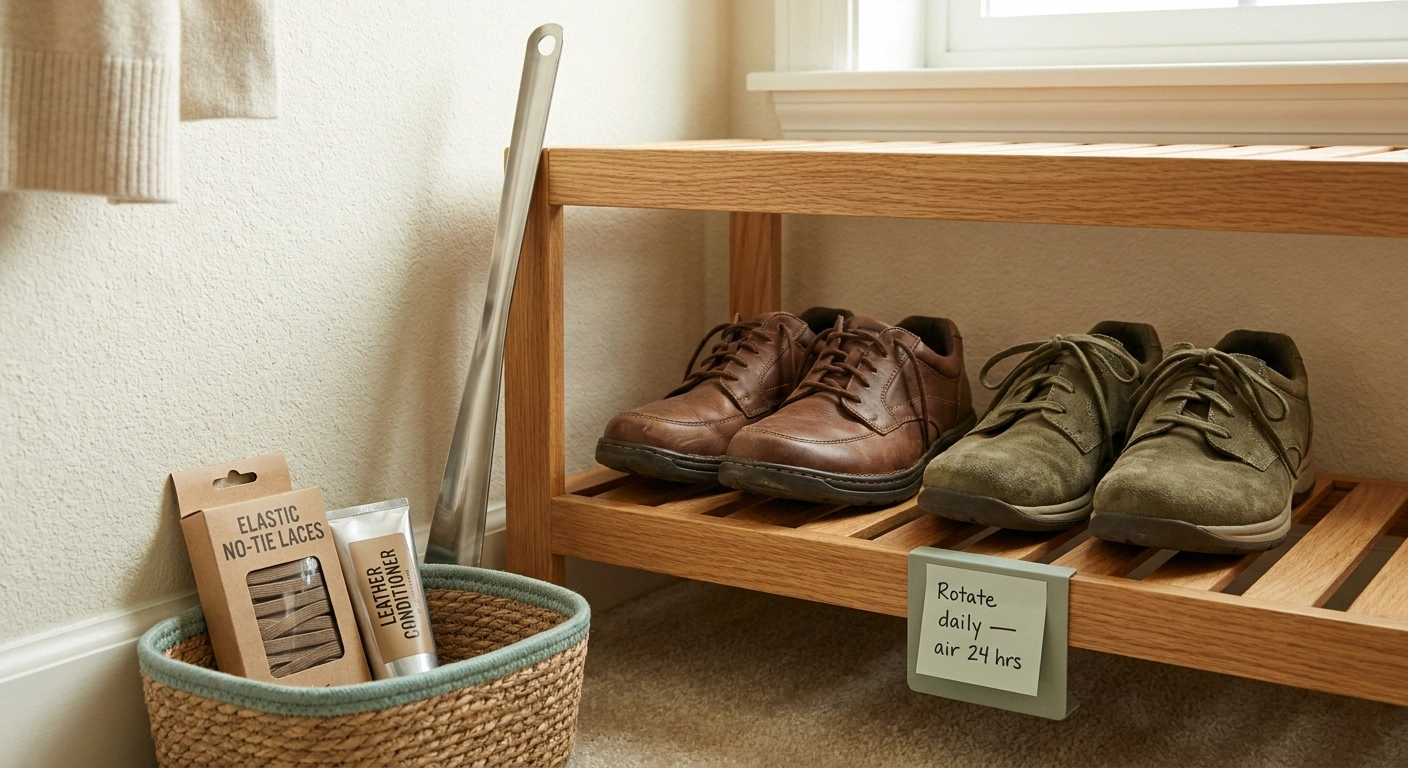
- Rotate two pairs. Shoes need 24 hours to fully air out between wears, especially when an AFO is creating warm-and-not-very-ventilated conditions inside. Two pairs roughly double the lifespan of each.
- Inspect the inside daily. Run your hand around the inside of the shoe before putting it on. AFOs occasionally rub a rough patch into the inside lining; a daily foot inspection plus an interior-shoe check catches problems before they become wounds.
- Replace at the first sign of heel-counter collapse. When you can squish the back of the shoe between thumb and forefinger more easily than you could when it was new, the shoe has lost its AFO-supporting structure. Time to replace.
- Clean the AFO regularly. Wipe the foot plate with a damp cloth at end of day. Some AFO users put a thin sock-liner between foot and AFO for moisture management.
The Honest Bottom Line
The first AFO-and-shoe match takes time. Plan on visiting at least two stores or trying multiple online pairs before you find one that works. Once you do, write down the exact brand, model, size, and width — and re-order without drama when they wear out. The frustrating part is the discovery phase. The good news is it’s a one-time effort that pays off for years.
And don’t be shy about asking your orthotist for help. They fit AFOs for a living. Most have a shortlist of local stores or online retailers they trust, and many will let you bring shoes back to their office to confirm the fit with the brace seated correctly. That’s a free second opinion most patients never use.
You’re not the first person to stand in the kitchen with an unwearable closet full of shoes, and you won’t be the last. There’s a pair out there that fits. We just have to find it.
Frequently Asked Questions
Do I really need extra-depth shoes, or can I just wear a bigger regular shoe?
A bigger regular shoe will technically accept the foot plus AFO, but the fit is usually wrong in ways that matter. The heel slides because the heel counter isn’t built for the bulk. The toe box is too narrow because regular shoes scale width and length together. And without a removable insole, you can’t reclaim the vertical space the AFO needs. Extra-depth shoes solve those problems in one design. They’re worth the search.
Can I wear sandals or open-toe shoes with my AFO?
Most AFOs require a closed-toe, closed-heel shoe to seat properly and to provide the stability the brace assumes. Some specialty AFO-compatible sandals exist (Allard makes a sandal version of the ToeOFF, for example), but they’re a minority and your orthotist may or may not approve them for your specific brace. Ask before you buy.
Will the same brand and model fit me forever?
Probably not. Brands quietly redesign shoes year over year. A 2024 New Balance 928v3 may fit slightly differently than a 2026 model — sometimes the change is just a sole tweak, sometimes it’s significant. Try the shoe on each time you re-buy, even if you “know” the size. Keep a photo of the working box as a starting point, not as a guarantee.
Are men’s shoes better for AFO use than women’s?
Many women with AFOs wear men’s shoes because they offer more width and depth options. There’s no rule against it. A women’s size 8 is roughly a men’s 6.5, so the conversion is straightforward. Walk into the store knowing both sizes and try whichever fits better.
What if both my feet need different shoe sizes now?
AFO use commonly creates a left-vs-right size mismatch. A few specialty retailers and some Medicare-covered programs will sell mismatched pairs. Most consumer brands won’t — so the workaround is to buy two pairs, keep the correct-size shoe from each, and either return the others or donate them to programs that re-distribute mismatched shoes to amputees and AFO users.
How often should I replace AFO-friendly shoes?
Plan on 9 to 18 months of regular wear before the heel counter softens enough to compromise AFO support, even if the soles still look fine. Rotating two pairs extends both. Walking-shoe wear tends to be slightly faster than dress-shoe wear because of the activity level.
Do I need a doctor’s prescription to buy AFO-friendly shoes?
To buy them off the shelf, no. To have them paid for by Medicare or insurance under a therapeutic-shoe benefit, yes — you’ll need a prescription and the shoes must come from an approved supplier. Your orthotist or primary care doctor can write the prescription if you qualify.
Can I wear my AFO without a shoe around the house?
It’s usually safer not to. AFOs are designed to function within a shoe. Walking on a hard floor with just the plastic foot plate is slippery, and walking on carpet without a shoe lets the foot plate flex in ways it wasn’t engineered to. If you need lightweight house option, a soft-soled AFO-compatible house shoe is a better choice. Ask your orthotist for recommendations specific to your brace.
About the Author