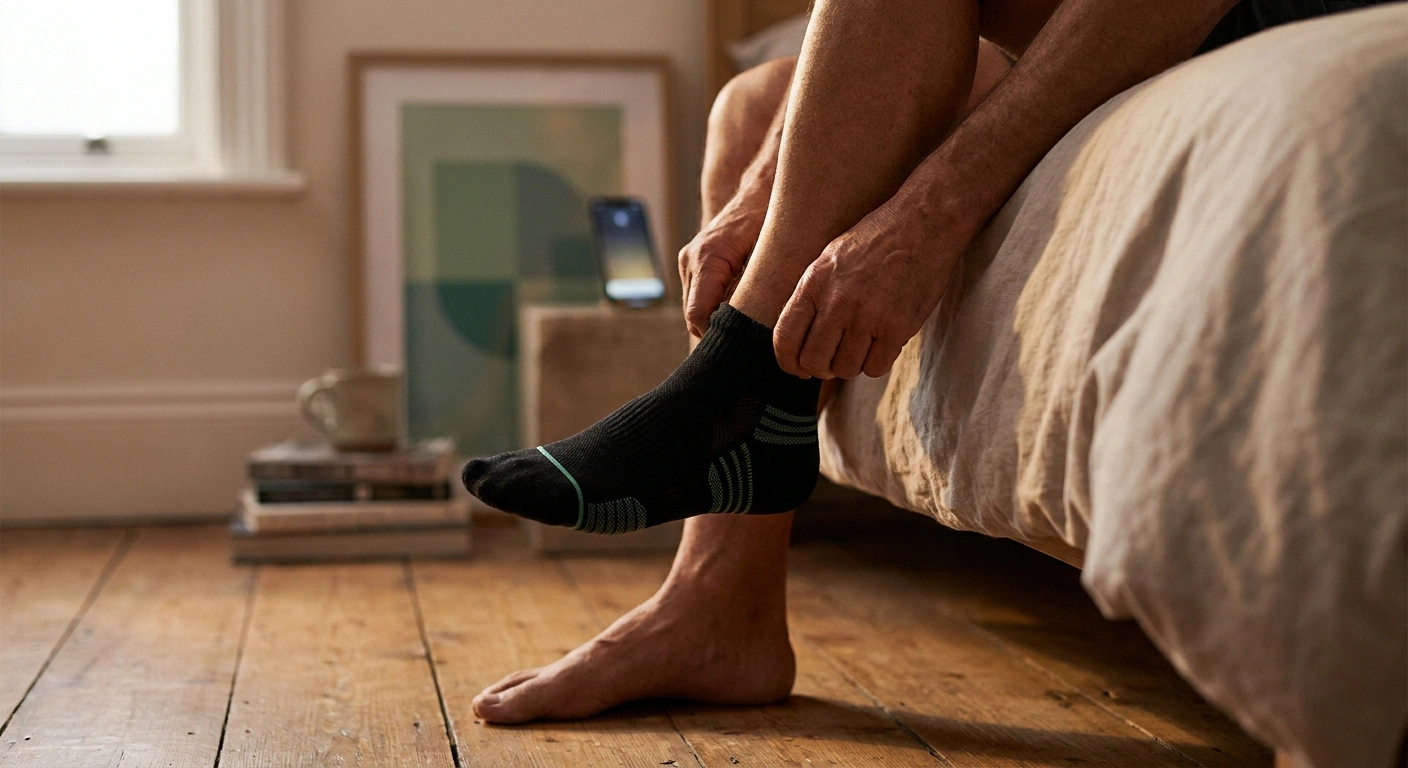
A man I met at a diabetic support meeting last spring — I’ll call him Wade — walked in on crutches. The week before, his podiatrist had told him he was going to lose two toes to a pressure ulcer he never felt forming. Wade has diabetic peripheral neuropathy. His feet had gone numb years earlier. Every night for a decade he’d done what his doctors told him: eye-check the top and bottom of each foot, run his hand across the pads, feel for anything hot or swollen. The morning the ulcer became visible, his sock was already sticking to it. Two days later he was in surgery.
Wade’s story is the one I think about every time someone asks me whether “smart socks” are worth the hype. Here’s the physics of what happened to him. Long before that ulcer was visible on the surface, a hot spot had been building inside the tissue — a small area of inflammation from repeated pressure, quietly climbing a degree or two above the rest of his foot for days. If Wade could have felt it, he’d have offloaded the pressure. He couldn’t feel it. And his once-a-day visual check missed it because at that stage it was still under the skin.
That temperature gap — the window between when the tissue starts signaling and when the eye can finally see damage — is exactly what smart socks and foot-monitoring mats are designed to close. This is the article I wish Wade had found five years ago.
Why Temperature Is Neuropathy’s Earliest Warning Sign
Pain is your body’s alarm bell. When a shoe rubs a hot spot, or a callus starts to break down, or a bit of gravel wears into the arch of your foot, healthy nerves send a signal so fast you don’t even remember pulling your foot back. Neuropathy silences that alarm. The rubbing keeps happening. The tissue keeps breaking down. And by the time the damage becomes visible, it’s usually well past the earliest, most treatable stage.
The One Number Worth Remembering
When the same spot on one foot runs 2.2°F (1.2°C) warmer than the matching spot on the other foot for two days in a row, ulcer risk in the next week is dramatically elevated. That single asymmetric-warming threshold is the trigger every smart sock and monitoring mat is calibrated against, and catching it early is what drove a 52% reduction in ulcer incidence in the Podimetrics VA trial.
What most patients — and, honestly, plenty of clinicians — don’t realize is that the tissue has been signaling for days before the eye can see anything. That signal is heat. Inflammation increases local blood flow, and increased blood flow warms the skin at the site. In one foot, on one small patch. The other foot, doing the same walking and wearing the same shoe, stays at baseline. So a spot on your right heel might quietly climb two or three degrees above the matching spot on your left heel for four or five days straight before any redness, swelling, or open wound shows up.
Researchers have known this for decades. What’s new is that we now have technology sensitive enough to catch that temperature difference in your own kitchen, without a clinician standing over you with a thermal camera. If you’re new to the ways diabetic neuropathy silently accumulates damage, the fact that heat rises before pain would is one of the most useful things to understand about the disease.
What the Research Actually Shows
The specific threshold that clinicians pay attention to comes out of years of work by Dr. David Armstrong, Dr. Lawrence Lavery, and colleagues. In their published studies, when the same spot on one foot runs 2.2°F (1.2°C) warmer than the matching spot on the other foot for two days in a row, the risk of an ulcer forming at that spot within the next week is dramatically elevated. That single number — 2.2°F asymmetric warming — is the trigger threshold most home-monitoring programs use today.
What the Research Says
The pivotal outcomes trial (Frykberg et al., Diabetes Care, 2017) followed high-risk Veterans Affairs patients over 34 weeks. Those using a daily home temperature-monitoring mat experienced a 52% reduction in diabetic foot ulcer incidence compared to standard care alone.
The VA has since scaled the program to thousands of veterans nationwide, and follow-up studies through 2019 and 2022 continue to show the same pattern.
The most convincing outcomes data comes from a 2017 clinical trial led by Dr. Robert Frykberg, published in Diabetes Care, that studied Podimetrics’ remote temperature monitoring in a high-risk Veterans Affairs population. Over 34 weeks, patients using a daily monitoring mat had a 52% reduction in the incidence of diabetic foot ulcers compared to standard care alone. The Department of Veterans Affairs has since expanded the program to thousands of veterans nationwide based on those results.
Follow-up studies through 2019 and 2022 have continued to show the same pattern. When patients can catch an emerging hot spot 5 to 7 days before it becomes a visible wound, and when they can respond by offloading pressure or calling their care team, the ulcer often never forms. When it does form, it forms smaller and heals faster. For a complication that in worst-case scenarios ends in amputation, “we caught it a week early” is language that changes lives.
If you’re not sure where you fall on the risk spectrum, the stages of neuropathy map out how loss of protective sensation typically progresses, and your neuropathy diagnosis workup should include a 10-gram monofilament test to establish whether you’ve crossed that threshold.
Siren Care Smart Socks — How They Work
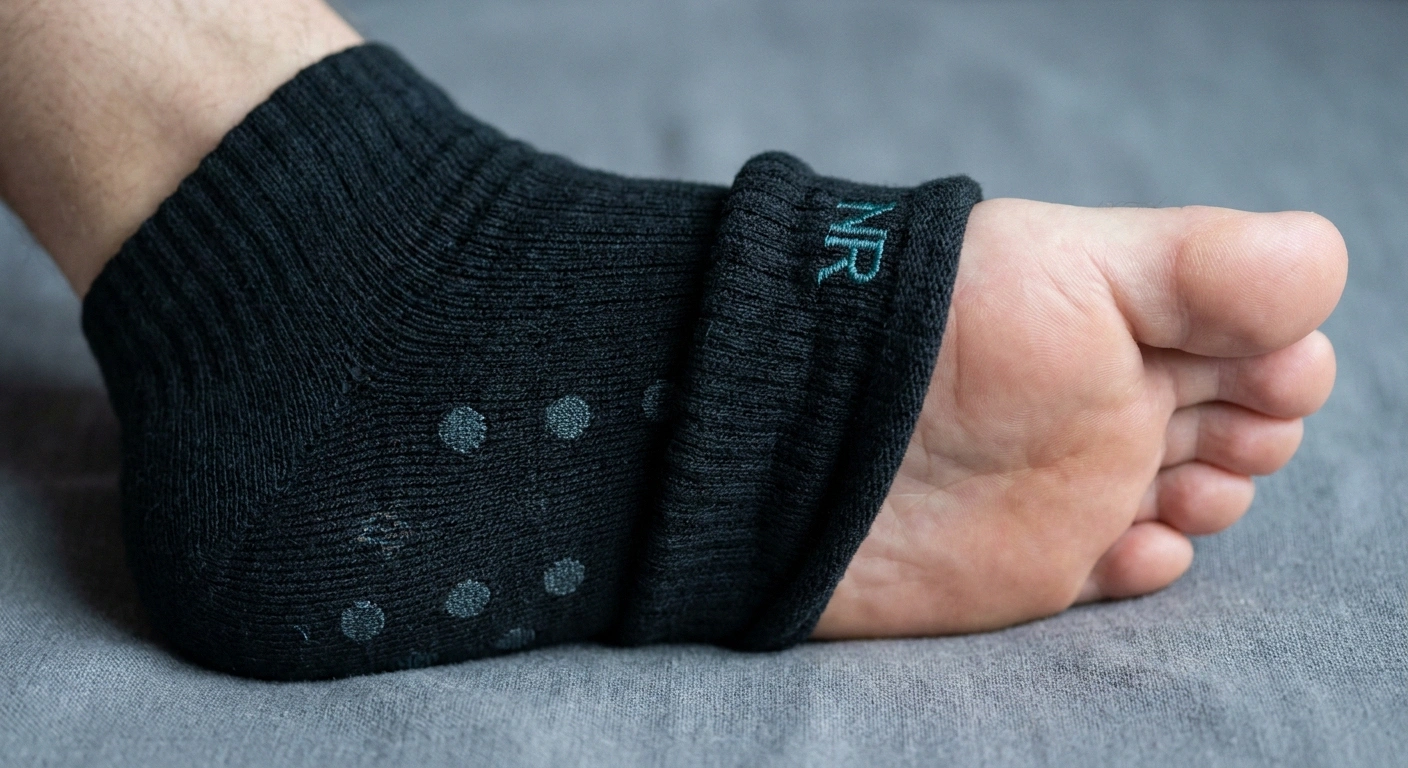
Siren’s product looks, at a glance, essentially like a pair of black athletic socks. What makes them different is invisible. Woven into the fabric across the bottom of the foot are six tiny microsensors — three per sock in most current models. Those sensors continuously read the surface temperature of the foot at specific anatomical points, all day long, whenever you’re wearing the sock.
How the Daily Loop Actually Works
Sensors read foot temperature continuously (socks) or in a 20-second daily scan (mat).
Data streams to a home hub, then to an app or the manufacturer’s clinical team.
Software compares left vs right feet at matching anatomical points.
If asymmetry crosses 2.2°F for 2+ days, an alert fires to patient and care team.
Patient offloads pressure and gets in to the podiatrist within 24-48 hours.
The data streams by Bluetooth to a small hub in the house and then up to a smartphone app. The app compares the readings from your left foot to your right foot at matching points — heel to heel, first-metatarsal to first-metatarsal, big-toe pad to big-toe pad. If any pair diverges by that 2.2°F threshold for a sustained period, the app alerts you. In the medical-monitoring version of the service, the alert also goes to a clinical team who can call you directly.
The socks are machine washable, which was a genuine engineering challenge — the sensors and antennae have to survive detergent, hot water, and tumbling. The company recommends replacing the pair every six months, and the model is subscription-based: you get replacement socks on a rolling schedule as part of the monthly fee. Battery life on the sensors is designed to outlast that six-month window without needing a charge, so from your side, there’s nothing to plug in.
The practical experience for most patients is that you put on the socks in the morning, forget you’re wearing them, and only think about them if the app pings. In the trials and post-market studies Siren has published, the alert rate for any given patient is low — you’re not getting notifications every day. That’s the point: the technology is meant to be invisible until it matters.
Podimetrics SmartMat — The Home-Mat Approach
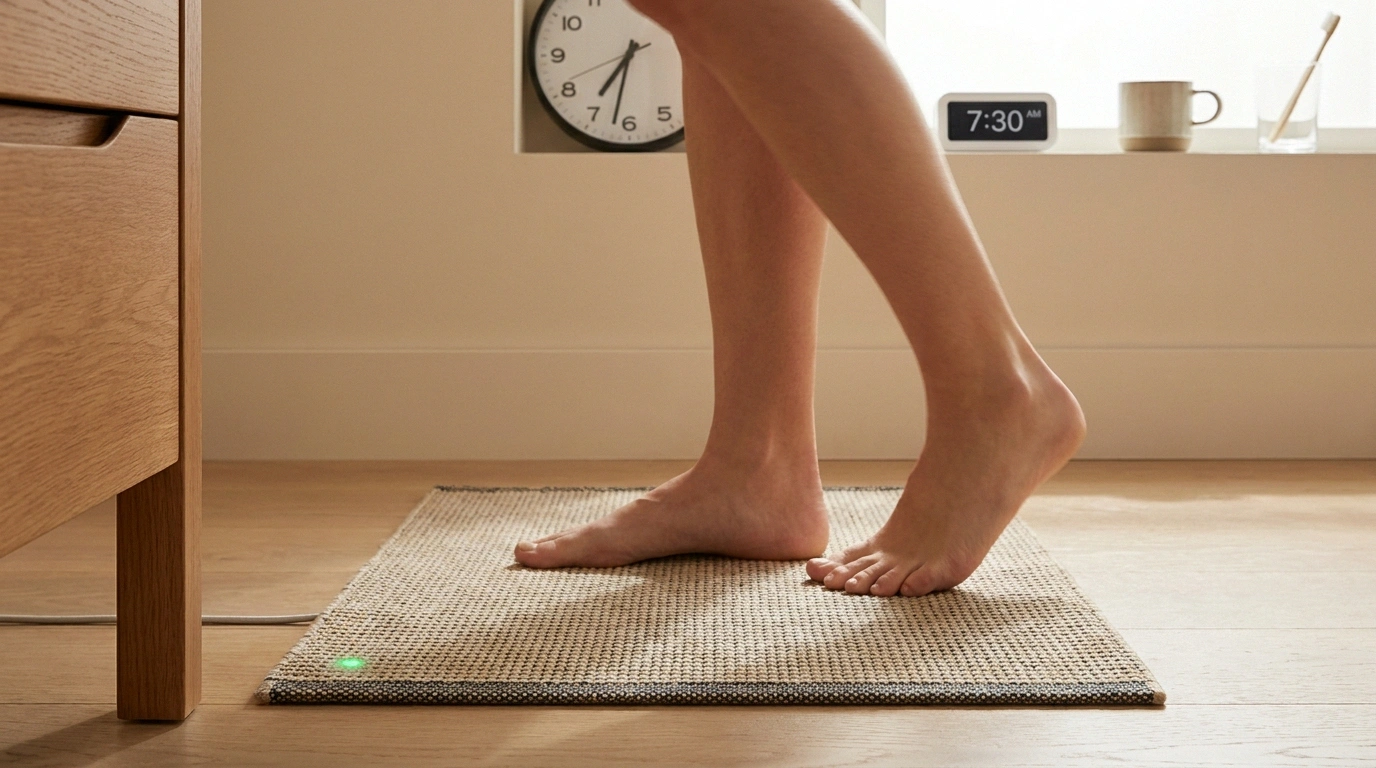
Podimetrics takes a different design approach to the same problem. Instead of putting sensors in socks, they put a grid of temperature sensors into a floor mat about the size of a bathroom scale. The patient steps onto the mat, barefoot, once a day for about 20 seconds. The mat captures a full temperature map of the bottoms of both feet in that time and sends the data to a cellular hub that lives in the home. No smartphone or Wi-Fi setup required.
Two Approaches, Same Goal
Siren Care Smart Socks
Form: Machine-washable athletic sock with 6 embedded microsensors.
Wear pattern: All-day passive monitoring during weight-bearing activity.
Alert path: Smartphone app plus optional clinical team call.
Replaced: Every 6 months via subscription.
Podimetrics SmartMat
Form: Bathroom-scale-sized floor mat with sensor grid.
Wear pattern: Barefoot 20-second stand once daily.
Alert path: Cellular hub, then direct phone call from a nurse care manager.
Coverage: Fully covered by VA and many Medicare Advantage plans.
The reading goes to a Podimetrics clinical care team that reviews trends and asymmetries. If anything crosses the trigger threshold, they call the patient directly — not a text or an app notification, an actual phone call from a nurse care manager who walks them through what to do next: offload the pressure, inspect the spot, get in to see the podiatrist. That human-in-the-loop touch is a big part of why the VA program has scaled so successfully. It doesn’t rely on patients interpreting their own data.
For many older patients, especially those who don’t want to fuss with a smartphone app or worry about whether their socks are charged, the mat’s simplicity is its whole appeal. Step on it while you’re brushing your teeth in the morning. If they don’t call you, everything is fine. If they call, you know something needs attention. It’s the smart-home equivalent of a smoke detector on the ceiling: silent until it isn’t.
The mat model has one other quiet advantage worth naming. Because the readings all come from the sole of the foot in a standardized position, the temperature map is highly consistent day over day. A sock’s sensors move slightly with each wear, and the software has to account for that. The mat effectively takes the same picture every morning, which makes trend lines cleaner and false alerts less common. Neither approach is inherently better than the other — they’re solving the same problem from two different angles, and the right one for you depends on your daily life, not on the technology alone.
Who These Tools Are Actually For
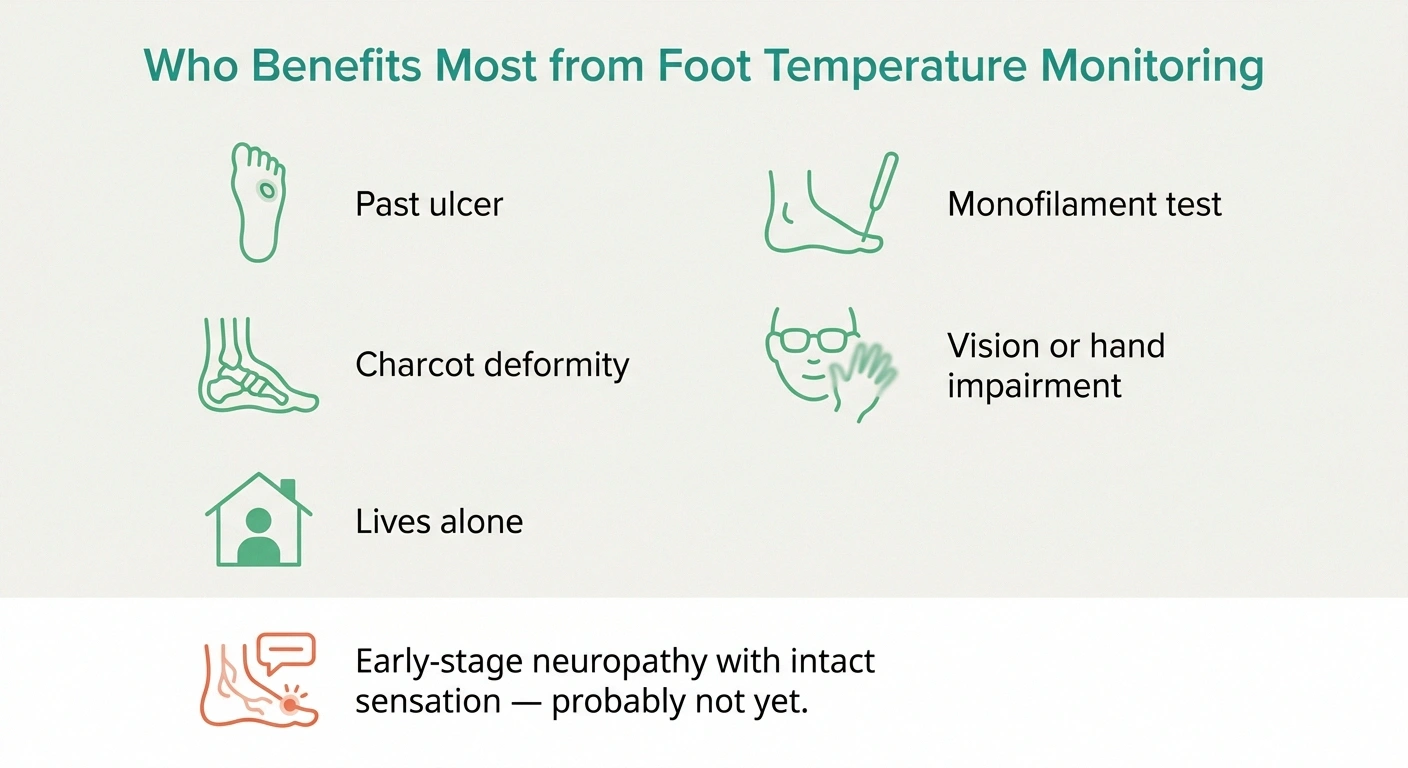
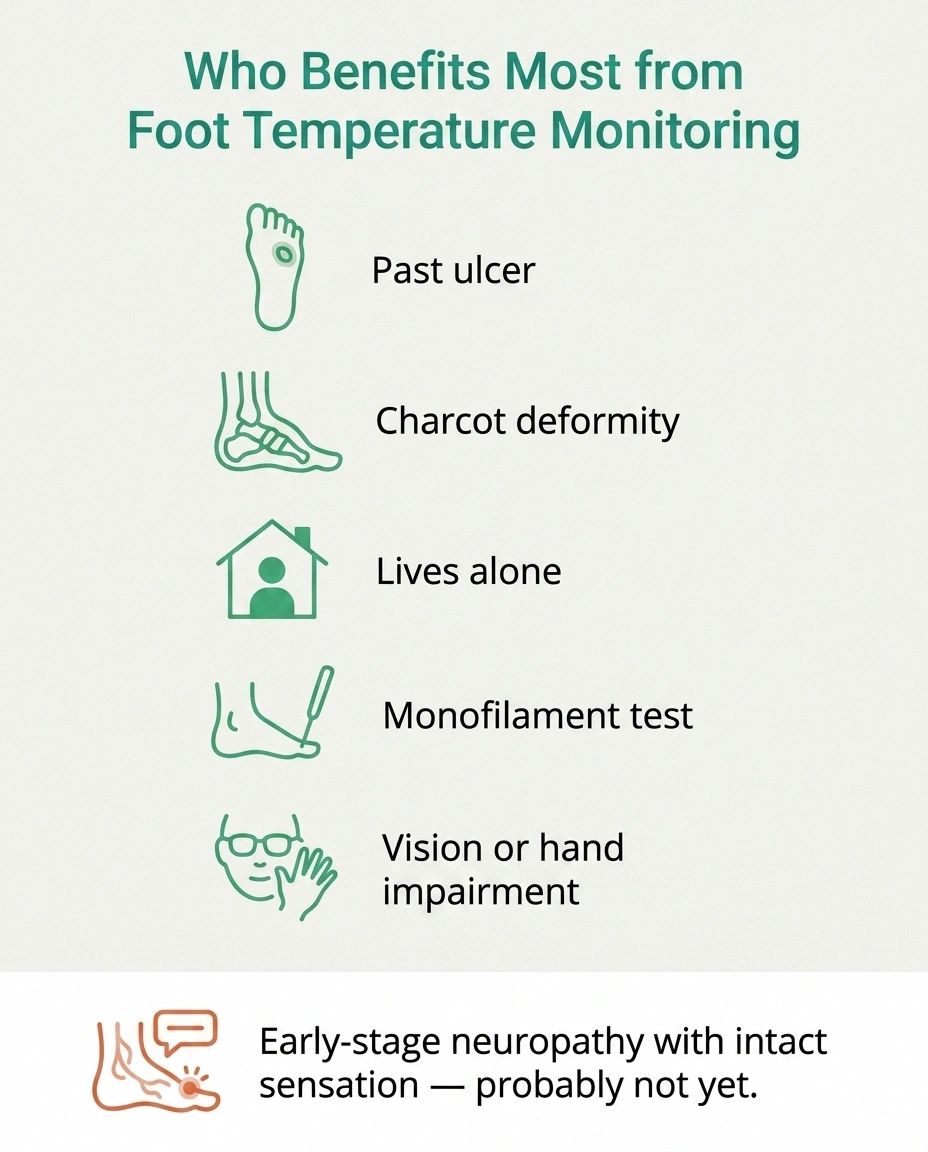
Temperature monitoring is not for every person with neuropathy. It’s specifically designed for people who have lost protective sensation in their feet and who are therefore at elevated risk for ulceration. The clearest candidates are:
reduction in diabetic foot ulcer incidence at 34 weeks in the Podimetrics VA trial — the strongest single data point behind home temperature monitoring as a prevention strategy.
- Anyone with diabetic peripheral neuropathy who has had a foot ulcer in the past. Recurrence rates are as high as 40% within a year, and prevention is everything.
- Patients who fail a 10-gram monofilament test at two or more sites on the foot, indicating loss of protective sensation.
- People with Charcot foot deformity or a history of Charcot changes, where subtle temperature asymmetries can also signal an acute flare.
- Patients with vision impairment or arthritis in the hands that makes reliable daily self-inspection genuinely difficult.
- People who live alone or don’t have a partner who can help check the bottoms of their feet each night.
Someone with early-stage neuropathy who still has intact protective sensation, and who doesn’t yet fit any of those risk categories, may not get much value from continuous temperature monitoring. The device is expensive, the alert threshold is calibrated for high-risk feet, and it can generate anxiety more than useful information in someone whose alarm bell still works. For that group, the fundamentals of good neuropathy foot care and well-fitting shoes for neuropathy matter more than any device.
Insurance, Cost, and Practical Realities
The honest answer on cost is that it depends heavily on your insurance and where you live. Podimetrics has partnerships with the VA and with a growing number of Medicare Advantage plans that fully cover the mat and the monitoring service for eligible patients, with no out-of-pocket cost. The company also contracts with several large commercial insurers. If your plan is one of them, you pay nothing beyond your normal premium. If not, cash prices exist but are meaningful.

Siren has moved more toward direct-to-consumer subscription pricing, typically in the range of a modest gym membership per month, with insurance coverage still expanding. Medicare Part B may cover the socks as durable medical equipment under certain codes when they’re prescribed for a patient meeting specific risk criteria, but this varies by region and by your local Medicare Administrative Contractor. The single best first step is to have your podiatrist or endocrinologist submit a prior authorization on your behalf and see what comes back.
A few practical realities to weigh honestly. Both products require some level of technology comfort or a caregiver willing to help. Someone has to set up the hub, keep the app updated, respond to alerts. Adherence matters: if the mat sits in the closet, or the socks stay in the drawer, no benefit accrues. And when a genuine alert comes in, you have to be willing and able to act on it. Offload the foot, get to your podiatrist, take the whole thing seriously. The device is a signal; you and your care team are the response.
What Temperature Monitoring Doesn’t Replace
This is the part that matters most, and it’s the part that gets glossed over in marketing. Smart socks and mats do not replace daily foot inspection. They add a second layer on top of it. Every published protocol I’ve read, and every clinician I’ve asked, treats them as adjuncts to eye and hand checks, not substitutes.

Smart Socks Are a Second Layer, Not the Whole Plan
Daily visual and hand-check foot inspection remains non-negotiable, because temperature sensors cannot detect:
- Small cuts, splinters, or dried blister remnants
- Ingrown toenails and nail-bed infections
- A callus that has darkened over a possible bleed underneath
- Changes in skin color, texture, or dryness patterns
- Symptoms of nerve pain that need a different clinical response
There are things a visual inspection catches that a temperature sensor can’t. A small cut. A splinter. A blister that popped and dried. An ingrown toenail. A callus that has darkened and might have a bleed underneath. Nail-bed infections. A change in skin color. These are all things you or a caregiver see with the eye and can’t detect with a thermal signal alone. Similarly, the burning, tingling, and sharp shooting pains that flag other kinds of nerve trouble — like the burning feet syndrome some patients live with — are symptoms these devices aren’t designed to monitor.
The devices also can’t tell you when to change your shoes, whether an alert is coming from a new pair of socks that seams differently, or whether one foot is simply closer to a heater than the other. Human context still matters. The best-case scenario is a patient who does the daily visual check AND wears the socks or steps on the mat, so the two signals complement each other. If you can only do one, do the visual check. That’s the fundamental level of care.
None of this is a reason not to use the technology. It’s a reason to use it correctly. Ask your podiatrist whether you’re a candidate. If yes, layer it on top of the fundamentals — never underneath them. And keep having the conversation about what stage of the disease you’re actually in so your prevention strategy tracks with your risk.
Frequently Asked Questions
Are smart socks or the SmartMat covered by Medicare?
Coverage varies by product, plan, and region. Podimetrics is fully covered for many veterans through the VA program and for members of a growing list of Medicare Advantage plans. Siren socks may be covered as durable medical equipment under Medicare Part B with a prescription and documented risk criteria, but approval is regional. The most reliable path is to have your podiatrist or endocrinologist submit a prior authorization request on your behalf.
Do these devices actually prevent ulcers?
Not directly. They detect the earliest warning sign, which is asymmetric warming of the skin, and alert you so you can offload the pressure and see your care team before an ulcer forms. In the Podimetrics VA trial, that early-warning system reduced ulcer incidence by 52% at 34 weeks. The device signals, you act, and the ulcer often never becomes visible.
How is 2.2 degrees Fahrenheit accurate in a home device?
The threshold is not about the absolute room temperature of your foot. It’s about the asymmetry between matching spots on your left and right feet, measured by the same sensors under the same conditions. That comparison eliminates most of the noise you might worry about, like whether one foot was closer to a heater. Both devices use calibrated sensors and confirm the pattern for at least two consecutive days before triggering an alert.
Can I wear the socks all night?
Siren’s socks are designed for daytime wear during weight-bearing activity, which is when hot spots typically develop from pressure. Overnight wear is generally not recommended, both because the temperature comparison is calibrated for active use and because your feet do not need constant monitoring while offloaded in bed. Follow the specific instructions your care team provides with your subscription.
What if I already have poor circulation on top of my neuropathy?
Peripheral arterial disease combined with neuropathy is the highest-risk foot situation, and it is exactly the population most likely to benefit from continuous temperature monitoring. However, severe circulation problems can affect the temperature signal itself. Bring this up with your podiatrist or vascular specialist so they can decide whether the device fits your clinical picture and interpret alerts in that context.
How fast do I need to act when I get an alert?
Within 24 to 48 hours is the general expectation. That usually means inspecting the flagged foot area carefully, offloading it by wearing a rocker-bottom shoe, an offloading sandal, or staying off it as much as possible, and calling your podiatry office to be seen. In the Podimetrics model, a nurse care manager will call you directly to walk you through the plan.
Are smart socks the same as compression socks?
No. Compression socks apply graduated pressure to improve circulation, which is a different clinical purpose. Smart socks are a monitoring device, and they look and feel much like ordinary athletic socks. Some patients wear compression socks under other conditions and would need to discuss with their care team whether combining the two products is appropriate for their situation.
About the Author