My friend Marcia almost skipped the phone call. She had seen a note in our neuropathy support group email about a Phase 3 trial of Vertex’s suzetrigine (they call it VX-548 in the paperwork) for painful diabetic peripheral neuropathy, and she nearly deleted it. Trials sounded like something for people who were dying, or for people at big-city hospitals with connections she did not have. Marcia was tired, her feet burned every night, and she had been on gabapentin and duloxetine for eleven years without ever really getting comfortable.
I nudged her to call. Six weeks later she was at her screening visit, and eight weeks after that she was enrolled. She still does not know which arm she is in (that is how a blinded trial works), but her pain scores are the lowest they have been in a decade, and her insurance is covering her routine care because the trial qualifies under a federal protection most patients do not know about. Whether she is on the drug or the placebo, one thing is now different: she is no longer just waiting.
I am Janet Ellis. I am not a doctor. I live with peripheral neuropathy, I read a lot of research, and I have walked several friends through this process. What follows is the map I wish Marcia had had that morning.
The Trial My Friend Almost Skipped
What almost stopped Marcia is what stops most of us. “Trial” sounds experimental in a scary way. “Placebo” sounds like a shell game. “Research” sounds like something you do on somebody else.
A well-run clinical trial gives you real access to a medicine that may be years away from your pharmacy, pays for the study drug and study-specific care, and keeps two rights you never lose: the right to take the consent form home for a weekend, and the right to leave at any time, for any reason, without giving one.
A clinical trial is how a treatment moves from a promising idea into an approved medicine your neurologist can eventually prescribe. Every drug at your pharmacy went through this pipeline. When you join a well-run trial, three things become true. You may get access to a medicine that is years from market. The study drug, most visits, and care for drug-related side effects are paid for by the sponsor. And your body’s response becomes part of the evidence that shapes what the FDA eventually approves for people like you.
You are not a lab rat. You are a partner. You keep the right to leave at any time, for any reason, without giving one. And nothing you agree to at screening is final until you sign the consent, take it home, and sign it again in front of a coordinator with your regular doctor looped in.
Why Consider a Trial in the First Place
There are three honest reasons a neuropathy patient looks at trials, and one honest reason to slow down.
The first is early access. Right now there are drugs in Phase 2 and Phase 3 for painful diabetic peripheral neuropathy, small fiber neuropathy, and CIDP that many of us have read about for years. Vertex’s suzetrigine program is enrolling nationwide. Lexicon’s LX9211 (pilavapadin) has a Phase 2b in diabetic peripheral neuropathic pain. Immunovant’s imeroprubart is enrolling adults with CIDP. If one of these fits you, a trial is the only way to try the drug today.
The second is the workup and the attention. Legitimate trials give you a level of neurological workup regular care rarely budgets for: repeat nerve conduction studies, sometimes a skin punch biopsy, autonomic testing, careful symptom tracking.
The third is contribution. Every current neuropathy medication exists because a few hundred to a few thousand patients tested something with unknown outcomes years before approval. If you have benefited from any of them, you have benefited from that. And if you have been following the nerve regeneration research pipeline, this is how those ideas eventually reach your prescription bottle.
The reason to slow down is honesty about risk. Some trials use a placebo arm. Time commitment is real. Side effects are, by definition, less well characterized than for an approved drug. The next sections walk each of those out.
The Four Phases in Plain English
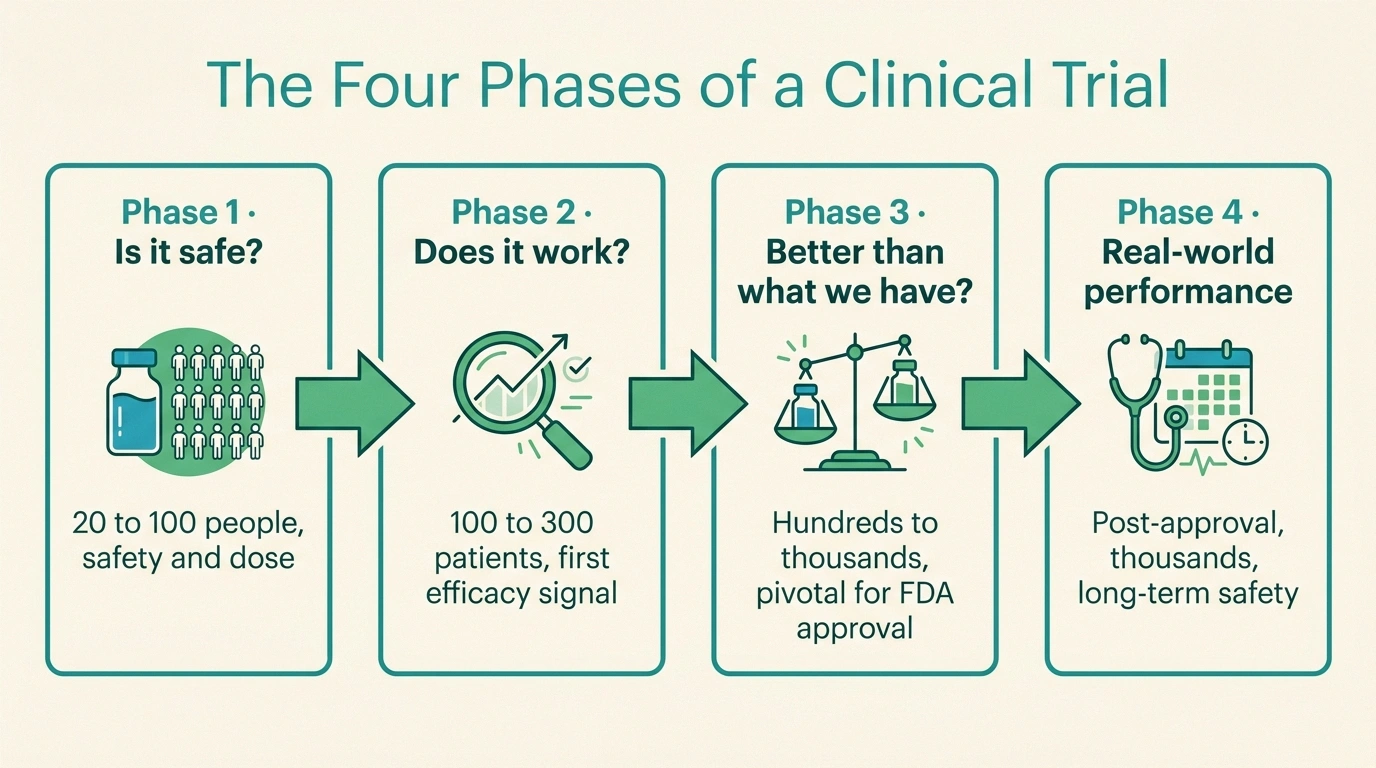
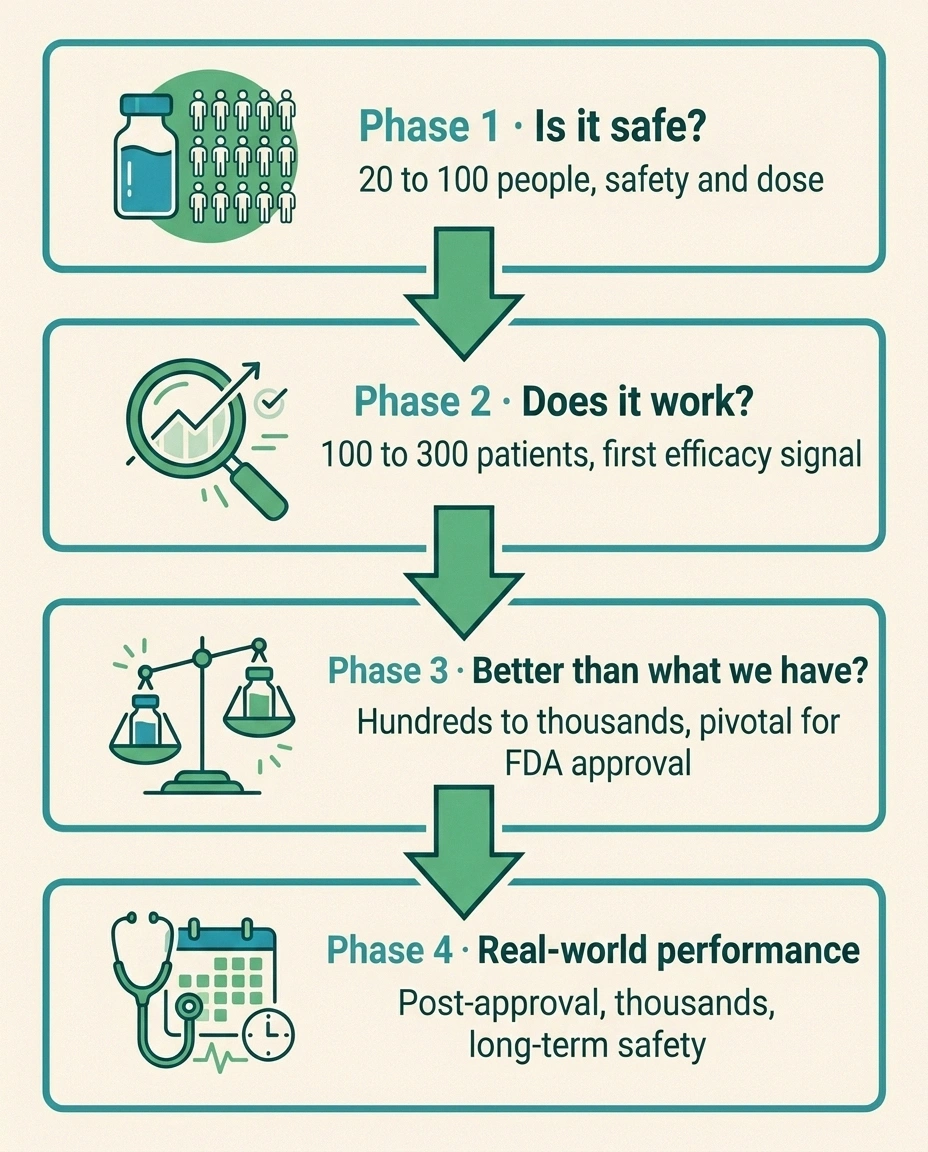
Every trial belongs to one of four phases. The phase is the single most important number to know because it tells you roughly how much is already known about safety.
Across all disease areas, roughly 1 in 10 drugs that enter Phase 1 eventually reach FDA approval. The bulk of the fallout happens in Phase 2, where about half of drugs fail to show a strong enough efficacy signal to justify moving on. By Phase 3, roughly 50 to 60 percent of drugs that reach the pivotal stage do make it to approval, which is why Phase 3 tends to be the phase most patients feel most confident enrolling in.
The Foundation for Peripheral Neuropathy’s research registry has enrolled nearly 1,400 patients since 2012, connecting members to both basic and clinical studies.
Phase 1 is the first test in humans. Usually 20 to 100 people, sometimes healthy volunteers. Goal: safety and dose finding, not efficacy. Phase 1 carries the most medical uncertainty. Rare for a neuropathy patient to enroll unless it is a gene therapy for an inherited neuropathy or a novel biologic for a rare condition.
Phase 2 tests 100 to 300 patients who have the condition. Goal: a first efficacy signal, continued safety, dose refinement. Roughly half of drugs wash out here. Many neuropathy trials right now are Phase 2 or 2b (LX9211, imeroprubart, several IVIG protocols).
Phase 3 is the big pivotal test, usually hundreds to thousands of patients across many hospitals, compared against placebo or standard care. By Phase 3, extensive safety data already exists from earlier phases, which is why Phase 3 is often the safest of the pre-approval phases. Vertex’s suzetrigine program in painful diabetic peripheral neuropathy is Phase 3 and the highest-profile neuropathy trial recruiting in the U.S. right now.
Phase 4 happens after FDA approval. The drug is already available by prescription and researchers watch it in the real world. Phase 4 carries the lowest research risk. It often looks like “your normal care plus some extra measurements.”
A rough rule of thumb:
- Rapidly progressing condition, no other options: Phase 1 or 2 may be worth considering.
- Stable chronic neuropathy, wanting early access: Phase 2b or Phase 3.
- Already on an approved medicine, wanting to contribute: Phase 4.
Where to Actually Search for Neuropathy Trials
Almost every trial in the United States is listed on the government’s registry. That is your starting point, not your only stop.
ClinicalTrials.gov at clinicaltrials.gov is where you begin. Search by condition (“peripheral neuropathy,” “small fiber neuropathy,” “diabetic peripheral neuropathy,” “CIDP,” “chemotherapy-induced peripheral neuropathy,” “CMT,” “ATTR amyloidosis”). Set status to “Recruiting” or “Not yet recruiting.” Filter by miles from your ZIP code, phase, and age. Each listing shows the sponsor, primary outcome, and full inclusion and exclusion criteria. Read those before you pick up the phone.
One important caveat: presence on ClinicalTrials.gov is not the same as FDA authorization. The registry accepts listings from studies not conducted under a formal FDA investigational drug application, including some unregulated stem cell clinics. See the red flags section below.
Beyond the registry, neuropathy-specific matchers save time:
- The Foundation for Peripheral Neuropathy maintains a Clinical Trials Resource Center at foundationforpn.org/clinical-trials, actively updated and filtered for peripheral neuropathy. Its Peripheral Neuropathy Research Registry has enrolled nearly 1,400 patients since 2012.
- NeuropathyCommons (Harvard and Beth Israel-linked) at neuropathycommons.org/patient-support/clinical-trials is a plain-language explainer with curated links.
- Small Fiber Neuropathy Network at smallfiberneuropathy.help/trials lists condition-specific studies.
- CenterWatch, Antidote, TrialX, WithPower are broader matchers with friendlier questionnaires; Antidote partners with several patient foundations.
Do not skip academic centers. UCSF, UCSD, Mayo, Johns Hopkins, Vanderbilt, and the NIH Clinical Center in Bethesda all run active neuropathy programs, and many NIH Clinical Center trials reimburse travel for eligible patients. If you have your eye on a specific drug, go to the sponsor’s site; Vertex, Lexicon, Immunovant and others list recruiting studies on their pipeline pages.
Inclusion and Exclusion: Why an EMG Diagnosis Matters
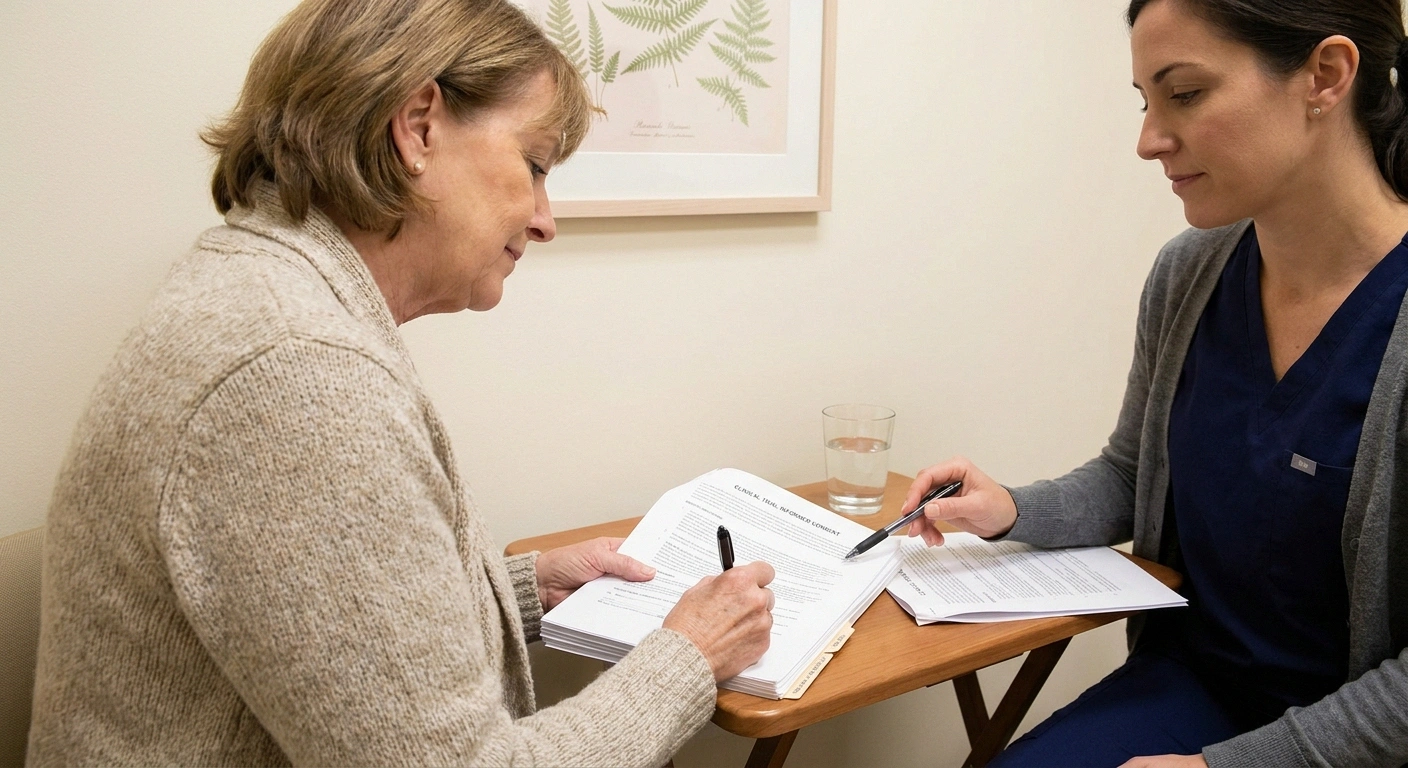
Inclusion and exclusion criteria are the rules that decide who can enroll. This is where most patients get screened out, and often for reasons that have nothing to do with severity.
Typical inclusion criteria:
- An age range, most often 18 to 75.
- A confirmed neuropathy diagnosis with objective documentation: nerve conduction study plus needle EMG for large-fiber or demyelinating disease, or a 3-millimeter skin punch biopsy showing reduced intraepidermal nerve fiber density for small-fiber neuropathy, or quantitative sensory or autonomic testing.
- A minimum pain or symptom score (often average daily pain of 4 or higher on a 0-to-10 scale).
- A stable medication regimen for a set period before enrollment, sometimes with a washout of certain pain medications.
Typical exclusion criteria that trip patients up:
- HbA1c above a specific cutoff in diabetic trials.
- Other identifiable causes with their own treatments: B12 deficiency, thyroid disease, active chemotherapy, HIV, vasculitis, spinal disease compressing nerves.
- Current use of specific medications (many trials exclude gabapentin, pregabalin, duloxetine, or opioids above certain doses, or require a taper).
- Kidney or liver impairment beyond a lab cutoff.
- Recent chemotherapy (typically within six months).
- Pregnancy, breastfeeding, or unwillingness to use contraception.
The practical point that saves people trouble: most drug trials require objective documentation, not just symptoms. If you walk in with burning feet and no workup, you are usually screened out because the trial cannot measure whether the drug worked without a proper baseline. Get the workup done first. Start with a nerve conduction study and needle EMG (our guide on how to read your EMG results walks you through the numbers). If your EMG is normal but your symptoms are real, ask about a skin biopsy or QSART; that story is covered in our piece on a normal EMG with small fiber neuropathy. Also make sure your workup has ruled out the reversible causes in our complete guide to neuropathy causes, since trials exclude you if a treatable cause has not been chased down.
Where to Search: Neuropathy Trial Registries at a Glance
| Registry | Best For | Where to Find It | Cost | Coverage |
|---|---|---|---|---|
| ClinicalTrials.gov | The complete government registry, exact search by condition | clinicaltrials.gov | Free | U.S. and international |
| Foundation for Peripheral Neuropathy | Curated PN-specific studies plus research registry | foundationforpn.org/clinical-trials | Free | U.S., PN-focused |
| NeuropathyCommons | Plain-language patient explainer plus curated links | neuropathycommons.org | Free | Global, PN-focused |
| Antidote | Friendly matcher questionnaire, foundation partnerships | antidote.me | Free | U.S. and international |
| CenterWatch | Industry-side listings, sponsor detail | centerwatch.com | Free | U.S. and international |
| Academic center portals (UCSF, UCSD, Mayo, Hopkins, NIH) | Direct access to institution-run studies, travel reimbursement often available | Institution research site | Free | U.S., specific cities |
Placebo, Randomization, and What Your Odds Really Are

Three words show up in every consent form.
Randomization means a computer, not the doctor, decides which arm you go into. That prevents any human’s preferences (the doctor’s, the coordinator’s, yours) from tipping the results.
Blinding means people do not know who is in which arm. Single-blind: you do not know. Double-blind: neither you nor your doctor knows. Triple-blind: even the statisticians analyzing the data do not know until unblinding. Blinding is not there to fool you; it keeps the placebo effect and unconscious bias out of the results.
Placebo is an inactive substance given to some participants. Ethical trials use a placebo arm only when no proven treatment already exists, when the placebo is added on top of standard care, or when a short delay in active treatment poses no serious harm. In pain trials the placebo response is famously large, which means a good drug has to beat a strong placebo signal.
Your odds of getting the drug depend on the study design. A typical two-arm 1:1 trial is 50/50. A 2:1 trial gives you a two-in-three chance. A 3:1 trial gives you three-in-four. The consent form states the ratio; ask the coordinator to say it out loud too.
Two things most patients do not know. You can leave the trial at any time, so if you are certain you are on placebo and it is not helping, you are not trapped. And many well-designed trials include an open-label extension, a follow-on study where everyone, including former placebo participants, gets access to the active drug. Ask about it before you enroll.
The Questions to Ask the Study Coordinator
Adapted from the National Eye Institute and NIMH clinical trial checklists, plus what my friends wish they had asked. Print this. Bring it. Take notes.
About the study:
- What is the purpose of this study, and what phase is it?
- Who is sponsoring it: pharma, NIH, foundation, or academic institution?
- Why do researchers believe this treatment might help my type of neuropathy?
- What has been shown about it in earlier phases?
- How long will the study last, and how many visits will I have?
About my participation:
- What are the specific inclusion and exclusion criteria, and am I truly eligible?
- Will I definitely get the study drug, or is there a placebo arm? What are my odds?
- Is the trial blinded? Will I find out my arm when it ends?
- What procedures are involved? Any invasive ones like biopsy or lumbar puncture?
- What are all the known and possible side effects?
About my current care and my off-ramp:
- Can I stay on my current neuropathy medications? Which ones need to stop, and when? (Our comparison of gabapentin versus pregabalin is worth reading if a washout is on the table.)
- Will my regular neurologist and primary care physician be kept informed?
- Whom do I call at 2 a.m. if I have a problem?
- If the trial helps, can I keep receiving the drug through an open-label extension after the study ends?
- If it does not help, or hurts, what is my off-ramp back to standard care?
About money and consent:
- What is paid for by the study, what is billed to my insurance, and what do I pay out of pocket?
- Do you reimburse travel, parking, meals, or lodging?
- Is there compensation if I am injured?
- Can I take the consent form home to read it with my family and my regular doctor?
- If I leave, what is the process, and does it affect any care outside the trial?
Costs, Insurance, and What You Actually Pay

Money is what patients ask about last and worry about most. The rules are more favorable than most of us think.
What the trial almost always pays for: the study drug, all study-specific procedures (extra blood draws, imaging, biopsies done only because of the trial), study visits with the research team, and care for side effects clearly caused by the study drug.
What the trial almost never pays for: your regular medical care outside the study, standard tests you would have had anyway, and care unrelated to the study.
Travel and lodging vary by sponsor. Many Phase 3 programs and most NIH Clinical Center studies reimburse mileage, tolls, meals, and sometimes overnight stays. Ask.
The part very few patients know: the Affordable Care Act protects you. Section 2709 of the Public Health Service Act, added by the ACA and in force since January 1, 2014, requires most private insurance plans and Medicaid expansion plans to cover routine patient care costs for a qualifying individual in a qualifying clinical trial for the prevention, detection, or treatment of cancer or another life-threatening disease or condition. Routine care means the standard care you would have gotten anyway. The investigational study drug and anything given purely for data collection are paid for by the trial, not insurance.
8 Questions to Bring to Your Coordinator Visit
A qualifying trial is federally funded (NIH, VA, DoD), regulated by the FDA under an IND or IDE, or specifically exempted. Most legitimate neuropathy trials at academic centers qualify. Grandfathered plans and some short-term or non-ACA-compliant plans may be exempt. Medicare has its own separate rules that also cover most routine costs; traditional Medicaid varies by state.
The practical move: before you sign the consent, call your insurer’s member services line. Say, “I am considering enrolling in this clinical trial. The identifier is NCT” and read the number. “Please confirm you will cover routine patient care costs under ACA Section 2709. I would like this in writing.” Get a reference number. If you get pushback, ask the coordinator to help; they usually have a template letter for exactly this call.
Red Flags: The ‘Trials’ That Are Not Trials
Not everything called a “clinical trial” is one. An entire cottage industry of unregulated clinics, many offering stem cell products for neuropathy, uses the language of research to charge patients for treatments not being studied in any meaningful way. Here is how to tell the difference before you write a check.
Legitimate clinical trials do not charge you for the drug being tested. If any of these show up, close the door and report the operation to the FDA MedWatch program:
- You are being asked to pay for the “investigational treatment” (stem cell scams have charged $1,200 to $50,000)
- No written informed consent document, no FDA IND or IDE authorization, no named IRB you can verify
- Guaranteed cures, “success rates,” or specific outcomes promised before enrollment
- Pressure to enroll immediately without time to take the consent home to your family and doctor
- Cash, wire, or crypto-only payment for anything associated with the study
Walk away, and report to the FDA MedWatch program, if any of the following are true:
- You are asked to pay for the investigational treatment itself. Legitimate trials do not charge you for the drug being tested. Documented “stem cell” scams have charged patients anywhere from $1,200 to $50,000.
- There is no written informed consent that covers purpose, risks, benefits, procedures, alternatives, confidentiality, and your right to leave.
- The “trial” is on ClinicalTrials.gov but is not conducted under an FDA IND or IDE. Presence on the registry is not FDA authorization. Ask the coordinator: “Is this trial conducted under an FDA IND or IDE, and can you show me?”
- You feel pressured to enroll immediately, without time to take the consent home, review it with your family, and talk to your regular doctor.
- Someone guarantees a cure or specific results before you enroll. No legitimate researcher will guarantee an outcome.
- You are shown testimonials but no peer-reviewed publications. A real program publishes data or presents it at scientific meetings.
- There is no proper eligibility screening. If the clinic will enroll anyone who pays, without imaging, a detailed history, a hands-on exam, and objective neuropathy documentation, it is not research.
- The “clinic” will not name a verifiable Institutional Review Board (IRB) or ethics oversight body.
- Payment is cash, wire, or crypto only. Legitimate research is not funded by patient credit cards.
This matters especially in neuropathy because unproven cell-therapy clinics scrape ClinicalTrials.gov for keyword matches and market to desperate patients. If a clinic is asking for money to participate in “research,” it is not research.
A Note on Hope, and What Comes Next

Hope and clear-eyed decision-making are not opposites. You can be excited about a Phase 3 drug and still ask the coordinator about the placebo ratio. You can be grateful for the chance to try something new and still take the consent home for the weekend. You can contribute to the research that changes what our grandkids inherit and still keep the right to leave on a Tuesday afternoon.
Marcia is halfway through her study now. Whatever the results say when the blind is broken, she has already gotten something the eleven years of gabapentin never gave her: the feeling of doing something. If you are ready to look, start with ClinicalTrials.gov and the Foundation for Peripheral Neuropathy’s matcher. If not yet, get your workup done, work with the neurologist you trust (our guide on choosing a neurologist for neuropathy is a good starting point), and keep an eye on the pipeline your doctor is watching. The list of drugs in serious research for our condition is fuller right now than it has been in twenty years.
Frequently Asked Questions
How do I qualify for a neuropathy clinical trial?
Most trials require an age within the study’s range, a confirmed neuropathy diagnosis with objective documentation (nerve conduction study and EMG for large-fiber disease, or a skin biopsy or QSART for small-fiber symptoms), a minimum symptom or pain score, and a stable medication regimen. Common exclusions include HbA1c above the cutoff for diabetic trials, other identifiable causes with their own treatments, certain current medications, and recent chemotherapy. Get your workup done first.
Hope and clear-eyed decision-making are not opposites. You can be excited about a Phase 3 drug and still ask the coordinator about the placebo ratio. You can be grateful for the chance to try something new and still take the consent form home for the weekend. You can contribute to the research that changes what our grandkids inherit and still keep the right to leave on a Tuesday afternoon.
The trial will still be there next week. Take the time you need.
Are clinical trials free?
The study drug, study-specific procedures, and study visits are almost always paid by the sponsor, along with care for drug-related side effects. Routine care outside the trial is typically billed to your insurance, and under ACA Section 2709, most private plans and Medicaid expansion plans must cover those routine costs for qualifying trials. Travel and lodging reimbursement varies; academic centers and NIH Clinical Center studies often reimburse eligible patients.
Can I leave a clinical trial once I have started?
Yes. You can withdraw at any time, for any reason, without penalty. No investigator, sponsor, or provider can legally penalize you, deny you standard medical care, or bill you for study procedures if you leave. Your regular care and relationships with other physicians cannot be jeopardized. The right to withdraw is spelled out in federal human-research regulation (45 CFR 46) and in the FDA’s Good Clinical Practice standards.
What is the difference between Phase 2 and Phase 3?
Phase 2 tests a first efficacy signal in 100 to 300 patients; roughly half of drugs wash out here. Phase 3 confirms safety and efficacy at scale, usually with hundreds to thousands of patients, often against placebo or standard of care. Phase 3 is the pivotal test for FDA approval, and it typically has more safety data behind it from earlier phases, which is why many patients feel more comfortable enrolling in Phase 3 than in earlier phases.
What is the best website to find a neuropathy clinical trial?
Start with ClinicalTrials.gov, the government registry, and use the condition, phase, status, and distance filters. Then check the Foundation for Peripheral Neuropathy’s Clinical Trials Resource Center at foundationforpn.org/clinical-trials for a curated peripheral-neuropathy list. Add condition-specific matchers like the Small Fiber Neuropathy Network. Check academic centers running neuropathy programs (UCSF, UCSD, Mayo, Johns Hopkins, Vanderbilt, NIH Clinical Center) directly.
Does insurance cover clinical trial costs?
Under ACA Section 2709, most private insurance plans and Medicaid expansion plans must cover routine patient care costs for a qualifying individual in a qualifying clinical trial for the prevention, detection, or treatment of cancer or another life-threatening disease or condition. The investigational drug and anything given only for data collection are covered by the trial. Grandfathered and some non-ACA plans may be exempt. Call your insurer with the NCT number before enrolling and get the coverage confirmation in writing.
Can I keep taking gabapentin or Lyrica during a clinical trial?
It depends on the protocol. Many pain-drug trials require a washout so the drug’s effect can be measured cleanly. Some allow you to continue at a stable dose; some require a taper before enrollment. The study coordinator will tell you exactly. Never taper on your own; work with your prescriber and the study team together.
How do I spot a fake clinical trial?
The clearest sign is that you are asked to pay for the investigational treatment. Real trials do not charge patients for the drug being studied. Other red flags: no written informed consent, no FDA IND or IDE, pressure to enroll immediately, guaranteed cures, testimonials but no peer-reviewed publications, no proper eligibility screening, no named IRB, and cash or crypto-only payment.
Talk it over with your family and your regular doctor, take the consent home, and give yourself the time you need. The trial will still be there next week.
Warmly,
Janet Ellis
About the Author