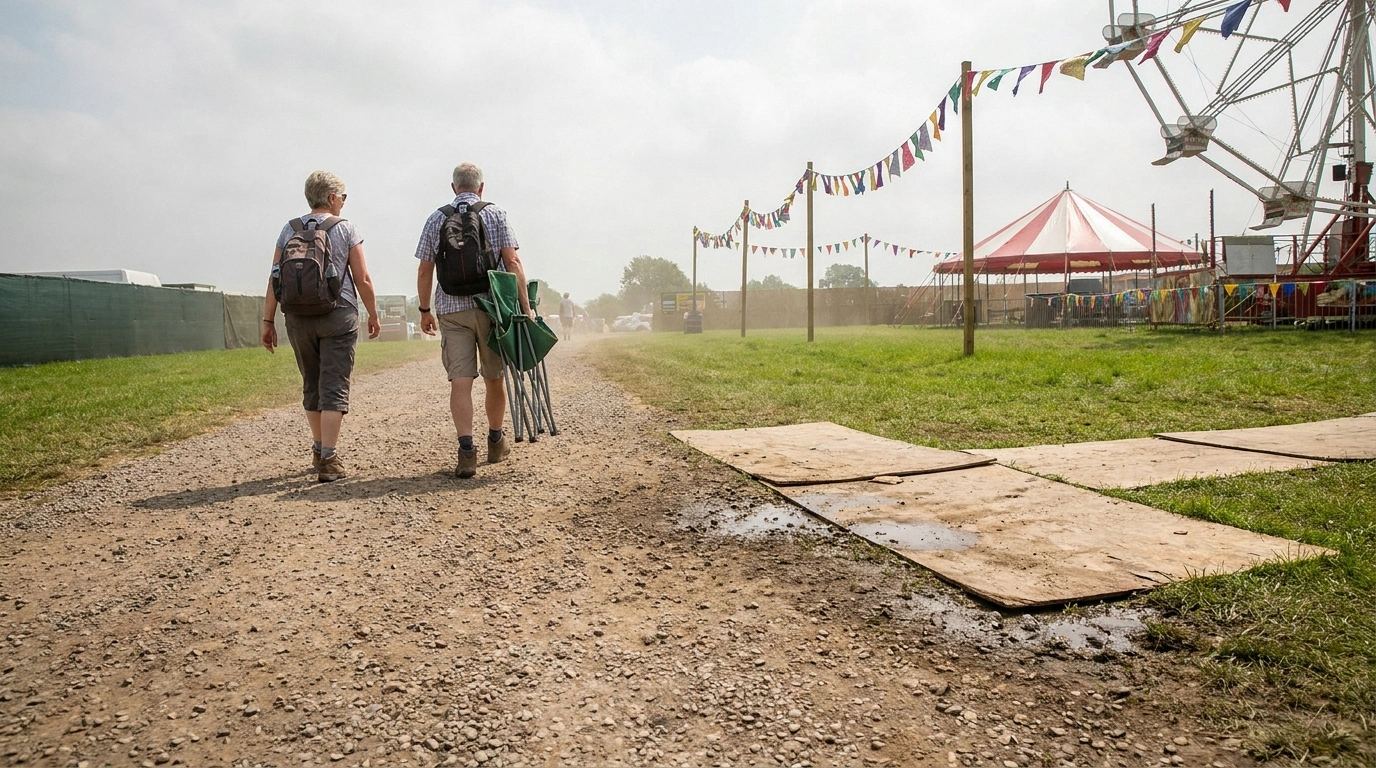
Gravel from the parking field. Then mown grass, uneven and hiding holes. Then a stretch of plywood laid over mud. Then a rubber cable cover. Then more gravel, this time with a slope.
That is roughly the first four hundred feet of most county fairs and outdoor festivals, and it is the actual reason these events are hard when your feet cannot report back to you properly.
Every article you will find on this subject is about blisters. Blisters are a real issue and they come up later. But the thing that turns a good afternoon into a bad one is that the ground keeps changing under you, and your feet are no longer telling you when it does.
Why the Ground Matters More Than the Distance
Walking on a sidewalk is a solved problem for most people with neuropathy. The surface is flat, predictable, and consistent, so the same step works every time.
A fairground is the opposite of that. In a single afternoon you will cross gravel of at least two different sizes, grass that hides dips and gopher holes, packed dirt that goes soft where a truck sat, temporary flooring with a lip at every edge, cable covers that are effectively small speed bumps, and at least one ramp that is steeper than it looks.
Healthy feet handle this without conscious thought. Hundreds of tiny pressure signals per second travel up from the sole, and the ankle adjusts before you notice anything. That system is exactly what reduced sensation interrupts. The signals arrive late, or faint, or not at all, and the ankle corrects after the fact instead of during.
Which produces two consequences worth planning around.
Your balance costs more than it used to. You are compensating with vision and with conscious attention, and both of those are finite. That is why an hour at a fair is more tiring than an hour walking around your neighbourhood, even at the same distance. The fatigue is not weakness. It is the price of doing consciously what used to happen automatically, and it is worth understanding how much of your balance now depends on what you can see.
Dusk changes everything. If you are using your eyes to substitute for what your feet cannot feel, then losing the light takes away the substitute. Many fairs are at their best in the evening, and the same path you crossed easily at two in the afternoon is a genuinely different proposition at eight. Plan the walk back to the car for while you can still see the ground clearly.
The Phone Call That Changes the Whole Day
Five minutes on the phone to the event office, or two minutes on their website, decides more about your day than anything you pack.
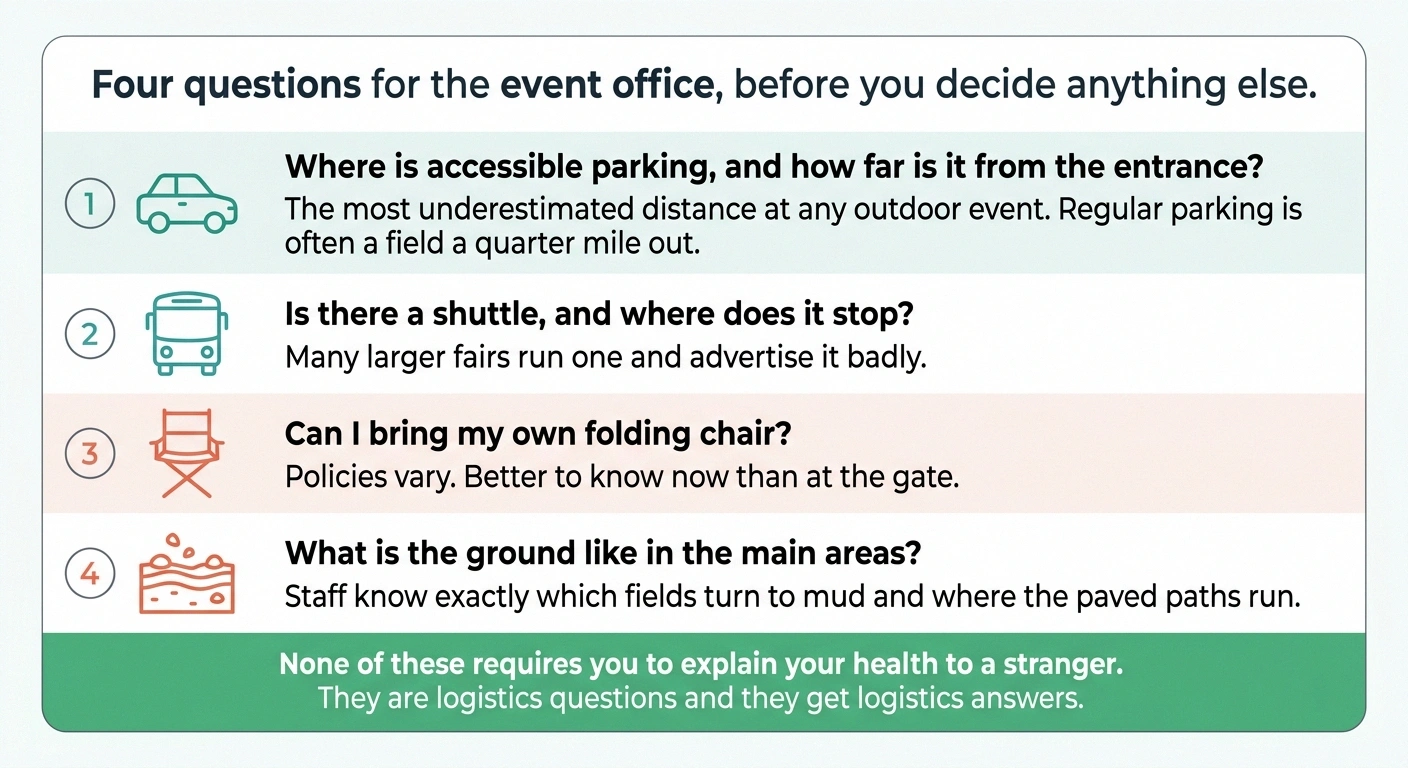
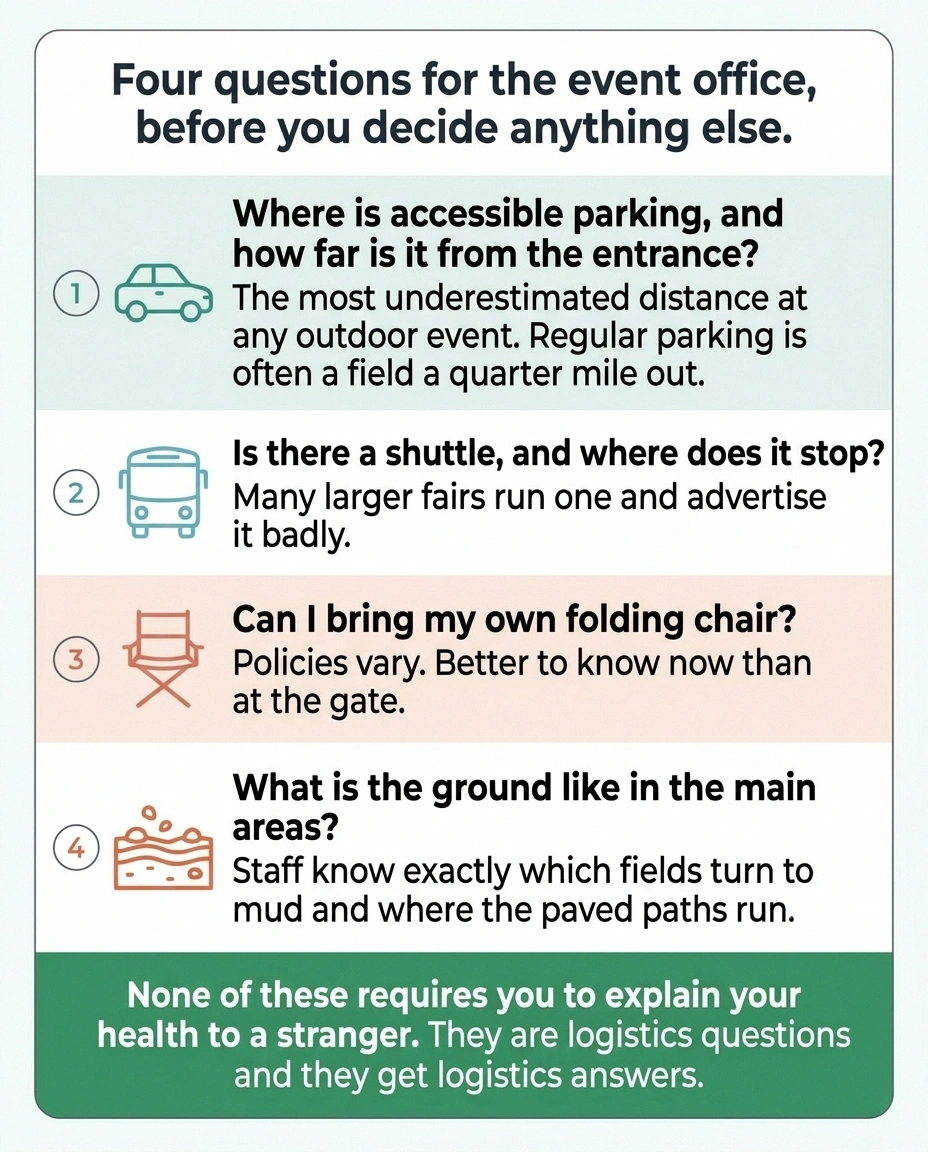
Four questions, and none of them require you to explain your health to a stranger.
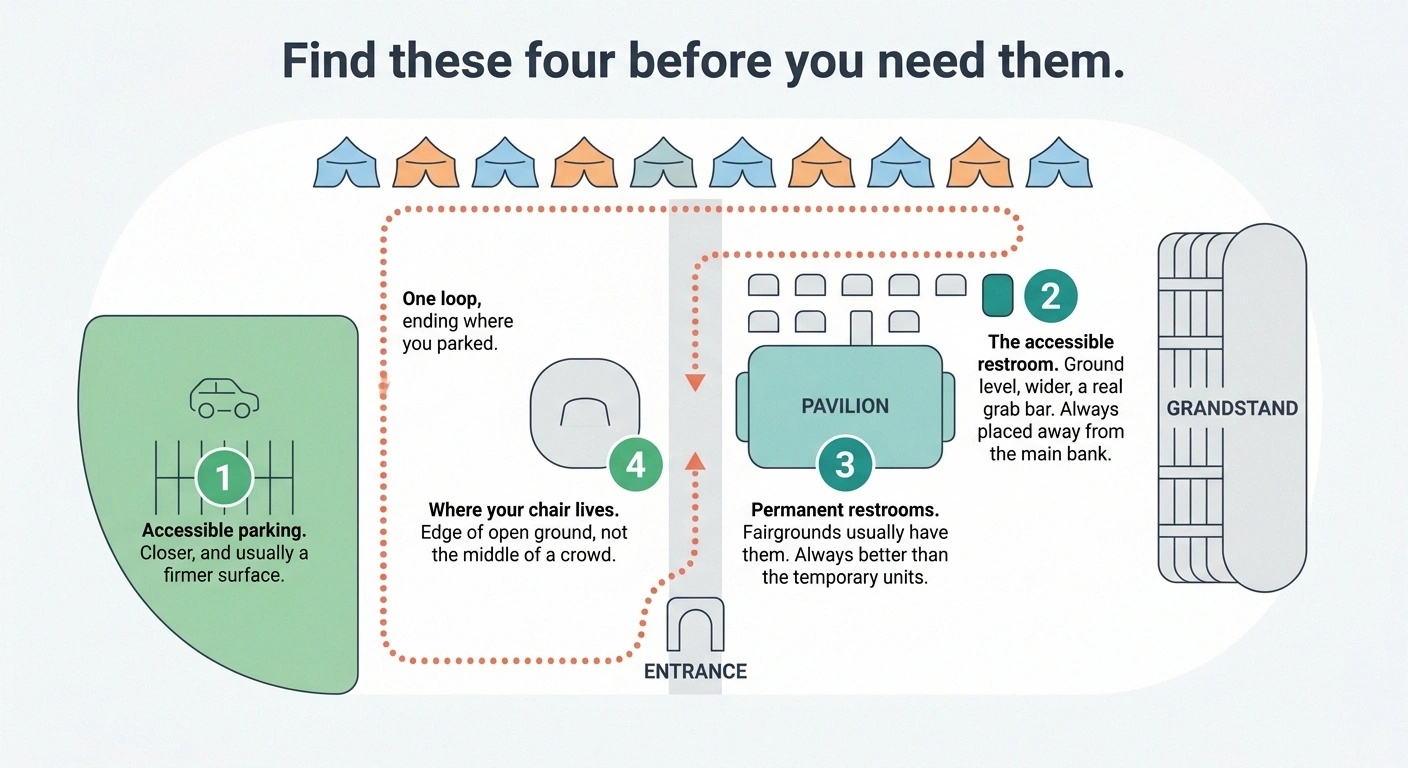
- Where is accessible parking, and how far is it from the entrance? This is the single most underestimated distance at any outdoor event. Regular parking is often a field a quarter mile out. Accessible parking is usually much closer and frequently on a firmer surface, which matters as much as the distance.
- Is there a shuttle, and where does it stop? Many larger fairs run one and do not advertise it well.
- Can I bring my own folding chair? Policies vary enormously and some ticketed festivals prohibit it. Better to know now than at the gate.
- What is the ground like in the main areas? Ask it plainly. Staff who work the event know exactly which fields turn to mud and where the paved paths run.
If you have a disabled parking permit, this is the day to use it even if you normally do not. And if you do not have one but your walking distance is genuinely limited, that conversation with your doctor is worth having before next season rather than after.
One more thing worth asking about: many fairs have a designated accessible viewing area for grandstand events, and it usually has actual chairs with backs instead of bleachers. Bleachers are among the worst surfaces to navigate with reduced sensation, since the treads are narrow, the risers are tall, and there is nothing to hold.
The Folding Chair Is the Single Best Thing You Can Bring
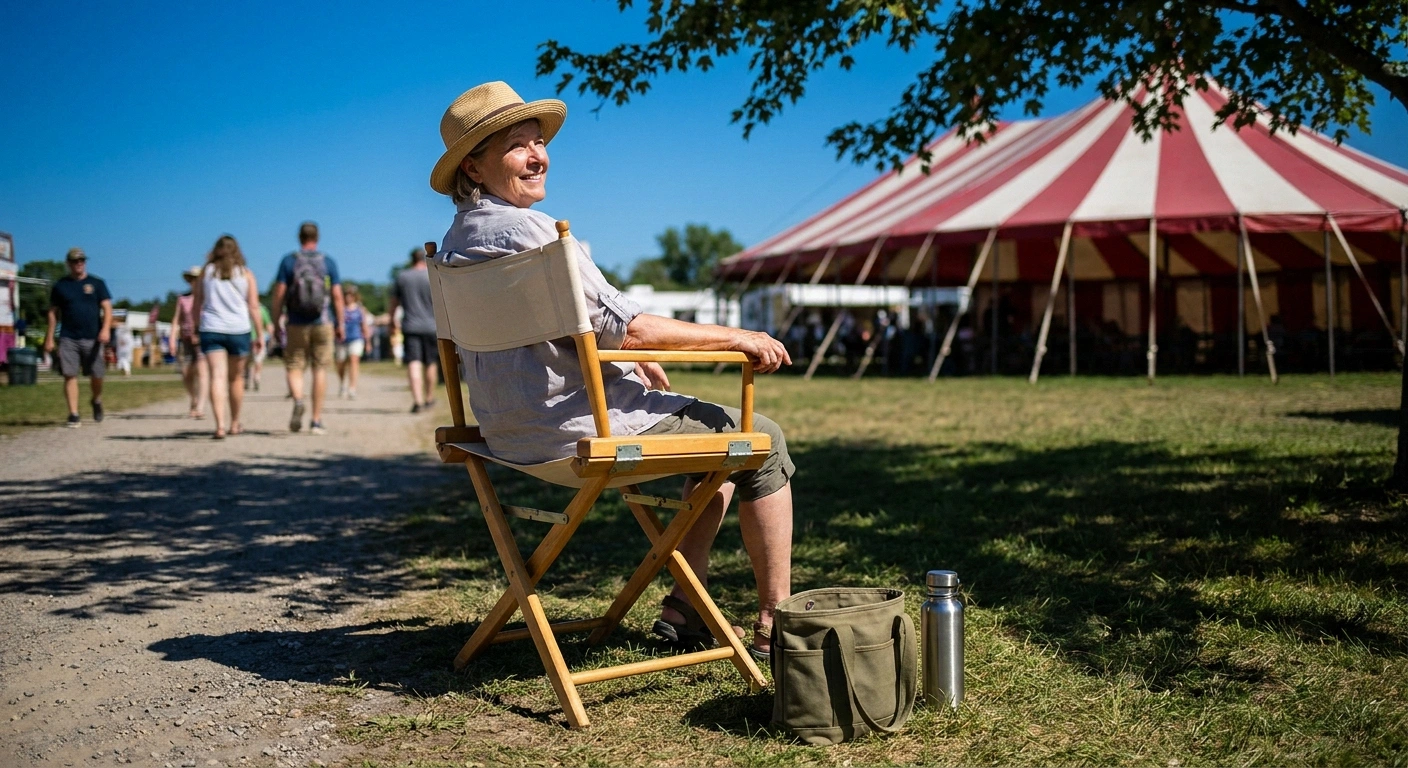
If you take one item from this page, take this one.
Outdoor events have almost no seating. What exists is bleachers, low straw bales, picnic tables, and the occasional bench, all of it occupied. Standing is the default, and standing still is harder on neuropathic feet than walking, because nothing changes the pressure distribution and the burning builds without a break.
A lightweight folding chair with a shoulder strap solves this permanently. It weighs two or three pounds, costs very little, and it means you are never negotiating for a seat or deciding whether to sit on the grass and then work out how to get back up.
What to look for, since not all of them are equal here:
- Arms. Non-negotiable. Getting out of an armless camp chair means pushing off your thighs or the ground, and the low ones are worse than no chair at all.
- A higher seat. The classic low-slung festival chair puts your hips below your knees, which is the hardest position to stand up from. Look for one described as a directors chair or a high camp chair.
- Wide feet on the legs. Thin metal tube legs sink into grass and soft dirt, which is how a stable chair becomes a tilted one.
- A shoulder strap, not a handle. A handle means one hand is occupied while you cross uneven ground, and you want that hand free.
Set it somewhere you can find again, ideally at the edge of an open area rather than in the middle of a crowd, and treat it as your base rather than something you carry all day.
Shoes for a Surface That Keeps Changing
The usual advice is to wear supportive shoes, which is true and not very useful. Here is what specifically matters on this terrain.
Seven things in one small bag, and the job each one does
Read the second line of each and the list stops looking like over-packing. The whole set fits in a shoulder bag and weighs less than a coat.
A dry pair of socks
Damp socks cause friction, friction causes damage, and you will not feel it happening. Highest value item per ounce on the list.
A refillable bottle
Easier to keep up with than deciding to buy one each time, which is how people end up behind on water by two in the afternoon.
A small towel or cloth
Wet it at any water station. On the neck and wrists it cools you far faster than fanning your face.
Blister plasters and tape
For covering a hot spot you happen to notice, not for waiting until something hurts. It may not.
A brimmed hat
Shade you carry, for the stretches between tents where there is none.
Any medication you take midday
In the bag that stays with you, not the one in the car a quarter mile away.
A small flashlight
For the walk back across the parking field if the evening runs longer than planned.
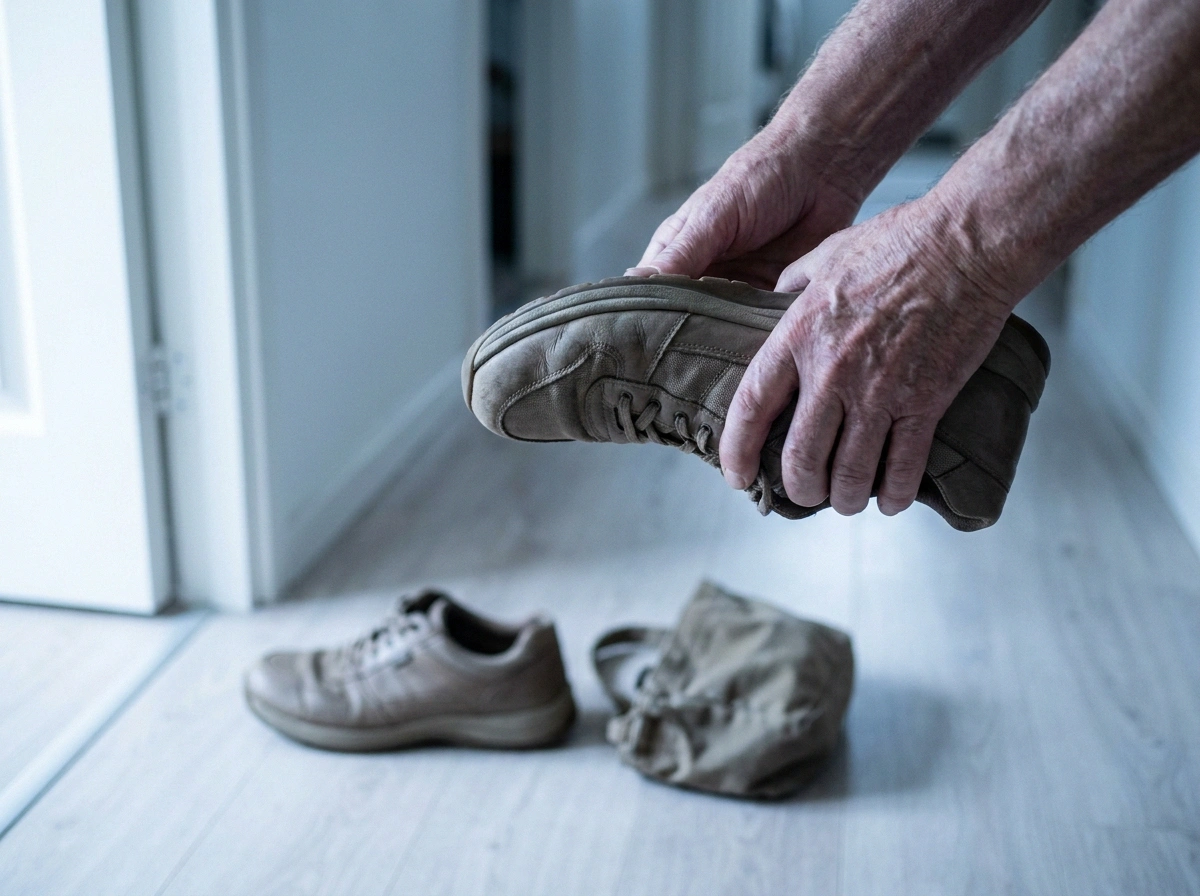
Test the sole before you leave. Hold the shoe at both ends and try to twist it, then try to fold it in half. If it twists easily or folds at the middle, it will not stabilise you on gravel and uneven grass. A sole with real torsional stiffness is doing work your ankle would otherwise have to do consciously.
Closed and fastened, all day. No sandals, no slip-ons, no backless anything. Fairground surfaces include small sharp gravel, tent stakes, cable edges, and things that have been dropped and stepped on. You will not feel any of it at the time, which is the entire problem. Our guide to choosing shoes for neuropathy goes into fit in more detail.
Roomier than usual, laced properly. Feet swell over a long day outdoors in heat. Wear the pair with a little extra room, and take a moment mid-afternoon to loosen the laces a notch before the swelling makes them tight rather than after.
Seamless socks, and a spare pair. Damp socks cause friction, friction causes damage, and you will not feel the damage happening. A dry pair in the bag takes up no room and is the highest-value spare you can carry. If you wear compression socks, put them on before you leave the house rather than once your feet already feel tight.
One thing to skip: brand-new shoes. A fair is the worst possible place to break something in, because the feedback that would normally tell you a shoe is rubbing is exactly what is missing.
Heat Deserves More Respect Than It Usually Gets
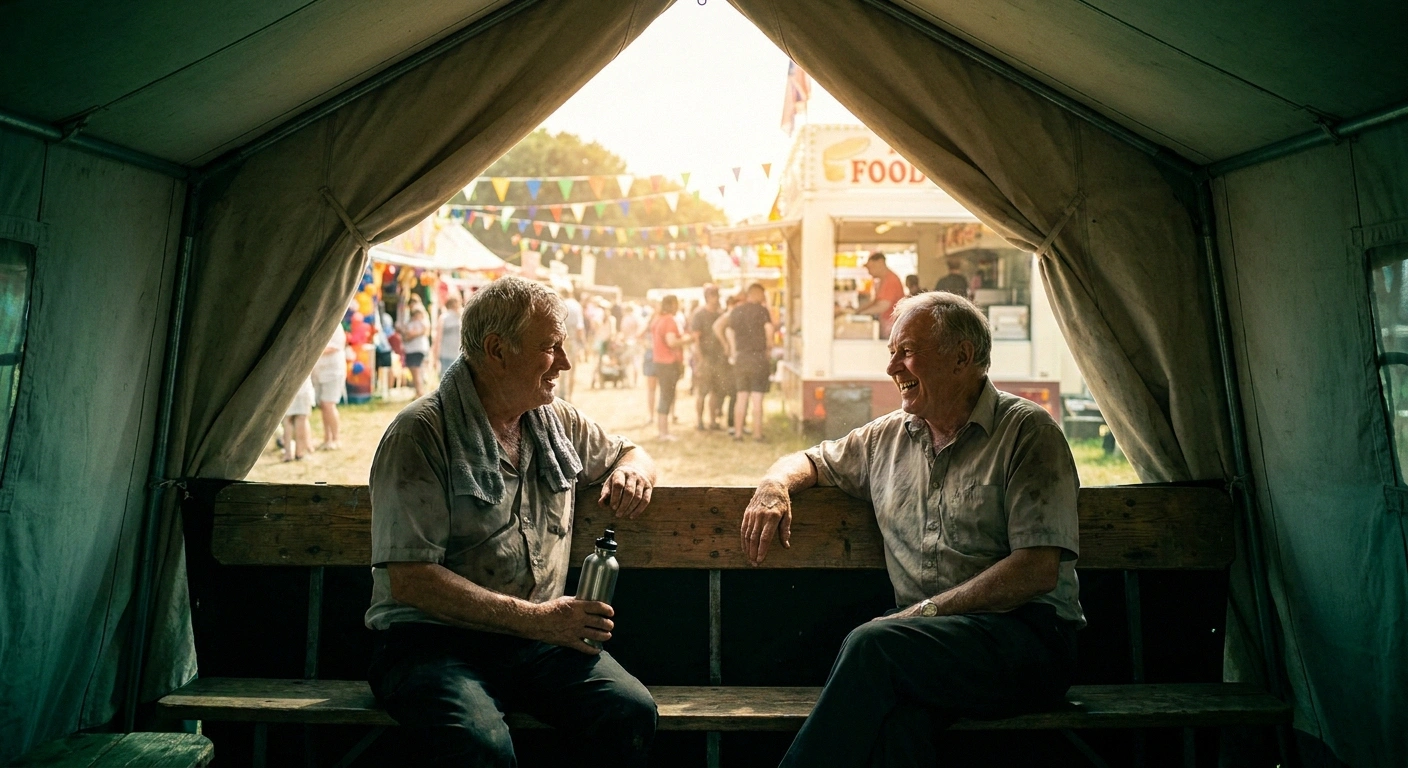
Most of these events happen in July and August in an open field with limited shade, and heat has a specific relationship with neuropathy that goes beyond general discomfort.
Warmth makes nerve pain louder. The channels that carry burning sensation are heat-activated, and when they are already sensitized, a hot day pushes them further. That is why burning feet flare on exactly the days you most wanted to be outdoors, and it is a real physiological effect rather than a matter of tolerance.
Three practical countermeasures, in order of how much they help.
Shade on a schedule, not on demand. Decide in advance that you will be under cover for fifteen minutes out of every hour, and pick your spots as you walk past them. Waiting until you feel overheated means the flare has already started.
Water before you are thirsty. Dehydration worsens cramping and makes swelling worse, not better, which is counterintuitive. A bottle you refill is easier to keep up with than deciding to buy one each time.
Cool the right places. A damp cloth on the back of the neck and the inside of the wrists does far more than fanning your face. Some people bring a small towel and wet it at a water station, which costs nothing.
Also worth knowing: if you have any autonomic involvement, your sweating may be uneven or reduced in some areas, which means your usual internal signals about overheating are less reliable. Go by the clock and the thermometer rather than by how you feel.
The Portable Toilet, Planned in Advance
Nobody writes about this and everybody deals with it.
A standard portable toilet has a step up, a door that swings toward you in a space with no room, no grab bar worth the name, and a floor that is often wet. It is a poor environment for anyone relying on visual balance cues in a small dark box.
Three things make it manageable.
Find the accessible unit first, before you need it. Most events have at least one, and it is a completely different proposition: ground level, wider, with a real grab bar. It is also usually placed away from the main bank of units, so locate it early and note where it is rather than searching under pressure.
Look for the real restrooms. Fairgrounds and parks often have permanent buildings that the temporary units are supplementing. They are frequently near the main pavilion or the administration building and they are always better.
Go on a schedule. Same principle as the shade. Going when you decide to, rather than when you must, means you can walk to the better option instead of using the nearest one.
Plan a Loop, Not a Wander
The thing that gets people at fairs is not one long walk. It is six unplanned ones.
Nobody plans three miles. Everybody walks three miles.
Here is a fairly typical afternoon, written out as it actually happens rather than as anyone intends it. Each leg on its own sounds like nothing.
Car to gate, across the parking field 0.25 mi
Gate to the livestock barns 0.3 mi
Back across for the quilts somebody mentioned 0.4 mi
Doubling back to the food stalls 0.35 mi
Over to the grandstand for the show 0.4 mi
Back to the car for a jacket, then back again 0.5 mi
The walk out, in the dark, on the day's worst surface 0.25 mi
Total: about 2.45 miles, all of it on mixed uneven ground.
The two legs marked in coral are the ones a loop plan removes entirely, and together they are more than a third of the total. The jacket goes in the bag at the start, and the departure time gets decided in the car park before you walk in.
You go to the livestock barn, then somebody mentions the quilts, then you double back for food, then across to the stage, then back to the car for a jacket. None of those individually is far. Together they are three miles of uneven ground, and nobody planned for three miles.
A better shape for the day looks like this.
Pick two or three things you actually came for, find them on the map, and walk them as a single loop that ends where you parked. Set the chair down somewhere central and return to it between segments rather than carrying everything continuously. Let other people do the back-and-forth: if someone wants a funnel cake from the far end, that is a job for whoever's feet are working.
And decide the leaving time before you arrive. Not a vague sense of leaving when tired, an actual time. The mistake nearly everyone makes is staying for the last thing, then walking to the car in the dark, tired, on the day's worst surface. That final walk is when falls happen, and it is entirely avoidable by leaving forty minutes earlier. The same logic applies to any long outdoor day, and it is covered from a different angle in the guides to game-day tailgating and outdoor ceremonies.
The Check You Do When You Get Home
This takes two minutes and it is the part of the day that most affects the following week.
Things worth saying out loud to whoever you came with
Most of the day's extra walking comes from nobody knowing they could have gone instead. These are short, they are not requests for help, and they change the shape of the afternoon.
“I'm going to set up the chair by the pavilion and use it as home base. Come find me there.”
“If you want something from the far end, you're the runner. I'll hold the seats.”
“Let's head to the car at six, before the light goes. I'd rather leave early than do that field in the dark.”
“Fifteen minutes in the shade every hour. Not because I'm flagging, it's just how I do a hot day.”
The pattern in all four: state the plan, not the reason. People act on a plan immediately and worry about a reason for the rest of the day.
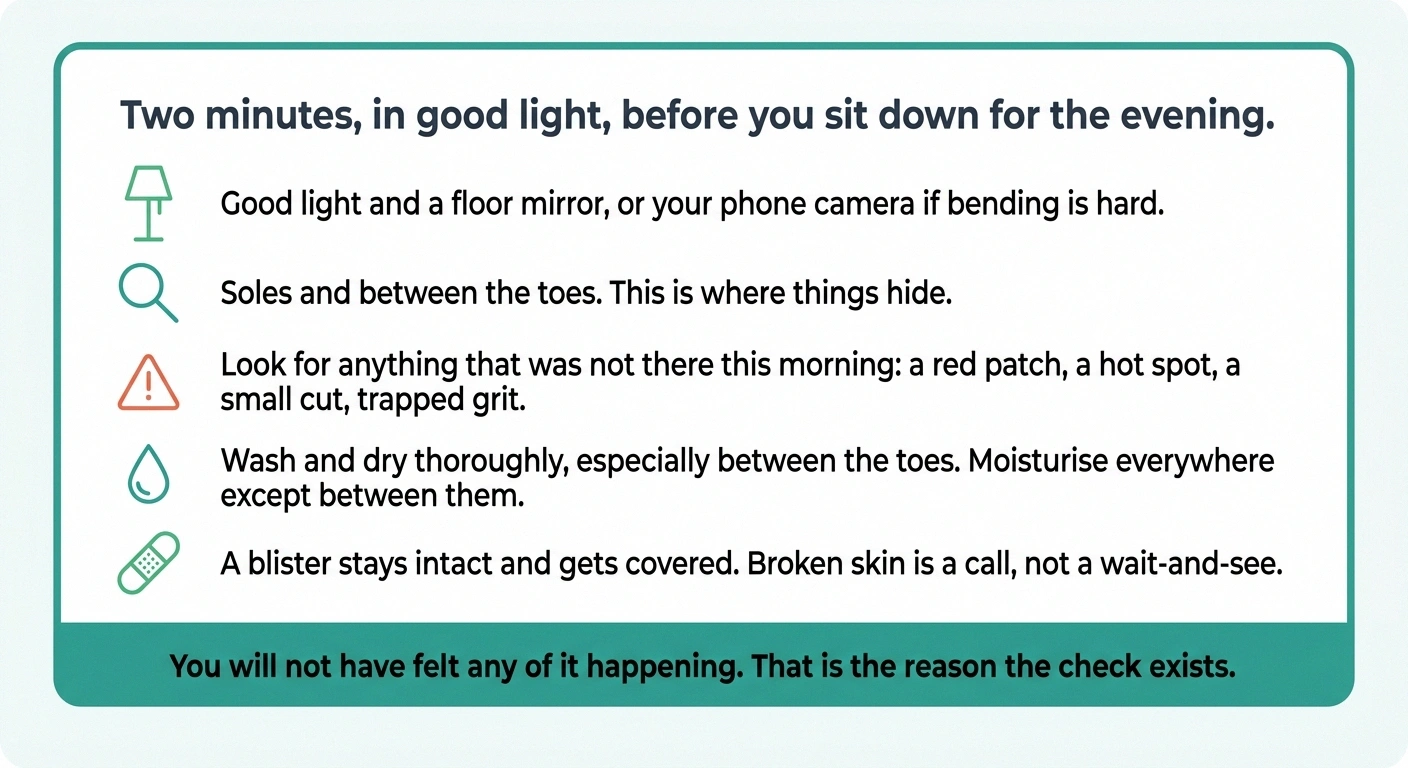
Shoes and socks off, good light, and look at both feet properly, including the soles and between the toes. Use a mirror on the floor or your phone camera if bending is difficult.
What you are looking for is anything that was not there this morning: a red patch, a hot spot, a small cut, a blister that has already formed, or grit that got in and stayed. On a normal day none of this is urgent. After a day on gravel and grass with feet that do not report pain reliably, it genuinely matters, because a small unnoticed injury on a foot with reduced sensation is how a two-week problem starts.
Wash and dry thoroughly, especially between the toes, and moisturise everywhere except between them. If you find a blister, leave it intact and cover it rather than opening it. If you find anything that looks like a break in the skin, that is worth a call rather than a wait-and-see, and the reasoning behind that is set out in our daily foot care guide.
Then put your feet up for a while. You earned the afternoon and there is no prize for pretending it was effortless.
Frequently Asked Questions
What is the single most useful thing to bring?
A lightweight folding chair with arms, a higher seat, and a shoulder strap. Outdoor events have very little seating, standing still is harder on neuropathic feet than walking, and having your own seat means you never have to negotiate for one or get up off the ground. Check the event's policy first, since some ticketed festivals do not allow them.
How do I find out about accessible parking?
Call the event office or check the website before you go, and ask specifically how far accessible parking is from the entrance and what surface it is on. Regular parking at a fair is often a field a quarter mile away, and the distance is the thing people consistently underestimate. Also ask whether a shuttle runs and where it stops.
What shoes should I wear?
Closed, fastened, and with a sole you cannot easily twist or fold in half. Hold the shoe at both ends and try to twist it before you leave the house. Skip sandals and anything backless, because fairground surfaces include sharp gravel and dropped objects you will not feel. Never wear a brand-new pair, since the warning signs that a shoe is rubbing are exactly what reduced sensation removes.
Why does heat make my symptoms worse at these events?
The nerve channels that carry burning sensation are heat-activated, so a hot day makes an already sensitized system louder. Prolonged standing adds to it. Take shade on a schedule rather than waiting until you feel overheated, drink before you are thirsty, and cool the back of your neck and the inside of your wrists rather than your face.
How do I handle portable toilets?
Locate the accessible unit early, before you need it. It sits at ground level, is wider, and has a real grab bar, and it is usually placed apart from the main bank. Many fairgrounds also have permanent restroom buildings near the main pavilion. Going on a schedule rather than waiting until it is urgent means you can walk to the better option.
How far will I actually walk?
Considerably further than you expect, because the distance accumulates in short unplanned trips rather than one long walk. Pick two or three things you came for, walk them as a single loop ending at your car, and set a base with your chair to return to between segments. Deciding your departure time before you arrive is the most useful thing you can do.
Should I check my feet afterward even if nothing hurts?
Especially then. Reduced sensation means a cut, a blister, or trapped grit can be there without any pain to announce it. Two minutes with good light and a mirror after a day on mixed outdoor surfaces catches the small problems while they are still small.
About the Author