Two things reliably go wrong for people with neuropathy in a hospital, and neither of them is the thing that put you there.
Your feet get injured while you are lying still. And your nerve pain medication stops without anyone deciding to stop it.
Both are preventable. Both are prevented mostly by saying a couple of specific sentences at the right moment, usually within the first hour of admission, to someone who is busy. Here is what to say and when.
Why Your Heels Are the Weak Point
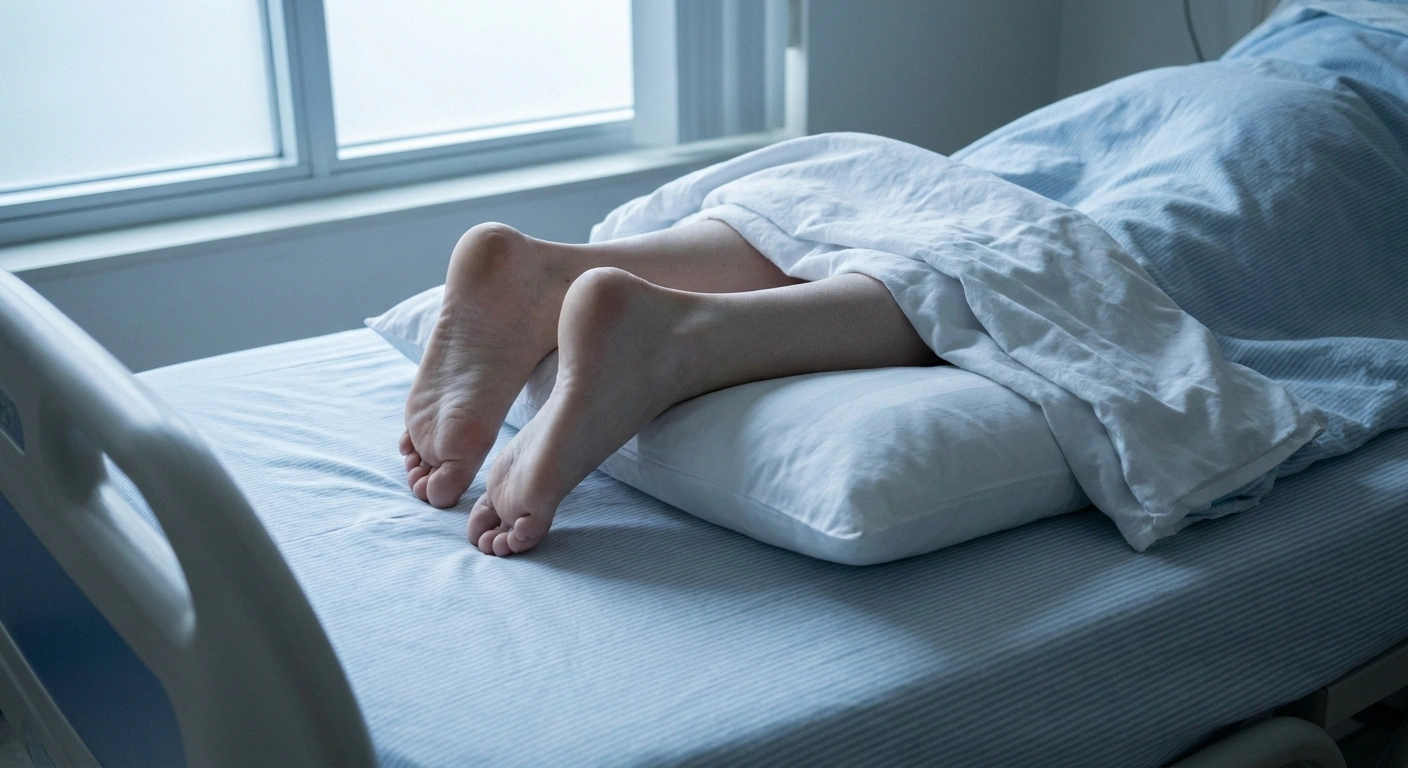
The heel has almost no padding over the bone, and in a hospital bed it presses into the mattress for hours at a stretch. On a foot with normal sensation, that discomfort makes you shift position without ever noticing you did it. On a foot that cannot feel pressure, nothing prompts the shift, and the skin over the heel is the part that pays.
The ten-second test that finds a pressure injury on day one
Press a fingertip firmly on any red area for a few seconds, then lift it. Normal skin goes pale under the pressure and the colour floods back. That is blanching, and it means the blood supply is intact.
Redness that does not go pale under your finger is the first stage of a pressure injury. It is a reportable finding at that moment, not something to watch for another day. On darker skin tones the colour change is harder to see, so compare with the same spot on the other foot and use warmth, firmness or a boggy feel as the signal instead.
Other things worth reporting the moment you find them: a purple or maroon patch, a blister on the heel, skin that feels noticeably warmer or cooler than the surrounding area, and any break in the surface however small.
You are the only person checking hourly. Everyone else is checking on a rota, and a heel injury that starts on Monday morning is usually found on Wednesday.
Hospitals know this. American Diabetes Association inpatient guidance says a process should be in place to reduce pressure on the heels of every inpatient with diabetes, specifically to prevent heel pressure sores caused by the hospital stay itself. UK national guidance says inpatients at moderate or high risk of a diabetic foot problem should be given a device to offload heel pressure.
Knowing the policy exists is useful, because it means you are asking for something standard rather than requesting a favour. The phrase that works is short:
“I have neuropathy and I cannot feel pressure in my feet. Can I get heel offloading?”
What you are asking for is one of a few things: a pressure-relieving boot, a heel-suspension device, or in the simplest version, a pillow placed lengthwise under your calves so the heels hang free of the mattress entirely. That last one costs nothing and any nurse can do it in ten seconds. It is often called floating the heels.
Ask on the first day. A pressure injury can begin within a few hours of unrelieved pressure, and the ones that start on day one are usually discovered on day three.
The Medication Gap Nobody Warns You About
This is the one that surprises people.
Which of your medications matter most if a dose is missed
Not everything on your list carries the same urgency. These are the ones worth naming individually at admission rather than handing over as a list.
| If you take | Why an interruption matters | Ask this |
|---|---|---|
| Gabapentin or pregabalin | Withdrawal starts within 12 to 48 hours and can look like delirium | “If I am nil by mouth, can this be given with a sip of water?” |
| Duloxetine or an SNRI | Abrupt stopping causes distinctive discontinuation symptoms | “Is this continued, and at my usual dose?” |
| A tricyclic at night | Easily dropped because the dose is small and taken late | “Is my bedtime dose on the chart?” |
| Anything for blood pressure drops on standing | Bed rest plus a missed dose makes the first stand up considerably riskier | “Can someone be with me the first time I stand?” |
Ask again whenever a new doctor takes over your care. Handover is where continued medications quietly become discontinued ones.
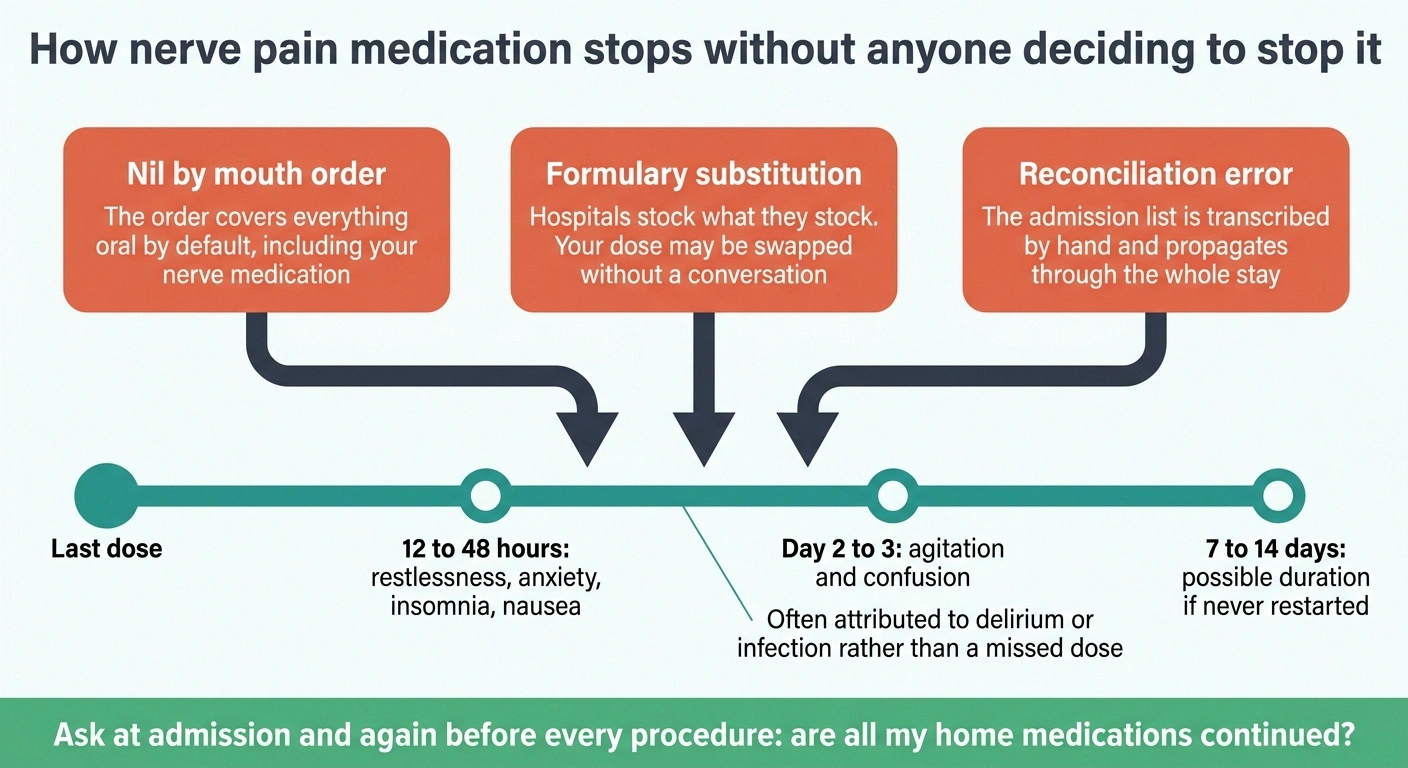
You arrive on a Tuesday. Someone takes a list of your home medications. A procedure gets scheduled for Wednesday morning, so you are nil by mouth from midnight. The procedure runs late and happens Wednesday afternoon. By Thursday morning you have missed four doses of gabapentin and nobody has noticed, because your chart says you are being treated for the thing that brought you in.
Gabapentin withdrawal typically begins 12 to 48 hours after the last dose. It shows up as restlessness, anxiety, insomnia, nausea, agitation and confusion, and in the medical literature there are reports of seizures after abrupt discontinuation in people on long-term treatment. There is a published case of exactly this pattern: a hospitalised patient took nothing by mouth including home medications for two days, became restless, disoriented, confused and agitated on day three, and improved the same evening the gabapentin was restarted on day five.
Read that timeline again, because the trap is in it. Confusion in an older hospitalised patient gets attributed to delirium, infection, or the hospital itself. It rarely gets attributed to a missed nerve pain medication, and the person best placed to raise the possibility is you or whoever is with you.
Three separate mechanisms cause the gap.
Nil by mouth orders. The order covers everything oral by default. Ask directly whether your nerve medication can be given with a sip of water, or whether an alternative route exists.
Formulary substitution. Hospitals stock what they stock. If your specific medication or dose is not on the list, a substitution or a dose change happens, sometimes without conversation.
Reconciliation errors. The admission medication list is transcribed by hand from whatever you brought or remembered. A missing dose, a wrong frequency or a missed drug entirely is common, and it propagates through the whole stay.
The counter-move is to bring a written, current list rather than reciting it. Drug name, dose in milligrams, how many times a day, and the time you actually take each one. Hand over a copy and keep one. Knowing your own medication regimen precisely matters more in a hospital than anywhere else, because there is nobody in the building who knows it.
Then ask the question that catches most problems: “Are all my home medications continued, and if any were changed or stopped, which ones?” Ask it at admission and again if a new doctor takes over your care.
What to Actually Pack
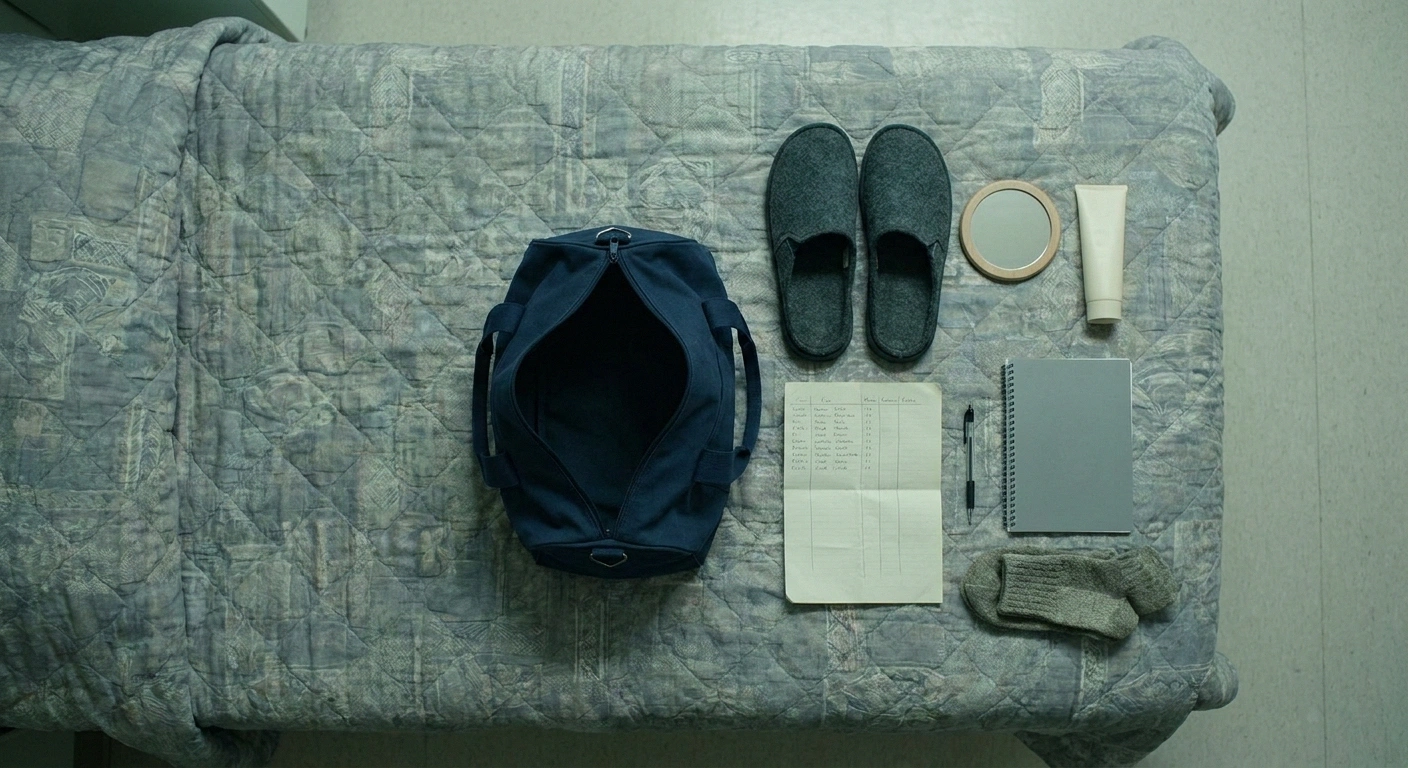
A short list, weighted toward the things nobody thinks of.
What to leave at home, and what to decline politely
Anything that heats. Heating pads, hot packs, hot water bottles, heated blankets applied to the feet. Burns on skin that cannot register temperature happen at settings everyone else finds comfortable, and they are one of the classic injuries in this population. Extra socks solve the same problem safely.
Backless slippers and hospital socks alone. Grip on the sole is not protection. An open toe on a numb foot meets a bed frame, a wheelchair footplate or a dropped object, and you will not know it happened.
Compression garments from home, unless they are already part of your plan. Bring them and mention them rather than putting them on unasked, since fluid balance and circulation both change during a stay.
Your own pain relief taken quietly. Anything taken from your own bag that the chart does not know about is invisible to whoever is calculating what else you can safely have.
Bring the bottles by all means. Hand them over rather than using them from the bedside drawer.
Non-slip footwear that closes. Hospital socks have grip on the sole and no structure at all, which is the wrong footwear for a foot that cannot feel a bump. Slippers with a firm sole and a closed toe are better protection against stubbing, dropped equipment and wheels.
Your written medication list, plus the actual bottles if the admission is unplanned. Bottles resolve dose questions instantly.
A small hand mirror. This is the item people leave at home and miss. You will be in bed, and checking your own soles from a hospital bed is difficult otherwise. If your daily foot check depends on a mirror at home, it depends on one here too, and here it matters more.
Your own lotion. Hospital air dries skin badly, and cracked skin on an insensate foot is an entry point for infection. Apply to the tops and soles, never between the toes.
Anything you use for temperature. Bring your own socks if cold feet keep you awake. What you must not do is ask for a heating pad or a hot pack for your feet. Burns on numb skin are one of the classic injuries, and they happen at temperatures that feel fine to everyone else in the room.
A pen and a notebook. Staff change every shift. Writing down who said what, and when, is how you keep the thread.
Getting Out of Bed in a Room You Do Not Know
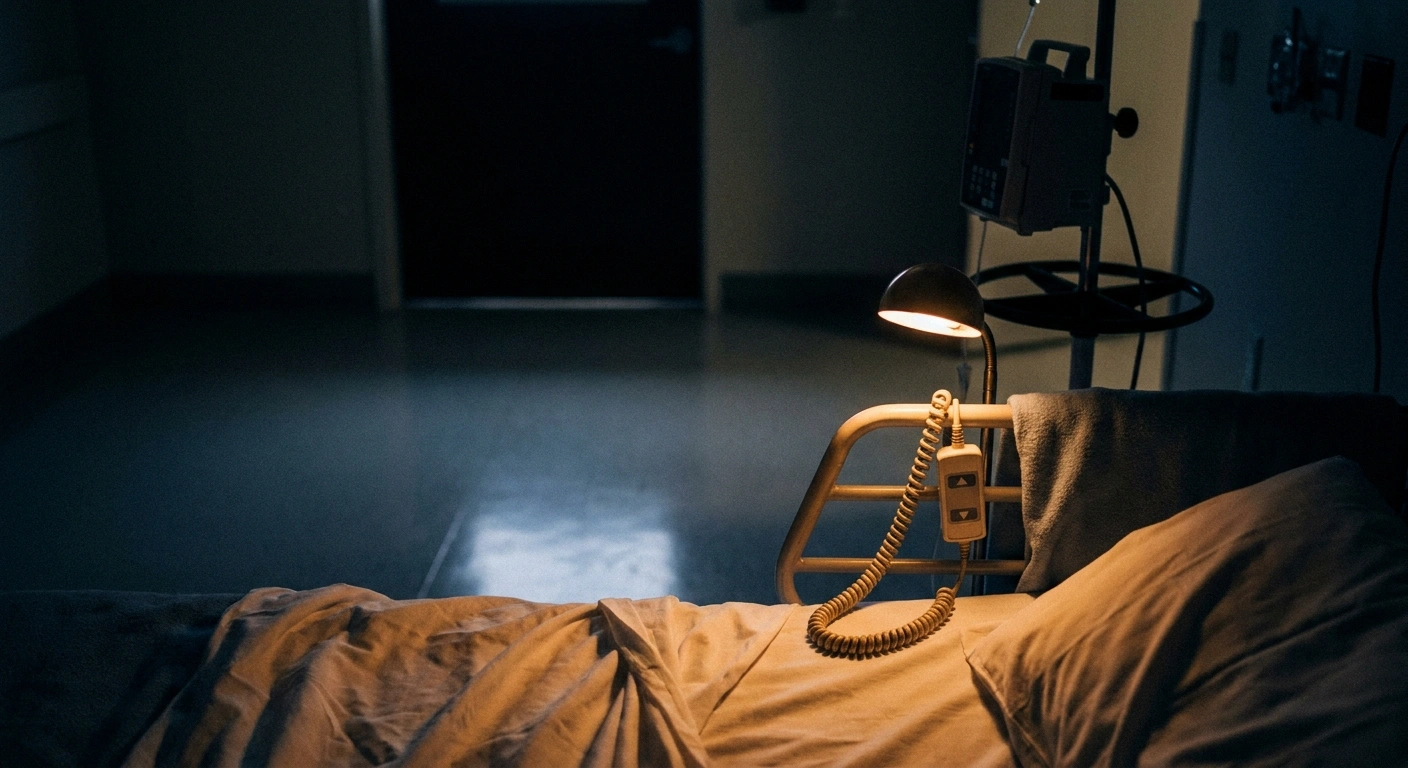
Hospital beds sit higher than home beds. The floor is hard and often slick near the bathroom. There are lines and tubes and a bed rail in an unfamiliar place, and the lighting at 3 a.m. is nothing like your bedroom.
Everything that makes getting in and out of bed safely a considered process at home applies more strongly here, with one addition: use the call button, even when it feels excessive. Falls during unassisted toileting are among the most common hospital falls, and neuropathy already raises the underlying risk of falling before you add a strange room and a bag of fluid attached to your arm.
Ask for the bed to be lowered as far as it goes, so your feet reach the floor flat before you commit your weight. Ask where the call button is clipped and keep it within reach on the side you get out of. Sit on the edge for a slow count of ten before standing, especially if you have any autonomic involvement, because lying flat for hours and then standing quickly drops blood pressure in exactly the population that already struggles with it.
If you use a walker or cane at home, bring it and keep it at the bedside. Hospital equipment gets borrowed and wheeled away.
Say These Things at Admission
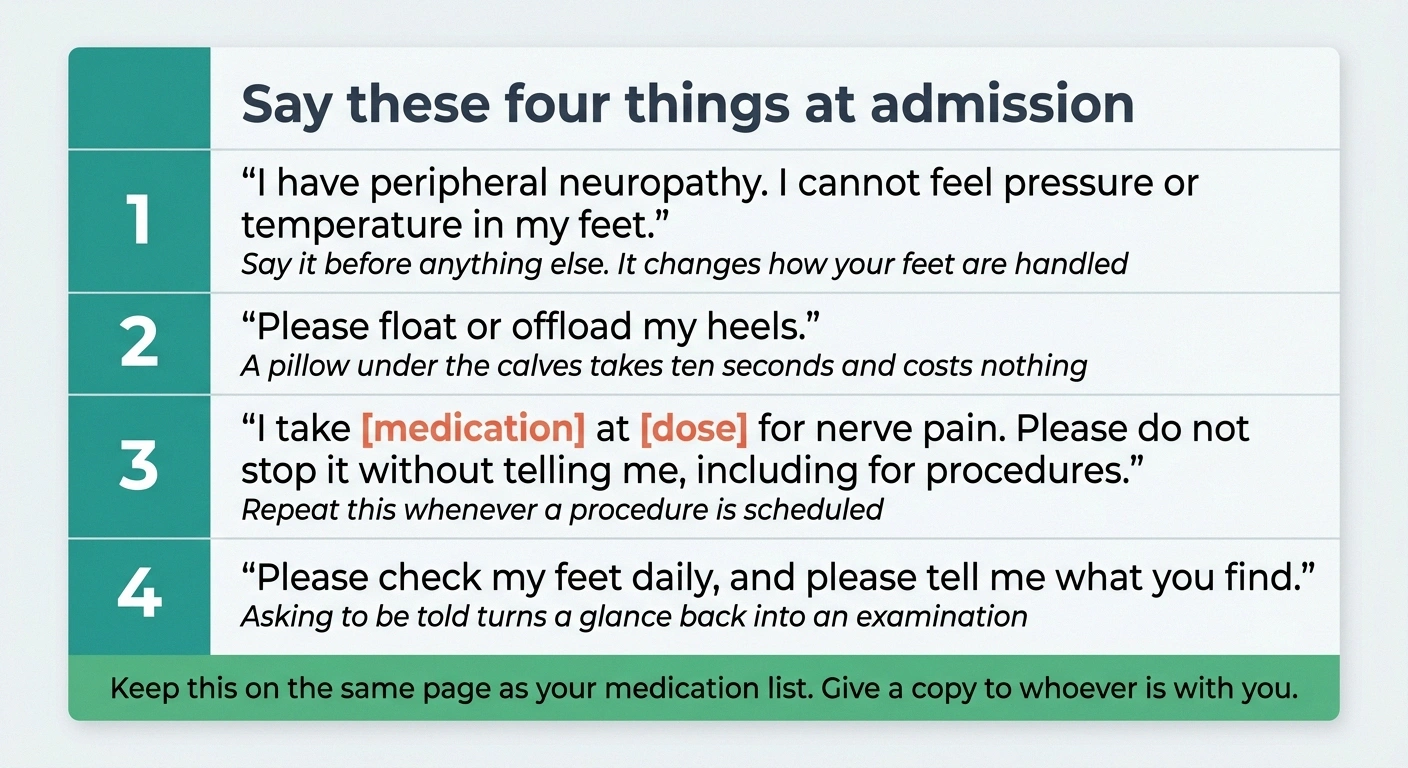
Admission is a blur of questions and you are usually unwell while answering them. Keeping four sentences ready makes the difference, and it helps to have them written on the same page as your medication list.
“I have peripheral neuropathy. I cannot feel pressure or temperature in my feet.”
“Please float or offload my heels.”
“I take [medication] at [dose] for nerve pain. Please do not stop it without telling me, including for procedures.”
“Please check my feet daily, and please tell me what you find.”
That last one deserves its own note. Foot assessment is a recognised part of inpatient care for people with diabetes, including staging any wound and checking for circulation problems and infection. But a foot check on a busy ward can quietly become a glance, and asking to be told what was seen turns it back into an examination. If you cannot see your own soles, someone else's eyes are the only monitoring you have.
If you have a person with you, give them a copy of the page. Advocacy is much easier from a chair than from a bed.
If Surgery Is Involved
Operations add positioning risk. Long procedures involve lying still on a firm table with limbs held in one position, and nerves that are already damaged tolerate compression and stretch poorly. Preparing properly for anesthesia when you have neuropathy is worth its own conversation with the surgical team rather than a line on a form.
Tell the anesthesia team about the neuropathy specifically, including which limbs and how severe. Ask about padding for pressure points. Ask what happens to your nerve pain medication before and after, since the plan should be decided rather than defaulted. And know that new or worsened numbness after surgery is worth reporting promptly rather than waiting to see whether it settles.
Before You Go Home
Discharge is fast and usually happens when you are keen to leave, which is a poor combination for catching errors.
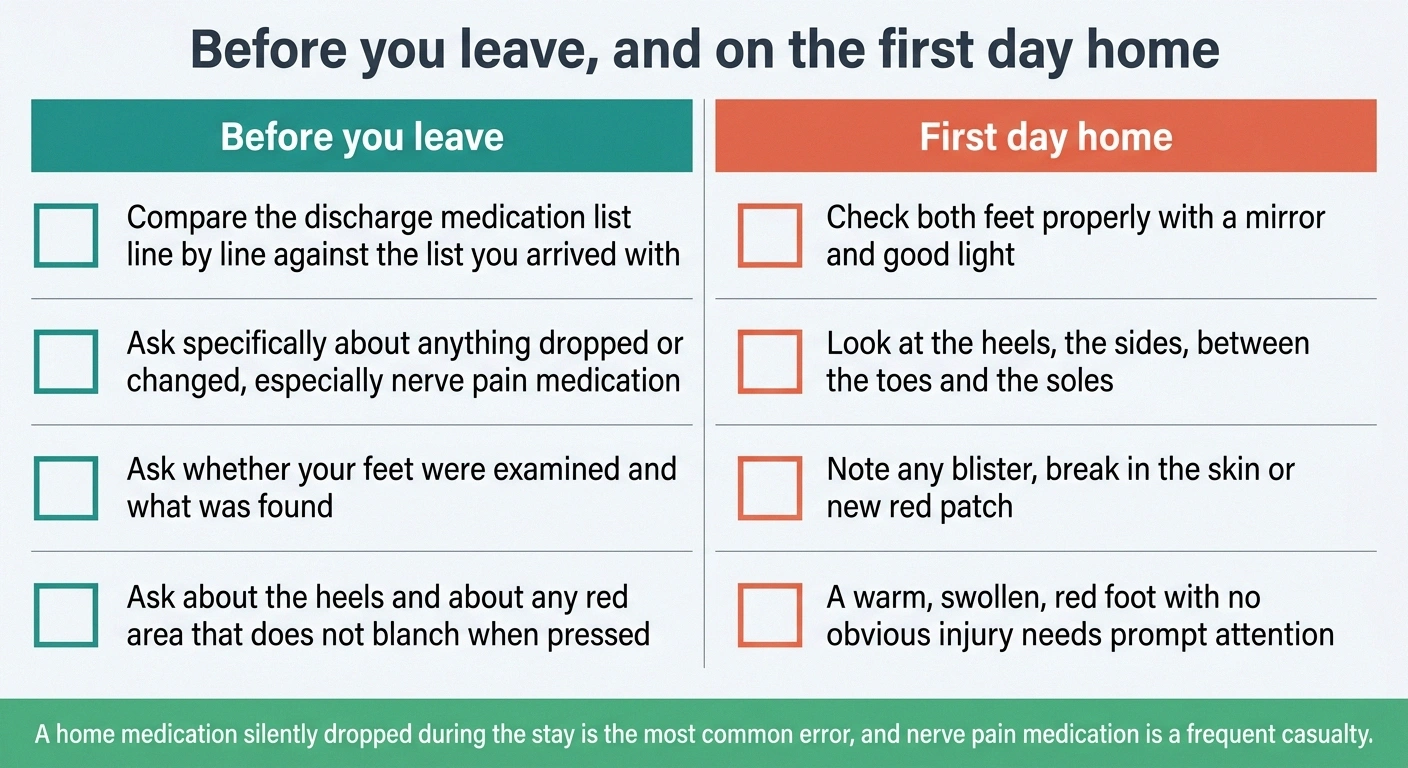
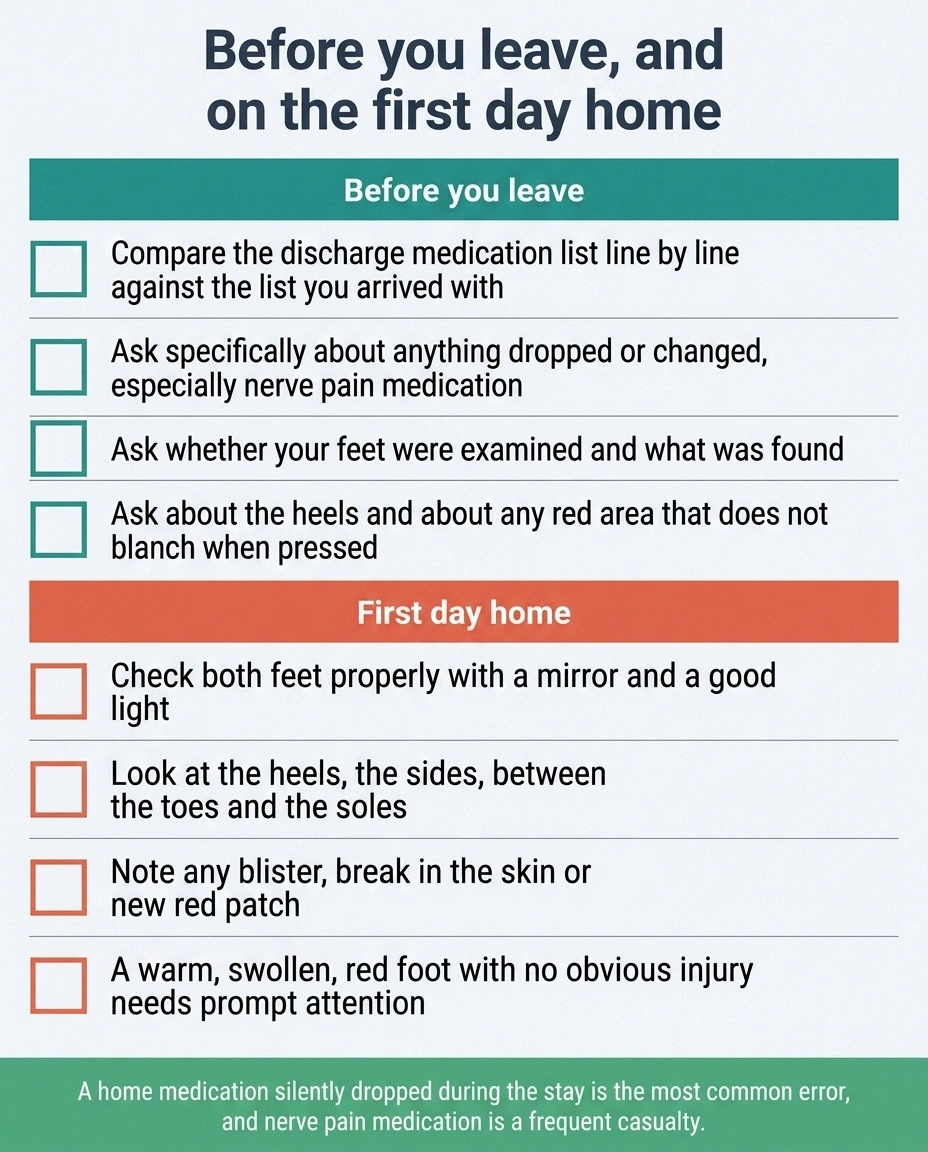
Get the discharge medication list and compare it line by line against the list you brought in. Anything added, anything missing, anything at a different dose. The single most common problem is a home medication silently dropped during the stay and never restarted, and nerve pain medication is a frequent casualty because it is not what you were admitted for.
Ask whether your feet were examined and what was found. Ask specifically about the heels, and ask about any red area that does not blanch when pressed, which is how a pressure injury begins.
Then check your own feet on the first day home, properly, with the mirror and good light. Look at the heels, the sides, between the toes and the soles. A new red patch, a blister, a warm swollen area or any break in the skin needs attention quickly rather than at your next routine visit, because on a numb foot a small wound can become an ulcer without ever hurting. A foot that is warm, swollen and red with no obvious injury also raises the question of Charcot foot, which is time-sensitive and easy to mistake for a sprain.
Most hospital stays go fine. The ones that leave people worse off in the feet tend to fail in the same two places every time, and both of those places are covered by a page of notes and a few sentences said early. Keep the page with your regular foot care routine so it is ready the next time, planned or not.
Frequently Asked Questions
What should I tell the hospital about my neuropathy?
Say that you have peripheral neuropathy and cannot feel pressure or temperature in your feet, ask for heel offloading, state which nerve pain medication you take and at what dose, and ask that it not be stopped without being told. Those four points cover the two things that most often go wrong.
Why do hospitals care so much about heels?
The heel has minimal padding over bone and rests against the mattress for long periods. On a foot without protective sensation, nothing prompts you to shift, so pressure goes unrelieved. Inpatient guidance treats heel pressure injuries in people with diabetes as preventable and expects a process to be in place to offload them.
Can my nerve pain medication be stopped while I am in hospital?
It can be interrupted without anyone intending it, most often because of a nil by mouth order for a procedure, a formulary substitution, or an error in the admission medication list. Gabapentin withdrawal symptoms usually begin 12 to 48 hours after the last dose and can include agitation, confusion, insomnia and nausea, so ask directly whether all home medications are continued and raise it again whenever a procedure is scheduled.
What should I bring for my feet?
Closed-toe non-slip slippers with a firm sole, your own lotion, a small hand mirror for checking your soles from bed, and your usual socks. Skip anything that heats, since burns on skin that cannot feel temperature are a genuine risk.
Should I use the call button every time I get up?
Yes, particularly at night and for bathroom trips. Unassisted toileting is a leading cause of hospital falls, and neuropathy already raises fall risk through numbness and loss of position sense before you add an unfamiliar room, a high bed and any lines attached to you.
What should I check before discharge?
Compare the discharge medication list against the list you arrived with, line by line, looking for anything dropped or changed. Ask whether your feet were examined and what was found, especially the heels. Then inspect your own feet on the first day home with a mirror and good light.
About the Author