The mailer usually shows a foot. Sometimes it is standing on tacks, sometimes it is drawn wrapped in flame, and the headline above it promises a breakthrough that local doctors have not told you about. On the back there is an invitation to a free dinner at a steakhouse on a Tuesday evening.
The Foundation for Peripheral Neuropathy has been documenting these campaigns for years, right down to the imagery. Those mailers work because they describe the sensation accurately. Whoever wrote the copy understood what burning feet feel like, which is more than a lot of people in the reader’s life have managed.
That accuracy is not evidence that the treatment works. It is evidence that someone did good market research.
What follows is not a list of clinics to avoid. It is a set of questions and distinctions that let you evaluate any clinic yourself, before money changes hands, using information they are obligated to give you if you ask.
The Three-Word Distinction That Does Most of the Work
Almost every disputed claim in this space collapses into one confusion, and clearing it up settles a surprising number of arguments.
What the brochure says, and what it can support
Each phrase on the left is legal to print. The right column is what it actually establishes.
| Phrase in the marketing | What it establishes |
|---|---|
| “FDA-cleared technology” | Similar enough to an existing device to be sold. No trial of benefit required. |
| “Clinically proven” | Undefined and unregulated as a phrase. Ask which study, how many people, and whether there was a placebo group. |
| “Drug-free and non-invasive” | A description of the delivery method. Says nothing about whether it works. |
| “Stimulates nerve regeneration” | Not a cleared or approved indication for any device in this market. |
| “Increases circulation” | Often accurate, and often the actual cleared indication. Note how much narrower it is than the headline. |
These three phrases sound similar and mean entirely different things:
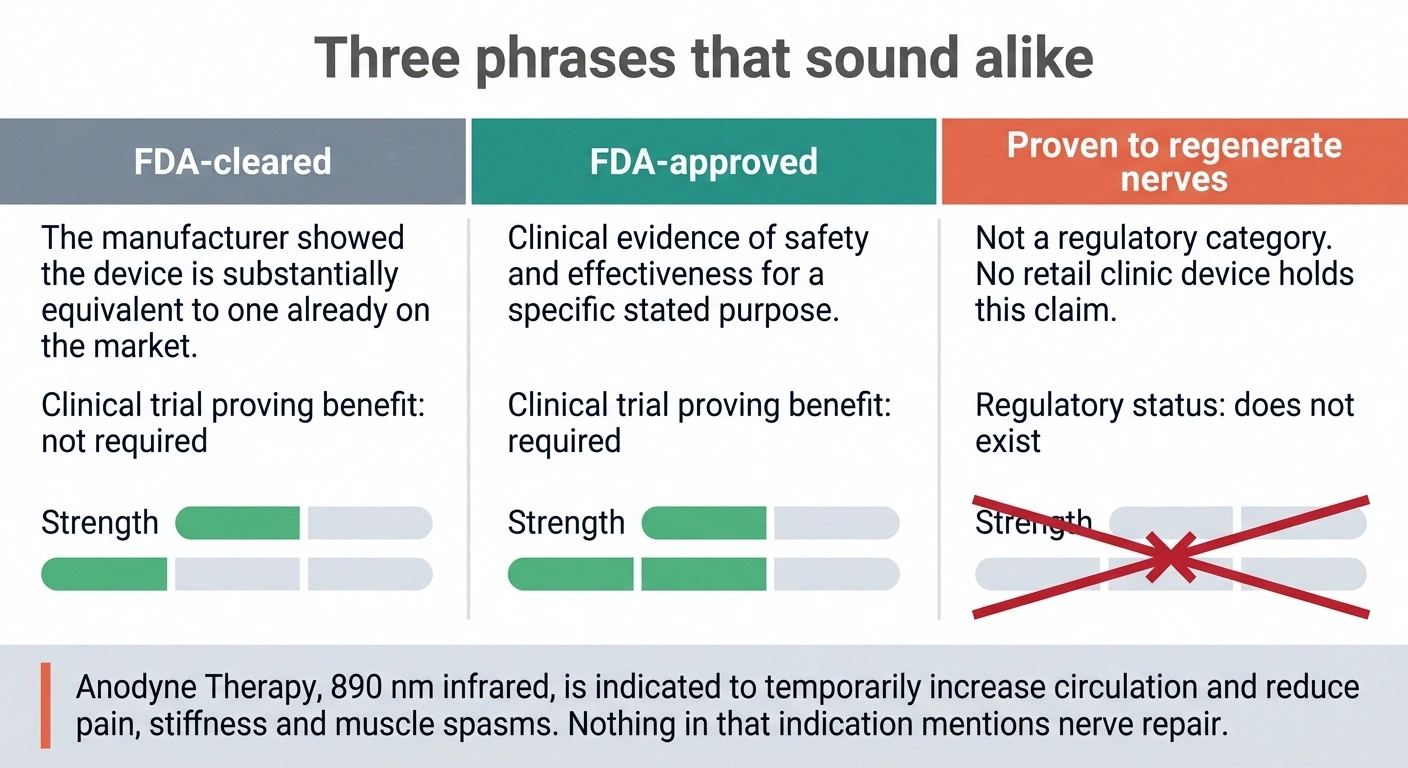
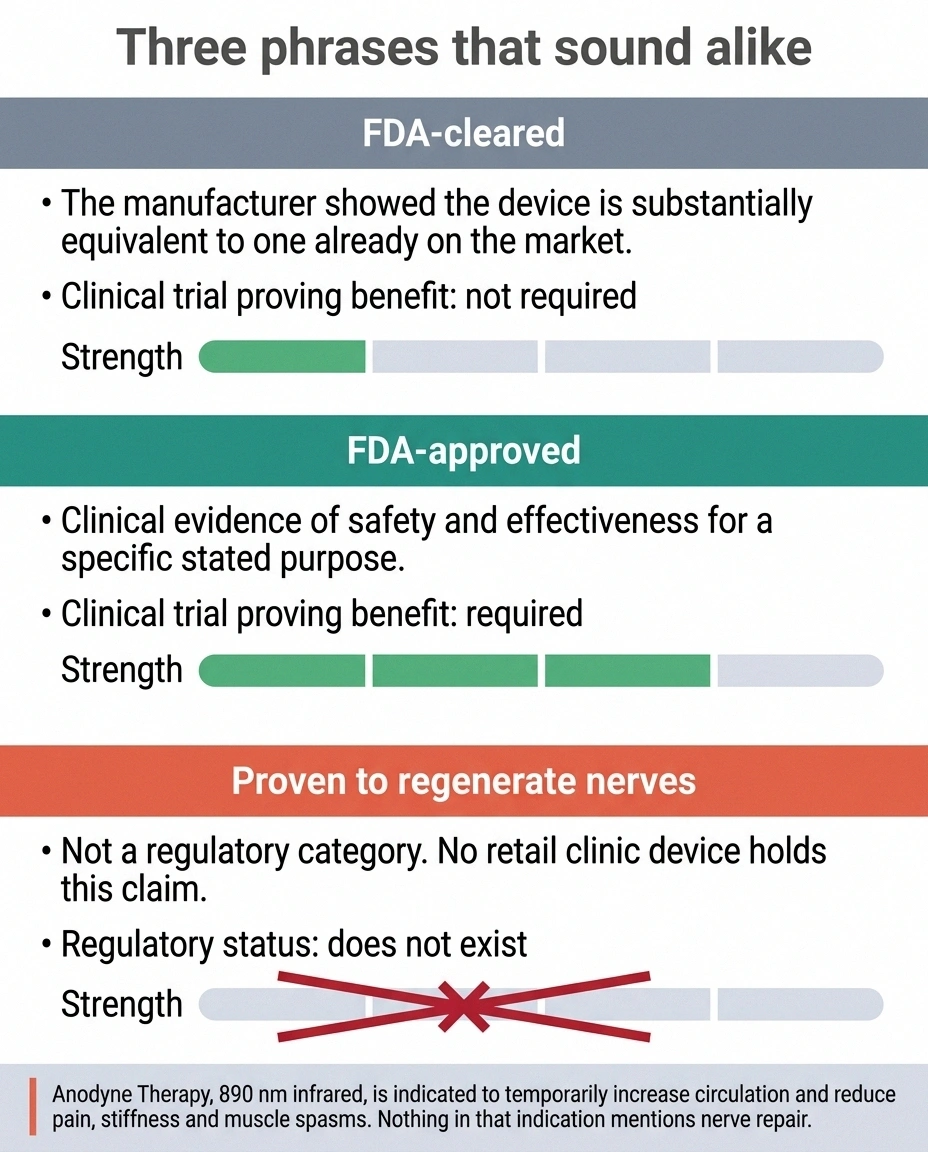
- FDA-cleared. The manufacturer showed the device is substantially equivalent to one already on the market. This is a paperwork pathway. It does not require a clinical trial proving the device helps anyone.
- FDA-approved. A higher bar involving clinical evidence of safety and effectiveness for a stated purpose. Most devices sold for neuropathy are not in this category.
- Proven to regenerate nerves. Not a regulatory category at all. No device sold in a retail clinic setting holds this claim.
Here is how the substitution happens in practice. Anodyne Therapy is a real infrared device emitting light at 890 nanometers, and its FDA indication is specific and narrow: to temporarily increase circulation and reduce pain, stiffness and muscle spasms. Every word of that is doing work. Temporarily. Circulation. Reduce pain.
Nothing in that indication says the device repairs nerve fibers. Yet clinic marketing routinely presents the same device as nerve regeneration technology, and the leap from the approved language to the marketing language happens quietly, in a room where nobody has the regulatory text in front of them.
So the first question to ask, in exactly these words: “What is this device FDA-cleared or approved to do? Please show me the indication.” A legitimate clinic will produce it without friction. Watch what happens if the answer becomes a story about patient results instead.
The Free Dinner, Looked at Structurally
The seminar deserves its own look, because it is engineered and most attendees experience it as hospitality.
Consider what the format accomplishes. It gathers a room of people who share one condition and one frustration, which manufactures a sense of consensus that no individual consultation could. It creates a small reciprocal obligation through the meal itself, which is well documented as a driver of compliance. It presents testimony from people whose relationship to the clinic is not disclosed. And it ends with a limited number of complimentary evaluations available to those who book before leaving, which converts a room into an appointment book.
None of that is illegal, and versions of it show up in plenty of ordinary sales contexts. The reason it matters here is the specific vulnerability it is aimed at. People in that room have often spent years being told by clinicians that little more can be done. A presenter who opens by validating that experience is credible before making a single medical claim, and the audience has been primed to weigh the claims more generously than they otherwise would.
Going is fine. Deciding there is the part worth avoiding. The information presented will be identical tomorrow, when the room is not helping it along.
Diagnosis First or Protocol First
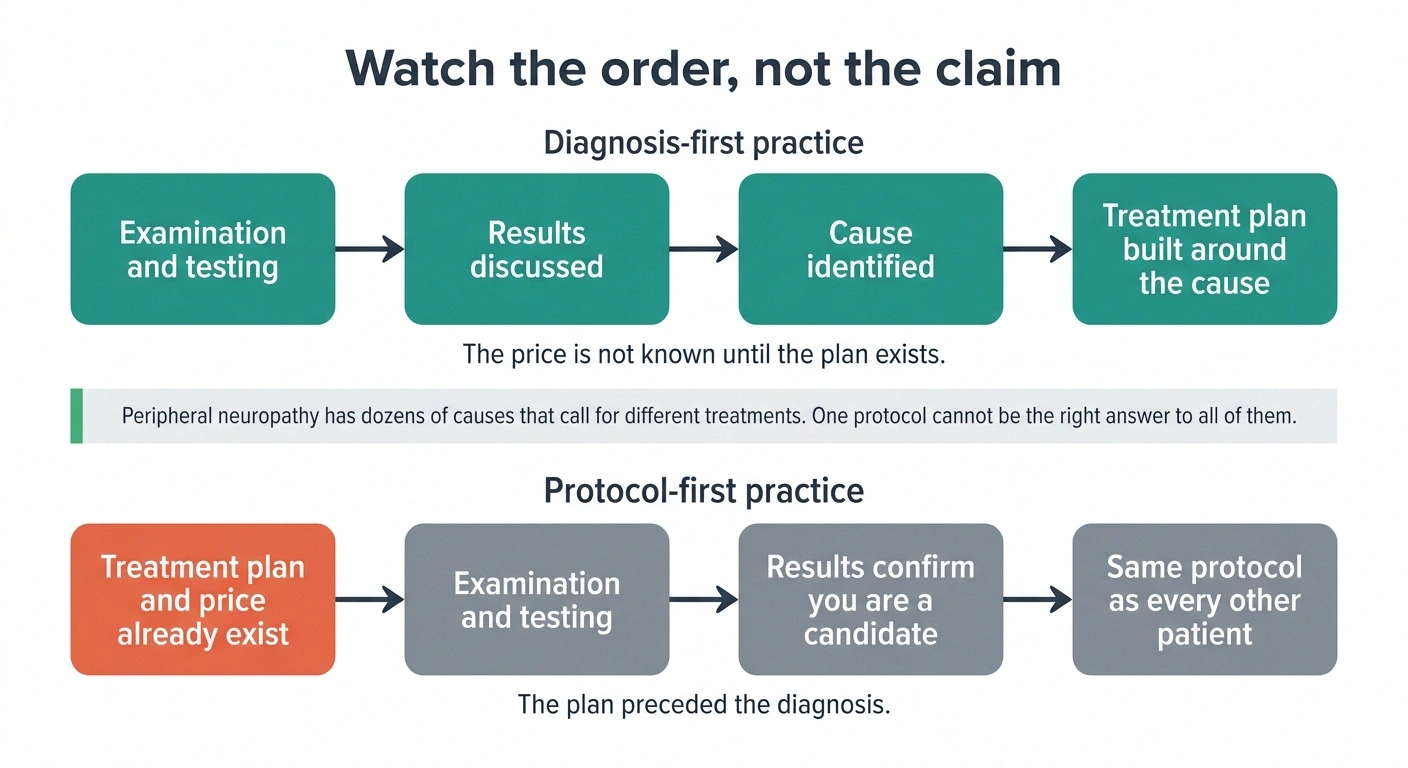
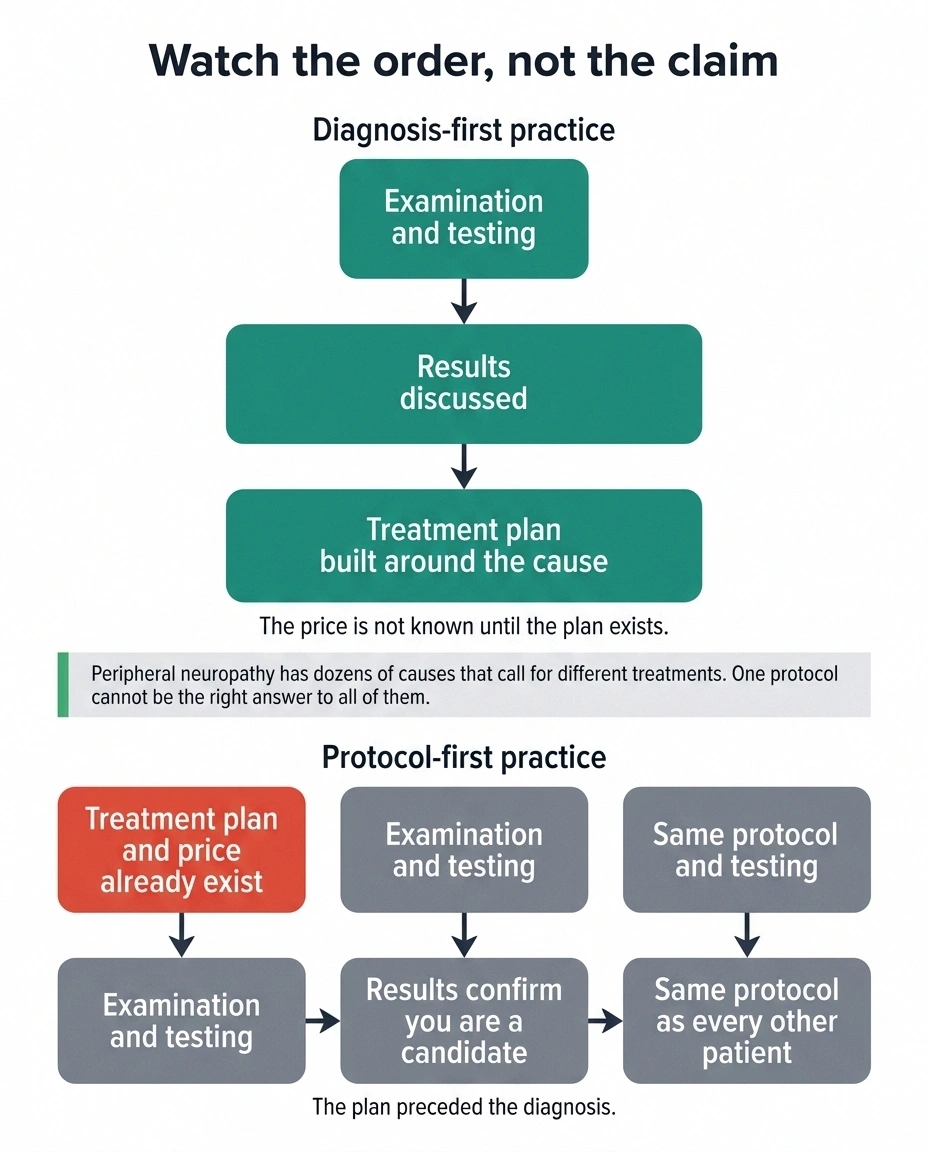
This is the structural test, and it separates real clinics from packaged ones more reliably than any individual claim does.
Peripheral neuropathy is a symptom pattern with dozens of possible causes. Diabetes and prediabetes. B12 deficiency. Thyroid disease. Autoimmune conditions. Alcohol. Chemotherapy. Certain antibiotics and cardiac drugs. Hereditary conditions. Kidney disease. And in a meaningful share of cases, no identified cause at all after a full workup.
Those causes call for genuinely different treatments. B12 deficiency is corrected with B12. An autoimmune neuropathy may need immunotherapy. Diabetic nerve damage is addressed primarily through glycemic control. There is no single intervention that is the right answer to all of them, which means a clinic offering one protocol to every patient who walks in has decided the treatment before knowing the disease.
The tell is the sequence of the sales conversation. In a diagnosis-first practice, testing comes first, results are discussed, and only then does a treatment plan appear, shaped by what the testing found. In a protocol-first practice, the treatment plan and its price exist before the results do, and the testing serves mainly to confirm that you are a candidate for the thing they already sell.
If you have not had a full workup yet, our walkthrough of the tests a neuropathy workup should include is a reasonable baseline to measure any clinic’s testing against.
Reading the Testing Itself
Testing is where a lot of the money in these operations is actually made, which makes it worth examining separately.
Nerve conduction studies are a real and valuable diagnostic tool. Used once, at the start, to characterize what kind of nerve damage is present, they earn their cost. The Foundation for Peripheral Neuropathy flags a different use: extensive nerve conduction testing repeated throughout a treatment course, which it describes bluntly as testing that “may have no basis other than to generate income for the clinic.”
Same for imaging. The Foundation specifically notes clinics X-raying the neck, back, arms, legs and feet, which adds radiation exposure without a clear diagnostic question driving it. An X-ray answers questions about bone. Peripheral nerves do not appear on one.
Two questions cut through this quickly. What decision will this test change? And how many times will it be repeated, and why? Any test worth running has an answer to the first. Repeat testing without a stated clinical trigger is worth a hard look.
The Injection Protocol Worth Knowing About
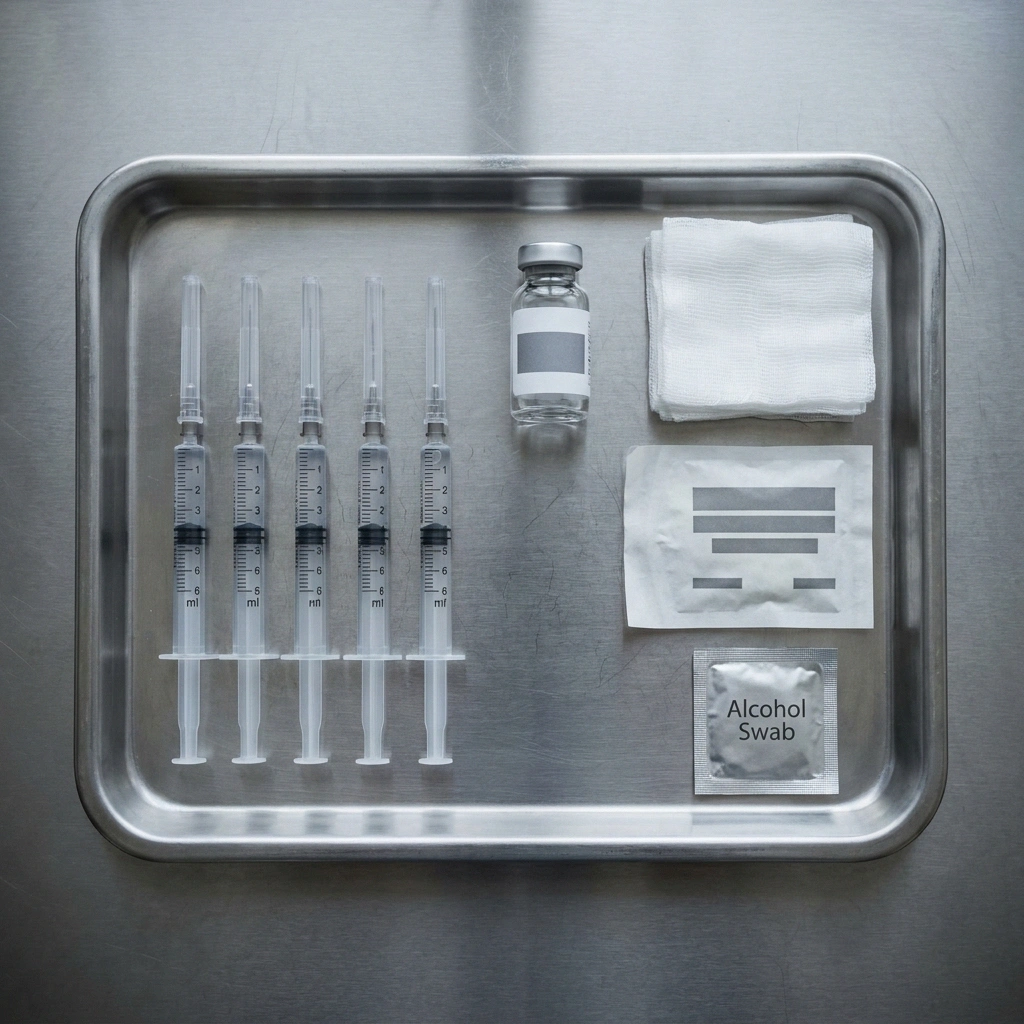
One specific treatment model appears often enough to name it.
The documented protocol, counted out
Two to three sessions a week is a schedule most people agree to without doing the arithmetic first.
Around 130
sessions in a year at 2 to 3 per week
Up to 5
injections in a single day, as documented
0
studies found supporting a rationale for frequent peripheral nerve blocks
There is a second cost nobody quotes. A course at that frequency also consumes travel, half of most weekdays, and the annual insurance benefit you may need in November.
The protocol involves injections of a local anesthetic, frequently Marcaine, into peripheral nerves, given two to three times per week over an extended course. The Foundation for Peripheral Neuropathy has documented patients receiving more than 100 treatments, with up to five injections in a single day.
The relevant finding is what the Foundation reports about the evidence base. Their review of peer-reviewed journals and position statements from recognized medical and chiropractic professional societies “failed to identify studies that support a rationale for frequent peripheral nerve blocks.”
That is a precise statement and worth reading precisely. It is not saying nerve blocks never help anyone. It is saying that the specific model, high-frequency repeated blocks delivered over months, has no supporting literature and no professional society backing it.
Meanwhile the billing runs to thousands of dollars, and there is a downstream cost that patients rarely see coming: the Foundation notes these claims “can exhaust the patient’s insurance benefits that they may need for regular health care.” Benefit caps and out-of-pocket maximums are finite. A protocol that consumes them in the first four months of the year affects everything else you might need that year.
What the Payment Structure Tells You
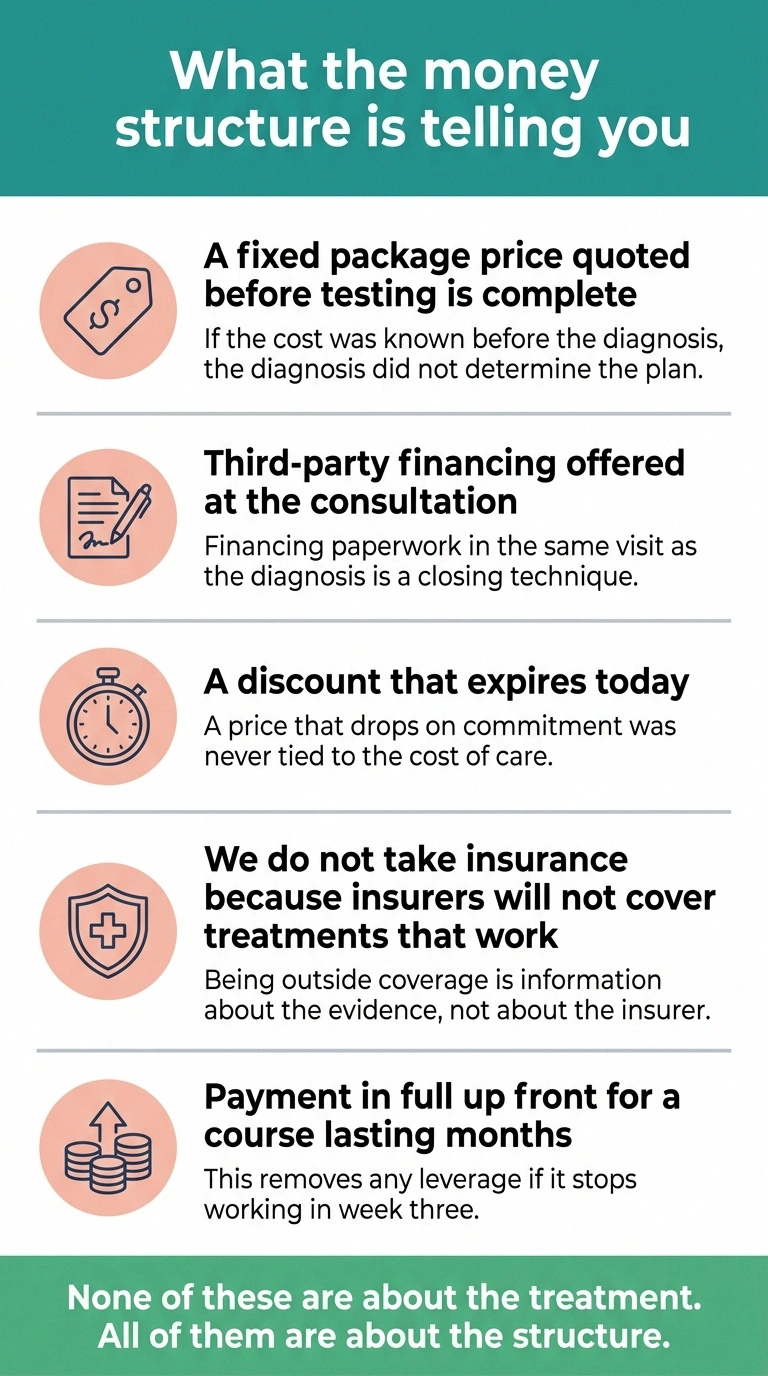
Money mechanics are unusually informative here, because a treatment plan and a sales structure are built differently and it shows.
Signals worth taking seriously:
- A fixed package price quoted before testing is complete. If the cost is known before the diagnosis, the diagnosis was not what determined the plan.
- Third-party medical financing offered at the consultation. Financing exists for legitimate reasons. Financing paperwork presented in the same visit as the diagnosis, before you have gone home to think, is a closing technique.
- Discounts that expire. A price that drops if you commit today is a price that was never fixed to the cost of care.
- “We don’t take insurance because insurers won’t cover treatments that work.” Insurers cover plenty of expensive things. What they generally will not cover is a service with no supporting evidence, and being outside coverage is information about the evidence, not about the insurer.
- Payment in full up front for a course lasting months. This transfers all the risk to you and removes any leverage if it stops working in week three.
Compare that against how coverage normally functions for nerve care, which our guide to neuropathy insurance coverage lays out in more detail.
Claims That Should Stop the Conversation

Some statements are strong enough on their own to end the evaluation.
A guaranteed success rate. Numbers like 90% success turn up frequently in this market. Ask where the number comes from. In-house patient satisfaction data collected by the seller is not an outcome study, and outside of a controlled trial with a comparison group there is no way to separate treatment effect from natural fluctuation, regression to the mean, and the substantial placebo response that pain conditions reliably produce.
Reversal or cure language applied universally. Some neuropathy genuinely improves, and the honest version of this is specific: which causes, in which circumstances, to what degree. We cover that range in whether neuropathy can be reversed. Undifferentiated cure language applied to every patient regardless of cause is the claim that does not survive contact with how the condition actually behaves.
“Your neurologist doesn’t know about this.” Treatments with real evidence reach neurologists. They attend conferences and read journals. A therapy that has been available for years while remaining unknown to the specialty most responsible for it is not being suppressed.
Pressure to decide before leaving. No legitimate treatment for a chronic condition that developed over years requires a decision inside an hour.
Where the Real Modalities Sit
Worth being fair here, because “clinic marketing overstates it” is not the same as “the underlying therapy is worthless.”
Several modalities these clinics sell have genuine, if modest, research behind them. Red light and near-infrared therapy have actual studies, which we walk through in red light therapy for neuropathy and infrared therapy for neuropathy. The findings are mixed and the effect sizes are moderate at best.
That is the actual gap. Not that these devices do nothing, but that “may modestly reduce pain in some patients, with mixed evidence” gets sold as “regenerates damaged nerves,” and the price is set against the second claim rather than the first.
A clinic willing to describe its own modality in the first set of words is behaving differently from one that only speaks in the second.
A Practical Sequence Before You Pay

Five steps, in order, none of which require any expertise you do not already have.
Three sentences that end the pressure without an argument
Most people struggle less with spotting the problem than with leaving the room. These are polite, final, and hard to counter.
“I don’t make medical decisions the same day I hear about them. Please put it in writing and I’ll call you.”
“I’d like the FDA indication wording for each device before I decide anything.”
“My physician reviews anything I sign. That isn’t negotiable for me.”
Watch the response as closely as the answer. A practice comfortable with its own evidence treats all three as reasonable. Notice if the price changes after you say them.
- Ask for the treatment plan in writing, including the specific diagnosis it treats, the total cost, the number of sessions, and what happens if you stop early. Written claims are made more carefully than spoken ones.
- Ask for the FDA indication for each device, and read the actual wording rather than the summary you are handed.
- Ask what happens at the point of no improvement. “If I have had ten sessions and nothing has changed, what do you do differently?” A clinic with a real clinical model has an answer. A package has only more sessions.
- Take the plan to your existing physician. Not for permission, for a second read. Our guide on getting a neuropathy second opinion covers how to set that up efficiently.
- Go home before deciding. Every legitimate option will still be available tomorrow.
If you want the same money working somewhere with a stronger evidence base, two comparisons are worth making. A neurologist consultation through normal insurance channels typically costs a fraction of these packages, and our guide to choosing a neurologist for neuropathy covers how to find one who takes the condition seriously. And neuropathy clinical trials offer access to genuinely novel treatments, under monitoring, usually at no cost.
If You Already Paid
Plenty of people find this article after the fact, and there are still moves available.
Four places a complaint has teeth, and what each one can do
- Your state medical or chiropractic board
- Holds the licence. The only body that can restrict a practitioner’s ability to practise. Complaints are free to file and do not require a lawyer.
- Your insurer’s fraud line
- Relevant when services were billed but not delivered, or coded as something other than what happened. Insurers investigate billing patterns across many patients, which is leverage no individual has.
- The FTC, at ReportFraud.ftc.gov
- Handles deceptive advertising rather than individual refunds. Reports feed a database that supports action against patterns, so filing matters even when nothing comes back to you.
- The financing company, if a loan was involved
- Medical credit agreements carry their own dispute provisions, and a claim raised with the lender is a separate track from any argument with the clinic. Read the agreement before assuming the debt is fixed.
Request your complete records, including all test results and treatment notes, which you are entitled to. Review the itemized billing against what was actually delivered. If services were billed but not rendered, that is a matter for your insurer’s fraud line and for your state medical board. Complaints go to the FTC at ReportFraud.ftc.gov and to your state attorney general, and if the treatment was financed, the financing agreement may have its own dispute provisions worth reading.
Then take the test results to a neurologist. Even from a clinic with a questionable business model, real nerve conduction data is real data, and it does not need to be repeated.
Frequently Asked Questions
Are neuropathy clinics legitimate?
The category contains both. Some are genuine multidisciplinary practices that diagnose first and treat according to cause. Others are marketing operations selling one fixed protocol to everyone. The distinguishing question is not the signage but the sequence: whether the diagnosis determines the treatment plan, or the treatment plan exists before the diagnosis does.
Is FDA-cleared the same as FDA-approved?
No, and the difference is substantial. FDA-cleared means the manufacturer demonstrated the device is substantially equivalent to something already marketed, which does not require proof that it helps patients. FDA-approved involves clinical evidence of safety and effectiveness for a specific stated use. Marketing frequently uses “cleared” while implying “approved.”
Why do these clinics want cash up front?
Two reasons usually given are that insurers do not cover the treatment and that package pricing is cheaper. The structural effect is that full payment before delivery removes your ability to stop paying if the treatment is not working, and shifts the entire financial risk onto you.
Can damaged nerves actually be regrown?
Peripheral nerves do have some regenerative capacity, and axons can regrow slowly, on the order of about a millimeter a day, when the underlying cause is removed. That is genuinely different from a device claim to regenerate nerves on demand. The strongest lever remains addressing the cause, whether that means blood sugar control, correcting a deficiency, or stopping an offending medication.
What should a real neuropathy workup include?
At minimum: a clinical neurological examination, blood work covering glucose and A1c, B12, thyroid function, kidney function and inflammatory markers, and where indicated, nerve conduction studies with EMG. Additional testing depends on what the initial round suggests. The workup should be aimed at identifying a cause, not at qualifying you for a program.
My symptoms did improve at the clinic. Does that mean it worked?
It might, and it is also the hardest thing to interpret without a comparison group. Neuropathy symptoms fluctuate on their own, pain conditions show large placebo responses, and most clinic programs bundle several changes at once, often including footwear, activity and supplements alongside the headline treatment. Improvement is real and worth having. Attributing it correctly is a separate question.
How much do these programs typically cost?
Package pricing commonly runs into the thousands, and the Foundation for Peripheral Neuropathy specifically cites braces alone costing thousands of dollars with little benefit to the patient’s pain. Beyond the direct cost, insurance-billed programs can consume annual benefit limits that you may need later in the year for other care.
Should I tell my regular doctor I am considering one of these clinics?
Yes, and bring the written plan rather than describing it from memory. Some proposed treatments interact with existing conditions or medications, and a physician who knows your full history can spot that quickly. Our guide on how to talk to your doctor about neuropathy pain covers how to raise it without the conversation turning defensive.
About the Author