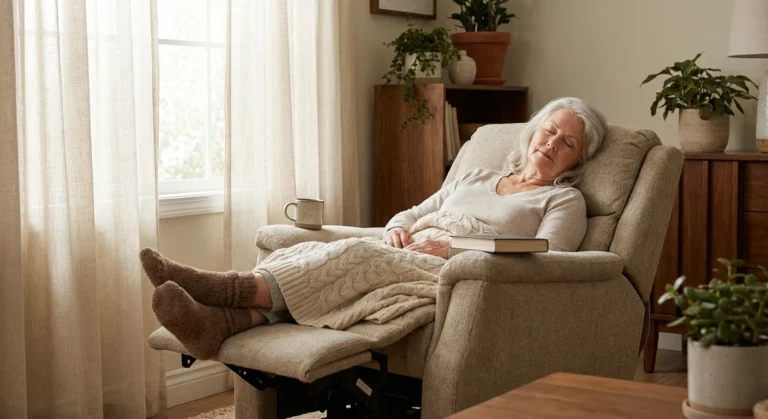
It is nine in the evening and you are standing in the cold and flu aisle with a scratchy throat, holding a box that promises to handle six symptoms at once.
Here is what almost nobody tells people with neuropathy: that box may contain an ingredient that interacts with the medication in your cabinet at home. Not a mild interaction either. One of the most common nighttime cold ingredients carries a major interaction warning with two of the drugs most often prescribed for nerve pain.
So this article does two jobs. It explains why your feet are so much louder this week, which is normal and does settle. And it walks the pharmacy shelf with you, because that is the part that actually carries risk.
Why Being Sick Makes Nerve Pain Louder
The flare is real. You are not imagining it and you have not lost ground.
Assemble this in October, not at nine in the evening
Every difficult decision in this article disappears if the right things are already in the cupboard. One shoebox, assembled once a year.
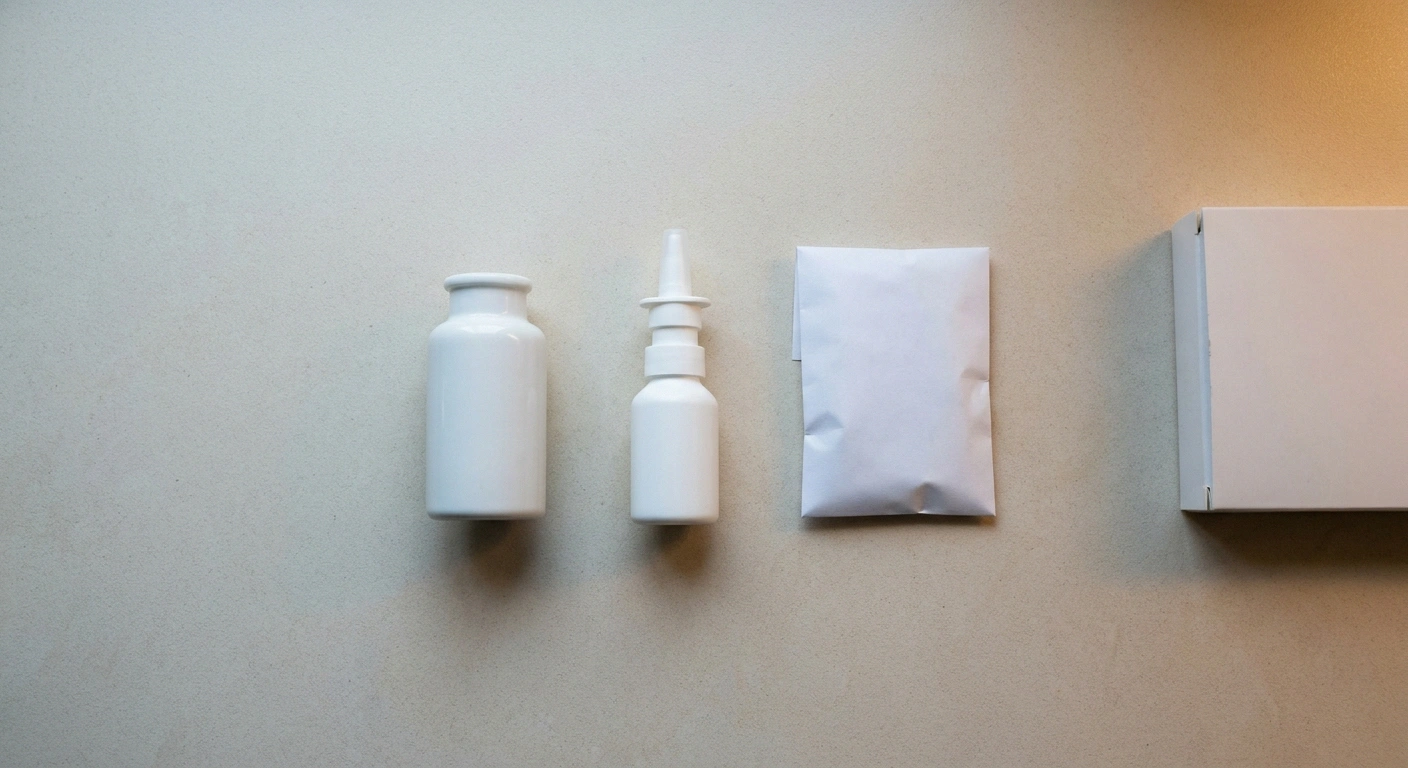
- Plain acetaminophen, single ingredient, nothing added
- Saline nasal spray, which does much of a decongestant’s work with none of the blood pressure effect
- Guaifenesin on its own if you want something for chest congestion, since it thins mucus rather than suppressing cough and carries none of the interactions
- Plain honey or simple cough drops, sugar-free versions if you have diabetes
- An oral rehydration sachet or two, more useful than water alone across several feverish days
- A thermometer that works, checked before the season rather than during it
- A written list of everything you take, doses included, kept in the box so a pharmacist can read it rather than hear it recited
Notice what is absent: any product treating more than one symptom. That single rule removes the interaction problem before it arises.
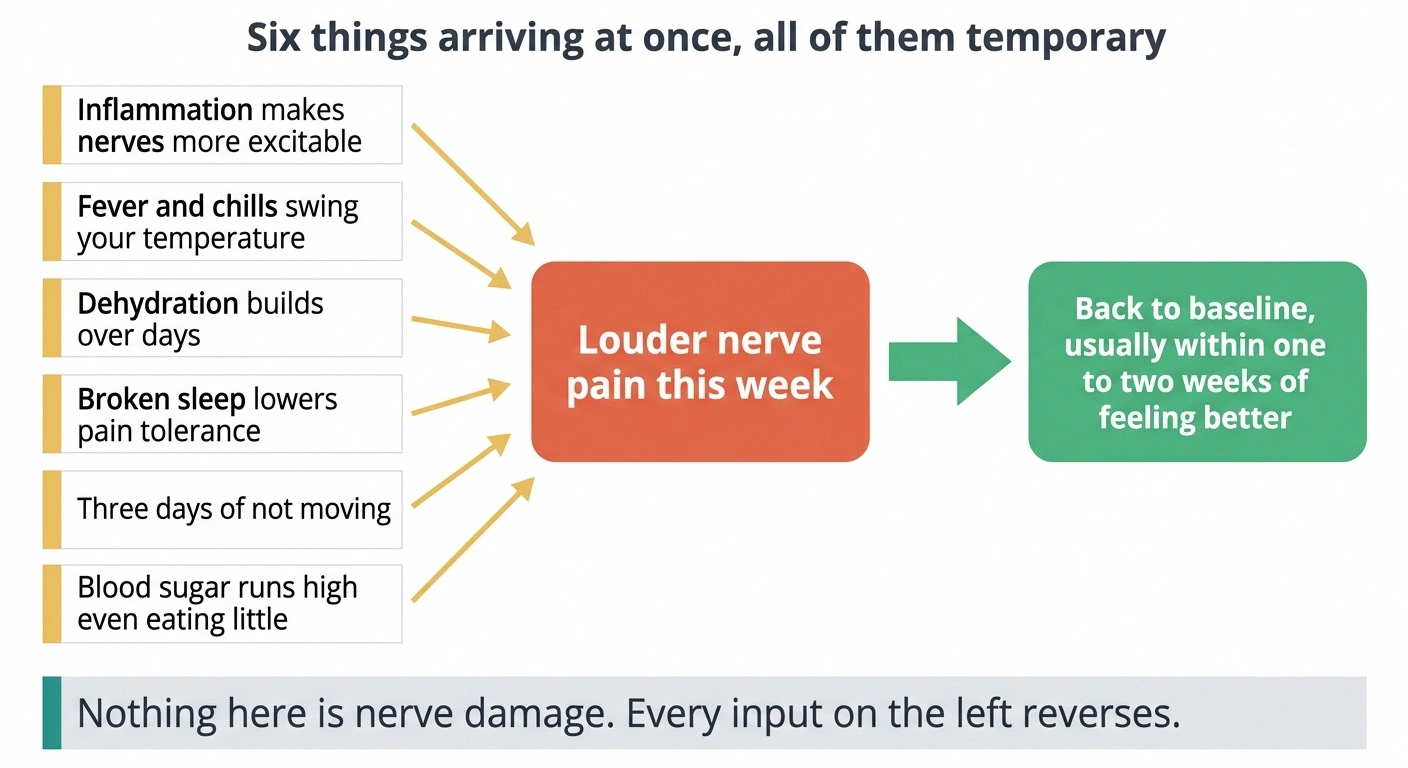
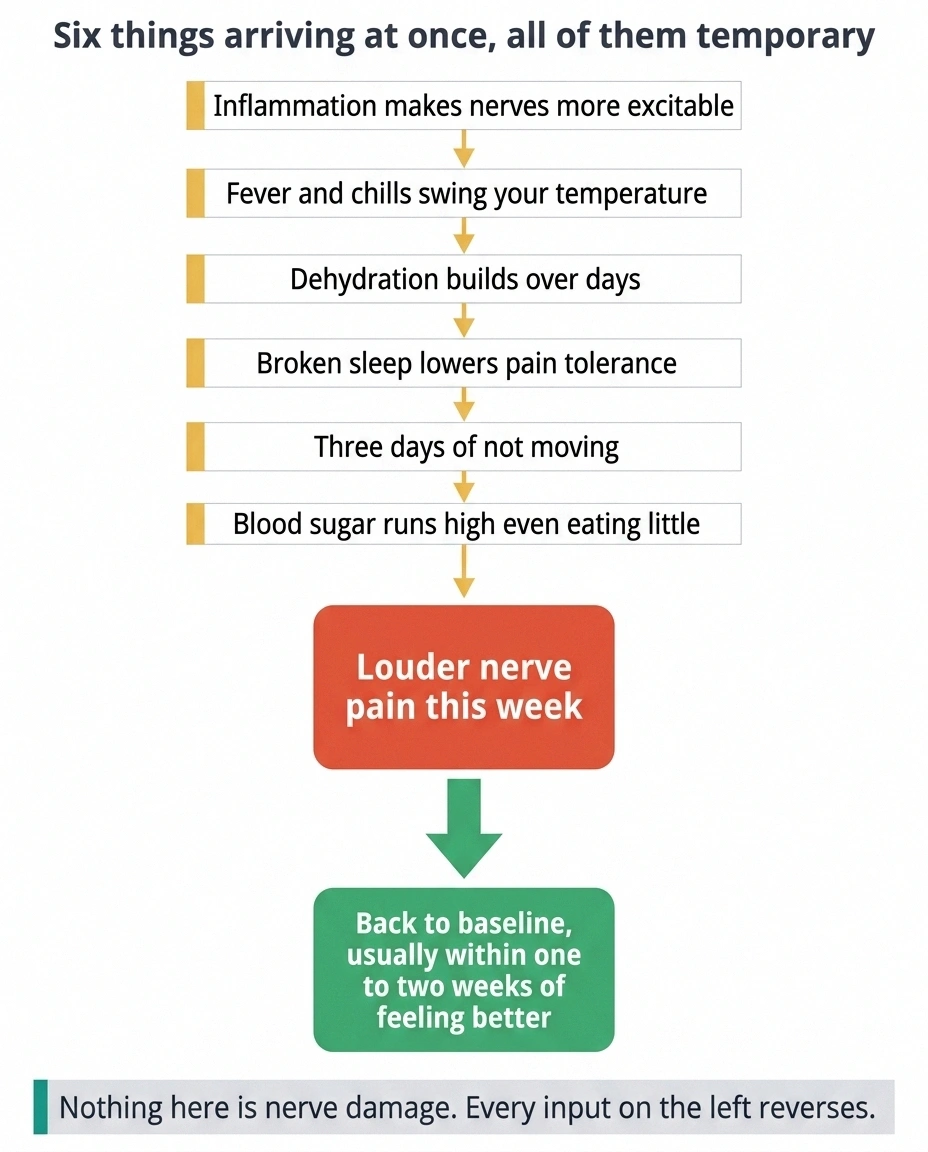
Inflammation turns up the volume. Fighting an infection means mounting a whole-body inflammatory response, and inflammatory signalling makes pain-carrying nerves more excitable. Nerves that were already sending faulty signals now send them more readily. People with neuropathy tend to run a heightened inflammatory response to begin with, which is part of why seasonal illness hits this population harder than the symptom list suggests it should.
Fever changes nerve conduction. Damaged nerves are less tolerant of temperature swings in either direction, and a fever plus the chills that follow it is a temperature swing every few hours. If you already notice temperature sensitivity in your feet, expect it to be amplified.
Dehydration adds up quietly. Fever, sweating, poor appetite and a few days of drinking less than usual combine faster than people expect, and dehydration worsens cramping and general symptom intensity.
Sleep goes to pieces. Poor sleep lowers pain tolerance measurably by the following day, and nerve pain is already at its worst at night. Coughing through three nights builds a deficit that shows up as pain rather than as tiredness.
You stop moving. Three days on the sofa means three days of reduced circulation and stiffening, and the deconditioning is noticeable by the end of the week even in people who normally walk daily.
Blood sugar climbs. For the large share of readers whose neuropathy is diabetic, this one matters most. Illness raises blood glucose through stress hormones even when you are eating almost nothing, and higher glucose worsens nerve symptoms directly.
Walking the Pharmacy Shelf
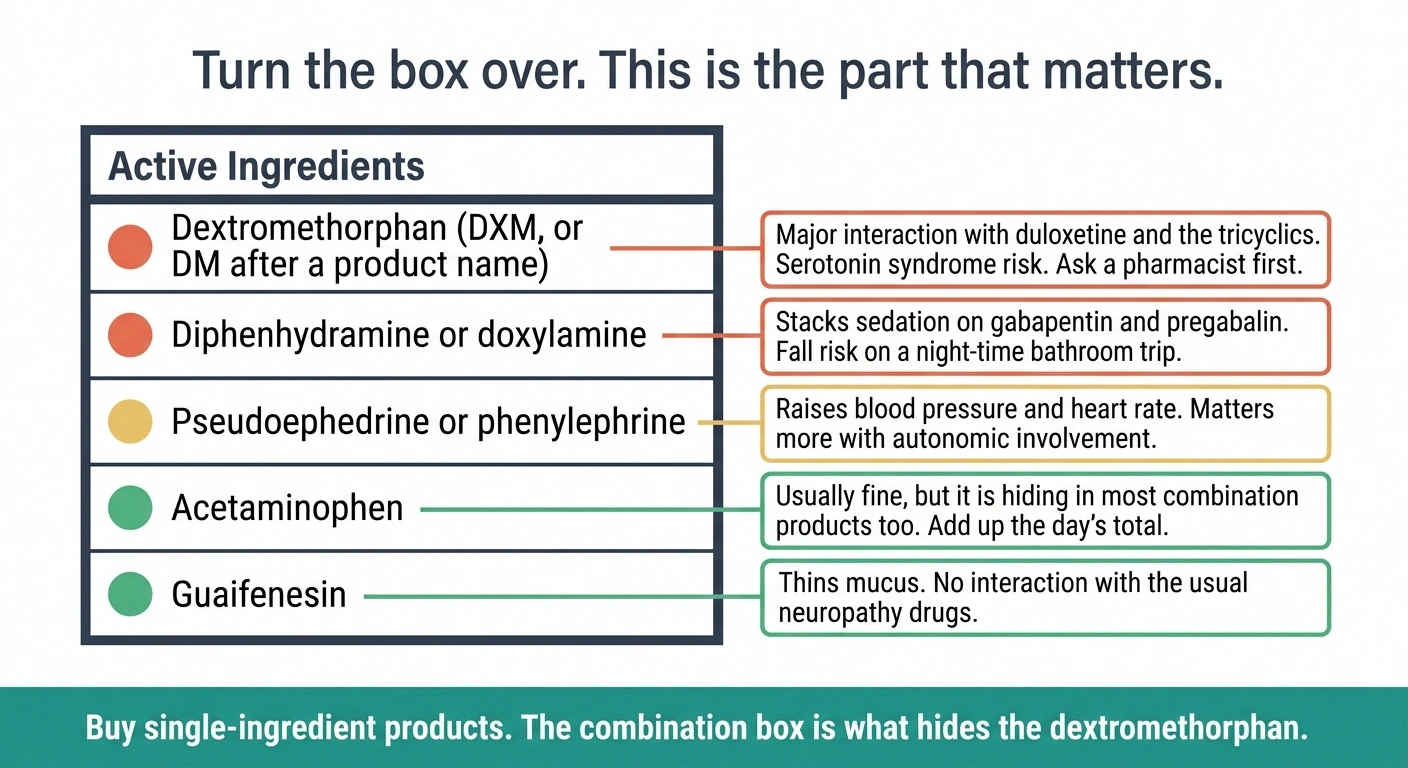
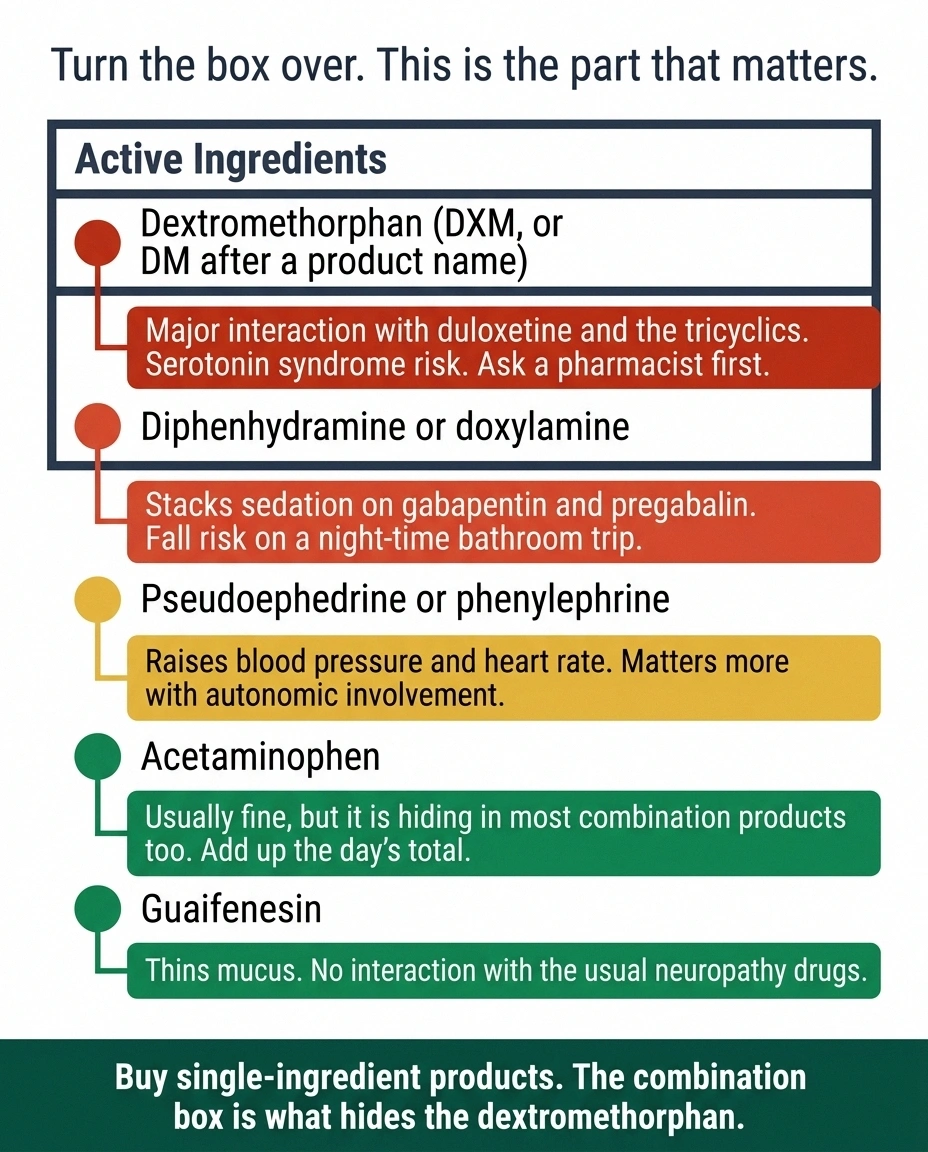
The safety section. The problem is not any single product, it is that combination products hide three or four active ingredients behind one brand name, and the one that matters is rarely on the front of the box.
Turn the box over and read the Active Ingredients panel. Everything below is organized by what you will find there.
Dextromethorphan, the cough suppressant
This is the important one. Dextromethorphan appears as DXM or as the letters DM after a product name, and it is in most nighttime formulas and most cough syrups.
It carries a major interaction with duloxetine (Cymbalta) and with the tricyclics, meaning amitriptyline and nortriptyline. All of these raise serotonin activity, and combining them can trigger serotonin syndrome. The signs are confusion, agitation, rapid heartbeat, blood pressure swings, fever, heavy sweating, shivering, tremor, muscle stiffness, loss of coordination and gastrointestinal upset. Most cases are mild, but severe ones are genuinely dangerous.
If you take duloxetine, venlafaxine, amitriptyline or nortriptyline for nerve pain, treat dextromethorphan as a product to clear with your pharmacist before you buy it rather than one to try and see. This takes about two minutes at the counter and the pharmacist does not need an appointment.
Antihistamines, in almost every nighttime product
Diphenhydramine and doxylamine are what make nighttime formulas make you sleepy. Stacked on top of gabapentin or pregabalin, which already cause sedation and unsteadiness, the combined effect is more than either alone.
The risk that follows is the fall. You already have reduced position sense in your feet, and adding double sedation to that before a three-in-the-morning trip to the bathroom in the dark is how people with neuropathy end up in an emergency department during a head cold. If you use a nighttime product, leave a light on in the hallway and use the handrail on the stairs.
Older adults have a second reason to be careful, since diphenhydramine is strongly anticholinergic and produces confusion, urinary retention and next-day fog more readily with age. If you already take amitriptyline, you are adding anticholinergic load to anticholinergic load.
Decongestants
Pseudoephedrine and phenylephrine raise blood pressure and heart rate. That matters if you take a tricyclic, or if you have the high blood pressure that frequently accompanies diabetes. It matters more if you have autonomic neuropathy, since your blood pressure regulation is already unreliable and these drugs push it around further. Decongestants also disrupt sleep, which is the last thing this week needs.
Saline nasal spray, steam and a humidifier do much of the same work with none of this.
Pain and fever reducers
Acetaminophen is usually the straightforward choice, with one warning that is easy to miss: it is in a very large share of combination cold products. Taking a combination product and then acetaminophen separately for a headache is the most common route to accidental overdose in the whole category. Add up everything you are taking across the day.
NSAIDs such as ibuprofen and naproxen need more thought. Kidney function is often reduced in long-standing diabetes, and NSAIDs are hard on kidneys, particularly while dehydrated. There is a second reason specific to this audience: gabapentin and pregabalin are cleared by the kidneys, so anything that reduces kidney function can raise their levels and produce sedation and confusion that look like the illness getting worse.
Combination products, as a category
The single most useful habit is to buy single-ingredient products instead of the six-symptom box. A plain acetaminophen, a plain saline spray and a plain cough drop let you see exactly what you are taking and skip the ingredient you should not have. The convenience of the combination box is what hides the dextromethorphan.
Our page on neuropathy drug interactions covers the wider set worth knowing about.
Keep Taking Your Neuropathy Medication
Worth its own heading because the instinct runs the other way when you feel awful.
Do not stop gabapentin or pregabalin abruptly. Both require tapering, and stopping cold produces anxiety, insomnia, sweating and a sharp rebound in nerve pain, all of which will feel like the illness worsening. That is the last confusion you need while running a fever.
The same applies to duloxetine and the tricyclics, which have their own discontinuation effects.
If you are vomiting and cannot keep a dose down, or if you have gone several days with very little to drink while taking a renally-cleared drug, that is a phone call to the pharmacy or prescriber rather than a decision to make alone. Ask specifically about your neuropathy medication when you call, since it will not come up otherwise.
Sick-Day Blood Sugar
For anyone with diabetes, this is the part that affects your nerves most directly over the following month.
Sick-day rules, in numbers
Diabetes teams issue a version of these, and most people are given them once and never again. Worth writing your own version down while you are well and putting it in the sick-day box.
- Check glucose more often than usual, commonly every four hours while symptomatic, including overnight if levels are running high.
- Keep taking diabetes medication unless a clinician has specifically told you to hold something. Glucose climbs during illness even when you are barely eating, so stopping treatment runs against the tide.
- Aim for steady fluid intake through the day rather than large amounts occasionally. If you cannot eat, small sips of a carbohydrate-containing drink keep you covered.
- If you have been told to test for ketones, do it when glucose stays persistently high rather than waiting to feel worse.
- Write down what your glucose actually did. A week of unusual readings is useful information at your next appointment, and none of it will be remembered otherwise.
If you use a continuous monitor, the illness week is one of the most informative stretches of data you will collect all year. Do not delete it.
Glucose runs high during illness even with almost no food, because stress hormones drive it up. Check more often than usual rather than less. Keep taking your diabetes medication unless a clinician has specifically told you otherwise, since stopping it while glucose is climbing is the wrong direction.
Watch what is in the cold products themselves. Syrups and lozenges carry sugar, and a sugar-free version of the same product usually sits on the same shelf. Hydration matters twice over here, once for the illness and once for glucose control.
Protecting Your Feet While You Are Down

A few sick days remove the routines that normally protect insensate feet, and this is the part people only notice afterward.
Keep the daily foot check going even on the worst day. It takes two minutes and a foot problem that starts this week will otherwise be found next week, larger.
Keep something on your feet. Shuffling to the bathroom barefoot at night while feverish is exactly the circumstance in which people step on things they never feel.
Be careful with heat. Reaching for a heating pad or a hot water bottle while chilled and half-asleep is a burn risk, because the two protections you would normally rely on, feeling the heat and staying awake, are both compromised.
Move a little. Ankle circles, calf raises and a few laps of the hallway keep circulation going without demanding anything you do not have.
When to Stop Managing It at Home
Most colds and flus resolve without help. These are the reasons to make the call.
Which number to ring, and when
Most of these are pharmacist questions, which is the fastest route and needs no appointment. Knowing that in advance saves a day.
| What is happening | Who to contact | How fast |
|---|---|---|
| Checking whether a cold product is safe with your medication | Pharmacist | Before you buy it |
| Cannot keep a dose down because of vomiting | Pharmacist or prescriber | Same day |
| New redness, warmth, swelling or an open area on a foot | Primary care or podiatry | Same day, do not wait for the cold to pass |
| Glucose staying high despite your usual correction | Diabetes team or primary care | Same day |
| Fever past three days, or returning after breaking | Primary care | Within a day |
| Breathlessness, chest pain, confusion, or the serotonin syndrome signs above | Emergency care | Now |
Pharmacists field interaction questions all day and do not charge for them. Two minutes at a counter is the cheapest safety check available anywhere in this article.
Any new open area, redness, warmth or swelling on your foot, which needs same-day attention rather than waiting for the cold to pass. Persistent vomiting or an inability to keep fluids down, particularly with diabetes. Blood sugar that stays high despite your usual correction, or ketones if you test for them. Breathlessness, chest pain, or confusion. A fever that persists beyond three days or returns after breaking. Signs of dehydration such as very dark urine, dizziness on standing or passing little urine at all.
And separately, any symptom you recognize from the serotonin syndrome list above after taking a cough product, which is a reason to seek care promptly rather than to wait and watch.
The Part That Is Genuinely Reassuring

The flare is temporary.
Three tests for whether this was a flare or a change
Apply these a few weeks after recovering. They are the questions a clinician will ask, and having answered them yourself makes the conversation much shorter.
- Did it track the illness?
- A flare rises with the infection and falls with it. Symptoms that began during recovery, after you were feeling better, follow a different pattern and deserve a different conversation.
- Is it the same symptom, louder?
- More of what you already had is what a flare looks like. A genuinely new quality, a new area of the body, or new weakness rather than new pain is a different observation and worth reporting rather than absorbing.
- Has it come back down?
- Most people are near their usual level within one to two weeks of feeling better. Still noticeably above baseline three or four weeks on is the point at which it stops being the flare and starts being something to raise.
Answering all three from memory is nearly impossible, which is the entire argument for writing two lines down while it is happening.
Your nerves have not deteriorated this week. You have not lost progress. What has happened is that a system already sending noisy signals is being run through inflammation, disturbed sleep, dehydration, higher glucose and less movement all at once, and every one of those is reversible. As the illness clears, the extra noise clears with it. Most people find symptoms back to their usual level within a week or two of feeling better.
It is worth writing down what happened, though. If you keep a symptom diary, a note that this week’s spike coincided with a chest cold saves you from reading it later as a decline that came from nowhere. That misreading leads to unnecessary medication changes, and it happens often.
If symptoms have not returned toward baseline several weeks after recovering, that is worth raising, since a flare that does not resolve is a different conversation from one that does.
Frequently Asked Questions
Can I take NyQuil or DayQuil with gabapentin?
Check the active ingredients panel rather than the brand, because these product lines contain different combinations depending on the version. Nighttime formulas typically include an antihistamine that stacks sedation and unsteadiness on top of gabapentin, which raises fall risk for someone whose balance is already affected. Many versions also contain dextromethorphan, which is a bigger issue if you take duloxetine or a tricyclic alongside. A pharmacist can check the specific box you are holding in under two minutes.
Why does my neuropathy get worse when I have a cold?
Several things arrive together. Inflammatory signalling from fighting the infection makes pain-carrying nerves more excitable, fever and chills swing your temperature repeatedly, dehydration builds over a few days, sleep is broken, you move much less than usual, and if you have diabetes your blood glucose runs high even while eating little. Each of those independently worsens nerve symptoms, and they compound. All of them reverse as the illness clears.
Is it safe to take cough medicine with duloxetine?
Dextromethorphan and duloxetine carry a major interaction warning because both raise serotonin activity and the combination can trigger serotonin syndrome. Dextromethorphan is in most cough syrups and most nighttime cold products, listed as DXM or indicated by DM in the product name. Guaifenesin, which thins mucus rather than suppressing cough, does not carry this interaction, and honey or a plain cough drop handles a lot of throat irritation without any of it.
Should I get a flu shot if I have neuropathy?
This is a discussion worth having with your own clinician, particularly if your neuropathy is autoimmune in origin such as CIDP or if you have a history of Guillain-Barre syndrome, since those histories change the calculation. For the far more common diabetic and idiopathic forms, the general considerations are that infection itself reliably worsens nerve symptoms and that diabetes raises susceptibility to infection in the first place. Bring your specific diagnosis to the conversation rather than a general one.
Can being sick cause permanent nerve damage?
A routine cold or seasonal flu causing lasting damage to existing neuropathy is not the usual pattern, and the flare that comes with illness settles as the illness does. Some infections can trigger new nerve problems through immune mechanisms, which is a different situation from a temporary worsening of what you already have. The distinguishing feature is timing: a flare that tracks the illness and resolves with it behaves differently from symptoms that appear during recovery and then persist or spread.
How long should the flare last?
Most people find symptoms return to their usual level within one to two weeks of feeling better, with the tail running a little longer than the illness itself because sleep debt, dehydration and reduced activity take a few days to correct after the infection clears. If you are still noticeably above baseline three or four weeks after recovering, that is worth mentioning at your next appointment.
Should I stop my neuropathy medication while I am sick?
No, and stopping gabapentin or pregabalin abruptly is specifically a bad idea, since both need tapering and stopping cold produces anxiety, insomnia, sweating and a rebound in pain that is easy to mistake for the illness getting worse. If you cannot keep a dose down because of vomiting, or if you have gone several days with very little fluid intake while taking a medication cleared by the kidneys, call the pharmacy or prescriber for advice rather than deciding alone.
Does dehydration really affect nerve pain?
Enough to be worth attention during an illness. Dehydration worsens muscle cramping, which many people experience alongside neuropathy, and it raises blood glucose concentration for anyone with diabetes. It also reduces kidney clearance, which matters if you take gabapentin or pregabalin, since both are cleared renally and can build up when clearance drops. Steady small sips through the day work better than trying to catch up all at once.
About the Author