Count the invitations you got this year. Compare it with three years ago.
For a lot of us the number has dropped, and the usual explanation is that we have said no too often. I do not think that is what happened. I think most people who find their social calendar shrinking got there by saying yes.
Yes to the dinner, yes to the drive, yes to the standing reception, and then a phone call two hours before, because the day turned out to be one of the bad ones. Three of those in a row and the invitations quietly stop. Nobody announces it. They tell themselves they are being considerate, and they are, and it still ends with you at home.
A no costs you almost nothing. A cancel costs you a place on the list. That distinction is the whole of this page, and everything below is about how to decide early enough that you never have to make the phone call.
The Real Reason This Is Hard
Everything written about this subject treats it as a guilt problem, and tells you to be kinder to yourself.
Fine advice, wrong diagnosis. Most people I know are not frozen by guilt in the abstract. They are trying to answer a genuinely difficult forecasting question, on the spot, out loud, while somebody stands there waiting.
How will my feet be nine days from now, in a room I have not seen, in shoes I have not chosen, for a length of time nobody has specified? That is not a question anyone can answer well. So we say yes, because yes is easy and the event is far away, and we hand the problem to a future version of ourselves who turns out to be in no state to solve it.
The guilt shows up later, and it is real. But it arrives because of a decision that was made badly nine days earlier, not because you lack the right attitude toward your own limits. Fix the decision and most of the guilt has nowhere to attach.
What You Are Actually Being Asked

An invitation is never as simple as it sounds. “Come to lunch on Saturday” contains half a dozen unstated variables, and every one of them is a foot question.
One message to the host answers most of it
Every invitation hides these. None of them are rude to ask, and the answers change the decision more often than people expect.
| What to ask | What it tells you |
|---|---|
| Is it sit-down or standing? | The single biggest predictor of how tomorrow goes. Two hours seated and two hours standing are different events. |
| Roughly what time does it wrap up? | Lets you set your leave time now instead of improvising on the night. |
| Indoors or out? | Cold makes burning worse and heat swells feet. An October garden is a different proposition from the same room in March. |
| How dressy is it? | Really a footwear question. If your good shoes are not allowed, neither are your feet. |
| Where should I park? | Surfaces the distance and the ground surface without your having to explain why you asked. |
Time on your feet, not time at the event. Two hours seated at a table and two hours at a standing reception are entirely different requests, and the invitation states neither. This is the single biggest predictor of how you will feel afterwards.
Whether a chair is guaranteed. Not whether chairs exist. Whether one will be available to you, near enough to reach without queueing.
The ground. Gravel drives, lawns, cobbles, uneven paving. All of them turn a manageable walk into a careful one.
What you will be able to wear. A dress code that rules out the shoes that work is a hidden cost nobody else sees. If your good shoes are not on the guest list, neither are your feet. Our page on shoes that actually work for neuropathy covers the smarter formal options.
Temperature. Cold makes many people’s feet burn worse; heat swells them. An outdoor evening in October is a different proposition from the same event in a warm room.
The journey. Forty minutes in a passenger seat with feet you cannot shift counts toward the total. Driving home at ten at night, after fatigue has set in, counts double.
The exit. Whether leaving early means slipping out of a back row or crossing a room in front of forty people.
Tomorrow. The most important one, and the one people forget. Read on.
Half of these are answerable with one text message. “Is it sit-down or standing?” is not a rude question, and the answer often converts a no into a yes.
Look at the Day After, Not the Day Of
Most people assess an invitation by asking whether they can manage the event.
Two numbers worth knowing about yourself
Your daily ceiling. For most people it is one demanding outing, and the demanding part is time on your feet rather than hours elapsed.
Your weekly ceiling. Usually two or three, and it is not simply seven times the daily one, because the payback overlaps.
Once you can name both numbers, an invitation stops being a question about how you feel and becomes a question about what you have already spent. That is a far easier question to answer on the spot, and it is answerable nine days in advance, which the mood question never is.
Wrong day. The event is rarely the problem. The problem is Sunday, when the payback arrives and you have a grandchild’s recital or a doctor’s appointment you cannot move.
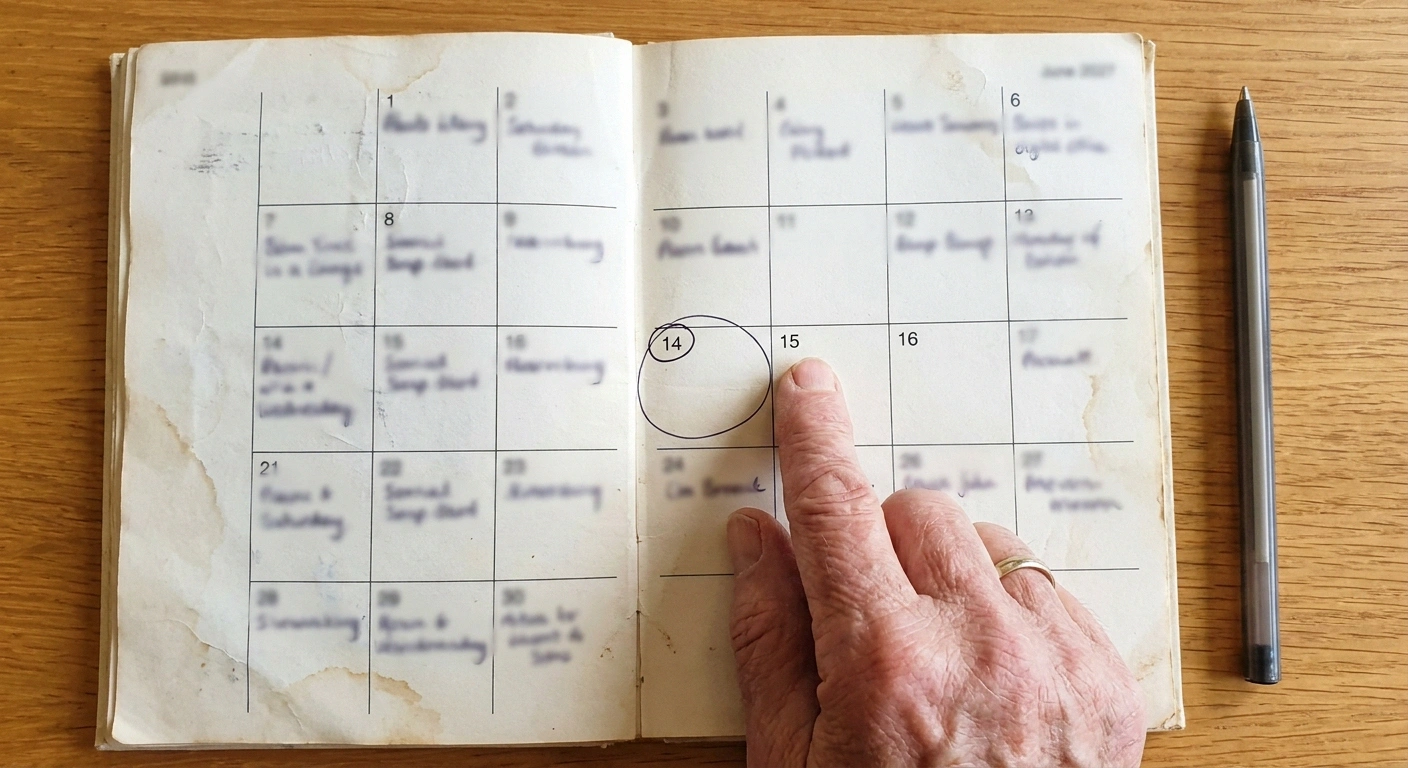
So the question to ask is: what does the following day have to hold? If the answer is nothing much, you can afford a bigger event than you think. If the answer is something that matters, then even a manageable evening may be the wrong purchase, and that is a scheduling decision rather than a failure of will.
This one habit prevents more cancellations than anything else, because it moves the decision to a fact you can look up. Your calendar is knowable. Saturday’s pain level is not.
Two ceilings are worth knowing about yourself. Roughly one demanding outing per day, and a weekly ceiling as well, which is usually two or three. Once you know your numbers, an invitation stops being a mood question and becomes an inventory question: have I already spent this week. Our page on pacing and the spoon theory goes deeper into budgeting energy this way.
Most Invitations Are Not Yes or No
This is the part the general advice never teaches, and it is where you get most of your social life back.
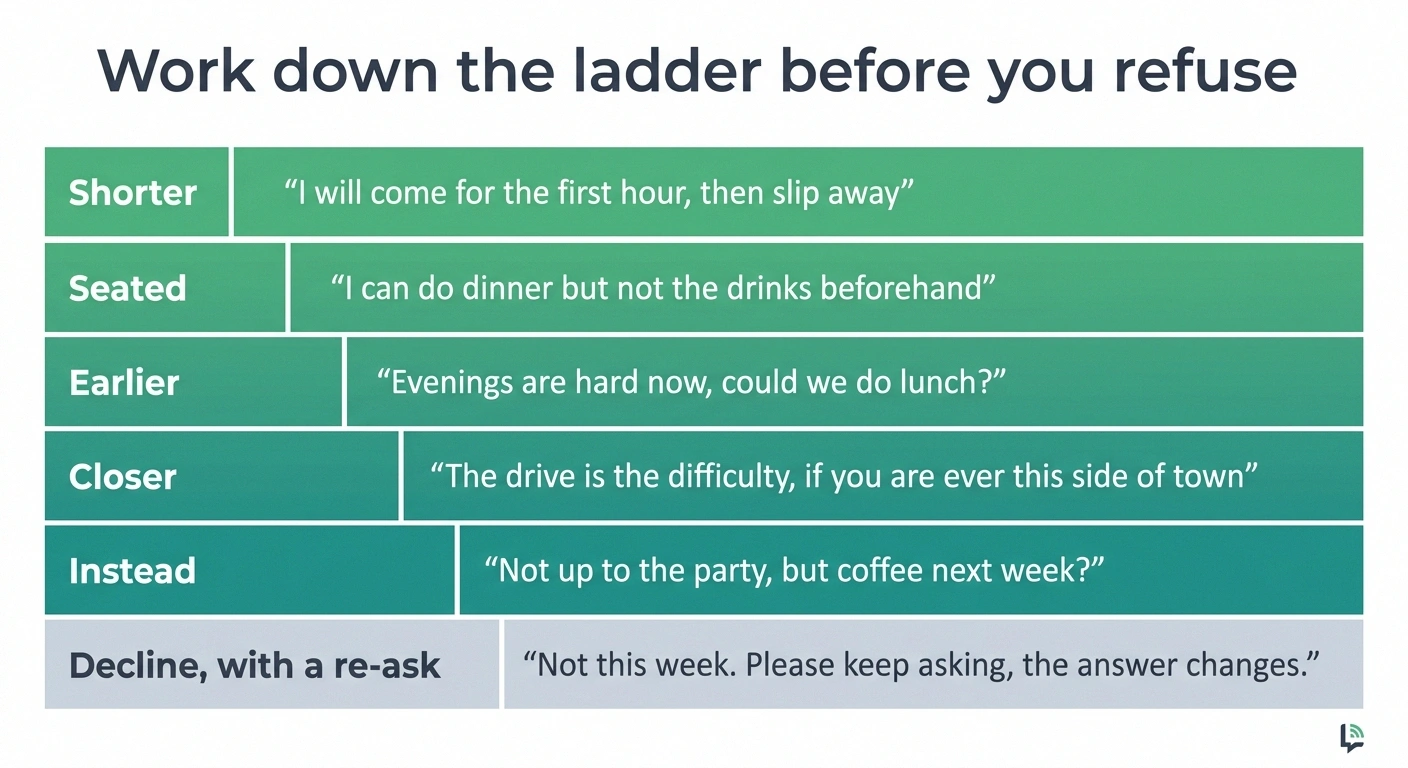
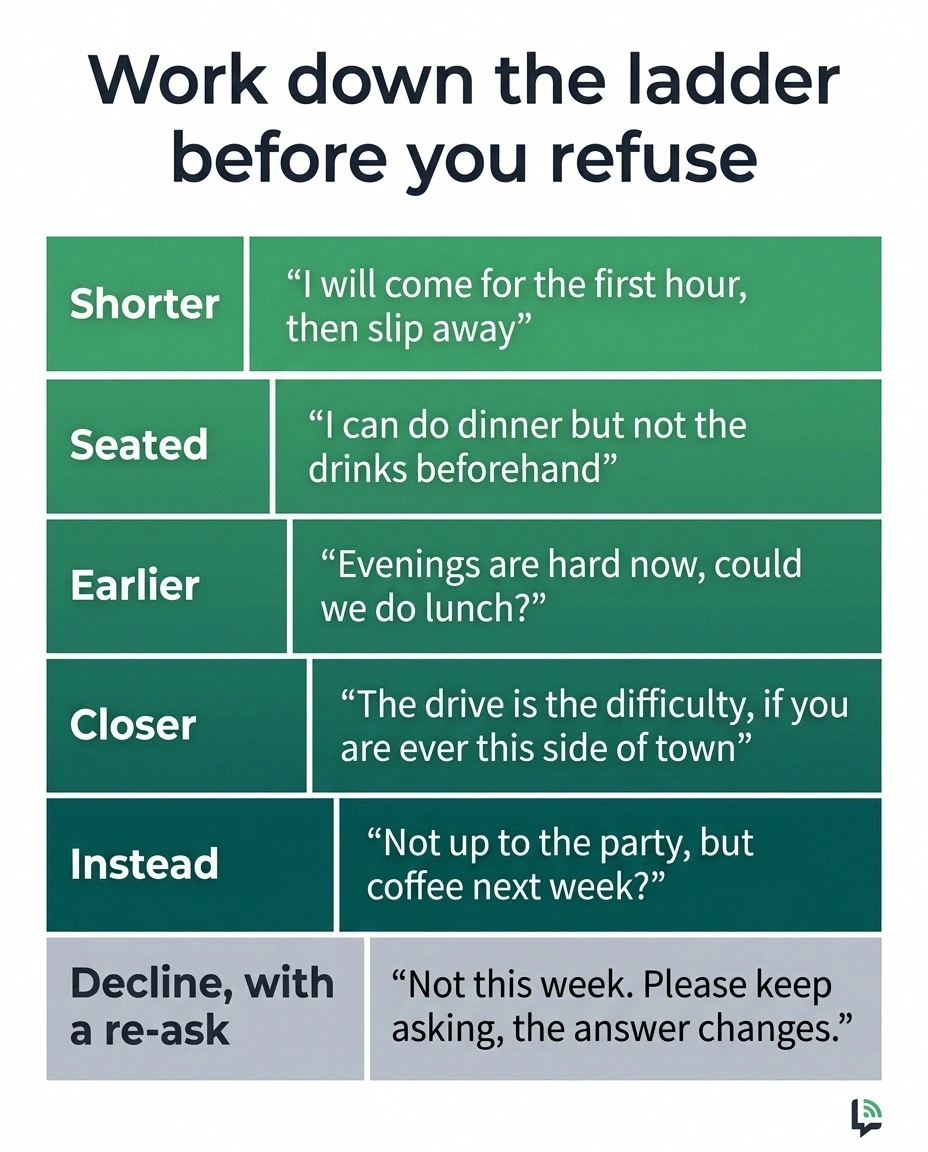
Work down the ladder before you refuse
Most people never get past the top rung, because they are answering a question that was never yes or no.
- 1. Shorter
- “I will come for the first hour and then slip away, if that works.”
- 2. Seated
- “I can do dinner but not the drinks beforehand. Shall I meet you at the table?”
- 3. Earlier
- “Evenings are hard for me now. Could we do lunch instead?”
- 4. Closer
- “The drive is the difficulty. If you are ever this side of town, I am in.”
- 5. Instead
- “Not up to the party, but I would really like to see you. Coffee next week?”
- 6. Decline, with a re-ask
- “Not this week, sorry to miss it. Please keep asking, the answer changes.”
You are treating invitations as a two-button decision when almost all of them have a dial. The counteroffer is a real answer, it is nearly always welcome, and it works because the person inviting you wants your company rather than your endurance.
Some worth having ready:
Shorter. “I will come for the first hour and then head off, if that works.” Turning up for part of something is normal. Most people would rather have an hour of you than an apology.
Seated. “I can do dinner, I cannot do the drinks beforehand. Shall I meet you at the table?”
Earlier. “Evenings are hard for me now. Could we do lunch instead?” Many of us have a reliable good window, usually mid-morning to mid-afternoon. Say so, rather than accepting a time that was never going to work.
Closer. “I would love to, but the drive is the difficulty. If you are ever this side of town, I am in.”
Instead. “I am not up to the party, but I would really like to see you. Coffee next week?” This one does more for a friendship than attending would have.
A counteroffer signals something a plain no cannot: that you want to be there. That signal is what keeps you on the list.
Front-Load the Terms When You Accept

A rule that seems small and changes how these evenings go.
Announce your leave time when you accept, not on the night.
“I would love to come. I will need to leave around eight, and that is nothing to do with the company.”
Said nine days out, that is a plan, and people arrange around it. Said at eight o’clock in a hallway, with a coat in your hand, the identical information reads as something having gone wrong, and the whole room shifts. Now there are questions, and a fuss, and somebody insisting you sit down for a minute.
Same fact. Completely different social event, decided entirely by when you said it.
The same trick works for the practical asks. “Could you save me a seat at the end of a row?” is easy to hear a week out and awkward to ask in the moment. Give people the chance to accommodate you when accommodating is easy. Our page on explaining neuropathy to people who cannot see it has more on the sentences that do this work.
How to Say No and Stay on the List
When the answer really is no, the delivery matters more than the reason.
Four parts, about eleven seconds
Answer within a day. A week of silence followed by a no reads as reluctance, and hosts remember that far longer than the refusal.
Keep it to one sentence. Long explanations invite negotiation. Every extra detail is another opening for someone to suggest you would feel better if you came out.
Apologise once. Three apologies hand the other person the job of comforting you, which is not what they rang for.
Ask them to ask again. Without this, people quietly conclude they are sparing you and stop. This is the part that keeps the invitations coming.
Assembled: “Not up to it this week, sorry to miss it. Please keep asking me though, the answer really does change week to week.”
Four ingredients, and it takes about eleven seconds.
Answer quickly. An answer within a day is a courtesy. A week of silence followed by a no reads as reluctance, and hosts remember it.
Be brief and be honest. “I am not up to it this week” is complete. You do not owe a medical account, and long explanations invite negotiation. The more you explain, the more openings you leave for somebody to suggest you would feel better if you just came out.
Do not over-apologise. One “sorry to miss it” is warm. Three is heavy, and it puts the other person in the position of having to comfort you about your own decline. That is a job nobody wants at the end of a phone call.
Ask them to ask again. This is the load-bearing part of the whole page.
“Please keep asking me. The answer genuinely changes week to week.”
Without that line, people do the arithmetic themselves and conclude they are sparing you the trouble. With it, you have given them a clear instruction, and most people follow instructions gratefully because they were never sure what the kind thing was.
If the invitations have already thinned out, say so directly to one or two people. “I have noticed I am not getting asked as much, and I would rather be asked and say no than not be asked.” Almost nobody finds that awkward, and it repairs the pattern faster than anything else I know. Our page on loneliness and isolation with neuropathy covers the longer version of this problem.
When You Genuinely Do Have to Cancel
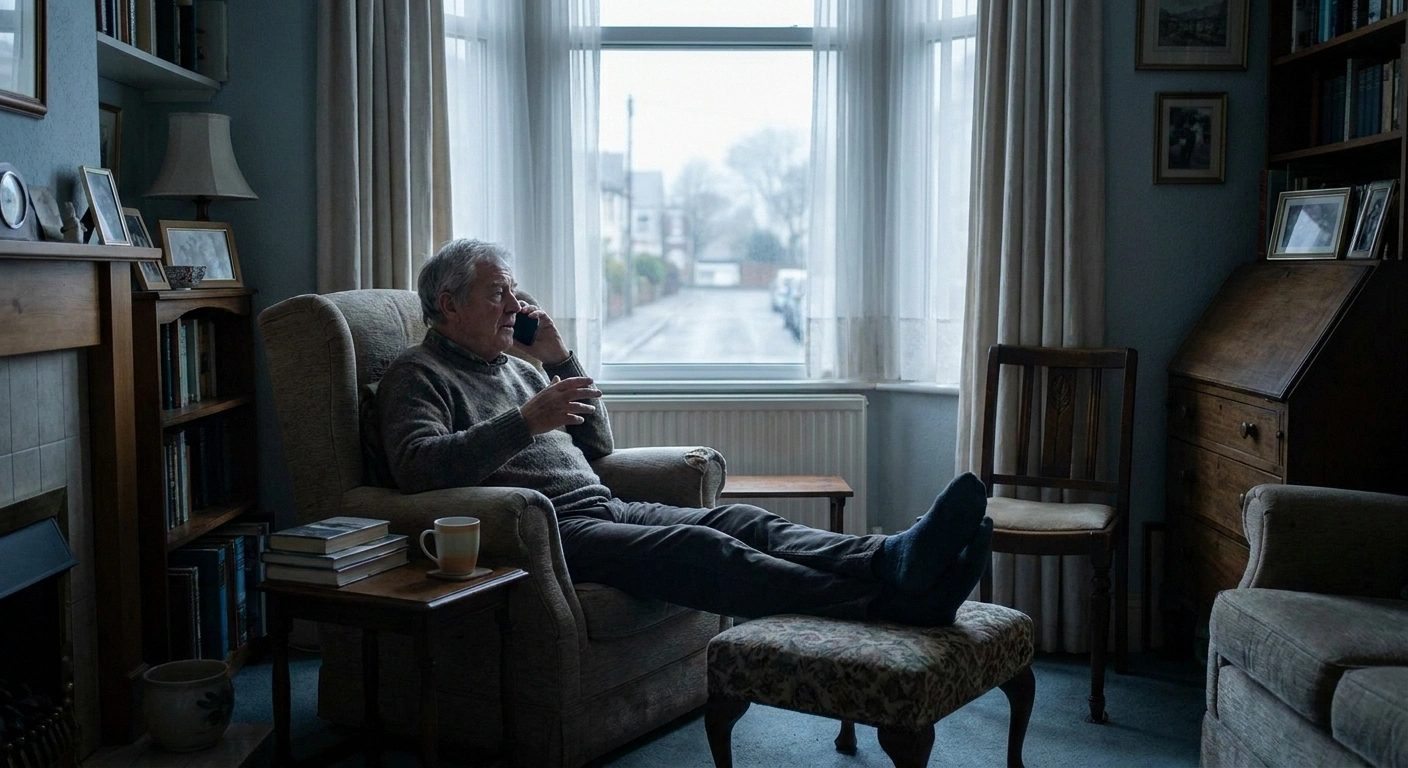
It happens. Flares are not scheduled. Our page on what triggers flare-ups covers reducing them, but never to zero.
When it happens, four things:
As early as you can manage. Six hours’ notice is a different favour from one hour. If you wake up knowing, say it at breakfast rather than hoping through the afternoon.
Name it plainly. “My feet are bad today and I need to stay off them.” Specific and unarguable. Vagueness invites the suggestion that you push through.
Skip the essay. Two sentences. Guilt tempts us into paragraphs, and paragraphs make the other person’s job harder, not easier.
Propose the replacement in the same message. This is the one that protects the friendship. “Can we do Thursday instead?” turns a cancellation into a rearrangement, and people file those very differently.
The Arrangements That Remove the Decision
For the relationships that matter most, the best move is to stop deciding altogether.
A standing arrangement takes the whole negotiation off the table. Tuesday mornings, your kitchen, whoever turns up. No invitation, no assessment, no phone call. If you are not up to it, they make the tea and you sit down, and the visit still counts.
Home is the cheapest venue you own. No drive, your own chair, your own shoes, and you can put your feet up mid-conversation without anybody thinking twice. Hosting badly and often beats attending well and rarely.
And accept the shortest possible invitations without much thought. Twenty minutes on a doorstep is not a lesser version of friendship. It is the version that survives, and over a year it adds up to far more contact than the four large events you would have said yes to and then missed two of.
What to Do With the Guilt
One honest paragraph, because it deserves that and not a lecture.
The guilt is not irrational and it will not be argued away. It comes from an accurate observation: you used to be the person who turned up, and now sometimes you are not, and other people carry a bit more as a result. That is a genuine loss and pretending otherwise helps nobody.
What helps is aiming it correctly. Guilt about a no you delivered promptly and warmly is misfiled, because that no cost the other person nothing. Guilt about a yes that became a cancellation the night before is at least pointing at something real, and the fix for it is not more resolve. It is deciding earlier. That is the whole trade this page is asking you to make: a slightly harder conversation nine days out, in exchange for never making the two-hours-before phone call again.
If the low mood is running deeper than the ordinary frustration of a shrinking calendar, that is worth naming out loud rather than absorbing, and our page on neuropathy and mental health covers where that line sits.
Frequently Asked Questions
How do I turn down an invitation without offending anyone?
Answer within a day, keep it short, apologise once rather than three times, and finish by asking them to invite you again. Something like: “I am not up to it this week, sorry to miss it. Please keep asking, because the answer really does change.” Long explanations tend to invite negotiation, and repeated apologies leave the other person feeling they have to reassure you.
How do I stop people from giving up on me?
Tell them directly to keep asking. Most people who stop inviting someone believe they are being kind and sparing them an awkward refusal. That assumption is what shrinks a social circle, not the refusals themselves. One clear sentence, said once to each person who matters, usually corrects it. If it has already happened, say plainly that you would rather be asked and decline than not be asked at all.
What should I say when I have to cancel at the last minute?
Send it as early in the day as you can, name the reason plainly, keep it to two sentences, and propose an alternative in the same message. “My feet are bad today and I need to stay off them. Can we try Thursday instead?” Proposing the replacement is what turns a cancellation into a rearrangement, which people forgive far more readily.
How do I decide whether I am up to something?
Look at the day after rather than the day of, since the payback is usually the real cost. Then check what is unstated in the invitation: how long you will be on your feet as opposed to how long the event runs, whether a chair is guaranteed, what the ground and the temperature will be like, and how far the journey is. Most of those can be settled with one message to the host, and the answers often turn a no into a yes.
Is it rude to accept and then leave early?
Not at all, provided you say so when you accept rather than on the night. Announced in advance, an early departure is a plan people arrange around. Announced in the moment it looks like something has gone wrong and creates a fuss you did not want. The exact same information lands completely differently depending on when it is given.
Do I have to explain my neuropathy every time?
No. Most people need to know the practical consequence rather than the diagnosis: how long you can stand, that you may need to leave, and that it is nothing to do with the company. Save the fuller explanation for the handful of people who will be arranging things around you regularly.
What if my family thinks I have become antisocial?
Counter it with a counteroffer rather than an argument. Suggesting coffee instead of the party, or offering to host at home, proves you want the contact and the format was the obstacle. A standing arrangement with the people closest to you does this even better, because it removes the repeated question of whether you are up to it and lets attendance vary without anyone having to interpret it.
About the Author