“Like I’m wearing concrete boots.” “Like someone strapped weights to my ankles.” “Like walking through wet sand.” “Like my feet belong to somebody bigger than me.”
Those are all real descriptions from people with neuropathy, and they’re describing something that shows up on no test. The feet weigh what they’ve always weighed. Nothing is swollen. The scale hasn’t moved. And yet by four in the afternoon, lifting them feels like a chore that used to be free.
Heaviness gets less attention than burning or tingling, partly because it’s harder to describe and partly because it sounds vague when you say it out loud. It isn’t vague. It’s a specific and fairly common feature of nerve damage, and it can come from three genuinely different mechanisms that happen to produce the same word.
Which one you’re dealing with changes what actually helps. So let’s separate them.
Heavy Can Mean Three Different Things
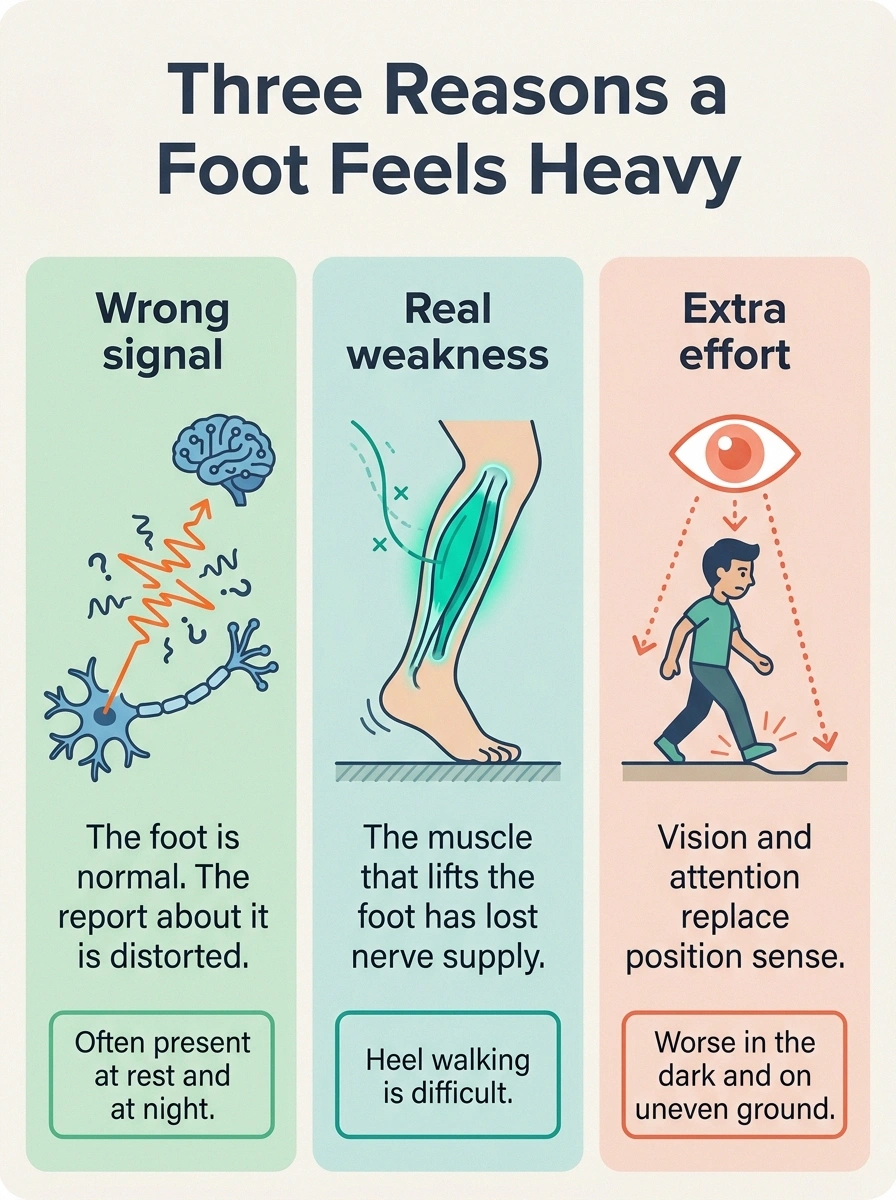
When someone says their feet feel heavy, one of these is usually going on. Sometimes two at once.
Do both tests along a wall or counter you can reach. Write down what happened, because this is the observation your doctor cannot make in a five-minute appointment.
| Heel walk | Toe walk | What that points to |
|---|---|---|
| Clean | Clean | Sensory or proprioceptive heaviness. Strength work is not the priority; lighting, pacing and a cane are. |
| Forefoot slaps down | Clean | Early dorsiflexor weakness. Shoe weight and targeted strengthening matter most, and a brace is worth asking about. |
| Difficult | Difficult | More extensive motor involvement. Worth a formal assessment rather than self-directed exercises. |
| One side only | Either | Asymmetry is the finding here. One-sided weakness is not typical length-dependent neuropathy and should be looked at. |
One: the sensation is wrong, the foot is fine. Damaged nerves don’t just go quiet. They also misfire, generating signals that were never triggered by anything in the outside world. Your brain receives those signals and does what it always does, which is interpret them as information about your body. A garbled stream of pressure and position data gets read as weight. Nothing about the foot has changed. The report about the foot has changed.
Two: the foot really is harder to lift. Neuropathy that reaches motor nerves weakens the muscles those nerves supply, and the muscle that lifts the front of your foot is one of the first to be affected because its nerve supply runs the whole length of the leg. When that muscle weakens, dorsiflexion takes measurable effort. The heaviness is honest — you’re lifting the same foot with less machinery.
Three: walking has stopped being automatic. This is the one almost nobody names, and it might be the most common of the three. Normally your feet report their position continuously and your nervous system handles balance below the level of awareness. Lose that reporting and the brain has to substitute — mostly vision, plus conscious attention. Every step becomes a small task that you’re actually doing rather than something that just happens. That effort is real, and it’s experienced as heaviness and fatigue rather than as concentration.
The third mechanism explains a pattern people find baffling: the feet feel much heavier in the dark, on grass or gravel, and late in the evening. Vision is doing the work, so removing light or adding surface complexity increases the load, and hours of concentration deplete it. The deeper background on that is in the piece on proprioception loss, which is the sense this mechanism runs on.
Two Tests You Can Do in Your Hallway
Sorting sensation from weakness is one of the more useful things you can do before an appointment, because the two point at different problems and different treatments. Two simple checks get you part of the way there, and both take under a minute. Neither replaces an examination, and neither can rule weakness out.
The heel walk. Lift your toes and walk ten steps on your heels alone, holding a wall or counter for balance. If your forefoot slaps down before you finish, or you can’t hold the toes up at all on one side, that’s dorsiflexion weakness rather than sensation.
The toe walk. Same distance up on your toes. This tests the calf, which is usually affected later than the front of the leg, so difficulty here suggests more advanced motor involvement.
Do both with a wall or counter within reach the whole way, and skip them entirely if you are already unsteady on your feet, have fallen recently, or feel dizzy standing up. Ask someone to stay with you if there is any doubt. These are rough screens, not a strength examination: subtle weakness can pass them, and a physical therapist or neurologist can measure what they cannot. If you clear both and your feet still feel heavy, the likelier explanation is sensory or proprioceptive rather than muscular, which is the better of the two answers.
The other thing to check is your shoes. Look at where the sole is worn and whether the toe of one shoe is scuffed more than the other. Scuffing concentrated at the toe often means that foot isn’t clearing the ground, which can be an early sign of the pattern described in the article on foot drop. It has other explanations too, including an old injury, a difference in leg length, or simply how you sit at the wheel, so treat it as a reason to look closer rather than as a finding. Shoes still keep a more honest record than memory does.
Heaviness That Only Shows Up When You Walk
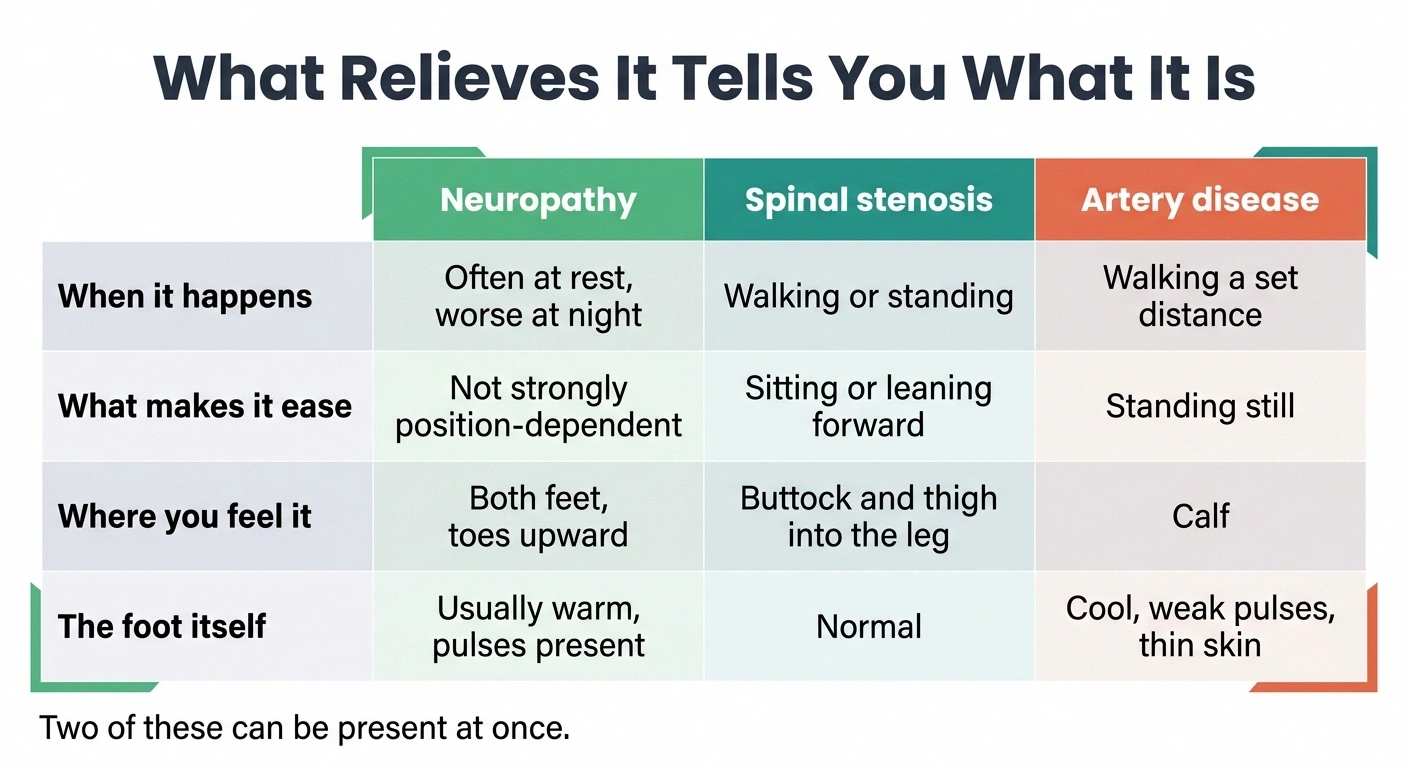
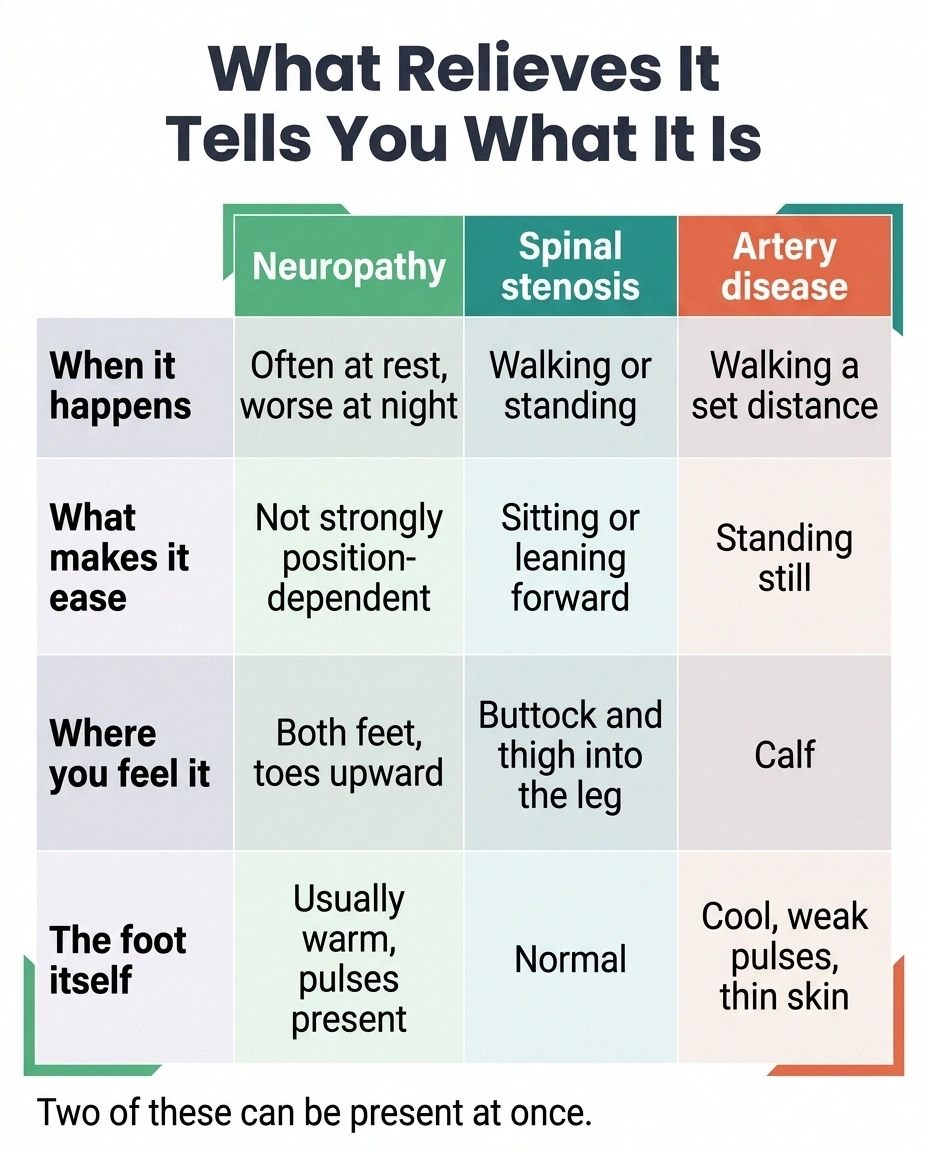
There’s an important fork here. Heaviness present at rest, worse at night, unchanged by sitting down, is behaving like neuropathy. Heaviness that appears reliably after a certain walking distance and eases when you stop is behaving like something else, and it’s worth knowing what.
Three conditions produce leg heaviness on walking, and they’re distinguishable by what relieves them.
Peripheral neuropathy tends not to care much about position. Symptoms are often there at rest, frequently worse in bed, and stopping to stand still doesn’t reliably change them. The foot is usually warm and pulses are usually present.
Lumbar spinal stenosis produces what’s called neurogenic claudication. Heaviness, aching or weakness comes on with walking or standing, and the giveaway is what fixes it: sitting down, or leaning forward. People with stenosis often notice they can push a shopping cart around a supermarket indefinitely while the same distance in open air defeats them, because leaning on the cart flexes the spine and opens space around the nerves. Symptoms may be one-sided and often involve the buttock and thigh, not just the foot.
Peripheral artery disease produces vascular claudication. Muscles working harder need more oxygen than narrowed arteries can deliver, so the calf tightens or aches after a fairly reproducible distance. It’s relieved by standing still — no sitting or bending required, which is the cleanest contrast with stenosis. The foot tends to be cool rather than warm, with weak pulses, thin shiny skin and reduced hair growth.
That contrast is the most useful thing you can carry into an appointment. “It goes away when I sit or lean on the cart” and “it goes away as soon as I stand still” point in different directions, and doctors take the distinction seriously. Two dedicated comparisons go further into this: spinal stenosis versus neuropathy and the broader leg weakness differential, which also covers the conditions that mimic all three.
Plenty of people over sixty have two of these at once. Sorting out which one is producing today’s symptom is exactly the kind of question a neurologist or vascular specialist is good at, and the answer usually changes the plan.
Why the Brain Adds Weight That Isn’t There
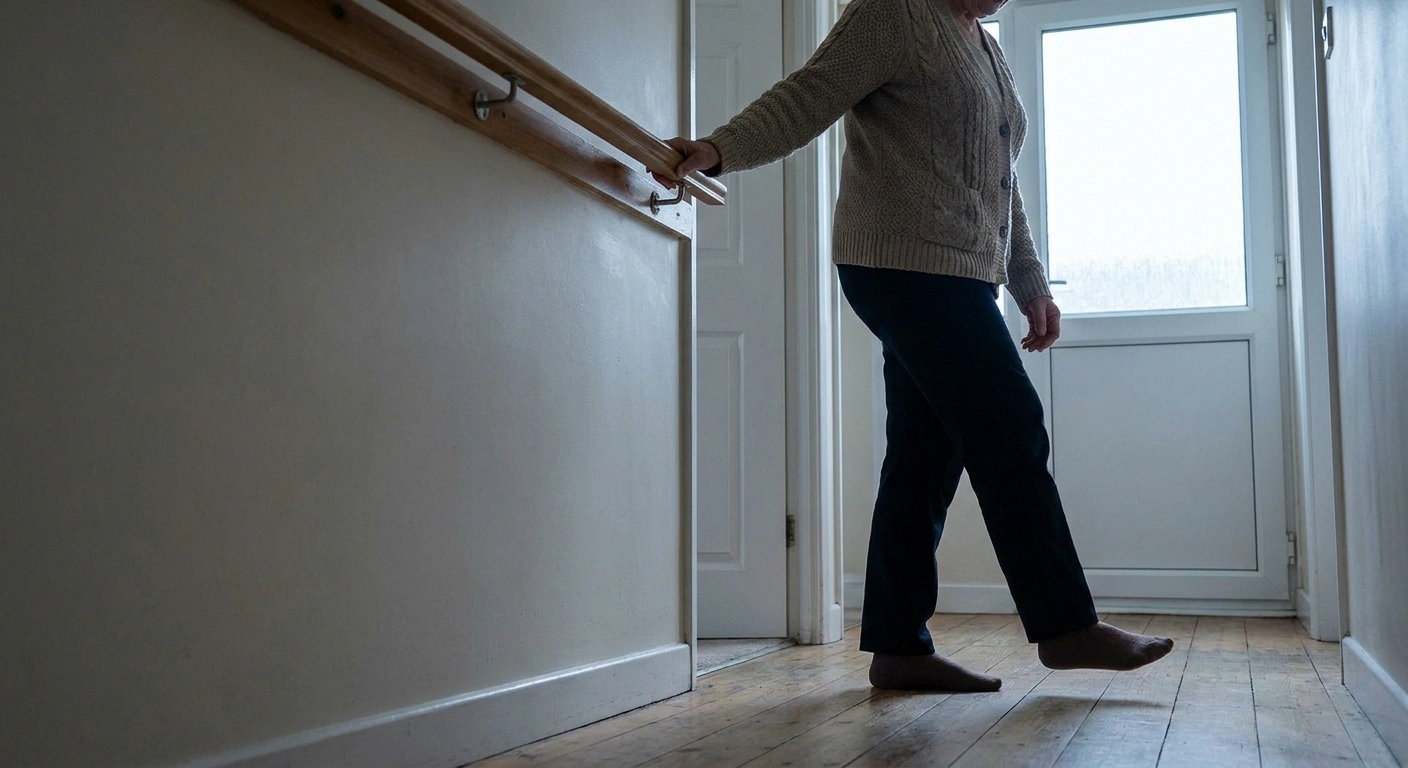
It’s worth sitting with the first mechanism a moment longer, because “the sensation is wrong” sounds dismissive and it isn’t meant to be.
Your sense of your own body is constructed, not received. The brain takes signals from skin, joints, muscles and the inner ear and builds a working model of where your limbs are and what they’re doing. When the incoming signal degrades, the model doesn’t shut down — it fills in, and it fills in badly. That’s the same process that produces the phantom sock, the sense of walking on gravel, the feeling of a foot swollen to twice its size when a tape measure says otherwise.
The article on the walking-on-marbles feeling covers a close relative of the same phenomenon. Different sensation, identical origin: a model built from bad data.
Knowing this doesn’t make the sensation stop. It does two useful things anyway. It tells you that a foot which feels enormous and dead isn’t necessarily deteriorating — the feeling is a measurement error, not a status report. And it explains why treatments aimed at the foot itself so often disappoint, while things that change the signal or the interpretation sometimes help more than expected.
When Heaviness Means Muscle
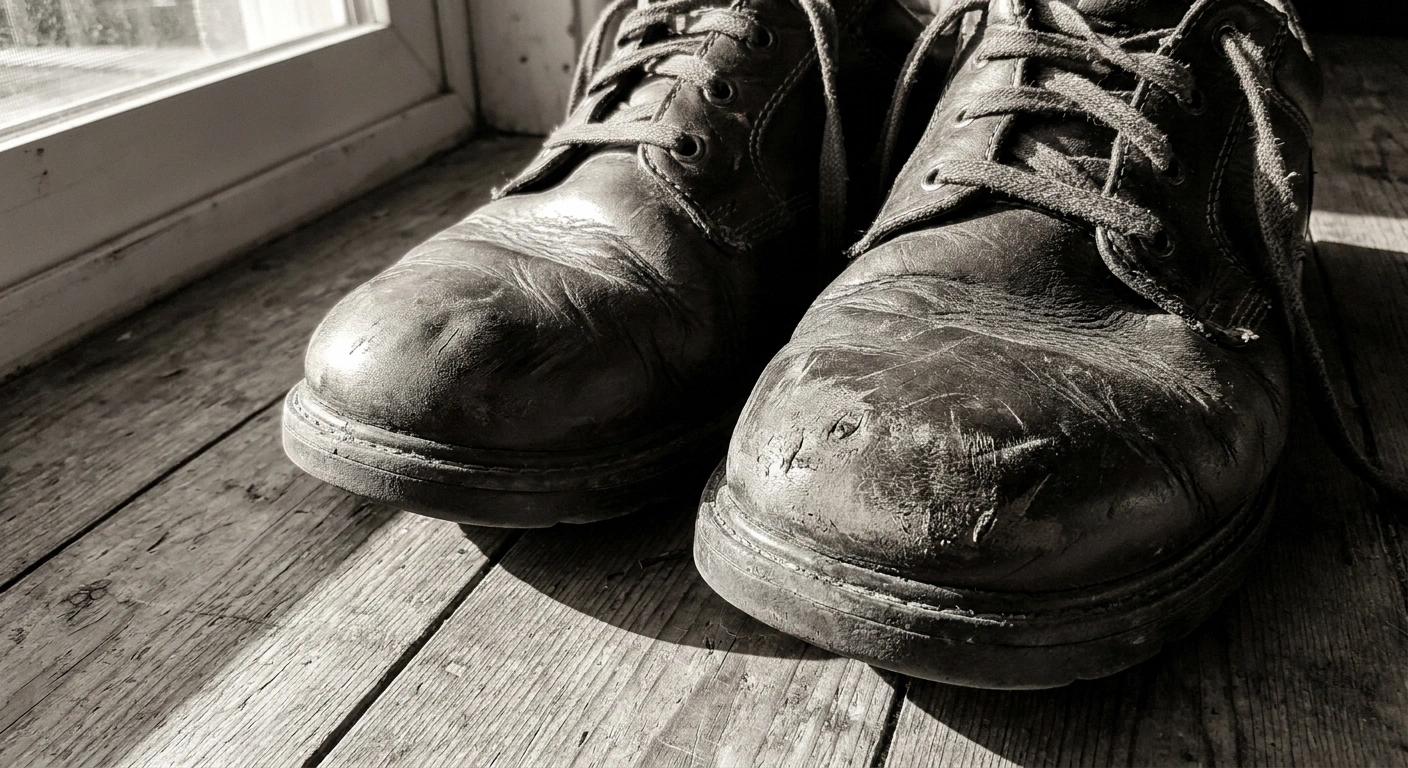
If the heel walk failed, or if you’re catching your toe on thresholds and rugs, you’re dealing with motor involvement, and that has a different playbook.
A weak shin muscle lifts the shoe once per step. Multiply by a realistic step count and the difference between two shoes on the same shelf stops being a detail.
| Typical weight, one shoe | Lifted across 4,000 steps |
|---|---|
| Lightweight trainer, around 8 oz | About 2,000 lb of cumulative lift |
| Cushioned walking shoe, around 12 oz | About 3,000 lb |
| Winter or work boot, around 20 oz | About 5,000 lb |
| Difference, trainer to boot | Roughly 3,000 lb more, every day |
Rough arithmetic, not a measurement, and it ignores the cushioning and stability you may need from the heavier shoe. The point is only that the trade is real and worth making deliberately. Take a kitchen scale to the shoe shop.
Weak dorsiflexors mean your foot doesn’t clear the ground the way it used to. People compensate automatically, usually by lifting the knee higher or swinging the leg outward. Those compensations work, and they cost energy, which is part of why motor-pattern heaviness gets worse over the course of a day.
Things that make a genuine difference here:
Shoe weight. This is the most overlooked variable in the whole article. If you take roughly six thousand steps a day, every extra ounce in the shoe is lifted six thousand times by a muscle that’s already struggling. Heavy work boots, thick winter boots and some cushioned trainers are surprisingly hefty. Weighing a pair on a kitchen scale before buying is not a strange thing to do.
Targeted strengthening. Dorsiflexion work with a resistance band, heel raises, and toe-tapping drills, done consistently. A physical therapist can tell you which muscles are actually weak instead of which ones you think are, and that assessment is worth having before you pick exercises off the internet.
Bracing where it’s warranted. An ankle-foot orthosis holds the foot at a neutral angle so you’re not lifting it yourself. People resist these, and then most of them wish they’d tried one sooner, because a brace removes the effort rather than merely supporting it.
If weakness is progressing quickly, spreading upward past the ankle, or noticeably worse on one side, that pattern needs assessment rather than exercises. Visible hollowing between the long bones on the top of the foot, or a calf that has clearly slimmed compared to the other side, belongs in the same category.
The Fatigue Multiplier
Heaviness rarely arrives alone. It travels with a specific kind of exhaustion that people struggle to explain to anyone who hasn’t had it, because a mile is a mile and nobody looks tired from a mile.
But the accounting is different. When walking requires visual monitoring and conscious attention, you’re paying with a resource that has a daily limit, and it’s the same resource you use for concentration and patience. Ration it badly and you get a bad evening. The framework in the piece on pacing and neuropathy fatigue is built for exactly this, and it applies more cleanly to heaviness than to pain.
Two practical points fall out of it. First, front-load your walking. The same errand costs less at ten in the morning than at six in the evening, and the difference is often large. Second, sleep is not a soft factor here. Nights broken by nerve pain leave less of the resource available the next day, so heaviness at 3pm can trace directly back to 3am.
Small Changes That Take Weight Off
Beyond shoes and strengthening, a handful of adjustments help across all three mechanisms.
- Cane height
- Stand in your usual shoes with arms hanging loose. The top of the handle should sit at the crease of your wrist, which puts a slight bend in the elbow when you grip it. A cane cut too short pitches you forward and makes walking feel heavier rather than lighter.
- Which hand
- Opposite the weaker leg, moving forward at the same time as that leg. This is the reverse of what most people do instinctively.
- Hallway lighting
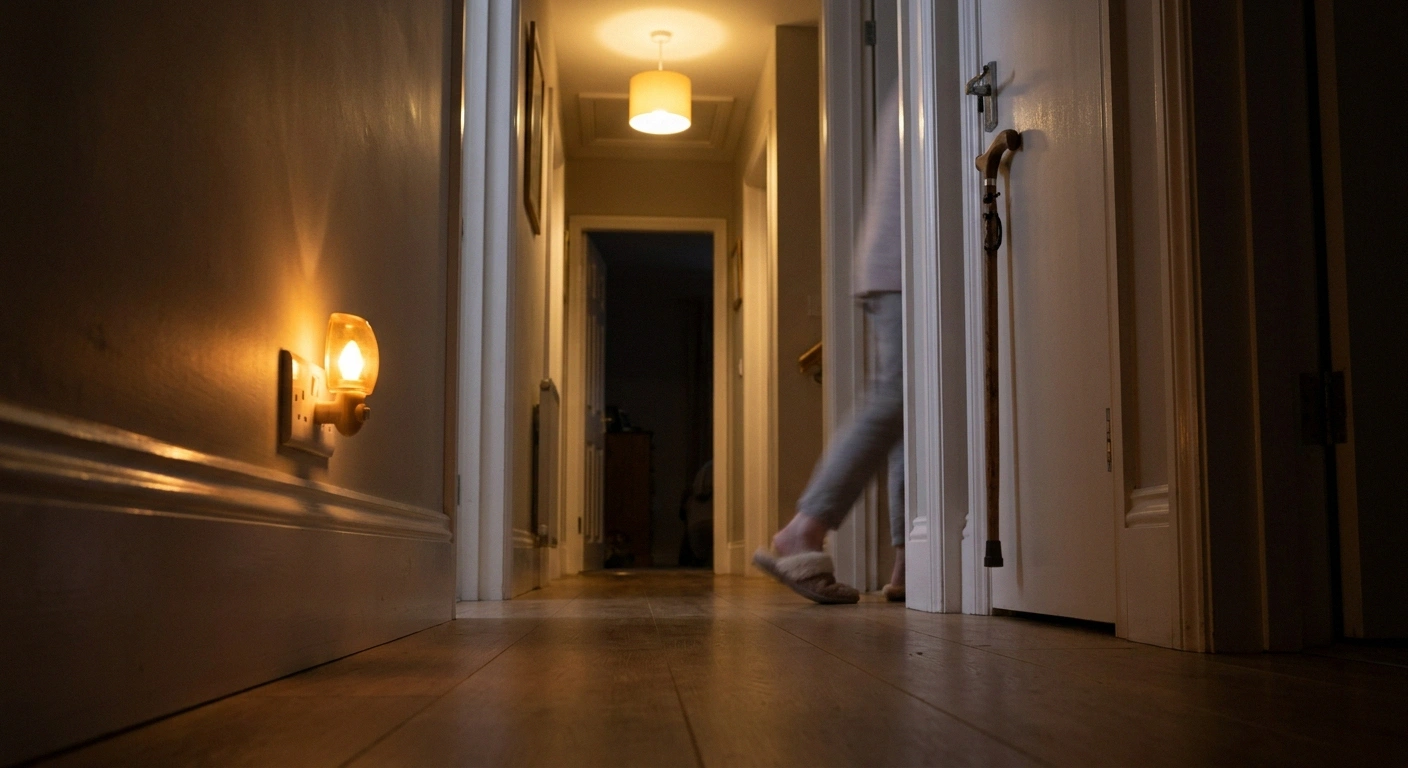
- Aim for a continuously lit path rather than one bright fixture. Gaps of darkness between pools of light are where vision stops being able to substitute for position sense.
- Night lights
- Low on the wall, aimed at the floor rather than out into the room. Floor-level light shows you thresholds and obstacles; eye-level light mostly produces glare.
Turn the lights up. If vision is substituting for position sense, light is functional equipment, not decoration. Brighter hallway lighting and a lit path from bed to bathroom often make walking feel noticeably lighter, and the same change reduces fall risk. Details on that are in the balance and fall prevention guide.
Try a cane before you think you need one. A cane returns a stream of ground contact information through your hand, which the brain uses in place of the feedback your feet aren’t supplying. Users regularly report that walking feels lighter, not just safer, and that’s the mechanism.
Keep moving, moderately. Deconditioning makes everything heavier and it arrives quickly. Regular walking within your tolerance holds the line on the muscular component, and the case for it is laid out in does walking help neuropathy.
Get the reversible causes checked. B12 deficiency, thyroid dysfunction and poorly controlled blood sugar all contribute to both neuropathy and general heaviness, and all three are treatable. Heaviness is a symptom, not a diagnosis, and it’s worth confirming nobody has skipped the basic labs.
Signs That Need a Faster Response
Most heaviness builds slowly over months and is best handled at a scheduled appointment. A few presentations don’t fit that description.
The distinction that matters is speed of onset. Nerve damage from the common causes builds over months. Anything that arrives in hours or days is a different kind of problem.
| Emergency room now | New numbness in the groin or saddle area, or a change in bladder or bowel control. A cold, pale, painful foot with no pulse. |
| Same or next day | Weakness that came on over hours or a couple of days. Weakness climbing above the ankle. Clear one-sided weakness. |
| Next scheduled visit | Gradual heaviness over months, both feet, no new tripping. Bring the results of your two hallway tests. |
Get urgent assessment for heaviness or weakness that comes on suddenly over hours or days, for weakness clearly affecting one leg only, for weakness climbing above the ankle into the thigh, and for any heaviness accompanied by numbness in the groin or saddle area, or by a change in bladder or bowel control — that last combination is a spinal emergency and shouldn’t wait for morning. A foot that turns cold, pale and painful with no palpable pulse is a vascular emergency and belongs in the same category.
Outside of those, the ordinary version of this symptom responds well to unglamorous work: lighter shoes, stronger ankles, better light, honest pacing, and treating whatever is driving the neuropathy underneath.
The concrete boots aren’t real. The effort of walking in them is.
Frequently Asked Questions
Why do my feet feel heavy when nothing is swollen?
Damaged nerves misfire and send distorted pressure and position information, and the brain interprets that distorted input as weight. The foot has not changed; the signal describing it has. This is the same process behind related sensations such as feeling like a tight sock is on, or feeling as though the foot is swollen when measurement shows it is not.
Does heavy feeling in the feet mean muscle weakness?
Sometimes, but not always. Heaviness has three common sources: distorted sensory signals, genuine weakness of the muscles that lift the foot, and the mental effort required when position sense is lost and vision has to compensate. Heel walking and toe walking for ten steps each give a rough indication of whether obvious weakness is present, though subtle weakness can pass both and only a proper strength examination can rule it out. If both are easy, the heaviness is more likely sensory or proprioceptive. Do them within reach of a wall, and skip them if you are already unsteady.
Why are my feet heaviest in the evening?
When automatic balance control degrades, walking requires conscious attention and visual monitoring, and both deplete over the course of a day. Compensating movement patterns also burn extra energy. Poor sleep from nighttime nerve pain reduces the starting reserve, which is why a difficult night frequently produces a heavy afternoon.
How can I tell heavy legs from neuropathy apart from circulation problems?
What relieves it is the most useful clue. Neuropathy symptoms are often present at rest, frequently worse at night, and not strongly position-dependent. Peripheral artery disease produces heaviness after a fairly consistent walking distance that eases with standing still, usually with a cool foot and weak pulses. Spinal stenosis produces heaviness on walking or standing that eases specifically with sitting or leaning forward, such as over a shopping cart. Two of these can be present at once, and testing is the way to be sure.
Can lighter shoes really make a difference?
They can when weakness of the foot-lifting muscles is part of the picture. At several thousand steps a day, every ounce of shoe weight is lifted several thousand times by a muscle with reduced nerve supply. Comparing the weight of shoe options on a kitchen scale is a reasonable way to choose between otherwise similar pairs.
Will a cane help if I am not falling?
Often yes. A cane delivers ground contact information through the hand, which partially replaces feedback that is no longer arriving from the feet. Many people report that walking feels less effortful with one, independent of any fall risk reduction. Correct height matters: the handle should sit at wrist crease height with the arm hanging relaxed.
Is heaviness a sign my neuropathy is getting worse?
Not necessarily. Heaviness can appear or fluctuate without any change in underlying nerve damage, and it varies with fatigue, sleep, lighting, footwear and activity level. A meaningful change is a new or increasing inability to lift the foot, new tripping, or weakness spreading upward, and those warrant assessment rather than reassurance.
What kind of doctor should I see about heavy feet?
Starting with primary care is reasonable, since basic bloodwork including B12 and thyroid function and a pulse examination can be arranged there. A neurologist is the right destination if nerve testing is needed, and a vascular assessment is appropriate if the foot is cool with weak pulses or symptoms are clearly tied to walking distance.
About the Author