
A reader forwarded me a page last month with a subject line that just said “is this real?”
The page was one of those clinical-trial aggregator sites. Clean layout, hopeful headline, a button that said something like See if you qualify. The treatment was called Engensis. Gene therapy, injected into the calf, for painful diabetic nerve damage. She’d had burning feet for nine years and wanted to know whether she should call the number.
She shouldn’t have. The trial that page was advertising finished in 2024, and it failed to beat placebo.
I want to walk through this one carefully, because Engensis isn’t really a story about one drug. It’s a story about how a person with nerve pain ends up on a page like that in the first place, and how to tell, on your own, whether the next hopeful headline is worth your attention.
Where Engensis Stands Right Now
Plainly: it is not approved, it is not available, and its phase 3 program in painful diabetic neuropathy did not succeed.
The main trial, called REGAiN-1A, finished collecting data on 31 July 2024. The topline analysis did not show the treatment beating placebo on its primary measure. There is no FDA approval, no prescription pathway, no compassionate-use route worth chasing.
If that’s all you came for, you have it, and you can stop reading with a clear conscience.
What follows is for the person who wants to understand why a drug with a genuinely clever idea behind it, backed by a decade of money and a mountain of press releases, still ended up here. That understanding is worth more than any single drug name, because you’re going to meet another one of these next year.
What VM202 Actually Is
Engensis has three names, which is part of why searching for it is confusing. VM202 is the development code. Engensis is the brand name. Donaperminogene seltoplasmid is the generic name. All one thing, made by Helixmith, a Korean biotech that used to be called ViroMed.
| Plasmid (Engensis) | Viral vector (ST-503) | |
|---|---|---|
| Carrier | None. Naked circular DNA | A modified, disabled virus |
| Enters your chromosomes | No | Designed to persist long term |
| How long it works | Weeks, then it degrades | The goal is years from one dose |
| How it’s given | Repeated injections into calf muscle | A single delivery into spinal fluid |
| If it goes wrong | It wears off | Harder to reverse, which is why safety data takes longer |
Worth knowing before you read the next headline: the reversibility in the left column is the reason plasmid studies move faster through early safety review, and the durability in the right column is the reason they attract more investment.
Here’s the part that surprised me when I first read the protocol: calling it gene therapy is technically accurate and practically misleading.
When most of us hear “gene therapy,” we picture something permanent. A virus carrying a corrected gene, delivered once, editing your cells for good. That’s what’s happening in the eye and blood-disorder therapies that made headlines.
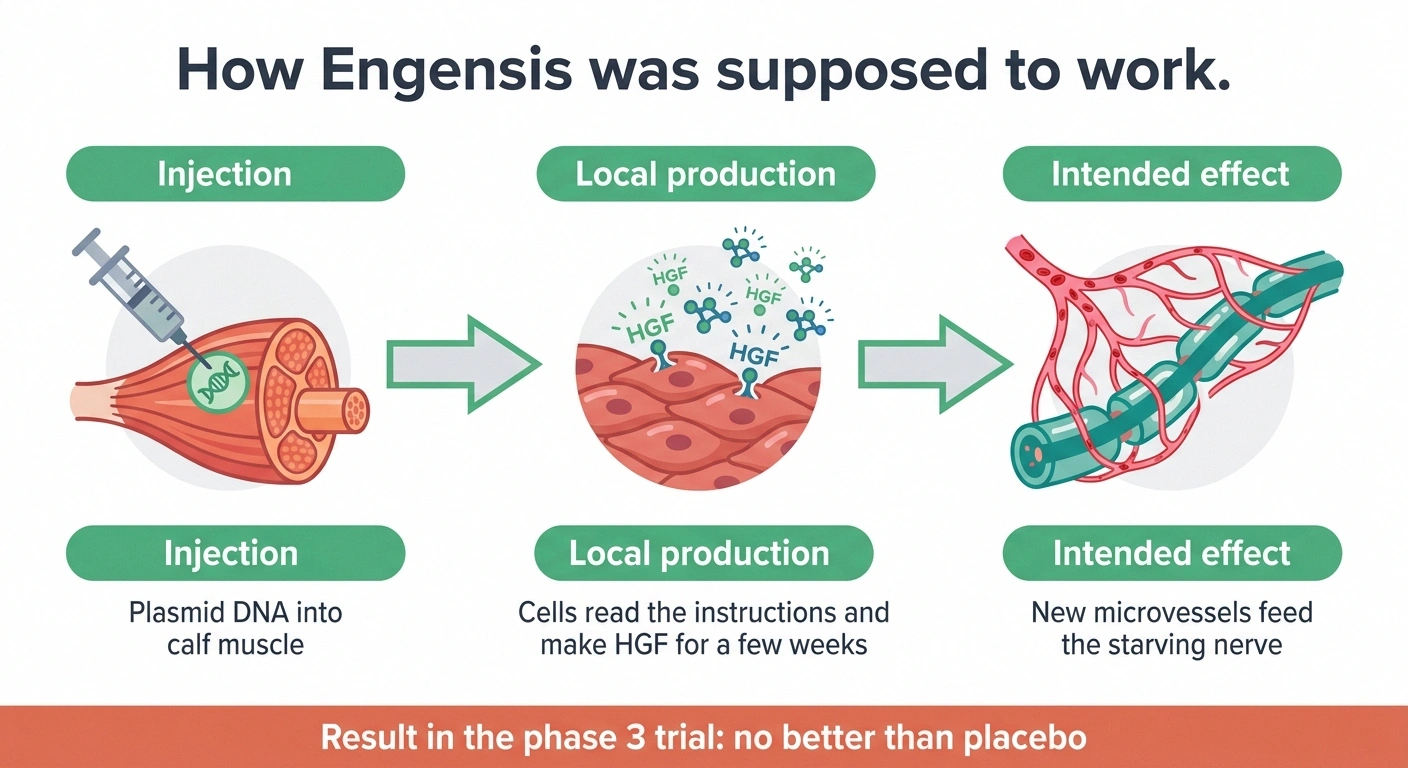
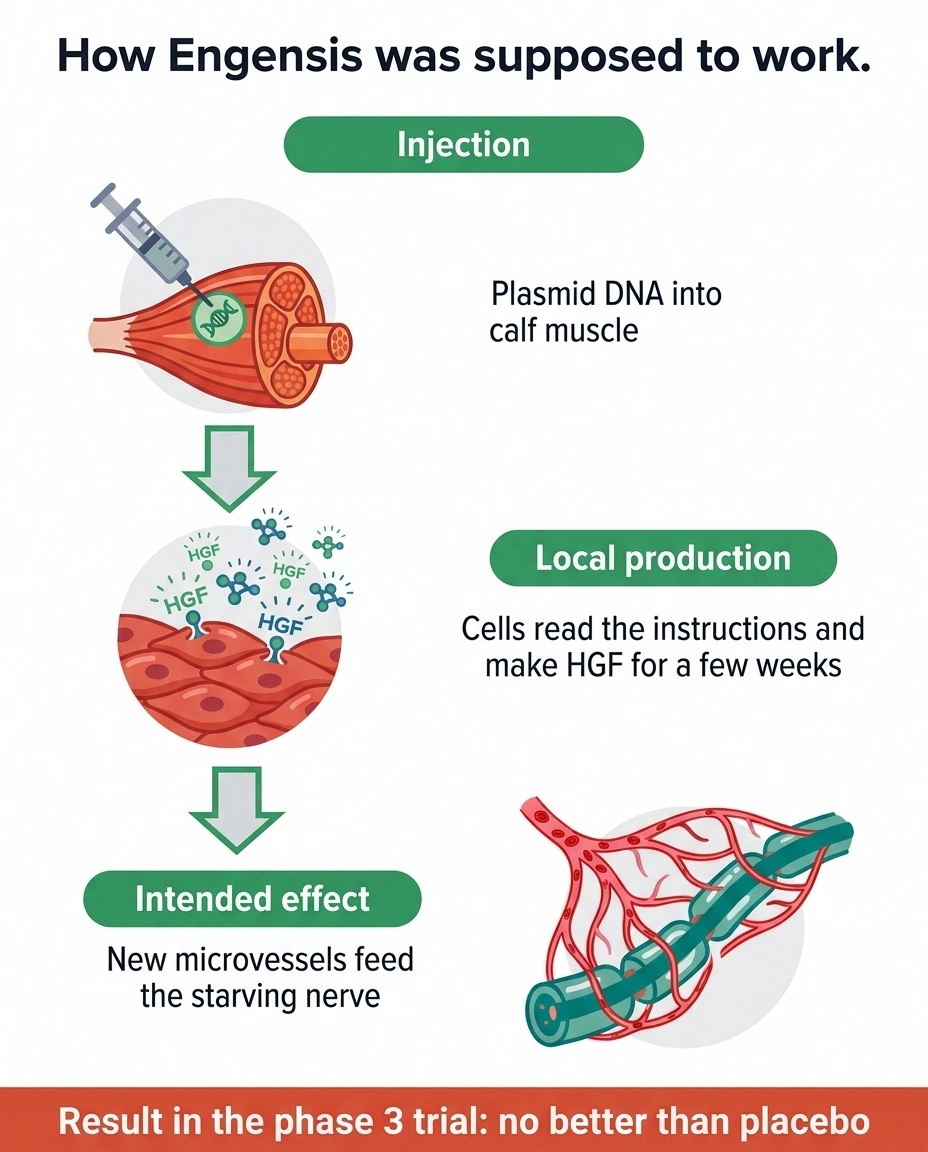
Engensis is not that. It’s a plasmid, which is a small circular loop of DNA, injected as naked genetic material without any viral carrier. It isn’t designed to integrate into your chromosomes, and it doesn’t change anything permanently. Your muscle cells take it up, read the instructions on it for a while, produce a protein, and then the plasmid degrades and the effect fades. That’s why the treatment was given in repeated cycles rather than once.
Think of it less as rewriting a book and more as slipping a sticky note into one — knowing the note will fall out in a few weeks.
That distinction matters for two reasons. It makes the safety profile much less frightening than the phrase “gene therapy” suggests, and it makes the durability question much harder, because a temporary effect has to be re-created over and over to be useful.
The Idea: Feed the Nerve, Don’t Just Quiet It
Nearly everything you can be prescribed for diabetic neuropathy right now works on the signal. Gabapentin and pregabalin turn down excitable nerves. Duloxetine works on how pain is processed centrally. They can help a great deal — and for some people they’re the difference between sleeping and not. None of them do anything about the nerve itself.
The instruction on the Engensis plasmid was for hepatocyte growth factor, or HGF. Despite the name, which comes from where it was first discovered, HGF does several things well beyond the liver. Two of them are the point here.
First, it drives angiogenesis — the growth of new small blood vessels. Peripheral nerves are fed by their own tiny dedicated vessels, the vasa nervorum, and in long-standing diabetes those vessels stiffen and narrow. One credible theory of why diabetic nerves die is simple starvation: the wiring loses its blood supply and the longest wires, the ones reaching your toes, go first. That’s part of why symptoms almost always start at the feet.
Second, HGF is neurotrophic, meaning it supports nerve cells directly and has been shown in animal work to encourage repair.
Put those together and the pitch writes itself. Inject the instructions into calf muscle, let local cells make HGF for a few weeks, grow fresh microvessels around the starving nerves, and give them a chance to recover. Not pain relief. Repair.
I want to be fair to this idea, because it’s a good one. It sits in the same family as the work I covered in nerve regeneration research, and the blood-supply angle is under-appreciated in most patient conversations about why nerves fail.
2019: The Trial That Fell Apart

Now the part almost nobody tells patients.
Helixmith ran an earlier phase 3 study, and in September 2019 the company disclosed that the results were uninterpretable. Not negative. Uninterpretable.
When they analyzed blood and tissue samples, they found VM202 plasmid in participants who were supposed to be in the placebo group. The likeliest explanation was that at some clinical sites, the drug and the placebo got mixed up during handling and administration. If a meaningful share of your control group received the actual treatment, the comparison at the heart of the study is destroyed. You cannot rescue that with statistics.
The company’s stock lost a devastating share of its value in the days that followed. Korean regulators and investors spent years arguing about what went wrong and who was responsible.
Sit with what that meant for the people in the study. Some of them had spent a year attending visits, receiving injections into both calves in repeated cycles, keeping daily pain diaries. They had given a year of their lives to a question, and the answer came back blank — not because their nerves didn’t respond, but because of how vials were handled in a back room.
I raise it not to pile on. I raise it because of what happened next in the public conversation. The 2019 collapse produced a narrative that has followed this drug ever since: it never actually failed, it was just badly run. That narrative is emotionally satisfying and it kept hope alive for years. It also set up exactly the situation my reader walked into, where a page written in 2019’s optimism was still ranking in 2026.
REGAiN-1A: The Second Attempt
To Helixmith’s credit, they ran it again properly. The redesigned study was registered as VMDN-003-2, known as REGAiN-1A, aiming for roughly 152 participants with painful diabetic peripheral neuropathy across about fifteen US sites.
Phase 2. Encouraging pain reduction, with the strongest signal appearing in participants not taking gabapentin or pregabalin. That subgroup shaped everything after it.
2019, first phase 3. Study drug detected in samples from placebo participants. Data declared uninterpretable. Share price collapsed.
Extension study. Reported as meeting safety endpoints with secondary efficacy signals at twelve months. Open-label, so participants and staff knew who got what, which is the weakest form of efficacy evidence.
REGAiN-1A. Around 152 participants, roughly fifteen US sites, pain measured against placebo at day 180 and day 365. Data collection completed 31 July 2024.
Result. No superiority over placebo on the primary endpoint. The molecule moved on to Charcot-Marie-Tooth type 1A, ALS, and circulation disorders.
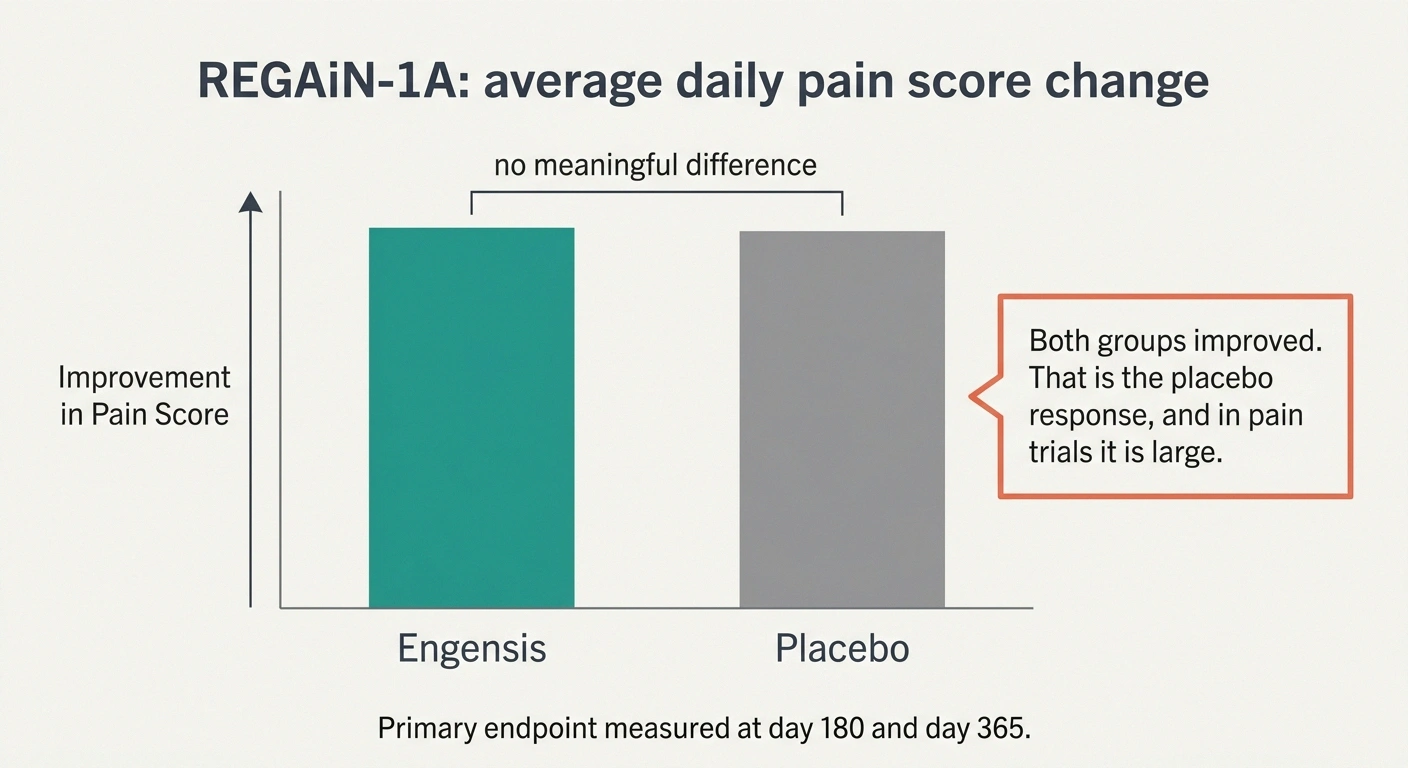
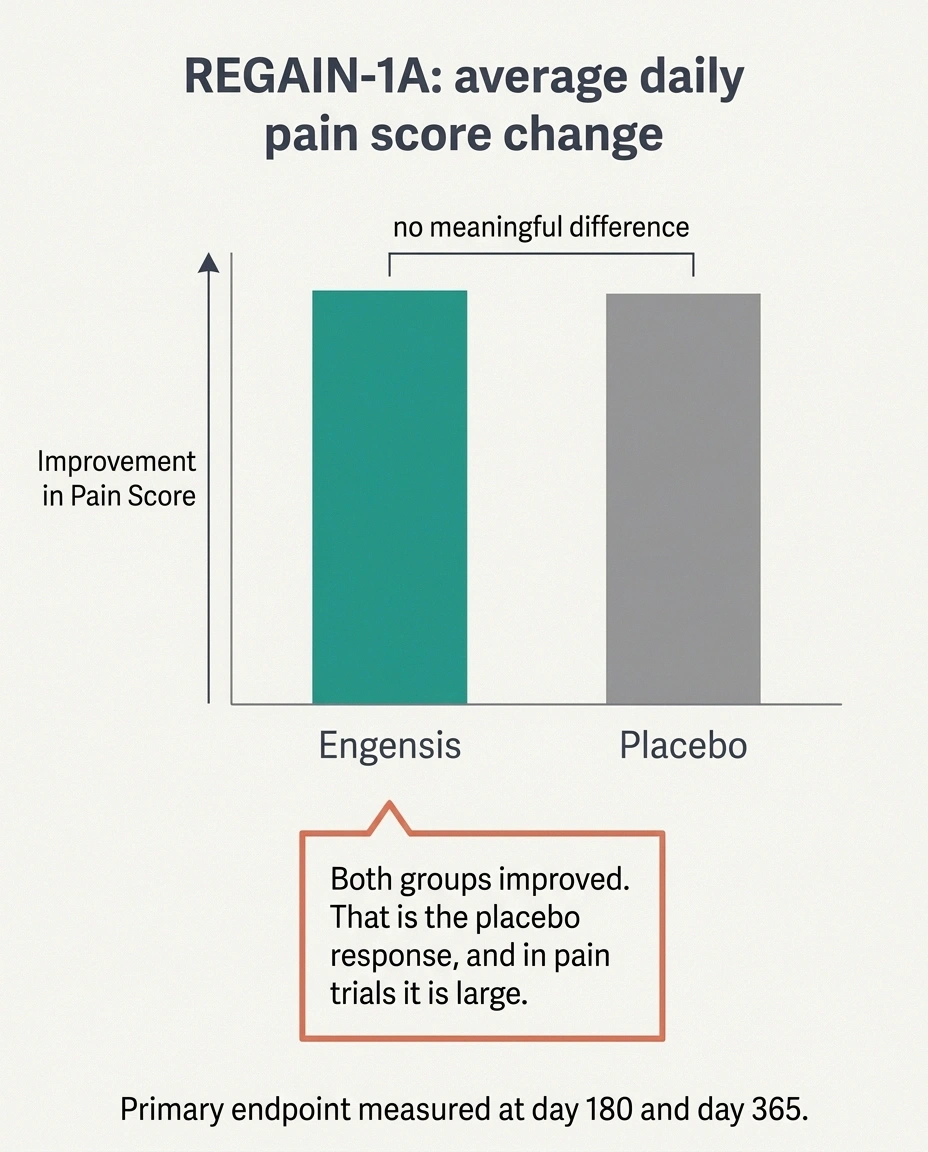
The primary endpoint was the honest one: change in average daily pain score over the previous seven days, compared against placebo, measured at day 180 and again at day 365. A six-month extension study ran alongside it to look at durability and longer-term safety.
The trial completed in July 2024. The topline analysis did not demonstrate superiority over placebo.
That’s the whole result. No asterisk this time, no contaminated control group, no site-handling scandal. The comparison was clean and the drug did not win it.
Why Promising Phase 2 Results Keep Doing This
The phase 2 data had looked genuinely encouraging, and one finding in particular drove everything that followed: the benefit appeared strongest in participants who were not taking gabapentin or pregabalin.
You can construct a perfectly sensible story for that. Maybe those drugs mask a real improvement. Maybe people not taking them have a different kind of nerve pain, one more responsive to blood-supply repair. Maybe there’s a direct interference nobody understands yet.
You can also construct a much duller story. If you slice a modest trial into subgroups and hunt for the slice where the numbers look best, you will find one. That’s not fraud — it’s arithmetic. Randomness produces attractive-looking pockets, and human beings are extraordinarily good at building explanations around them after the fact.
The way to tell those two stories apart is to specify the subgroup in advance and run a trial designed to test it. That is more or less what REGAiN-1A did, and the signal did not hold.
I’ve now watched this exact sequence play out enough times to name the pattern. A striking phase 2 subgroup. A confident phase 3. A quiet result. If you take one thing from this article to use elsewhere, take this: a subgroup finding is a question, not an answer. It earns a trial. It does not earn your hope yet.
Placebo response is the other half of the trap, and it’s brutal in pain research specifically. People enrolled in a nerve pain trial are seen often, taken seriously, asked detailed questions about their symptoms, and given something. Pain scores improve on that alone, sometimes substantially. A drug isn’t competing against nothing. It’s competing against attention plus expectation — and that bar is higher than it looks.
Which is its own quiet finding, if you let it be one. Being seen regularly, asked careful questions, and taken seriously moves pain scores. That isn’t a trick of measurement or a failure of the patients involved. It’s a real effect, reproduced in trial after trial, and most of us get almost none of it in ordinary care.
What Helixmith Is Doing With It Now

The molecule hasn’t been abandoned. It’s been redirected, which is normal and sensible after a failed indication.
Engensis has been studied for safety and tolerability in Charcot-Marie-Tooth type 1A, the most common inherited neuropathy, which I’ve written about in the piece on hereditary neuropathy and CMT. It’s also been explored in ALS, and in circulation problems including intermittent claudication and critical limb ischemia.
Personally, I think the vascular indications are the most logical home for it. If your drug’s central action is growing new blood vessels, a disease defined by inadequate blood flow is a cleaner target than a pain condition with a dozen overlapping mechanisms and a famously noisy endpoint.
None of those programs has produced an approved treatment. Early safety studies are early safety studies.
If You Came Here Hoping to Enroll
This is the practical part, and it applies well beyond Engensis.
- Recruiting
- The study is enrolling. This is the only status worth acting on, though enrolling is not the same as you qualifying — the entry criteria still decide that.
- Not yet recruiting
- Registered but not open. Sites and dates often shift by many months.
- Active, not recruiting
- Enrolled participants are still being followed. The door is shut.
- Completed
- Finished. Results may or may not be posted yet, and a completed study says nothing about whether the drug worked.
- Terminated / Withdrawn / Suspended
- Stopped early, never started, or paused. Terminated is the one worth reading the reason for, since safety and futility are very different explanations.
Search the drug name, not the condition. Condition searches return hundreds of studies and bury the one you were actually reading about.
Those aggregator sites that scrape the trial registry and dress it up with a signup button are a real problem for people in pain. They rarely make the recruitment status obvious. They don’t distinguish between a study that’s actively enrolling and one that closed two years ago. Some of them are essentially lead generation.
The fix is free and takes two minutes:
Go to ClinicalTrials.gov directly and search the drug name. Every study has a recruitment status printed near the top — Recruiting, Active, not recruiting, Completed, Terminated, Withdrawn. Only the first one is worth acting on, and even then it means the study is enrolling rather than that you personally will qualify — entry criteria still decide that. If it says Completed, no button on any other website changes it.
Then check the locations list, because “a trial exists” and “a trial exists somewhere you can physically get to every few weeks” are different facts. I’ve written a fuller walkthrough of the process in the guide to finding and joining neuropathy clinical trials, including what the screening visit involves and the questions worth asking before you commit.
The Gene Therapy That Is Still Running
It would be a shame to leave you with the impression that the whole category collapsed with this one drug. It didn’t.
1. Was there a placebo group, and were people blinded? If the headline comes from an open-label extension, everyone knew what they were getting. In pain research that alone can produce the entire reported improvement.
2. Is the impressive number from the whole trial or from a slice of it? Language like “in patients who were not also taking” is the tell. A slice generates the next study; it does not settle anything.
3. Who is telling me, and what are they selling? A company press release, an investor note, and a peer-reviewed publication are three different documents with three different obligations to be right.
A story that survives all three is worth following. Most do not survive the first.
ST-503, from Sangamo, is a genuinely different proposition — a true viral-vector therapy delivered into the spinal fluid, designed to turn down the Nav1.7 sodium channel in the sensory nerves that carry pain signals. Different mechanism, different delivery, different durability profile. I covered it in detail in the piece on ST-503 and Sangamo’s small fiber neuropathy trial.
Sodium channels in general are where a lot of current energy sits, and several of those programs are further along than Engensis ever got. If you want the wider view of what’s actually in trials right now rather than what’s being advertised, the 2026 neuropathy drug pipeline is the piece to read next.
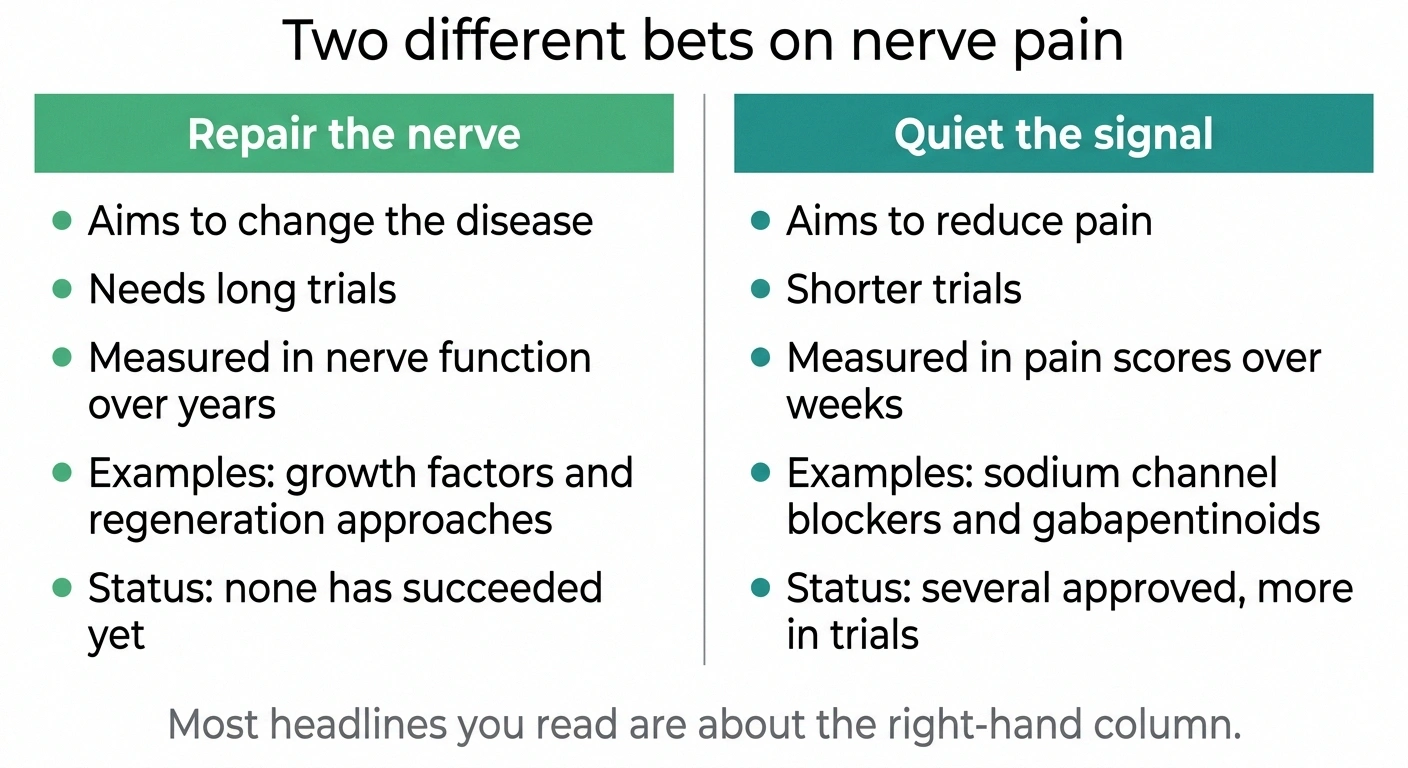
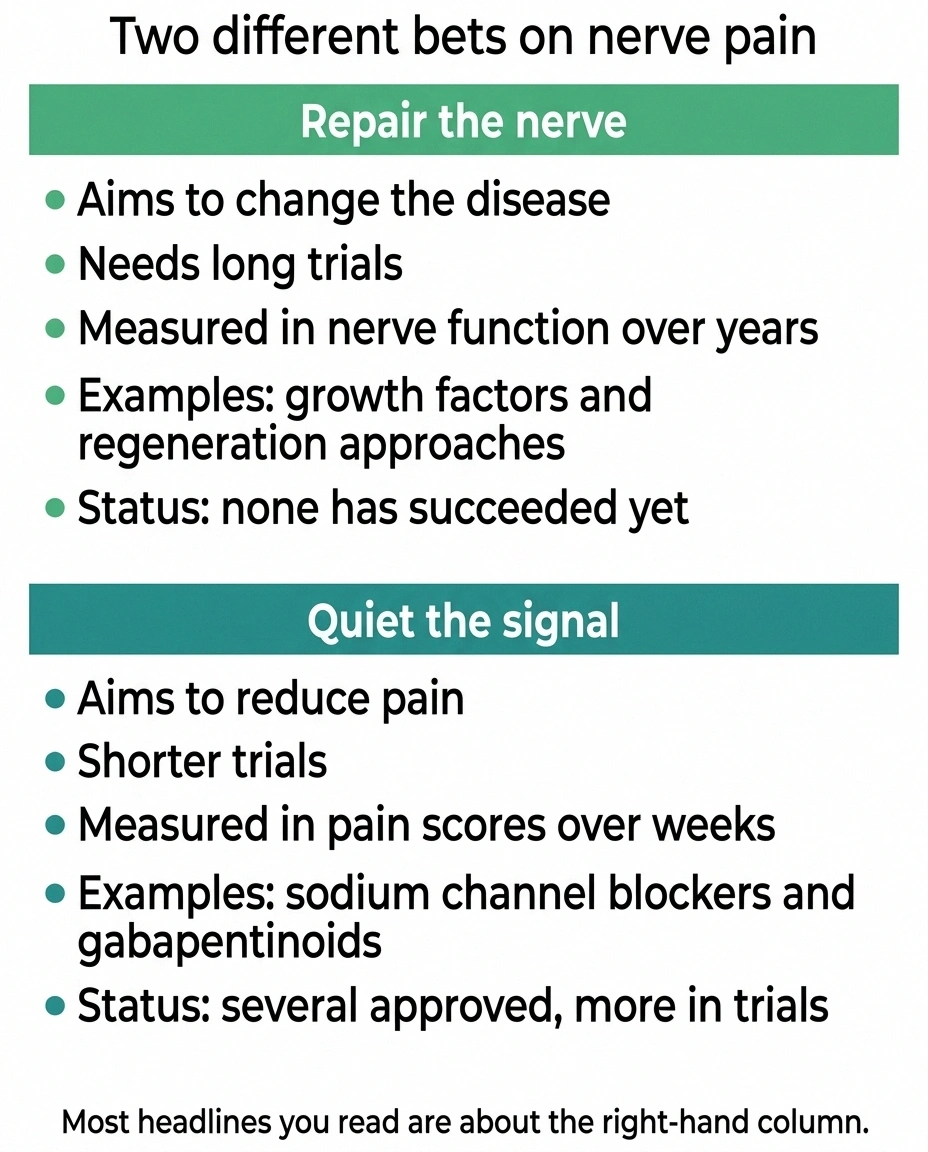
One structural difference is worth holding onto, because it will help you sort future headlines quickly. Engensis was trying to repair the environment around the nerve. The sodium channel drugs are trying to quiet the signal the nerve sends. Those are opposite bets. The repair bet, if it ever pays off, changes the disease. The signal bet is easier to prove in a trial, because pain scores respond within weeks rather than years, and easier to fail safely.
Nobody has won the repair bet yet. Not with growth factors, not with stem cells, not with any of it. That doesn’t mean the bet is wrong — it means the endpoint is slow, the trials are long, and the money tends to run out before the answer arrives.
What I’d Tell a Friend

I wrote back to my reader and told her to save her phone call.
What I’ve been thinking about since is how much time we spend, collectively, on drugs that are not coming. There’s a version of living with neuropathy where you refresh trial news every week and measure your year in press releases. I’ve been that person. It feels like doing something, and it mostly isn’t.
The unglamorous truth is that blood sugar control, foot care, sleep, movement, and getting your medication regimen properly optimized will do more for the next twelve months of your life than any pipeline drug will. I’ve laid out that whole approach in the diabetic neuropathy treatment guide, and none of it is exciting.
Follow the research. Genuinely, follow it. Just hold it loosely, check the recruitment status yourself, and don’t let a page from 2019 tell you what’s possible in 2026.
Frequently Asked Questions
Is Engensis approved for diabetic neuropathy?
No. Engensis is not approved by the FDA or any other regulator for painful diabetic peripheral neuropathy. It is not available by prescription and there is no expanded-access pathway to pursue for this condition.
What is VM202?
VM202 is the development code for Engensis, generic name donaperminogene seltoplasmid, made by Helixmith. It is a plasmid, a small circular piece of DNA, injected into the calf muscles. It carries instructions for two forms of hepatocyte growth factor, a protein that promotes new blood vessel growth and supports nerve cells.
Is Engensis the same kind of gene therapy as the ones that use viruses?
No, and the difference is significant. Engensis uses naked plasmid DNA with no viral carrier. It does not integrate into your chromosomes and its effect is temporary, which is why it was given in repeated cycles. Viral-vector gene therapies are designed to produce a lasting change from a single administration.
Did the Engensis phase 3 trial succeed?
No. The REGAiN-1A trial, which measured change in average daily pain score against placebo at day 180 and day 365, completed in July 2024 and the topline analysis did not show the treatment beating placebo on that primary measure.
What happened with the 2019 trial?
An earlier phase 3 study produced uninterpretable data. Analysis of samples found VM202 plasmid present in participants assigned to the placebo group, indicating that drug and placebo had likely been mixed up during handling at some study sites. Without an intact control group there was no valid comparison to make.
Can I still join an Engensis trial for neuropathy?
Not for painful diabetic peripheral neuropathy. The main study is completed. Always confirm recruitment status on ClinicalTrials.gov directly rather than through a third-party trial-listing website, since those sites often keep closed studies visible and advertised.
Why did the drug work in phase 2 but not phase 3?
The most encouraging phase 2 finding was in a subgroup: participants not taking gabapentin or pregabalin. Subgroup findings frequently fail to reproduce, because slicing a modest trial into smaller groups reliably produces at least one attractive-looking result by chance. The larger, properly controlled study did not confirm it.
Is gene therapy for nerve pain a dead end?
Not at all. ST-503 from Sangamo is an active viral-vector program targeting the Nav1.7 sodium channel in sensory nerves, delivered into the spinal fluid. It is a fundamentally different approach from Engensis, and it is one of several genetic-medicine strategies still in development for nerve pain.
About the Author