
Four days of small injections under the skin. Then nothing for three weeks.
That’s the entire treatment schedule for a drug called Halneuron, and it’s the reason I wanted to write about it. Almost everything we take for nerve pain works the other way round. Gabapentin three times a day, forever. Duloxetine every morning, forever. The pill’s in you, the pain is quieter; the pill wears off, the pain comes back. That trade is so familiar most of us stopped noticing it was a trade.
Halneuron doesn’t follow that pattern. In the published trial, the drug had cleared a patient’s bloodstream within about a day — and researchers were still measuring real pain relief four weeks later.
I want to be careful here, because I’ve watched too many people get their hopes lifted by a press release. This drug isn’t approved. Its most important trial hasn’t reported yet. And the published study it rests on missed its own primary endpoint, which is a detail the coverage keeps skipping. So let’s go through what’s actually known.
Where This Drug Stands Right Now
Halneuron is a purified, tiny dose of tetrodotoxin — the compound found in pufferfish. It’s being developed by Dogwood Therapeutics for chemotherapy-induced neuropathic pain, the burning, shooting, electric misery that can outlast cancer treatment by years.
As of the middle of 2026, here’s the honest status. The Phase 2b trial has enrolled 217 patients against a target of 210 to 240. An interim look at the unblinded data in December 2025 found that treated patients were separating from placebo on pain scores, and an independent committee recommended the study continue. Topline results are expected in the fall of 2026. The FDA has granted the program fast track designation, which speeds up review and communication but says nothing whatsoever about whether the drug works.
Phase 3, if it happens, is projected to start in the first half of 2027. That’s the realistic timeline, and it means a pharmacy shelf is several years away at best.
What Tetrodotoxin Does to a Nerve
Pain from a damaged nerve isn’t a normal pain signal. A healthy nerve fires when something happens to you. An injured nerve develops what researchers call ectopic discharges — a formal way of saying it fires when nothing is happening at all. Nobody touched your foot. The nerve sent the message anyway.
Those false messages travel on sodium channels, the tiny gates in the nerve membrane that let an electrical signal move down the line. Tetrodotoxin blocks certain of those gates with unusual precision. Block the gate, and the false signal can’t propagate.
This is the same broad territory as several other drugs now in development, including the Nav1.8 sodium channel blockers and the approved non-opioid suzetrigine. What sets tetrodotoxin apart is that it isn’t a modern designed molecule at all. It’s a marine toxin that happened to be one of the most selective sodium channel blockers anyone has ever found, which is why it spent decades as a laboratory tool before anybody tried it as a medicine.
It also stays out on the periphery. At these micro-doses it doesn’t act on the brain the way the gabapentinoids do, and that’s the origin of a practical difference I’ll come back to.
The Four-Day Course That Keeps Working After It Stops
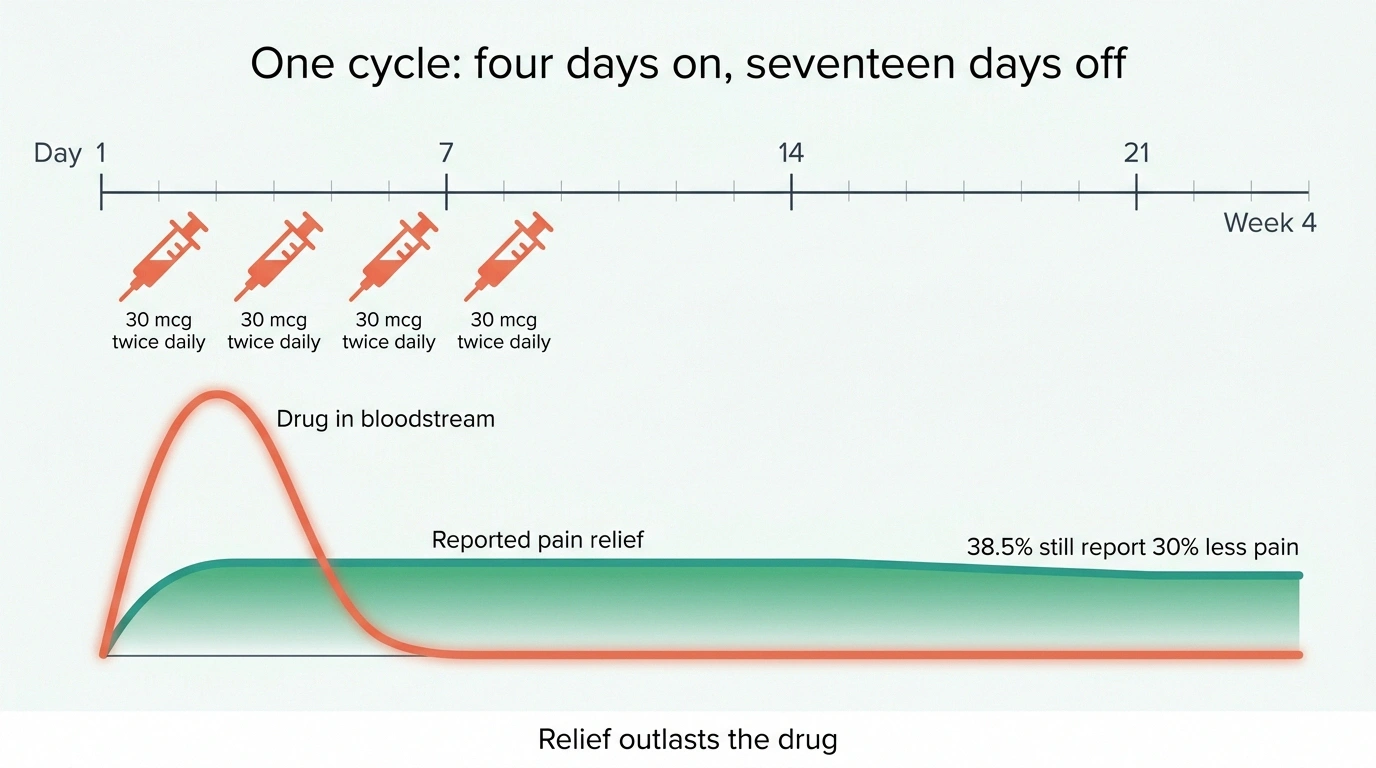
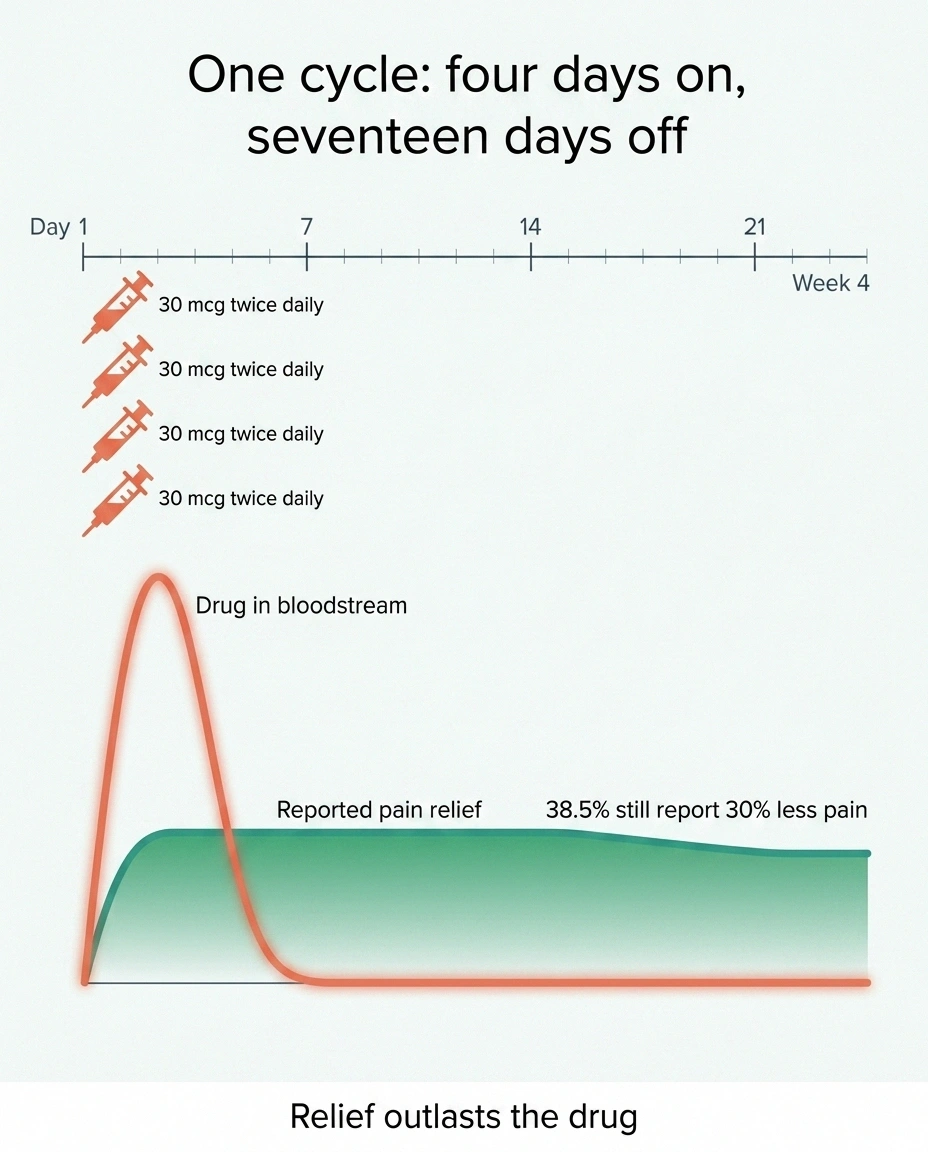
The dosing schedule looks odd until you sit with it. In the published trial, patients got injections for four consecutive days and then stopped. Blood levels peak roughly ninety minutes after a shot and fall away fast.
Yet 38.5% of patients in the highest-dose group still reported at least a 30% reduction in pain during the fourth week after treatment ended. Across all the tetrodotoxin groups combined, that figure was about 33%. A third of people were still better off, weeks after the last molecule had gone.
Nobody has proven why. The leading idea is that if you silence a misfiring nerve for long enough, the pain circuit above it — in the spinal cord and the brain — starts to quiet down too. Chronic nerve pain is partly a learned state, a system that’s been rehearsing an alarm so long the alarm keeps itself going. Interrupt the rehearsal and the system may not restart at the same volume. That’s the theory, at least, and it’s cousin to what’s supposed to happen with the Qutenza capsaicin patch, another treatment where one application is meant to buy months.
If that holds up in a bigger trial, it changes the shape of what treatment looks like. Not a daily pill you organise your life around. A short course, a few times a year.
What the 125-Patient Trial Actually Found
This is where I have to be a spoilsport, because it’s the part the headlines leave out.
| Four-day regimen | Total dose over the course | Outcome |
|---|---|---|
| Placebo | None | 32.0% reached 30% pain relief |
| 7.5 mcg twice daily | 60 mcg | Not carried forward |
| 15 mcg twice daily | 120 mcg | Not carried forward |
| 30 mcg once daily | 120 mcg | Not carried forward |
| 30 mcg twice daily | 240 mcg | Taken to Phase 2b on a three-week cycle |
Note that 15 mcg twice daily and 30 mcg once daily deliver the same total dose. Splitting it differently did not produce the same result, which is part of why the twice-daily schedule was chosen.
The published randomized trial enrolled 125 patients across 24 US sites. Five groups, four days of dosing: placebo, 7.5 micrograms twice daily, 15 micrograms twice daily, 30 micrograms once daily, and 30 micrograms twice daily.
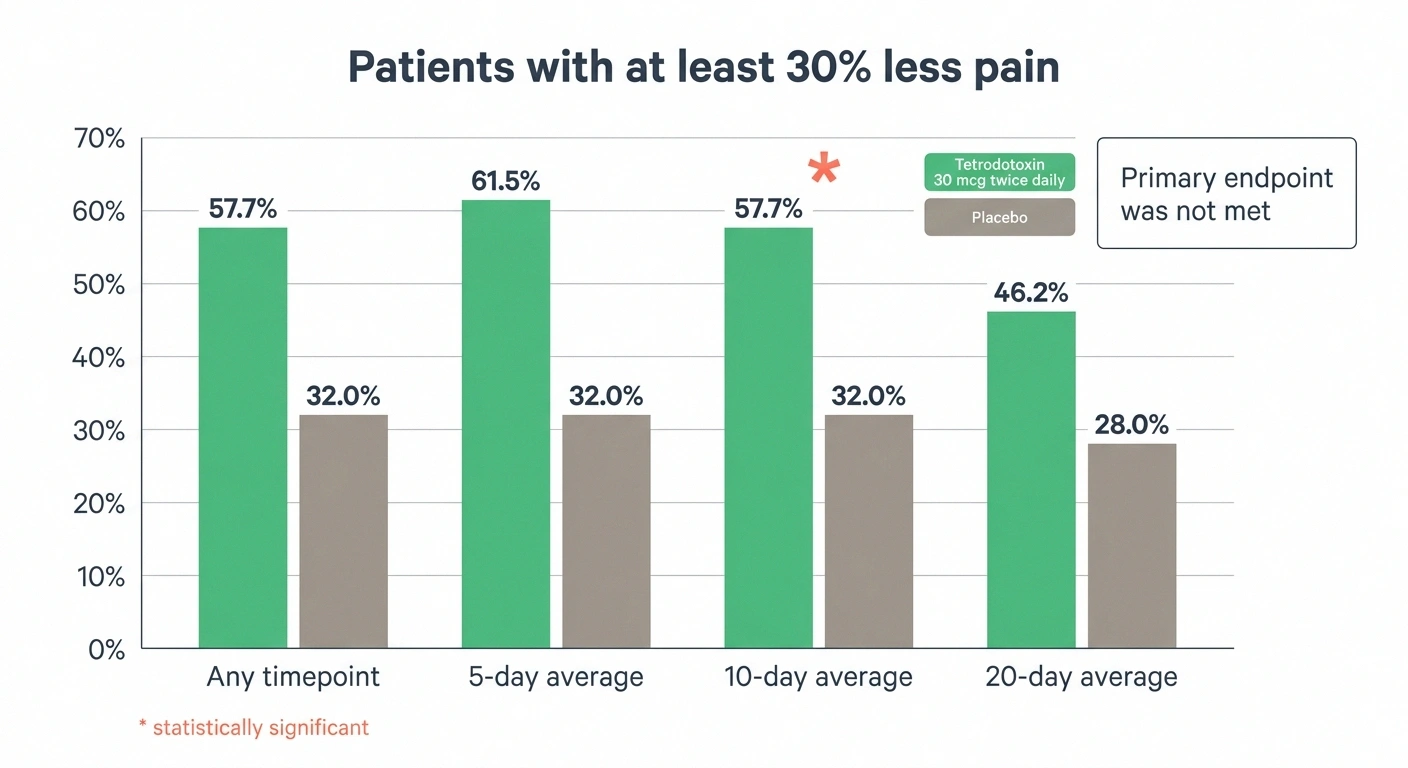
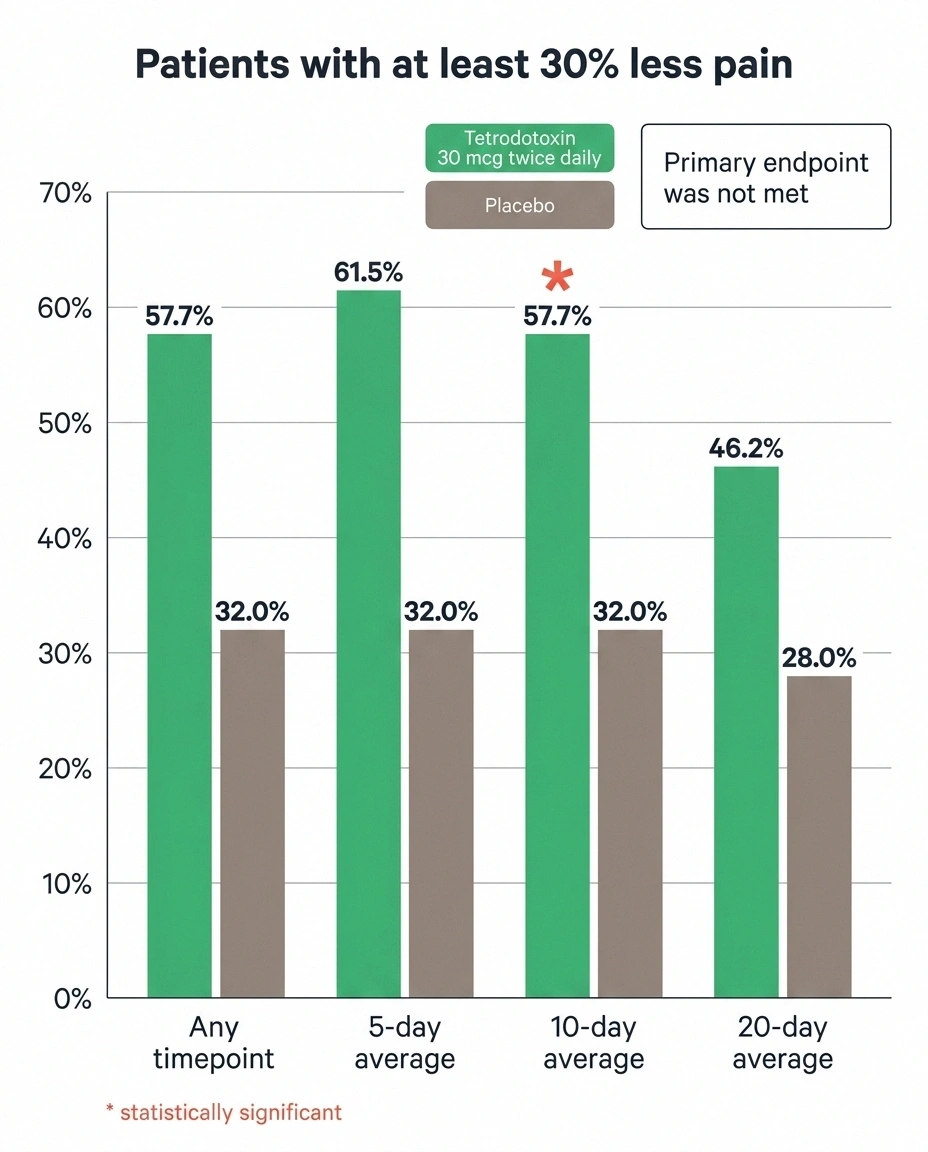
The primary endpoint didn’t reach statistical significance. Average pain reduction across days 22 to 28 didn’t separate the groups convincingly. On a strict reading, the trial failed.
What the researchers found instead came out of a responder analysis, which asks a different question. Not “how much did average pain fall” but “how many people got meaningfully better.” Using a 30% improvement threshold, the highest dose group came out like this against placebo:
- At any single timepoint: 57.7% versus 32.0%
- Over a 5-day rolling average: 61.5% versus 32.0%
- Over a 10-day rolling average: 57.7% versus 32.0% — and this one reached statistical significance
- Over a 20-day rolling average: 46.2% versus 28.0%
One significant result out of four related comparisons, in a secondary analysis, after the primary endpoint missed. That’s a signal worth chasing. It isn’t proof, and anyone telling you otherwise is selling something.
What it did do was pick the dose. The authors took 30 micrograms twice daily forward on a three-week cycle, which is exactly the regimen the current Phase 2b is built around.
The Side Effect You’ll Notice First

Your mouth tingles.
Primary endpoint. The single question the trial committed to answering before it started. Miss it, and everything else in the paper is a secondary analysis, whatever the press release leads with.
Responder rate. The share of people who improved by an agreed amount, usually 30% or 50%. More honest than an average for nerve pain, because a few large responses can drag an average upward while most people feel nothing.
Fast track designation. An FDA process that speeds up meetings and review for a serious condition with unmet need. It is granted on the basis of the condition, not the evidence, and says nothing about whether a drug works.
In the trial, oral paresthesia — tingling around the mouth and lips — hit 34% of treated patients against 12% on placebo. Oral hypoesthesia, meaning numbness rather than tingling, hit 28% against 12%. Tingling elsewhere in the body ran at 24%. Headache affected 19.6% and dizziness 17.6%.
I know how that reads when the drug in question comes from a pufferfish. So let me say the useful thing plainly: that tingling is the drug doing exactly what it’s designed to do, arriving at nerve endings, and the mouth is simply where you notice it first because the lips and tongue are so densely wired. It showed up at doses thousands of times below anything dangerous, it was mild to moderate in nearly every case, and it faded.
“Nearly every case” is doing real work in that sentence. Four severe adverse events occurred in the highest-dose group, three of them possibly treatment-related. Two patients left the study because of side effects, both with vertigo. There was one death, from metastatic cancer, judged unrelated to the drug.
The pattern in the current Phase 2b is reassuring on a different measure: the dropout rate is under 5%, which is remarkably low for a chronic pain trial. People are staying in it. That usually means the treatment is tolerable enough to live with.
Why Chemo Nerve Pain Has No Approved Drug At All
This is the context that makes a mid-stage trial newsworthy, and it deserves saying out loud.
Expected: tingling or numbness around the lips and tongue starting within a few hours of a dose and fading before the next one. Roughly one in three trial participants reported it. Mild headache and a period of unsteadiness were also common.
Not expected: numbness spreading to the hands or feet, difficulty swallowing or speaking, weakness in a limb, or vertigo severe enough to stop you walking. Vertigo was the reason both study withdrawals happened.
This distinction only matters inside a monitored trial, where a study nurse can be reached the same day. There is no route to taking this compound outside one, and no version of it exists that anyone should attempt to source independently.
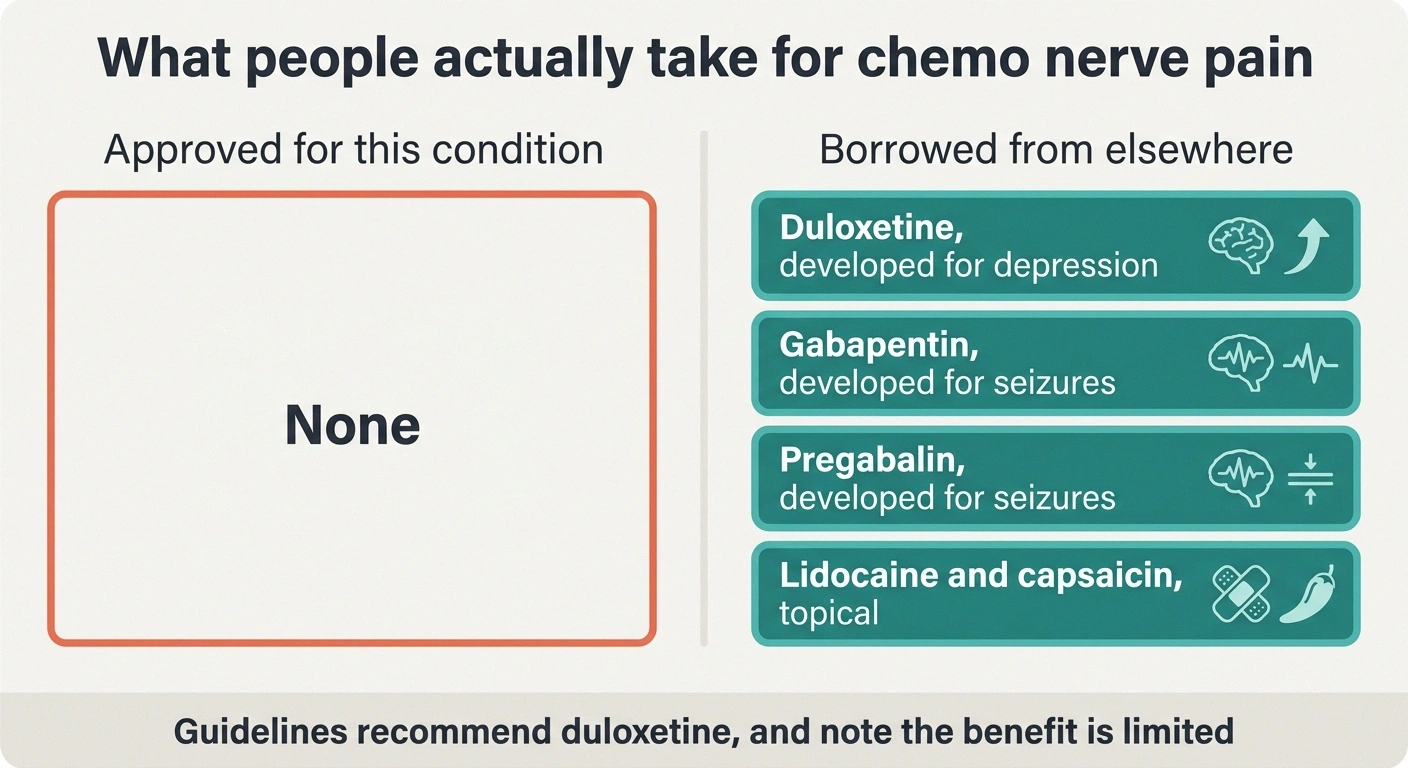
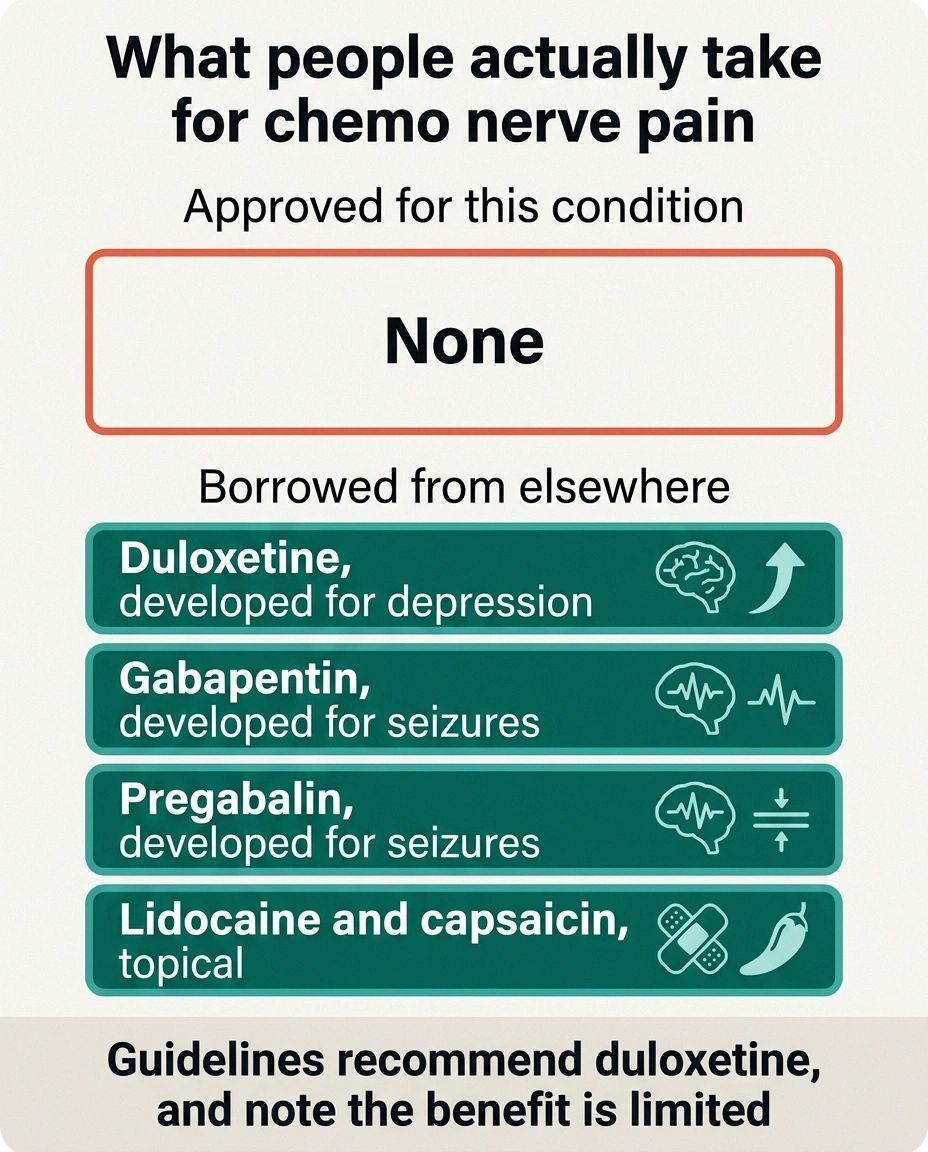
There’s no FDA-approved medication for established chemotherapy-induced peripheral neuropathy. Not one. The major oncology guideline recommends duloxetine, and it does so with a moderate strength recommendation while stating flatly that the amount of benefit is limited. For prevention it recommends nothing at all, because nothing has held up — I went through that ground in the piece on preventing chemo neuropathy.
So the treatments people actually receive are borrowed. Duloxetine, developed for depression. Gabapentin and pregabalin, developed for seizures. Lidocaine patches. Capsaicin. Every one of them repurposed from somewhere else, and the response rates show it.
The average person in the current Halneuron trial has had this pain for more than five years. That number tells you what the landscape has been like.
How It Compares to What You Can Get Today
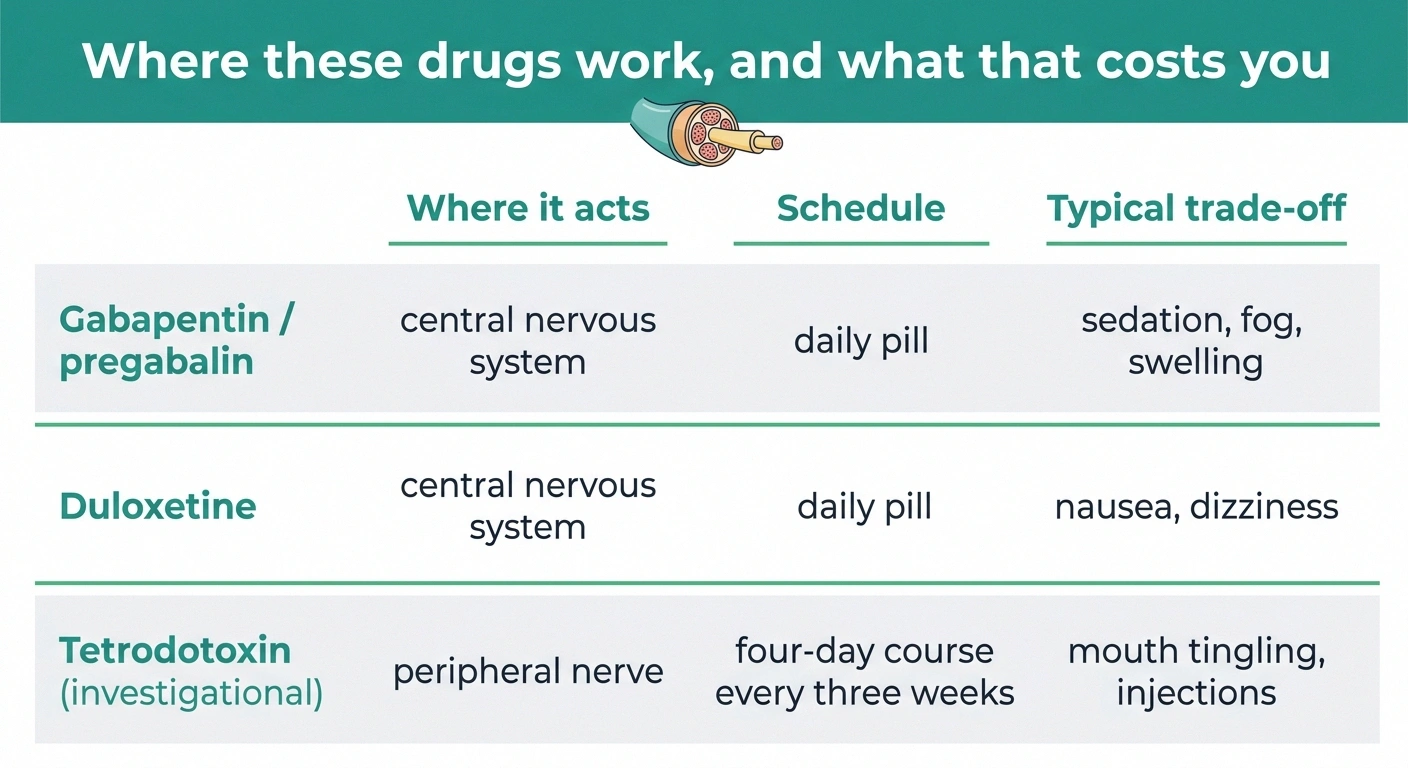
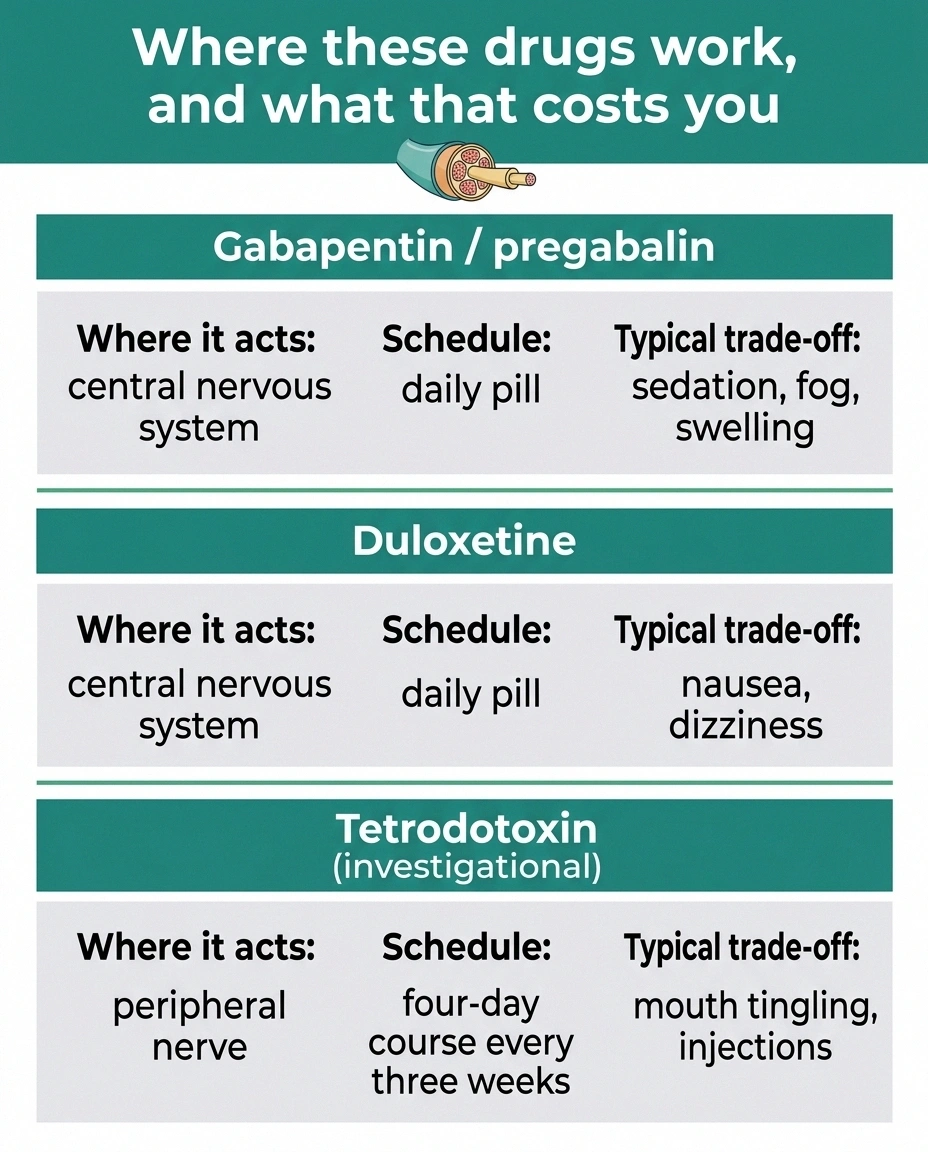
Assume for a moment that Halneuron eventually works as well as the interim data hints. How would it sit next to what your oncologist can prescribe this afternoon?
The clearest difference is where the drugs act. Gabapentinoids and duloxetine work centrally, which is why they cause sedation, mental fog and — with the gabapentinoids — swelling and weight gain. Tetrodotoxin acts out at the nerve, so the trial side effect profile looks nothing like a gabapentinoid’s. Nobody in these studies described the flattened, cotton-headed feeling that makes so many people quietly stop taking their nerve pain medication.
The second difference is the schedule, and it cuts both ways. A short course beats a daily pill for convenience. But injections mean a clinic visit or training, and that’s a genuine burden for someone already spending too many mornings in waiting rooms.
The third is that none of this is either-or. Halneuron isn’t being tested as a replacement for what you take. If it’s approved, it would most likely be added to a regimen rather than swapped in.
Can You Join the Trial?

Enrollment for the main Phase 2b has hit its target, so that door is closing or closed. A long-term extension study opened in May 2026, offering three more months of treatment across various dosing regimens, but extension studies almost always recruit from people already in the parent trial.
Fall 2026. Topline Phase 2b results. This is the one that counts, because it either confirms the December 2025 interim signal on the full 217 patients or it does not.
First half of 2027. Projected start of Phase 3, only if the fall results support it. Phase 3 is normally when broad recruitment opens and when trial sites multiply.
Several years beyond that. A Phase 3 program in chronic pain typically runs two years or more before a submission, and review adds most of another year.
Worth setting expectations against: roughly nine out of ten drugs that enter human trials never reach approval, and pain drugs fare worse than average because placebo response rates are so high.
If you want to be considered for whatever comes next, the practical step isn’t to wait for a press release. It’s to be findable. Ask your oncology team whether the centre participates in neuropathy trials, get your neuropathy documented properly in your chart with dates and pain scores, and search the registry yourself. I walked through how to do that in the guide to finding and joining neuropathy clinical trials, and the same approach works for everything in the 2026 drug pipeline.
One thing about eligibility that surprises people. Trials of chemo-related nerve pain usually require a specific chemotherapy exposure history and a pain score above a threshold, and they often exclude anyone whose cancer is currently active or progressing. So if you took paclitaxel or oxaliplatin years ago and have lived with the damage ever since, you’re closer to the profile these studies want than you’d probably assume.
What I’d Actually Do With This Information

Not much yet, and I mean that kindly.
A drug whose pivotal data lands in a few months and whose Phase 3 hasn’t started isn’t a plan. It’s a reason to keep the folder open. The people who benefit soonest from news like this are the ones who are already organised — symptoms tracked, treatment history written down, an oncology team that knows they’re interested.
Meanwhile the boring things still matter more than the pipeline does. Getting a real trial of the medications that already exist, at a proper dose for a proper length of time, instead of a low dose abandoned after ten days. Protecting the feet you can’t fully feel. Keeping moving, because deconditioning compounds everything else.
What I take from Halneuron is narrower than hope and steadier than it. Somebody is finally running a properly powered trial in a condition that has never had a drug of its own. Whatever the answer turns out to be this fall, we’ll know something we didn’t know before. After five years of being told there’s nothing, that isn’t nothing.
Frequently Asked Questions
Is Halneuron FDA approved?
No. Halneuron is investigational and available only through clinical trials. It has FDA fast track designation for chemotherapy-induced neuropathic pain, which speeds up the review process but is not an approval and says nothing about whether the drug works. Topline Phase 2b results are expected in the fall of 2026, with Phase 3 projected to begin in the first half of 2027.
Is Halneuron really made from pufferfish poison?
It is a purified pharmaceutical preparation of tetrodotoxin, the compound responsible for pufferfish toxicity. The doses used in pain trials are measured in micrograms and sit thousands of times below the toxic range. Tetrodotoxin has been a laboratory tool for studying sodium channels for decades because of how precisely it blocks them, and that same precision is what makes it interesting as a painkiller.
How is Halneuron given?
By small injections under the skin. In the published dose-finding trial, the regimen taken forward was 30 micrograms twice daily for four consecutive days, repeated on a three-week cycle. It is not a pill and cannot be taken by mouth, because tetrodotoxin is not reliably absorbed from the gut.
Did the trial show that it works?
Partly, and the honest answer comes with caveats. The published 125-patient randomized trial missed its primary endpoint, which was average pain reduction over days 22 to 28. A secondary responder analysis found that 57.7% of patients on the highest dose achieved at least 30% pain relief on a 10-day rolling average, versus 32.0% on placebo, and that comparison did reach statistical significance. The current Phase 2b was designed to answer the question properly, and an interim review found treated patients separating from placebo.
What are the side effects?
The most common are tingling around the mouth (34% versus 12% on placebo), numbness around the mouth (28% versus 12%), tingling elsewhere in the body (24%), headache (19.6%) and dizziness (17.6%). Most were mild to moderate and temporary. Four severe events occurred in the highest-dose group, and two patients withdrew because of vertigo.
How long does the pain relief last?
Longer than the drug stays in the body, which is the most unusual thing about it. Tetrodotoxin clears within roughly a day, yet 38.5% of patients on the highest dose still reported at least 30% pain reduction during the fourth week after their four-day course ended. The three-week dosing interval being tested now was built around that observation.
Is it different from gabapentin or duloxetine?
Yes, in mechanism and in where it acts. Gabapentin and pregabalin work on calcium channels and duloxetine works on serotonin and norepinephrine, all of them mainly inside the central nervous system, which is why sedation and mental fog are so common. Tetrodotoxin blocks sodium channels out at the peripheral nerve, and trial participants did not report the cognitive dulling that leads many people to abandon the older drugs.
Can I get into the Halneuron trial?
The main Phase 2b has reached its enrollment target, so new enrollment is likely closed. A long-term extension opened in May 2026, but extensions typically recruit only from participants already in the parent study. The useful move is to ask your oncology team whether your centre runs neuropathy trials, make sure your neuropathy is documented in your records with dates and pain scores, and watch the registry for whatever opens next.
About the Author