The first fall I had after my neuropathy started was in my own kitchen. I stepped on what I thought was solid ground, didn’t feel it give beneath me, and went down hard. Nothing broken, thankfully — just bruised and shaken, and deeply embarrassed by how vulnerable I’d become in the place I was supposed to feel safest.
That fall changed how I looked at my home. Every house, even a familiar one you’ve lived in for decades, contains hazards that are invisible to healthy feet and hands but become genuine threats when you can’t fully feel the ground beneath you or grip things reliably with your hands. The numbers are sobering: people with peripheral neuropathy fall at a rate two to three times higher than people without it, and falls are the leading cause of injury-related hospitalizations in older adults.
The good news is that most fall hazards are fixable. This room-by-room guide covers the modifications that make the biggest difference — the ones that take your home from a subtle obstacle course to a genuinely safe environment where you can focus on living your life rather than managing your risk.
Understanding the Neuropathy-Specific Fall Risk
Before diving into room-specific changes, it’s worth understanding exactly what makes neuropathy a fall risk — because it’s not just about the obvious numbness in your feet.
Key Takeaway
People with peripheral neuropathy fall 2-3 times more often than those without it — mostly in their own homes. Grab bars, motion-activated lighting, and removing loose rugs address the highest-risk hazards and can prevent the injuries that most severely limit independence.
Proprioception loss: Proprioception is your body’s sense of where it is in space — the continuous feedback from muscles, joints, and skin that tells your brain how you’re positioned without you having to look. Neuropathy often damages this system. When proprioception is impaired, you may not notice that your foot has landed at an odd angle, that your weight is unevenly distributed, or that you’re starting to lean. Your body loses the automatic micro-corrections that keep most people upright without conscious thought.
Reduced grip strength and dexterity: If your upper extremities are affected, you can’t trust yourself to catch a grab bar quickly, hold a railing firmly, or break a fall safely.
Delayed reaction time: Damaged nerves conduct signals more slowly. By the time your nervous system registers that you’re off-balance and sends correction signals to your muscles, you may already be falling.
Medication effects: Many medications used for neuropathic pain — including gabapentin, pregabalin, and tricyclic antidepressants — cause dizziness, drowsiness, or orthostatic hypotension (blood pressure dropping when you stand). These effects multiply fall risk, especially at night or when changing positions.
With this in mind, the goal of home modification isn’t just removing tripping hazards — it’s creating an environment that compensates for reduced sensation, slower reflexes, and medication effects at the times when you’re most vulnerable.
General Principles That Apply Throughout the Home
Before we go room by room, these principles should guide modifications everywhere.
65%
of studies analyzing home modifications for aging in place confirmed they significantly reduce falls and improve functional independence.
Lighting Is Non-Negotiable
Vision compensates for impaired proprioception. When you can’t fully feel where your feet are, your eyes become your primary tool for safe navigation. This means lighting quality is more critical for someone with neuropathy than for the average person.
- Replace dim or yellow-toned bulbs with bright white LED bulbs throughout the house
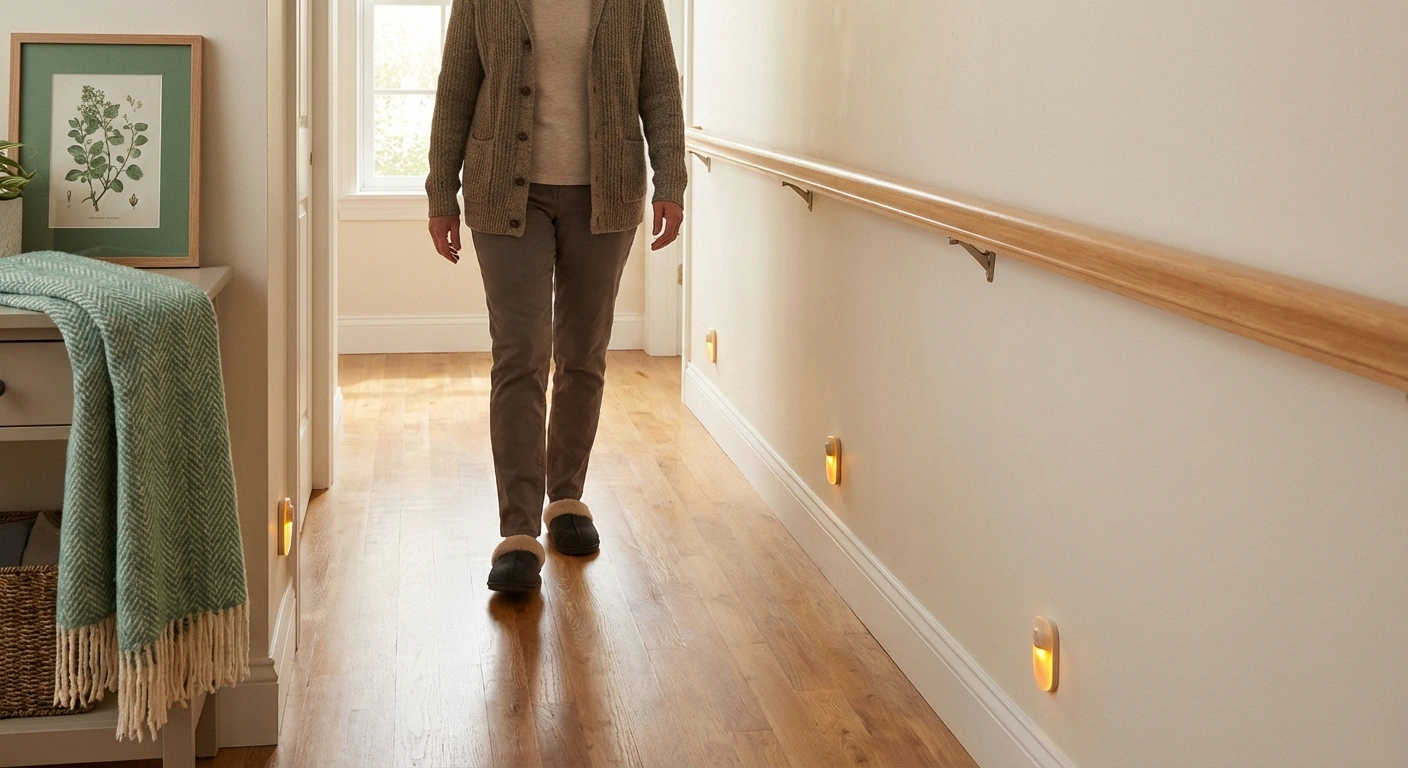
- Install motion-activated night lights along the bathroom pathway — this is the most important single safety measure for nighttime, when falls are most dangerous
- Eliminate dark corners and shadowy transition zones between rooms
- Consider illuminated light switches so you can find them before entering a room