
I was at our county library a few weeks ago when a woman from book club caught me by the supplements aisle of the pharmacy next door. “Janet, my pharmacist mentioned myo-inositol for my diabetic feet. I’ve never heard of it. Is this another one of those Instagram supplements, or is there something to it?” She held up a bottle. The price tag was eleven dollars and ninety-nine cents — about a third of what the alpha-lipoic acid next to it cost.
I’m Janet, a patient advocate (not a medical professional), and I get this question a lot. Myo-inositol sits in a strange middle zone in the neuropathy world. It’s not a fashionable new molecule — researchers have been studying it for nerve health since the 1970s. It’s not a foundation supplement like methyl-B12 or alpha-lipoic acid. But there’s a real, decades-long thread of evidence linking it specifically to diabetic neuropathy, and the price is quietly reasonable. Here’s the honest tour.
What Myo-Inositol Actually Is
Myo-inositol is a six-carbon sugar alcohol. Despite the name, it doesn’t behave like the kind of “sugar” that raises your blood glucose. It’s a structural and signaling molecule that the body makes in small amounts and gets the rest of from food. Most people consume between 500 and 1,500 milligrams a day from a normal diet — beans, citrus fruit, cantaloupe, whole grains, and nuts are the richest natural sources.
Key Takeaway
Myo-inositol has 40 years of evidence specifically in diabetic neuropathy. The signal is real (improved nerve conduction at 8-12 weeks), the cost is reasonable ($10-18/month for powder), and the safety profile is one of the cleanest among nerve supplements. It’s not a foundation — that’s still methyl-B12 and ALA — but it’s a defensible Tier 3 add-on for diabetic neuropathy specifically.
Inside your cells, myo-inositol does several jobs. It’s a building block of phospholipids that make up cell membranes. It’s part of the signaling system that lets insulin work properly in muscle and fat cells. And critically for the nerve story, peripheral nerves contain unusually high concentrations of myo-inositol in their cells. They use it for membrane stability and for the fast electrical signaling that lets a nerve fire correctly.
It’s part of a small family of related molecules. The two forms most commonly sold are myo-inositol (the most abundant and most studied) and d-chiro-inositol (a related form involved more directly in insulin signaling). They’re often sold separately and sometimes combined in a 40-to-1 ratio that matches the natural balance found in human tissue.
Why Anyone Started Studying It for Neuropathy
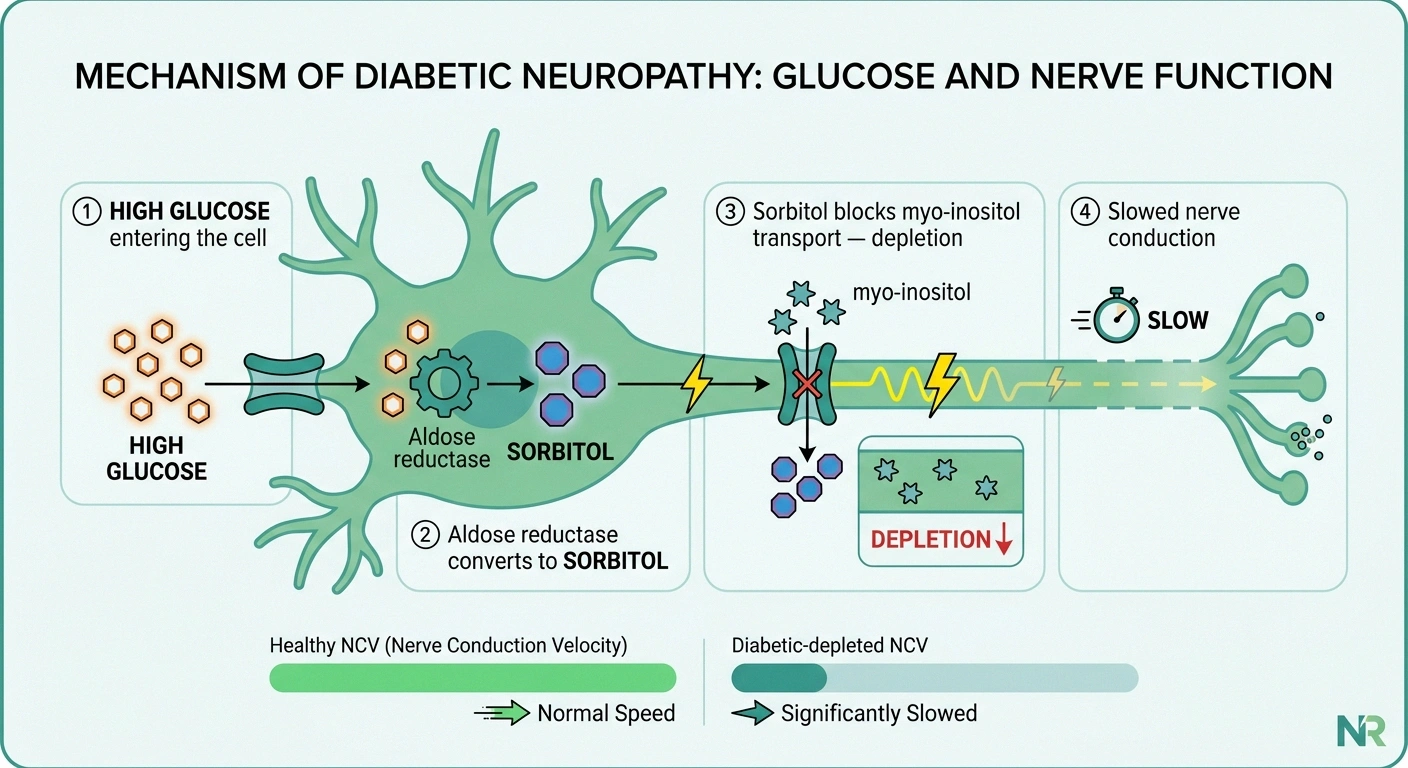
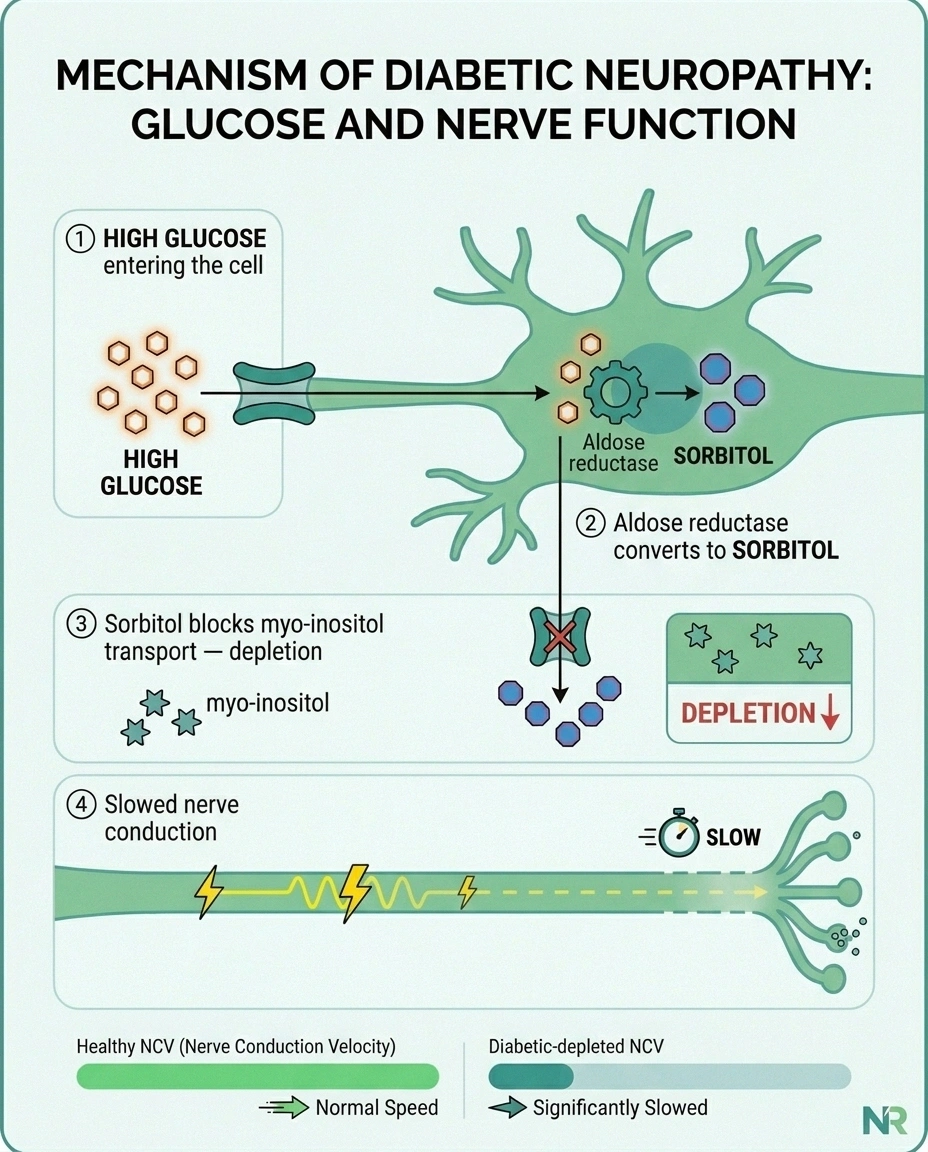
The story begins in animal research in the 1970s and 1980s. Scientists noticed that in diabetic rats, the peripheral nerves were running low on myo-inositol — significantly lower than in healthy animals. The cause turned out to be a quietly damaging quirk of how nerve cells handle excess glucose.
When blood sugar is chronically elevated, glucose enters nerve cells without needing insulin. Inside the cell, an enzyme called aldose reductase converts that excess glucose into sorbitol. Sorbitol can’t easily leave the cell, so it builds up. As it does, it competes with myo-inositol for the same membrane transporters — and myo-inositol levels in the nerve start to fall.
Low myo-inositol means slower nerve conduction. Nerves that don’t have enough myo-inositol fire more slowly and less reliably. In animal models, this was the earliest measurable abnormality of diabetic nerve disease — appearing before any visible damage, before any symptoms, before the nerve started to die back.
The natural next question was whether replacing what diabetes depleted could improve nerve function. That question has been studied in patients for forty years now, with results that are genuinely interesting but not as clean as supplement marketers suggest.
If you want the broader picture of how high blood sugar damages nerves over time, our piece on diabetic neuropathy covers the full mechanism story and its progression. The myo-inositol angle is one of several converging insults on the diabetic nerve, not the whole story.
What the Human Evidence Actually Shows
This is the part most supplement bottles skip. Here’s the honest version.
Myo-Inositol Evidence: What’s Strong, What’s Mixed
The strongest signal comes from nerve conduction velocity (NCV). Multiple small studies of patients with type 1 and type 2 diabetic neuropathy have shown that myo-inositol supplementation — usually 500 to 2,000 mg per day for 6 to 12 weeks — produces a measurable improvement in how fast peripheral nerves fire. The effect is real but modest, typically a 1 to 2 meter-per-second increase, which is meaningful on an EMG/NCS test but doesn’t always translate to a dramatic reduction in patient symptoms.
The signal on symptoms — burning, numbness, tingling — is more mixed. A few studies have shown statistically significant improvement in pain scores and vibration sensitivity over 8 to 12 weeks. Others have shown no clear difference from placebo. The studies that are most positive tend to use higher doses (2-4 grams per day), focus on type 1 diabetic patients with earlier-stage neuropathy, and run longer (12+ weeks). The studies that are negative tend to use lower doses or shorter trials.
The signal on insulin sensitivity in people with insulin resistance or PCOS is stronger than the neuropathy signal. Combination myo-inositol plus d-chiro-inositol has been studied extensively in polycystic ovary syndrome and pre-diabetes. Better blood sugar control indirectly benefits anyone with diabetic neuropathy, so this is a sideways way it might help even if the direct nerve effect is modest.
One realistic way to summarize the evidence: myo-inositol is one of the better-studied supplements for diabetic neuropathy specifically, but it sits clearly below alpha-lipoic acid for neuropathy in terms of trial size and consistency. ALA has thousands of patients across decade-long studies. Myo-inositol has hundreds across shorter ones. It’s a real ingredient, not a snake-oil ingredient, but it’s not the strongest option on the shelf.
Dosing — What the Bottles Say vs. What the Studies Used
Here’s where shopping gets confusing. Myo-inositol bottles range from 500 mg capsules to 4-gram powder scoops, and the dose that worked in the published studies isn’t always what’s recommended on the label.
Myo-Inositol Dosing at a Glance
A reasonable starting framework, based on what’s been tested:
- Standard adult dose for nerve support: 1,000 to 2,000 mg of myo-inositol per day, divided into two doses (morning and evening) with meals.
- Higher dose for insulin sensitivity or PCOS: 2,000 to 4,000 mg per day, often combined with 50 to 100 mg of d-chiro-inositol in the 40:1 ratio.
- Powder vs. capsules: Powder is much more cost-effective at higher doses. It dissolves easily in water with a mildly sweet taste. Capsules typically cap out around 600 mg per cap, so a 2,000 mg dose means three or four capsules at a time.
- With or without food: Either works. Taking it with breakfast and dinner gives the most consistent blood levels and reduces any mild stomach upset.
- Time to test: Plan a minimum of 8 weeks, ideally 12, before judging whether it’s helping. Nerve conduction studies in the trials usually showed change at the 8-to-12-week mark.
Don’t expect a dramatic short-term result. Myo-inositol is a slow, gradual support agent, not an analgesic. If you want a same-day pain reduction, this isn’t your supplement.
The Cost Picture — Where It Actually Wins
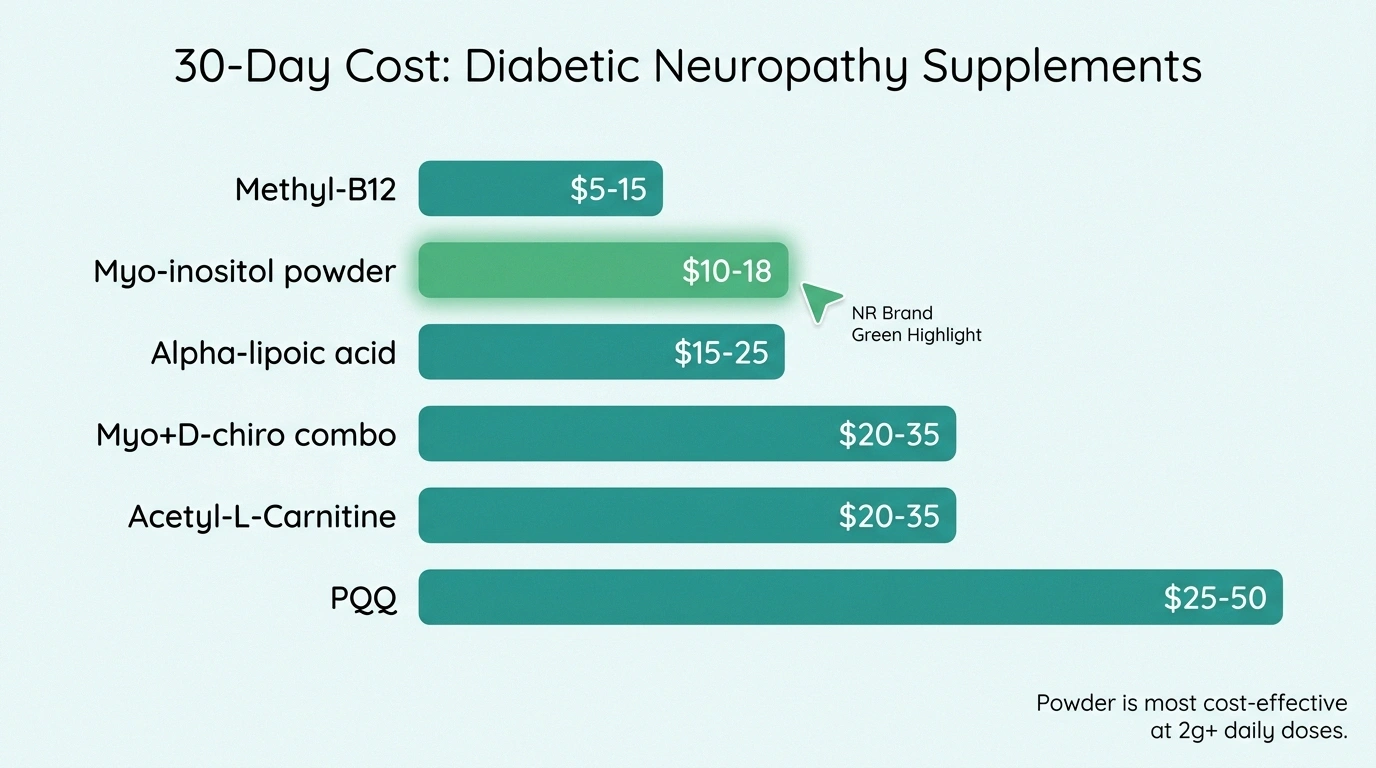
One of the quiet strengths of myo-inositol is the price. A 30-day supply at 2,000 mg per day typically runs:
- Capsules (a name brand): roughly $15 to $25 per month
- Bulk powder: roughly $10 to $18 per month for the same dose
- Combination 40:1 myo + d-chiro: roughly $20 to $35 per month
For comparison, the same monthly budget buys:
- Alpha-lipoic acid at 600 mg per day — $15 to $25 per month, with stronger trial evidence
- Acetyl-L-carnitine at 1,500 mg per day — $20 to $35 per month, also with reasonable evidence
- Methyl-B12 at 1,000-5,000 mcg per day — $5 to $15 per month, foundational
Where myo-inositol shines is in stacking. It’s well-tolerated enough and inexpensive enough that someone already taking ALA, methyl-B12, and a B-complex can add myo-inositol without breaking the budget. It’s a reasonable second- or third-tier addition for someone with diabetic neuropathy who’s optimized the foundation. For the bigger conversation about which supplements actually have evidence behind them, our roundup of the best neuropathy supplements for nerve health ranks the options.
Safety — One of the Most Tolerated Supplements on the Shelf
This is the part where myo-inositol genuinely earns its place. Across the published studies, it has one of the cleanest safety profiles of any nerve supplement.
One of the Cleanest Safety Profiles
Across decades of trials at neuropathy doses (1,000-2,000 mg/day), myo-inositol has shown no consistent serious side effects, no documented major drug interactions, and no kidney or liver toxicity signals. The most common mild effects at much higher doses (12+ grams) are gas and loose stools. For someone with diabetic neuropathy already on multiple medications, the low interaction risk and absence of mood, sleep, or cardiac effects makes it one of the safer additions to a thoughtful supplement stack.
Side effects, when they occur, are mild and dose-dependent:
- Mild stomach upset, gas, or loose stools at doses above 12 grams per day (well above any typical nerve dose)
- Headache, rare and usually short-lived
- Mild blood sugar lowering — useful for diabetics, something to be aware of if you’re already on insulin or a sulfonylurea
- Mild nausea on an empty stomach (resolved by taking with food)
What’s largely absent from the safety literature: serious drug interactions, kidney or liver toxicity, dependence, or rebound symptoms. Myo-inositol is not regulated like a medication, but it’s also one of the few supplements where the safety data is genuinely reassuring.
Two practical cautions. First, if you’re on insulin or a sulfonylurea, the mild blood-sugar effect is worth watching for. Some people report needing slightly less insulin after a few weeks on inositol. Talk to your prescriber. Second, the rare case reports of bipolar mood changes in psychiatric studies using very high doses (12-18 grams per day) don’t apply to neuropathy doses, but anyone with a personal history of bipolar disorder should mention this to their psychiatrist before adding it.
Who Might Reasonably Consider Myo-Inositol
Based on the evidence pattern, myo-inositol makes the most sense for a specific group of people:
If You’re on Insulin or a Sulfonylurea
Myo-inositol has a mild blood-sugar-lowering effect that builds gradually over weeks. For most patients this is a small benefit. For anyone already on insulin or a sulfonylurea (glipizide, glyburide, glimepiride), it can mean lower readings than expected:
- Watch for hypoglycemia symptoms — shakiness, sweating, hunger, confusion
- Check blood sugar more frequently during the first 2-4 weeks
- Tell your prescriber before starting — your medication dose may need a small adjustment over time
Someone with diabetic neuropathy who has already built a foundation. If you’ve optimized blood sugar control, you’re taking methyl-B12, you’ve tried alpha-lipoic acid, and you’re looking for one more layer of nerve support without much downside, myo-inositol is a reasonable next addition.
Someone with type 2 diabetes plus insulin resistance. The dual benefit (insulin sensitivity plus nerve support) makes it more efficient per dollar than it would be for someone with normal insulin sensitivity.
Someone who can’t tolerate ALA. A small minority of people get nausea or skin reactions from alpha-lipoic acid. Myo-inositol is genuinely better tolerated and can fill a similar role in the stack at a fraction of the side-effect profile.
Someone with PCOS or polycystic ovary syndrome. The combination supplement (myo + d-chiro in 40:1 ratio) is well-supported for PCOS-related insulin resistance, and the nerve support comes along as a bonus.
Who probably shouldn’t bother:
Someone with non-diabetic neuropathy. The mechanism (sorbitol-pathway depletion) is specifically a diabetic story. The evidence for myo-inositol in chemotherapy-induced, idiopathic, alcohol-related, or hereditary neuropathy is much weaker. Other supplements are better-matched to those causes.
Someone with a tight supplement budget and no foundation. If you have to choose just one or two supplements, methyl-B12 (especially if you’re deficient) and alpha-lipoic acid have stronger evidence and should come first.
Someone looking for fast pain relief. This is a slow nerve-support agent, not an analgesic. If your goal is reducing burning or shooting pain this week, this isn’t your tool.
How to Test It Honestly If You Decide to Try

Here’s a practical 90-day protocol that works for any supplement and works particularly well for slow-acting agents like myo-inositol:
Week 0 — Baseline. Before starting, write down a simple 0-to-10 score on three symptoms that matter most to you. Common ones for diabetic neuropathy: “burning at night,” “numbness when walking,” “balance going down stairs,” “tingling in fingertips.” Date the entry. If you have access to a recent A1C or nerve conduction study, write those down too. Don’t skip this step — memory will not give you an honest baseline three months from now.
Hold everything else steady. Don’t add or remove other supplements during the 90-day test. If you’re already on ALA, keep taking it. If you’re on metformin, don’t change the dose. The goal is to isolate the inositol’s effect.
Week 1-12 — Take it consistently. 1,000 to 2,000 mg per day in divided doses with food. Once a week, re-score your three symptoms in the same notebook. Note any side effects honestly. Skip any heroic interpretation — just the numbers.
Week 12 — Honest review. Compare your week-1 and week-12 numbers. The standard for a real effect: at least 2 of the 3 symptoms improved by 2 points or more. If you can say yes, it’s worth continuing. If you can’t, the supplement isn’t doing enough to justify the cost or the cabinet space. Discontinue and try a different layer.
This kind of structured honest test is the antidote to supplement-stack creep. A symptom diary, kept simply, will save you hundreds of dollars over a few years of supplement decisions. Our article on neuropathy foot care includes simple tracking habits that pair naturally with the supplement-test approach.
Putting It in Context With Other Supplements
If you’re building a thoughtful nerve-support stack and trying to figure out where myo-inositol fits, here’s the practical hierarchy I’d suggest based on the evidence:
Where It Fits
Myo-inositol is not a foundation. It’s not the strongest evidence. But it is one of the best-tolerated, most reasonably-priced, and most diabetes-specific supplements on the shelf. If you have diabetic neuropathy, you’ve already optimized B12 and ALA, and you have $10-18 a month to test one more layer for 12 weeks, this is a defensible choice. Track your symptoms honestly — and stop if it isn’t earning its place.
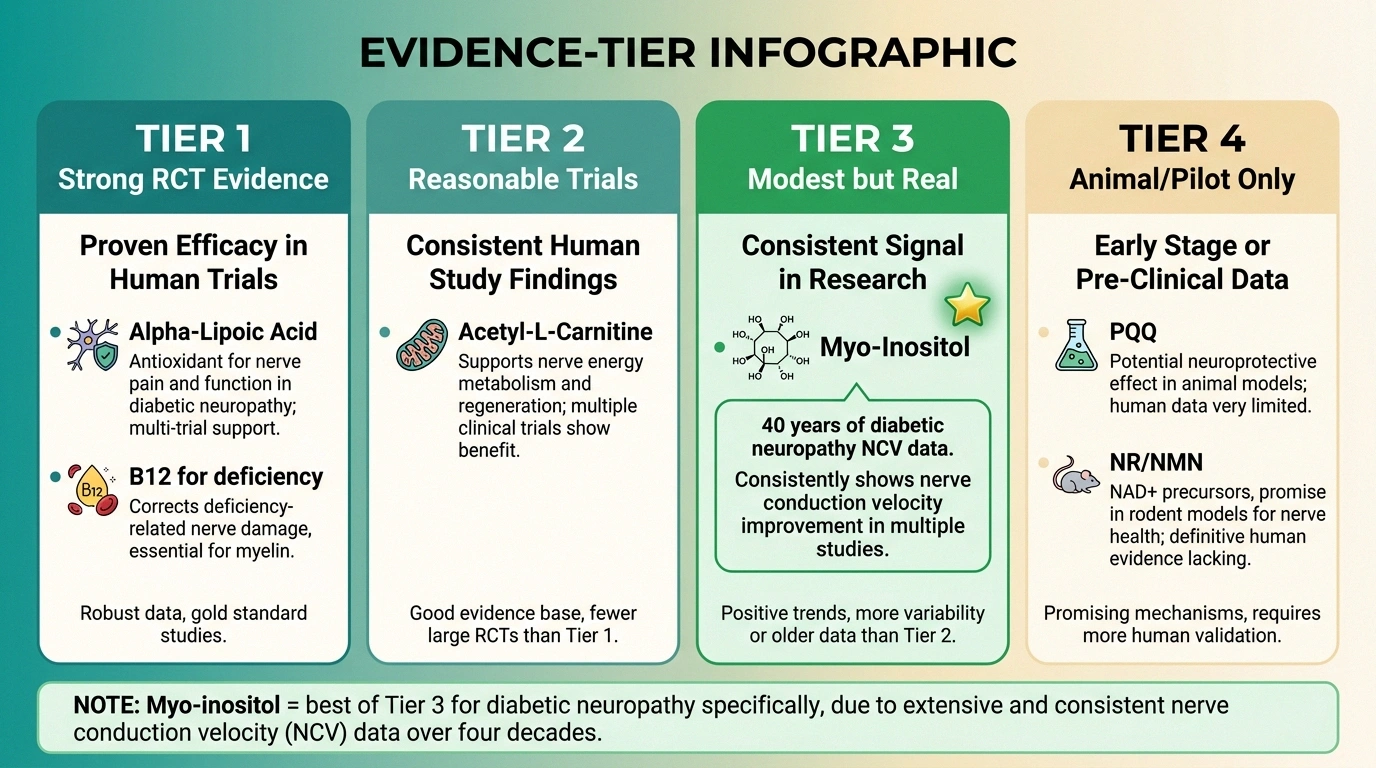
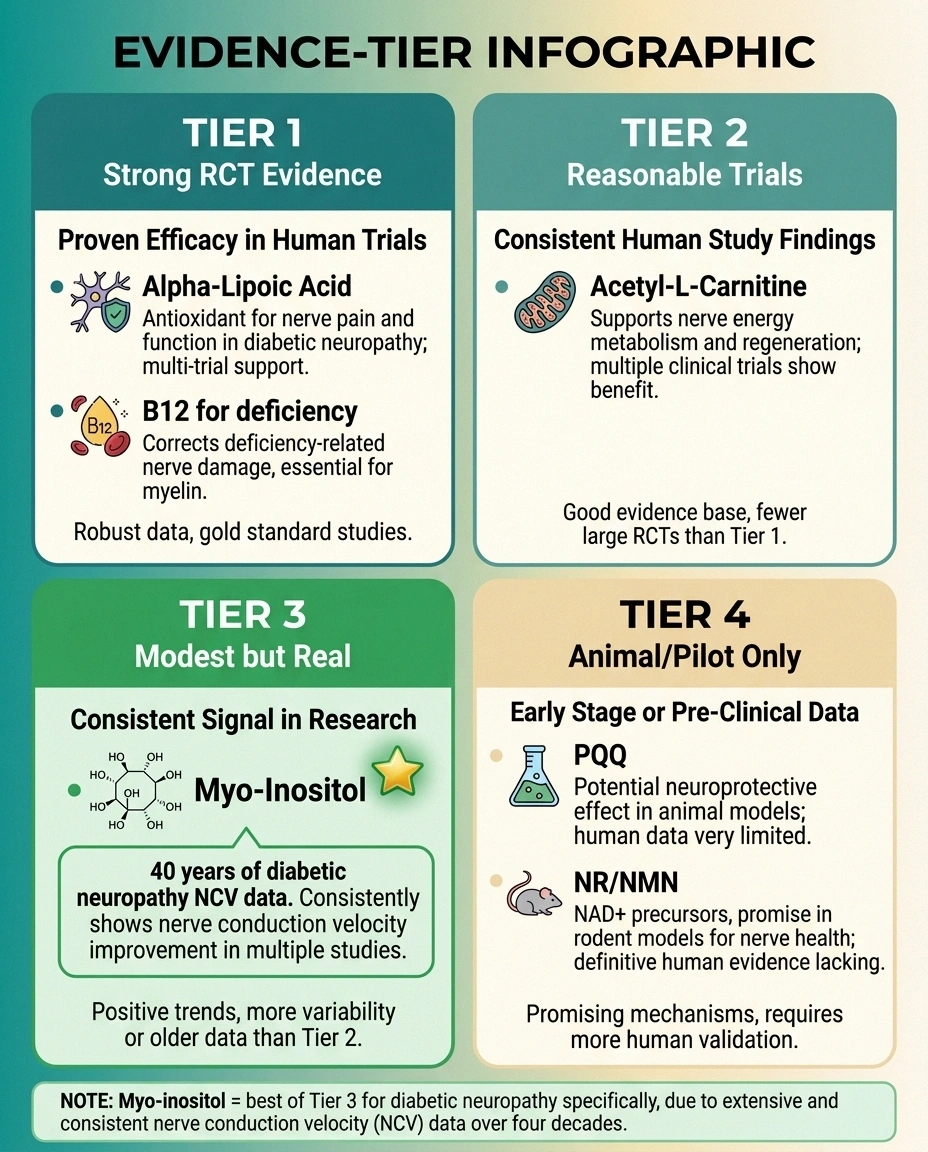
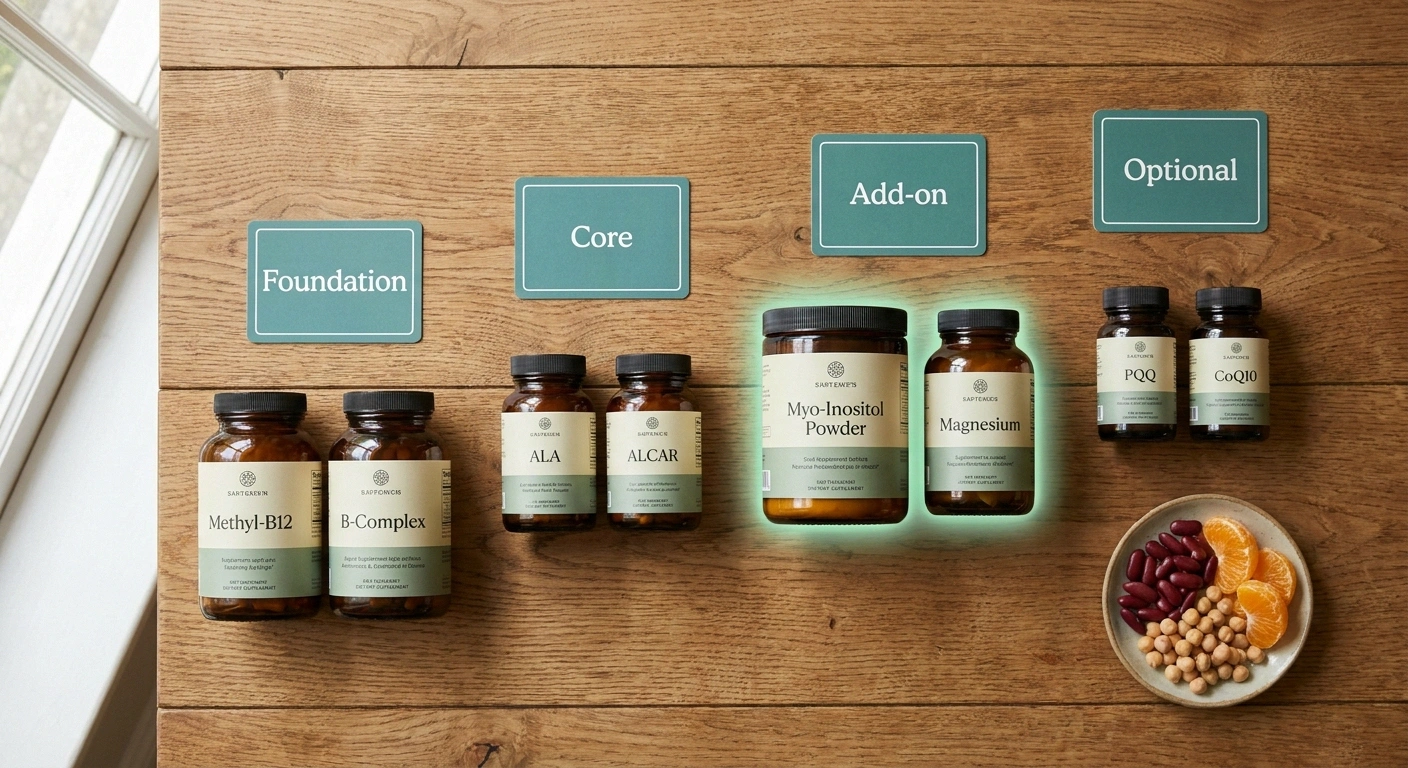
Tier 1 — Foundation. Methyl-B12 (especially if any deficiency is present — see our overview of vitamin-deficiency neuropathy), a standard B-complex (RDA-level, NOT high-dose B6), and adequate vitamin D. These are non-negotiable foundations.
Tier 2 — Core nerve support. Alpha-lipoic acid (600 mg/day for diabetic neuropathy), acetyl-L-carnitine at 1,500-2,000 mg/day. These have the strongest human trial evidence specifically for neuropathy.
Tier 3 — Reasonable add-ons. Myo-inositol (especially for diabetic neuropathy), magnesium glycinate for cramps and sleep, curcumin/turmeric for inflammation. Useful but secondary.
Tier 4 — Optional or weaker evidence. PQQ, CoQ10, NAC, NR/NMN. Mechanism interesting, human evidence thin.
Myo-inositol’s most reasonable spot is firmly in Tier 3. Useful, well-tolerated, modestly evidence-based, especially for diabetic neuropathy specifically.
The Diet Angle
One detail worth flagging: a varied whole-food diet provides 500 to 1,500 mg of myo-inositol naturally. Beans (kidney, navy, lima), citrus fruit (especially cantaloupe and citrus segments), whole grains, nuts (almonds, peanuts), and brown rice are all rich sources. Someone eating a mostly processed-food diet may be consuming less than half what the recipe-based whole-food diet provides.
This doesn’t mean food alone will give you the 2,000 mg studied dose — but it does mean that improving the diet has compounding benefits beyond the supplement. The same eating pattern that boosts dietary inositol — beans, citrus, whole grains, nuts — is also a foundation of the kind of neuropathy-friendly diet that supports overall blood sugar control, weight, and inflammation. The supplement layered on top of a good diet is more efficient than the supplement layered on top of poor eating.
Frequently Asked Questions
How long does myo-inositol take to work for neuropathy?
In the published trials of diabetic neuropathy, measurable improvements in nerve conduction velocity appeared at 6 to 12 weeks of consistent daily use. Symptomatic improvements, when they occur, also typically show up in this window. A shorter trial of 2 to 4 weeks is unlikely to be informative. Plan a minimum of 90 days before judging whether it’s helping you.
What is the best dose of inositol for diabetic neuropathy?
The doses used in the published trials range from 500 to 4,000 milligrams per day, with most studies clustering around 1,000 to 2,000 milligrams per day in divided doses with meals. Start at 1,000 mg per day for a week to assess tolerance, then increase to 2,000 mg per day if no side effects. Higher doses (3,000-4,000 mg) are sometimes used in PCOS protocols but are not necessary for the nerve effect.
Is myo-inositol the same as d-chiro-inositol?
No, they are two different forms of the same family of molecules. Myo-inositol is the most abundant in human tissue and is the form most studied for nerve health. D-chiro-inositol is more specifically involved in insulin signaling and is studied alongside myo-inositol in PCOS and insulin-resistance research. Many combination supplements use a 40-to-1 myo-to-d-chiro ratio, which matches the natural balance in human tissue.
Can I take inositol with metformin?
There is no documented direct interaction, and the combination is studied in some PCOS and pre-diabetes trials with no reported safety issue. Both have mild blood-sugar-lowering effects, so monitor your readings for the first few weeks if you’re on insulin or a sulfonylurea. Bring all your supplements to your next pharmacy visit and ask for an interaction review.
Will inositol help non-diabetic neuropathy?
The mechanism (replacing what diabetes depletes via the sorbitol pathway) is specifically a diabetic story, and most of the human evidence is in diabetic patients. There is no strong reason to expect a meaningful benefit in chemotherapy-induced, idiopathic, alcohol-related, or hereditary neuropathy. Other supplements better match those mechanisms.
Is the powder or the capsule better?
Both deliver the same molecule. Powder is significantly more cost-effective at higher doses (over 1,500 mg per day) and dissolves easily in water with a mildly sweet taste. Capsules are easier to dose precisely and travel well but typically cost more per gram of inositol. For a 2,000 mg daily dose taken for months, the powder usually wins on price.
What about side effects at high doses?
The most common dose-dependent side effects are mild gastrointestinal symptoms — gas, loose stools, mild nausea — typically only at doses above 12 grams per day, well above any nerve-support dose. At the 1,000-2,000 mg range used for neuropathy, side effects are uncommon and mild. If you experience them, taking the supplement with food and splitting the dose into morning and evening usually resolves the issue.
Does inositol affect mood?
At very high doses studied in psychiatric research (12-18 grams per day), inositol has been investigated for mood disorders with mixed results. At the much lower doses used for nerve support (1,000-2,000 mg per day), mood effects are not typically reported. People with a history of bipolar disorder should mention any new supplement to their psychiatrist before starting.
About the Author